NASA Telescopes Start the Year With a Double Bang

NASA Telescopes Start the Year With a Double Bang
X-ray: NASA/CXC/Penn State Univ./L. Townsley et al.; Optical: NASA/STScI/HST; Infrared: NASA/JPL/CalTech/SST; Image Processing: NASA/CXC/SAO/J. Schmidt, N. Wolk, K. Arcand

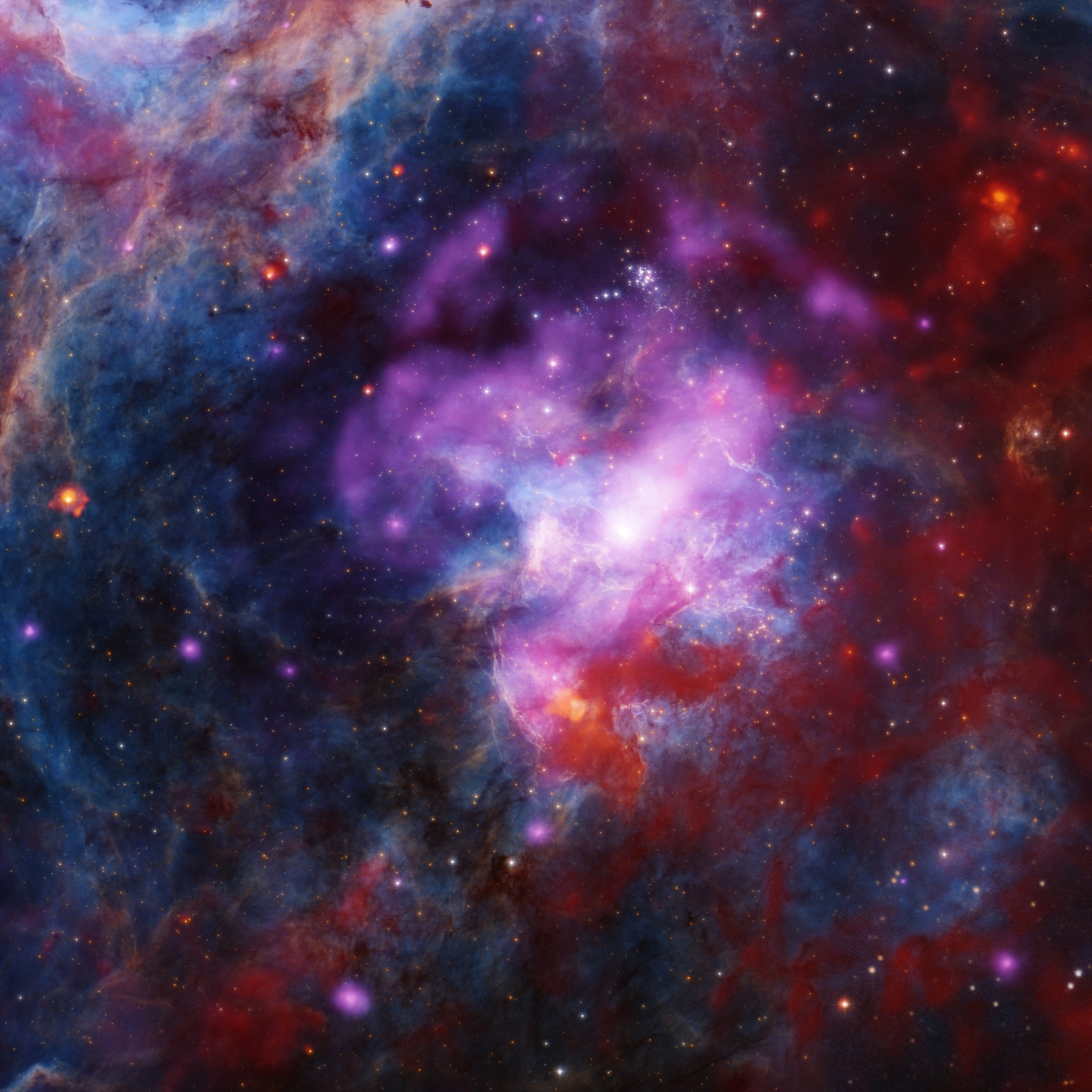
A colorful, festive image shows different types of light containing the remains of not one, but at least two, exploded stars. This supernova remnant is known as 30 Doradus B (30 Dor B for short) and is part of a larger region of space where stars have been continuously forming for the past 8 to 10 million years. It is a complex landscape of dark clouds of gas, young stars, high-energy shocks, and superheated gas, located 160,000 light-years away from Earth in the Large Magellanic Cloud, a small satellite galaxy of the Milky Way.

The new image of 30 Dor B was made by combining X-ray data from NASA’s Chandra X-ray Observatory (purple), optical data from the Blanco 4-meter telescope in Chile (orange and cyan), and infrared data from NASA’s Spitzer Space Telescope (red). Optical data from NASA’s Hubble Space Telescope was also added in black and white to highlight sharp features in the image.

A team of astronomers led by Wei-An Chen from the National Taiwan University in Taipei, Taiwan, have used over two million seconds of Chandra observing time of 30 Dor B and its surroundings to analyze the region. They found a faint shell of X-rays that extends about 130 light-years across. (For context, the nearest star to the Sun is about 4 light-years away). The Chandra data also reveals that 30 Dor B contains winds of particles blowing away from a pulsar, creating what is known as a pulsar wind nebula.

When taken together with data from Hubble and other telescopes, the researchers determined that no single supernova explosion could explain what is being seen. Both the pulsar and the bright X-rays seen in the center of 30 Dor B likely resulted from a supernova explosion after the collapse of a massive star about 5,000 years ago. The larger, faint shell of X-rays, however, is too big to have resulted from the same supernova. Instead, the team thinks that at least two supernova explosions took place in 30 Dor B, with the X-ray shell produced by another supernova more than 5,000 years ago. It is also quite possible that even more happened in the past.

This result can help astronomers learn more about the lives of massive stars, and the effects of their supernova explosions.

The paper led by Wei-An Chen describing these results was recently published in the Astronomical Journal. The co-authors of the paper are Chuan-Jui Li, You-Hua Chu, Shutaro Ueda, Kuo-Song Wang, Sheng-Yuan Liu, all from the Institute of Astronomy and Astrophysics, Academia Sinica, in Taipei, Taiwan, and Bo-An Chen from National Taiwan University.

NASA’s Marshall Space Flight Center manages the Chandra program. The Smithsonian Astrophysical Observatory’s Chandra X-ray Center controls science operations from Cambridge, Massachusetts, and flight operations from Burlington, Massachusetts.

Read more from NASA’s Chandra X-ray Observatory.

For more Chandra images, multimedia and related materials, visit:

https://www.nasa.gov/mission/chandra-x-ray-observatory/

Visual Description:

Today’s release features a spectacular composite image of a large region of space where stars have been continuously forming for the past eight to ten million years. At the center of this complex landscape of brilliant, colorful gas clouds is a supernova remnant. Known as 30 Doradus B, the remnant likely contains the remains of at least two exploded stars.

The entire image is awash in intricate clouds, and swathes of superheated gas. At our upper lefthand corner is a thick, coral pink and wine-colored cloud with a texture resembling cotton candy. At our lower and upper right is a network of deep red clouds that resemble streaks of thick red syrup floating in water. A layer of wispy blue cloud appears to be present across the entire image, but is most evident at our lower left which is free of overlapping gas. Glowing pink, orange, and purple specks of light, which are stars, dot the image.

In the center of the frame is a bright purple and pink cloud, aglow with brilliant white dots, and streaked with lightning-like veins. This is 30 Doradus B, which is delineated by a faint shell of X-rays identified by Chandra. Within this supernova remnant are high energy shocks and winds of particles blowing away from a pulsar.

News Media Contact

Megan Watzke
Chandra X-ray Center
Cambridge, Mass.
617-496-7998

Jonathan Deal
Marshall Space Flight Center
Huntsville, Ala.
256-544-0034

Powered by WPeMatico

Get The Details…
Lee Mohon
La NASA anticipa el primer vuelo del avión experimental X-59 para 2024 

La NASA anticipa el primer vuelo del avión experimental X-59 para 2024 

3 min read

Preparations for Next Moonwalk Simulations Underway (and Underwater)

X-59 being moved from the construction site.
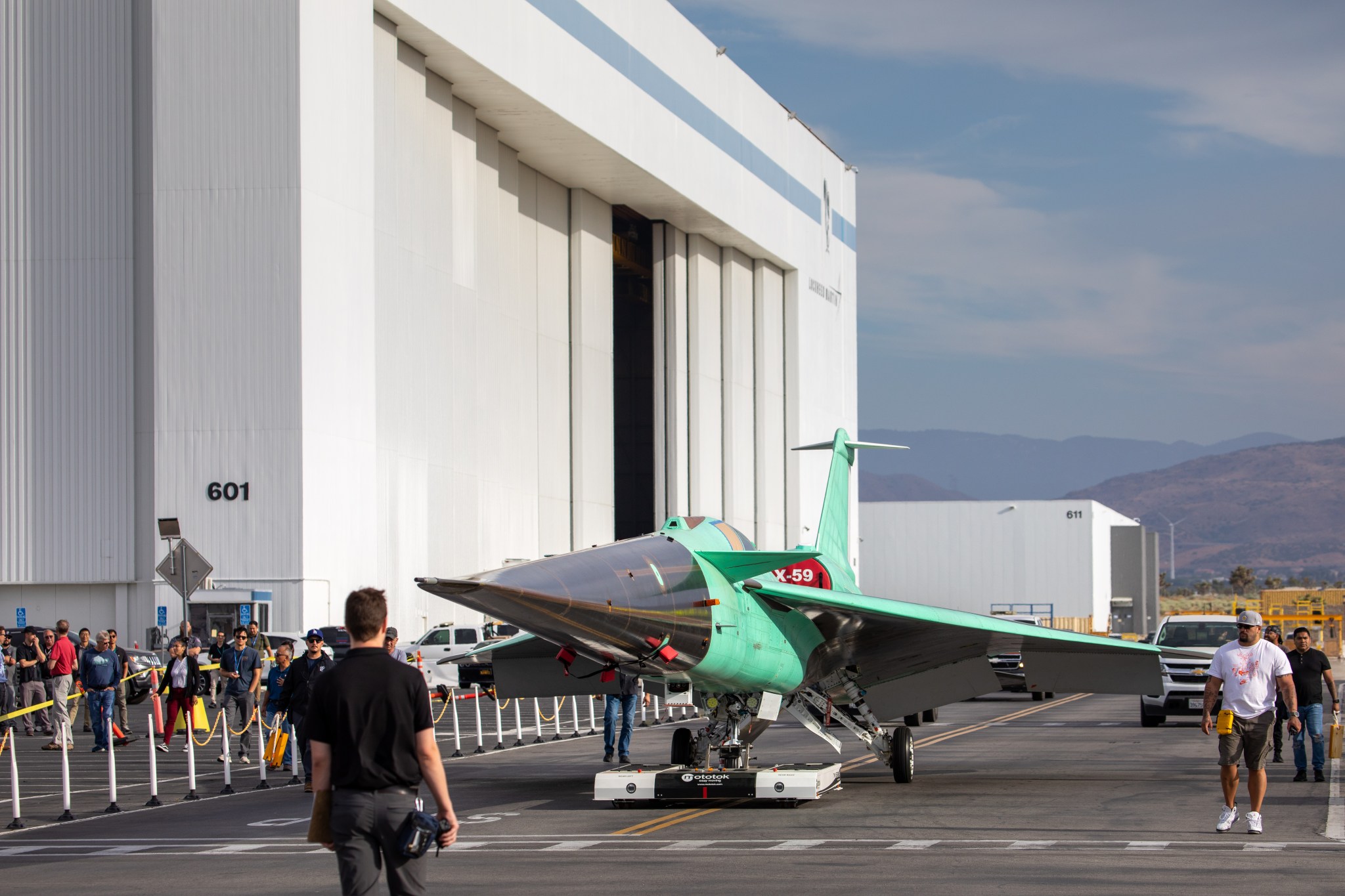
El avión de investigación X-59 de la NASA se trasladó de su lugar de construcción a la línea de vuelo -o el espacio entre el hangar y la pista- en Lockheed Martin Skunk Works, en Palmdale (California), el 16 de junio de 2023. El traslado permitió al equipo del X-59 realizar pruebas de seguridad y estructurales, pasos críticos hacia el primer vuelo.
Lockheed Martin

Lee esta historia en inglés aquí.

La misión Quesst de la NASA ha ajustado la fecha prevista para el primer vuelo de su avión supersónico silencioso X-59 a 2024. 

El X-59, un avión experimental único en su clase, ha requerido una compleja labor de ingeniería por parte de los investigadores de la NASA que trabajan con el contratista principal Lockheed Martin Skunk Works. Además del diseño de la aeronave, el X-59 también combina nueva tecnología con sistemas y componentes de múltiples aeronaves ya establecidas, como su tren de aterrizaje procedente de un F-16 y su sistema de soporte vital adaptado de un F-15.  

Para poder desarrollar esta aeronave única, el equipo de Quesst está trabajando en varios retos técnicos identificados a lo largo de 2023, cuando estaba previsto que el X-59 realizara su primer vuelo.  Se necesita más tiempo para integrar plenamente los sistemas en la aeronave y garantizar que funcionen juntos como se espera. El equipo también está resolviendo problemas intermitentes con algunos de los ordenadores redundantes de seguridad que controlan los sistemas de la aeronave. 

Quesst realizó progresos constantes hacia el vuelo durante el pasado año. El equipo dio los últimos toques a la estructura de la cola del X-59, lo que les permitió finalizar su cableado eléctrico y continuar con las pruebas críticas en tierra, y trasladarlo desde sus instalaciones de ensamblaje a la línea de vuelo para realizar pruebas estructurales. 

El X-59 demostrará la capacidad de volar supersónicamente, es decir, más rápido que la velocidad del sonido, mientras reduce el normalmente fuerte estallido sónico, a un golpe más leve o silencioso. La NASA tiene previsto volar el X-59 sobre varias comunidades para obtener datos sobre cómo notan los residentes el sonido que hace. La agencia facilitará esa información a los organismos reguladores estadounidenses e internacionales para que modifiquen las normas que actualmente prohíben los vuelos supersónicos comerciales sobre tierra. 

Las principales prioridades de la NASA para cualquier misión son la seguridad y garantizar el éxito. Para Quesst, eso significa no sólo estar seguro de que el X-59 es seguro antes de volar, sino seguro a largo plazo y confiable durante la fase de pruebas comunitarias. La aeronave está siendo examinada actualmente en pruebas integradas, que deben completarse antes de que vuele. En cuanto finalice esta fase, la aeronave continuará su viaje con una revisión de preparación para el vuelo, momento en el que la NASA tiene previsto publicar un calendario más específico para el primer vuelo. 

Quesst es una misión con el potencial de revolucionar los viajes de la aviación comercial al reducir drásticamente el tiempo de viaje. Un vuelo seguro y fiable del X-59 es fundamental para que la NASA consiga esos beneficios. La agencia está comprometida con un proceso exhaustivo de revisión y pruebas que redunde en el éxito de esa misión. 

Artículo Traducido por: Elena Aguirre 

Share

Details

Last Updated

Jan 03, 2024

Editor
Lillian Gipson
Contact
Jim Banke

Powered by WPeMatico

Get The Details…
Lillian Gipson

NASA Invites You to X-59 Rollout Watch Party

NASA Invites You to X-59 Rollout Watch Party

2 min read

Preparations for Next Moonwalk Simulations Underway (and Underwater)

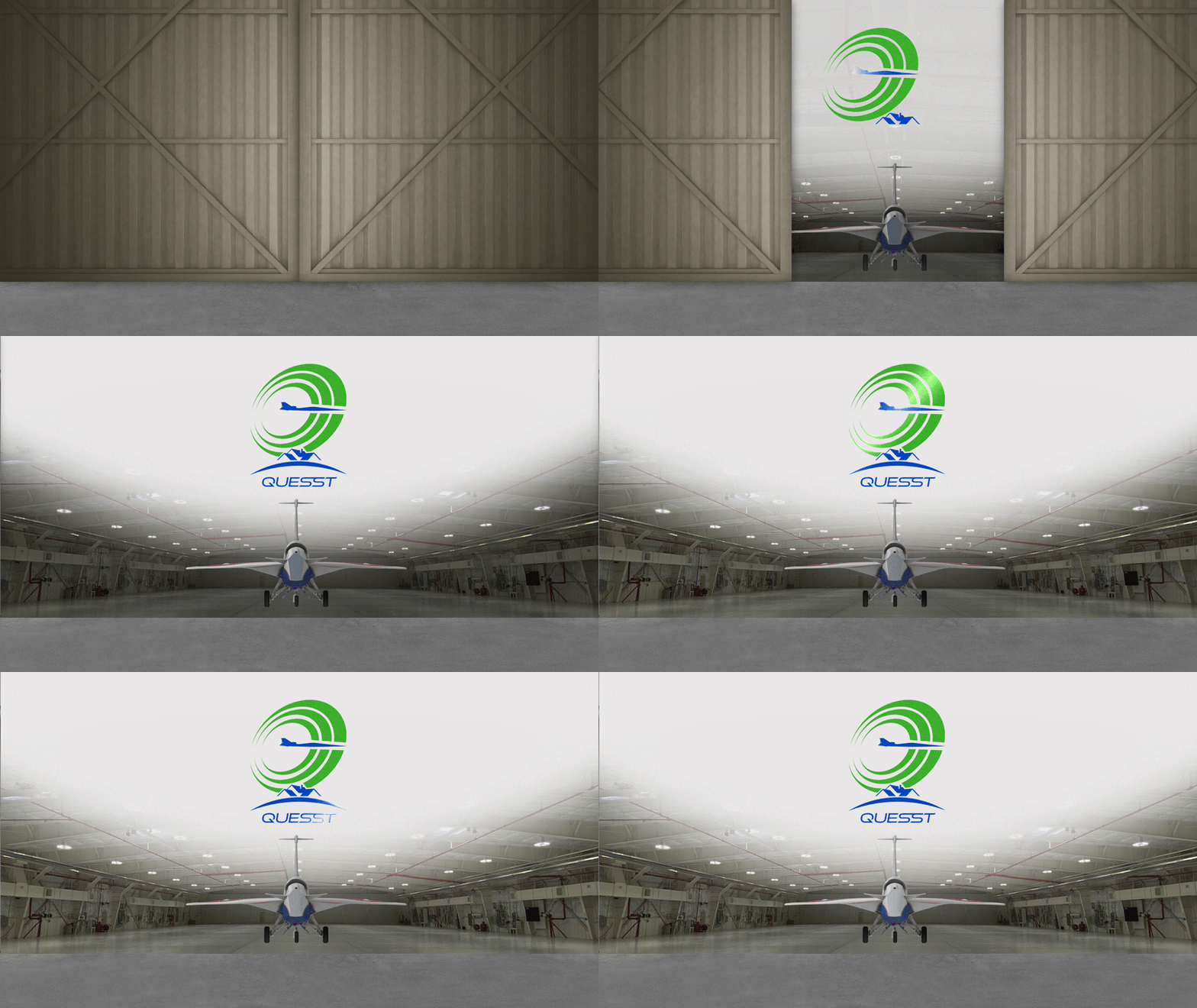
An animated gif of an artist illustration of the X-59 inside a hangar with the new Quesst mark above it.

It’s almost time for NASA’s supersonic X-59 airplane to make its red, white, and blue public debut, and you’re invited to join friends and family in taking a front-row, virtual VIP seat to the rollout ceremony in the California high desert.

As a historic milestone in aviation history, NASA is encouraging people across the nation and around the world to get together and celebrate the occasion by hosting a watch party to view the rollout festivities from their classrooms, homes, or anywhere else.

Although NASA won’t provide snacks and refreshments, the agency does have some ideas to help you host a successful watch party. They include printable invitations, links to STEM-related activities, and a complete X-59 Watch Party Planning Guide.

The centerpiece of NASA’s Quesst mission to study sound and help reduce the sonic boom made by supersonic flight to a sonic thump, the Lockheed Martin-built X-59 is scheduled to be rolled out from the company’s Skunk Works hangar in Palmdale, California on Jan. 12.

The X-59’s rollout ceremony will be broadcast live on the NASA+ streaming service beginning at 4 p.m. EST on Jan. 12, 2024. The event also will air live on the NASA app, YouTube, and on the agency’s website. Viewers can also learn how to stream NASA TV through a variety of platforms, including social media.

If you’re ready to commit to hosting an X-59 rollout ceremony watch party let us know and we’ll add your location to our world map, where a growing list of dozens of sites are already signed up.

All the details for signing up and more are available on our Watch Party web page. 

About the Author

Jim Banke

Jim Banke

Managing Editor/Senior Writer

Jim Banke is a veteran aviation and aerospace communicator with more than 35 years of experience as a writer, producer, consultant, and project manager based at Cape Canaveral, Florida. He is part of NASA Aeronautics’ Strategic Communications Team and is Managing Editor for the Aeronautics topic on the NASA website.

Powered by WPeMatico

Get The Details…
Jim Banke

Crescent Moon Over NASA’s Kennedy Space Center

Crescent Moon Over NASA’s Kennedy Space Center

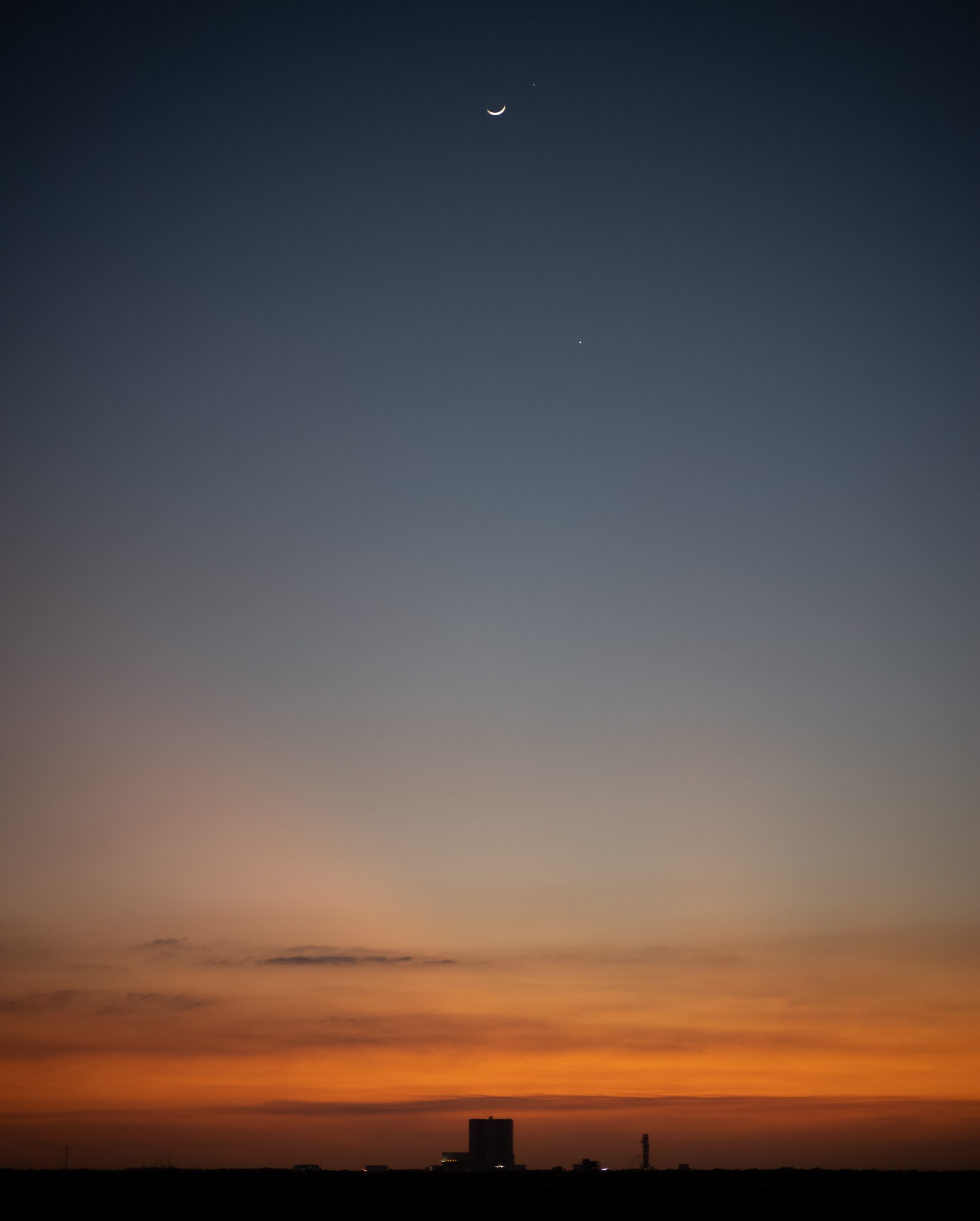
The sky shifts from a deep blue to burnt orange (top to bottom). The crescent moon is at the top of the image, with Jupiter to its right and Venus below it. The silhouette of the Vehicle Assembly Building at NASA's Kennedy Space Center stands out against the orange sky.
NASA / Joel Kowsky

The crescent moon, along with Jupiter (top right of Moon) and Venus (below Moon) appeared over the Vehicle Assembly Building at NASA’s Kennedy Space Center in Florida Feb. 22, 2023, as preparations continued for NASA’s SpaceX Crew-6 mission. NASA astronauts Stephen Bowen and Warren “Woody” Hoburg, UAE (United Arab Emirates) astronaut Sultan Alneyadi, and Roscosmos cosmonaut Andrey Fedyaev launched to the International Space Station March 2, 2023.

The NASA Headquarters photographers chose this photo as one of the best images from 2023. See the rest on Flickr.

Image Credit: NASA/Joel Kowsky

Powered by WPeMatico

Get The Details…
Monika Luabeya

Payroll

Payroll

1 Min Read

Payroll

The NASA Shared Services Center (NSSC) Payroll Office (NPO) reviews, validates, and delivers time and attendance data to the Department of the Interior (DOI) Interior Business Center (IBC) for NASA Centers.  NPO acts as liaison between Centers, employees and IBC for other payroll related activities such as supplemental payments, prior pay period adjustments  (PPPA) and settlement agreements.

2024 NASA Payroll Calendar

Employment Verification

POD A-12 – Non-Receipt of DD/EFT Payment

Payroll Schedule Calendars

Powered by WPeMatico

Get The Details…
NASA