La comandante Callie sigue su misión en segunda novela gráfica de NASA
La astronauta Callie Rodríguez continúa sus aventuras espaciales como la primera mujer en pisar la Luna en la nueva novela gráfica de la NASA, “La primera mujer: Expandiendo nuestro universo”.
La astronauta de ficción Callie Rodríguez continúa explorando el espacio como la primera mujer que camina en la Luna en un nuevo tomo de la serie novelada “La primera mujer” de la NASA. Actualmente disponible en formato digital en inglés y español, “La primera mujer: Expandiendo nuestro universo” sigue la historia de Callie y sus compañeros de tripulación mientras trabajan juntos para explorar lo desconocido, hacer descubrimientos científicos y cumplir los objetivos de su misión.
Este segundo número de la serie de novelas gráficas presenta a una tripulación de astronautas diversa en la superficie de la Luna, que aprenden y crecen como equipo enfrentándose a situaciones inesperadas mientras realizan experimentos y demostraciones de tecnología para el beneficio de la humanidad.
Mediante la serie “La primera mujer”, la NASA está inspirando a la nueva generación de exploradores, la Generación Artemis, mientras trabaja en la vida real para llevar a la primera mujer y a la primera persona de color a la Luna con el programa Artemis.
“La diversidad está en el núcleo de las misiones de la NASA y es la razón por la que seguimos superando los límites de lo posible. “La primera mujer” encarna la rica historia de innumerables mujeres que rompieron barreras y siguen guiando a la NASA hacia las estrellas”, dijo el administrador de la NASA, Bill Nelson. “Gran parte de lo que hace la NASA es inspirar a futuros exploradores, porque cada miembro de la Generación Artemis debe sentirse representado en nuestras misiones. La historia de Callie nos recuerda que haremos lo que nunca se ha hecho antes: llevar a la primera mujer a la Luna, y esto inspirará al mundo.”
La última vez que los lectores vieron a Callie, ella y su robot RT estaban refugiados dentro de un túnel de lava en la Luna. Descubre lo que sucede a continuación visitando el renovado sitio web de “La primera mujer” —el cual incluye una nueva opción en español— y la aplicación actualizada First Woman de la NASA, que está disponible para descargar en iOS y Android.
El sitio web y la aplicación inmersiva permiten al público explorar un nuevo entorno virtual en 3D, tecnologías y objetos relacionados con la exploración lunar. Los seguidores también pueden explorar contenido actualizado de “La primer mujer”, que incluye videos, juegos interactivos y otros materiales relacionados con las misiones actuales y futuras de la NASA.
“Callie es un personaje inspirador para las comunidades subrepresentadas y, como persona de ascendencia india con hijos pequeños, entiendo profundamente el poder de una base diversa de seguidores que se ven a sí mismos ocupando un lugar dentro de
nuestras ambiciosas misiones. Para resolver los numerosos desafíos de la exploración lunar sostenible, necesitamos ideas innovadoras que provengan de diversas fuentes y de comunidades no tradicionales”, dijo el doctor Prasun Desai, administrador asociado interino de la Dirección de Misiones de Tecnología Espacial en la sede de la NASA en Washington. “Continuamos con ese tema aspiracional en nuestro segundo tomo, profundizando en la compleja misión y los antecedentes personales de la tripulación, a la vez que ampliamos una gran cantidad de contenido interactivo y en varios idiomas sobre ciencia, tecnología, ingeniería y matemáticas en nuestras plataformas digitales”.
El tomo que marcó el debut de la serie, “La primera mujer: Del sueño a la realidad”, obtuvo una gran respuesta en Estados Unidos y en el resto del mundo, logrando una distribución de casi 100.000 copias impresas. La audiencia digital acumuló casi 300.000 visitas a la página web y miles de usuarios descargaron la aplicación First Woman, lo que le valió un Premio Webby 2022 a la Mejor Experiencia Móvil Integrada.
En el futuro, la NASA colaborará con sus socios internacionales para traducir “La primera mujer” a más idiomas.
Para obtener más información sobre la novela gráfica y las experiencias interactivas, visita la página web:
Commander Callie Continues Moon Mission in NASA’s New Graphic Novel
“Astronaut Callie Rodriguez continues her space adventures as the first woman to walk on the Moon in NASA’s new graphic novel, “First Woman: Expanding Our Universe.”
Fictional astronaut Callie Rodriguez continues exploring space as the first woman to walk on the Moon in a new issue of NASA’s First Woman graphic novel series. Now available digitally in English and Spanish, “First Woman: Expanding Our Universe,” follows Callie and her crewmates as they work together to explore the unknown, make scientific discoveries, and accomplish their mission objectives.
This second issue of the graphic novel series features a diverse crew of astronauts on the Moon’s surface, learning and growing as a team navigating the unexpected while conducting experiments and technology demonstrations for the benefit of humanity.
Through the First Woman series, NASA is inspiring the next generation of explorers – the Artemis Generation – as it works in real life to land the first woman and first person of color on the Moon under the Artemis program.
“Diversity is at the core of NASA’s missions, and the reason we continue breaking the boundaries of what’s possible. First Woman embodies the rich history of countless women who broke barriers and continue to lead NASA to the stars,” said NASA Administrator Bill Nelson. “So much of what NASA does is to inspire future explorers because each member of the Artemis Generation should feel represented in our missions. Callie’s story reminds us that we will do what has never been done before — land the first woman on the Moon, and it will inspire the world.”
When readers last met Callie, she and her robot RT were sheltering inside of a lunar lava tunnel. Find out what happens next by visiting the revamped First Woman website, which includes a new Spanish-language option, and the agency’s updated First Woman app available for download on Android and iOS.
The website and immersive app allow audiences to explore a new virtual 3D environment, technologies and objects related to lunar exploration. Fans also can explore updated First Woman content, including videos, interactive games, and other materials related to ongoing and future NASA missions.
“Callie is an inspirational character for underrepresented communities and, as a person of Indian descent with young children, I deeply understand the power of a diverse fanbase seeing a place for themselves within our ambitious missions. To solve the many challenges of sustainable lunar exploration, we need innovative ideas from diverse sources and non-traditional communities,” said Dr. Prasun Desai, acting associate administrator, Space Technology Mission Directorate at NASA Headquarters in Washington. “We continue that aspirational theme with our second issue, diving further into the crew’s complex mission and personal backgrounds while expanding a wealth of interactive, multilingual science, technology, engineering, and mathematics content across our digital platforms.”
The series debut, “First Woman: Dream to Reality,” saw a large response across the United States and abroad, with nearly 100,000 print copies distributed. The digital audience garnered nearly 300,000 webpage views, and the First Woman app was downloaded by thousands of users, earning a 2022 Webby Award for Best Integrated Mobile Experience.
NASA will collaborate with its international partners to translate First Woman into more languages in the future.
To learn more about the graphic novel and interactive experiences, visit:
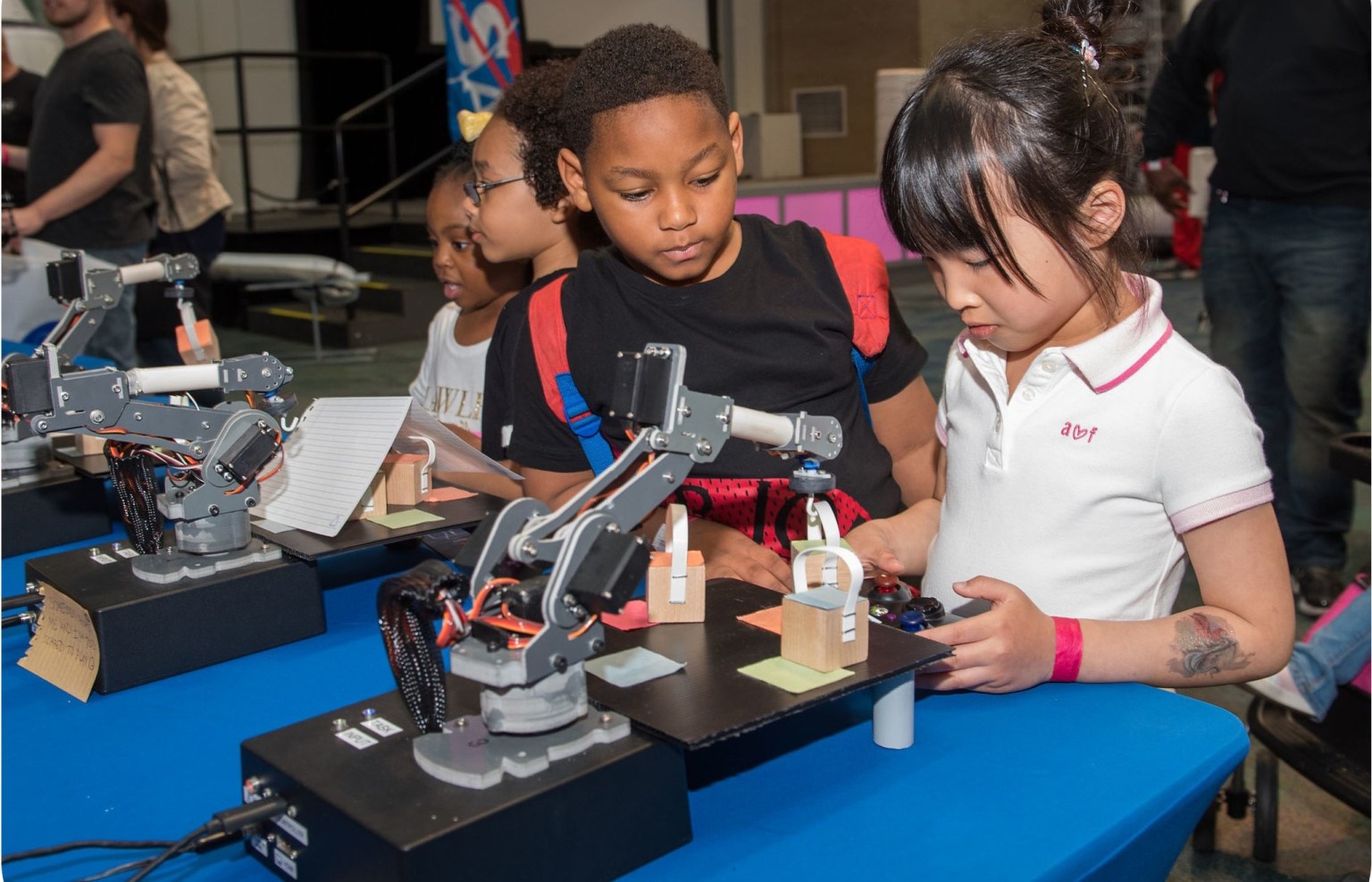
Lilia Miller and Molly Kearns, employees from NASA’s Glenn Research Center, discuss communication in space as they build paper satellites with students during a STEM event at Rocket Mortgage Field House in Cleveland, Ohio.
NASA’s Glenn Research Center in Cleveland is seeking to collaborate with organizations across the country to bring the NASA experience to new, diverse audiences.
This opportunity is designed to provide organizations with:
Interactive NASA exhibits and historical artifacts to showcase NASA’s missions and research.
Access to NASA subject matter experts for interactive speaking engagements.
The center is requesting event proposals to:
Reach larger audiences by leveraging the experiences of community organizations with existing high-quality events.
Strengthen community relationships by collaborating on efforts that result in increased returns on mutually desired outcomes.
Raise awareness of NASA’s contributions to the nation’s aeronautics and space programs.
NASA’s Glenn Research Center
NASA’s Glenn Research Center in Cleveland designs, develops, and tests innovative technology to revolutionize air travel, advance space exploration, and improve life on Earth. As one of 10 NASA centers, and the only one in the Midwest, Glenn is a vital contributor to the region’s economy and culture. Many NASA missions have Glenn contributions, and every U.S. aircraft has NASA Glenn technology on board, making flight cleaner, safer, and quieter.
Glenn is conducting revolutionary aeronautics research in electrified aircraft propulsion, advanced materials, and alternative fuels to help the nation achieve its climate change goals. The center is also exploring next-generation supersonic and hypersonic aircraft.
In addition to its aeronautics research, NASA Glenn’s world-class test facilities and unrivaled expertise in power, propulsion, and communications are crucial to advancing the Artemis program. Glenn’s solar electric propulsion will help propel future missions to the Moon and eventually Mars, where astronauts will conduct scientific research and establish a presence on the surface. The road to the Moon goes through Ohio.
Glenn’s Expertise:
Air-Breathing Propulsion (Jet Engines)
Communications
In-Space Propulsion and Cryogenic Fluids Management
Power, Energy Storage, and Conversion
Materials and Structures for Extreme Environments
Physical Sciences and Biomedical Technologies in Space
Eligibility Requirements
NASA is seeking:
Organizations with established events that have direct connections to their communities and reach diverse audiences. Greater consideration will be given to organizations reaching underserved and/or underrepresented communities. For purposes of this solicitation, underserved and/or underrepresented communities include Black, Latino, Indigenous, and Native American persons; Asian Americans, Pacific Islanders, and other persons of color; members of religious minorities; lesbian, gay, bisexual, transgender, and queer (LGBTQ+) persons; persons with disabilities; persons who live in rural areas; and persons otherwise adversely affected by persistent poverty or inequality (source: NASA’s Mission Equity). Greater consideration may also be given to organizations throughout the Great Lakes Region (Illinois, Indiana, Michigan, Minnesota, Ohio, and Wisconsin) based on factors such as schedule and budget availability.
Events scheduled to occur between Jan. 1, 2024, and Dec. 31, 2024.
Selected organizations must agree to the following:
Attend mutually agreed-upon planning meetings held virtually through an online business communication platform.
Be responsible for coordinating all marketing, media communications, and logistics as described in the event proposal.
Provide final attendance data within one week of the conclusion of the event including the following:
Number of attendees
Estimated percentage of attendees from underrepresented audiences
Submitting a Proposal
All proposals are to be submitted through the online proposal form here. Proposals must be submitted by 5 p.m. Eastern time on Nov. 24, 2023. Only proposals submitted online will be accepted.
Proposal Review Process
Proposals will be evaluated to determine the likelihood of event success using the following criteria:
Number of proposed audience participants.
Percentage of audience from underrepresented populations as defined in the solicitation.
Alignment of the program’s goals and objectives to those of this opportunity.
Expected return on investment of NASA resources.
Plans to maximize audience participation through marketing and media communications.
Evidence of historical attendance at this or similar events hosted by the proposing organization.
Proposing organizations will be notified of their selection status by Dec. 15, 2022.
Point of Contact
If you have questions about the project or the online proposal form, contact NASA Glenn Research Center’s Office of Communications at: GRC-Public-Engagement@mail.nasa.gov
NASA Glenn Seeking Proposals to Support 2024 Events
2 min read
NASA Glenn Seeking Proposals to Support 2024 Events
Oct. 26, 2023
RELEASE: 23-011
NASA’s Glenn Research Center in Cleveland wants to collaborate with organizations across the country to bring the NASA experience to new, diverse audiences.
Glenn has a collection of engaging exhibits and a pool of experts who can speak on space and aeronautics topics. NASA engagement is popular, and each year Glenn receives more event requests than it can accommodate.
Organizations are invited to take advantage of this opportunity and submit proposals for established events taking place in 2024 that could benefit from a NASA engagement presence.
This opportunity is designed to provide organizations with:
Interactive NASA exhibits and historical artifacts to showcase NASA’s missions and research.
Access to NASA subject matter experts for interactive speaking engagements.
A man with an open-mouthed smile wears a balloon hat made at the Fall Family Fest alongside children who are also enjoying their balloon toys during a Bingo round.
Credits: NASA/Charles Beason
Marshall Team Members Enjoy Beginning of Autumn at Fall Family Fest
By Celine Smith
Team members at NASA’s Marshall Space Flight Center and their family members participated in the festivities of Fall Family Fest Oct. 19 at the walking trail behind Building 4315.
“Once the rain threat was gone, it was the perfect fall afternoon to welcome back over a thousand NASA family members for the first time since COVID-19,” said Jose Matienzo, who is the operations manager of the Marshall Exchange, which hosted the event.
A man with an open-mouthed smile wears a balloon hat made at the Fall Family Fest alongside children who are also enjoying their balloon toys during a Bingo round.
NASA/Charles Beason
The Exchange provided free barbecue and beverages for attendees. A food truck also provided ice cream treats.
Several rocket inflatables and a balloon artist were present for children to enjoy. Falcon Punch, a band comprised of Marshall engineers, performed rocking classics for attendees. Additionally, the Exchange hosted several rounds of Bingo for guests as well.
Fall Family Fest also featured activities for participants to share their interests with others. Artisans displayed their handcrafted goods, paintings, and photographs. Bakers brought deserts for attendees to sample and judge who made the best one. Car enthusiasts entered their prized vehicles into a competition with the crowd choosing their favorites.
“I had a great time meeting some of our new employees and reconnecting with longtime friends at the Fall Festival,” said Joseph Pelfrey, acting center director. “It’s fun to see the Marshall family not just working together but having fun together. This is how we build the cultural fabric of Marshall for the future.”
The event was a space for team members and families to unwind, reconnect and enjoy the turn of the season.
“It felt so good to see so many old friends, new faces, their families, and retirees on a beautiful fall afternoon having a good time,” Matienzo said.
Smith, a Media Fusion employee, supports the Marshall Office of Communications.
Priorities, Leadership Stressed at Mission Success is in Our Hands Forum; Jennifer Robinson Receives Golden Eagle Award
By Wayne Smith
Garrett Harencak, a retired Air Force major general and Jacobs vice president and president of Mission Support and Test Services LLC, said determining priorities and practice are crucial steps toward establishing a culture focused on mission success and safety during his keynote address for the Mission Success is in Our Hands Shared Experiences Forum.
The Oct. 19 event was in Building 4203 at NASA’s Marshall Space Flight Center. Mission Success is in Our Hands is a safety initiative collaboration between Marshall and Jacobs.
Garrett Harencak, Jacobs vice president and president of Mission Support and Test Services LLC, makes a point during his presentation at the Mission Success is in Our Hands hybrid Shared Experiences Forum on Oct. 19.
NASA/Danielle Burleson
Harencak also shared his experiences in working and leading nuclear safety, high hazard projects, and conducting operations in the nuclear and national security industries. Using the analogy of a lion chasing chipmunks or zebras, he said leaders must focus on the most important tasks in a mission as opposed to spending time on lesser objectives. Harencak said that while a lion is quick and nimble enough to chase chipmunks, the rodent does not provide as much nutritional value to a lion’s pride when compared to a zebra.
“Are you chasing chipmunks or zebras?” Harencak asked during his presentation. “You have to focus on what matters most. And when you tell your team members to chase chipmunks, they know it’s not the most important thing they should be doing that day.”
He also stressed the importance of practicing a routine to be prepared for an unplanned event to happen. “The value of practice and repetition is that it allows you to overcome when things go wrong, and things will go wrong,” Harencak said. “Practice reduces fear. Without practice, what follows fear is panic, and what follows panic are bad decisions.”
Golden Eagle Award winner Jennifer Robinson, center, receives a plaque commemorating her award during the Oct. 19 Mission Success is in Our Hands event. Joining Robinson are Bill Hill, left, director of the Safety and Mission Assurance Directorate at Marshall, and Jeff Haars, Jacobs vice president and program manager for Jacobs Space Exploration Group.
NASA/Danielle Burleson
In talking about leadership, Harencak said it’s everyone’s responsibility to “be the boss you always wanted to work for” in building a culture of mission success, particularly in a high-hazard business.
“It’s a constant struggle as leaders to build an atmosphere that allows everyone to do what’s necessary to make sure we do it safely and securely,” Harencak said.
Jennifer Robinson was awarded the Golden Eagle Award during the event. Robinson, a Jacobs Space Exploration Group employee, is the SLS (Space Launch System) debris analysis team lead. The team is responsible for analyzing the launch debris environment and identifying the debris risk to SLS. Bill Hill, director of the Safety and Mission Assurance Directorate at Marshall, said Robinson’s team developed a process for evaluating potential debris issues during countdown in the months leading up to the Artemis I launch.
Eight new testimonial banners are displayed as part of the Mission Success is in Our Hands Shared Experiences Forum
NASA/Danielle Burleson
“This process subsequently was adopted as the standing operating procedure that allows for imagery and debris teams to work together to disposition debris findings during critical hours leading to launch,” Hill said.
Since 2015, the Golden Eagle Award has been presented by Mission Success is in Our Hands. The award promotes awareness and appreciation for flight safety, as demonstrated through the connections between employees’ everyday work, the success of NASA and Marshall’s missions, and the safety of NASA astronauts. The award recognizes individuals who have made significant contributions to flight safety and mission assurance above and beyond their normal work requirements. Management or peers can nominate any team member for the award. Honorees are typically recognized at quarterly Shared Experiences forums.
As part of the final Shared Experiences Forum of the year, the Mission Success committee displayed eight new testimonial banners featuring Marshall team members as part of its rebranding. The banners will be placed across the center.
Smith, a Media Fusion employee and the Marshall Star editor, supports the Marshall Office of Communications.
Marshall Kicks Off Participation in 2023 Combined Federal Campaign
NASA’s Marshall Space Flight Center kicked off its participation in the CFC (Combined Federal Campaign) Oct. 17 after raising more funds than any other large federal agency in the Greater Tennessee Valley Zone last year.
The CFC Kickoff Charities Fair was held in Marshall’s Activities Building 4316. Ten charities from the Tennessee Valley participated in the event to talk about their needs and how Marshall team members could help or get involved through volunteering. This year’s theme is “Give Happy.”
Marshall Associate Director, Technical, Larry Leopard, welcomes team members to the CFC Kickoff Charities Fair.
NASA/Alex Russell
Every year, federal workers come together to raise money and volunteer for their favorite charities. The CFC, in its 62nd year, is the world’s largest and most successful annual workplace charity campaign for federal employees and retirees. Since its inception, the campaign has raised nearly $8.7 billion for charities and people in need.
During the 2022 campaign year, Marshall team members pledged $295,454. The 2023 CFC solicitation period started Oct. 2 and runs through Jan. 15, 2024. Marshall’s goal this year is to increase participation by 15%. Last year, 343 people at Marshall contributed.
Donors can contribute financially via credit or debit card payment or PayPal, with some team members able to donate a portion of their paycheck during the campaign period. Donors can also contribute their time at a participating charity, with each volunteer hour counted toward the overall fundraising goal. Team members can visit Inside Marshall for more information about this year’s campaign.
Marshall team members visit some of the different charities represented at the CFC kickoff event.
NASA/Alex Russell
In the Greater Tennessee Valley Zone, there are 69 charities currently listed as active CFC participants, from community health clinics and animal rescues to veteran and social justice groups.
“We can create change by supporting our favorite causes and promoting a greater good,” Marshall Associate Director, Technical, Larry Leopard said at the event kickoff. “For this year’s campaign, I want to challenge everyone at Marshall to donate or volunteer at a local charity. Take the time to discover a cause that you and your family can connect with. Make a small donation, or volunteer as a family or with friends. These actions matter so much to our local nonprofits and our community.”
Learn more about CFC and see the list of participating charities in your community by visiting https://cfcgiving.opm.gov.
Keith Savoy credits his father for teaching him how to do a number of things. His father also inspired him to pursue a career in engineering.
“My dad, a U.S. Marine, sugar cane farmer, and shipping and loading supervisor for CF Industries, inspired me to do lots of things,” said Savoy, chief operating officer at NASA’s Michoud Assembly Facility. “Although he did not have a college degree, he was a jack of all trades and could rebuild vehicle engines, weld, perform carpentry, and do many other tasks that are essential to our daily lives.”
Keith Savoy is the chief operating officer at NASA’s Michoud Assembly Facility.
NASA/Michael DeMocker
In his role, Savoy oversees the day-to-day administrative and operational functions at Michoud, helping sustain NASA’s SLS (Space Launch System) and Orion spacecraft production efforts, and coordinating requirements and logistics with the facility’s tenant leadership for approximately 3,500 employees. Michoud is managed by NASA’s Marshall Space Flight Center.
In addition to learning from his father, Savoy credits an internship with Lockheed Martin for spurring his interest in working with NASA.
“During my junior year in college, I was selected to an intern program with Lockheed Martin, working for Mr. George Hasting during the summer,” Savoy said. “As a mentor, he provided insight and leadership, as well as piquing my interest in the space program. This is what led me to ultimately accepting a position with Lockheed Martin at Michoud after I graduated.”
Question: What excites you most about the future of human space exploration and your team’s role it?
Savoy: What excites me most about the future of human space exploration is the continued involvement of the Michoud Assembly Facility in the manufacturing of several components for Artemis, including the SLS core stage, future SLS Exploration Upper Stage, and the Orion pressure vessel. Michoud has been involved in the manufacturing and assembly of space flight hardware since the 1960s. I have been fortunate to be involved in the External Tank Program for shuttle and Artemis. I am very proud of the Michoud team’s accomplishment of successfully executing all facility and program modifications to support these two major NASA programs.
Question: What has been the proudest moment of your career and why?
Savoy: I believe the proudest moments of my career have been every time I have watched a shuttle launch and most recently the Artemis I launch, knowing Michoud and everyone working there contributed to the successful launch. I usually get nervous right before the powerful RS-25 engines ignite and the vehicle slowly pulls away from the launch pad.
Question: Who or what drives/motivates you?
Savoy: I have always been a self-motivated individual, whether it was sports, education, or my career. I am very passionate about a lot of things, as most people who work around me know.
Question: What advice do you have for employees early in their NASA career or those in new leadership roles?
Savoy: Take every opportunity to cross train in multiple jobs if available. I started my career as an engineer in the Operations and Maintenance organization with Lockheed Martin during the External Tank Program. I held numerous jobs with Lockheed with increasing areas of responsibility to include new business planner, environmental engineer, electrical engineering supervisor, critical systems associate manager, Enhancement Team manager and Operational Planning and Layout manager. After my 20 years with Lockheed Martin, I transitioned to NASA as a logistics engineer for the site and later to the facilities operations manager. Finally, in 2023 I accepted the responsibility of NASA chief operating officer. Each one of these learning opportunities/challenges has provided me with necessary technical and leadership attributes to effectively manage a complex site like Michoud with multiple program and site tenants.
Question: What do you enjoy doing with your time while away from work?
Savoy: I enjoy working out/exercising, relaxing at my camp in Pierre Part, Louisiana, watching or going to LSU Tigers and New Orleans Saints football games, and traveling with my family. We typically have a family vacation once a year; the next one is Yellowstone National Park.
Higgins, a Manufacturing Technical Solutions Inc. employee, works in communications at Michoud Assembly Facility.
NASA’s Innovative Rocket Nozzle Paves Way for Deep Space Missions
By Ray Osorio
NASA recently built and tested an additively-manufactured – or 3D printed – rocket engine nozzle made of aluminum, making it lighter than conventional nozzles and setting the course for deep space flights that can carry more payloads.
Under the agency’s Announcement of Collaborative Opportunity, engineers from NASA’s Marshall Space Flight Center partnered with Elementum 3D, in Erie, Colorado, to create a weldable type of aluminum that is heat resistant enough for use on rocket engines. Compared to other metals, aluminum is lower density and allows for high-strength, lightweight components.
The RAMFIRE nozzle performs a hot fire test at Marshall’s East test area stand 115. The nozzle, made of the novel aluminum alloy 6061-RAM2, experiences huge temperature gradients. As hot gasses approach 6000 degrees Fahrenheit and undergo combustion, icicles are forming on the outside of the engine nozzle.
NASA
However, due to its low tolerance to extreme heat and its tendency to crack during welding, aluminum is not typically used for additive manufacturing of rocket engine parts – until now.
Meet NASA’s latest development under the Reactive Additive Manufacturing for the Fourth Industrial Revolution, or RAMFIRE, project. Funded under NASA’s STMD (Space Technology Mission Directorate), RAMFIRE focuses on advancing lightweight, additively manufactured aluminum rocket nozzles. The nozzles are designed with small internal channels that keep the nozzle cool enough to prevent melting.
With conventional manufacturing methods, a nozzle may require as many as thousand individually joined parts. The RAMFIRE nozzle is built as a single piece, requiring far fewer bonds and significantly reduced manufacturing time.
At the RPM Innovation facility in Rapid City, South Dakota, manufacturing for a large-scale aerospike demonstration nozzle with integral channels is underway. The laser powder directed energy deposition process creates a melt pool using a laser and blows powder into the melt pool to deposit material layer by layer. NASA engineers will use the nozzle as a proof of concept to inform future component designs.
RPM Innovation
NASA and Elementum 3D first developed the novel aluminum variant known as A6061-RAM2 to build the nozzle and modify the powder used with LP-DED (laser powder directed energy deposition) technology. Another commercial partner, RPM Innovations in Rapid City, South Dakota, used the newly invented aluminum and specialized powder to build the RAMFIRE nozzles using their LP-DED process.
“Industry partnerships with specialty manufacturing vendors aid in advancing the supply base and help make additive manufacturing more accessible for NASA missions and the broader commercial and aerospace industry,” said Paul Gradl, RAMFIRE principal investigator at Marshall.
NASA’s Moon to Mars objectives require the capability to send more cargo to deep space destinations. The novel alloy could play an instrumental role in this by enabling the manufacturing of lightweight rocket components capable of withstanding high structural loads.
Seen here at NASA’s Marshall Space Flight Center, and developed with the same 6061-RAM2 aluminum material used under the RAMFIRE project, is a vacuum jacket manufacturing demonstrator tank. The component, made for cryogenic fluid application, is designed with a series of integral cooling channels that have a wall thickness of about 0.06 inches.
NASA
“Mass is critical for NASA’s future deep space missions,” said John Vickers, principal technologist for STMD advanced manufacturing. “Projects like this mature additive manufacturing along with advanced materials, and will help evolve new propulsion systems, in-space manufacturing, and infrastructure needed for NASA’s ambitious missions to the Moon, Mars, and beyond.”
Earlier this summer at Marshall’s East Test Area, two RAMFIRE nozzles completed multiple hot-fire tests using liquid oxygen and liquid hydrogen, as well as liquid oxygen and liquid methane fuel configurations. With pressure chambers in excess of 825 pounds per square inch – more than anticipated testing pressures – the nozzles successfully accumulated 22 starts and 579 seconds, or nearly 10 minutes, of run time. This event demonstrates the nozzles can operate in the most demanding deep-space environments.
“This test series marks a significant milestone for the nozzle,” Gradl said. “After putting the nozzle through the paces of a demanding hot-fire test series, we’ve demonstrated the nozzle can survive the thermal, structural, and pressure loads for a lunar lander scale engine.”
NASA engineers Tessa Fedotowsky and Ben Williams, from Marshall, inspect the RAMFIRE nozzle following successful hot-fire testing.
NASA
In addition to successfully building and testing the rocket engine nozzles, the RAMFIRE project has used the RAMFIRE aluminum material and additive manufacturing process to construct other advanced large components for demonstration purposes. These include a 36-inch diameter aerospike nozzle with complex integral coolant channels and a vacuum-jacketed tank for cryogenic fluid applications.
NASA and industry partners are working to share the data and process with commercial stakeholders and academia. Various aerospace companies are evaluating the novel alloy and the LP-DED additive manufacturing process and looking for ways it can be used to make components for satellites and other applications.
Osorio is a public affairs officer with the Marshall Office of Communications.
Vicky Garcia Speaker for Oct. 30 Marshall Association Event
Vicky Garcia, a launch vehicle systems engineer at NASA’s Marshall Space Flight Center, will be the guest speaker for the Marshall Association Speaker Series on Oct. 30.
NASA
The event will be 11 a.m.-12 p.m. The event is free to attend and open to everyone via Teams. Marshall team members can attend in Building 4221, Conference Room 1103. The meeting topic follows this year’s theme of Breaking Boundaries.
In recognition of National Disability Month, Garcia will discuss AstroAccess, a project dedicated to promoting inclusion in human space exploration by paving the way for disabled astronauts.
Since its founding in 2021, AstroAccess has conducted five microgravity missions in which disabled scientists, engineers, veterans, students, athletes, and artists perform demonstrations onboard parabolic flights with the Zero Gravity Corporation, as the first step in a progression toward flying a diverse range of people to space. This project is part of SciAccess, an international non-profit dedicated to advancing disability inclusion in STEM. Read more about AstroAccess.
Email the Marshall Association for questions about the event. For more information on the Marshall Association and how to join, team members can visit their page on Inside Marshall.
The curation team processing NASA’s asteroid Bennu sample has removed and collected 2.48 ounces (70.3 grams) of rocks and dust from the sampler hardware – surpassing the agency’s goal of bringing at least 60 grams to Earth.
And the good news is, there’s still more of NASA’s OSIRIS-REx (Origins, Spectral Interpretation, Resource Identification, and Security–Regolith Explorer) sample to collect.
The curation team processing NASA’s asteroid Bennu sample from the OSIRIS-REx mission has surpassed the agency’s goal of bringing at least 60 grams to Earth, removing and collecting 2.48 ounces (70.3 grams) of rocks and dust from the sampler hardware.
NASA
The sample processed so far includes the rocks and dust found on the outside of the sampler head, as well as a portion of the bulk sample from inside the head, which was accessed through the head’s mylar flap. Additional material remaining inside the sampler head, called the Touch-and-Go Sample Acquisition Mechanism, or TAGSAM, is set for removal later, adding to the mass total.
In the last week, the team at NASA’s Johnson Space Center changed its approach to opening the TAGSAM head, which contained the bulk of the rocks and dust collected by the spacecraft in 2020. After multiple attempts at removal, the team discovered two of the 35 fasteners on the TAGSAM head could not be removed with the current tools approved for use in the OSIRIS-REx glovebox. The team has been working to develop and implement new approaches to extract the material inside the head, while continuing to keep the sample safe and pristine.
As a first step, the team successfully accessed some of the material by holding down the head’s mylar flap and removing the sample inside with tweezers or a scoop, depending on material size. The collection and containment of material through this method, combined with the earlier collection of material located outside the head, yielded a total mass exceeding the 60 grams required.
The team will spend the next few weeks developing and practicing a new procedure to remove the remaining asteroid sample from the TAGSAM sampler head while simultaneously processing the material that was collected last week. The OSIRIS-REx science team will also proceed with its plan to characterize the extracted material and begin analysis of the bulk sample obtained so far.
All curation work on the sample – and the TAGSAM head – is performed in a specialized glovebox under a flow of nitrogen to keep it from being exposed to Earth’s atmosphere, preserving the sample’s pristine state for subsequent scientific analysis. The tools for any proposed solution to extract the remaining material from the head must be able to fit inside the glovebox and not compromise the scientific integrity of the collection, and any procedures must be consistent with the clean room’s standards.
While the procedure to access the final portion of the material is being developed, the team has removed the TAGSAM head from the active flow of nitrogen in the glovebox and stored it in its transfer container, sealed with an O-ring and surrounded by a sealed Teflon bag to make sure the sample is kept safe in a stable, nitrogen-rich, environment.
OSIRIS-REx is the third mission in NASA’s New Frontiers Program, managed by NASA’s Marshall Space Flight Center for the agency’s Science Mission Directorate in Washington. Read more about Marshall’s role in OSIRIS-REx.