NASA Participates in “Ohioans in Space” Painting Unveiling

NASA Participates in “Ohioans in Space” Painting Unveiling

1 min read

Preparations for Next Moonwalk Simulations Underway (and Underwater)

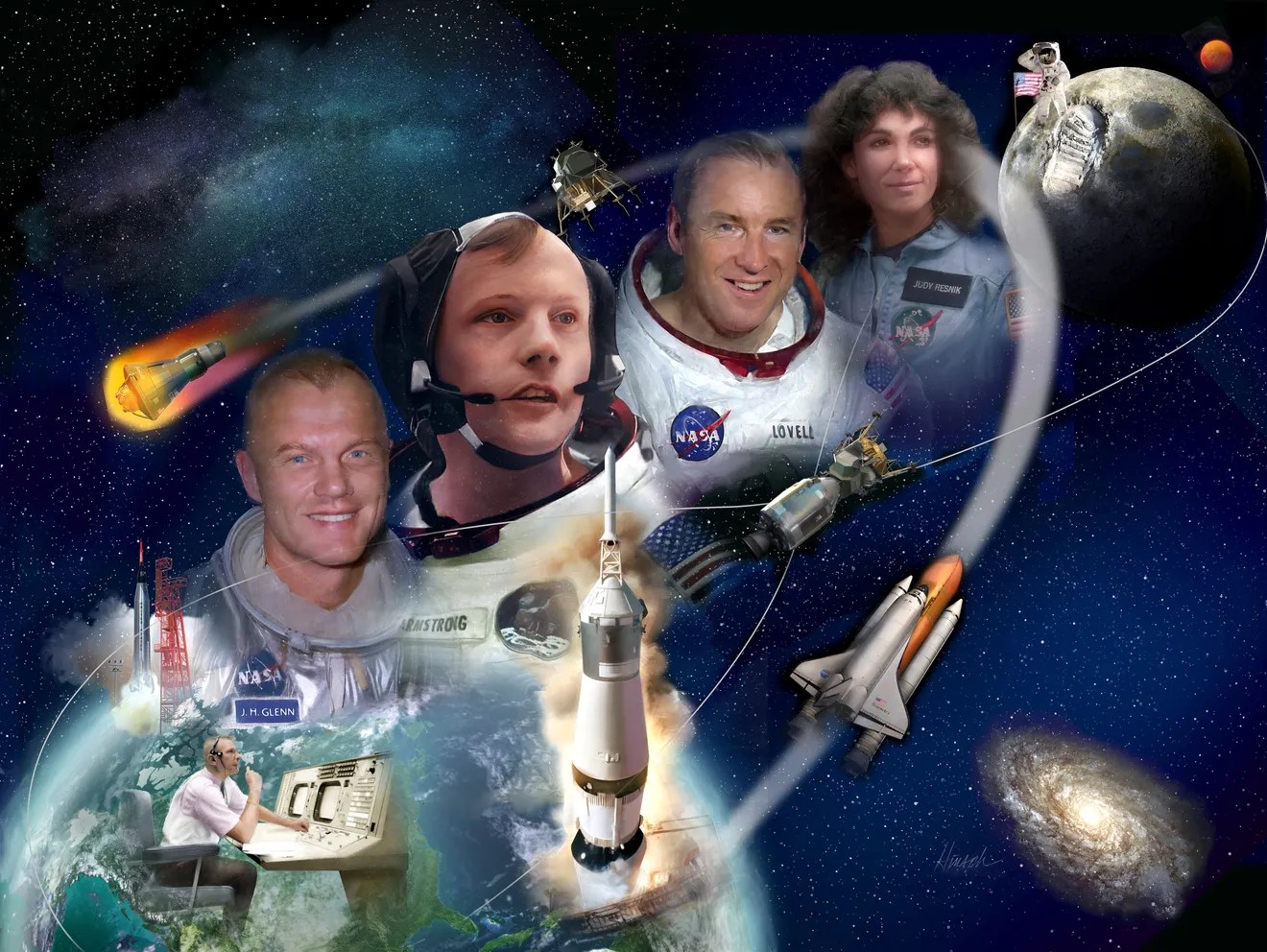
Representatives from NASA Headquarters and NASA’s Glenn Research Center in Cleveland participated in the unveiling of the “Ohioans in Space” painting at a large gala at the Ohio Statehouse in Columbus on Jan. 24. The portrait, which depicts Ohio-born national heroes Neil Armstrong, John Glenn, Jim Lovell, Judy Resnik, and Gene Kranz, is the first painting hung in the Ohio Statehouse Rotunda in nearly 70 years – since a portrait of the Wright Brothers, who grew up in Ohio, was hung.   

Central Ohio middle school students participated in a large interactive Science, Technology, Engineering, and Math (STEM) event at the Statehouse. The Center of Science and Industry (COSI), NASA Glenn and its Office of STEM Engagement, Great Lakes Science Center, and other museums from across Ohio led the activities. Ohio Gov. Mike DeWine, First Lady Fran DeWine, and three former NASA astronauts from Ohio participated.   

A public panel discussion on aviation and aerospace was also held. Speakers included NASA’s Deputy Associate Administrator Casey Swails; former astronauts Carl Walz, Michael Good, and Dr. Don Thomas; The Ohio State University’s Dr. John Horack; State Rep. Adam Holmes; and COSI CEO Dr. Frederic Bertley.  

A large mural depicts portraits of John Glenn, Neil Armstrong, Jim Lovell, and Judy Resnik in space attire. Gene Kranz is seated at a control desk at far left.
The portrait unveiled at the Ohio Statehouse in Columbus depicts Ohio-born national heroes Neil Armstrong, John Glenn, Jim Lovell, Judy Resnik, and Gene Kranz.
Credit: Artist Bill Hinsch   
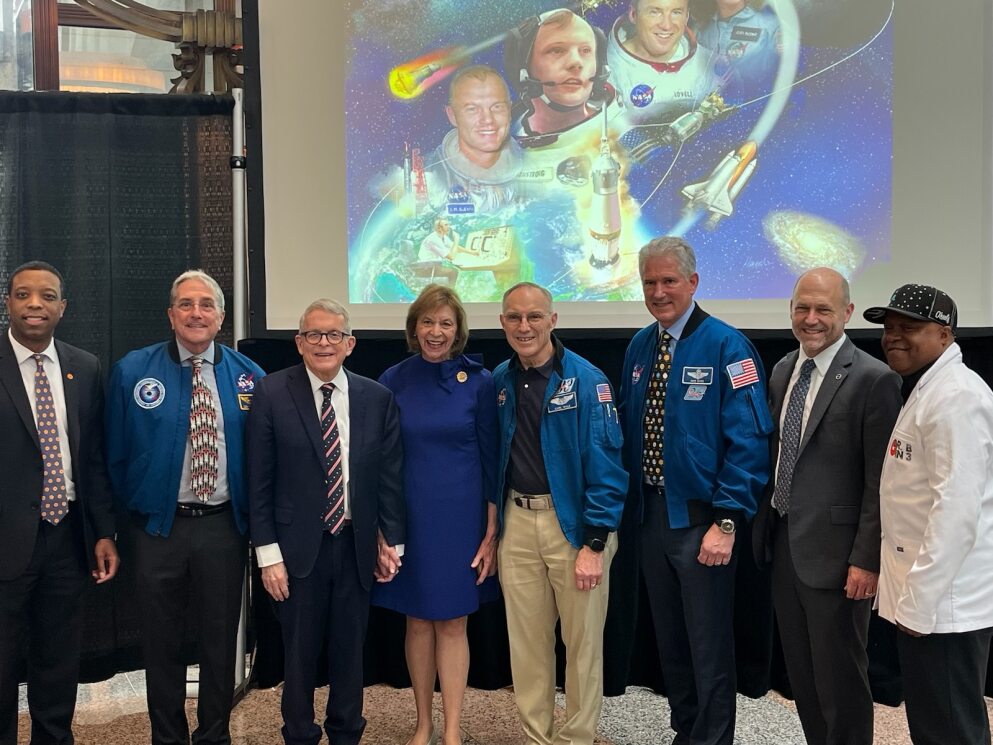
Eight people pose in front of the large mural on a screen at the Ohio Statehouse.
Left to right: Vice President, Center of Science and Industry (COSI) Stephen White; former astronaut Dr. Don Thomas; Ohio Gov. Mike DeWine; First Lady Fran DeWine; former astronaut Carl Walz, former astronaut Michael Good; NASA Glenn Center Director Dr. Jimmy Kenyon; and COSI President and CEO Dr. Frederic Bertley stand in front of the mural.
Credit: NASA/Scott Broemsen   

Powered by WPeMatico

Get The Details…
Kelly M. Matter

NASA’s Day of Remembrance

NASA’s Day of Remembrance

2 min read

Preparations for Next Moonwalk Simulations Underway (and Underwater)

Every year on NASA’s Day of Remembrance, the agency pauses to honor the sacrifice of the NASA family members who gave their lives to advance the cause of exploration. Employees remember friends and colleagues, including the crews of Apollo 1 and space shuttles Challenger and Columbia.  

A key element in observances across the agency centers on lessons learned from each tragedy and the importance of embracing NASA’s core value of safety. 

NASA Administrator Bill Nelson, Deputy Administrator Pam Melroy, and Associate Administrator Jim Free led a virtual agencywide Day of Remembrance Safety Town Hall on Jan. 23. In a dialogue with employees, the leaders highlighted how NASA safety is the cornerstone to achieving mission success. 

NASA Administrator Bill Nelson and NASA Deputy Administrator Pam Melroy lay a wreath of red and white carnations on a white stand. A soldier assists them by holding the stand for the wreath.
NASA Administrator Bill Nelson, left, and NASA Deputy Administrator Pam Melroy, right, lay a wreath at the Tomb of the Unknowns at Arlington National Cemetary in Arlington, Virginia, as part of NASA’s Day of Remembrance.
Credit: NASA/Keegan Barber

Center Director Dr. Jimmy Kenyon and Deputy Director Dawn Schaible led NASA Glenn Research Center’s Day of Remembrance observance in Cleveland. While at NASA’s Kennedy Space Center in Florida, Schaible worked on payload recovery efforts for Columbia and helped get the space shuttle back in flight. She shared how these experiences affected her and shaped her NASA career. 

NASA Glenn Deputy Director Dawn Schaible stands at the front of an auditorium and addresses employees who are seated in the audience. A screen with the words, “NASA Day of Remembrance,” with three mission patches are behind her. Two smaller screens with the same information are at each side of the front of the room.
NASA Glenn Research Center Deputy Director Dawn Schaible addresses employees during NASA Glenn’s Day of Remembrance Observance.
Credit: NASA/Sara Lowthian-Hanna

Schaible stressed the importance of communication and the threat of compliancy. She explained that all jobs have potential hazards to employees and others. Schaible called on employees to take the time to pause, listen, and ask questions during their daily activities. 

Powered by WPeMatico

Get The Details…
Kelly M. Matter

Stars Sparkle in New Hubble Image

Stars Sparkle in New Hubble Image

1 min read

Stars Sparkle in New Hubble Image

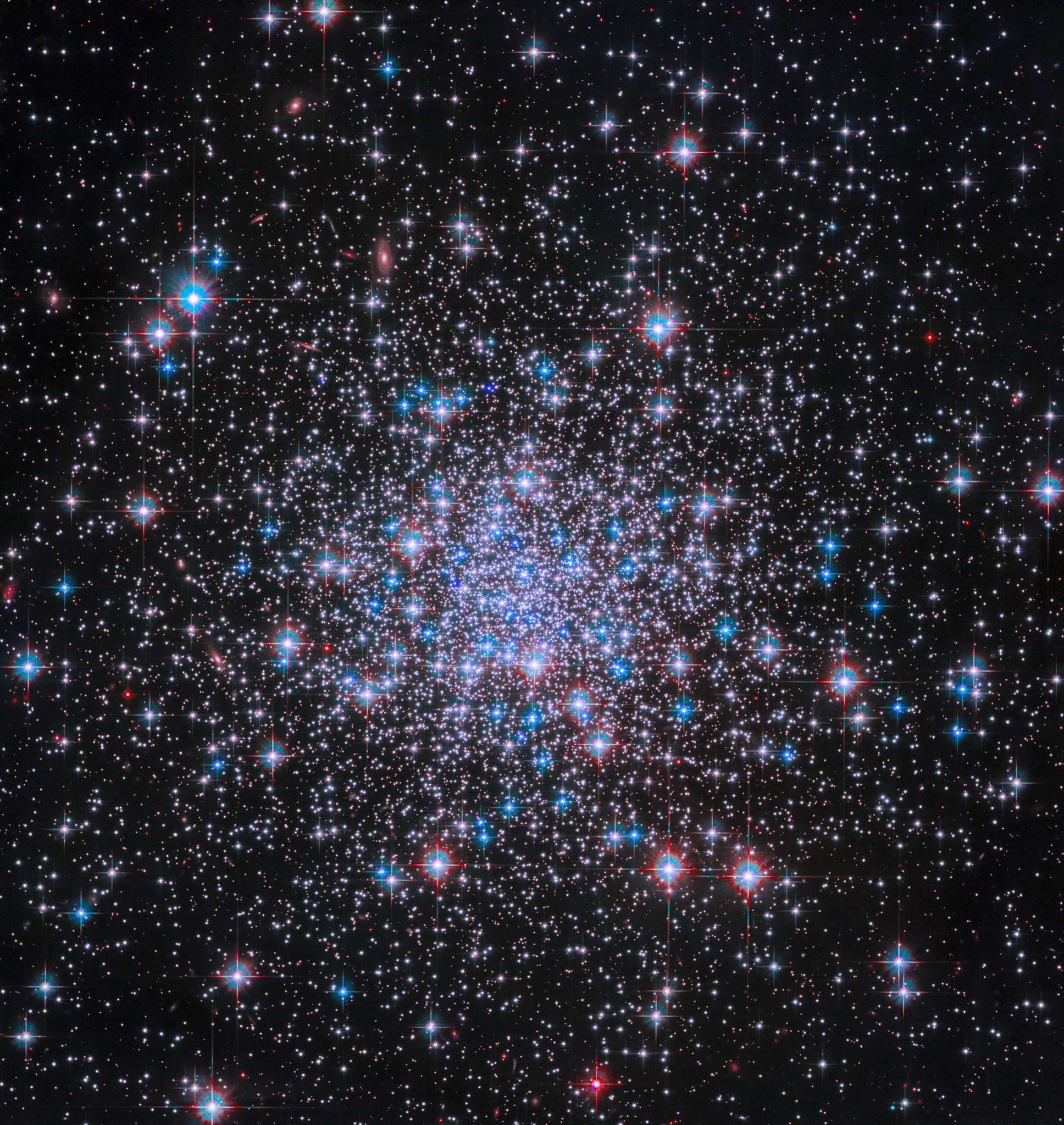
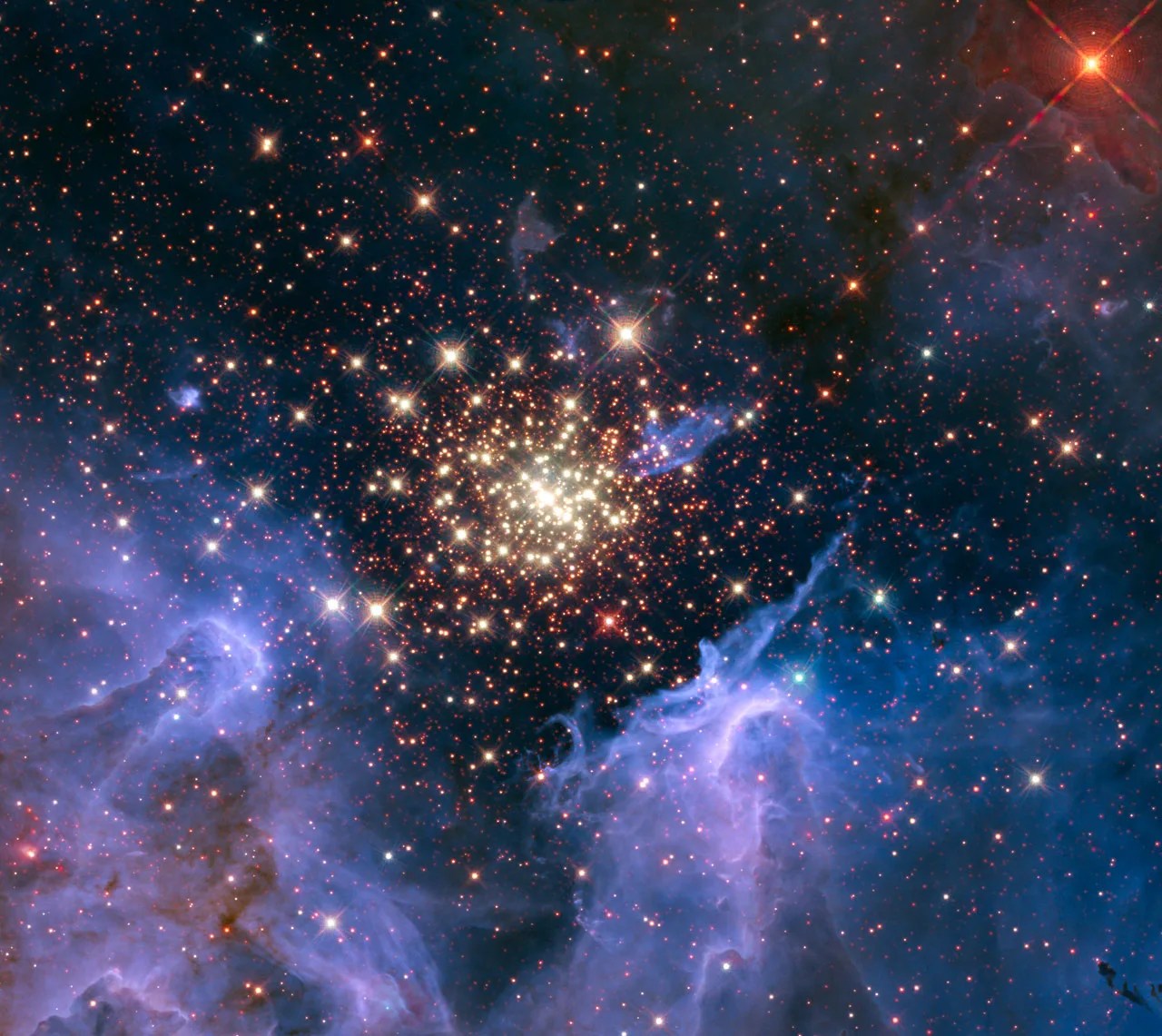
Thousands of bright stars shine against black space, more tightly condensed near the image’s center. The stars glint in shades of white, blue, and red, and diffraction spikes are visible around the foreground stars.
The globular cluster, NGC 2298, sparkles in this new NASA Hubble Space Telescope image.
NASA, ESA, G. Piotto (Universita degli Studi di Padova), and A. Sarajedini (Florida Atlantic University); Processing: Gladys Kober (NASA/Catholic University of America)

This new NASA Hubble Space Telescope view shows the globular cluster NGC 2298, a sparkling collection of thousands of stars held together by their mutual gravitational attraction. Globular clusters are typically home to older populations of stars, and they mostly reside in the dusty outskirts of galaxies.

Scientists utilized Hubble’s unique ability to observe the cosmos across multiple wavelengths of light to study NGC 2298 in ultraviolet, visible, and near-infrared light. This valuable information helps astronomers better understand how globular clusters behave, including their internal movements, orbits, and the evolution of their stars.

Media Contact:

Claire Andreoli
NASA’s Goddard Space Flight Center, Greenbelt, MD
claire.andreoli@nasa.gov

Share

Details

Last Updated
Feb 14, 2024
Editor
Andrea Gianopoulos
Location
Goddard Space Flight Center

Powered by WPeMatico

Get The Details…

NASA Johnson Director to Discuss Exploration Park at ASCENDxTexas

NASA Johnson Director to Discuss Exploration Park at ASCENDxTexas

Feb. 13, 2024

MEDIA ADVISORY: J24-002

Director Vanessa Wyche
JSC Town Hall with Center Director Vanessa Wyche. Photographer: Robert Markowitz
NASA

NASA Johnson Director to Discuss Exploration Park at ASCENDxTexas

Media are invited to attend an event with NASA taking place as part of ASCENDxTexas on Thursday, Feb. 15.

Vanessa Wyche, director of NASA’s Johnson Space Center in Houston, will be in attendance, as will Texas A&M University System Chancellor John Sharp and Texas A&M University President Mark Welsh. They will provide updates on Exploration Park and are available briefly for interviews after the announcement.

NASA sought proposals for use of the undeveloped and underutilized land near Saturn Lane, known as Exploration Park, on June 9, 2023. The parcel is outside of Johnson’s controlled access area and adjacent to its main campus.

ASCENDxTexas, hosted by AIAA, begins on Wednesday, Feb. 14, at South Shore Harbour Resort and Conference Center, League City, Texas. Media check-in will begin at 9:20 a.m. CST, with the event beginning promptly at 9:45 a.m. For ASCENDxTexas media credentialing, visit:

https://www.aiaa.org/events-learning/events/ascend/ascend-press-pass

For more than 60 years, NASA’s Johnson Space Center in Houston has led the nation and the world on a continuing adventure of human exploration, discovery, and achievement. Today, Johnson is the hub of human spaceflight, the home of mission control and astronaut training, and leads the International Space Station, Orion, and Gateway programs, while also playing important roles in numerous other advanced human exploration and research projects.

-end-

Kelly Humphries

Johnson Space Center, Houston

281-483-5111

kelly.o.humphries@nasa.gov

Powered by WPeMatico

Get The Details…
Kelly O. Humphries

New NASA Mission will Study Ultraviolet Sky, Stars, Stellar Explosions

New NASA Mission will Study Ultraviolet Sky, Stars, Stellar Explosions

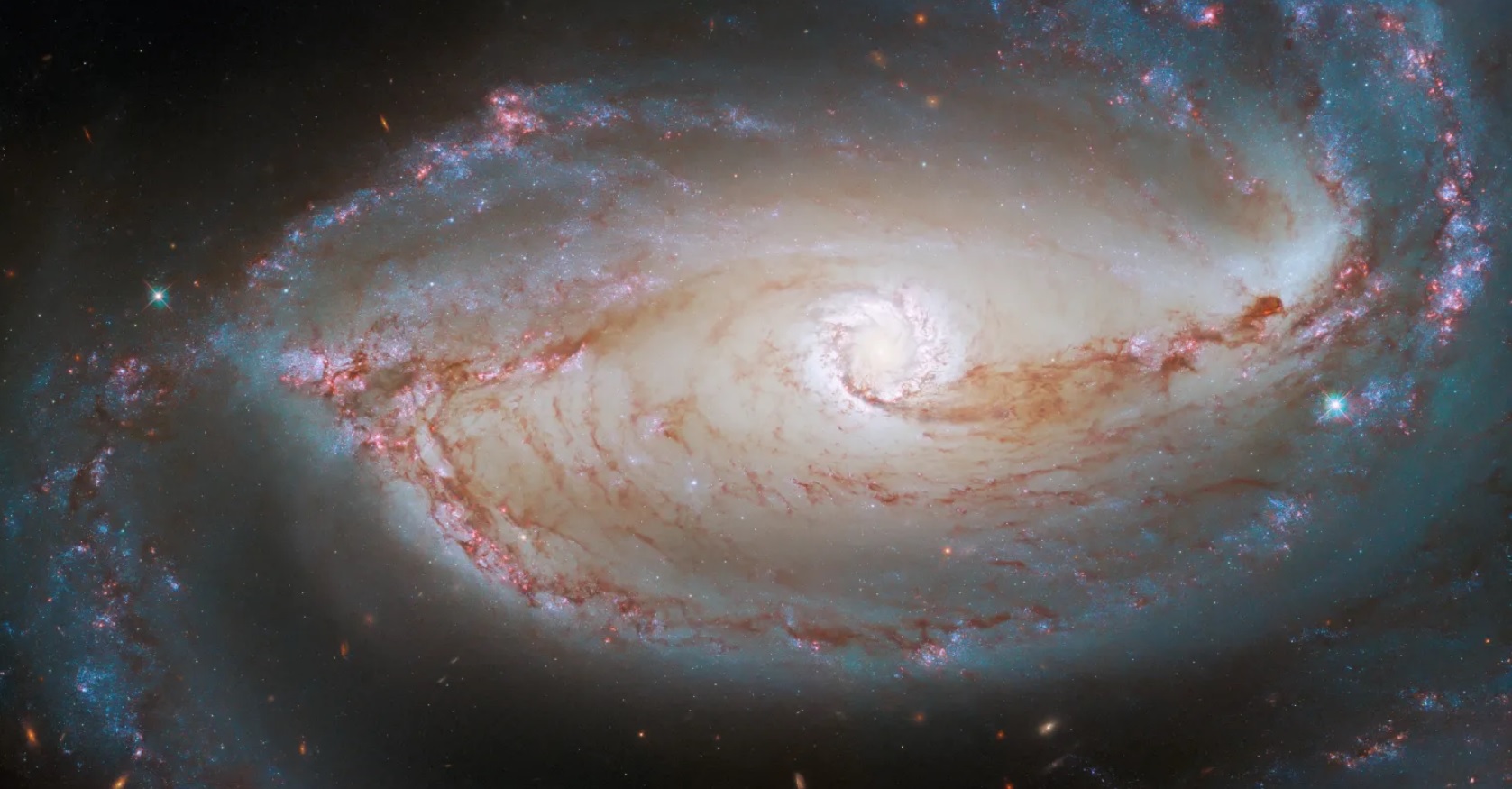
This image shows the heart of the barred spiral galaxy NGC 1097, as seen by NASA’s Hubble Space Telescope.
Credit: ESA/Hubble & NASA, D. Sand, K. Sheth

As NASA explores the unknown in air and space, a new mission to survey ultraviolet light across the entire sky will provide the agency with more insight into how galaxies and stars evolve. The space telescope, called UVEX (UltraViolet EXplorer), is targeted to launch in 2030 as NASA’s next Astrophysics Medium-Class Explorer mission.

In addition to conducting a highly sensitive all-sky survey, UVEX will be able to quickly point toward sources of ultraviolet light in the universe. This will enable it to capture the explosions that follow bursts of gravitational waves caused by merging neutron stars. The telescope also will carry an ultraviolet spectrograph to study stellar explosions and massive stars.

“NASA’s UVEX will help us better understand the nature of both nearby and distant galaxies, as well as follow up on dynamic events in our changing universe,” said Nicola Fox, associate administrator, Science Mission Directorate at NASA Headquarters in Washington. “This mission will bring key capabilities in near-and far-ultraviolet light to our fleet of space telescopes, delivering a wealth of survey data that will open new avenues in exploring the secrets of the cosmos.”

The telescope’s ultraviolet survey will complement data from other missions conducting wide surveys in this decade, including the Euclid mission led by ESA (European Space Agency) with NASA contributions, and NASA’s Nancy Grace Roman Space Telescope, set to launch by May 2027. Together, these missions will help create a modern, multi-wavelength map of our universe.

“With the innovative new UVEX mission joining our portfolio, we will gain an important legacy archive of data that will be of lasting value to the science community,” said Mark Clampin, director of the Astrophysics Division at NASA Headquarters. “This new telescope will contribute to our understanding of the universe across multiple wavelengths and address one of the major priorities in Astrophysics today: studying fleeting changes in the cosmos.”

NASA selected the UVEX Medium-Class Explorer concept to continue into development after detailed review of two Medium-Class Explorer and two Mission of Opportunity concept proposals by a panel of scientists and engineers, and after evaluation based on NASA’s current astrophysics portfolio coupled with available resources. The UVEX mission was selected for a two-year mission and will cost approximately $300 million, not including launch costs.

The mission’s principal investigator is Fiona Harrison at Caltech in Pasadena, California. Other institutions involved in the mission include University of California at Berkeley, Northrop Grumman, and Space Dynamics Laboratory.

The Explorers Program is the oldest continuous NASA program. The program is designed to provide frequent, low-cost access to space using principal investigator-led space science investigations relevant to the agency’s astrophysics and heliophysics programs.

Since the launch of Explorer 1 in 1958, which discovered the Earth’s radiation belts, the Explorers Program has launched more than 90 missions, including the Uhuru and Cosmic Background Explorer missions that led to Nobel prizes for their investigators.

The program is managed by NASA’s Goddard Space Flight Center for the Science Mission Directorate, which conducts a wide variety of research and scientific exploration programs for Earth studies, space weather, the solar system, and the universe.

For more information about the Explorers Program, visit:

https://explorers.gsfc.nasa.gov

-end-

Alise Fisher
Headquarters, Washington
202-358-2546
alise.m.fisher@nasa.gov

Share

Details

Last Updated

Feb 13, 2024

Related Terms

Powered by WPeMatico

Get The Details…
Roxana Bardan