Expedition 68 Crew With Three NASA Astronauts to Discuss Mission

Expedition 68 Crew With Three NASA Astronauts to Discuss Mission

Dec. 4, 2023

MEDIA ADVISORY: M23-001

NASA logo

Four astronauts, including the current record-holder for the longest single stay in space aboard the International Space Station, will make their first public appearance in Houston since returning to Earth. The crew will be available for interviews at 5 p.m. CST Wednesday, Dec. 6, at Space Center Houston.

NASA astronauts Nicole Mann, Josh Cassada, and Frank Rubio, along with JAXA (Japan Aerospace Exploration Agency) astronaut Koichi Wakata, will be at NASA Johnson Space Center’s visitor center to share highlights from their missions during a free, public event at 6:15 p.m. At 7:40 p.m., the crew will help recognize key contributors to its mission success in an awards ceremony.

Reporters may request an in-person interview no later than 12 p.m. Dec. 6 by emailing Dana Davis at dana.l.davis@nasa.gov.  

Crew-5

NASA’s SpaceX Crew mission launched in October 2022 with Mann, Cassada, and Wakata, as well as Roscosmos cosmonaut Anna Kikina, on the fifth commercial crew rotation mission to the International Space Station. The crew spent 157 days aboard the space station, traveled 66,577,531 miles, and completed 2,512 Earth orbits, splashing down off the coast of Tampa, Florida, on March 11. This was the first spaceflight for Mann, Cassada, and Kikina. It was the fifth flight for Wakata who has now logged a total of 505 days in space.

Soyuz Crew
The international crew that flew on the Soyuz spacecraft served on Expeditions 68 and 69 aboard the space station. The flight launched on the Soyuz MS-22 spacecraft in September 2022 with Rubio and Roscosmos cosmonauts Sergey Prokopyev and Dmitri Petelin. The crew spent 371 days aboard the space station, traveled 157,412,306 statute miles, and completed 5,963 Earth orbits, landing in Kazakhstan aboard the Soyuz MS-23 spacecraft on Sept. 27, 2023. This was the second spaceflight for Prokepyev and Petelin. This was Rubio’s first spaceflight mission and it broke the U.S. record for a single spaceflight by an American.

While on the station, the crew members conducted important scientific investigations and helped maintain the orbiting laboratory. While aboard they tested hydroponic and aeroponic techniques to grow plants without using soil, studied how liquids move in a container in simulated lunar gravity to generate data to improve Moon rover designs, and tested an on-demand system to produce specific quantities of key nutrients from yogurt, kefir, and a yeast-based beverage. The crew also released Uganda and Zimbabwe’s first satellites.

Stay current on space station activities by following @space_station and @ISS_Research on Twitter, as well as the station Facebook and Instagram accounts and the space station blog.

-end-

Chelsey Ballarte
Johnson Space Center, Houston
281-483-5111
chelsey.n.ballarte@nasa.gov

Dana Davis
Johnson Space Center, Houston
281-244-0933
dana.l.davis@nasa.gov

Powered by WPeMatico

Get The Details…
Wendy K. Avedisian

NASA Audio Specialist Named in Forbes 30 Under 30 List of Innovators

NASA Audio Specialist Named in Forbes 30 Under 30 List of Innovators

3 min read

Preparations for Next Moonwalk Simulations Underway (and Underwater)

Katie Konans, NASA’s audio and podcasting lead at the agency’s Goddard Space Flight Center in Greenbelt, Maryland, is one of two NASA employees named to Forbes’ 30 Under 30 Class of 2024. The other agency honoree, Clare Luckey, is a systems engineer at NASA’s Johnson Space Center in Houston.

Katie Konans sits at a dark-colored desk wearing a white sweater with long brown hair. Behind her is a TV screen with the Curious Universe logo.
Katie Konans is NASA’s audio and podcasting lead at the agency’s Goddard Space Flight Center in Greenbelt, Maryland.
NASA/Rob Andreoli

Forbes’ 30 Under 30 list is a selection of young, creative, and bold minds the magazine’s experts consider revolutionaries, changing the course of business and society. Forbes evaluated more than 20,000 nominees to decide on 600 business and industry figures, with 30 selected in each of 20 industries.

“When I joined NASA in 2018, the agency didn’t have a dedicated audio program or strategy,” Konans said. “I was fresh out of an NPR member station fellowship, excited about the world of audio storytelling, and had the rare opportunity to build out a new part of NASA’s communications program.

“I will forever feel fortunate to have had that chance to experiment with a new medium and grow NASA’s audio program into the storytelling unit it is today. I recognize what a unique privilege it is to get the time, space, and encouragement – to do something new and different, that also pushes against the status quo, and have that big bet pay off.”

Konans has revolutionized NASA’s digital strategy through her work in audio communication. She is a creative communicator who works at the intersection of storytelling and strategy. Konan’s work has expanded NASA’s reach in the digital audio space, resulting in millions of downloads worldwide. 

At NASA, she manages five active podcasts, including the flagship podcast “NASA’s Curious Universe,” which she launched in 2020. Since taking the leadership role in 2019, she’s grown the podcast audience to more than 8 million episode plays on Apple Podcasts alone, with a listener retention rate of 70% on average. She’s received the NASA Early Career Achievement Medal, a Webby Award, and the Robert H. Goddard Award for her team’s contributions to NASA’s public engagement and communication.

Prior to joining NASA, Konans was a features reporter at NPR affiliate Georgia Public Broadcasting, where she covered community-focused stories. Konans is passionate about working with students and is a coordinating mentor for Goddard’s Office of Communications internship program.

“I’m from the small town of McDonough, Georgia. I graduated from Mercer University in 2019 as the first in my family to complete a traditional college degree, but not without overcoming significant roadblocks. I put myself through school, and really struggled financially to make it to the finish line. I didn’t give up, and it’s one of the big reasons I was able to make it to NASA.

“I have to thank the many mentors I’ve had along the way, but especially the faculty of Mercer University’s Center for Collaborative Journalism. While I was battling those challenges, they saw something in me and truly encouraged me to reach for the stars. It’s one of the reasons I’m so involved in mentoring NASA’s communications interns today – I know that having just one person in your corner can absolutely change your life.”

In 2023, Konans also launched the agency’s first Spanish podcast in collaboration with the NASA en Español team.

“Today, NASA’s podcasts reach hundreds of thousands of podcast listeners across the globe, sharing stories of space and science that educate, inspire, and encourage younger audiences to get curious about the world of science and space. Working with my team to share those stories is more than I could have ever dreamed of being a part of. It’s incredibly rewarding.”

Rob Gutro
NASA’s Goddard Space Flight Center

Share

Details

Last Updated

Dec 04, 2023

Editor
Jamie Adkins
Contact
Location
Goddard Space Flight Center

Powered by WPeMatico

Get The Details…
Jamie Adkins

NASA Administrator Bill Nelson Participates in Space Agencies Leaders’ Summit at COP 28

NASA Administrator Bill Nelson Participates in Space Agencies Leaders’ Summit at COP 28

Leaders from two dozen space agencies sit in rows of chairs around a large open rectangular table illuminated under a truss of white lights.

NASA Administrator Bill Nelson participated in the first-ever Space Agencies Leaders’ Summit at COP 28 in Dubai, UAE, on Dec. 4, 2023. At the summit, organized by the UAE Space Agency, Nelson underscored the importance of sharing climate data transparently and openly with the world.

Leaders from two dozen space agencies discussed enhancing data sharing between established and emerging space nations, strengthening climate research by allocating resources and funding towards climate research initiatives within the space sector, supporting climate monitoring initiatives by establishing new programs, and promoting sustainable space operations by minimizing the environmental impact of space operations.

The summit ended with participants adopting a pledge to enhance space-based climate initiatives to transform and accelerate climate action to meet the commitments outlined in the 2015 Paris Agreement.

Image Credit: COP 28/Stuart Wilson

Powered by WPeMatico

Get The Details…
Michelle Zajac

NASA Continues Progress on Artemis III Rocket Adapter with Key Joint Installation

NASA Continues Progress on Artemis III Rocket Adapter with Key Joint Installation

The cone-shaped launch vehicle stage adapter, seen in yellow, is in a production area.
NASA/Sam Lott

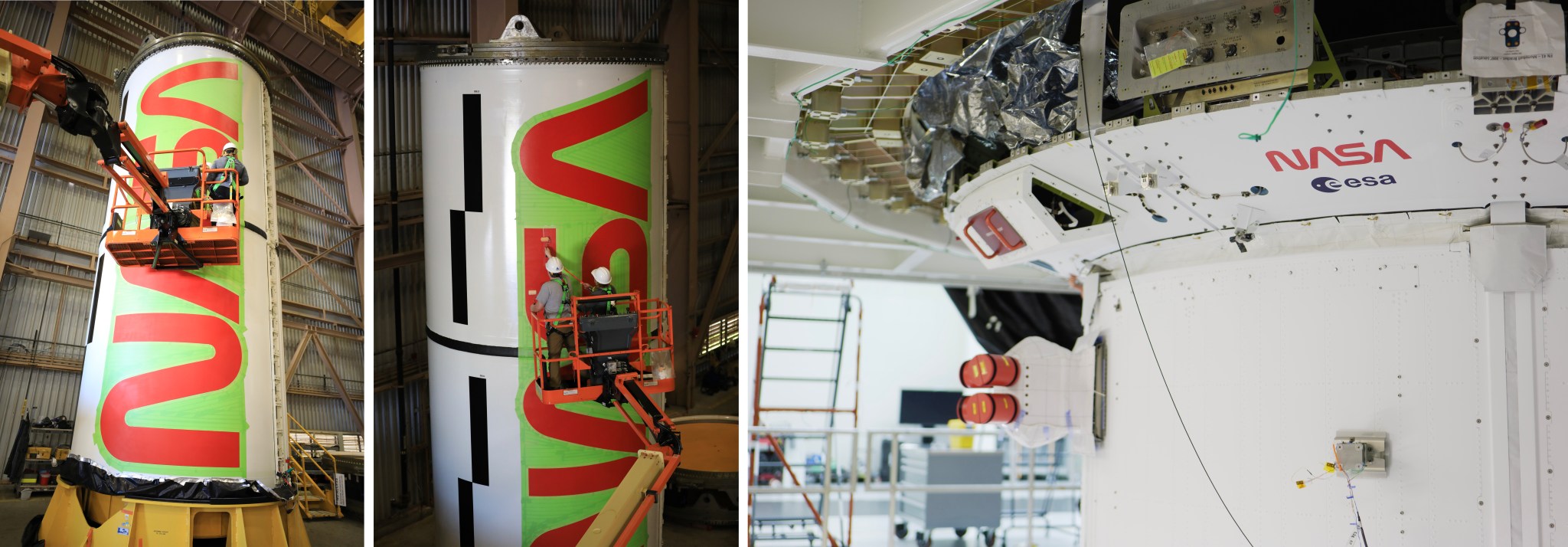
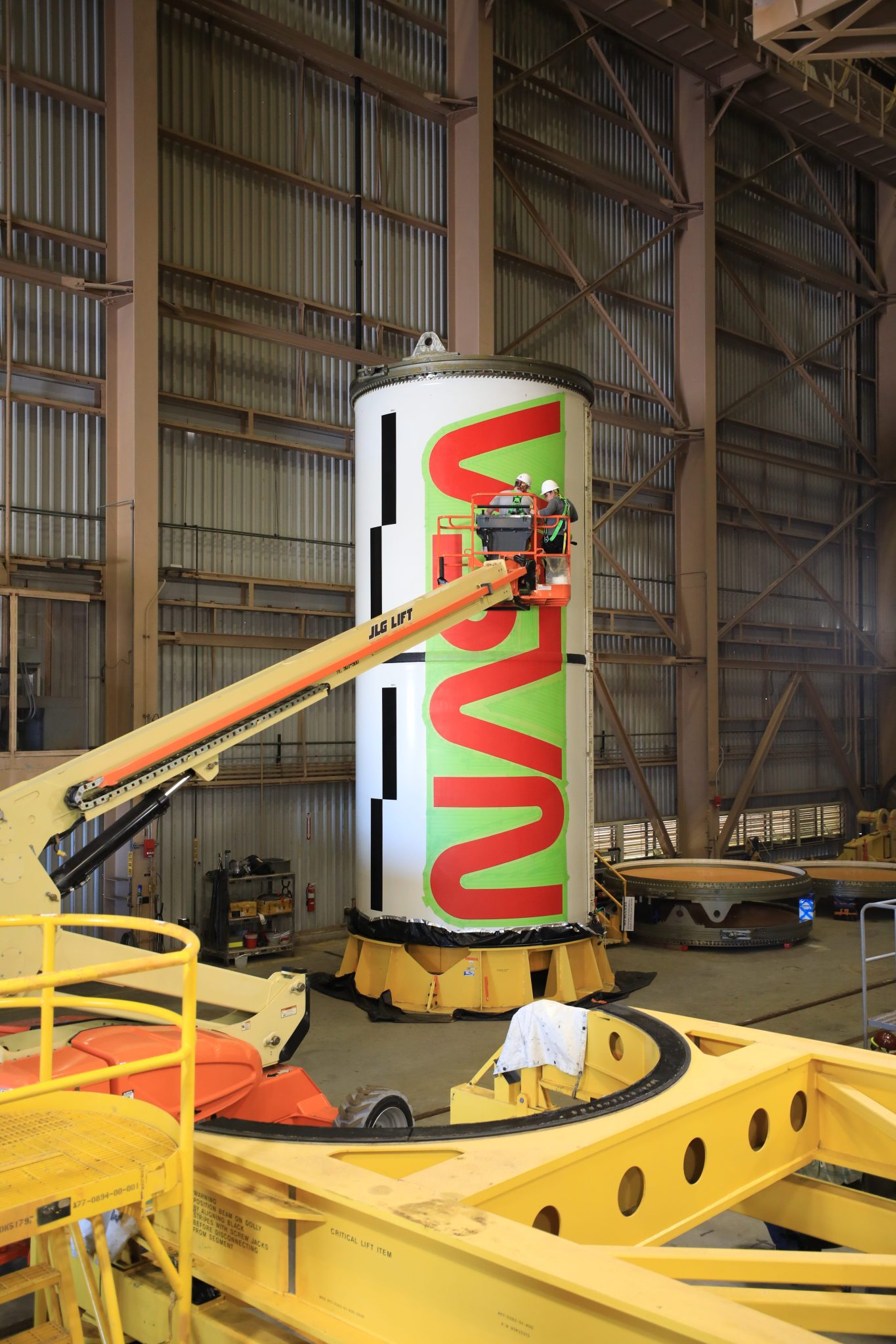
Engineers and technicians at NASA’s Marshall Space Flight Center in Huntsville, Alabama, recently installed a key component called the frangible joint assembly onto the adapter that connects the core stage to the upper part of the NASA’s SLS (Space Launch System) rocket. The cone-shaped stage adapter, called the launch vehicle stage adapter, will be part of the SLS mega rocket that will power NASA’s Artemis III mission to the Moon. The frangible joint sits atop the adapter and operates as a separation mechanism. The frangible joint is designed to break apart upon command, allowing the upper part of the rocket, NASA’s Orion spacecraft, and the crew inside Orion to quickly separate from the SLS core stage and adapter. Frangible joint assemblies are widely used across the space industry in a variety of crewed and uncrewed spacecraft to efficiently separate fairings or stages during launch, during ascent, in orbit and during payload deployment. The stage adapter used for Artemis III is set to be the last of its kind as SLS evolves into a larger and more powerful configuration for future Artemis missions, beginning with Artemis IV. The adapter is fully assembled at Marshall by NASA and lead contractor Teledyne Brown, which is also based in Huntsville.

The cone-shaped launch vehicle stage adapter, seen in yellow, is in a production area.
NASA/Sam Lott

SLS is part of NASA’s backbone for deep space exploration, along with Orion and the Gateway in orbit around the Moon, and commercial human landing systems. SLS is the only rocket that can send Orion, astronauts, and supplies to the Moon in a single launch.

For more on NASA SLS, visit:

https://www.nasa.gov/sls

News Media Contact

Corinne Beckinger
Marshall Space Flight Center, Huntsville, Ala.
256.544.0034
corinne.m.beckinger@nasa.gov

Powered by WPeMatico

Get The Details…
Lee Mohon

Pioneer 10 Crosses the Asteroid Belt

Pioneer 10 Crosses the Asteroid Belt

In this illustration, the Pioneer 10 spacecraft flies through the asteroid belt between Mars and Jupiter. The spacecraft is shown to the right of Jupiter (right), dwarfed by the planet's size. The white line representing Pioneer 10's path curls around Earth and past Jupiter. At the center, the Sun is represented in bright, luminous white and orange, while streaks of red, orange, purple, and black represent space. The image is dotted with spots of purple, blue, yellow, and white.
If spacecraft are to visit the outer solar system, they must cross the asteroid belt between Mars and Jupiter. The Pioneer mission was faced with the question of just how dangerous this asteroid belt would be to a spacecraft passing through it.
NASA

This illustration made on Nov. 26, 1974, by Rick Giudice shows the Pioneer 10 spacecraft traveling through the asteroid belt between Mars and Jupiter, the largest planet in the solar system. At the time, it was uncertain whether it would traverse it safely since the density of particles large enough to damage the craft was not yet known, but Pioneer 10 became the first satellite to enter and pass through the asteroid belt.

The mission’s primary goal was to explore Jupiter, its satellites, its magnetic field, and trapped radiation belts. On Nov. 6, 1973, while still 16 million miles from Jupiter, Pioneer 10 began to image the giant planet with its photopolarimeter, and shortly thereafter began to take measurements with its other instruments as well. Twenty days later, the spacecraft passed the front of Jupiter’s bowshock, where the solar wind clashed with the planet’s magnetosphere. By Dec. 1, the spacecraft was returning images of the planet exceeding the best pictures from Earth. Pioneer 10 sent its last signal on Jan. 23, 2003, when it was 7.6 billion miles (12.23 billion kilometers) away from Earth.

Learn about Pioneer and other planetary exploration and scientific satellite research planned for the 1970s in the Seeds of Discovery documentary on NASA+.

Image Credit: NASA

Powered by WPeMatico

Get The Details…
Monika Luabeya