Compact Robot Takes Flight to Support CERISS Initiative
3 min read
Compact Robot Takes Flight to Support CERISS Initiative
NASA’s TechFlights 2023 Selections Advance Space Science in Collaboration with Industry
A new robot will be taking flight soon to test its ability to support biological and physical science experiments in microgravity. As one of NASA’s 2023 TechFlights selections, this compact robot will have a chance to fly on a commercial suborbital flight to see just how well it can perform in a space environment.
Managed by NASA’s Flight Opportunities program, the TechFlights 2023 solicitation included a call for technologies to support the agency’s Commercially Enabled Rapid Space Science (CERISS) initiative. CERISS, administered by NASA’s Biological and Physical Sciences Division, uses the spaceflight environment to study phenomena in ways that cannot be done on Earth.
One of the 11 TechFlights selections that will undergo flight testing is a compact robot designed to prepare samples for science experiments in microgravity, improve in-flight sample preparation capabilities and potentially reduce astronauts’ time tending to such research while on the International Space Station or future commercial destinations in low Earth orbit. Led by principal investigator Phil Putman, manager of advanced projects at Sierra Lobo, Inc, in Fremont, Ohio, the tests will leverage parabolic flights from Zero Gravity Corporation to evaluate the technology’s performance in microgravity.
“We need transformative capabilities to conduct research in space as NASA continues its exploration mission,” said BPS division director Lisa Carnell. “The commercial testing supported by Flight Opportunities will help CERISS advance a key research spaceflight innovation with the goal of improving in-flight sample analysis and advancing our study of biological and physical systems in space.”
CERISS aims to advance biological and physical research capabilities with the commercial space industry, including sample preparation and analysis technologies for use in microgravity. The project’s long-term goals include conducting scientist astronaut missions on commercial space stations as well as developing automated hardware for experiments beyond low Earth orbit, such as on the lunar surface. Benefits include an increase in the pace of research for a wide range of research leading to an increased demand for research and development in low Earth orbit, facilitating growth of the commercial space industry.
NASA’s Biological and Physical Sciences Division pioneers’ scientific discovery and enables exploration by using space environments to conduct investigations not possible on Earth. Studying biological and physical phenomenon under extreme conditions allows researchers to advance the fundamental scientific knowledge required to go farther and stay longer in space, while also benefitting life on Earth.
Marshall Celebrates Alabama Space Day in Montgomery
By Jessica Barnett
Team members from NASA’s Marshall Space Flight Center joined Montgomery-area students, the U.S. Space & Rocket Center, NASA’s aerospace partners, and elected officials in celebrating the aerospace industry’s impact in Alabama on March 5.
This year’s event kicked off at the state Capitol in Montgomery with a proclamation from Alabama Gov. Kay Ivey declaring March 5 as Alabama Space Day. Students from the Montgomery area were then invited to take part in various STEM (science, technology, engineering, and mathematics) activities, chat with an astronaut, hear what it takes to become a NASA intern or work at Marshall, and check out exhibits highlighting NASA’s many programs, including the Space Launch System, Human Landing System, and Centennial Challenges.
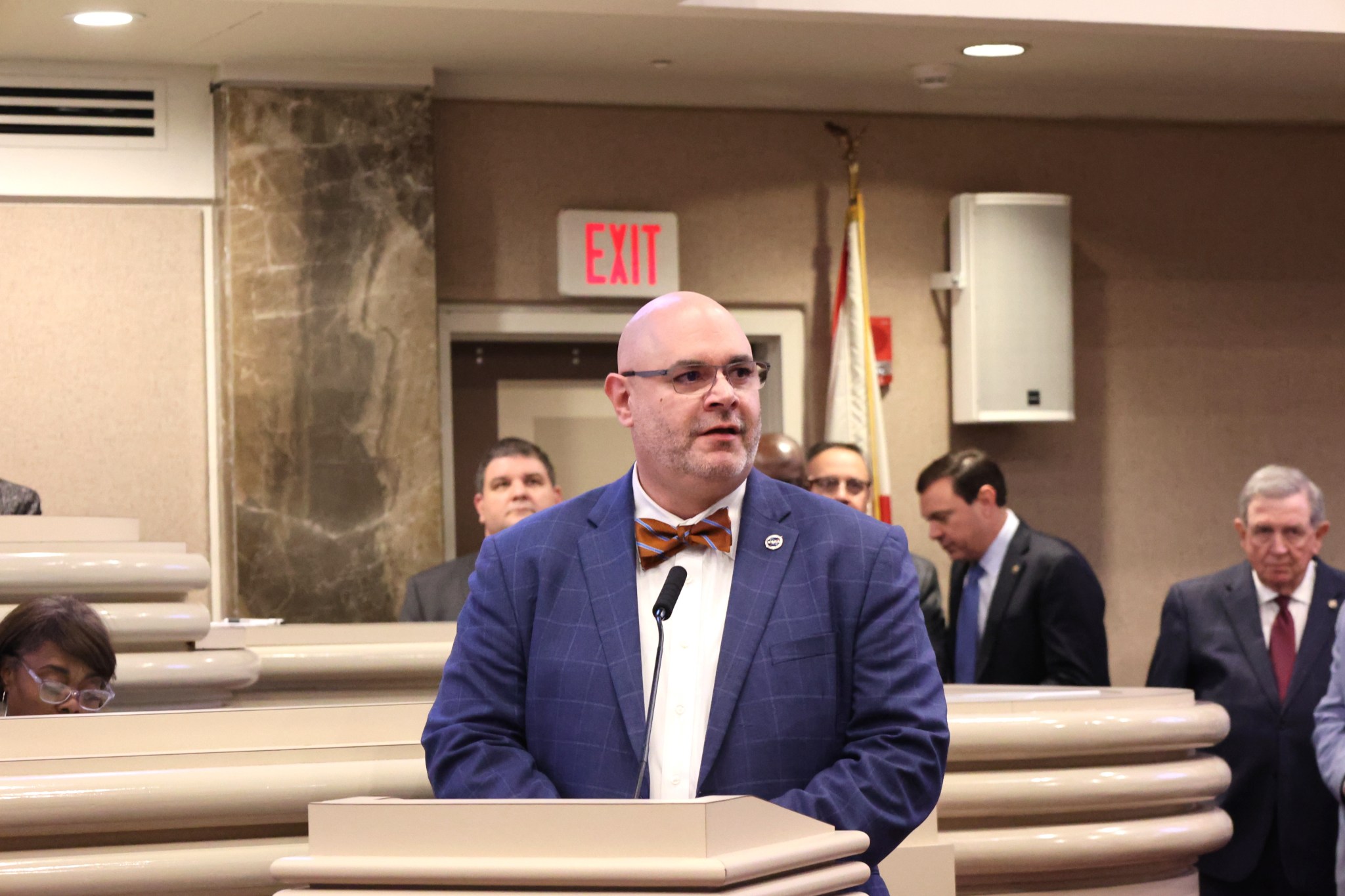
Joseph Pelfrey, director of NASA’s Marshall Space Flight Center, speaks inside the House Chamber of the Alabama State House during Alabama Space Day in Montgomery on March 5.
Dionne Whetstone
NASA astronaut Raja Chari attended the event and spoke to students about his experience serving as flight engineer of Expedition 66 and 67 aboard the International Space Station for 177 days.
Ivey said she felt honored to host the annual event, which aims to highlight Alabama’s contributions to space exploration as well as encourage the next generation of scientists and engineers by pursuing degrees and careers in aerospace.
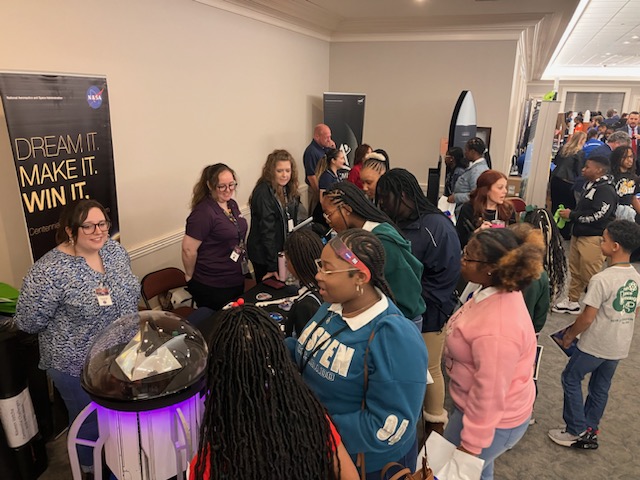
Students from middle and high schools in the Montgomery area visit a series of exhibits featuring many NASA programs managed at Marshall. The displays were part of Alabama Space Day, celebrated March 5 at the state Capitol in Montgomery.
NASA/Christopher Blair
“We are blessed to have such a world-class space and technology presence in our state,” Ivey said. “Alabama is very proud of its historic contributions to the American space program, which go back well over 60 years.”
Marshall Center Director Joseph Pelfrey echoed the sentiment, calling it “a great day to celebrate space in Alabama.”
“Alabama Space Day was a huge success, thanks to the workforce at Marshall, as well as our aerospace partners and sponsors,” Pelfrey said. “We truly appreciate the bipartisan support we receive across the state and enjoy highlighting these partnerships through events like this. I especially valued speaking on panels today with my colleagues and engaging with local high school and college students, who will be the first generation to travel to Mars.”
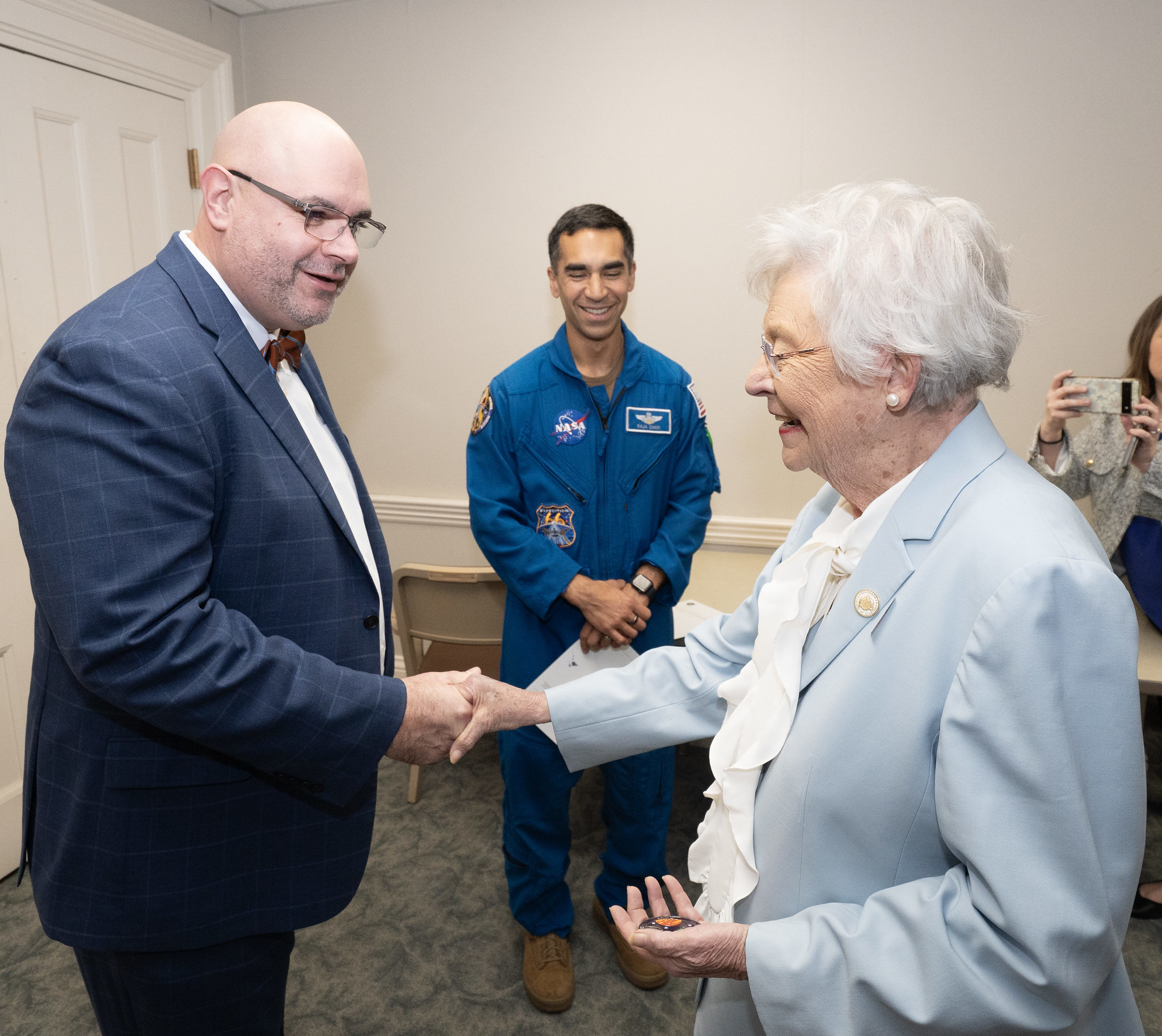
Alabama Gov. Kay Ivey, right, greets Pelfrey during Alabama Space Day as NASA astronaut Raja Chari, center, looks on. The governor issued a proclamation declaring the state holiday in honor of the aerospace industry’s impact on Alabama.
Hal Yeager
Barnett, a Media Fusion employee, supports the Marshall Office of Communications.
President’s NASA Fiscal Year 2025 Funding Supports US Space, Climate Leadership
The Biden-Harris Administration on March 11 released the President’s Budget for Fiscal Year 2025, which includes funding to invest in America and the American people and will allow NASA to continue advancing our understanding of Earth and space while inspiring the world through discovery.
“As history has proven, as the present has shown, and as the future will continue to demonstrate, an investment in NASA is an investment in America for the benefit of humanity,” said NASA Administrator Bill Nelson. “President Biden’s budget will fund our nation’s abilities and leadership for the future of space exploration, scientific discovery, cutting-edge technology, climate data, the next generation of aeronautics, and inspiring our future leaders – the Artemis Generation.”
The budget allows NASA to launch the Artemis II mission, which will send astronauts around the Moon for the first time in more than 50 years, research Earth’s changing climate, grow commercial markets to serve America’s interests in space, and inspire the Artemis Generation of science, technology, engineering, and math professionals.
“This budget shows NASA’s value in contributing to the global leadership of the United States,” said Nelson. “Every dollar supports our ability to continue exploring new cosmic shores and making the impossible possible, all while creating competitive and good-paying jobs in all 50 states.”
At NASA, the budget request would:
Invest in the U.S.-led Artemis campaign of lunar exploration: The budget includes $7.8 billion for the Artemis campaign, which will bring astronauts – including the first woman, first person of color, and first international astronaut – to the lunar surface starting this decade as part of a long-term journey of science and exploration.
Enhance climate science and information: The budget invests $2.4 billion in the Earth science program for missions and activities that advance Earth systems science and increase access to information to mitigate natural hazards, support climate action, and manage natural resources.
Advance U.S. space industry technology development: The budget provides $1.2 billion for NASA’s space technology portfolio to foster innovative technology research and development to meet the needs of NASA, support the expanding U.S. space industry, which is creating a growing number of good jobs, and keep America ahead of competitors at the forefront of space innovation.
Support highly efficient and greener commercial airliners: The budget invests $966 million in NASA’s aeronautics program, which will develop hybrid-electric jet engines, lightweight aircraft structures, and a major new flight demonstrator to pave the way for new commercial airliners that would be cheaper to operate and produce less pollution.
Continue the transition to commercial space stations:The budget funds continued operation of the International Space Station, a vehicle to safely de-orbit the space station after it is retired in 2030, and the commercial space stations that NASA will use as soon as they become available.
Increase STEM opportunities at minority-serving institutions: The budget provides $46 million to the Minority University Research and Education Project, to increase competitive awards to Historically Black Colleges and Universities, tribal colleges and universities, and other minority-serving institutions, and recruit and retain underrepresented and underserved students in STEM fields.
Find more information on NASA’s fiscal year 2025 budget request at nasa.gov.
Jason Adam Named Deputy Manager of Marshall’s Science and Technology Office
Jason Adam has been named as deputy manager of the Science and Technology Office at NASA’s Marshall Space Flight Center.
Adam will assist in leading the organization responsible for projects and programs in support of the Science Mission Directorate and Space Technology Mission Directorate. This includes the Planetary Missions Program Office, the Technology Demonstration Missions Program Office, deep space and planetary exploration, fundamental research in heliophysics, astrophysics, and Earth science, and technology development, including Centennial Challenges and Technology Transfer.
Jason Adam has been named as deputy manager of the Science and Technology Office at NASA’s Marshall Space Flight Center.
NASA
He has been the Cryogenic Fluid Management Portfolio Project manager since the project office’s inception in February 2021. From February 2020 to 2021, Adam worked an executive-level detail as a senior technical assistant in the center director’s office.
From 2017 to 2021, he was the manager of the Exploration and Systems Development Office in the Science and Technology Office. Adam managed technology and flight projects in support of NASA’s science and human exploration missions from 2008 to 2017.
In 2014, he was selected as a member of the NASA Mid-level Leadership Program. During that time, Adam completed a detail at NASA Headquarters working for the agency’s associate administrator on the Technical Capability Assessments team.
He joined Marshall in 2008 to work on the Constellation rocket Ares I. Adam began his NASA career at Stennis Space Center in 2003, focusing on propulsion testing of the space shuttle main engines. He completed a program management detail in 2007, supporting the Space Shuttle Program as a technical assistant.
A federally certified senior/expert project manager, Adam is a graduate of the Office of Personnel Management Federal Executive Institute’s Leadership for a Democratic Society. He is the recipient of NASA’s Outstanding Leadership Medal.
An engineering graduate from North Dakota State University in Fargo, North Dakota, Adam and his wife, Jessica, live in Huntsville. They have three children.
NASA Expanding Lunar Exploration with Upgraded SLS Mega Rocket Design
By Martin Burkey
As NASA prepares for its first crewed Artemis missions, the agency is making preparations to build, test, and assemble the next evolution of its SLS (Space Launch System) rocket. The larger and power powerful version of SLS, known as Block 1B, can send a crew and large pieces of hardware to the Moon in a single launch and is set to debut for the Artemis IV mission.
“From the beginning, NASA’s Space Launch System was designed to evolve into more powerful crew and cargo configurations to provide a flexible platform as we seek to explore more of our solar system,” said John Honeycutt, SLS Program manager. “Each of the evolutionary changes made to the SLS engines, boosters, and upper stage of the SLS rocket are built on the successes of the Block 1 design that flew first with Artemis I in November 2022 and will, again, for the first crewed missions for Artemis II and III.”
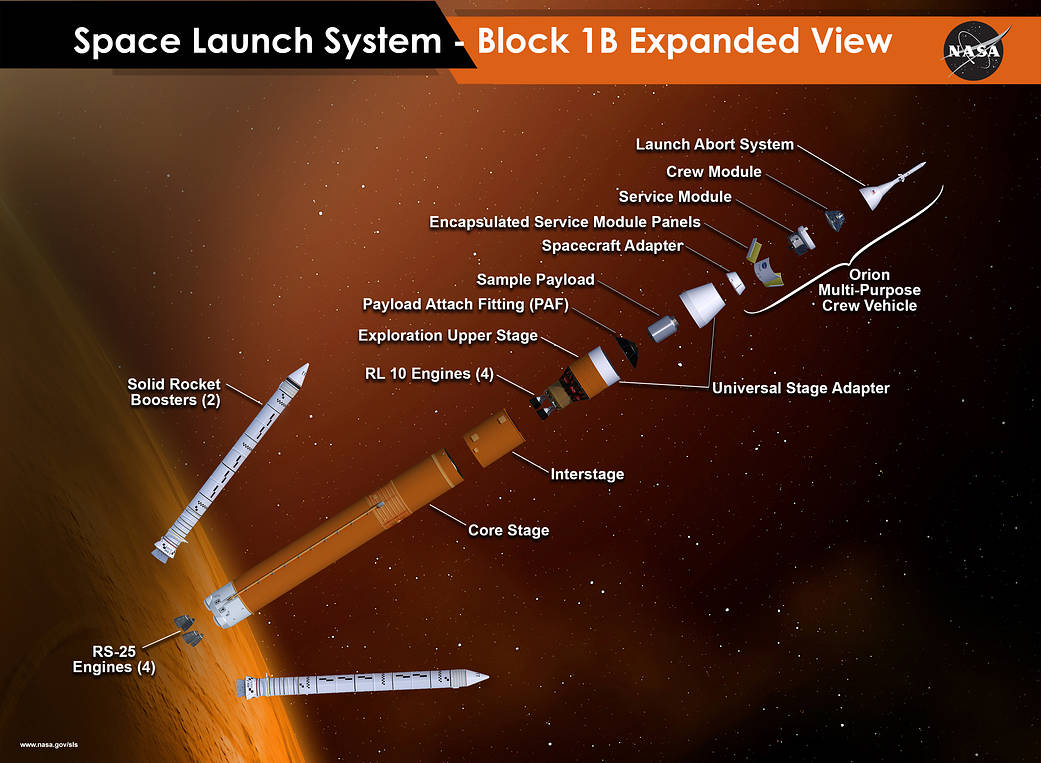
This graphic shows an expanded view of the larger and power powerful version of SLS, known as Block 1B. It can send a crew and large pieces of hardware to the Moon in a single launch and is set to debut for the Artemis IV mission.
NASA
Early manufacturing is already underway at NASA’s Michoud Assembly Facility, while preparations for the green run test series for its upgraded upper stage are in progress at nearby Stennis Space Center. NASA’s Marshall Space Flight Center manages the SLS Program and Michoud.
While using the same basic core stage and solid rocket booster design, and related components as the Block 1, Block 1B features two big evolutionary changes that will make NASA’s workhorse rocket even more capable for future missions to the Moon and beyond. A more powerful second stage and an adapter for large cargos will expand the possibilities for future Artemis missions.
“The Space Launch System Block 1B rocket will be the primary transportation for astronauts to the Moon for years to come,” said James Burnum, deputy manager of the NASA Block 1B Development Office. “We are building on the SLS Block 1 design, testing, and flight experience to develop safe, reliable transportation that will send bigger and heavier hardware to the Moon in a single launch than existing rockets.”
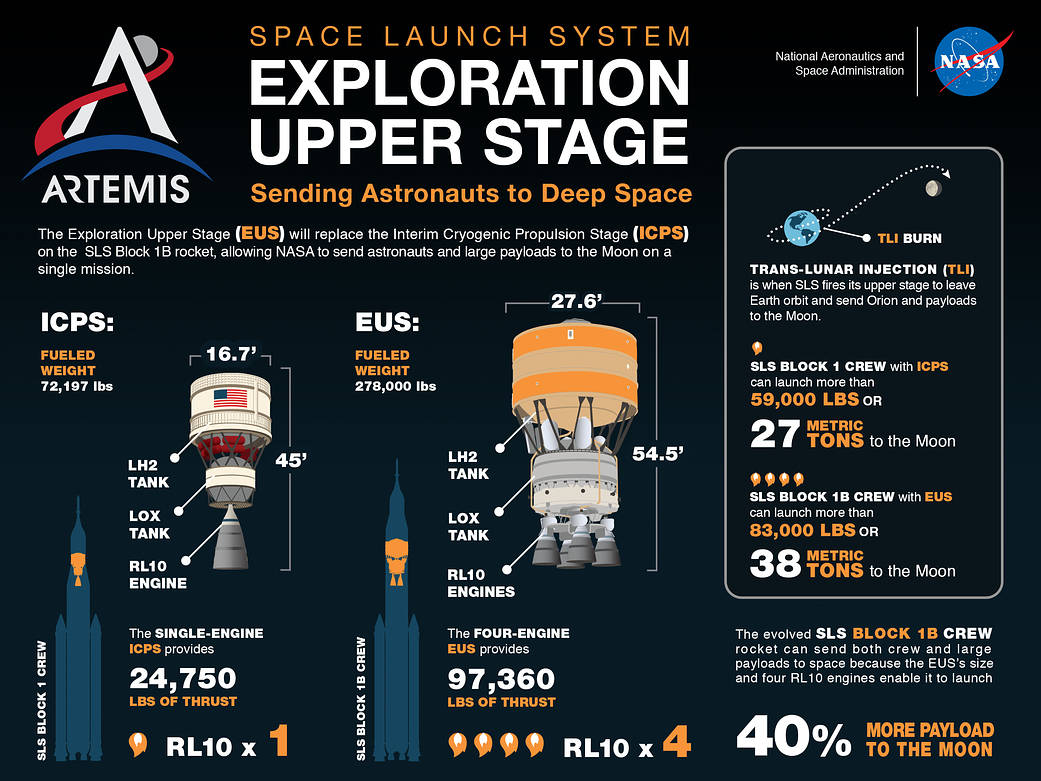
This graphic shows some of the benefits of the exploration upper stage, which will replace the interim cryogenic propulsion stage on the SLS Block 1B rocket.
NASA
The in-space stage used to send the first three Artemis missions to the Moon, called the interim cryogenic propulsion stage, uses a single engine and will be replaced by a larger, more powerful four-engine stage called the exploration upper stage. A different battery is among the many changes that will allow the exploration upper stage to support the first eight hours of the mission following launch compared to the current interim cryogenic propulsion stage two hours. All new hardware and software will be designed and tested to meet the different performance and environmental requirements.
The other configuration change is a universal stage adapter that connects the rocket to the Orion spacecraft. It also offers more than 10,000 cubic feet of space to carry large components, such as modules for NASA’s future Gateway outpost that will be in lunar orbit to support crew between surface missions and unique opportunities for science at the Moon.
Together, those upgrades will increase the payload capability for SLS from 59,000 pounds to approximately 84,000 pounds. The four RL10 engines that will be used during the exploration upper stage green run test series at Stennis are complete, and work on the Artemis IV core stage is in progress at nearby Michoud.
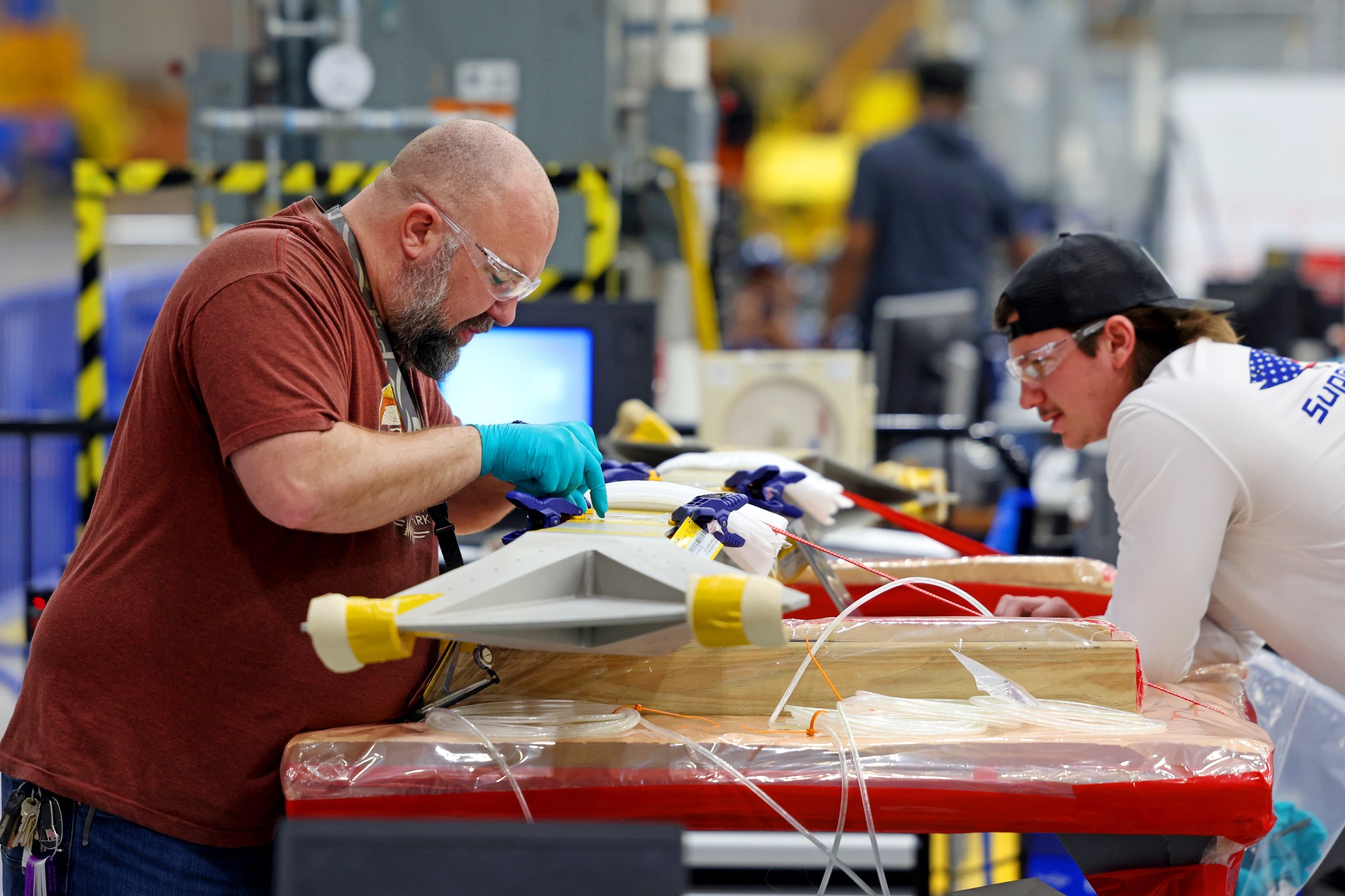
Technicians at NASA’s Michoud Assembly Facility on Feb. 22 prepare elements that will form part of the midbody for the exploration upper stage. The midbody struts, or V-struts, will create the cage-like outer structure of the midbody that will connect the upper stage’s large liquid hydrogen tank to the smaller liquid oxygen tank.
NASA
The evolved design also gives astronaut explorers more launch opportunities on a path to intercept the Moon. With four times the engines and almost four times the propellant and thrust of interim cryogenic propulsion stage, the exploration upper stage also enables two daily launch opportunities compared to Block 1’s more limited lunar launch availability.
Among other capabilities, both astronauts and ground teams will be able to communicate with the in-space stage and safely control it while using Orion’s docking system to extract components destined for Gateway from the stage adapter.
NASA is working to land the first woman, first person of color, and its first international partner astronaut on the Moon under Artemis. SLS is part of NASA’s backbone for deep space exploration, along with Orion and the Gateway in orbit around the Moon and commercial human landing systems, next-generation spacesuits, and rovers on the lunar surface. SLS is the only rocket that can send Orion, astronauts, and supplies to the Moon in a single launch.
Burkey, a Media Fusion employee, is a technical writer supporting the SLS Program.
NASA Continues Artemis Moon Rocket Engine Test Series
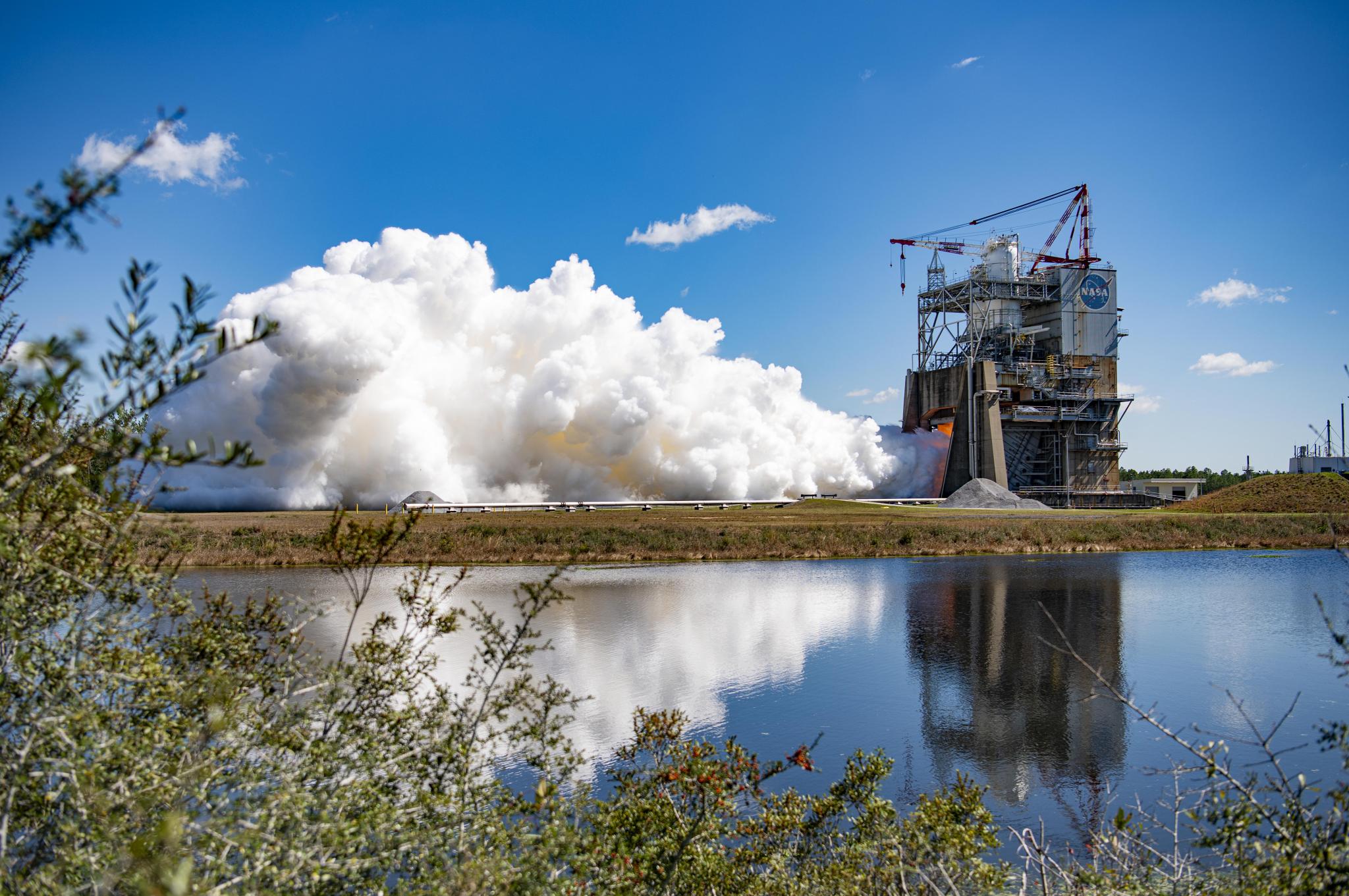
NASA conducted a full-duration RS-25 engine hot fire March 6, continuing a final round of certification testing for production of new engines to help power the SLS (Space Launch System) rocket on future Artemis missions to the Moon and beyond.
The full-duration test on the Fred Haise Test Stand at NASA’s Stennis Space Center, marked the ninth in a scheduled 12-test series. NASA astronauts and Artemis II crew members Reid Wiseman, commander, and Christina Koch, mission specialist, attended the test.
NASA conducts a full-duration RS-25 engine hot fire March 6 at the agency’s Stennis Space Center.
NASA/Danny Nowlin
Engineers are collecting test data to certify an updated engine production process, using innovative manufacturing techniques, for lead engines contractor Aerojet Rocketdyne, an L3Harris Technologies company.
During the March 6 test, operators fired the certification engine for 10 minutes (600 seconds), longer than the amount of time needed to help launch the SLS rocket and send astronauts aboard the Orion spacecraft into orbit. The test team also fired the engine at power levels between 80% and 113% to test performance in multiple scenarios. Four RS-25 engines, along with a pair of solid rocket boosters, launch NASA’s powerful SLS rocket, producing more than 8.8 million pounds of thrust at liftoff for Artemis missions.
While clear skies were over Stennis Space Center on March 6, two special guests experienced a brief “rain shower” from water vapor produced during the RS-25 hot fire test on the Fred Haise Test Stand. NASA astronauts Reid Wiseman and Christina Koch – both of whom will fly around the Moon as Artemis II crew members – were hosted by Acting Center Director John Bailey and Engineering & Test Directorate Director Joe Schuyler to view the test and meet the test team. (NASA)
NASA is working to land the first woman, first person of color, and its first international partner astronaut on the Moon under Artemis. SLS is part of NASA’s backbone for deep space exploration, along with the Orion spacecraft and Gateway in orbit around the Moon and commercial human landing systems, next-generational spacesuits, and rovers on the lunar surface. SLS is the only rocket that can send Orion, astronauts, and supplies to the Moon in a single launch.
NASA’s Marshall Space Flight Center manages the SLS and human landing system programs.
RS-25 tests at NASA Stennis are conducted by a diverse team of operators from NASA, Aerojet Rocketdyne, and Syncom Space Services, prime contractor for site facilities and operations.
Splashdown! NASA’s SpaceX Crew-7 Finishes Mission, Returns to Earth
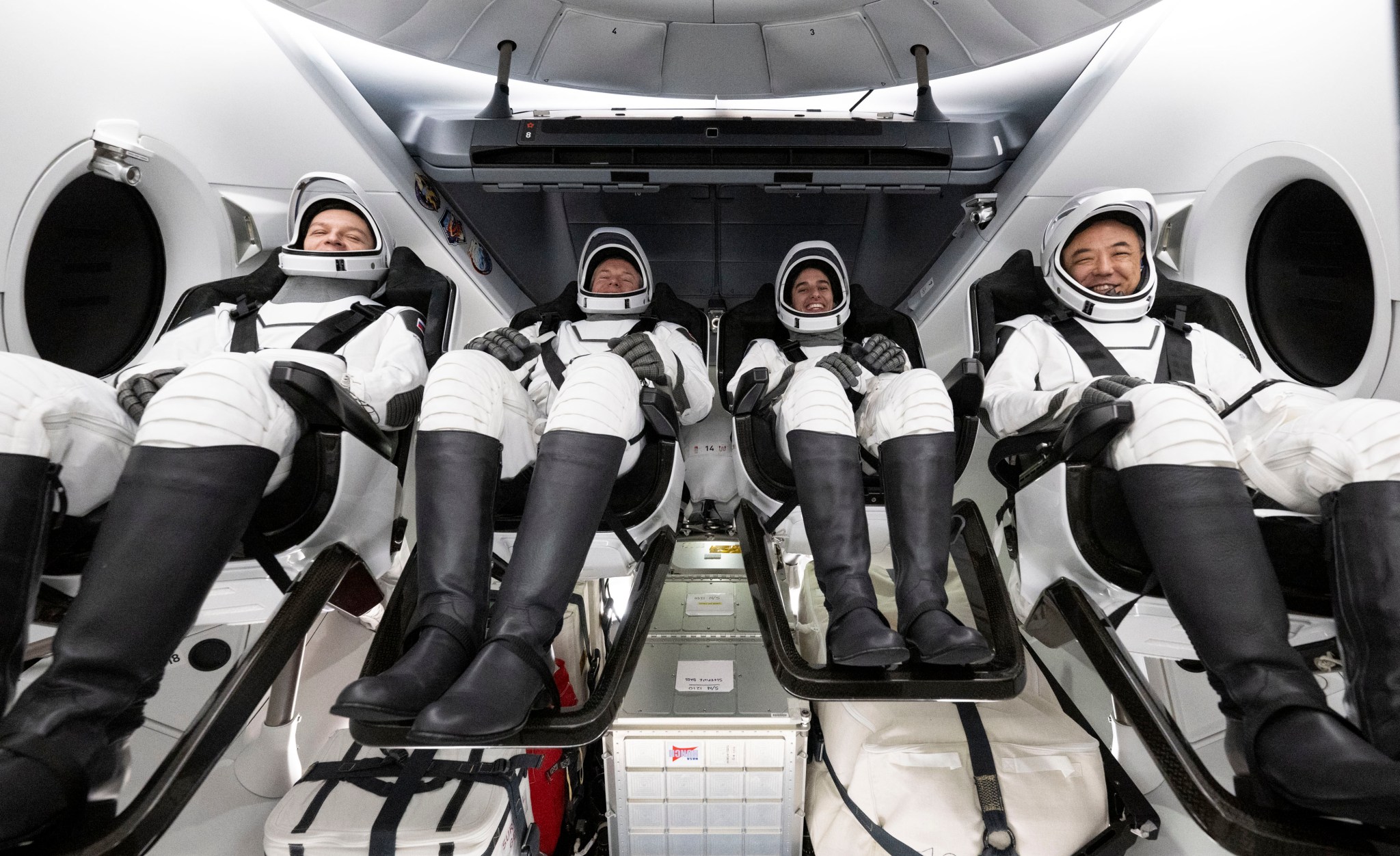
NASA’s SpaceX Crew-7 completed the agency’s seventh commercial crew rotation mission to the International Space Station on March 12 after splashing down safely in a Dragon spacecraft off the coast of Pensacola, Florida. The international crew of four spent 199 days in orbit.
NASA astronaut Jasmin Moghbeli, ESA (European Space Agency) astronaut Andreas Mogensen, JAXA (Japan Aerospace Exploration Agency) astronaut Satoshi Furukawa, and Roscosmos cosmonaut Konstantin Borisov returned to Earth splashing down at 4:47 a.m. CDT. Teams aboard SpaceX recovery vessels retrieved the spacecraft and its crew. After returning to shore, the crew was flown to NASA’s Johnson Space Center.
Roscosmos cosmonaut Konstantin Borisov, left, European Space Agency astronaut Andreas Mogensen, NASA astronaut Jasmin Moghbeli, and Japan Aerospace Exploration Agency astronaut Satoshi Furukawa are seen inside the SpaceX Dragon Endurance spacecraft onboard the SpaceX recovery ship MEGAN shortly after having landed in the Gulf of Mexico off the coast of Pensacola, Florida, March 12. Moghbeli, Mogensen, Furukawa, and Borisov are returning after nearly six months in space as part of Expedition 70 aboard the International Space Station.
NASA/Joel Kowsky
“After more than six months aboard the International Space Station, NASA’s SpaceX Crew-7 has safely returned home,” said NASA Administrator Bill Nelson. “This international crew showed that space unites us all. It’s clear that we can do more – we can learn more – when we work together. The science experiments conducted during their time in space will help prepare for NASA’s bold missions at the Moon, Mars, and beyond, all while benefitting humanity here on Earth.”
The Crew-7 mission lifted off at 2:27 a.m. Aug. 26, 2023, on a Falcon 9 rocket from NASA’s Kennedy Space Center. About 30 hours later, Dragon docked to the Harmony module’s space-facing port. Crew-7 undocked at 10:20 a.m. March 11 to begin the trip home.
Moghbeli, Mogensen, Furukawa, and Borisov traveled 84,434,094 miles during their mission, spent 197 days aboard the space station, and completed 3,184 orbits around Earth. The Crew-7 mission was the first spaceflight for Moghbeli and Borisov. Mogensen has logged 209 days in space over his two flights, and Furukawa has logged 366 days in space over his two flights.
Throughout their mission, the Crew-7 members contributed to a host of science and maintenance activities and technology demonstrations. Moghbeli conducted one spacewalk, joined by NASA astronaut Loral O’Hara, replacing one of the 12 trundle bearing assemblies on the port solar alpha rotary joint, which allows the arrays to track the Sun and generate electricity to power the station.
The crew contributed to hundreds of experiments and technology demonstrations, including the first study of human response to different spaceflight durations, and an experiment growing food on the space station.
This was the third flight of the Dragon spacecraft, named Endurance. It also previously supported the Crew-3 and Crew-5 missions. The spacecraft will return to Florida for inspection and processing at SpaceX’s refurbishing facility at Cape Canaveral Space Force Station, where teams will inspect the Dragon, analyze data on its performance, and process it for its next flight.
The Crew-7 flight is part of NASA’s Commercial Crew Program and its return to Earth follows on the heels of NASA’s SpaceX Crew-8 launch, which docked to the station March 5, beginning another science expedition.
The goal of NASA’s Commercial Crew Program is safe, reliable, and cost-effective transportation to and from the space station and low Earth orbit. This already is providing additional research time and has increased the opportunity for discovery aboard humanity’s microgravity testbed for exploration, including helping NASA prepare for human exploration of the Moon and Mars.
The HOSC (Huntsville Operations Support Center) at NASA’s Marshall Space Flight Center provides engineering and mission operations support for the space station, the Commercial Crew Program, and Artemis missions, as well as science and technology demonstration missions. The Payload Operations Integration Center within the HOSC operates, plans, and coordinates the science experiments onboard the space station 365 days a year, 24 hours a day.
When you are trying to solve one of the biggest conundrums in cosmology, you should triple check your homework. The puzzle, called the “Hubble Tension,” is that the current rate of the expansion of the universe is faster than what astronomers expect it to be, based on the universe’s initial conditions and our present understanding of the universe’s evolution.
Scientists using NASA’s Hubble Space Telescope and many other telescopes consistently find a number that does not match predictions based on observations from ESA’s (European Space Agency’s) Planck mission. Does resolving this discrepancy require new physics? Or is it a result of measurement errors between the two different methods used to determine the rate of expansion of space?
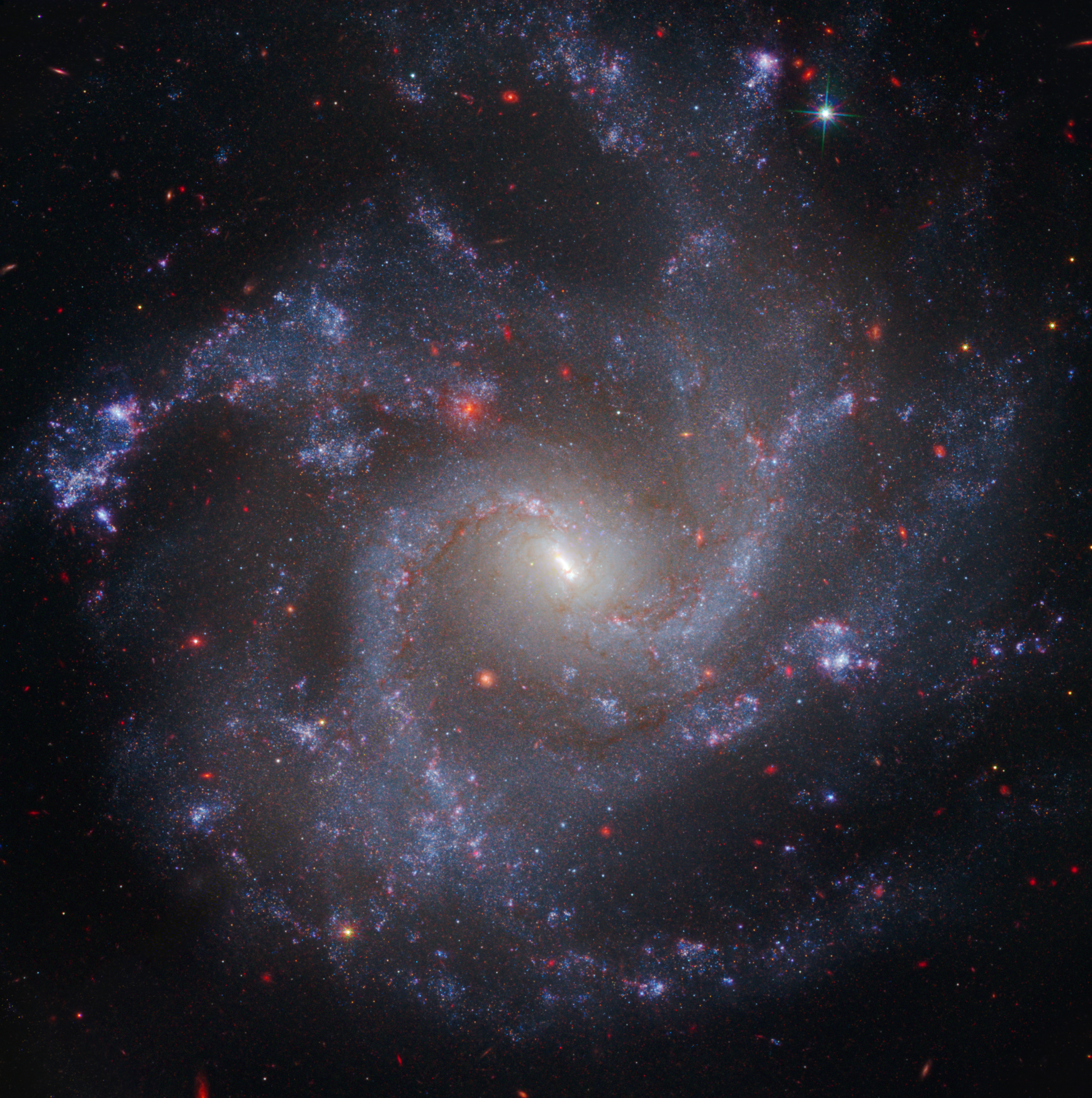
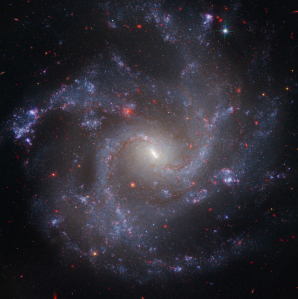
This image of NGC 5468, a galaxy located about 130 million light-years from Earth, combines data from the Hubble and James Webb space telescopes. This is the farthest galaxy in which Hubble has identified Cepheid variable stars. These are important milepost markers for measuring the expansion rate of the universe. The distance calculated from Cepheids has been cross-correlated with a type Ia supernova in the galaxy. Type Ia supernovae are so bright they are used to measure cosmic distances far beyond the range of the Cepheids, extending measurements of the universe’s expansion rate deeper into space.
NASA
Hubble has been measuring the current rate of the universe’s expansion for 30 years, and astronomers want to eliminate any lingering doubt about its accuracy. Now, Hubble and NASA’s James Webb Space Telescope have tag-teamed to produce definitive measurements, furthering the case that something else – not measurement errors – is influencing the expansion rate.
“With measurement errors negated, what remains is the real and exciting possibility we have misunderstood the universe,” said Adam Riess, a physicist at Johns Hopkins University in Baltimore. Riess holds a Nobel Prize for co-discovering the fact that the universe’s expansion is accelerating, due to a mysterious phenomenon now called “dark energy.”
As a crosscheck, an initial Webb observation in 2023 confirmed that Hubble measurements of the expanding universe were accurate. However, hoping to relieve the Hubble Tension, some scientists speculated that unseen errors in the measurement may grow and become visible as we look deeper into the universe. Stellar crowding could affect brightness measurements of more distant stars in a systematic way.
The Supernova H0 for the Equation of State of Dark Energy (SH0ES) team, led by Riess, obtained additional observations with Webb of objects that are critical cosmic milepost markers, known as Cepheid variable stars, which now can be correlated with the Hubble data.
“We’ve now spanned the whole range of what Hubble observed, and we can rule out a measurement error as the cause of the Hubble Tension with very high confidence,” Riess said.
The team’s first few Webb observations in 2023 were successful in showing Hubble was on the right track in firmly establishing the fidelity of the first rungs of the so-called cosmic distance ladder.
Astronomers use various methods to measure relative distances in the universe, depending upon the object being observed. Collectively these techniques are known as the cosmic distance ladder – each rung or measurement technique relies upon the previous step for calibration.
But some astronomers suggested that, moving outward along the “second rung,” the cosmic distance ladder might get shaky if the Cepheid measurements become less accurate with distance. Such inaccuracies could occur because the light of a Cepheid could blend with that of an adjacent star – an effect that could become more pronounced with distance as stars crowd together and become harder to distinguish from one another.
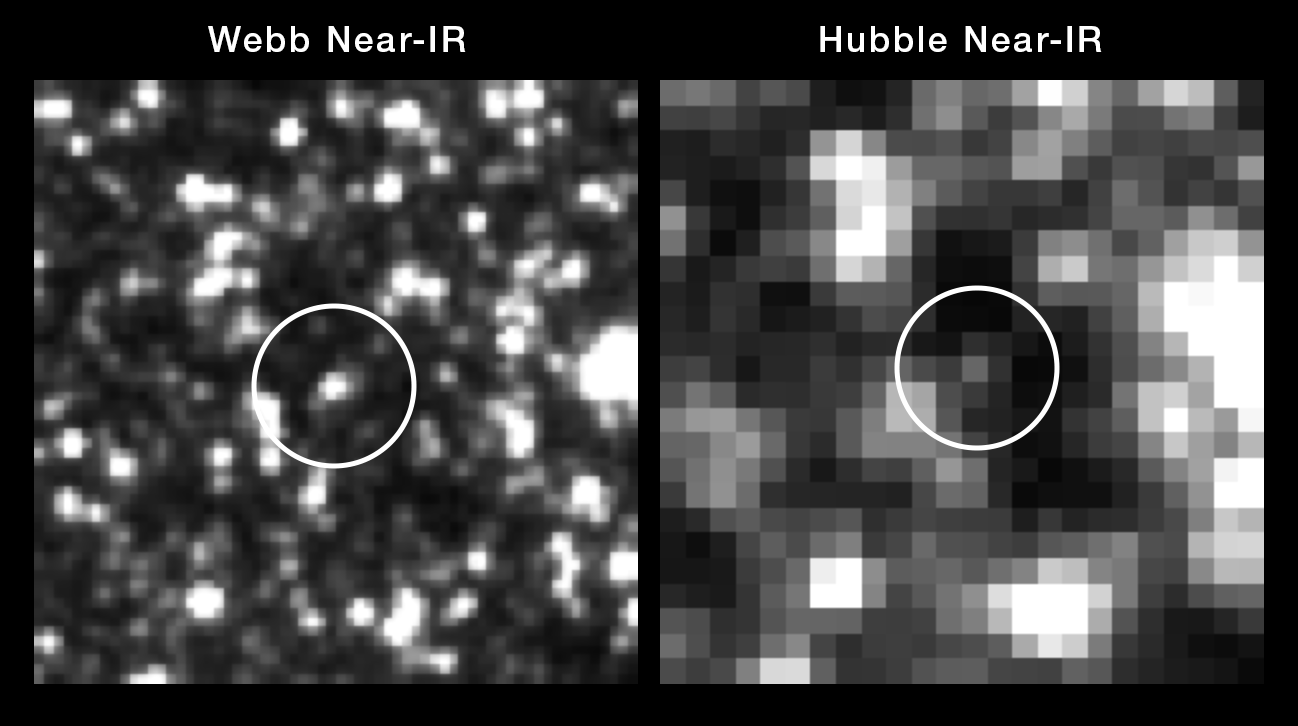
At the center of these side-by-side images is a special class of star used as a milepost marker for measuring the universe’s rate of expansion – a Cepheid variable star. The two images are very pixelated because they are a very zoomed-in view of a distant galaxy. Each of the pixels represents one or more stars. The image from the James Webb Space Telescope is significantly sharper at near-infrared wavelengths than Hubble, which is primarily a visible-ultraviolet light telescope. By reducing the clutter with Webb’s crisper vision, the Cepheid stands out more clearly, eliminating any potential confusion.
NASA, ESA, CSA, STScI, Adam G. Riess (JHU, STScI
The observational challenge is that past Hubble images of these more distant Cepheid variables look more huddled and overlapping with neighboring stars at ever farther distances between us and their host galaxies, requiring careful accounting for this effect. Intervening dust further complicates the certainty of the measurements in visible light. Webb slices though the dust and naturally isolates the Cepheids from neighboring stars because its vision is sharper than Hubble’s at infrared wavelengths.
“Combining Webb and Hubble gives us the best of both worlds. We find that the Hubble measurements remain reliable as we climb farther along the cosmic distance ladder,” Riess said.
The new Webb observations include five host galaxies of eight Type Ia supernovae containing a total of 1,000 Cepheids and reach out to the farthest galaxy where Cepheids have been well measured – NGC 5468 – at a distance of 130 million light-years. “This spans the full range where we made measurements with Hubble. So, we’ve gone to the end of the second rung of the cosmic distance ladder,” said co-author Gagandeep Anand of the Space Telescope Science Institute in Baltimore, which operates the Webb and Hubble telescopes for NASA.
Hubble and Webb’s further confirmation of the Hubble Tension sets up other observatories to possibly settle the mystery. NASA’s upcoming Nancy Grace Roman Space Telescope will do wide celestial surveys to study the influence of dark energy, the mysterious energy that is causing the expansion of the universe to accelerate. ESA’s Euclid observatory, with NASA contributions, is pursuing a similar task.
At present it’s as though the distance ladder observed by Hubble and Webb has firmly set an anchor point on one shoreline of a river, and the afterglow of the big bang observed by Planck’s measurement from the beginning of the universe is set firmly on the other side. How the universe’s expansion was changing in the billions of years between these two endpoints has yet to be directly observed. “We need to find out if we are missing something on how to connect the beginning of the universe and the present day,” Riess said.
These finding were published in the Feb. 6, 2024, issue of The Astrophysical Journal Letters.
The Hubble Space Telescope has been operating for over three decades and continues to make ground-breaking discoveries that shape our fundamental understanding of the universe. Hubble is a project of international cooperation between NASA and ESA. NASA’s Goddard Space Flight Center manages the telescope. Goddard also conducts mission operations with Lockheed Martin Space in Denver, Colorado. The Space Telescope Science Institute (STScI) in Baltimore, Maryland, conducts Hubble and Webb science operations for NASA. The agency’s Marshall Space Flight Center was the lead field center for the design, development, and construction of the space telescope.
The James Webb Space Telescope is the world’s premier space science observatory. Webb is solving mysteries in our solar system, looking beyond to distant worlds around other stars, and probing the mysterious structures and origins of our universe and our place in it. Webb is an international program led by NASA with its partners, ESA (European Space Agency) and the Canadian Space Agency. Several NASA centers contributed to Webb’s development, including Marshall.
NASA Unveils Design for Message Heading to Jupiter’s Moon Europa
Following in NASA’s storied tradition of sending inspirational messages into space, the agency has special plans for Europa Clipper, which later this year will launch toward Jupiter’s moon Europa. The moon shows strong evidence of an ocean under its icy crust, with more than twice the amount of water of all of Earth’s oceans combined. A triangular metal plate on the spacecraft will honor that connection to Earth in several ways.
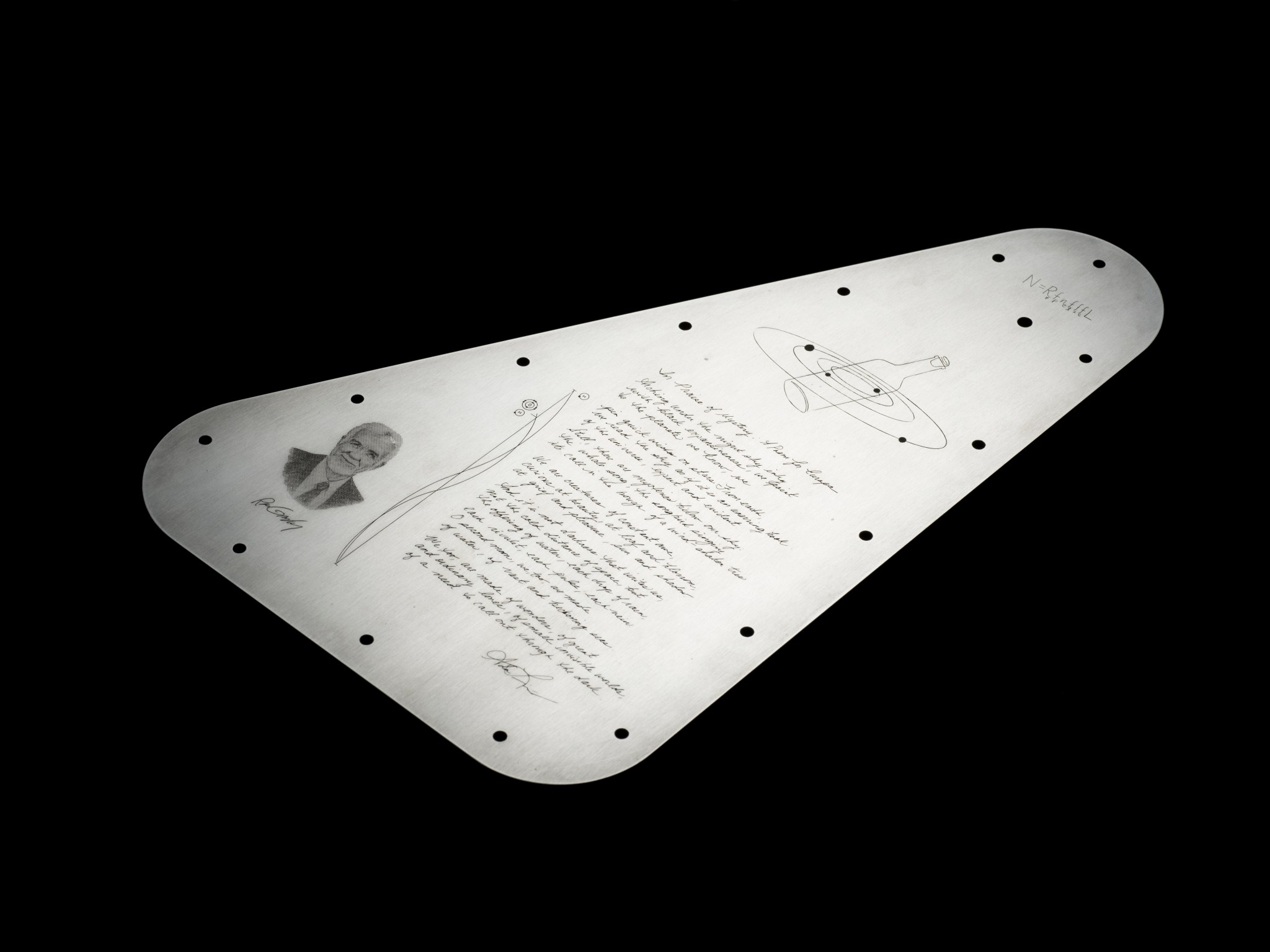
At the heart of the artifact is an engraving of U.S. Poet Laureate Ada Limón’s handwritten “In Praise of Mystery: A Poem for Europa,” along with a silicon microchip stenciled with more than 2.6 million names submitted by the public. The microchip will be the centerpiece of an illustration of a bottle amid the Jovian system – a reference to NASA’s “Message in a Bottle” campaign, which invited the public to send their names with the spacecraft.
This side of a commemorative plate mounted on NASA’s Europa Clipper spacecraft features U.S. Poet Laureate Ada Limón’s handwritten “In Praise of Mystery: A Poem for Europa.” It will be affixed with a silicon microchip stenciled with names submitted by the public.
NASA/JPL-Caltech
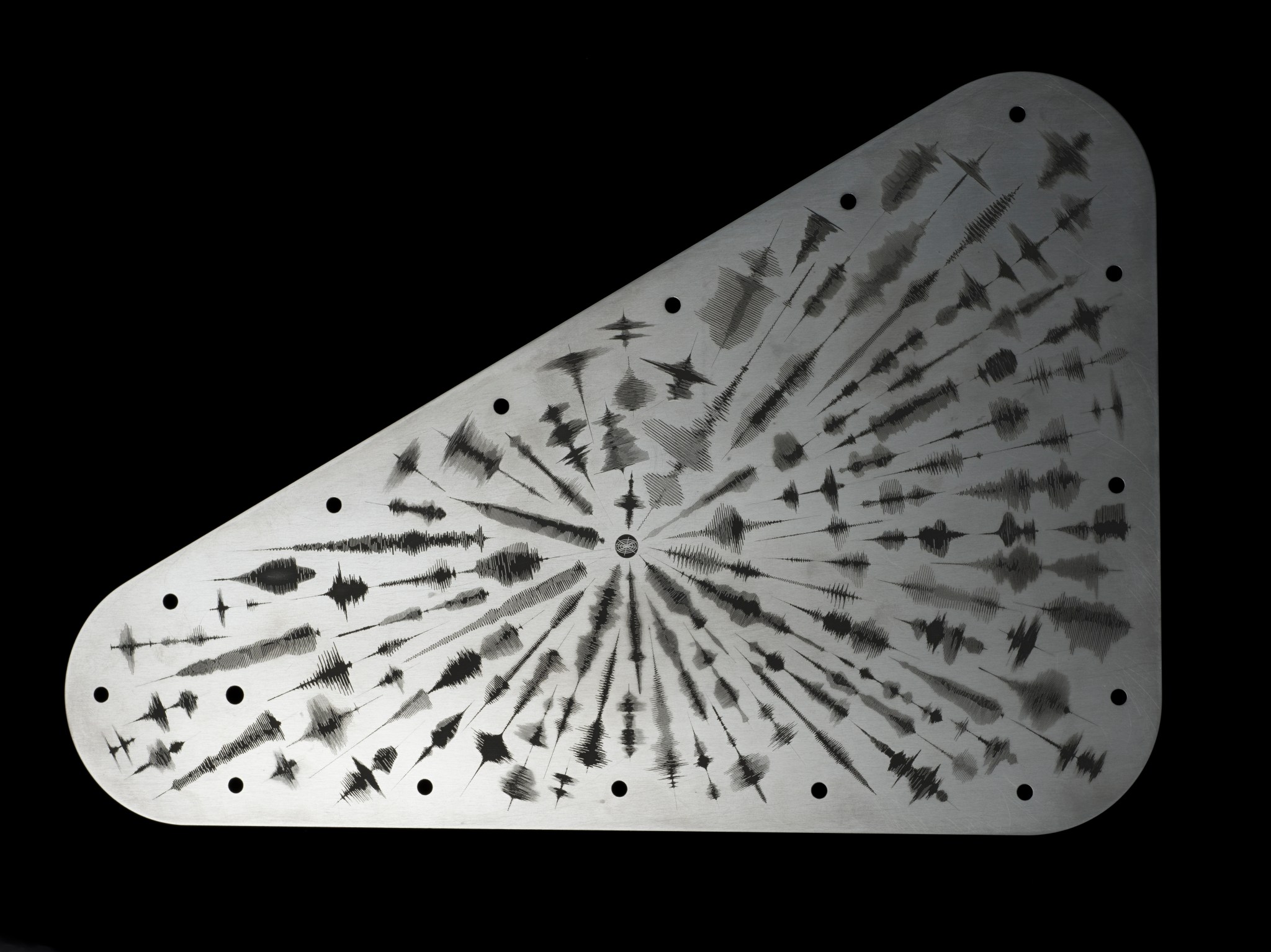
Made of the metal tantalum and about 7 by 11 inches, the plate features graphic elements on both sides. The outward-facing panel features art that highlights Earth’s connection to Europa. Linguists collected recordings of the word “water” spoken in 103 languages, from families of languages around the world. The audio files were converted into waveforms (visual representations of sound waves) and etched into the plate. The waveforms radiate out from a symbol representing the American Sign Language sign for “water.”
To hear audio of the spoken languages and see the sign, go to: go.nasa.gov/MakeWaves.
In the spirit of the Voyager spacecraft’s Golden Record, which carries sounds and images to convey the richness and diversity of life on Earth, the layered message on Europa Clipper aims to spark the imagination and offer a unifying vision.
“The content and design of Europa Clipper’s vault plate are swimming with meaning,” said Lori Glaze, director of the Planetary Science Division at NASA Headquarters. “The plate combines the best humanity has to offer across the universe – science, technology, education, art, and math. The message of connection through water, essential for all forms of life as we know it, perfectly illustrates Earth’s tie to this mysterious ocean world we are setting out to explore.”
In 2030, after a 1.6-billion-mile journey, Europa Clipper will begin orbiting Jupiter, making 49 close flybys of Europa. To determine if there are conditions that could support life, the spacecraft’s powerful suite of science instruments will gather data about the moon’s subsurface ocean, icy crust, thin atmosphere, and space environment. The electronics for those instruments are housed in a massive metal vault designed to protect them from Jupiter’s punishing radiation. The commemorative plate will seal an opening in the vault.
The art on this side of the plate, which will seal an opening of the vault on NASA’s Europa Clipper, features waveforms that are visual representations of the sound waves formed by the word “water” in 103 languages. At center is a symbol representing the American Sign Language sign for “water.”
NASA/JPL-Caltech
Because searching for habitable conditions is central to the mission, the Drake Equation is etched onto the plate as well – on the inward-facing side. Astronomer Frank Drake developed the mathematical formulation in 1961 to estimate the possibility of finding advanced civilizations beyond Earth. The equation has inspired and guided research in astrobiology and related fields ever since.
In addition, artwork on the inward-facing side of the plate will include a reference to the radio frequencies considered plausible for interstellar communication, symbolizing how humanity uses this radio band to listen for messages from the cosmos. These frequencies match the radio waves emitted in space by the components of water and are known by astronomers as the “water hole.” On the plate, they are depicted as radio emission lines.
Finally, the plate includes a portrait of one of the founders of planetary science, Ron Greeley, whose early efforts to develop a Europa mission two decades ago laid the foundation for Europa Clipper.
“We’ve packed a lot of thought and inspiration into this plate design, as we have into this mission itself,” said project scientist Robert Pappalardo of NASA’s Jet Propulsion Laboratory (JPL). “It’s been a decades-long journey, and we can’t wait to see what Europa Clipper shows us at this water world.”
Learn more about how Europa Clipper’s vault plate engravings were designed and the inspiration for the plate’s multilayered message. (NASA/JPL-Caltech)
Once assembly of Europa Clipper has been completed at JPL, the spacecraft will be shipped to NASA’s Kennedy Space Center in preparation for its October launch.
Europa Clipper’s main science goal is to determine whether there are places below Jupiter’s icy moon, Europa, that could support life. The mission’s three main science objectives are to determine the thickness of the moon’s icy shell and its surface interactions with the ocean below, to investigate its composition, and to characterize its geology. The mission’s detailed exploration of Europa will help scientists better understand the astrobiological potential for habitable worlds beyond our planet.
Managed by Caltech in Pasadena, California, JPL leads the development of the Europa Clipper mission in partnership with the Johns Hopkins Applied Physics Laboratory (APL) in Laurel, Maryland, for NASA’s Science Mission Directorate. APL designed the main spacecraft body in collaboration with JPL and NASA’s Goddard Space Flight Center. The Planetary Missions Program Office at NASA’s Marshall Space Flight Center executes program management of the Europa Clipper mission.
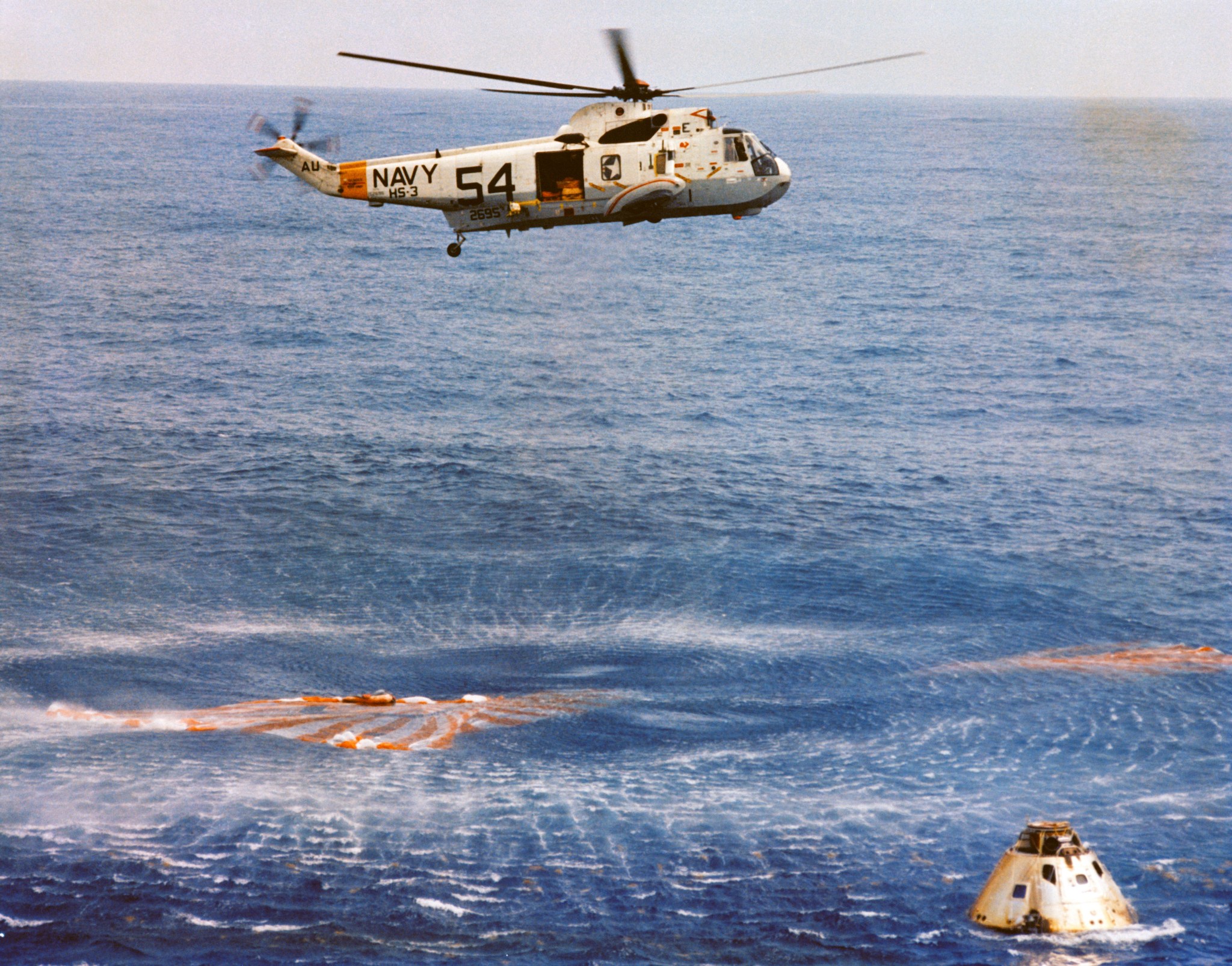
Fifty-five years ago today, NASA astronauts James A. McDivitt, David R. Scott, and Russell L. Schweickart splashed down 4.5 nautical miles from the USS Guadalcanal, concluding a successful 10-day Earth-orbital mission in space. In this image from March 13, 1969, a recovery helicopter hovers above the Apollo 9 spacecraft; the astronauts were still inside the command module.
Apollo 9 was the first crewed flight of the command/service module along with the lunar module. The mission’s three-person crew tested several aspects critical to landing on the Moon including the lunar module’s engines, backpack life support systems, navigation systems, and docking maneuvers.
NASA’s Space Tech Prize Bolsters Diversity, Inclusivity Champions
Credits: NASA
NASA selected the first winners of the agency’s Space Tech Catalyst prize to expand engagement with underrepresented and diverse individuals in the space technology sector as part of the agency’s broader commitment to inclusivity and collaboration. The winners are receiving $25,000 each to create more inclusive space technology ecosystems.
“As NASA continues to explore the unknown, making the impossible possible, we are committed to engaging talents from all backgrounds to advance exploration,” said Shahra Lambert, NASA senior advisor for engagement. “By providing funding to this space technology community, NASA is ensuring the Artemis Generation will have the necessary tools to expand humanity’s reach.”
Winning individuals and organizations demonstrate the best collaboration practices with diverse researchers, technologists, and entrepreneurs. The champions also bring effective strategies that contribute to NASA’s ongoing efforts to develop a representative space technology landscape, while enhancing its ability to find creative solutions to technical challenges.
The winners are:
Caitlin O’Brien, SciAccess, Inc.
Zainab Abbas, SciTech@U
Bahiy Watson, The 1881 Institute
Amber Imai-Hong, Mahina Aerospace
Marta Miletic, San Diego State University
Felecia Brown, NorthStar of GIS
Diego Sandoval, Cyncrocity
Arif Rahman, Hawaii Pacific University
Sierra Brown
Denise Thorsen, University of Alaska Fairbanks
Joshua Neubert, Institute of Competition Sciences
Madison Feehan, Space Copy, Inc.
Johnie Turnage, Black Tech Saturdays
Athip Thirupathi Raj, University of Arizona SpaceTREx Lab
Janeya Griffin, Equity Space Alliance, Inc.
Annika Rollock, Aurelia Institute
M. von Nkosi, Institute for Local Innovations, Inc.
Joseph Grant, New Generation Solutions SST
Sambit Bhattacharya, Fayetteville State University
Dalia David, Honest Eating, LLC
Each winner was selected for proving their ability to engage and develop underrepresented groups in space technology development, broaden NASA’s outreach efforts to diverse sources of developers, and build a community of emerging innovators equipped to compete for the agency’s technology development opportunities.
“We are proud to recognize and celebrate the accomplishments of these exceptional individuals and organizations leading the way in building an inclusive community in space technology for the benefit of humanity,” said Denna Lambert, inclusive innovation team lead, Space Technology Mission Directorate (STMD) at NASA Headquarters in Washington. “Their dedication and success in engaging underrepresented groups will undoubtedly inspire others to join us in advancing the frontiers of space exploration and innovation.”
To increase collaboration between NASA and its community partners, each winner will attend an in-person event at NASA’s Goddard Space Flight Center in Greenbelt, Maryland. Representatives from NASA and the winning organizations will participate in community-building activities to emphasize knowledge sharing, increase awareness of NASA’s competitive research and development environment, and expand the agency’s reach into diverse innovator communities.
The Space Tech Catalyst Prize, funded by STMD, is part of a commitment to expand NASA’s network of competitive proposers and enhance engagement approaches.
The awardees were recognized during NASA’s Technology Development Plan plenary session at the 55th Lunar and Planetary Science Conference (LPSC) March 13, in The Woodlands, Texas.
“Supporting innovation and research in science and technology is a central part of NASA’s overall mission,” said Joel Kearns, deputy associate administrator for exploration in NASA’s Science Mission Directorate in Washington. “These tools must demonstrate new technologies that significantly improve instrument measurement capabilities for addressing high-priority lunar science questions.”
The goal of DALI is to develop and demonstrate instruments that show promise for use in future NASA flight opportunities. In addition, the instruments are intended to be ready for flight hardware build after the three-year project duration. Each of the selected scientists is granted approximately $1 million per year to develop their instrument.
The grantees are based at institutions across the country:
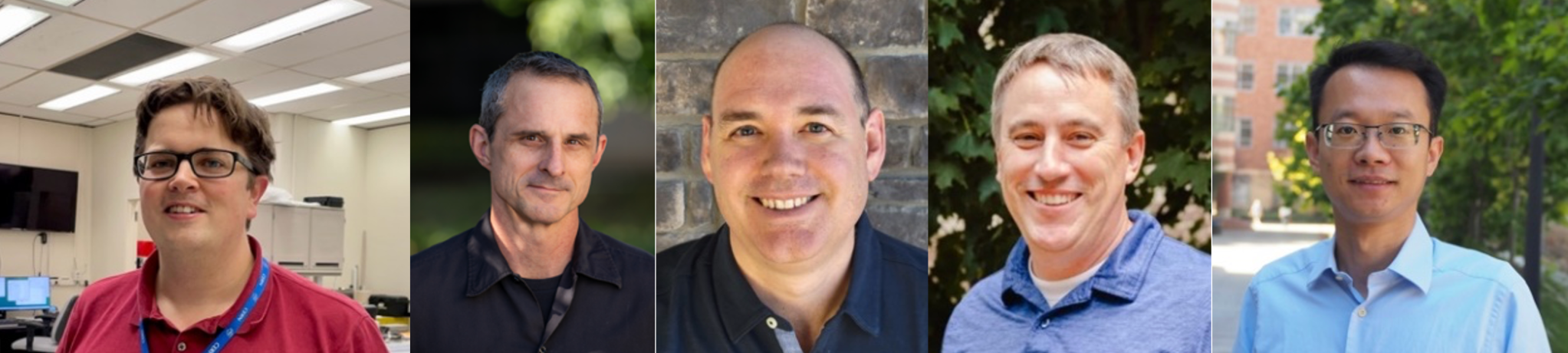
DALI grantees: Stuart George, Jason Kriesel, David Stillman, Jeffrey Gillis-Davis, Hao Cao
DALI grantees: Stuart George, Jason Kriesel, David Stillman, Jeffrey Gillis-Davis, Hao Cao
Stuart George, NASA’s Johnson Space Center in Houston
In this project, Dr. George will develop the Compact Electron Proton Spectrometer (CEPS), a miniaturized space weather and radiation measurement instrument. CEPS will provide long-term, science-quality space environment monitoring specifically targeted at real time forecasting of solar energetic particle events on the lunar surface, as well as radiation monitoring data for crew health and protection. A particular focus of the CEPS instrument is saturation-free measurement of the largest and most extreme solar particle events and high quality discrimination of proton and electron signals.
Jason Kriesel, Opto- Knowledge Systems, Inc (OKSI) in Torrance, California
Jason Kriesel, of OKSI, is teaming with Honeybee Robotics and NASA’s Goddard Space Flight Center in Greenbelt, Maryland, to produce a prototype instrument to measure lunar water and other volatiles on the Moon. The instrument will be designed to help answer important specific questions related to the origin, history, and future of water on the Moon, as well as help better understand planetary processes in general. The project will push forward a novel measurement approach using a hollow fiber optic gas cell, called a capillary absorption spectrometer (CAS). The CAS will be paired with a sample handling system optimized for analysis on the Moon. The resulting Lunar CAS (LuCAS) prototype will prove the technology on Earth, paving the way for its use on the Moon.
David Stillman, Southwest Research Institute (SwRI) in Boulder, Colorado
The focus of Dr. Stillman’s project is the Synthetic Pulse Artemis Radar for Crustal Imaging (SPARCI; pronounced “sparky”), a novel ground penetrating radar (GPR). SPARCI uses two stationary transmitting antennas and a mobile receiver. This geometry was pioneered by the Apollo 17 Surface Electrical Properties (SEP) experiment. As a robotic or crewed rover traverses away from the transmitter, images of subsurface interfaces or discontinuities are built up. SPARCI uses a much wider bandwidth than the SEP, enabling both deeper and higher-resolution imaging, and its coded signals provide higher signal-to-noise. SPARCI will determine the thickness and density of the regolith (~10 meters), the structure of the upper megaregolith (100s m to kms), and the depth to the lower megaregolith (several km). SPARCI is therefore designed to advance our understanding of impact processes and crustal stratigraphy at the Artemis landing site(s), and eventually elsewhere on the Moon or other planets.
Jeffrey Gillis-Davis, Washington University in St. Louis, Missouri
Dr. Gillis-Davis will lead the effort to develop an instrument to measure the chemistry of lunar materials using Laser-Induced Breakdown Spectroscopy (LIBS). Compositional information acquired by LIBS will help identify major lunar rock types as well as determine major element ice compositions, which relate to volatile sources. Knowledge about the chemical composition of these materials is of fundamental importance in lunar science. For instance, determining the proportions of different lunar rock types at exploration sites satisfies key goals of NASA and the lunar community. Further, measurements by this instrument are essential for figuring out how much water or other resources are present in a particular location on the Moon and could provide a necessary step toward better understanding water delivery to the Earth-Moon system. This LIBS system would incorporate cutting-edge technologies while reducing size, weight, and power relative to other LIBS systems.
Hao Cao, University of California, Los Angeles
In this project, Dr. Cao and team will be developing a miniaturized, low-power, ultra-stable fluxgate magnetometer system for prolonged, uninterrupted operation on the lunar surface. The system incorporates a low-power, magnetically-clean thermal solution to achieve a temperature stability of 0.2 degrees Celsius at two distinct set-point temperatures, one for the lunar day and the other for the lunar night, to minimize fluxgate sensor offset drifts. This instrument will facilitate high-precision monitoring of the lunar magnetic fields across different timescales, enabling survey of the lunar surface magnetic environment and low-frequency electromagnetic sounding of the lunar deep interior. These measurements will provide invaluable insights into the bulk water content of the lunar mantle, characteristics of the partial melt layer above the lunar core, and the physical properties of the iron core of the Moon; thus, placing critical constraints on the formation and evolution of the Earth-Moon system.
The deadline for NASA’s DALI24 Step-1 submissions is April 12, 2024.
DALI is part of NASA’s Lunar Discovery and Exploration Program (LDEP), which is managed by Science Mission Directorate’s Exploration Science Strategy and Integration Office (ESSIO). ESSIO ensures science is infused into all aspects of lunar exploration and leads lunar science integration within the Science Mission Directorate, with other NASA mission directorates, other government agencies, international partners, and commercial communities.
For more information about NASA’s Exploration Science Strategy Integration Office (ESSIO), visit: