Dragon’s Return to Earth Delayed, Crew Moves on to Research

Dragon’s Return to Earth Delayed, Crew Moves on to Research

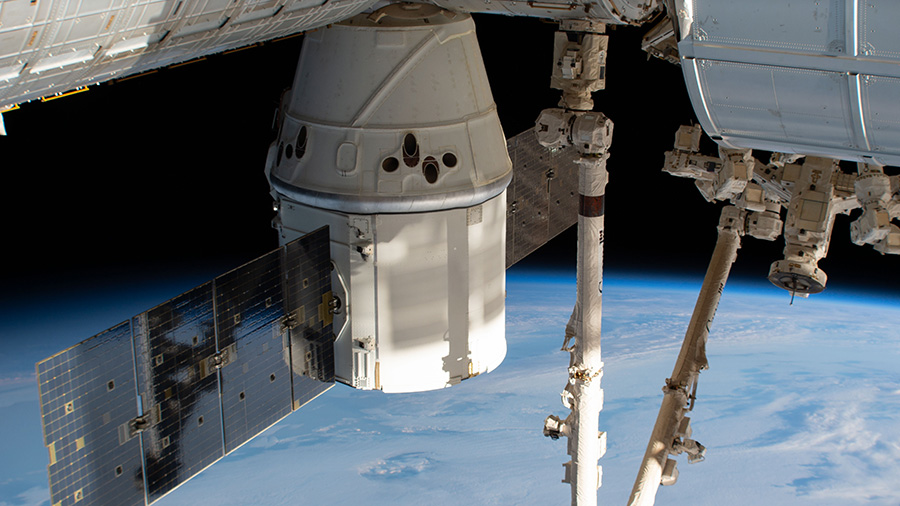
The SpaceX Dragon above Alaska's Aleutian Islands in the Bering Sea
The SpaceX Dragon cargo craft is pictured attached to the International Space Station’s Harmony module as the orbital complex flew 256 miles above Alaska’s Aleutian Islands in the Bering Sea.

The SpaceX Dragon cargo craft had its stay extended at the International Space Station a few more days. Mission managers observed inclement weather at Dragon’s splashdown site in the Pacific Ocean and decided against Dragon’s return to Earth today.

Meanwhile, Dragon’s hatch remains open and the Expedition 58 crew is tending to time-sensitive experiments targeted for return and analysis back on Earth. The Canadarm2 robotic arm has the Dragon firmly in its grips while the cargo vehicle is still attached to the Harmony module.

Robotics controllers will command the Canadarm2 to uninstall Dragon from Harmony on Saturday afternoon then slowly maneuver the U.S. space freighter to its release position. The Canadarm2 will then be commanded to release Dragon Sunday at 3:36 a.m. EDT as astronaut Anne McClain monitors from the cupola. NASA TV will broadcast the departure live without commentary starting Sunday at 3:15 a.m.

Today, the three space station residents are back on science and maintenance duties with Dragon poised for a weekend departure. McClain of NASA is checking out and preserving the space research meant for return inside Dragon.

Flight Engineer David Saint-Jacques of the Canadian Space Agency assisted McClain first thing Thursday morning. He then moved on to the Vascular Echo study scanning his leg’s femoral artery with an ultrasound device to understand how living in space affects the cardiovascular system.

Cosmonaut Oleg Kononenko explored ways to improve piloting techniques in space and participated in a psychological assessment. The four-time station resident also maintained Russian life support systems aboard the orbital lab.

Back on Earth, NASA and SpaceX are continuing to work on the activities leading toward the Demo-1, uncrewed flight test to the International Space Station. NASA and SpaceX are now targeting no earlier than February for the launch of Demo-1 to complete hardware testing and joint reviews. NASA and SpaceX will confirm a new target date after coordination with the Eastern Range and the International Space Station Program.

Get The Details…

Mark Garcia

UWE-4 CubeSat frequency change request approved

UWE-4 CubeSat frequency change request approved

After two weeks in orbit, UWE-4 is in very good shape. The batteries are fully charged, the temperatures of the batteries, the outside panels and the MCU are all lying in the expected range.

The temperatures of the outside Panels of UWE‑4 on the first day after launch

The temperatures of the outside Panels of UWE‑4 on the first day after launch

UWE-4 battery temperatures and State-of-charge on the first day after launch

UWE-4 battery temperatures and State-of-charge on the first day after launch

It can be seen, that the battery temperatures are slightly rising around 8:45 am, when the downlink of this measurement took place.

After the early orbit phase, we are looking forward to some interesting experiments with the attitude determination sensors and the propulsion system.

UWE-4 LogoUnfortunately, our uplink success rate is very poor, which currently prevents these experiments. In the precursor mission UWE-3, it was found that the reason for this is very likely a substantial noise floor at the used frequency range. For this reason, we filed a request for the change of our radio frequency to 435.600 MHz with IARU, which has already been approved.
Today, we will start the procedure to change the frequency of UWE‑4. So if you want to track UWE-4, please adjust your center frequency accordingly. We already started the procedure to change the frequency on UWE‑4, so during the next days it may happen that you can also still receive a signal on our old frequency. Additionally, we have been assigned NORAD ID 43880 in the meantime.

A tool in order to upload the received UWE-4 telemetry directly into our groundstation database is at the moment work in progress and will be shared with you as soon as we have tested it thoroughly. Until then, we would be very grateful, if you’d forward your UWE-4 telemetry files to uwe4@informatik.uni-wuerzburg.de.

Kind regards,

The UWE‑4 Team

Get The Details…

m5aka

AMSAT-UK

Astronauts and Robotics Experts Finalize Dragon Departure Work

Astronauts and Robotics Experts Finalize Dragon Departure Work

The SpaceX Dragon and Station above the Indian Ocean
The SpaceX Dragon cargo craft is pictured attached to the International Space Station’s Harmony module as the orbital complex orbited 261 miles above the Indian Ocean southeast of the continent of Africa. The Canadarm2 robotic arm vertically splits the frame prior to grappling the spacecraft ahead of planned departure activities.

The three Expedition 58 crew members have finished packing the SpaceX Dragon cargo craft with science experiments and hardware today. Final preparations for the vehicle’s departure are now on hold while teams wait for favorable weather in the splashdown area for Dragon’s return.

Dragon was scheduled for departure early Thursday morning from the International Space Station but mission managers made the decision to delay departure. Managers are assessing the backup release date of Sunday, Jan. 13 for Dragon’s return to Earth.

Robotics controllers maneuvered the Canadarm2 robotic arm Wednesday and grappled Dragon while it was still attached to the Harmony module. Prior to Dragon departure, they will remotely uninstall Dragon from Harmony and slowly guide it to its release position.

Astronaut Anne McClain will be in the cupola when robotics experts command the Canadarm2 to release Dragon finalizing its mission at the orbital lab. She’ll monitor its departure while her crewmates Commander Oleg Kononenko and Flight Engineer David Saint-Jacques work on their daily science and maintenance tasks.

Dragon, which arrived at the station Dec. 8, will orbit Earth a few more hours on its own before reentering the atmosphere. It will parachute to a splashdown in the Pacific Ocean off the coast of southern California where SpaceX personnel will retrieve the space freighter. They’ll deliver it to shore where NASA engineers will extract the precious cargo for immediate shipment to investigators around the country for analysis.

Get The Details…

Mark Garcia

Crew Wraps Up Science Packing After Robotic Arm Grips Dragon

Crew Wraps Up Science Packing After Robotic Arm Grips Dragon

The coast of southern California and Baja California
When the SpaceX Dragon cargo craft returns to Earth it will splash down in the Pacific Ocean a few hundred miles off the coast of southern California and Baja California.

The SpaceX Dragon space freighter is in the grips of the Canadarm2 robotic arm today as the Expedition 58 crew wraps up cargo transfers inside the vessel. The space trio is also on lab duty conducting a variety of microgravity research aboard the International Space Station.

Overnight, robotics controllers remotely commanded the Canadarm2 to grapple Dragon before its release from the Harmony module. Meanwhile, the hatches are still open and Flight Engineers Anne McClain and David Saint-Jacques continue loading time-critical space experiments inside the U.S. cargo craft.

The crew will shut the hatch to Dragon Wednesday and disconnect power cables. Then robotics controllers will take over, uninstall Dragon from Harmony overnight and maneuver it into release position. McClain will be in the cupola Thursday monitoring Dragon when it is released from the Canadarm2 around 4:35 a.m. EDT.

After its departure, Dragon will orbit Earth a few more hours before splashing down in the Pacific Ocean off the coast of southern California. SpaceX personnel will retrieve Dragon and return it to port where NASA engineers will extract the precious cargo for immediate shipment to investigators around the country.

Get The Details…

Mark Garcia

Dragon Packed With Science Before Thursday’s Departure

Dragon Packed With Science Before Thursday’s Departure

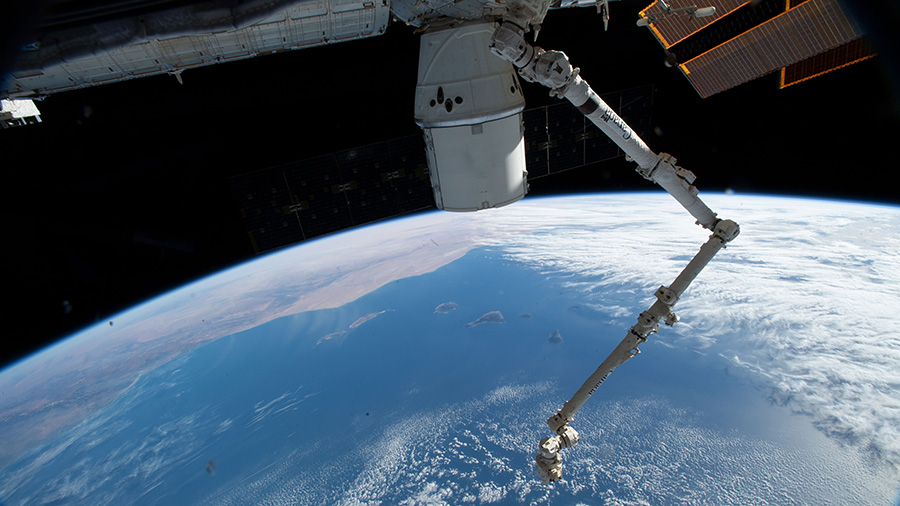
The SpaceX Dragon cargo craft and the Canadarm2 robotic arm
The SpaceX Dragon cargo craft and the Canadarm2 robotic arm are pictured attached to the International Space Station as the orbital complex was 251 miles above the Atlantic Ocean about to fly over Morocco.

The Expedition 58 crew members are packing the SpaceX Dragon space freighter ahead of its return to Earth on Thursday. Ground controllers are also readying communications gear and robotics systems prior to Dragon’s departure from the International Space Station.

Astronauts Anne McClain of NASA and David Saint-Jacques of the Canadian Space Agency are wrapping up final transfers of completed science experiments in Dragon today. The duo is loading science samples from several experiments for return to Earth, where they will quickly be delivered to investigators around the country for analysis.

Engineers on the ground are testing communications and control gear that will be used to monitor and command Dragon after its release from the station. Robotics controllers are also powering up the Canadarm2 robotic arm today to grapple Dragon before its removal from the Harmony module.

Get The Details…

Mark Garcia