Astronauts Gear Up for Spacewalk Amidst Cardiac Research

Astronauts Gear Up for Spacewalk Amidst Cardiac Research

Astronauts Jeanette Epps and Mike Barratt assist astronaut Tracy C. Dyson, all three from NASA, during a spacesuit fit check inside the space station's Quest airlock.
Astronauts Jeanette Epps and Mike Barratt assist astronaut Tracy C. Dyson, all three from NASA, during a spacesuit fit check inside the space station’s Quest airlock.

The two crews living and working aboard the International Space Station continued gearing up for next week’s science and maintenance spacewalk. The nine space lab inhabitants also focused on long-running heart research and continuous maintenance on orbital lab systems.

NASA Flight Engineers Tracy C. Dyson and Mike Barratt are getting ready for the first spacewalk of the Expedition 71 mission set to begin at 7 a.m. EDT on Monday, June 24. The suited up duo will exit the depressurized  Quest airlock into the vacuum of space for six-and-a-half hours of radio hardware removal tasks and sample collections of microorganisms that may have exited through station vents.

The veteran astronauts joined Matthew Dominick and Jeanette Epps, both first time NASA flight engineers, studying and practicing the Canadarm2 robotic arm maneuvers necessary to support Monday’s spacewalk. Afterward, the astronaut quartet called down to mission controllers and discussed readiness for the communications hardware and research excursion. This will be Dyson’s fourth career spacewalk since 2010 when she was an Expedition 24 Flight Engineer. This will Barratt’s third spacewalk since 2009 when he was an Expedition 20 Flight Engineer.

NASA astronauts Butch Wilmore and Suni Williams, Commander and Pilot respectively for the Boeing Crew Flight Test, helped tidy up the orbital lab on Thursday and adjusted seats inside the Starliner spacecraft. Wilmore first swapped out thermal gear that protects electronics hardware then refreshed crew provisions inside the orbital outpost. Williams packed trash inside Northrop Grumman’s Cygnus space freighter, swapped out plumbing components, then exchanged space physics research hardware. The two experienced crewmates also entered Starliner and configured the seats aboard the spacecraft before its upcoming departure.

Station Commander Oleg Kononenko and Flight Engineer Nikolai Chub took turns on Thursday staying still for a period of time while wearing sensors recording their heart activity. The yearslong Roscosmos space cardiac study is helping researchers understand how the human heart adapts to long-term weightlessness. Flight Engineer Alexander Grebenkin assisted the duo with the heart research, then set up a camera for automated photography of the Earth’s surface, and finally focused on life support maintenance.


Learn more about station activities by following the space station blog@space_station and @ISS_Research on X, as well as the ISS Facebook and ISS Instagram accounts.

Get weekly video highlights at: https://roundupreads.jsc.nasa.gov/videoupdate/

Get the latest from NASA delivered every week. Subscribe here: www.nasa.gov/subscribe

Powered by WPeMatico

Get The Details…

Mark Garcia

55 Years Ago: One Month Until the Moon Landing

55 Years Ago: One Month Until the Moon Landing

With the dress rehearsal completed during Apollo 10 in May 1969, only a few weeks remained until Apollo 11, the actual Moon landing mission to meet President Kennedy’s goal set in 1961. Apollo 11 astronauts Neil A. Armstrong, Michael Collins, and Edwin E. “Buzz” Aldrin and their backups James A. Lovell, William A. Anders, and Fred W. Haise entered the final phase of their training, rehearsing their mission in simulators and practicing for the lunar surface activities. Teams in Mission Control supported the simulations. A successful countdown demonstration cleared the way to start the actual countdown leading to launch. In the Pacific Ocean, U.S. Navy and NASA teams prepared for the recovery of the astronauts returning from the Moon, and for their postflight quarantine.

Apollo 10

After returning from their successful Moon landing dress rehearsal mission on May 26, 1969, Apollo 10 astronauts Thomas P. Stafford, John W. Young, and Eugene A. Cernan passed on their knowledge and lessons learned to the Apollo 11 Moon landing crew during postflight debriefs. On June 8, they accepted Emmy Awards on behalf of all Apollo crews for their television broadcasts from space, with special recognition for Apollo 10’s first use of color TV in space. On June 19, Stafford, Young, and Cernan returned to NASA’s Kennedy Space Center (KSC) in Florida to thank the employees there for getting them safely into orbit. On June 30, President Richard M. Nixon hosted them and their wives at a White House black tie dinner in their honor.
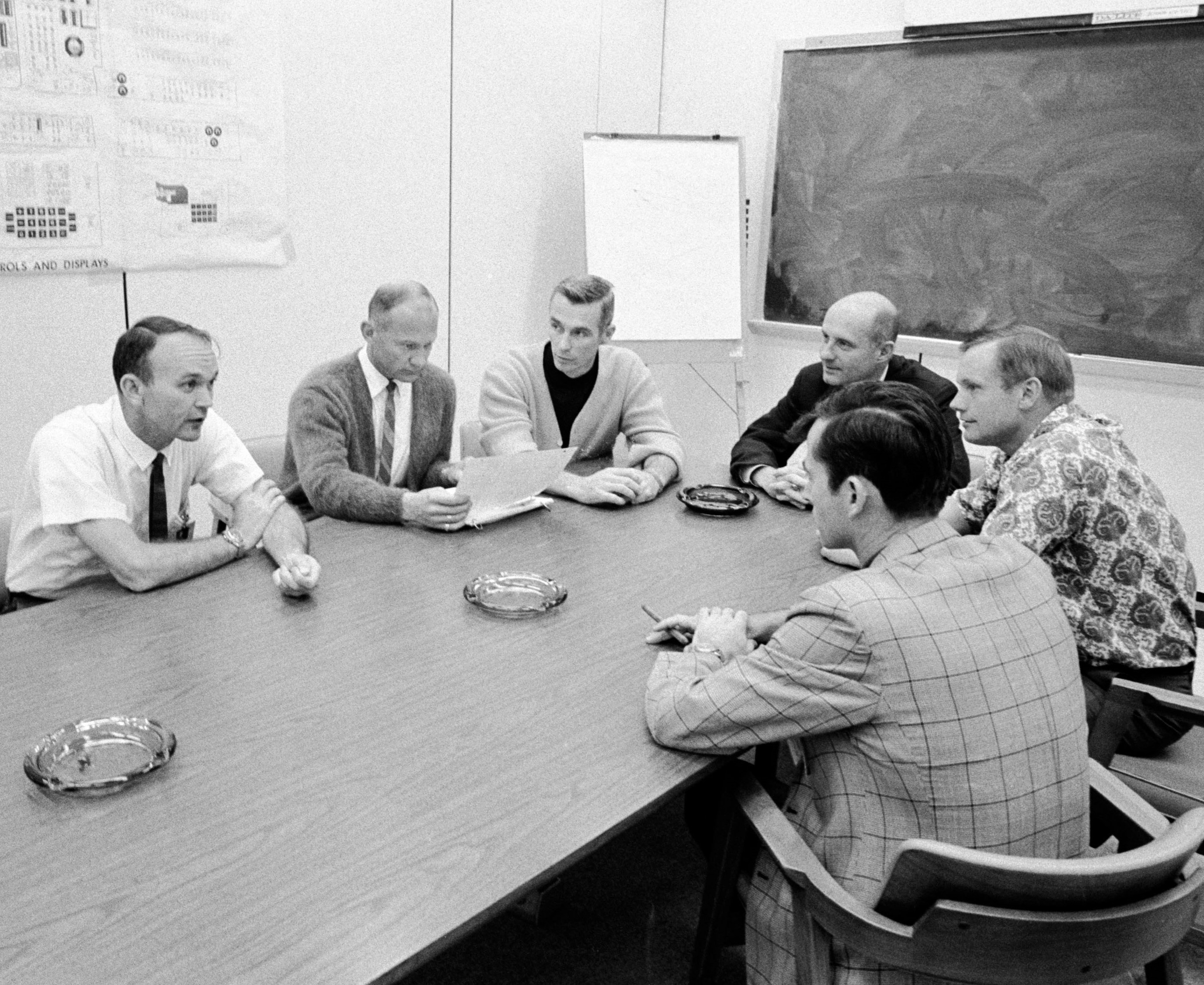

Apollo 10 astronauts debrief their mission with the Apollo 11 astronauts Apollo 10 astronauts John W. Young, left, Eugene A. Cernan, and Thomas P. Stafford hold their Emmy Awards At NASA’s Kennedy Space Center (KSC) in Florida, Stafford, left, Young, and Cernan hold photographs of their launch presented to them by KSC Launch Director Rocco A. Petrone
Left: Apollo 10 astronauts debrief their mission with the Apollo 11 astronauts. Middle: Apollo 10 astronauts John W. Young, left, Eugene A. Cernan, and Thomas P. Stafford hold their Emmy Awards. Right: At NASA’s Kennedy Space Center (KSC) in Florida, Stafford, left, Young, and Cernan hold photographs of their launch presented to them by KSC Launch Director Rocco A. Petrone.

Apollo 10 astronauts Thomas P. Stafford, left, John W. Young, and Eugene A. Cernan wave to employees as they ride in a convertible through NASA’s Kennedy Space Center in Florida
Apollo 10 astronauts Thomas P. Stafford, left, John W. Young, and Eugene A. Cernan wave to employees as they ride in a convertible through NASA’s Kennedy Space Center in Florida.

Apollo 11


The document from NASA’s Office of Manned Space Flight stating Apollo 11’s primary objective.

On June 26, Samuel C. Phillips, Apollo Program Director, and George E. Mueller, Associate Administrator for Manned Space Flight at NASA Headquarters in Washington, D.C., signed the directive stating Apollo 11’s primary objective: perform a manned lunar landing and return. The focus of the crew’s training, and all the other preparatory activities happening across the agency, aimed at accomplishing that seemingly simple, yet in truth extremely complex and never before accomplished, task.


Left: Apollo 11 astronauts Neil A. Armstrong, left, and Edwin E. “Buzz” Aldrin in the Lunar Module simulator at NASA’s Kennedy Space Center (KSC) in Florida. Right: Apollo 11 astronaut Michael Collins in KSC’s Command Module simulator.


Apollo 11 Flight Directors Eugene F. Kranz, left, Glynn S. Lunney, Clifford E. Charlesworth, Milton L. Windler, and Gerald D. Griffin pose in Mission Control.

The final weeks leading up to the launch of their historic mission proved quite busy for Apollo 11 astronauts Armstrong, Collins, and Aldrin and their backups Lovell, Anders, and Haise, as well as the ground teams preparing their rocket and spacecraft for flight. To train for the different phases of their mission, the astronauts conducted many sessions in Command Module (CM) and Lunar Module (LM) simulators at both the Manned Spacecraft Center (MSC), now NASA’s Johnson Space Center in Houston, and at KSC. For many of these sessions, teams of operators in MSC’s Mission Control monitored their activities as they would during the actual mission. Flight Directors Eugene F. Kranz, left, Glynn S. Lunney, Clifford E. Charlesworth, Milton L. Windler, and Gerald D. Griffin led the Mission Control teams.

Apollo 11 astronauts Neil A. Armstrong, left, and Edwin E. “Buzz Apollo 11 astronauts Neil A. Armstrong, left, and Edwin E. “Buzz
Apollo 11 astronauts Neil A. Armstrong, left, and Edwin E. “Buzz” Aldrin practice their lunar surface activities at the Manned Spacecraft Center, now NASA’s Johnson Space Center in Houston, left, and at NASA’s Kennedy Space Center in Florida.

Apollo 11 would conduct the first spacewalk on another celestial body and only the second spacewalk of the Apollo program. At training facilities at MSC and KSC, Armstrong and Aldrin practiced setting up a television camera that would relay their activities back to Earth during the 2.5-hour excursion, deploying the three science experiments, and collecting rock and regolith samples for return to Earth.

Apollo 11 Commander Neil A. Armstrong prepares to fly the Lunar Landing Training Vehicle (LLTV) at Ellington Air Force Base in Houston Armstrong airborne in the LLTV Apollo 11 backup Commander James A. Lovell following a flight in the LLTV
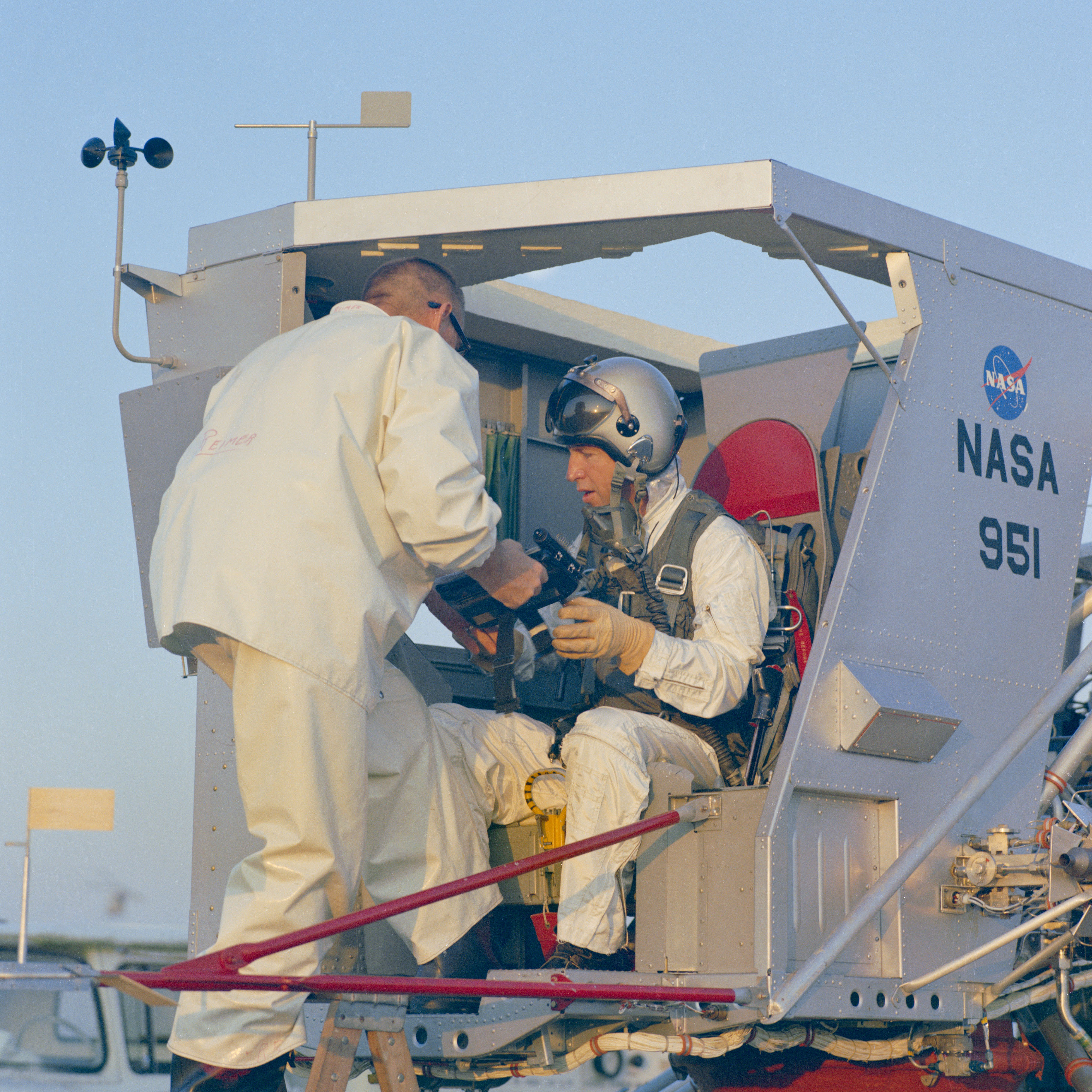
Left: Apollo 11 Commander Neil A. Armstrong prepares to fly the Lunar Landing Training Vehicle (LLTV) at Ellington Air Force Base in Houston. Middle: Armstrong airborne in the LLTV. Right: Apollo 11 backup Commander James A. Lovell following a flight in the LLTV.

On June 6, NASA managers approved the resumption of astronaut training flights in the Lunar Landing Training Vehicle (LLTV) at Ellington Air Force Base (AFB) near MSC. The LLTV simulated the flight characteristics of the LM and astronauts used it to train for the final 200 feet of the descent to the lunar surface. Managers reached the decision after reviewing findings from the Review Board headed by astronaut Walter M. Schirra that investigated the Dec. 8, 1968 crash of LLTV-1 as well as results from flights in LLTV-2 made by MSC test pilots Harold E. “Bud” Ream and Jere B. Cobb. Between June 14 and 16, Armstrong flew LLTV-2 eight times to complete his training program with the vehicle. He had previously completed 12 simulated Moon landings in the LLTV and its predecessor, the Lunar Landing Research Vehicle (LLRV), narrowly escaping the crash of LLRV-1 in May 1968. Backup Commander Lovell completed four flights in the LLTV between June 19 and July 1. Armstrong, Aldrin, Lovell, and Haise also practiced landings in the Lunar Landing Research Facility (LLRF) at NASA’s Langley Research Center in Hampton, Virginia.

Senior NASA managers monitor the Apollo 11 Countdown Demonstration Test (CDDT) in Firing Room 1 of the Launch Control Center at NASA’s Kennedy Space Center The team of controllers in Firing Room 1 monitor the Apollo 11 CDDT
Left: Senior NASA managers monitor the Apollo 11 Countdown Demonstration Test (CDDT) in Firing Room 1 of the Launch Control Center at NASA’s Kennedy Space Center. Right: The team of controllers in Firing Room 1 monitor the Apollo 11 CDDT.

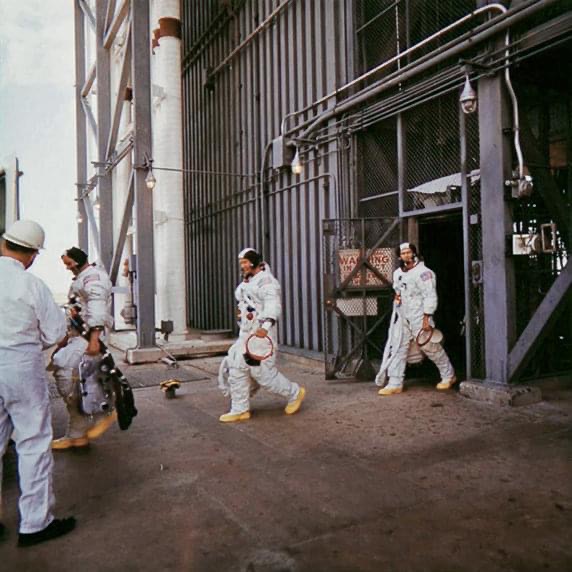
Apollo 11 astronauts Neil A. Armstrong, front, Michael Collins, and Edwin E. “Buzz” Aldrin about to board the transfer van to Launch Pad 39A for the Countdown Demonstration Test (CDDT) Workers in the White Room assist Collins, left, Armstrong, and Aldrin to enter their spacecraft for the CDDT Armstrong, left, Aldrin, and Collins leave Launch Pad 39A at the conclusion of the CDDT
Left: Apollo 11 astronauts Neil A. Armstrong, front, Michael Collins, and Edwin E. “Buzz” Aldrin about to board the transfer van to Launch Pad 39A for the Countdown Demonstration Test (CDDT). Middle: Workers in the White Room assist Collins, left, Armstrong, and Aldrin to enter their spacecraft for the CDDT. Right: Armstrong, left, Aldrin, and Collins leave Launch Pad 39A at the conclusion of the CDDT.

At KSC, engineers completed the three-day Flight Readiness Test on June 6, ensuring the flight readiness of the Saturn V rocket and the Apollo spacecraft perched on Launch Pad 39A. On June 17, top managers from NASA Headquarters and the Directors of MSC, KSC, and the Marshall Space Flight Center in Huntsville, Alabama, held the Flight Readiness Review at KSC. The meeting reviewed all aspects of readiness for the launch and mission, clearing the way for the next milestone, the Countdown Demonstration Test (CDDT). The CDDT, a full dress rehearsal for the actual countdown to launch, consisted of two parts. The “wet” test, conducted from June 27 to July 2, included fueling the rocket as if for flight, with the countdown stopping just prior to first stage engine ignition, and did not involve the flight crew. The “dry” test followed on July 3, an abbreviated countdown without fueling the rocket but with the astronauts boarding the CM as if on launch day. Controllers in Firing Room 1 of the Launch Control Center at Launch Complex 39 monitored all aspects of the CDDT as they would for an actual countdown. The successful test cleared the way for the start of the launch countdown at 8 p.m. EDT on July 10, leading to launch on July 16.

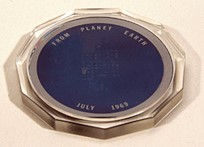
The Lunar Flag Assembly The stainless steel commemorative plaque The silicon disc containing messages of goodwill from world leaders
The three commemorative items carried aboard Apollo 11. Left: The Lunar Flag Assembly. Middle: The stainless steel commemorative plaque. Right: The silicon disc containing messages of goodwill from world leaders.

On July 2, NASA announced that Armstrong and Aldrin would leave three symbolic items behind on the Moon to commemorate the historic first landing – an American flag, a commemorative plaque, and a silicon disc bearing messages from world leaders. The astronauts would plant the three-by-five-foot flag near their LM during their spacewalk. The stainless steel plaque bore the images of the two hemispheres of the Earth and this inscription,

HERE MEN FROM THE PLANET EARTH

FIRST SET FOOT UPON THE MOON

JULY 1969 A.D.

WE CAME IN PEACE FOR ALL MANKIND

The signatures of the three astronauts and President Richard M. Nixon also appeared on the plaque. Workers mounted it on the forward landing leg strut of the LM. The one-and-one-half-inch silicon disc contained messages of goodwill from 73 world leaders, etched on the disk using the technique to make microcircuits for electronic equipment. The crew placed the disc on the lunar surface at the end of their spacewalk.

Apollo 11 astronauts Neil A. Armstrong, left, Edwin E. “Buzz” Aldrin, and Michael Collins hold a copy of the commemorative plaque they will leave behind on the Moon and their mission patch The Apollo 11 astronauts in the glass-enclosed room at the Lunar Receiving Laboratory
Left: Apollo 11 astronauts Neil A. Armstrong, left, Edwin E. “Buzz” Aldrin, and Michael Collins hold a copy of the commemorative plaque they will leave behind on the Moon and their mission patch. Right: The Apollo 11 astronauts in the glass-enclosed room at the Lunar Receiving Laboratory.

During a July 5 press conference in the MSC auditorium, the Apollo 11 astronauts revealed the call signs for their spacecraft. They named their CM Columbia and their LM Eagle. “We selected these as being representative of the flight, the nation’s hope,” said Armstrong. Columbia served as a national symbol represented by a statue atop the Capitol in Washington, D.C. They named the LM after the symbol of the United States, the bald eagle, featured on the Apollo 11 mission patch. In a second event, the astronauts answered reporters’ questions from inside a glass-enclosed conference room at MSC’s Lunar Receiving Laboratory (LRL). After their mission, the returning astronauts completed their 21-day quarantine in the LRL to prevent any back contamination of the Earth by any possible lunar microorganisms.

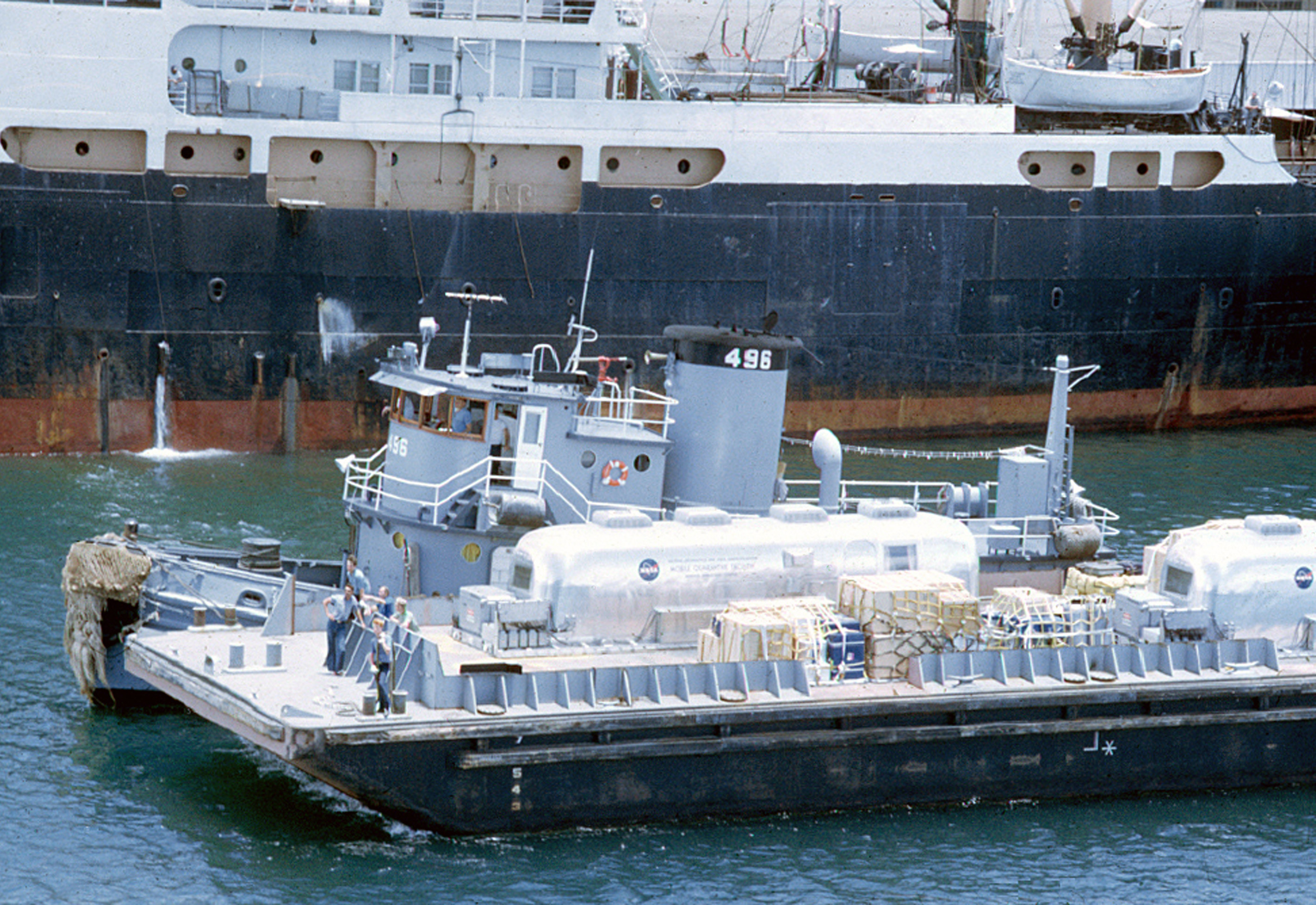
On the loading dock of the Lunar Receiving Laboratory (LRL) at the Manned Spacecraft Center, now NASA’s Johnson Space Center in Houston, workers simulate the arrival of the first Moon rocks and other items returned from Apollo 11 Workers practice docking the Mobile Quarantine Facility (MQF) with the LRL In Pearl Harbor, Hawaii, workers barge the prime and backup MQFs to load them onto the U.S.S. Hornet
NASA’s Johnson Space Center in Houston, workers simulate the arrival of the first Moon rocks and other items returned from Apollo 11. Middle: Workers practice docking the Mobile Quarantine Facility (MQF) with the LRL. Right: In Pearl Harbor, Hawaii, workers barge the prime and backup MQFs to load them onto the U.S.S. Hornet. Image credit: courtesy U.S. Navy.

At the LRL, other preparations for the return of the Apollo 11 astronauts from the Moon included a simulation of the arrival and processing of the Moon rocks and other items following the mission. The rocks, crew biological samples, and film would be flown from the prime recovery ship to Houston ahead of the crew. Engineers and technicians also rehearsed the arrival of the crew with a dry run of docking a Mobile Quarantine Facility (MQF) to the LRL’s loading dock. Following the test, workers loaded two MQFs, a prime and a backup, onto a cargo plane for transport to Hawaii and loading onto the prime recovery ship.

Workers in Pearl Harbor, Hawaii, prepare to lift a boilerplate Apollo Command Module onto the U.S.S. Hornet for splashdown and recovery rehearsals Crews from the U.S.S. Hornet practice recovery operations Recovery team members dry their Biological Isolation Garments aboard the U.S.S. Hornet following a recovery exercise
Left: Workers in Pearl Harbor, Hawaii, prepare to lift a boilerplate Apollo Command Module onto the U.S.S. Hornet for splashdown and recovery rehearsals. Image credit: courtesy U.S. Navy Bob Fish. Middle: Crews from the U.S.S. Hornet practice recovery operations. Right: Recovery team members dry their Biological Isolation Garments aboard the U.S.S. Hornet following a recovery exercise.

On June 12, the U.S. Navy notified NASA that it had selected the U.S.S. Hornet (CVS-12) as the prime recovery ship for Apollo 11 to undertake the most complex recovery of an astronaut crew. The same day, with Hornet docked in her home port of Long Beach, California, its commanding officer, Capt. Carl J. Seiberlich, held the first recovery team meeting to review the Apollo Recovery Operations Manual, written by MSC’s Landing and Recovery Division. Between June 12 and 25, Hornet onloaded NASA equipment required for the recovery. On June 27, Hornet left Long Beach for a three-hour stop in San Diego, where air group maintenance and support personnel embarked. The next day, after Hornet left for Pearl Harbor, Hawaii, pilots flew the aircraft required to support the recovery onto the carrier. During the cruise to Pearl Harbor, Hornet’s 90-man team detailed for Apollo 11 recovery operations held numerous meetings and table-top simulations. After arriving in Hawaii on July 2, workers loaded a boilerplate Apollo capsule onto the aircraft carrier to be used for recovery practice. The NASA recovery team, the Frogmen swimmers from the U.S. Navy’s Underwater Demolition Team 11 (UDT-11) who assisted with the recovery, and some media personnel arrived onboard. For the recovery operation, Capt. Seiberlich adopted the motto “Hornet Plus Three,” indicating the goal of a safe recovery of the three astronauts returning from the Moon. On July 3, Capt. Seiberlich introduced the 35-member NASA recovery team to the Hornet’s crew. Donald E. Stullken, Chief of the Recovery Operations Branch at MSC and inventor of the inflatable flotation collar attached by swimmers to the capsule after splashdown, led the NASA team. His assistant John C. Stonesifer oversaw the decontamination and quarantine operations. Stullken and Stonesifer briefed Hornet’s Command Module Retrieval Team on all events associated with the recovery and retrieval of an Apollo capsule and its crew. On July 6, workers loaded the two MQFs aboard Hornet. The prime MQF would house the returning astronauts, a flight surgeon, and an engineer from shortly after splashdown until their arrival at the LRL in Houston several days later. The second MQF served as a backup should a problem arise with the first or if violations of quarantine protocols required additional personnel to be isolated. Along with the MQFs, Navy personnel loaded other equipment necessary for the recovery, including 55 one-gallon containers of sodium hypochlorite to be used as a disinfectant. Between July 7 and 9, the Hornet conducted nine Simulated Recovery Exercises in local Hawaiian waters. Lieutenant Clarence J. “Clancy” Hatleberg led the team as the designated decontamination swimmer with U.S. Navy Frogmen serving as stand-ins for the astronauts, all wearing Biological Isolation Garments as they would on recovery day. The Hornet returned to Pearl Harbor to pick up the rest of the NASA recovery team before setting sail on July 12 for its first recovery position. 

Apollo 12

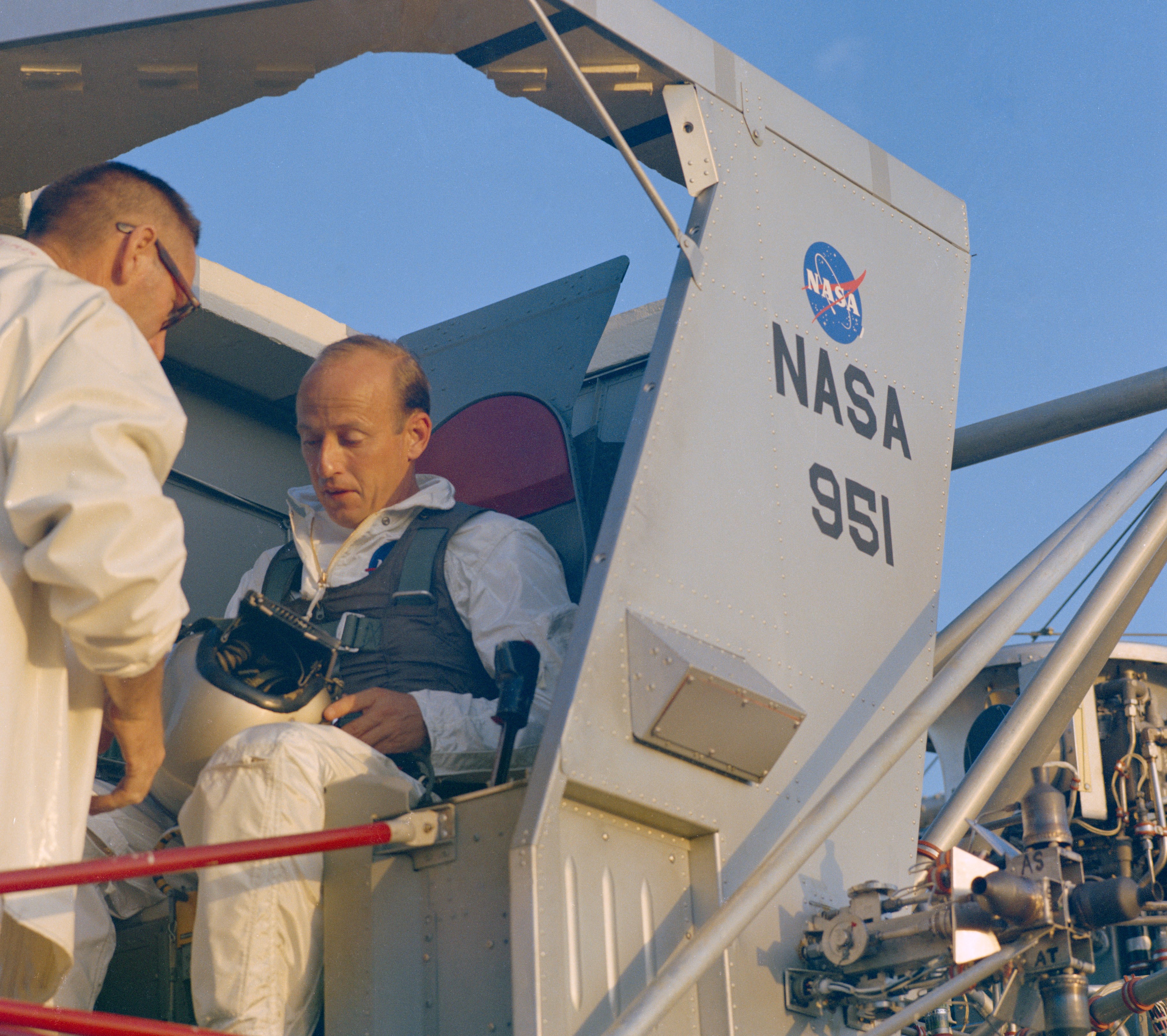
Conrad after completing a flight in the Lunar Landing Training Vehicle
Left: Apollo 12 astronauts Charles “Pete” Conrad, left, Alan L. Bean, and Richard F. Gordon prepare to enter their Command Module for an altitude test. Right: Conrad after completing a flight in the Lunar Landing Training Vehicle.

In the Manned Spacecraft Operations Building (MSOB) at NASA’s Kennedy Space Center, workers finish attaching the landing gear to the Apollo 12 Lunar Module (LM) Workers in the MSOB prepare to mate the Apollo 12 Command and Service Modules with the Spacecraft LM Adapter Workers move the assembled Apollo 12 spacecraft from the MSOB to the Vehicle Assembly Building (VAB) In the VAB. workers lower the Apollo 12 spacecraft onto its Saturn V rocket
Left: In the Manned Spacecraft Operations Building (MSOB) at NASA’s Kennedy Space Center, workers finish attaching the landing gear to the Apollo 12 Lunar Module (LM). Middle left: Workers in the MSOB prepare to mate the Apollo 12 Command and Service Modules with the Spacecraft LM Adapter. Middle right: Workers move the assembled Apollo 12 spacecraft from the MSOB to the Vehicle Assembly Building (VAB). Right: In the VAB. workers lower the Apollo 12 spacecraft onto its Saturn V rocket.

With Apollo 11 on its launch pad, workers continued to prepare Apollo 12 for its eventual journey to the Moon, targeting a September launch should Apollo 11 not succeed. If Apollo 11 succeeded in its Moon landing mission, Apollo 12 would fly later, most likely in November, to attempt the second Moon landing at a different location. In KSC’s Vehicle Assembly Building (VAB), the three-stage Saturn V stood on its Mobile Launcher, awaiting the arrival of the Apollo spacecraft. In the nearby Manned Spacecraft Operations Building, the Apollo 12 prime crew of Charles “Pete” Conrad, Richard F. Gordon, and Alan L. Bean and their backups David R. Scott, Alfred M. Worden, and James B. Irwin completed altitude chamber tests of the CM and LM during the first two weeks of June. Workers removed the spacecraft from the vacuum chambers, mated them on June 27, and transferred them to the VAB on July 1 for stacking on the Saturn V rocket. At Ellington AFB in Houston, Conrad completed his first flights aboard LLTV-2 on July 9-10.

Apollo 13

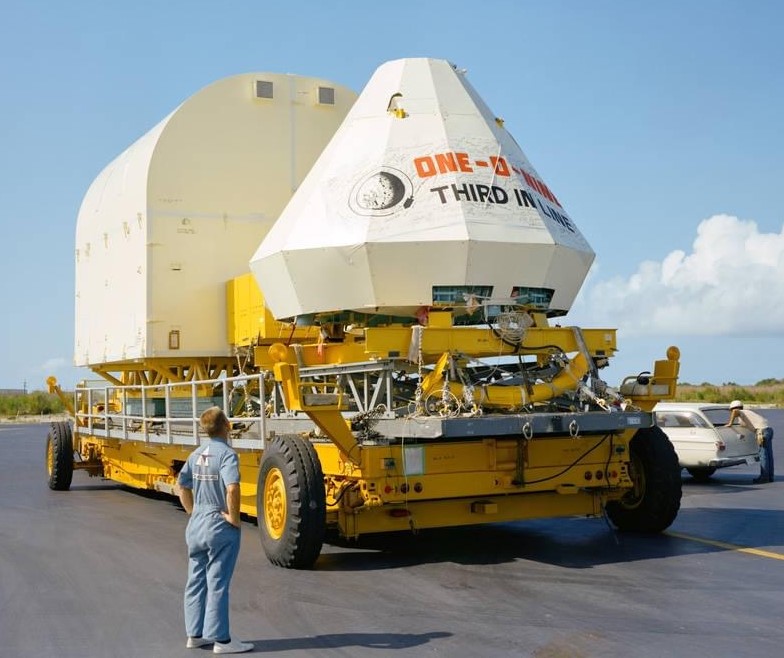
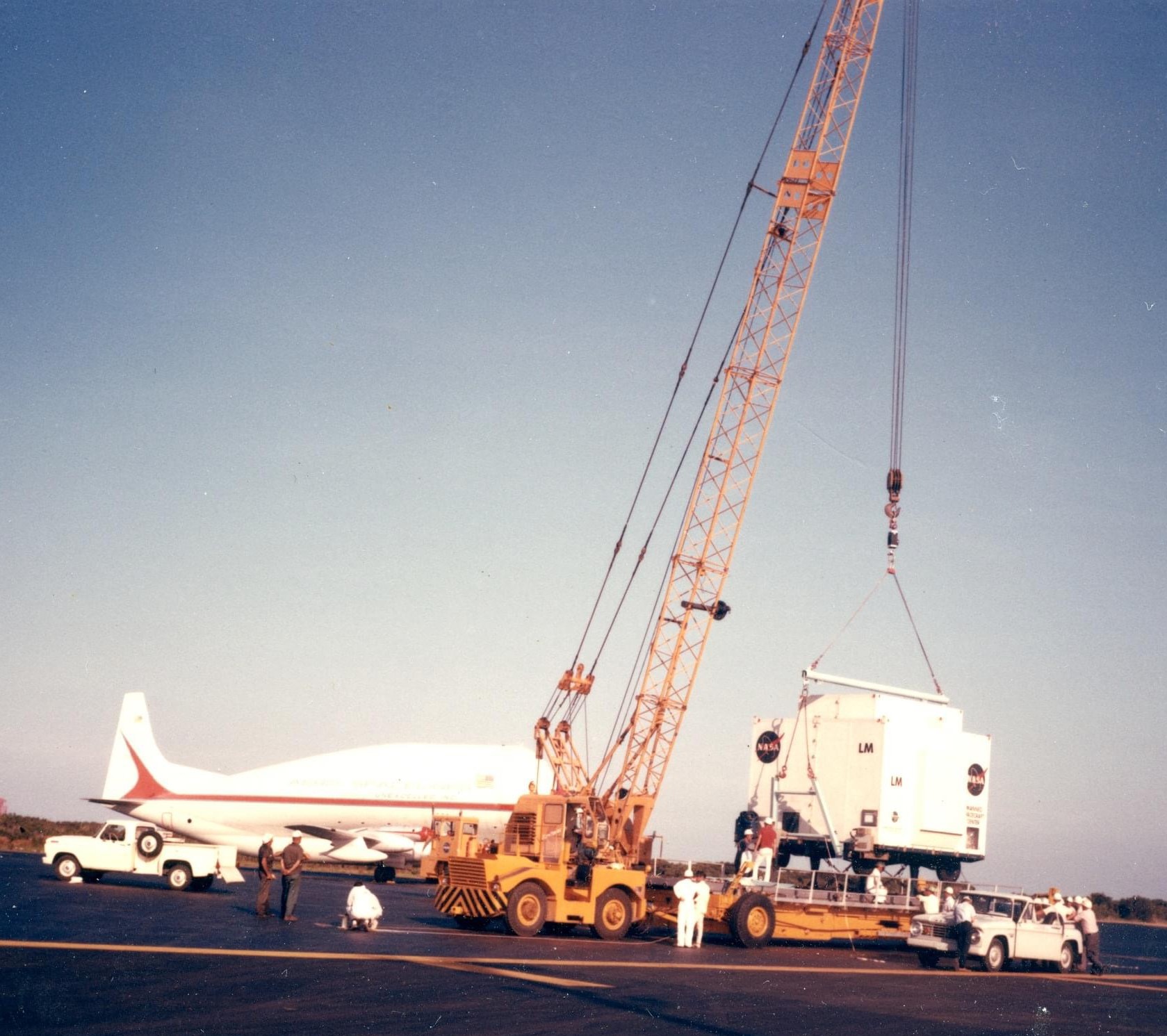
In the Vehicle Assembly Building at NASA’s Kennedy Space Center (KSC) in Florida, workers place the first stage of the Apollo 13 Saturn V rocket onto the Mobile Launcher to begin the stacking process The Apollo 13 Command and Service Modules arrive at KSC The ascent stage of the Apollo 13 Lunar Module arrives at KSC
Left: In the Vehicle Assembly Building at NASA’s Kennedy Space Center (KSC) in Florida, workers place the first stage of the Apollo 13 Saturn V rocket onto the Mobile Launcher to begin the stacking process. Middle: The Apollo 13 Command and Service Modules arrive at KSC. Right: The ascent stage of the Apollo 13 Lunar Module arrives at KSC.

In the event that neither Apollo 11 nor 12 succeeded in landing on the Moon, NASA stood prepared to try a third time with Apollo 13 in November or December, still in time to meet President Kennedy’s deadline. The Apollo 13 Command and Service Modules arrived at KSC on June 26, followed by the LM ascent and descent stages on June 28 and 29, respectively. The Saturn V’s S-IC first stage arrived on June 16 and workers placed it on its Mobile Launcher two days later. The S-IVB third stage and S-II second stage arrived June 13 and 29, respectively, and workers stacked the stages in mid-July.

To be continued …

News from around the world in June 1969:

June 3 – Eric Carle publishes children’s picture book “The Very Hungry Caterpillar.”

June 3 – The final episode of Star Trek airs on NBC.

June 5 – The Tupolev Tu-144 became the first passenger jet to fly faster than the speed of sound.

June 10 – The Nixon Administration cancels the U.S. Air Force Manned Orbiting Laboratory program.

June 15 – “Hee Haw,” with Roy Clark and Buck Owens, premieres on CBS.

June 20 – Georges Pompidou sworn in as the 19th President of France.

June 20 – 200,000 attend Newport ’69, then largest-ever pop concert, in Northridge, California.

June 23 – Warren E. Burger sworn in as U.S. Supreme Court Chief Justice.

June 28 – Police carry out a raid at the Stonewall Inn in Greenwich Village, New York, beginning the modern LGBT rights movement.

Powered by WPeMatico

Get The Details…
Kelli Mars

55 Years Ago: One Month Until the Moon Landing

55 Years Ago: One Month Until the Moon Landing

With the dress rehearsal completed during Apollo 10 in May 1969, only a few weeks remained until Apollo 11, the actual Moon landing mission to meet President Kennedy’s goal set in 1961. Apollo 11 astronauts Neil A. Armstrong, Michael Collins, and Edwin E. “Buzz” Aldrin and their backups James A. Lovell, William A. Anders, and Fred W. Haise entered the final phase of their training, rehearsing their mission in simulators and practicing for the lunar surface activities. Teams in Mission Control supported the simulations. A successful countdown demonstration cleared the way to start the actual countdown leading to launch. In the Pacific Ocean, U.S. Navy and NASA teams prepared for the recovery of the astronauts returning from the Moon, and for their postflight quarantine.

Apollo 10

After returning from their successful Moon landing dress rehearsal mission on May 26, 1969, Apollo 10 astronauts Thomas P. Stafford, John W. Young, and Eugene A. Cernan passed on their knowledge and lessons learned to the Apollo 11 Moon landing crew during postflight debriefs. On June 8, they accepted Emmy Awards on behalf of all Apollo crews for their television broadcasts from space, with special recognition for Apollo 10’s first use of color TV in space. On June 19, Stafford, Young, and Cernan returned to NASA’s Kennedy Space Center (KSC) in Florida to thank the employees there for getting them safely into orbit. On June 30, President Richard M. Nixon hosted them and their wives at a White House black tie dinner in their honor.
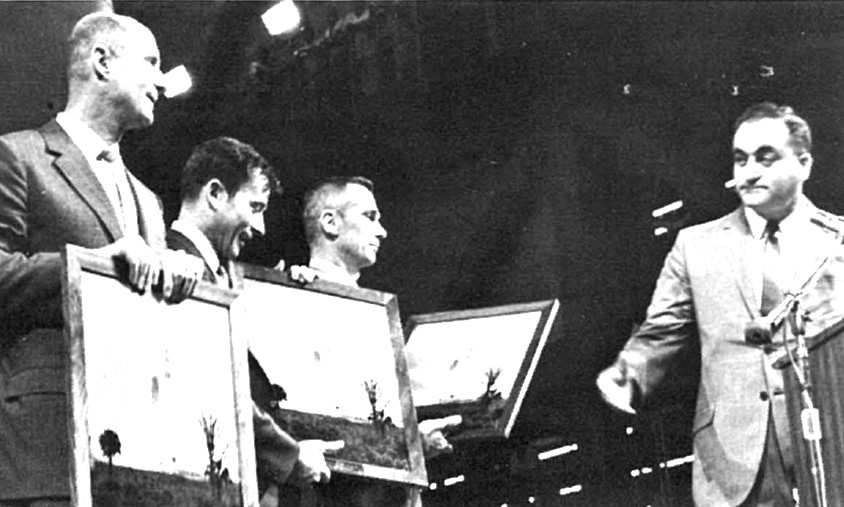
Apollo 10 astronauts debrief their mission with the Apollo 11 astronauts Apollo 10 astronauts John W. Young, left, Eugene A. Cernan, and Thomas P. Stafford hold their Emmy Awards At NASA’s Kennedy Space Center (KSC) in Florida, Stafford, left, Young, and Cernan hold photographs of their launch presented to them by KSC Launch Director Rocco A. Petrone
Left: Apollo 10 astronauts debrief their mission with the Apollo 11 astronauts. Middle: Apollo 10 astronauts John W. Young, left, Eugene A. Cernan, and Thomas P. Stafford hold their Emmy Awards. Right: At NASA’s Kennedy Space Center (KSC) in Florida, Stafford, left, Young, and Cernan hold photographs of their launch presented to them by KSC Launch Director Rocco A. Petrone.
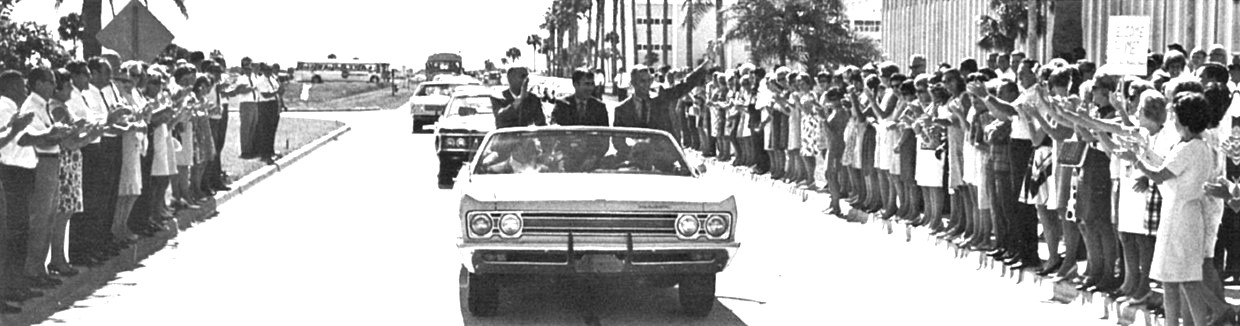
Apollo 10 astronauts Thomas P. Stafford, left, John W. Young, and Eugene A. Cernan wave to employees as they ride in a convertible through NASA’s Kennedy Space Center in Florida
Apollo 10 astronauts Thomas P. Stafford, left, John W. Young, and Eugene A. Cernan wave to employees as they ride in a convertible through NASA’s Kennedy Space Center in Florida.

Apollo 11
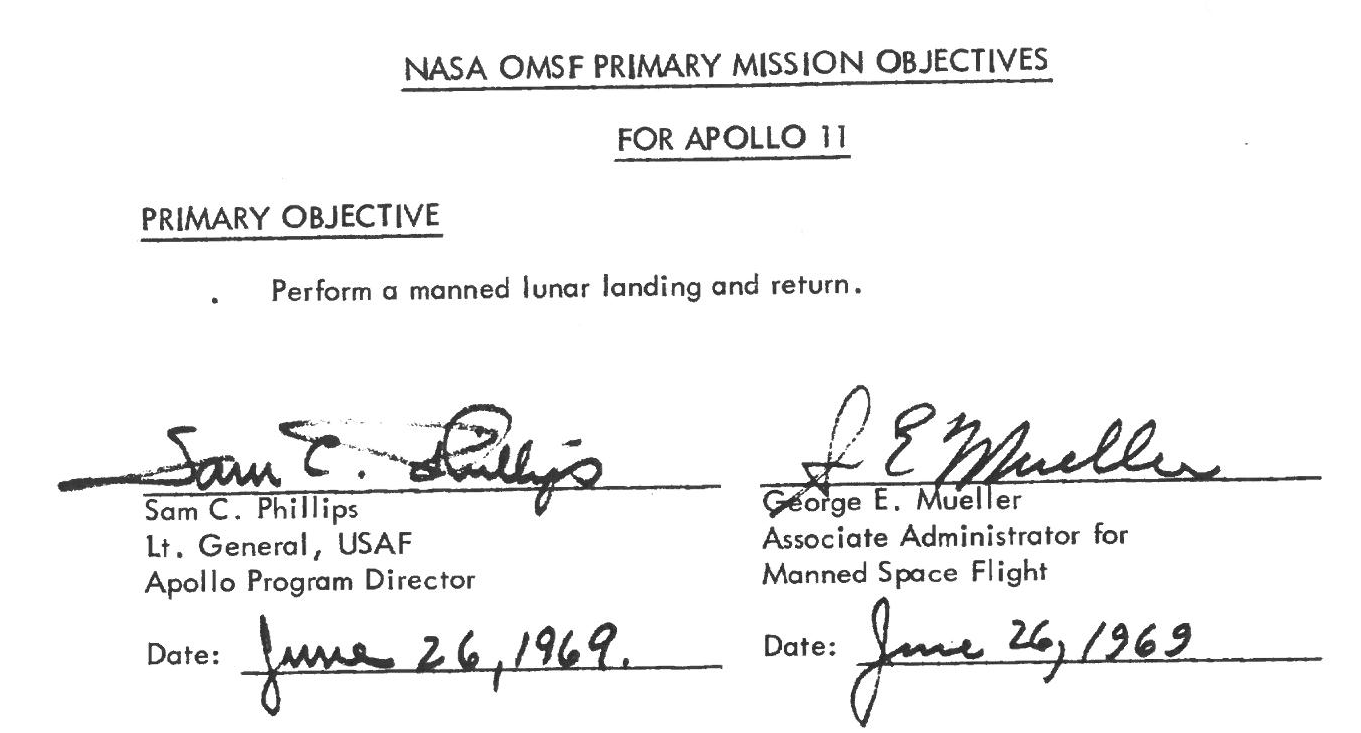

The document from NASA’s Office of Manned Space Flight stating Apollo 11’s primary objective.

On June 26, Samuel C. Phillips, Apollo Program Director, and George E. Mueller, Associate Administrator for Manned Space Flight at NASA Headquarters in Washington, D.C., signed the directive stating Apollo 11’s primary objective: perform a manned lunar landing and return. The focus of the crew’s training, and all the other preparatory activities happening across the agency, aimed at accomplishing that seemingly simple, yet in truth extremely complex and never before accomplished, task.
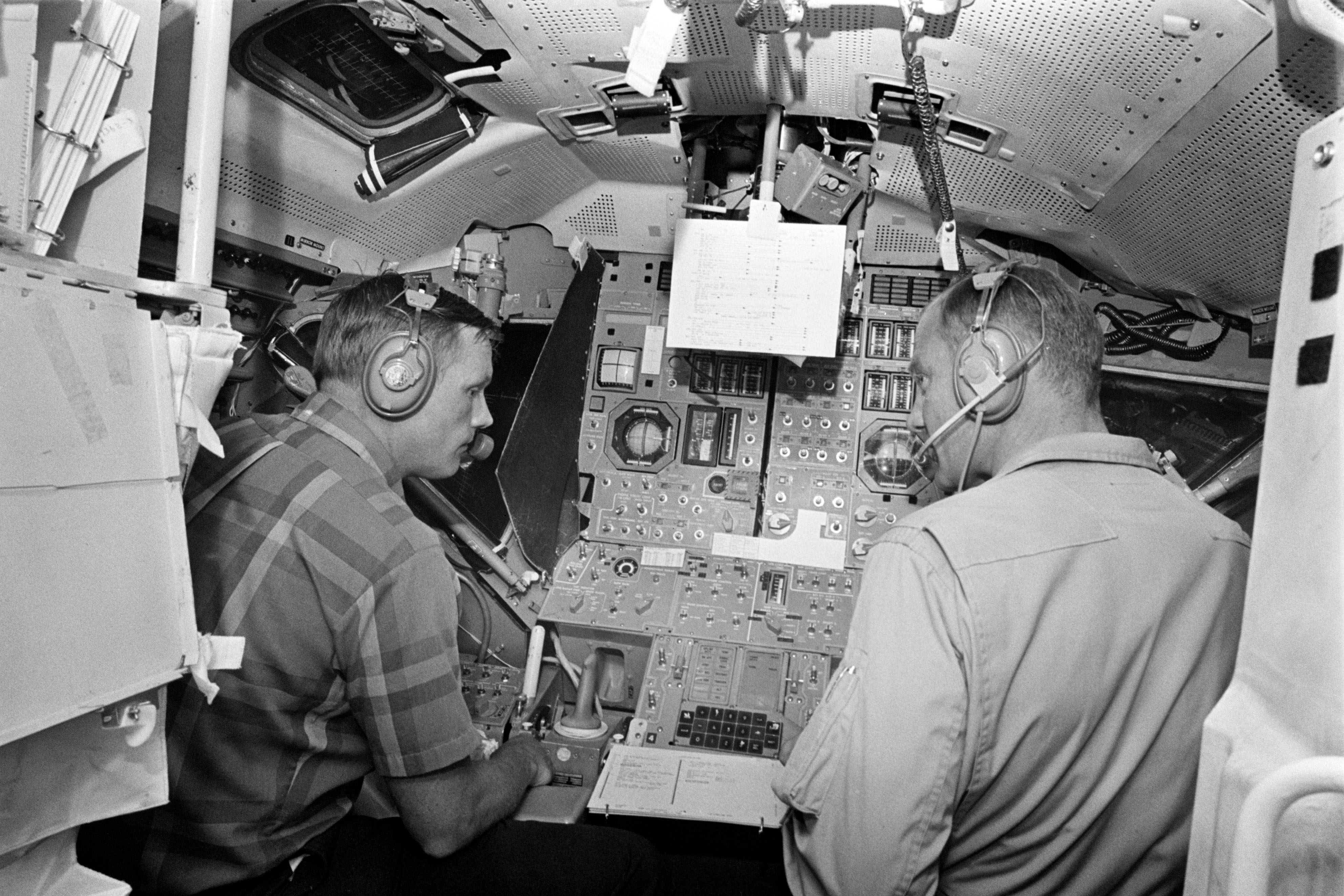

Left: Apollo 11 astronauts Neil A. Armstrong, left, and Edwin E. “Buzz” Aldrin in the Lunar Module simulator at NASA’s Kennedy Space Center (KSC) in Florida. Right: Apollo 11 astronaut Michael Collins in KSC’s Command Module simulator.
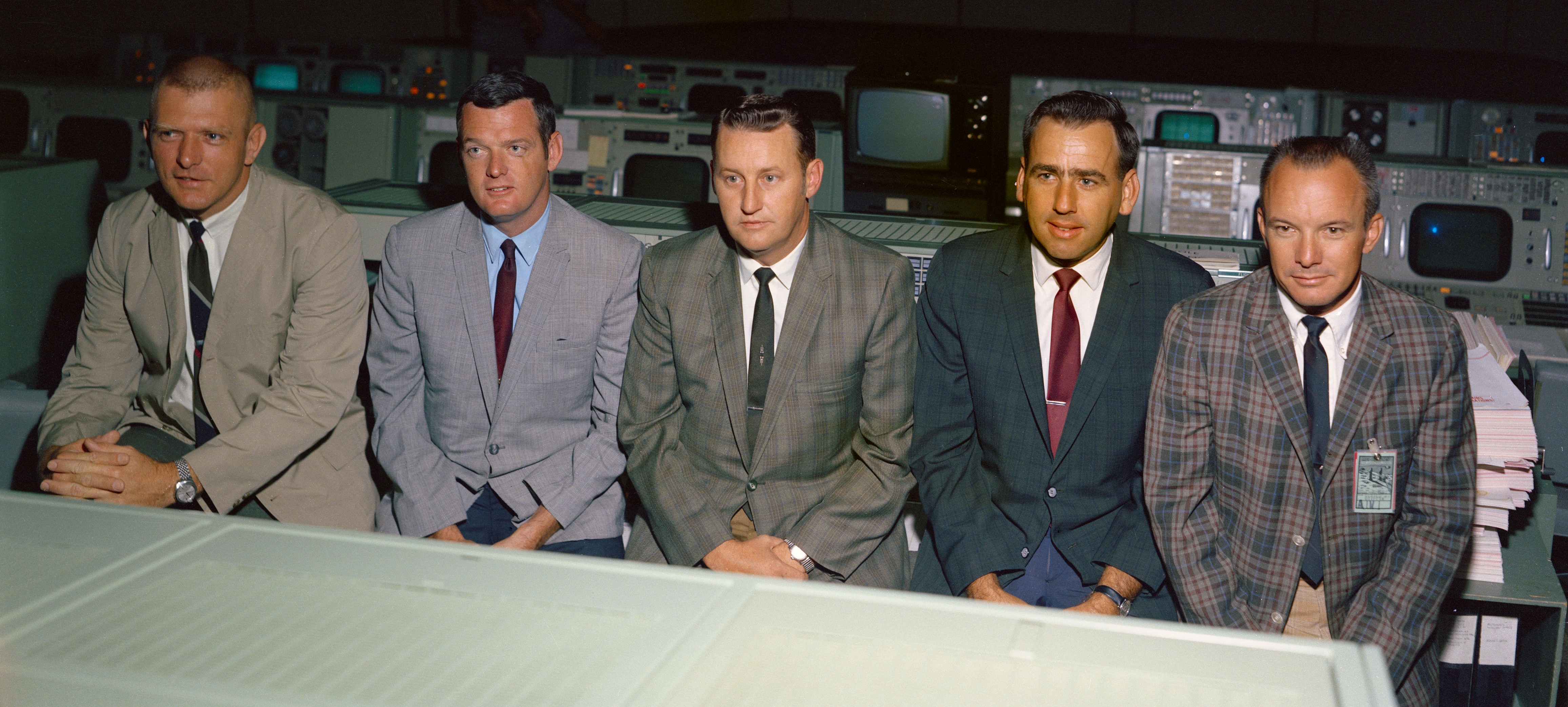

Apollo 11 Flight Directors Eugene F. Kranz, left, Glynn S. Lunney, Clifford E. Charlesworth, Milton L. Windler, and Gerald D. Griffin pose in Mission Control.

The final weeks leading up to the launch of their historic mission proved quite busy for Apollo 11 astronauts Armstrong, Collins, and Aldrin and their backups Lovell, Anders, and Haise, as well as the ground teams preparing their rocket and spacecraft for flight. To train for the different phases of their mission, the astronauts conducted many sessions in Command Module (CM) and Lunar Module (LM) simulators at both the Manned Spacecraft Center (MSC), now NASA’s Johnson Space Center in Houston, and at KSC. For many of these sessions, teams of operators in MSC’s Mission Control monitored their activities as they would during the actual mission. Flight Directors Eugene F. Kranz, left, Glynn S. Lunney, Clifford E. Charlesworth, Milton L. Windler, and Gerald D. Griffin led the Mission Control teams.
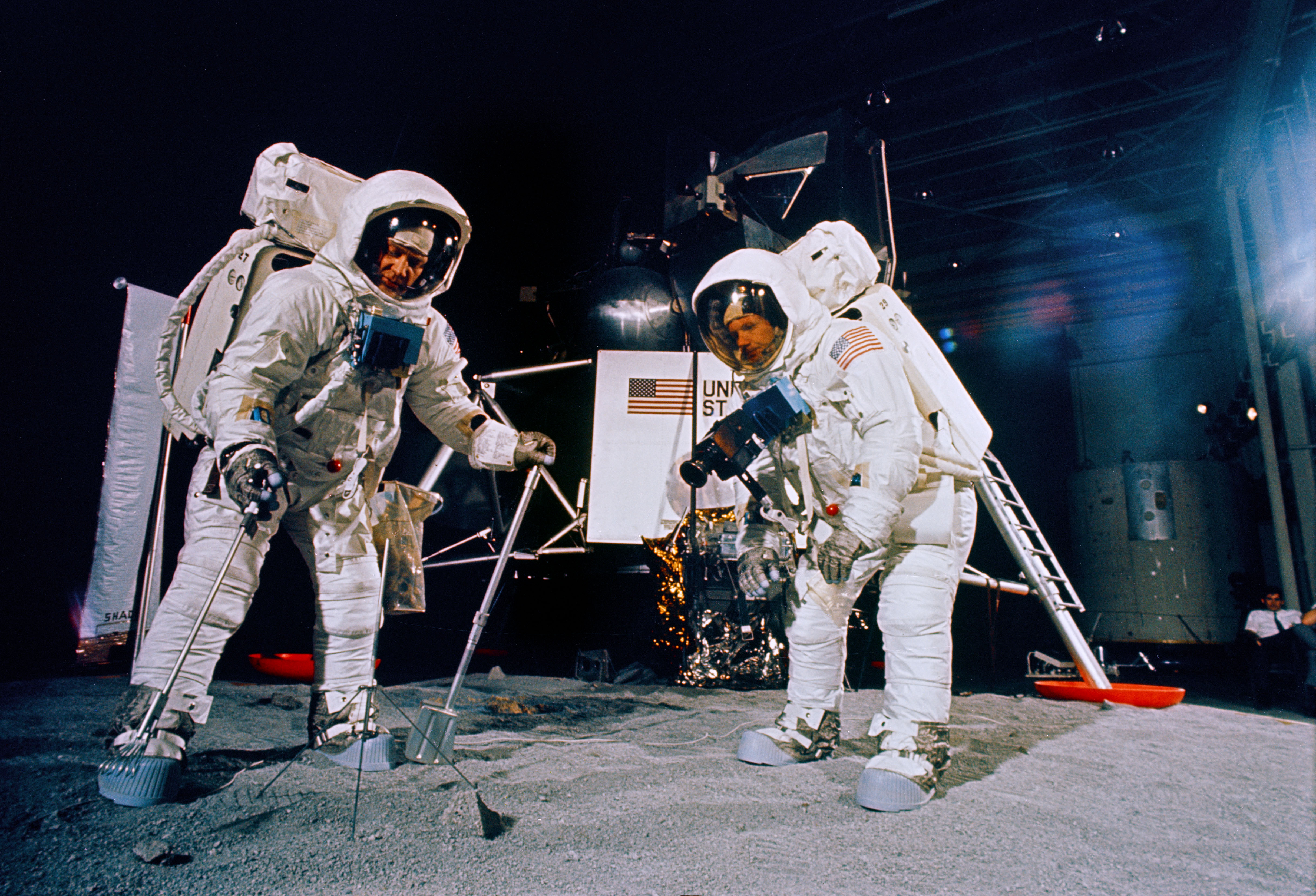
Apollo 11 astronauts Neil A. Armstrong, left, and Edwin E. “Buzz Apollo 11 astronauts Neil A. Armstrong, left, and Edwin E. “Buzz
Apollo 11 astronauts Neil A. Armstrong, left, and Edwin E. “Buzz” Aldrin practice their lunar surface activities at the Manned Spacecraft Center, now NASA’s Johnson Space Center in Houston, left, and at NASA’s Kennedy Space Center in Florida.

Apollo 11 would conduct the first spacewalk on another celestial body and only the second spacewalk of the Apollo program. At training facilities at MSC and KSC, Armstrong and Aldrin practiced setting up a television camera that would relay their activities back to Earth during the 2.5-hour excursion, deploying the three science experiments, and collecting rock and regolith samples for return to Earth.

Apollo 11 Commander Neil A. Armstrong prepares to fly the Lunar Landing Training Vehicle (LLTV) at Ellington Air Force Base in Houston Armstrong airborne in the LLTV Apollo 11 backup Commander James A. Lovell following a flight in the LLTV
Left: Apollo 11 Commander Neil A. Armstrong prepares to fly the Lunar Landing Training Vehicle (LLTV) at Ellington Air Force Base in Houston. Middle: Armstrong airborne in the LLTV. Right: Apollo 11 backup Commander James A. Lovell following a flight in the LLTV.

On June 6, NASA managers approved the resumption of astronaut training flights in the Lunar Landing Training Vehicle (LLTV) at Ellington Air Force Base (AFB) near MSC. The LLTV simulated the flight characteristics of the LM and astronauts used it to train for the final 200 feet of the descent to the lunar surface. Managers reached the decision after reviewing findings from the Review Board headed by astronaut Walter M. Schirra that investigated the Dec. 8, 1968 crash of LLTV-1 as well as results from flights in LLTV-2 made by MSC test pilots Harold E. “Bud” Ream and Jere B. Cobb. Between June 14 and 16, Armstrong flew LLTV-2 eight times to complete his training program with the vehicle. He had previously completed 12 simulated Moon landings in the LLTV and its predecessor, the Lunar Landing Research Vehicle (LLRV), narrowly escaping the crash of LLRV-1 in May 1968. Backup Commander Lovell completed four flights in the LLTV between June 19 and July 1. Armstrong, Aldrin, Lovell, and Haise also practiced landings in the Lunar Landing Research Facility (LLRF) at NASA’s Langley Research Center in Hampton, Virginia.
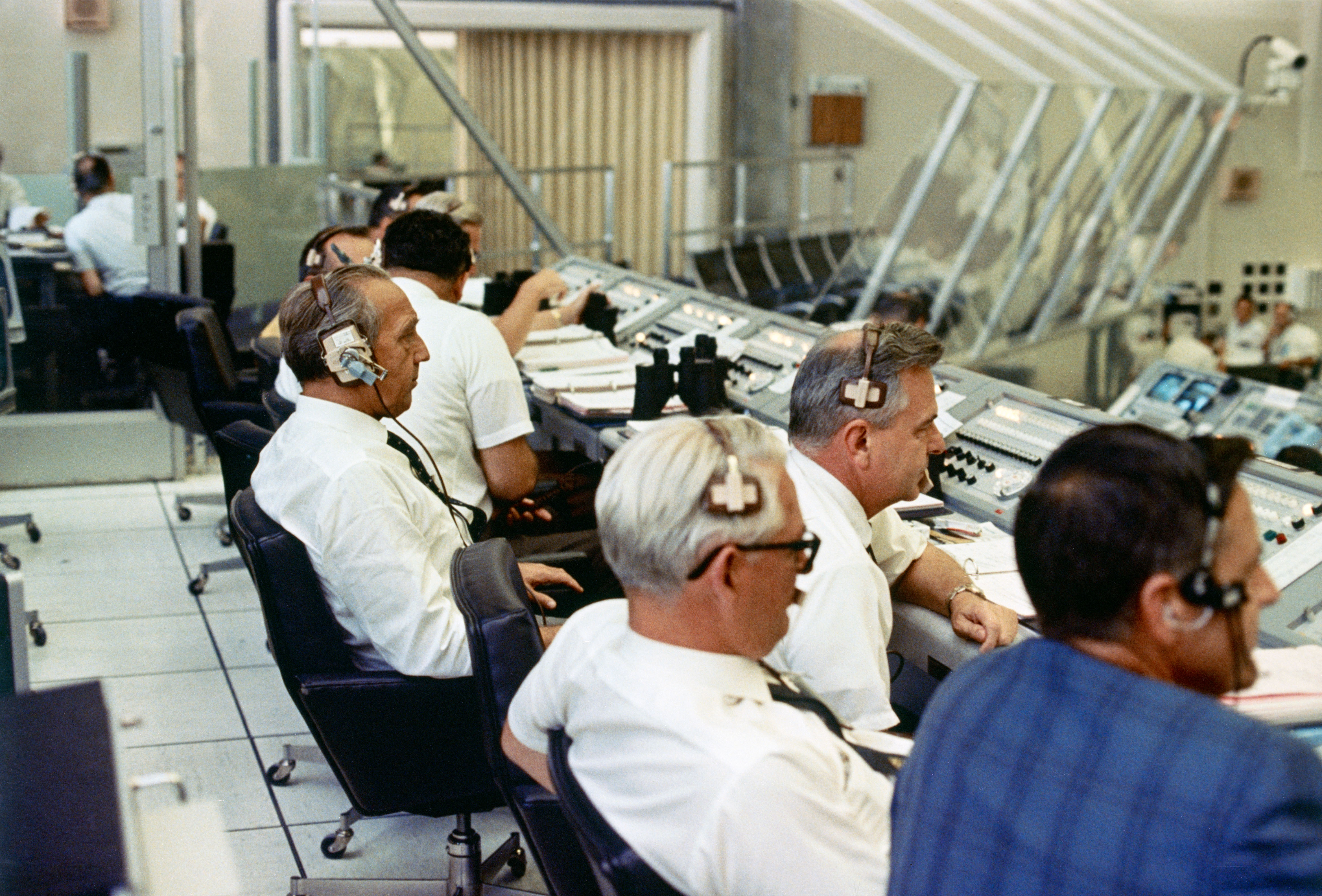
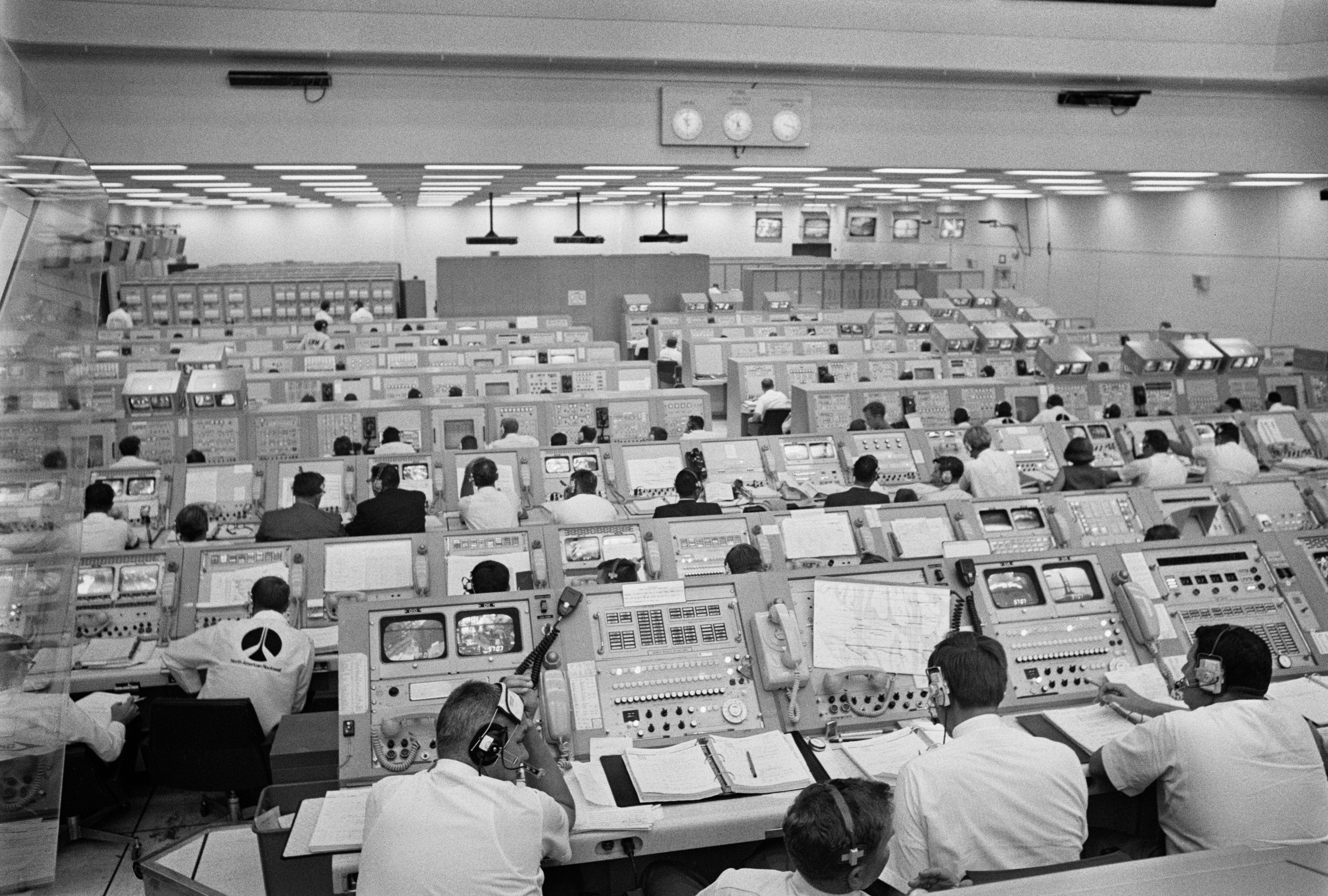
Senior NASA managers monitor the Apollo 11 Countdown Demonstration Test (CDDT) in Firing Room 1 of the Launch Control Center at NASA’s Kennedy Space Center The team of controllers in Firing Room 1 monitor the Apollo 11 CDDT
Left: Senior NASA managers monitor the Apollo 11 Countdown Demonstration Test (CDDT) in Firing Room 1 of the Launch Control Center at NASA’s Kennedy Space Center. Right: The team of controllers in Firing Room 1 monitor the Apollo 11 CDDT.

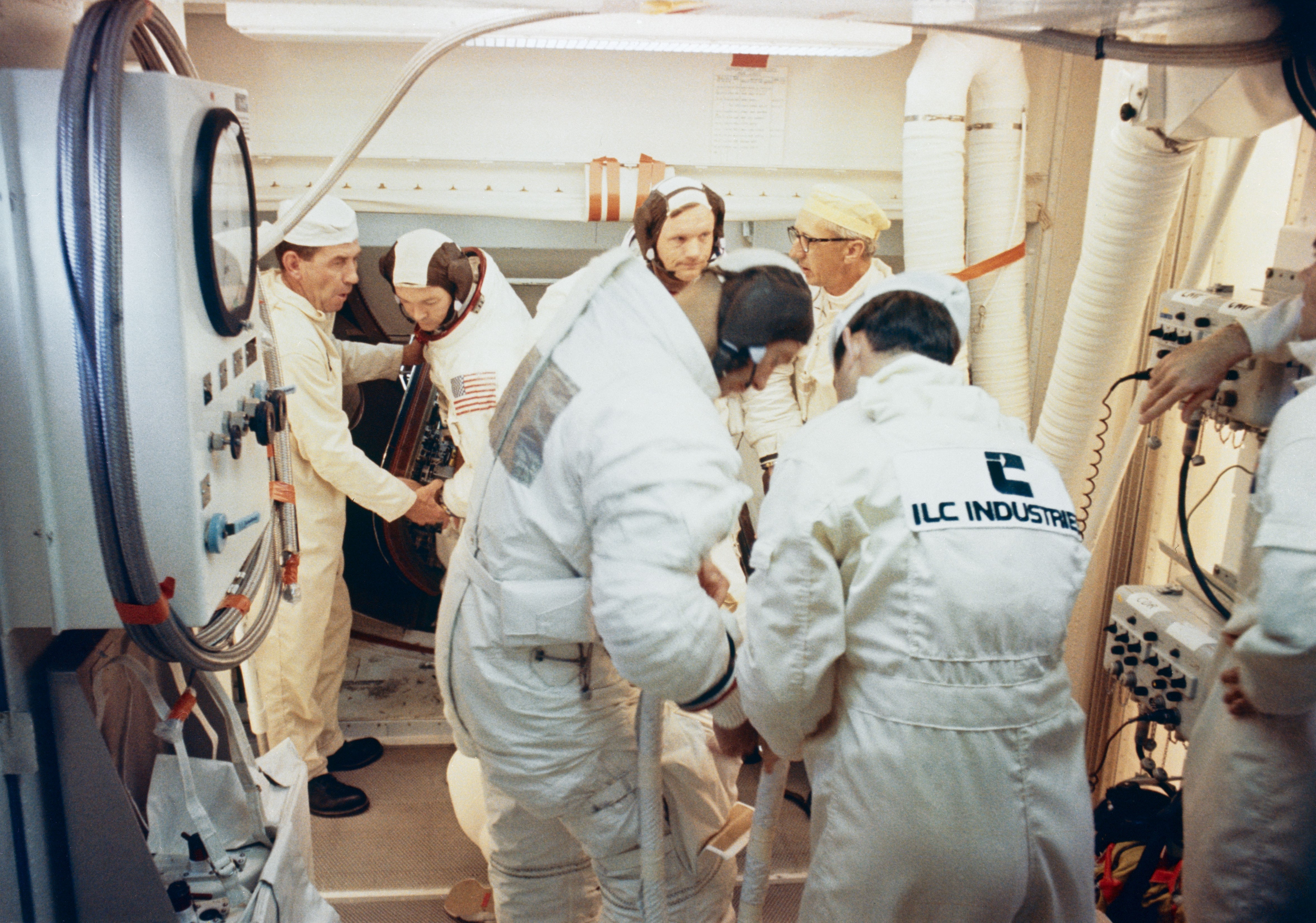
Apollo 11 astronauts Neil A. Armstrong, front, Michael Collins, and Edwin E. “Buzz” Aldrin about to board the transfer van to Launch Pad 39A for the Countdown Demonstration Test (CDDT) Workers in the White Room assist Collins, left, Armstrong, and Aldrin to enter their spacecraft for the CDDT Armstrong, left, Aldrin, and Collins leave Launch Pad 39A at the conclusion of the CDDT
Left: Apollo 11 astronauts Neil A. Armstrong, front, Michael Collins, and Edwin E. “Buzz” Aldrin about to board the transfer van to Launch Pad 39A for the Countdown Demonstration Test (CDDT). Middle: Workers in the White Room assist Collins, left, Armstrong, and Aldrin to enter their spacecraft for the CDDT. Right: Armstrong, left, Aldrin, and Collins leave Launch Pad 39A at the conclusion of the CDDT.

At KSC, engineers completed the three-day Flight Readiness Test on June 6, ensuring the flight readiness of the Saturn V rocket and the Apollo spacecraft perched on Launch Pad 39A. On June 17, top managers from NASA Headquarters and the Directors of MSC, KSC, and the Marshall Space Flight Center in Huntsville, Alabama, held the Flight Readiness Review at KSC. The meeting reviewed all aspects of readiness for the launch and mission, clearing the way for the next milestone, the Countdown Demonstration Test (CDDT). The CDDT, a full dress rehearsal for the actual countdown to launch, consisted of two parts. The “wet” test, conducted from June 27 to July 2, included fueling the rocket as if for flight, with the countdown stopping just prior to first stage engine ignition, and did not involve the flight crew. The “dry” test followed on July 3, an abbreviated countdown without fueling the rocket but with the astronauts boarding the CM as if on launch day. Controllers in Firing Room 1 of the Launch Control Center at Launch Complex 39 monitored all aspects of the CDDT as they would for an actual countdown. The successful test cleared the way for the start of the launch countdown at 8 p.m. EDT on July 10, leading to launch on July 16.
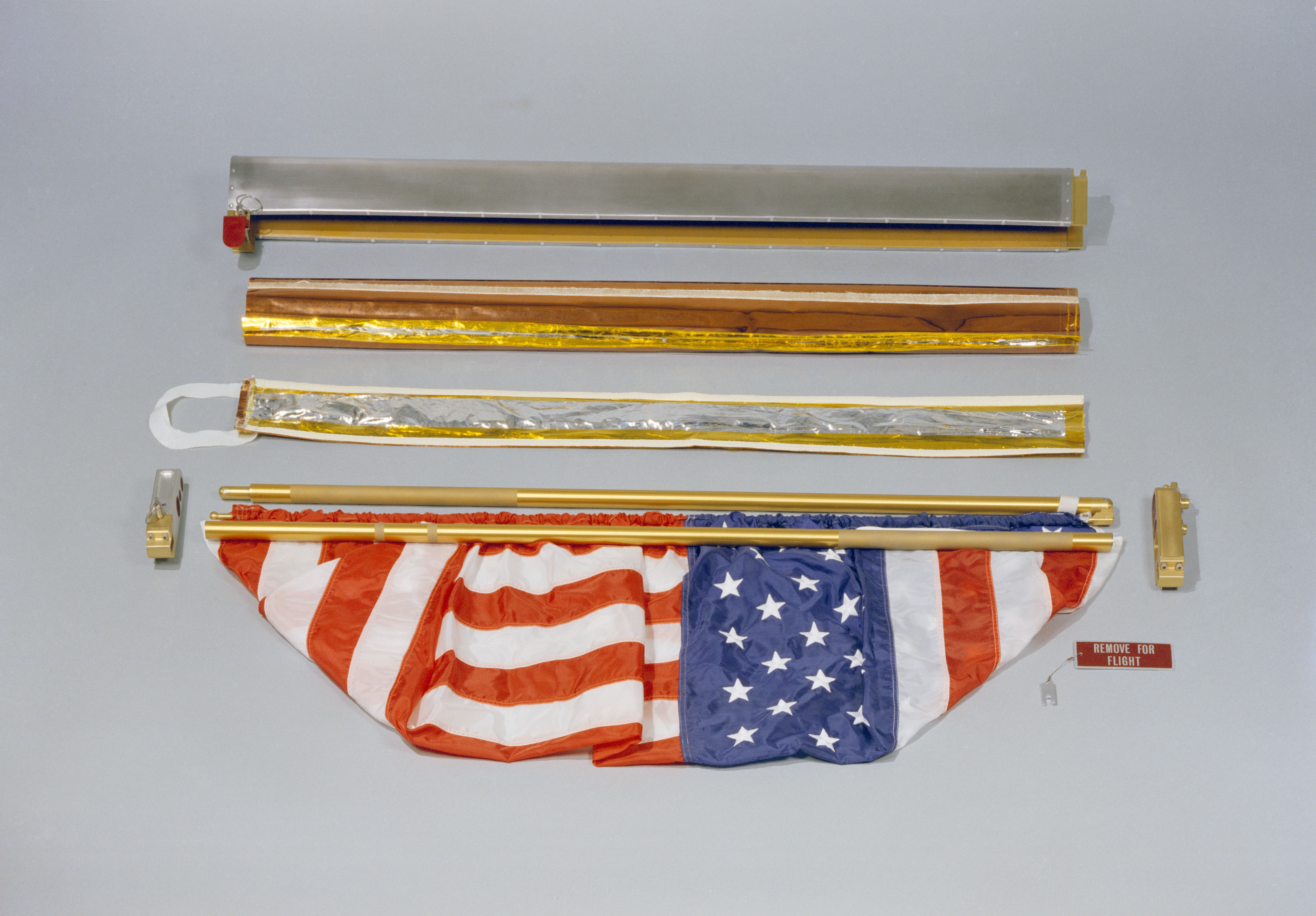
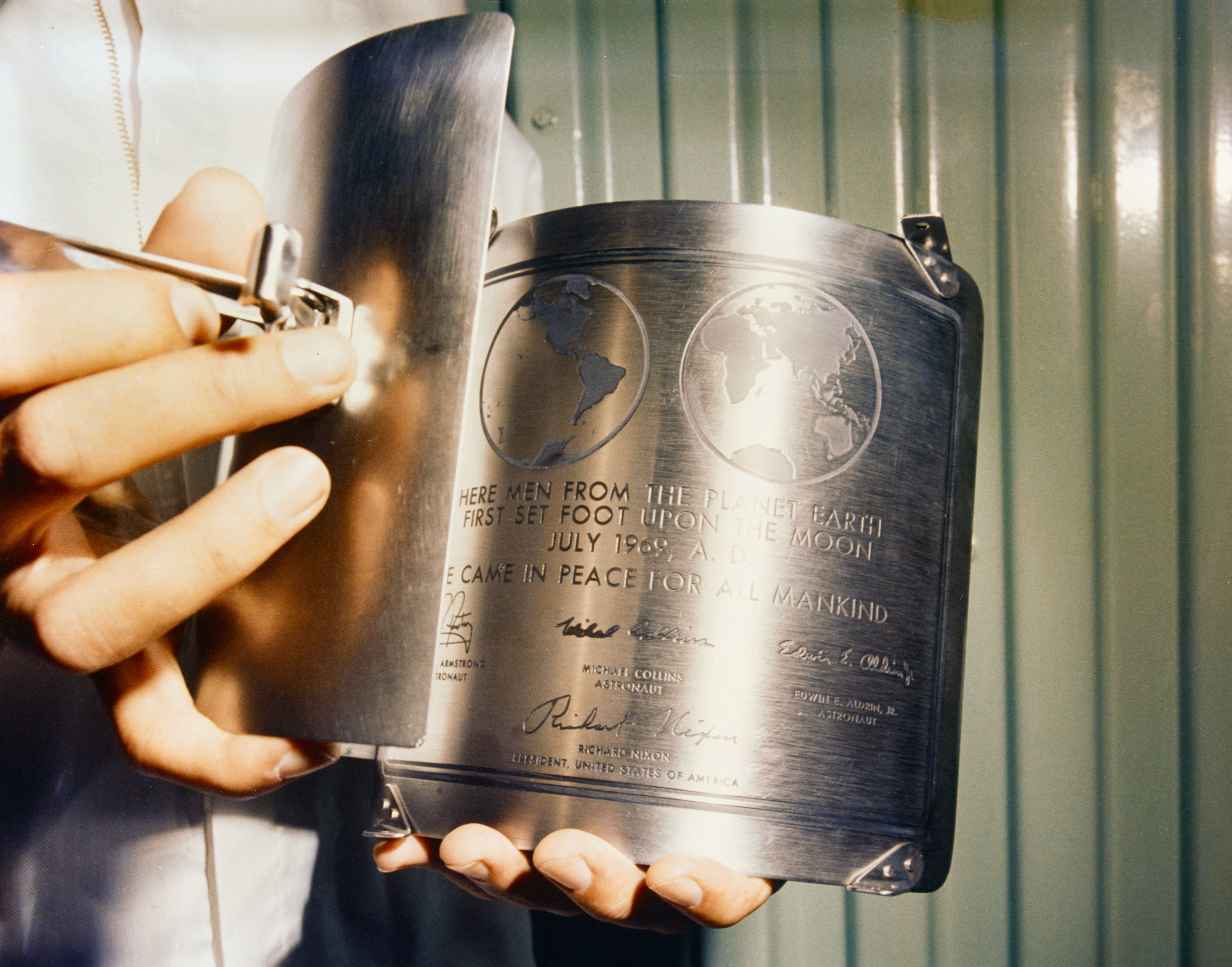
The Lunar Flag Assembly The stainless steel commemorative plaque The silicon disc containing messages of goodwill from world leaders
The three commemorative items carried aboard Apollo 11. Left: The Lunar Flag Assembly. Middle: The stainless steel commemorative plaque. Right: The silicon disc containing messages of goodwill from world leaders.

On July 2, NASA announced that Armstrong and Aldrin would leave three symbolic items behind on the Moon to commemorate the historic first landing – an American flag, a commemorative plaque, and a silicon disc bearing messages from world leaders. The astronauts would plant the three-by-five-foot flag near their LM during their spacewalk. The stainless steel plaque bore the images of the two hemispheres of the Earth and this inscription,

HERE MEN FROM THE PLANET EARTH

FIRST SET FOOT UPON THE MOON

JULY 1969 A.D.

WE CAME IN PEACE FOR ALL MANKIND

The signatures of the three astronauts and President Richard M. Nixon also appeared on the plaque. Workers mounted it on the forward landing leg strut of the LM. The one-and-one-half-inch silicon disc contained messages of goodwill from 73 world leaders, etched on the disk using the technique to make microcircuits for electronic equipment. The crew placed the disc on the lunar surface at the end of their spacewalk.
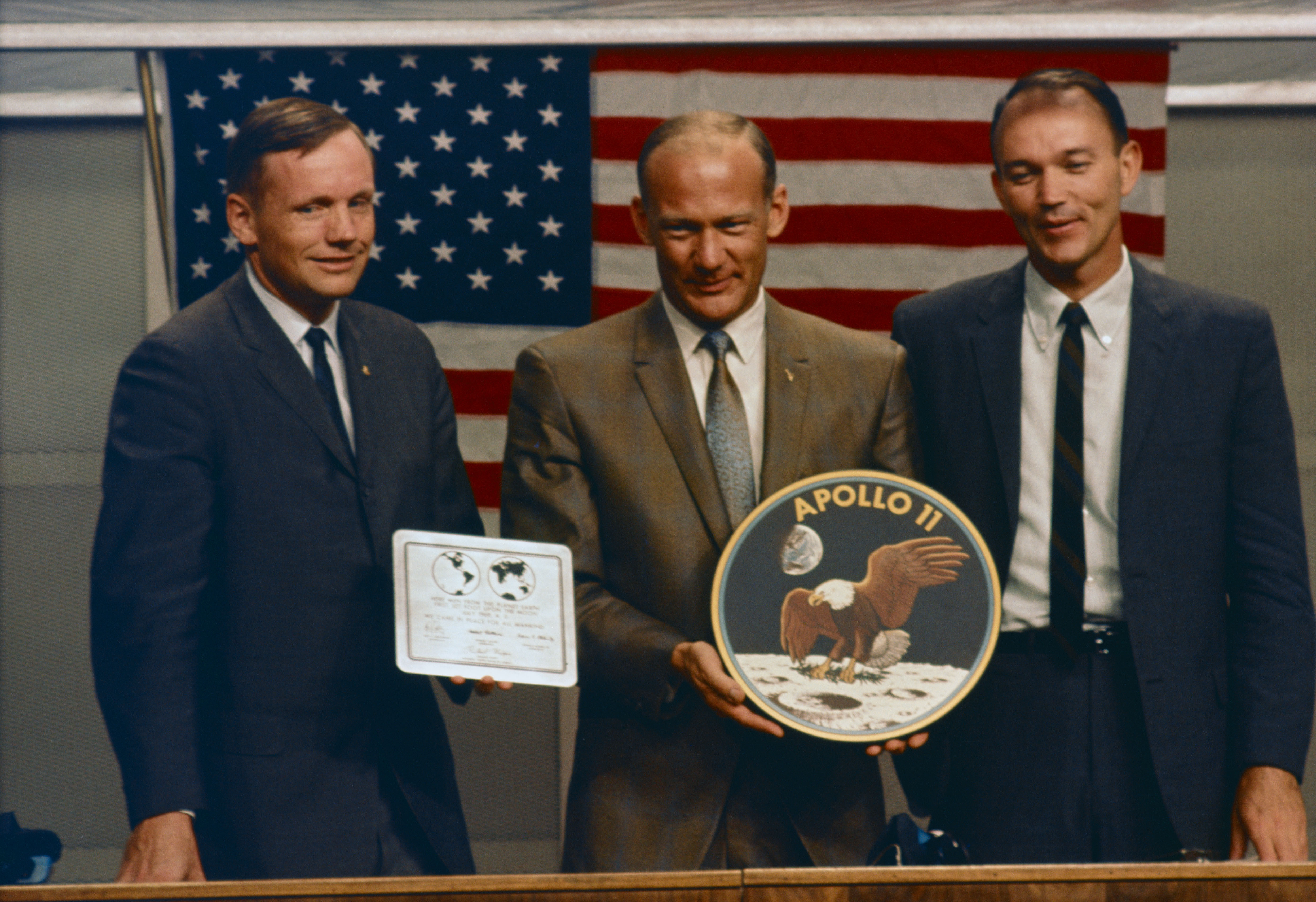
Apollo 11 astronauts Neil A. Armstrong, left, Edwin E. “Buzz” Aldrin, and Michael Collins hold a copy of the commemorative plaque they will leave behind on the Moon and their mission patch The Apollo 11 astronauts in the glass-enclosed room at the Lunar Receiving Laboratory
Left: Apollo 11 astronauts Neil A. Armstrong, left, Edwin E. “Buzz” Aldrin, and Michael Collins hold a copy of the commemorative plaque they will leave behind on the Moon and their mission patch. Right: The Apollo 11 astronauts in the glass-enclosed room at the Lunar Receiving Laboratory.

During a July 5 press conference in the MSC auditorium, the Apollo 11 astronauts revealed the call signs for their spacecraft. They named their CM Columbia and their LM Eagle. “We selected these as being representative of the flight, the nation’s hope,” said Armstrong. Columbia served as a national symbol represented by a statue atop the Capitol in Washington, D.C. They named the LM after the symbol of the United States, the bald eagle, featured on the Apollo 11 mission patch. In a second event, the astronauts answered reporters’ questions from inside a glass-enclosed conference room at MSC’s Lunar Receiving Laboratory (LRL). After their mission, the returning astronauts completed their 21-day quarantine in the LRL to prevent any back contamination of the Earth by any possible lunar microorganisms.
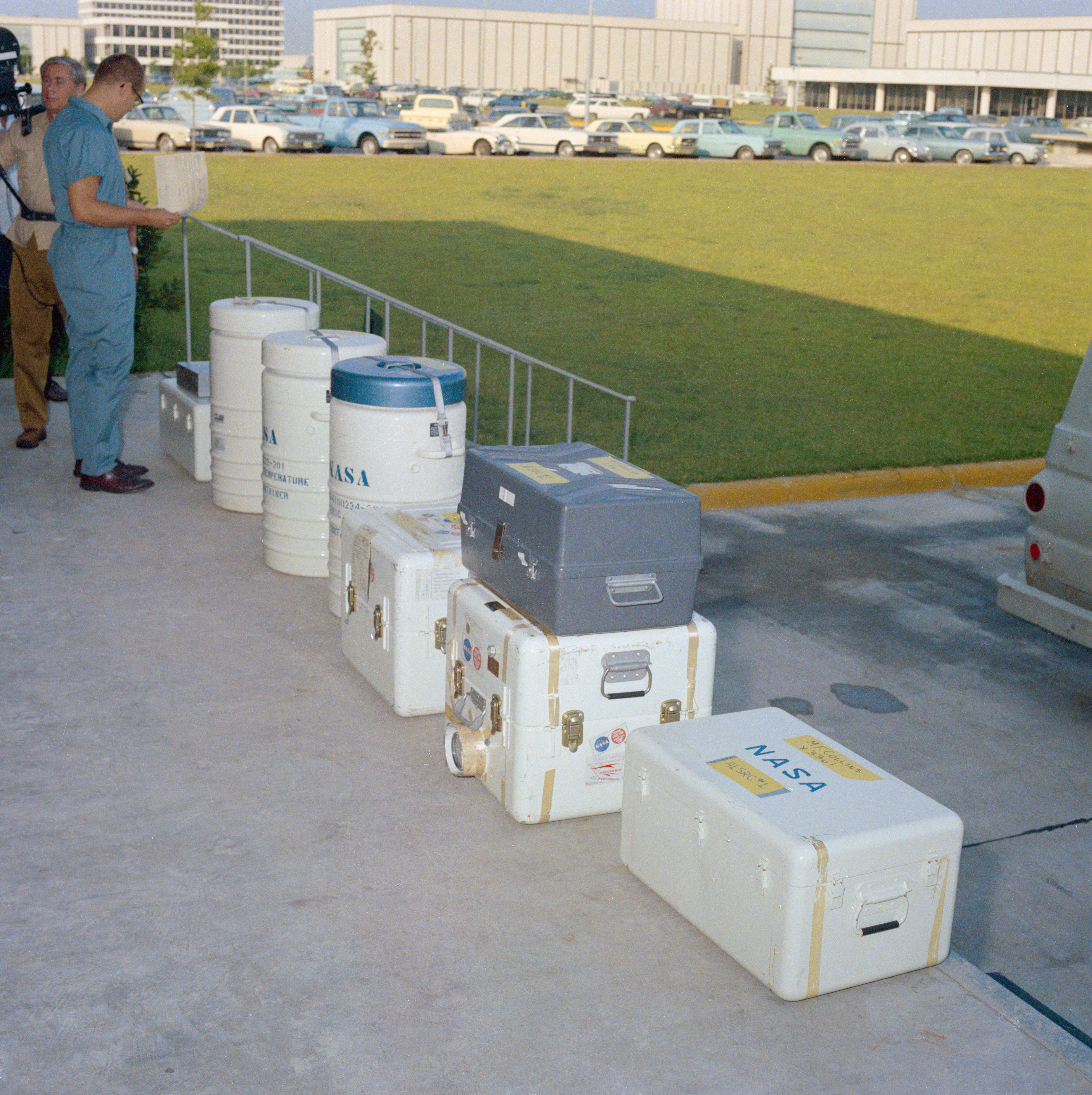
On the loading dock of the Lunar Receiving Laboratory (LRL) at the Manned Spacecraft Center, now NASA’s Johnson Space Center in Houston, workers simulate the arrival of the first Moon rocks and other items returned from Apollo 11 Workers practice docking the Mobile Quarantine Facility (MQF) with the LRL In Pearl Harbor, Hawaii, workers barge the prime and backup MQFs to load them onto the U.S.S. Hornet
NASA’s Johnson Space Center in Houston, workers simulate the arrival of the first Moon rocks and other items returned from Apollo 11. Middle: Workers practice docking the Mobile Quarantine Facility (MQF) with the LRL. Right: In Pearl Harbor, Hawaii, workers barge the prime and backup MQFs to load them onto the U.S.S. Hornet. Image credit: courtesy U.S. Navy.

At the LRL, other preparations for the return of the Apollo 11 astronauts from the Moon included a simulation of the arrival and processing of the Moon rocks and other items following the mission. The rocks, crew biological samples, and film would be flown from the prime recovery ship to Houston ahead of the crew. Engineers and technicians also rehearsed the arrival of the crew with a dry run of docking a Mobile Quarantine Facility (MQF) to the LRL’s loading dock. Following the test, workers loaded two MQFs, a prime and a backup, onto a cargo plane for transport to Hawaii and loading onto the prime recovery ship.
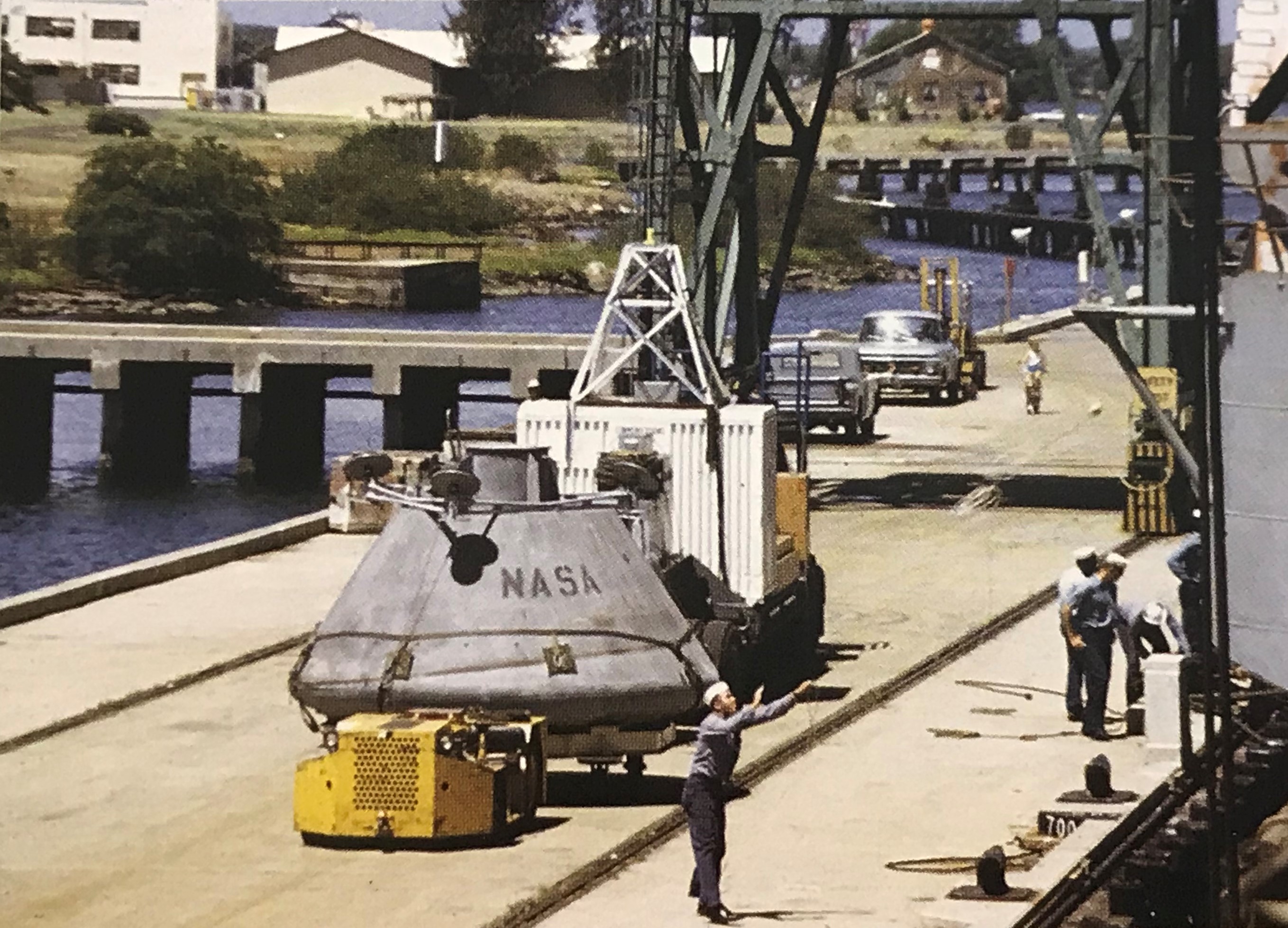
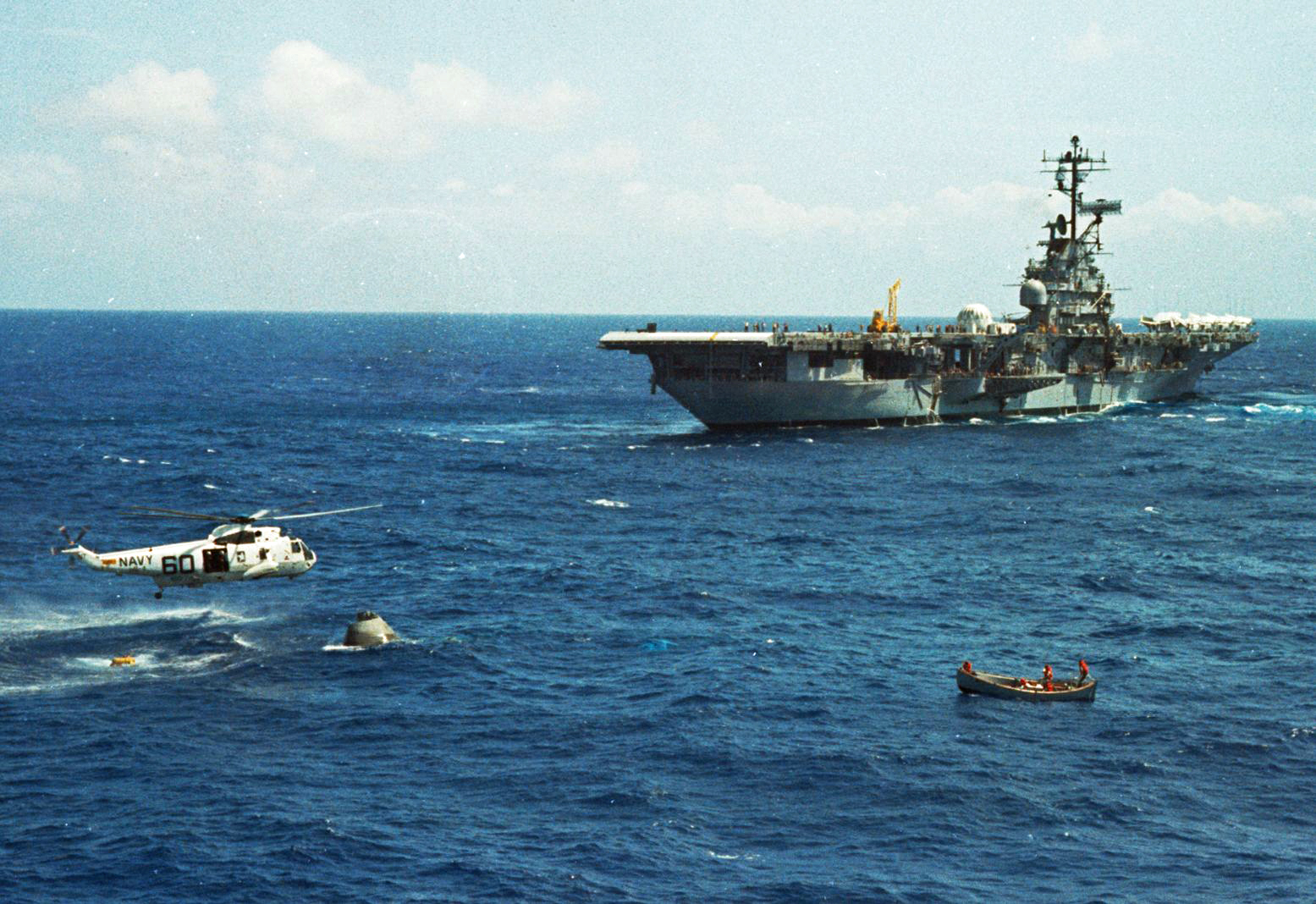
Workers in Pearl Harbor, Hawaii, prepare to lift a boilerplate Apollo Command Module onto the U.S.S. Hornet for splashdown and recovery rehearsals Crews from the U.S.S. Hornet practice recovery operations Recovery team members dry their Biological Isolation Garments aboard the U.S.S. Hornet following a recovery exercise
Left: Workers in Pearl Harbor, Hawaii, prepare to lift a boilerplate Apollo Command Module onto the U.S.S. Hornet for splashdown and recovery rehearsals. Image credit: courtesy U.S. Navy Bob Fish. Middle: Crews from the U.S.S. Hornet practice recovery operations. Right: Recovery team members dry their Biological Isolation Garments aboard the U.S.S. Hornet following a recovery exercise.

On June 12, the U.S. Navy notified NASA that it had selected the U.S.S. Hornet (CVS-12) as the prime recovery ship for Apollo 11 to undertake the most complex recovery of an astronaut crew. The same day, with Hornet docked in her home port of Long Beach, California, its commanding officer, Capt. Carl J. Seiberlich, held the first recovery team meeting to review the Apollo Recovery Operations Manual, written by MSC’s Landing and Recovery Division. Between June 12 and 25, Hornet onloaded NASA equipment required for the recovery. On June 27, Hornet left Long Beach for a three-hour stop in San Diego, where air group maintenance and support personnel embarked. The next day, after Hornet left for Pearl Harbor, Hawaii, pilots flew the aircraft required to support the recovery onto the carrier. During the cruise to Pearl Harbor, Hornet’s 90-man team detailed for Apollo 11 recovery operations held numerous meetings and table-top simulations. After arriving in Hawaii on July 2, workers loaded a boilerplate Apollo capsule onto the aircraft carrier to be used for recovery practice. The NASA recovery team, the Frogmen swimmers from the U.S. Navy’s Underwater Demolition Team 11 (UDT-11) who assisted with the recovery, and some media personnel arrived onboard. For the recovery operation, Capt. Seiberlich adopted the motto “Hornet Plus Three,” indicating the goal of a safe recovery of the three astronauts returning from the Moon. On July 3, Capt. Seiberlich introduced the 35-member NASA recovery team to the Hornet’s crew. Donald E. Stullken, Chief of the Recovery Operations Branch at MSC and inventor of the inflatable flotation collar attached by swimmers to the capsule after splashdown, led the NASA team. His assistant John C. Stonesifer oversaw the decontamination and quarantine operations. Stullken and Stonesifer briefed Hornet’s Command Module Retrieval Team on all events associated with the recovery and retrieval of an Apollo capsule and its crew. On July 6, workers loaded the two MQFs aboard Hornet. The prime MQF would house the returning astronauts, a flight surgeon, and an engineer from shortly after splashdown until their arrival at the LRL in Houston several days later. The second MQF served as a backup should a problem arise with the first or if violations of quarantine protocols required additional personnel to be isolated. Along with the MQFs, Navy personnel loaded other equipment necessary for the recovery, including 55 one-gallon containers of sodium hypochlorite to be used as a disinfectant. Between July 7 and 9, the Hornet conducted nine Simulated Recovery Exercises in local Hawaiian waters. Lieutenant Clarence J. “Clancy” Hatleberg led the team as the designated decontamination swimmer with U.S. Navy Frogmen serving as stand-ins for the astronauts, all wearing Biological Isolation Garments as they would on recovery day. The Hornet returned to Pearl Harbor to pick up the rest of the NASA recovery team before setting sail on July 12 for its first recovery position. 

Apollo 12

Conrad after completing a flight in the Lunar Landing Training Vehicle
Left: Apollo 12 astronauts Charles “Pete” Conrad, left, Alan L. Bean, and Richard F. Gordon prepare to enter their Command Module for an altitude test. Right: Conrad after completing a flight in the Lunar Landing Training Vehicle.
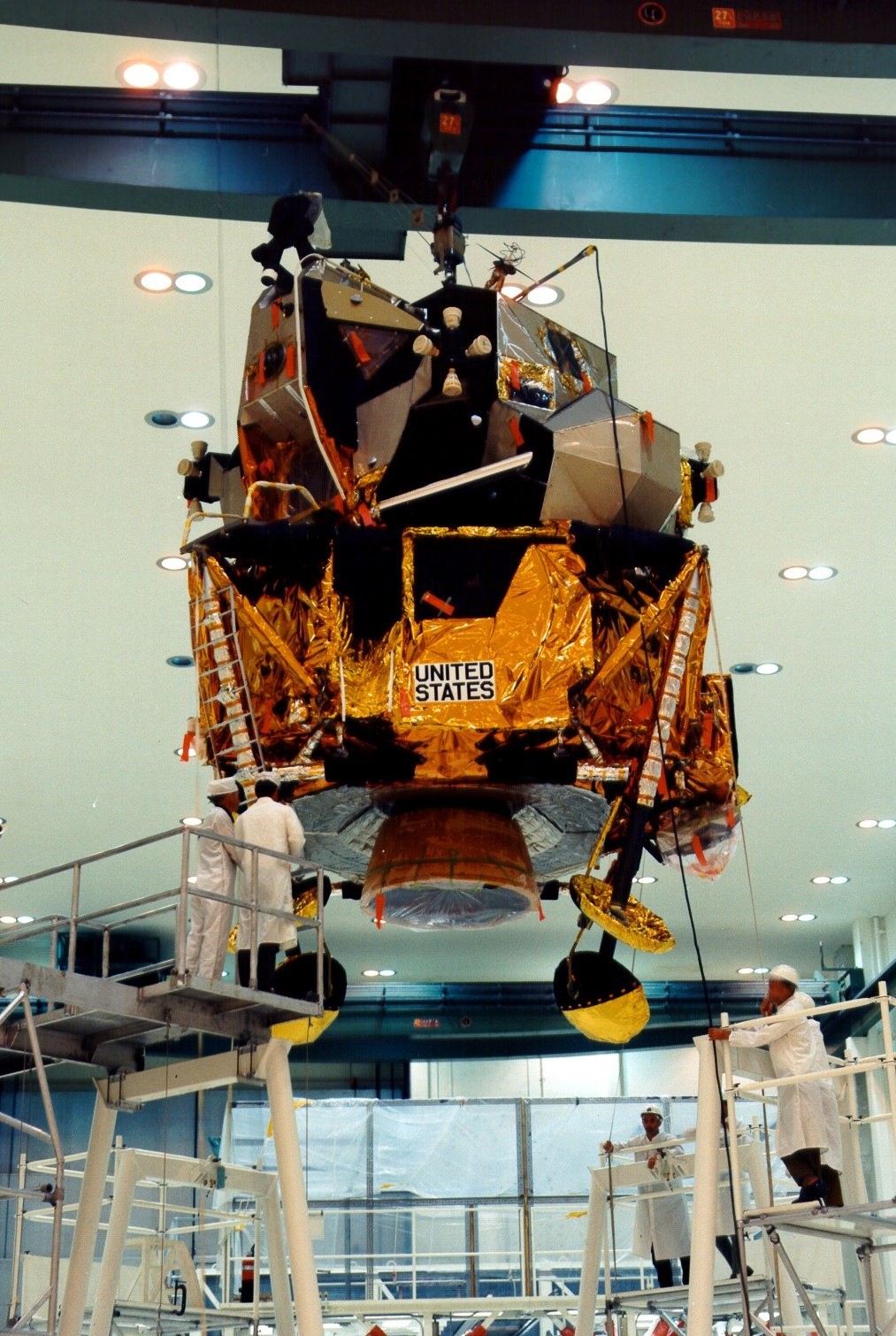
In the Manned Spacecraft Operations Building (MSOB) at NASA’s Kennedy Space Center, workers finish attaching the landing gear to the Apollo 12 Lunar Module (LM) Workers in the MSOB prepare to mate the Apollo 12 Command and Service Modules with the Spacecraft LM Adapter Workers move the assembled Apollo 12 spacecraft from the MSOB to the Vehicle Assembly Building (VAB) In the VAB. workers lower the Apollo 12 spacecraft onto its Saturn V rocket
Left: In the Manned Spacecraft Operations Building (MSOB) at NASA’s Kennedy Space Center, workers finish attaching the landing gear to the Apollo 12 Lunar Module (LM). Middle left: Workers in the MSOB prepare to mate the Apollo 12 Command and Service Modules with the Spacecraft LM Adapter. Middle right: Workers move the assembled Apollo 12 spacecraft from the MSOB to the Vehicle Assembly Building (VAB). Right: In the VAB. workers lower the Apollo 12 spacecraft onto its Saturn V rocket.

With Apollo 11 on its launch pad, workers continued to prepare Apollo 12 for its eventual journey to the Moon, targeting a September launch should Apollo 11 not succeed. If Apollo 11 succeeded in its Moon landing mission, Apollo 12 would fly later, most likely in November, to attempt the second Moon landing at a different location. In KSC’s Vehicle Assembly Building (VAB), the three-stage Saturn V stood on its Mobile Launcher, awaiting the arrival of the Apollo spacecraft. In the nearby Manned Spacecraft Operations Building, the Apollo 12 prime crew of Charles “Pete” Conrad, Richard F. Gordon, and Alan L. Bean and their backups David R. Scott, Alfred M. Worden, and James B. Irwin completed altitude chamber tests of the CM and LM during the first two weeks of June. Workers removed the spacecraft from the vacuum chambers, mated them on June 27, and transferred them to the VAB on July 1 for stacking on the Saturn V rocket. At Ellington AFB in Houston, Conrad completed his first flights aboard LLTV-2 on July 9-10.

Apollo 13
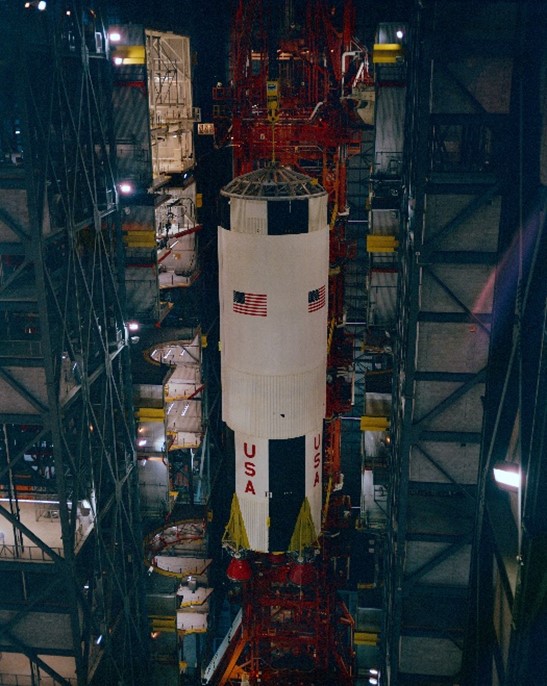
In the Vehicle Assembly Building at NASA’s Kennedy Space Center (KSC) in Florida, workers place the first stage of the Apollo 13 Saturn V rocket onto the Mobile Launcher to begin the stacking process The Apollo 13 Command and Service Modules arrive at KSC The ascent stage of the Apollo 13 Lunar Module arrives at KSC
Left: In the Vehicle Assembly Building at NASA’s Kennedy Space Center (KSC) in Florida, workers place the first stage of the Apollo 13 Saturn V rocket onto the Mobile Launcher to begin the stacking process. Middle: The Apollo 13 Command and Service Modules arrive at KSC. Right: The ascent stage of the Apollo 13 Lunar Module arrives at KSC.

In the event that neither Apollo 11 nor 12 succeeded in landing on the Moon, NASA stood prepared to try a third time with Apollo 13 in November or December, still in time to meet President Kennedy’s deadline. The Apollo 13 Command and Service Modules arrived at KSC on June 26, followed by the LM ascent and descent stages on June 28 and 29, respectively. The Saturn V’s S-IC first stage arrived on June 16 and workers placed it on its Mobile Launcher two days later. The S-IVB third stage and S-II second stage arrived June 13 and 29, respectively, and workers stacked the stages in mid-July.

To be continued …

News from around the world in June 1969:

June 3 – Eric Carle publishes children’s picture book “The Very Hungry Caterpillar.”

June 3 – The final episode of Star Trek airs on NBC.

June 5 – The Tupolev Tu-144 became the first passenger jet to fly faster than the speed of sound.

June 10 – The Nixon Administration cancels the U.S. Air Force Manned Orbiting Laboratory program.

June 15 – “Hee Haw,” with Roy Clark and Buck Owens, premieres on CBS.

June 20 – Georges Pompidou sworn in as the 19th President of France.

June 20 – 200,000 attend Newport ’69, then largest-ever pop concert, in Northridge, California.

June 23 – Warren E. Burger sworn in as U.S. Supreme Court Chief Justice.

June 28 – Police carry out a raid at the Stonewall Inn in Greenwich Village, New York, beginning the modern LGBT rights movement.

Powered by WPeMatico

Get The Details…
Kelli Mars

NASA Releases Updated Climate Change Adaptation, Resilience Plan

NASA Releases Updated Climate Change Adaptation, Resilience Plan

Artist’s concept of the Earth drawn from data from multiple satellite missions and created by a team of NASA scientists and graphic artists.
Credit: NASA Images By Reto Stöckli, Based On Data From NASA And NOAA

NASA joined more than 20 federal agencies in releasing its updated Climate Adaptation Plan Thursday, helping expand the Biden-Harris Administration’s efforts to make federal operations increasingly resilient to the impacts of climate change for the benefit of all.

The updated plans advance the administration’s National Climate Resilience Framework, which helps align climate resilience investments across the public and private sectors through common principles and opportunities.

“Thanks to the leadership of the Biden-Harris Administration, we are strengthening climate resilience to ensure humanity is well-prepared for the effects of climate change,” said NASA Administrator Bill Nelson. “NASA’s decades of Earth observation are key to building climate resiliency and sustainability across the country and the world.”

NASA serves as a global leader in Earth science, providing researchers with crucial data from its satellites and other assets, as well as other observations and research on the climate system. The agency also works to apply that knowledge and inform the public about climate change. NASA will continue to prioritize these efforts and maintain an open information policy that makes its science data, software, and research freely available to all.

Climate variability and change also have potential impacts on NASA’s ability to fulfill its mission, requiring proactive planning and action from the agency. To ensure coastal flooding, extreme weather events, and other climate change impacts do not stop the agency’s work, NASA is improving its climate hazard analyses and developing plans to protect key resources and facilities.  

“As communities face extreme heat, natural disasters and severe weather from the impacts of climate change, President Biden is delivering record resources to build climate resilience across the country,” said Brenda Mallory, chair of the White House Council on Environmental Quality. “Through his Investing in America agenda and an all-of-government approach to tackling the climate crisis, the Biden-Harris Administration is delivering more than $50 billion to help communities increase their resilience and bolster protections for those who need it most. By updating our own adaptation strategies, the federal government is leading by example to build a more resilient future for all.”

At the beginning of his administration, President Biden tasked federal agencies with leading whole-of-government efforts to address climate change through Executive Order 14008, Tackling the Climate Crisis at Home and Abroad. Following the magnitude of challenges posed by the climate crisis underscored last year when the nation endured a record 28 individual billion-dollar extreme weather and climate disasters that caused more than $90 billion in aggregate damage, NASA continues to be a leader and partner in adaptation and resilience.

NASA released its initial Climate Adaptation Plan in 2021 and progress reports outlining advancements toward achieving their adaptation goals in 2022. In coordination with the White House Council on Environmental Quality and the Office of Management and Budget, agencies updated their Climate Adaptation Plans for 2024 to 2027 to better integrate climate risk across their mission, operations, and asset management, including:

  • Combining historical data and projections to assess exposure of assets to climate-related hazards including extreme heat and precipitation, sea level rise, flooding, and wildfire.
  • Expanding the operational focus on managing climate risk to facilities and supply chains to include federal employees and federal lands and waters.
  • Broadening the mission focus to describe mainstreaming adaptation into agency policies, programs, planning, budget formulation, and external funding.
  • Linking climate adaptation actions with other Biden-Harris Administration priorities, including advancing environmental justice and the President’s Justice40 Initiative, strengthening engagement with Tribal Nations, supporting the America the Beautiful initiative, scaling up nature-based solutions, and addressing the causes of climate change through climate mitigation.
  • Adopting common progress indicators across agencies to assess the progress of agency climate adaptation efforts.

All plans from each of the more than 20 agencies and more information are available online.

To learn more about Earth science research at NASA, visit:

https://science.nasa.gov/earth-science//

-end-

Rob Margetta
Headquarters, Washington 
202-358-0918
robert.j.margetta@nasa.gov

Powered by WPeMatico

Get The Details…
Abbey A. Donaldson

NASA, Partners Conduct Fifth Asteroid Impact Exercise, Release Summary

NASA, Partners Conduct Fifth Asteroid Impact Exercise, Release Summary

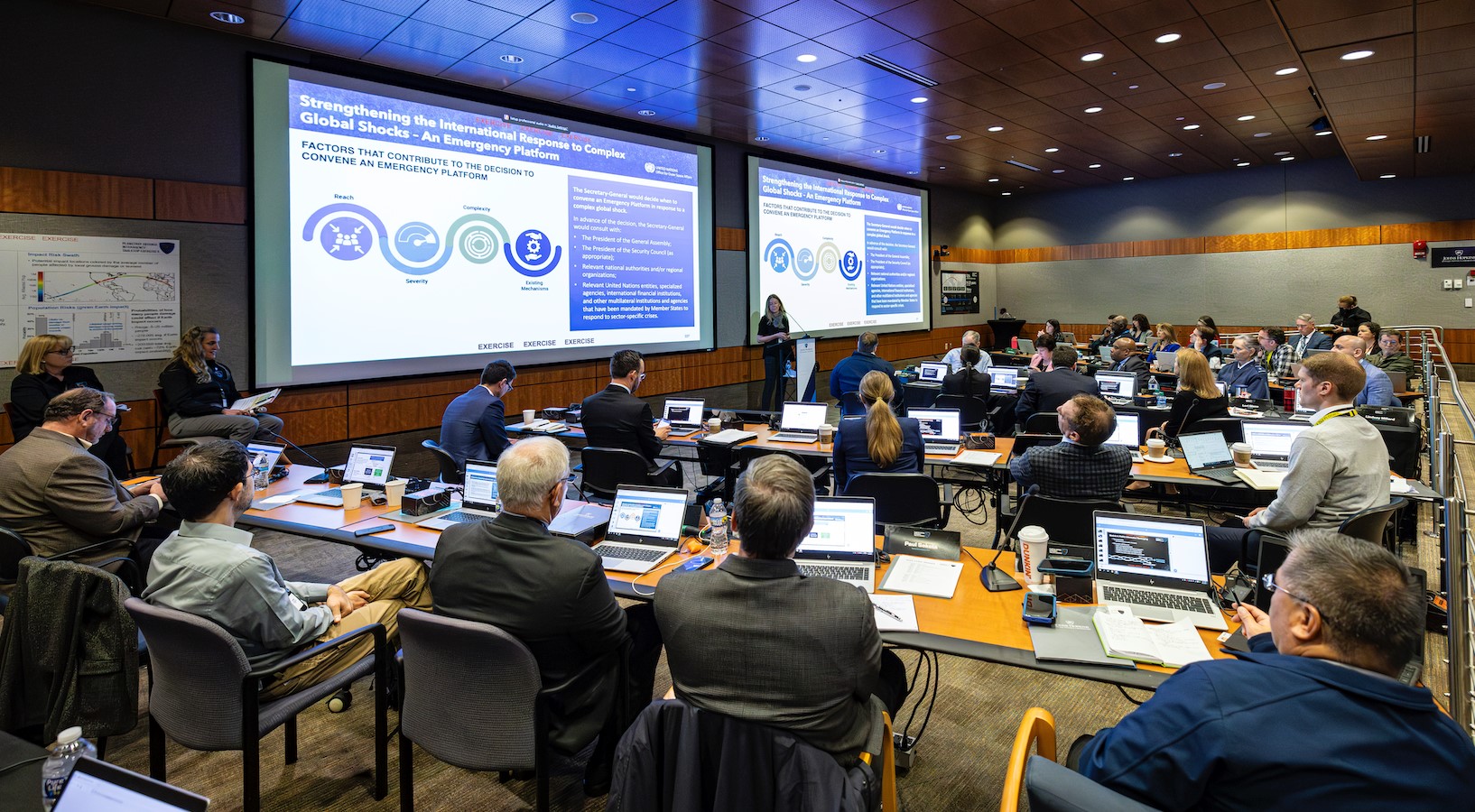
Representatives from NASA, FEMA, and the planetary defense community participate in the 5th Planetary Defense Interagency Tabletop Exercise to inform and assess our ability as a nation to respond effectively to the threat of a potentially hazardous asteroid or comet.
Credits: NASA/JHU-APL/Ed Whitman

For the benefit of all, NASA released a summary Thursday of the fifth biennial Planetary Defense Interagency Tabletop Exercise. NASA’s Planetary Defense Coordination Office, in partnership with FEMA (Federal Emergency Management Agency) and with the assistance of the U.S. Department of State Office of Space Affairs, convened the tabletop exercise to inform and assess our ability as a nation to respond effectively to the threat of a potentially hazardous asteroid or comet.

Although there are no known significant asteroid impact threats for the foreseeable future, hypothetical exercises provide valuable insights by exploring the risks, response options, and opportunities for collaboration posed by varying scenarios, from minor regional damage with little warning to potential global catastrophes predicted years or even decades in the future.

“The uncertainties in these initial conditions for the exercise allowed participants to consider a particularly challenging set of circumstances,” said Lindley Johnson, planetary defense officer emeritus NASA Headquarters in Washington. “A large asteroid impact is potentially the only natural disaster humanity has the technology to predict years in advance and take action to prevent.”

During the exercise, participants considered potential national and global responses to a hypothetical scenario in which a never-before-detected asteroid was identified that had, according to initial calculations, a 72% chance of hitting Earth in approximately 14 years. The preliminary observations described in the exercise, however, were not sufficient to precisely determine the asteroid’s size, composition, and long-term trajectory. To complicate this year’s hypothetical scenario, essential follow-up observations would have to be delayed for at least seven months – a critical loss of time – as the asteroid passed behind the Sun as seen from Earth’s vantage point in space.

Conducting exercises enable government stakeholders to identify and resolve potential issues as part of preparation for any real-world situation. It was held in April at the Johns Hopkins Applied Physics Laboratory (APL) in Laurel, Maryland, and brought together nearly 100 representatives from across U.S. government agencies and, for the first time, international collaborators on planetary defense.

“Our mission is helping people before, during, and after disasters,” said Leviticus “L.A.” Lewis, FEMA detailee to NASA’s Planetary Defense Coordination Office. “We work across the country every day before disasters happen to help people and communities understand and prepare for possible risks. In the event of a potential asteroid impact, FEMA would be a leading player in interagency coordination.” 

This exercise was the first to use data from NASA’s DART (Double Asteroid Redirection Test) mission, the first in-space demonstration of a technology for defending Earth against potential asteroid impacts. The DART spacecraft, which impacted the asteroid moonlet Dimorphos on Sept. 26, 2022, confirmed a kinetic impactor could change the trajectory of an asteroid. Applying this or any type of technology to an actual impact threat would require many years of advance planning.

To help ensure humanity will have the time needed to evaluate and respond to a potentially hazardous asteroid or comet, NASA continues the development of its NEO Surveyor (Near-Earth Object Surveyor), an infrared space telescope designed specifically to expedite our ability to discover and characterize most of the potentially hazardous near-Earth objects many years before they could become an impact threat. The agency’s NEO Surveyor’s proposed launch date is set for June 2028.

NASA will publish a complete after-action report for the tabletop exercise later, which will include strengths and gaps identified from analysis of the response, other discussions during the exercise, and recommendations for improvement.

“These outcomes will help to shape future exercises and studies to ensure NASA and other government agencies continue improving planetary defense preparedness,” said Johnson.

NASA established the Planetary Defense Coordination Office in 2016 to manage the agency’s ongoing planetary-defense efforts. Johns Hopkins APL managed the DART mission for NASA as a project of the agency’s Planetary Missions Program Office.

To learn more about planetary defense at NASA, visit:

https://science.nasa.gov/planetary-defense/

-end-

Charles Blue / Karen Fox
Headquarters, Washington 
202-802-5345 / 202-358-1600
charles.e.blue@nasa.gov / karen.fox@nasa.gov

Powered by WPeMatico

Get The Details…
Tiernan P. Doyle