Station Schedule Returns to Science on Tuesday

Station Schedule Returns to Science on Tuesday

A red sprite is pictured above the white light of an active thunderstorm as the space station orbited above North America in August of 2015.

Microgravity science picked up on Tuesday following the previous day’s focus on lab maintenance and housecleaning activities aboard the International Space Station. The nine orbital residents set up a host of science gear for external research and explored future space piloting techniques while also concentrating on daily household tasks.

Starliner Commander Butch Wilmore from NASA pointed a pair of cameras in the cupola toward Earth for thunderstorm monitoring. He plugged the high-speed Thor-Davis camera and a regular digital camera into the Astro Pi computer to record lightning and electrical activity at speeds up to 100,000 frames per second. Observations may help improve Earth climate models, lead to a better understanding of atmospheric dynamics, and demonstrate the advanced camera’s potential for future space applications.

NASA astronaut and Starliner Pilot Suni Williams installed the ArgUS Mission 1 research hardware inside the NanoRacks Bishop airlock where it will soon be robotically placed outside in the vacuum of space for experimentation. The advanced technology demonstration consists of three types of payloads designed to explore communications, computer processing, and high-definition video in the external microgravity environment.

Expedition 71 Flight Engineer Tracy C. Dyson spent the first half of her day inspecting a variety of station hardware including cryogenic gloves, cold stowage hardware, and the BioFabrication Facility, a research device being tested for its ability to print organ-like tissues in microgravity. During the afternoon, Dyson turned her attention to commercial activities and tested proprietary gear inside the Kibo laboratory module.

NASA Flight Engineers Matthew Dominick, Mike Barratt, and Jeanette Epps spent all day Tuesday on maintenance tasks. Dominick replaced carbon dioxide removal components in the Destiny laboratory module then videotaped his crew quarters’ airflow ducts as mission controllers monitored in real time. Barratt cleaned ventilation systems in his crew quarters located in the port side of the Harmony module before servicing electronic components on the Kermit fluorescence microscope. Epps started her day relocating a vibration sensor then took a cognition test just before lunchtime. In the afternoon, she set up a thigh cuff to study space-caused fluid shifts in astronauts then examined electrical systems supporting life support components.

Station Commander Oleg Kononenko from Roscosmos was back on inspection activities in the aft end of the Zvezda service module. He photographed glass panes and installed a smoke detector in Zvezda’s rear port where the Progress 87 cargo craft is docked. Flight Engineer Nikolai Chub studied futuristic spacecraft and robotic piloting techniques on a computer during the morning then assisted Kononenko with the Zvezda inspection activities in the afternoon. Flight Engineer Alexander Grebenkin focused his efforts on life support system maintenance in the orbital outpost’s Roscosmos segment.


Learn more about station activities by following the space station blog@space_station and @ISS_Research on X, as well as the ISS Facebook and ISS Instagram accounts.

Get weekly video highlights at: https://roundupreads.jsc.nasa.gov/videoupdate/

Get the latest from NASA delivered every week. Subscribe here: www.nasa.gov/subscribe

Powered by WPeMatico

Get The Details…

Mark Garcia

Designing Space Exploration With the Human in Mind

Designing Space Exploration With the Human in Mind

When designing a new spacecraft or exploration vehicle, there is intense focus on its technical performance. Do its systems perform as expected? What kind of power does it need? Will it safely reach its destination?

Equally important, however, is whether that vehicle also works for the humans inside. Can astronauts easily reach critical controls? Do the seats conform to a crew member regardless of their height and body size? Does the layout of crew workstations, translation paths, stowage, and other items support effective working and living conditions?

Those are just a few of the questions NASA’s Center for Design and Space Architecture (CDSA) seeks to answer. Based within the Human Health and Performance Directorate at Johnson Space Center in Houston, the CDSA is NASA’s conceptual, human-centered design studio. It creates advanced concepts for spacecraft, exploration vehicles, and habitats that put crew needs first. The team provides a full spectrum of design services, from concept sketches to CAD models, to scaled mockups and virtual reality (VR), to full-size prototype fabrication.

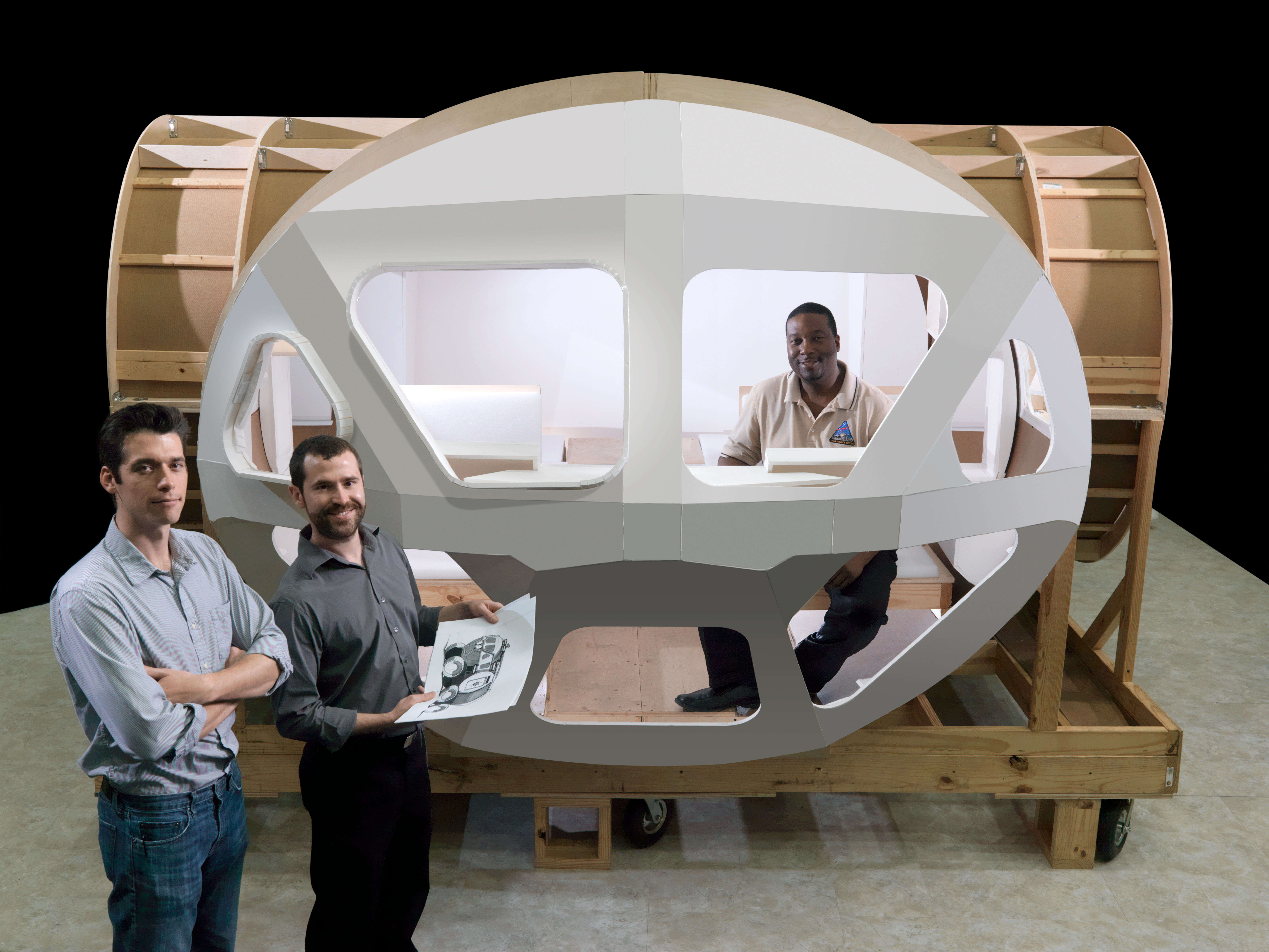
Three male NASA engineers perform a window node visibility study on the mockup of the Space Exploration Vehicle.
Carl Conlee, Evan Twyford, and Dr. Robert Howard perform a window node visibility study on the mockup of the Space Exploration Vehicle.
NASA

The CDSA has been an integral partner in the design of everything from dining tables for the International Space Station to ergonomic seats for the Orion spacecraft, and private sleeping bunks for the Space Exploration Vehicle (also known as the Small Pressurized Rover). The multidisciplinary team also played key roles in the design and construction of analog habitats onsite at Johnson, including the Human Exploration Research Analog (HERA) and the Crew Health And Performance Exploration Analog (CHAPEA) habitats where volunteer crews recently completed simulated Mars missions.

Dr. Robert Howard, CDSA co-lead and habitability domain lead, explained that the current HERA habitat was initially developed as the ground-test version of a lunar habitat envisioned by the Constellation Program. The CDSA team built medical operations and suit maintenance workstations, stowage systems, cameras, and outfitting supplies for the habitat, known then as the Habitat Demonstration Unit. Later, the team added a galley, exercise and stowage space, and crew quarters to university-built inflatable upper decks. They also outfitted the interior of a hygiene module provided by the Jet Propulsion Laboratory, helped Kennedy Space Center’s plant growth team locate their experiments in the habitat, and worked with the Human Factors Engineering Laboratory to develop crew procedures for testing the habitats at Johnson and in Arizona.

“The plan was to excess the habitat when the program ended, but CDSA realized the asset was too valuable and we campaigned to find a new owner for the mockup,” Howard said. “That led to the birth of HERA. The Human Research Program now performs the day-to-day maintenance and conducts the HERA missions.”

A NASA engineer presents an all-white model of a lunar lander to a group of former NASA astronauts.
Dr. Robert Howard (left) briefs Apollo astronauts Gene Cernan, Neil Armstrong, and Harrison Schmitt on the Altair lunar lander mockup.
NASA

For CHAPEA, the CDSA worked with NASA teams and commercial partners to determine the habitat’s necessary functions and layout, assisted with furniture installation, provided design consultation and fabrication assistance for an external airlock, and designed and built a docking node.

Another part of the CDSA’s work is the development of NASA test units for partner-produced vehicles and spacecraft. “In the early phases of a project, these test units can help NASA understand what requirements we want to levy on the partner,” Howard explained. “Later, they can be used to emulate partner concepts and NASA can perform independent studies with them, either to assess partner capabilities or to predict the impacts of possible changes.”

The CDSA team can also build replicas of contractor mockups for crew training or additional testing. They are currently supporting development of lunar surface logistics, a pressurized rover, and Gateway components, too. 

Three NASA engineers conduct habitability testing inside a mockup of a Gateway space station module.
Center for Design and Space Architecture team members test a Gateway habitat mockup. From left are Brett Montoya, Taylor Phillips-Hungerford, and Zachary Taylor.
NASA/Robert Markowitz

In addition to Howard, the CDSA team includes Maijinn Chen, the technical discipline lead for space architecture, and Nathan Moore, the technical discipline lead for fabrication, as well as nearly a dozen contractors who serve as space architects, industrial designers, mechanical engineers, and VR developers. “It is a very multidisciplinary team, so we are able to leverage different skillsets to complete our work,” Howard said. “All of the team members are well-versed in design ideation, so we can collaborate when developing concepts, whether for high-level architectures, individual vehicle assets, subsystem components, or even crew-worn items.”

Howard explained that the CDSA almost always works as a sub-team within a larger effort. “We can support a team at any point in a spacecraft lifecycle, but it is best when we are brought in at the very beginning,” he said. “That is where human-centered design processes can have the greatest impact in improving a space system for the lowest cost. It is also very helpful in ensuring that the requirements levied on our contractors and international partners reflect the needs of the future astronaut crews.”

Howard can trace his passion for space exploration back to his early childhood. “I feel like I was born interested! My mom said when I was three, I might not watch ‘The Electric Company,’ but I would not miss ‘Star Trek’ or ‘Space 1999,” he said. “As I got older, I would gravitate toward the space section of the library and read anything I could about NASA. I was always more interested in human spaceflight than in unmanned vehicles and I suppose that was the beginning of my path towards habitability and human-centered design.”

For Howard, the most rewarding part of the CDSA team’s work is creating things that have never existed. “I love it when we find a way to do something that was previously considered impossible, or beyond the scope of what was considered likely,” he said. “I consider it a personal calling to find ways to make space more habitable for humanity.”

Powered by WPeMatico

Get The Details…
Linda E. Grimm

NASA Releases First Integrated Ranking of Civil Space Challenges

NASA Releases First Integrated Ranking of Civil Space Challenges

3 min read

Preparations for Next Moonwalk Simulations Underway (and Underwater)

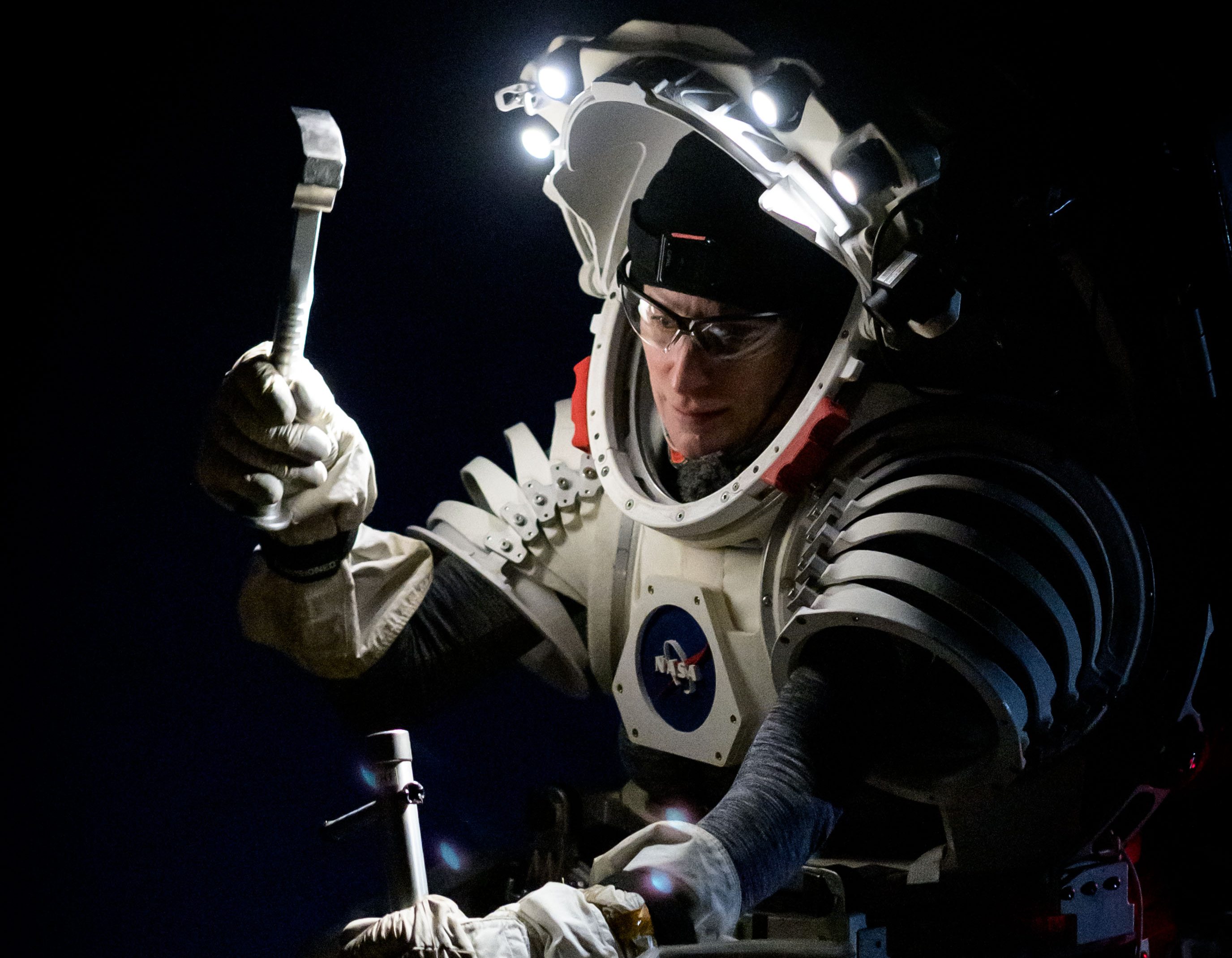
NASA astronaut wearing a mockup spacesuit system, illuminated by the lights on her helmet as she hammers a drive tube into the ground.
NASA astronaut Kate Rubins uses a hammer to get a drive tube into the ground to collect a pristine soil sample during a nighttime simulated moonwalk in the San Francisco Volcanic Field in Northern Arizona on May 16, 2024. Surviving and operating through the lunar night was identified as a top-ranked 2024 Civil Space Challenge, and tests such as these help NASA astronauts and engineers practice end-to-end lunar operations.
NASA/Josh Valcarcel

This spring, NASA published a document overviewing almost 200 technology areas requiring further development to meet future exploration, science, and other mission needs – and asked the aerospace community to rate their importance. The goal was to better integrate the community’s most pervasive technical challenges, or shortfalls, to help guide NASA’s space technology development and investments.

Today, NASA’s Space Technology Mission Directorate (STMD) released the 2024 Civil Space Shortfall Ranking document, integrating inputs from NASA mission directorates and centers, small and large industry organizations, government agencies, academia, and other interested individuals. STMD will use the inaugural list and annual updates as one of many factors to guide its technology development projects and investments.

“Identifying consensus among challenges across the aerospace industry will help us find solutions, together,” said NASA Associate Administrator Jim Free. “This is the groundwork for strengthening the nation’s technological capabilities to pave the way for new discoveries, economic opportunities, and scientific breakthroughs that benefit humanity.”

The integrated results show strong stakeholder agreement among the 30 most important shortfalls. At the top of the list is surviving and operating through the lunar night, when significant and sustained temperature drops make it difficult to run science experiments, rovers, habitats, and more. Solution technologies could include new power, thermal management, and motor systems. Second and third on the integrated list are the need for high-power energy generation on the Moon and Mars and high-performance spaceflight computing.

The inputs received are already igniting meaningful conversations to help us and our stakeholders make smarter decisions. We will refine the process and results annually to ensure we maintain a useful approach and tool that fosters resilience in our space technology endeavors.”

Michelle Munk

Michelle Munk

Acting Chief Architect for STMD

Highly rated capability areas in the top 20 included advanced habitation systems, autonomous systems and robotics, communications and navigation, power, avionics, and nuclear propulsion. Beyond the top quartile, stakeholder shortfall scores varied, likely aligning with their interests and expertise. With many shortfalls being interdependent, it emphasizes the need to make strategic investments across many areas to maintain U.S. leadership in space technology and drive economic growth.

STMD is evaluating its current technology development efforts against the integrated list to identify potential adjustments within its portfolio.

“This effort is an excellent example of our directorates working together to assess future architecture needs that will enable exploration and science for decades to come,” said Nujoud Merancy, deputy associate administrator for the Strategy and Architecture Office within NASA’s Exploration Systems Development Mission Directorate.

The 2024 results are based on 1,231 total responses, including 769 internal and 462 external responses. Twenty were consolidated responses, representing multiple individuals from the same organization. Once average shortfall scores were calculated for each organization, STMD grouped, totaled, and averaged scores for nine stakeholder groups and then applied pre-determined weights to each to create the overall ranking. In the document, NASA also published the ranked results for each stakeholder group based on the 2024 feedback.

The rankings are based on the numerical scores received and not responses to the open-ended questions. NASA anticipates the qualitative feedback will uncover additional insights and more.

NASA will host a webinar to overview the ranking process and results on July 26, 2024, at 2 p.m. EDT.

“Communicating our most pressing technology challenges is a great way to tap into the abilities across all communities to provide solutions to critical problems,” said Dr. Carolyn Mercer, chief technologist for NASA’s Science Mission Directorate.

To learn more about the inaugural civil space shortfall feedback opportunity and results as well as monitor future feedback opportunities, visit:

www.nasa.gov/civilspaceshortfalls

Powered by WPeMatico

Get The Details…
Anyah Dembling

Station Begins Week with Maintenance and Eye Checks

Station Begins Week with Maintenance and Eye Checks

The Nanoracks Bishop Airlock is in the grips of the Canadarm2 robotic arm as it is positioned away from the station prior to jettisoning a trash container for disposal.

The week kicked off with lab maintenance aboard the International Space Station as the Expedition 71 and Starliner crews relocated science gear, cleaned crew quarters, and conducted inspections. Eye checks were also on the schedule at the end of the day for four orbital residents.

Three NASA astronauts took turns during the first half of Monday moving the NanoRacks external platform from the Tranquility module to the Kibo laboratory module. Starliner Commander Butch Wilmore of Boeing’s Crew Flight Test started the work moving gear and making space to access the NanoRacks Bishop airlock in Tranquility where the external platform was stowed. Afterward, station Flight Engineers Mike Barratt and Matthew Dominick removed the external platform from Tranquility’s airlock and installed it inside Kibo’s airlock. The platform from NanoRacks can host a variety of payloads exposed to the external space environment for science experiments, technology demonstrations, and more.

Dominick then spent the rest of the afternoon cleaning his crew quarters located in the overhead compartment of the Harmony module. NASA Flight Engineer Jeanette Epps started her morning also cleaning her crew quarters in Harmony’s deck compartment. The pair each worked half a day cleaning their living spaces’ ventilation systems and airflow sensors. Epps later set up the camera robot, which can capture imagery and real-time video for downloading to mission controllers, and checked out its free-flying operations in Kibo.

NASA Flight Engineer Tracy C. Dyson started her day servicing a research furnace before configuring panels inside the Destiny laboratory module. Dyson spent the rest of the afternoon deep cleaning the Unity module vacuuming dust and wiping down surfaces with disinfectant wipes. Starliner Pilot Suni Williams of NASA reconfigured power systems in the Columbus laboratory module, loaded software on a Microgravity Science Glovebox computer, then wrapped up her shift collecting station air samples for analysis.

At the end of the day, Dominick, Barratt, and Epps joined Roscosmos Flight Engineer Alexander Grebenkin for a regularly scheduled eye exam. The quartet took turns looking at a standard eye chart and reading characters off of it to test their vision acuity and contrasty sensitivity.

Commander Oleg Kononenko and Flight Engineer Nikolai Chub split their day on inspection activities in the aft end of the Zvezda service module where the Progress 87 cargo craft is docked. Kononenko also set up hardware to observe luminous clouds and Earth’s upper atmosphere while Chub checked out batteries and their cables inside Zvezda.


Learn more about station activities by following the space station blog@space_station and @ISS_Research on X, as well as the ISS Facebook and ISS Instagram accounts.

Get weekly video highlights at: https://roundupreads.jsc.nasa.gov/videoupdate/

Get the latest from NASA delivered every week. Subscribe here: www.nasa.gov/subscribe

Powered by WPeMatico

Get The Details…

Mark Garcia