Crew Off-Duty, Cosmonauts Work Cargo and Station Upkeep

Crew Off-Duty, Cosmonauts Work Cargo and Station Upkeep

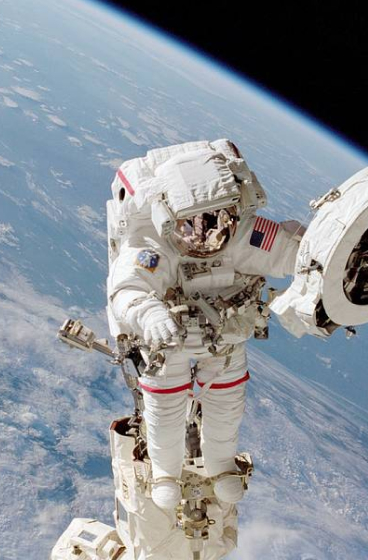
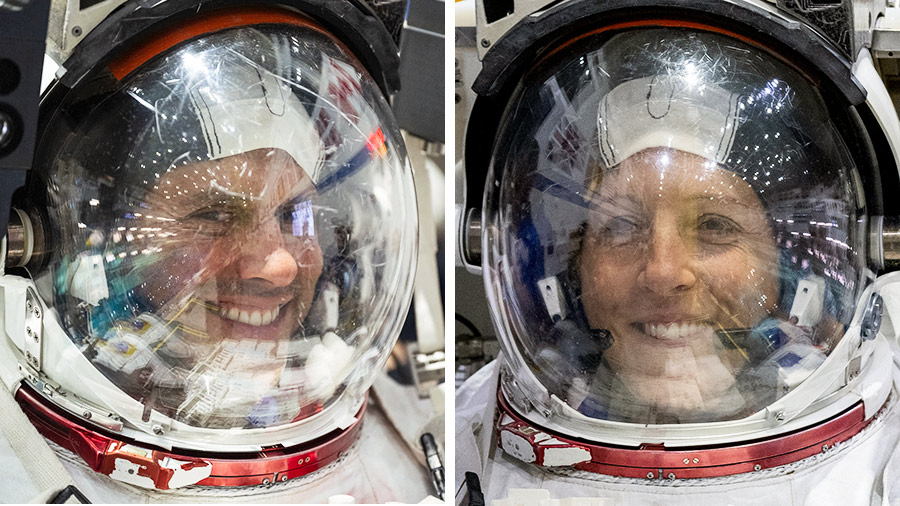
NASA astronaut Chris Williams smiles at the camera while conducting a spacewalk outside the International Space Station. Credit: NASA/Jessica Meir
NASA astronaut Chris Williams smiles at the camera while conducting a spacewalk outside the International Space Station.
NASA/Jessica Meir

Four Expedition 74 crew members are enjoying an off-duty day following a busy week of science prep, post-spacewalk closeout procedures, cargo operations, and more. Three other International Space Station residents set their sights on an array of maintenance tasks throughout the day.

NASA astronauts Chris Williams, Jessica Meir, and Jack Hathaway, along with European Space Agency (ESA) astronaut Sophie Adenot all had the day off on Friday. The quartet exercised and spent the day relaxing.

NASA continues to assess potential dates for U.S. spacewalk 95 outside the International Space Station as teams prepare for the installation of future roll-out solar arrays. The agency has been reviewing the standard spacesuit preparations and other procedures needed following U.S. spacewalk 94 along with other station activities including cargo, research, and maintenance activities

On March 18, NASA astronauts Jessica Meir and Chris Williams successfully completed U.S. spacewalk 94, preparing the 2A power channel and performing additional tasks. This work will enable the future installation of roll-out solar arrays to provide additional power for the orbiting laboratory, supporting critical systems and its safe, controlled deorbit. NASA will share the updated date and time for spacewalk 95 once scheduling is finalized.

In the Roscosmos segment, space station commander Sergey Kud-Sverchkov removed and replaced an AC compressor. He then proceeded to take a health assessment that analyzes how a crew member works individually and with their teammates before conducting some maintenance on the treadmill.

Flight engineer Andrey Fedyaev worked in the Nauka module to replace stowage battery units and test video cameras the crew uses to document work and life aboard the orbital complex.

Flight engineer Sergei Mikaev reviewed the schedule for next week, organized and cleaned up files on station computers, and configured cameras and hardware crewmembers use to take photos of Earth. He ended his day on Progress 94 cargo operations, unloading food and supplies that were delivered earlier this week, and installed a payload that will assist with acquiring images of Earth in the visible and near-infrared ranges.

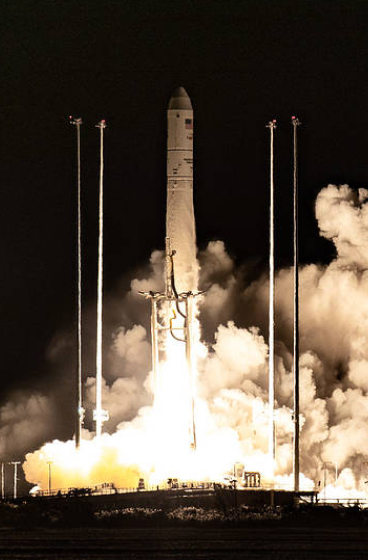
Science, supplies, and equipment are soon to be delivered to the International Space Station aboard a Northrop Grumman Cygnus XL spacecraft. NASA’s Northrop Grumman Commercial Resupply Services 24 mission is targeted to lift off from Space Launch Complex 40 at Cape Canaveral Space Force Station in Florida no earlier than Wednesday, April 8 at 8:49 a.m. EDT.

In addition to food, supplies, and equipment for the crew, Cygnus will deliver research to the space station, including a new module to advance quantum science that could improve computing technology and aid in the search for dark matter and hardware to produce a greater number of therapeutic stem cells for blood diseases and cancer. Cygnus also will carry model organisms to study the gut microbiome and a receiver that could enhance space weather models that protect critical space infrastructure, such as GPS and radar.

Learn more about station activities by following the space station blog@space_station on X, as well as the ISS Facebook and ISS Instagram accounts.

Get the latest from NASA delivered every week. Subscribe here.

Powered by WPeMatico

Get The Details…

Abby Graf

Artemis II Crew’s Suits

Artemis II Crew’s Suits

Four neon orange spacesuits hang on a rack decorated with NASA patches. Three of the suits have American flag patches on their left shoulder, while the last has a Canadian flag patch on its left shoulder. The room the suits are hanging in has a large black and white photo on the wall, in which astronauts are in their spacesuits and helmets while two people in white lab coats look on.
NASA/Joel Kowsky

The Orion Crew Survival System suits that Commander Reid Wiseman, Pilot Victor Glover, and Mission Specialist Christina Koch from NASA, and Mission Specialist Jeremy Hansen from the CSA (Canadian Space Agency) will wear on the Artemis II test flight are seen in the suit-up room of the Neil A. Armstrong Operations and Checkout Building, Saturday, Jan. 17, 2026, at NASA’s Kennedy Space Center in Florida.

The Artemis II test flight will be NASA’s first mission with crew aboard the SLS (Space Launch System) rocket and Orion spacecraft. Through Artemis, NASA will send astronauts to explore the Moon for scientific discovery, economic benefits, and to build the foundation for the first crewed missions to Mars.

Image credit: NASA/Joel Kowsky

Powered by WPeMatico

Get The Details…
Monika Luabeya

Satellite Spots a Spawn

Satellite Spots a Spawn

A swath of water along the coast of Vancouver Island appears cloudy and green to turquoise in color.
Water along the coast of Vancouver Island is brightened by a herring spawn in this image acquired on February 19, 2026, by the OLI (Operational Land Imager) on Landsat 9.
NASA Earth Observatory/Lauren Dauphin

Spawning season has sprung for Pacific herring (Clupea pallasii) in the waters off British Columbia, Canada. From mid-February through early May each year, thousands of the small, silvery fish congregate in shallow coastal areas around Vancouver Island and create a spectacle sometimes visible to satellites.

Sheltered waters in Barkley Sound, on the southwestern side of Vancouver Island, are regular sites for spawn events. On February 19, 2026, the Landsat 9 satellite caught a glimpse of early-season activity underway along the shore near Forbes Island. In these events, female herring produce eggs that stick to a variety of materials, from kelp and seagrass to rock surfaces. Males release a sperm-containing fluid called milt into the water, giving it a cloudy green or turquoise look.

An aerial photo shows cloudy, greenish water along the coast of Vancouver Island.
A herring spawn clouds the water along the coast of Vancouver Island near the village of Salmon Beach on February 19, 2026.
Photo by Ryan Cutler

Spawns near Forbes Island have been observed most years since the 1970s, according to Fisheries and Oceans Canada (DFO) records. “Herrings prefer spawning locations that are more protected, have rocky substrate, and allow them to select areas with reduced salinity,” said Jessica Moffatt, biologist with the Island Marine Aquatic Working Group (IMAWG), which works to strengthen First Nations fisheries through traditional knowledge, modern science, and management guidance. “Barkley Sound hits the sweet spot” in many of these regards, she said, adding that collective memory, predation pressure, and other factors also play a role in spawn size and location.

Spawning events last from several hours to several days. At Forbes Island in 2026, local observers saw that fish were staging in the area by February 13 (schools can arrive up to two weeks before spawning, Moffatt noted), and activity was reported to IMAWG from February 19 to February 21.

Along with changes in water color, spawns often come with increased wildlife presence, which can include whales and sea lions swimming nearby and eagles, wolves, and bears lurking on shore. After spawning, the fish will migrate back to summer feeding areas in deeper, more nutrient-rich waters, sometimes sticking with their same large school for several years.

An aerial photo shows a swath of cloudy, greenish water along one side of a small island covered in tall evergreen trees.
A herring spawn event near Forbes Island in Barkley Sound brightens nearshore waters on February 19, 2026.
Photo by Ryan Cutler

Records of spawn activity have historically been constrained by the timing of aerial and dive surveys, the availability of reports from remote locations, and fisheries priorities. But observations by satellites, including Landsat, can help monitor herring activity over larger areas and longer periods of time. Researchers at the University of Victoria in Canada have used decades of satellite observations to augment historical spawn records and develop methods to streamline future detections.

Herring and their roe are valuable both as a cultural food source and harvest practice by First Nations and for British Columbia’s commercial fisheries. As a forage fish species, Pacific herring are vital to salmon and other marine life, and a fuller picture of the locations of spawning areas could provide clues about changes in the marine ecosystem.

NASA Earth Observatory images by Lauren Dauphin, using Landsat data from the U.S. Geological Survey. Photos by Ryan Cutler. Story by Lindsey Doermann.

References & Resources

You may also be interested in:

Stay up-to-date with the latest content from NASA as we explore the universe and discover more about our home planet.

Showy Swirls Around Jeju Island

2 min read

Winds blowing past the volcanic landmass near the Korean Peninsula created a trail of spiraling clouds, while murky water churned…

Article

Puerto Rico From Above

4 min read

An astronaut photographed the island’s striking mix of mountains, forests, and expanding urban areas.

Article

Blooming Seas Around the Chatham Islands

2 min read

A vibrant display of phytoplankton encircled the remote New Zealand islands.

Article

Powered by WPeMatico

Get The Details…

Expedition 74 Works Health Research and Cargo Operations on Thursday

Expedition 74 Works Health Research and Cargo Operations on Thursday

The Progress 94 cargo spacecraft, loaded with nearly three tons of food, fuel, and supplies, nears the International Space Station ahead of its docking on March 24, 2026. Credit: NASA
The Progress 94 cargo spacecraft, loaded with nearly three tons of food, fuel, and supplies, nears the International Space Station ahead of its docking on March 24, 2026.
NASA

Expedition 74 Works Health Research and Cargo Operations on Thursday

Health research, biology experiments, cleaning, and cargo operations were the main tasks on Thursday’s schedule aboard the International Space Station. The Expedition 74 crew worked an array of activities that look at how the human body reacts to space, analyzed samples for microbial growth, and unloaded a cargo delivery.

NASA astronaut Jessica Meir and European Space Agency (ESA) astronaut kicked off the day collecting biological samples to take a deeper look at how the human body and its functions react and adapt to spaceflight. Afterward, Adenot prepped the samples before stowing them in the orbital lab’s Minus Eighty-Degree Freezer for future analysis.

Meir moved into the Destiny laboratory module to collect water samples from the Potable Water Dispenser. Adenot later processed those samples to assess for any microbial growth. Adenot then began to gather items for an upcoming tech demonstration that uses environmental sensors to collect CO2 measurements.

In the Kibo module, NASA astronaut Chris Williams spent part of his day moving and consolidating stowage. He then removed modules from the Nanoracks main frame to make room for new installations. Williams completed his two-hours of daily exercise on the station’s Advanced Resistive Exercise Device (ARED) and treadmill, to help maintain cardiovascular health and bone and muscle density in zero gravity.

NASA astronaut Jack Hathaway kicked off the day with his two hours of exercise on ARED and the station’s bicycle, CEVIS. Later on, he cleaned vent fans in the Unity module. Near the end of the day, he moved into the Permanent Multipurpose Module to organize stowage and clean with Meir.

Cargo operations were ongoing in the Roscosmos segment throughout the day. In the morning, station commander Sergey Kud-Sverchkov and flight engineer Sergei Mikaev worked together to disassemble the docking mechanism inside the Poisk module. The duo, along with flight engineer Andrey Fedyaev, then spent the day unloading cargo from the recently arrived Progress 94 spacecraft, in addition to a few other tasks, including food consolidation, general maintenance, and data transfers.

Learn more about station activities by following the space station blog@space_station on X, as well as the ISS Facebook and ISS Instagram accounts.

Get the latest from NASA delivered every week. Subscribe here.

Powered by WPeMatico

Get The Details…

Abby Graf

What’s Up: April 2026 Skywatching Tips from NASA

What’s Up: April 2026 Skywatching Tips from NASA

Mercury shines extra bright, the Lyrid meteor shower peaks, and a comet soars into view

Mercury shines at its brightest for the year, the Lyrid meteor shower peaks, and a bright new comet makes an appearance in April’s night sky.

Skywatching Highlights

  • April 3: Mercury at greatest elongation
  • April 17: Best chance to see Comet C/2025 R3
  • April 21 to 22: Lyrid meteor shower peak
  • April 27: Comet C/2025 R3 makes closest approach to Earth

Transcript

Mercury shines extra bright, the Lyrid meteor shower peaks, and a comet soars into view. That’s What’s Up this April. 

On April 3rd, Mercury will be at its most visible all year. On this date, the planet will be at its greatest elongation, or its furthest distance from the Sun, as we see it from Earth, making it easier to see the often hard-to spot-planet. 

A crescent moon and Mercury (circled) glow in a dark blue predawn sky, illustrating Mercury's rare visibility near the horizon during its April greatest elongation.

To find Mercury, look east before the Sun begins to rise. The planet will be very low on the horizon, just above Mars. 

The Lyrid meteor shower peaks April 21st to 22nd. This meteor shower comes from debris left behind by Comet Thatcher. 

When this debris hits and then burns up in our atmosphere, we see the “shooting stars” of a meteor shower. 

To experience the peak of the April Lyrids, look to the east starting at around 10 p.m. on April 21st and through the night into April 22nd. The meteor shower takes place nearby the star Vega, the fifth brightest star in the night sky, which can be found in the constellation Lyra, the Harp. 

A bright meteor streaks across a star-filled night sky beside the Milky Way over a dark silhouetted landscape, illustrating the Lyrid meteor shower peaking April 21–22.

April 17th might be your best chance to see the Comet C/2025 R3, which some think could be the brightest comet of the year. This comet will make its closest approach to Earth on April 27th, coming within 44 million miles of our planet. 

Comet C/2025 R3 glows green with a long blue ion tail stretching across a star-filled sky, previewing its closest approach to Earth on April 27 and potential visibility through binoculars.

Experts estimate that the comet will likely reach magnitude eight, which means you would need access to a telescope or binoculars to see it. The comet will be visible in the eastern sky in the constellations Pegasus and above Pisces. You’ll be able to spot the comet in the predawn hours from mid-April through the end of April in the Northern Hemisphere, and in the evenings in early May for viewers in the Southern Hemisphere. 

Diagram showing April 2026 moon phases: Full Moon on the 1st, Third Quarter on the 9th, New Moon on the 17th, and First Quarter on the 23rd.

Here are the phases of the Moon for April. You can stay up to date on all of NASA’s missions exploring the solar system and beyond, at science.nasa.gov. I’m Chelsea Gohd from NASA’s Jet Propulsion Laboratory and that’s What’s Up for this month.

Keep Exploring

Discover More Topics From NASA

Powered by WPeMatico

Get The Details…