NASA Webb Finds Young Sun-Like Star Forging, Spewing Common Crystals

NASA Webb Finds Young Sun-Like Star Forging, Spewing Common Crystals

5 Min Read

NASA Webb Finds Young Sun-Like Star Forging, Spewing Common Crystals

A rectangular image of the Serpens Nebula with black vertical rectangles at the bottom left and top right to indicate missing data. A young star-forming region is filled with wispy orange, red, and blue layers of gas and dust. The upper left corner of the image is filled with mostly orange dust, and within that orange dust, there are several small red plumes of gas that extend from the top left to the bottom right at the same angle. At center-left is a larger star that is circled. This star has Webb’s signature diffraction spikes, but along the right also has an arc of white, with the circular edge starting at the center of the star. Mostly blue gas fills the center. There is a particularly bright central star. The gas to the right is a darker orange. Small points of light are sprinkled across the field. The brightest sources have extensive eight-pointed diffraction spikes.
NASA’s James Webb Space Telescope’s 2024 NIRCam image shows protostar EC 53 circled. Researchers using new data from Webb’s MIRI proved that crystalline silicates form in the hottest part of the disk of gas and dust surrounding the star — and may be shot to the system’s edges.
Credits:
Image: NASA, ESA, CSA, STScI, Klaus Pontoppidan (NASA-JPL), Joel Green (STScI); Image Processing: Alyssa Pagan (STScI)

Astronomers have long sought evidence to explain why comets at the outskirts of our own solar system contain crystalline silicates, since crystals require intense heat to form and these “dirty snowballs” spend most of their time in the ultracold Kuiper Belt and Oort Cloud. Now, looking outside our solar system, NASA’s James Webb Space Telescope has returned the first conclusive evidence that links how those conditions are possible. The telescope clearly showed for the first time that the hot, inner part of the disk of gas and dust surrounding a very young, actively forming star is where crystalline silicates are forged. Webb also revealed a strong outflow that is capable of carrying the crystals to the outer edges of this disk. Compared to our own fully formed, mostly dust-cleared solar system, the crystals would be forming approximately between the Sun and Earth.

Webb’s sensitive mid-infrared observations of the protostar, cataloged EC 53, also show that the powerful winds from the star’s disk are likely catapulting these crystals into distant locales, like the incredibly cold edge of its protoplanetary disk where comets may eventually form.

“EC 53’s layered outflows may lift up these newly formed crystalline silicates and transfer them outward, like they’re on a cosmic highway,” said Jeong-Eun Lee, the lead author of a new paper in Nature and a professor at Seoul National University in South Korea. “Webb not only showed us exactly which types of silicates are in the dust near the star, but also where they are both before and during a burst.”

Image: Protostar EC 53 in the Serpens Nebula (NIRCam Image)

A rectangular image of the Serpens Nebula with black vertical rectangles at the bottom left and top right to indicate missing data. A young star-forming region is filled with wispy orange, red, and blue layers of gas and dust. The upper left corner of the image is filled with mostly orange dust, and within that orange dust, there are several small red plumes of gas that extend from the top left to the bottom right at the same angle. At center-left is a larger star that is circled. This star has Webbu2019s signature diffraction spikes, but along the right also has an arc of white, with the circular edge starting at the center of the star. Mostly blue gas fills the center. There is a particularly bright central star. The gas to the right is a darker orange. Small points of light are sprinkled across the field. The brightest sources have extensive eight-pointed diffraction spikes.
NASA’s James Webb Space Telescope’s 2024 NIRCam image shows protostar EC 53 circled. Researchers using new data from Webb’s MIRI proved that crystalline silicates form in the hottest part of the disk of gas and dust surrounding the star — and may be shot to the system’s edges.
Image: NASA, ESA, CSA, STScI, Klaus Pontoppidan (NASA-JPL), Joel Green (STScI); Image Processing: Alyssa Pagan (STScI)

The team used Webb’s MIRI (Mid-Infrared Instrument) to collect two sets of highly detailed spectra to identify specific elements and molecules, and determine their structures. Next, they precisely mapped where everything is, both when EC 53 is “quiet” (but still gradually “nibbling” at its disk) and when it’s more active (what’s known as an outburst phase).

This star, which has been studied by this team and others for decades, is highly predictable. (Other young stars have erratic outbursts, or their outbursts last for hundreds of years.) About every 18 months, EC 53 begins a 100-day, bombastic burst phase, kicking up the pace and absolutely devouring nearby gas and dust, while ejecting some of its intake as powerful jets and outflows. These expulsions may fling some of the newly formed crystals into the outskirts of the star’s protoplanetary disk. 

“Even as a scientist, it is amazing to me that we can find specific silicates in space, including forsterite and enstatite near EC 53,” said Doug Johnstone, a co-author and a principal research officer at the National Research Council of Canada. “These are common minerals on Earth. The main ingredient of our planet is silicate.” For decades, research has also identified crystalline silicates not only on comets in our solar system, but also in distant protoplanetary disks around other, slightly older stars — but couldn’t pinpoint how they got there. With Webb’s new data, researchers now better understand how these conditions might be possible.

“It’s incredibly impressive that Webb can not only show us so much, but also where everything is,” said Joel Green, a co-author and an instrument scientist at the Space Telescope Science Institute in Baltimore, Maryland. “Our research team mapped how the crystals move throughout the system. We’ve effectively shown how the star creates and distributes these superfine particles, which are each significantly smaller than a grain of sand.”

Webb’s MIRI data also clearly shows the star’s narrow, high-velocity jets of hot gas near its poles, and the slightly cooler and slower outflows that stem from the innermost and hottest area of the disk that feeds the star. The image above, which was taken by another Webb instrument, NIRCam (Near-Infrared Camera), shows one set of winds and scattered light from EC 53’s disk as a white semi-circle angled toward the right. Its winds also flow in the opposite direction, roughly behind the star, but in near-infrared light, this region appears dark. Its jets are too tiny to pick out.

Image: Silicate Crystallization and Movement Near Protostar EC 53 (Illustration)
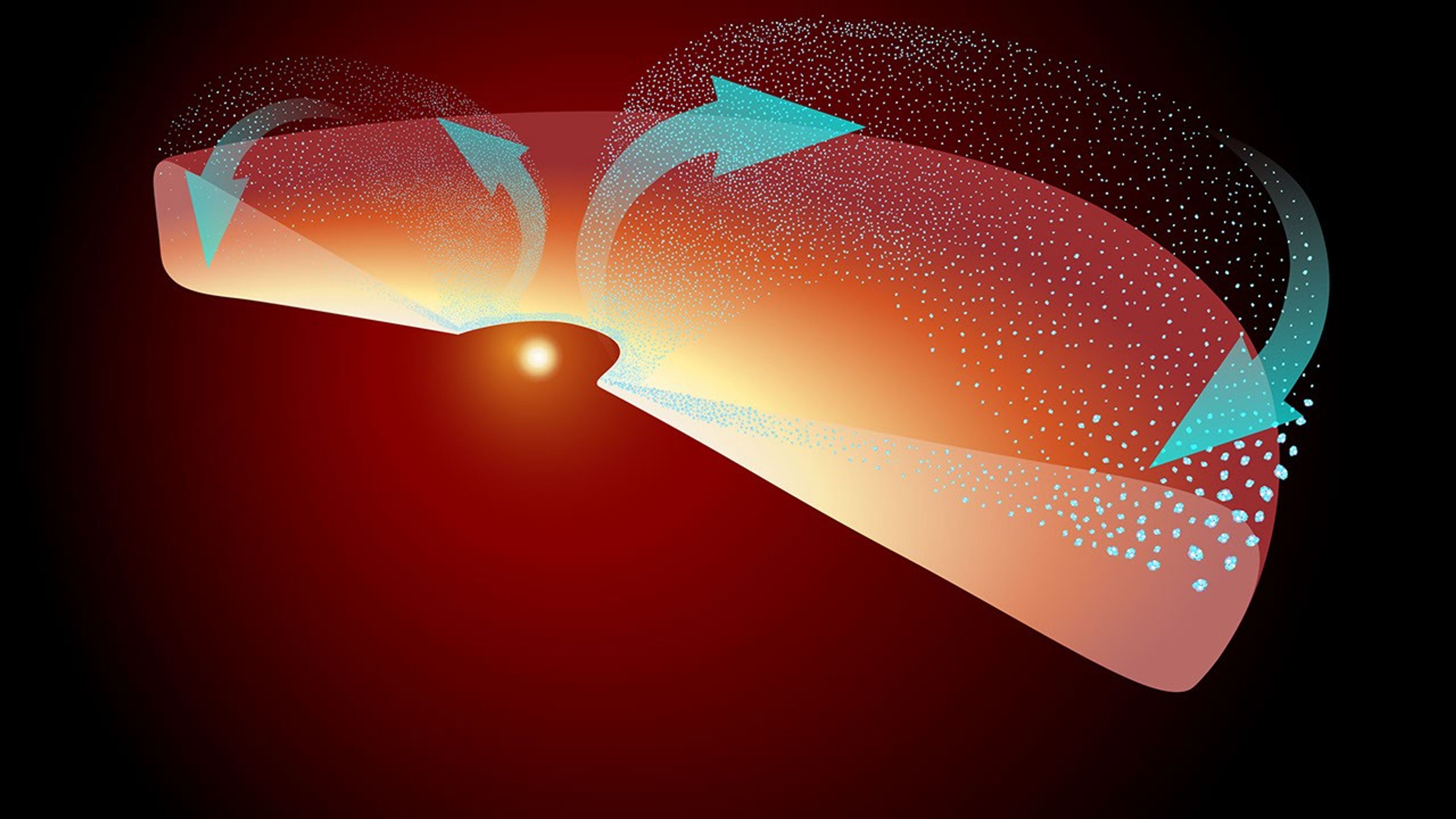
Illustration shows a small yellow sphere at center surrounded from upper left to lower right by a semi-circle that has the rough shape of half a pancake with rounded edges. The pancake has a hole in the middle and doesn’t touch the star. The semi-circle is bright yellow closest to the star, orange toward the center, and redder at its round edges. Several large teal arrows are within the semi-circle. Two arrows start in the area nearest the star at the left and right edges of the yellow disk. Each arrow goes immediately up and points outward to the left or right. Two additional large teal arrows appear at far left and far right, following a swooping pattern begun by the first arrows, with each pointing down to the farthest edges of the pancake. Small teal dots begin where the arrows begin, following the arrows, but also are embedded within the pancake forming a straight edge from the inner to the outer regions. A faint red haze extends from the star in the lower left diagonal and the background is black.
This illustration represents half the disk of gas and dust surrounding the protostar EC 53. Stellar outbursts periodically form crystalline silicates, which are launched up and out to the edges of the system, where comets and other icy rocky bodies may eventually form.
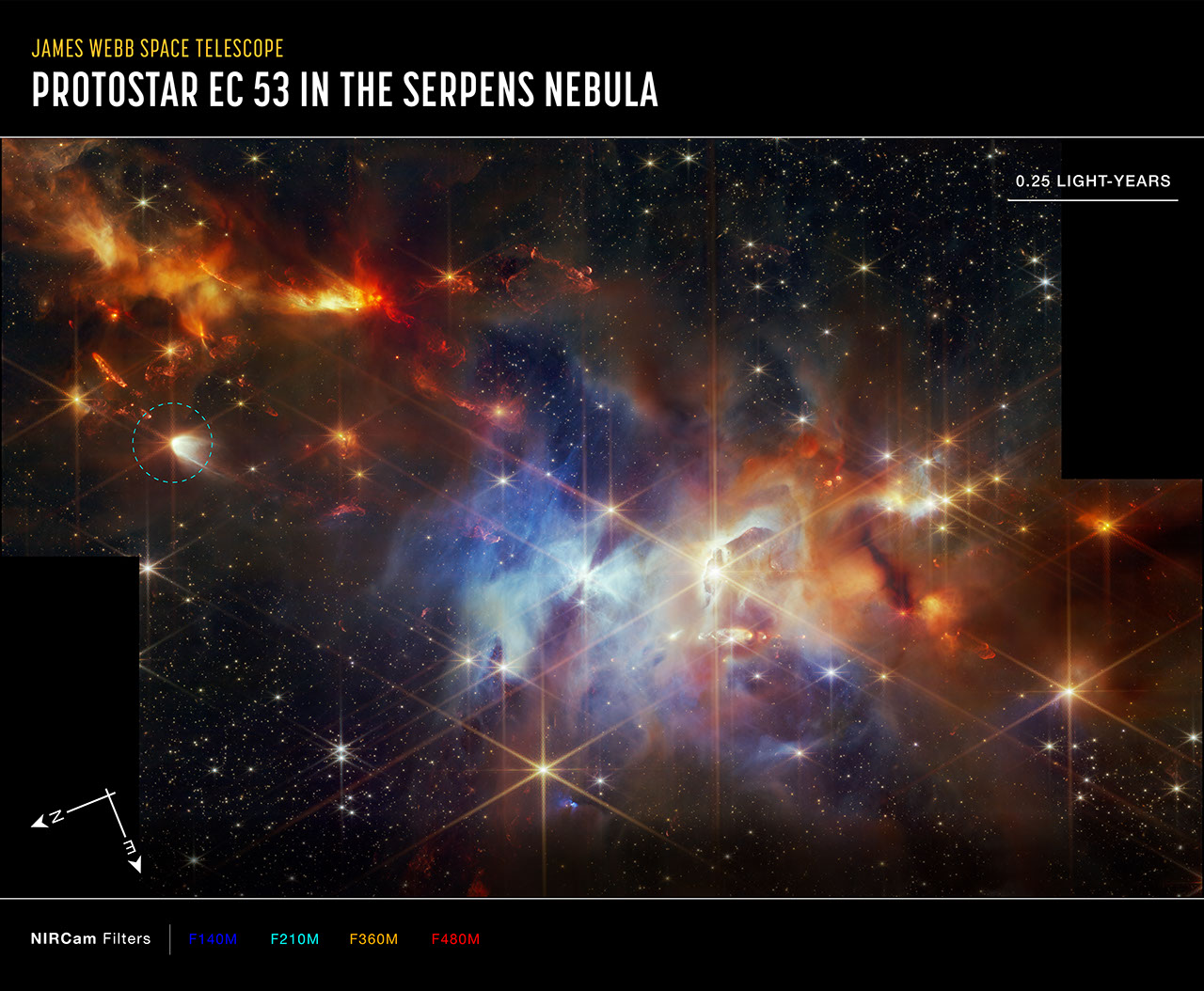
Illustration: NASA, ESA, CSA, Elizabeth Wheatley (STScI)

Look ahead

EC 53 is still “wrapped” in dust and may be for another 100,000 years. Over millions of years, while a young star’s disk is heavily populated with teeny grains of dust and pebbles, an untold number of collisions will occur that may slowly build up a range of larger rocks, eventually leading to the formation of terrestrial and gas giant planets. As the disk settles, both the star itself and any rocky planets will finish forming, the dust will largely clear (no longer obscuring the view), and a Sun-like star will remain at the center of a cleared planetary system, with crystalline silicates “littered” throughout.

EC 53 is part of the Serpens Nebula, which lies 1,300 light-years from Earth and is brimming with actively forming stars.

The James Webb Space Telescope is the world’s premier space science observatory. Webb is solving mysteries in our solar system, looking beyond to distant worlds around other stars, and probing the mysterious structures and origins of our universe and our place in it. Webb is an international program led by NASA with its partners, ESA (European Space Agency) and CSA (Canadian Space Agency).

To learn more about Webb, visit:

https://science.nasa.gov/webb

Downloads & Related Information

The following sections contain links to download this article’s images and videos in all available resolutions followed by related information links, media contacts, and if available, research paper and Spanish translation links.

Related Links

Read more: Webb’s Star Formation Discoveries

Explore more: Image Tour: Herbig-Haro 46/47

Read more: First-of-Its-Kind Detection Made in Striking New Webb Image

Read more: Infographic: Recipe for planet formation

Explore more: Star formation in the Eagle Nebula

Video: Exploring Star and Planet Formation

More Webb News

More Webb Images

Webb Science Themes

Webb Mission Page

Share

Details

Last Updated
Jan 21, 2026
Contact
Media

Laura Betz
NASA’s Goddard Space Flight Center
Greenbelt, Maryland
laura.e.betz@nasa.gov

Claire Blome
Space Telescope Science Institute
Baltimore, Maryland

Christine Pulliam
Space Telescope Science Institute
Baltimore, Maryland

Powered by WPeMatico

Get The Details…

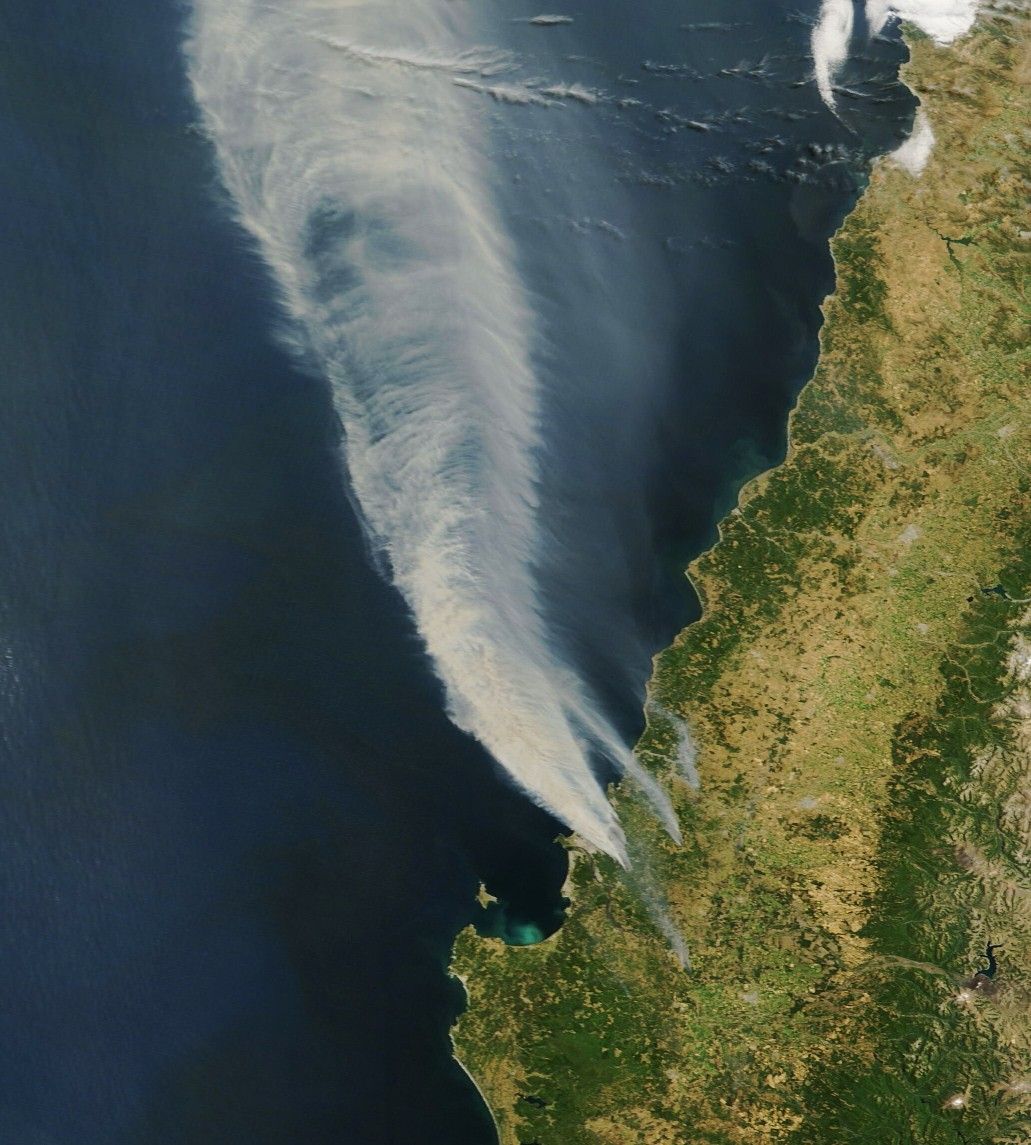
Fires Erupt in South-Central Chile 

Fires Erupt in South-Central Chile 

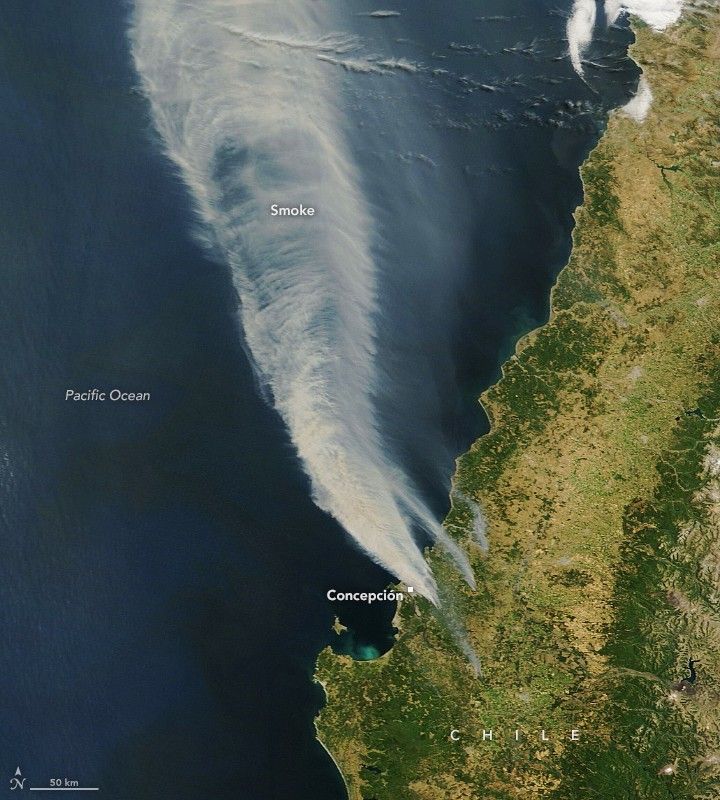
Brownish-gray smoke plumes billow to the northwest over the Pacific Ocean from wildfires near the Chilean city of Concepción.
January 18, 2026

Wildland fires broke out amid hot and dry conditions in south-central Chile in mid-January 2026, prompting evacuations and causing extensive damage to infrastructure. As of January 20, the spate of deadly fires had burned more than 30,000 hectares (74,000 acres) in the country’s Biobío and Ñuble regions, according to Chile’s National Forestry Corporation.

The MODIS (Moderate Resolution Imaging Spectroradiometer) instrument on NASA’s Terra satellite captured this image of smoke billowing from multiple fires on January 18. Dozens of active fires in the area prompted the evacuation of 50,000 people and destroyed more than 300 homes, according to a January 19 report from Chile’s U.N. Resident Coordinator’s Office. Aerial and ground-based photographs showed neighborhoods in Concepción charred in the aftermath.

Gusty winds, along with temperatures that exceeded 38 degrees Celsius (100 degrees Fahrenheit) in places, fanned the flames and hampered firefighting efforts, according to news reports. Chile’s president declared a state of catastrophe in the Biobío and Ñuble regions, allowing more resources to go toward battling the blazes and assisting affected communities.

Other parts of South America also faced hot and dry conditions during the 2025–2026 summer, likely priming vegetation to burn. About 650 kilometers (400 miles) south of Concepción, firefighters in Argentina battled wildfires in and around Los Alerces National Park, home to rare stands of long-lived cypress trees.

NASA Earth Observatory image by Lauren Dauphin, using MODIS data from NASA EOSDIS LANCE and GIBS/Worldview. Story by Lindsey Doermann.

References & Resources

You may also be interested in:

Stay up-to-date with the latest content from NASA as we explore the universe and discover more about our home planet.

Fire Threatens Rare Forests in Argentina

3 min read

Blazes spread across Los Alerces National Park, home to some of the world’s oldest trees.

Article

Smoky Skies in the Pacific Northwest

3 min read

Smoke filled river valleys in northeastern Washington and parts of British Columbia.

Article

Seeing the Monroe Canyon Fire in a New Light

5 min read

As wildland fires raged in the American West, NASA airborne technology was there to image it in incredible detail.

Article

Powered by WPeMatico

Get The Details…

Expedition 74 Spends Tuesday on Microbiology, Lab Maintenance

Expedition 74 Spends Tuesday on Microbiology, Lab Maintenance

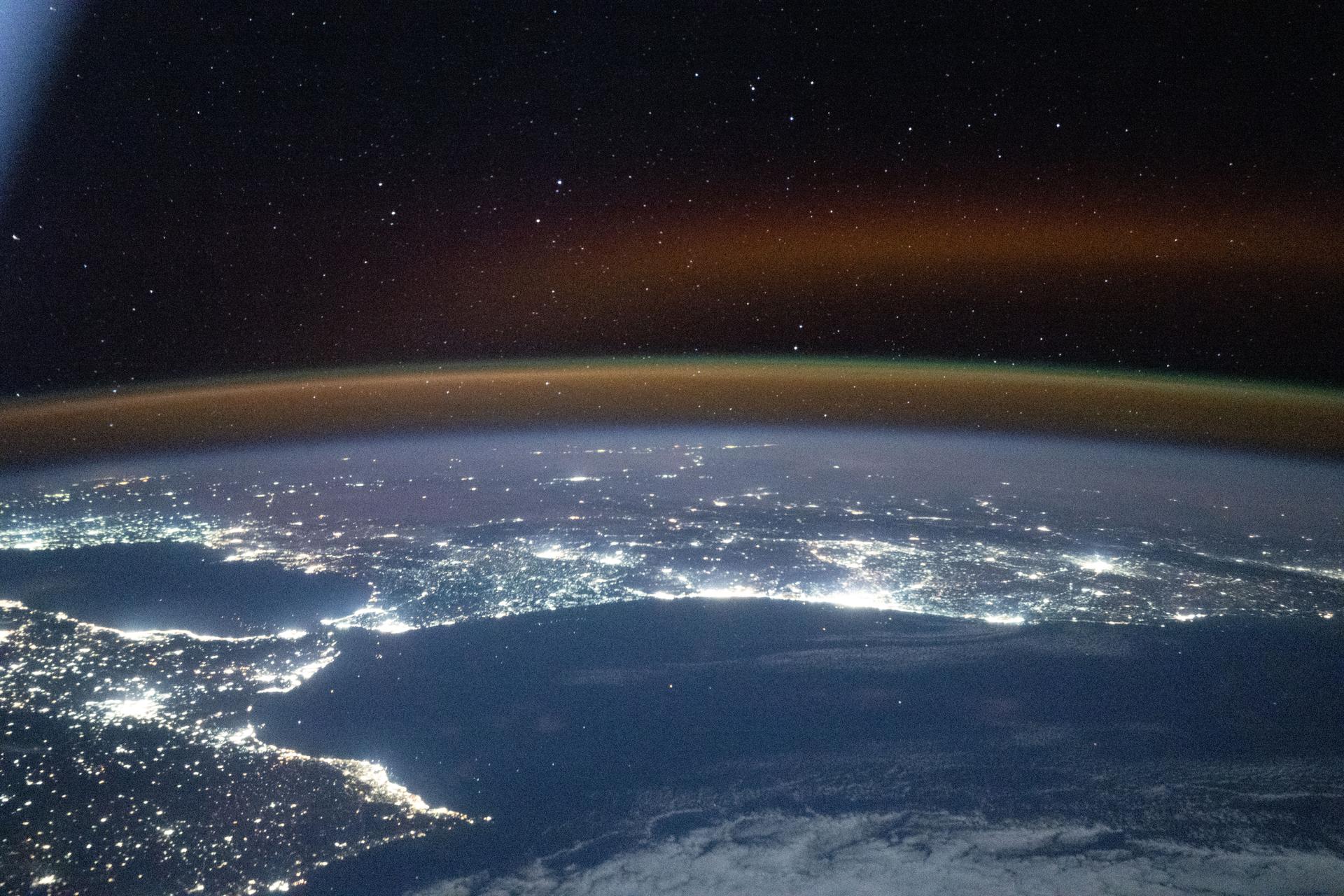
A red-yellow airglow blankets Earth's horizon as the city lights of southwestern Europe and North Africa sparkle in contrast to the Atlantic Ocean and the Mediterranean Sea that separates the two continents. The International Space Station was orbiting 262 miles above the Atlantic at approximately 7:47 p.m. local time when this photograph was taken.
A red-yellow airglow blankets Earth’s horizon as the city lights of southwestern Europe and North Africa sparkle in contrast to the Atlantic Ocean and the Mediterranean Sea that separates the two continents.
NASA

Microbiology research to protect astronaut health and spacecraft hardware topped the science schedule aboard the International Space Station on Tuesday. Earth observations and life support maintenance rounded out the day for the Expedition 74 trio.

NASA Flight Engineer Chris Williams worked throughout his shift safely processing samples of a bacterial pathogen inside the Kibo laboratory module’s Life Science Glovebox. Williams was exploring a way to prevent the formation of biofilms, or a layer of microorganisms, anywhere water is found on a spacecraft where they pose human health risks and can damage equipment. The microbe samples are housed inside a specialized cell culture chamber, called a BioCell, and exposed to different levels of ultraviolet light to learn how to inhibit microbial growth and reduce reliance on chemical disinfectants. Results may lead to safer life support and medical systems, more durable spacecraft materials, and healthier humans on and off the Earth.

Roscosmos Flight Engineer Sergei Mikaev spent his shift supporting a pair of ongoing Earth observation studies and servicing station equipment. Mikaev first deconfigured an automated overnight photography session that captured images of Earth’s nighttime atmospheric glow in near-ultraviolet wavelengths. The airglow is caused by atoms and molecules that are excited by solar ultraviolet radiation during the day and then release the energy as light at night. Next, he pointed a camera out a station window to photograph landmarks across Africa and the Middle East. Researchers will use the data to understand how natural disasters affect the surrounding landscape. Mikaev ended his day cleaning fans inside the Progress 92 cargo craft and transferring water between station tanks and inspecting water valves for microbes.

Station Commander Sergey Kud-Sverchkov assisted Mikaev during his second Earth photography session setting up and installing the hardware then downloading the imagery for analysis on the ground. Kud-Sverchkov completed his shift with orbital plumbing transferring fluids and refilling tanks before cleaning fan filters in the Zarya module.

Powered by WPeMatico

Get The Details…

Mark A. Garcia

NASA Astronaut Suni Williams Retires

NASA Astronaut Suni Williams Retires

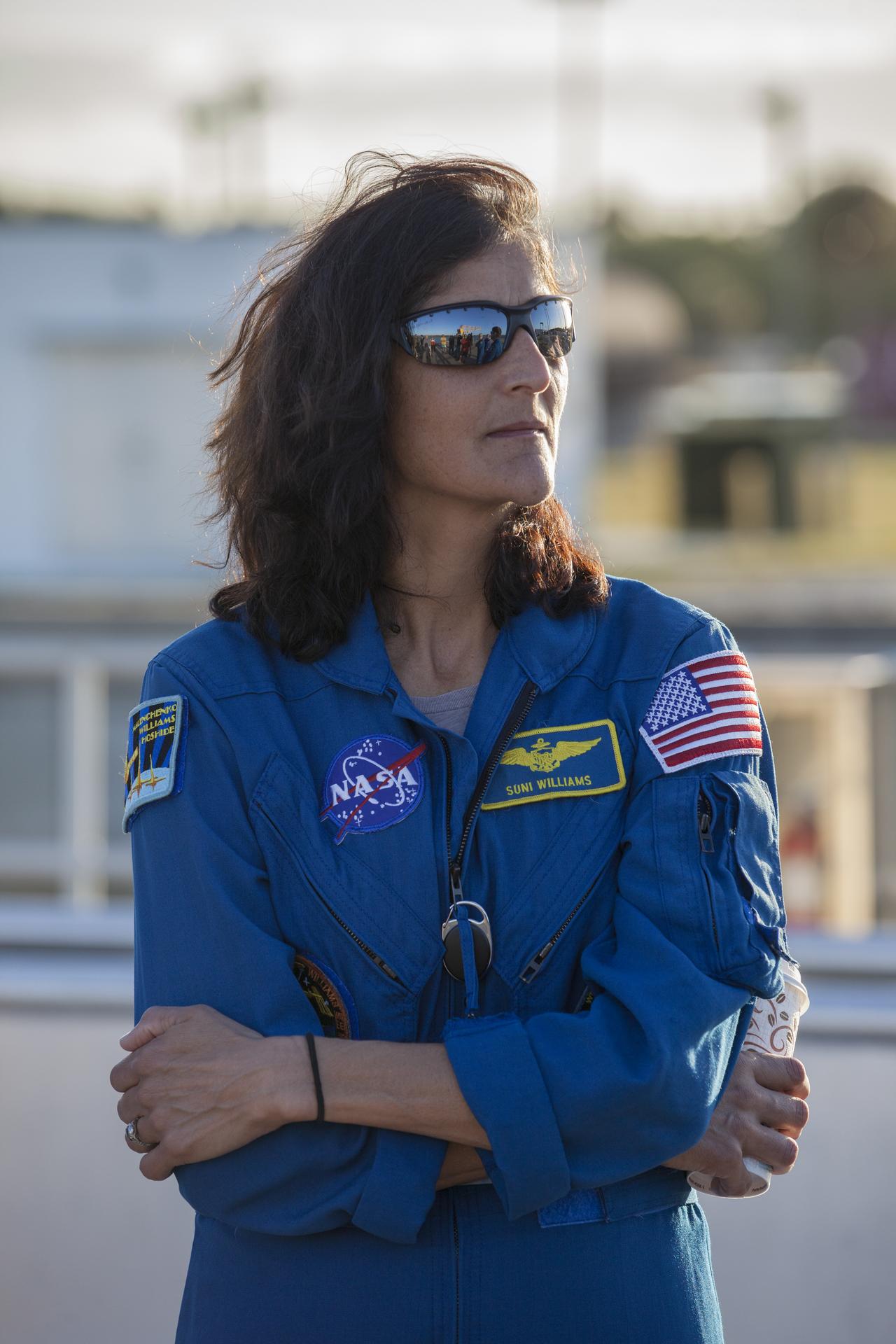
NASA astronaut Suni Williams at Cape Canaveral Air Force Station's Naval Ordnance Test Unit basin in Florida on March 28, 2018.
NASA astronaut Suni Williams at Cape Canaveral Air Force Station’s Naval Ordnance Test Unit basin in Florida on March 28, 2018.
Credit: NASA/Kim Shiflett

After 27 years of service, NASA astronaut Suni Williams retired from the agency, effective Dec. 27, 2025. Williams completed three missions aboard the International Space Station, setting numerous human spaceflight records throughout her career.

“Suni Williams has been a trailblazer in human spaceflight, shaping the future of exploration through her leadership aboard the space station and paving the way for commercial missions to low Earth orbit,” said NASA Administrator Jared Isaacman. “Her work advancing science and technology has laid the foundation for Artemis missions to the Moon and advancing toward Mars, and her extraordinary achievements will continue to inspire generations to dream big and push the boundaries of what’s possible. Congratulations on your well-deserved retirement, and thank you for your service to NASA and our nation.”

Williams logged 608 days in space — second on the list of cumulative time in space by a NASA astronaut. She ranks sixth on the list of longest single spaceflight by an American, tied with NASA astronaut Butch Wilmore, both logging 286 days during NASA’s Boeing Starliner and SpaceX Crew-9 missions. Williams also completed nine spacewalks, totaling 62 hours and 6 minutes, ranking as the most spacewalk time by a woman and fourth-most on the all-time cumulative spacewalk duration list. She also was the first person to run a marathon in space.

“Over the course of Suni’s impressive career trajectory, she has been a pioneering leader,” said Vanessa Wyche, director of NASA’s Johnson Space Center in Houston. “From her indelible contributions and achievements to the space station, to her groundbreaking test flight role during the Boeing Starliner mission, her exceptional dedication to the mission will inspire the future generations of explorers.”

Williams launched for the first time aboard space shuttle Discovery with STS-116 in December 2006 and returned aboard space shuttle Atlantis with the STS-117 crew. She served as a flight engineer for Expeditions 14/15 and completed a then-record-breaking four spacewalks during the mission.

In 2012, Williams launched from the Baikonur Cosmodrome in Kazakhstan for a 127-day mission as a member of Expedition 32/33. She also served as space station commander for Expedition 33. Williams performed three spacewalks during the mission to repair a leak on a station radiator and replace a component that gets power from the station’s solar arrays to its systems.

Most recently, Williams and Wilmore launched aboard the Starliner spacecraft in June 2024 as part of NASA’s Boeing Crew Flight Test mission. She and Wilmore went on to join Expedition 71/72, and Williams again took command of the space station for Expedition 72. She completed two spacewalks on the mission and returned to Earth in March 2025, as part of the agency’s SpaceX Crew-9 mission.

“Suni is incredibly sharp, and an all-around great friend and colleague,” said Scott Tingle, chief of the Astronaut Office at NASA Johnson. “She’s inspired so many people, including myself and other astronauts in the corps. We’re all going to miss her greatly and wish her nothing but the best.”

Beyond her spaceflight experience, Williams held numerous roles throughout her NASA career. In 2002, she served as a NEEMO (NASA Extreme Environments Mission Operations) crew member, spending nine days living and working in an underwater habitat. After her first flight, she served as deputy chief of NASA’s Astronaut Office. She later was the director of Operations in Star City, Russia, following her second mission to the space station. Most recently, she helped establish a helicopter training platform to prepare astronauts for future Moon landings.

The Needham, Massachusetts, native holds a bachelor’s degree in physical science from the United States Naval Academy and a master’s degree in engineering management from Florida Institute of Technology in Melbourne, Florida. A retired U.S. Navy captain, Williams is an accomplished helicopter and fixed-wing pilot, having logged more than 4,000 flight hours in 40 different aircraft.

“Anyone who knows me knows that space is my absolute favorite place to be,” said Williams. “It’s been an incredible honor to have served in the Astronaut office and have had the opportunity to fly in space three times. I had an amazing 27-year career at NASA, and that is mainly because of all the wonderful love and support I’ve received from my colleagues. The International Space Station, the people, the engineering, and the science are truly awe-inspiring and have made the next steps of exploration to the Moon and Mars possible. I hope the foundation we set has made these bold steps a little easier. I am super excited for NASA and its partner agencies as we take these next steps, and I can’t wait to watch the agency make history.”

Learn more about how NASA explores the unknown and innovates for the benefit of humanity at:

https://www.nasa.gov/

-end-

Bethany Stevens / Jimi Russell
Headquarters, Washington 
202-358-1100 
bethany.c.stevens@nasa.gov / james.j.russell@nasa.gov

Share

Details

Last Updated

Jan 20, 2026

Powered by WPeMatico

Get The Details…
Tiernan P. Doyle

New NASA Artemis Payloads To Study Moon’s Terrain, Radiation, History

New NASA Artemis Payloads To Study Moon’s Terrain, Radiation, History

NASA insignia.
NASA

NASA announced Tuesday the selection of three new science investigations that will strengthen humanity’s understanding and exploration of the Moon. As part of the agency’s CLPS (Commercial Lunar Payload Services) initiative and Artemis campaign, American companies will deliver these research payloads to the lunar surface no earlier than 2028.

“With CLPS, NASA has been taking a new approach to lunar science, relying on U.S. industry innovation to travel to the surface of the Moon and enable scientific discovery,” said Joel Kearns, deputy associate administrator for exploration, Science Mission Directorate, NASA Headquarters in Washington. “These selections continue this pipeline of lunar exploration, through research that will not only expand our knowledge about the Moon’s history and environment, but also inform future human safety and navigation on the Moon and beyond.”

The selected scientific payloads are:

  • Emission Imager for Lunar Infrared Analysis in 3D (EMILIA-3D). The EMILIA-3D payload will create three-dimensional thermal models of the lunar terrain, using a thermal imager to measure the temperature of the landscape coupled with a stereo pair of visible-light cameras. These models will help the U.S. better image and navigate the Moon’s surface through improved understanding of the properties of the dusty lunar soil, called regolith, and what temperature measurements convey about the lunar surface. The principal investigator is Andrew Ryan at the University of Arizona.
  • Lunar Instrumentation for Subsurface Thermal Exploration with Rapidity (LISTER). The LISTER instrument will measure the heat flow of the Moon’s interior by drilling beneath the lunar surface, pausing at intervals to measure temperature changes and the ability of the subsurface material to conduct heat. A previous version of LISTER flew on the Blue Ghost Mission 1 CLPS delivery to the Moon’s near side, where it took eight temperature and thermal conductivity measurements and drilled down to about three feet beneath the lunar surface. This new LISTER investigation will study the heat flow generated by the Moon itself, giving us a better understanding of its thermal history. The principal investigator is Seiichi Nagihara at Texas Tech University.
  • Site-agnostic Energetic Lunar Ion and Neutron Environment (SELINE). The SELINE payload will provide new insight into the Moon’s radiation environment by studying, for the first time at the lunar surface, the radiation from both primary galactic cosmic rays and their secondary particles and how this radiation interacts with the lunar regolith. Data from SELINE will improve our understanding of the planetary processes at work on the Moon, as well as inform space weather preparation and safety for long-term human exploration of the lunar surface. The principal investigator is Drew Turner at Johns Hopkins University.

These science experiments, selected through NASA’s Payloads and Research Investigations on the Surface of the Moon call for proposals, do not require a specific landing site on the lunar surface to gather their data, and NASA will assign them to specific CLPS delivery task orders at a later time.

NASA uses CLPS to send scientific instruments and technology demonstrations to advance capabilities for science, exploration, or commercial development of the Moon and beyond. By supporting a steady cadence of lunar deliveries, the agency will continue to enable a growing lunar economy while leveraging the entrepreneurial innovation of the commercial space industry.

To learn more about CLPS and Artemis, visit:

https://www.nasa.gov/clps

-end-

Alise Fisher
Headquarters, Washington
202-358-2546
alise.m.fisher@nasa.gov

Powered by WPeMatico

Get The Details…
Gerelle Q. Dodson