Journey to a Water World: NASA’s Europa Clipper Is Ready to Launch

Journey to a Water World: NASA’s Europa Clipper Is Ready to Launch

5 min read

Preparations for Next Moonwalk Simulations Underway (and Underwater)
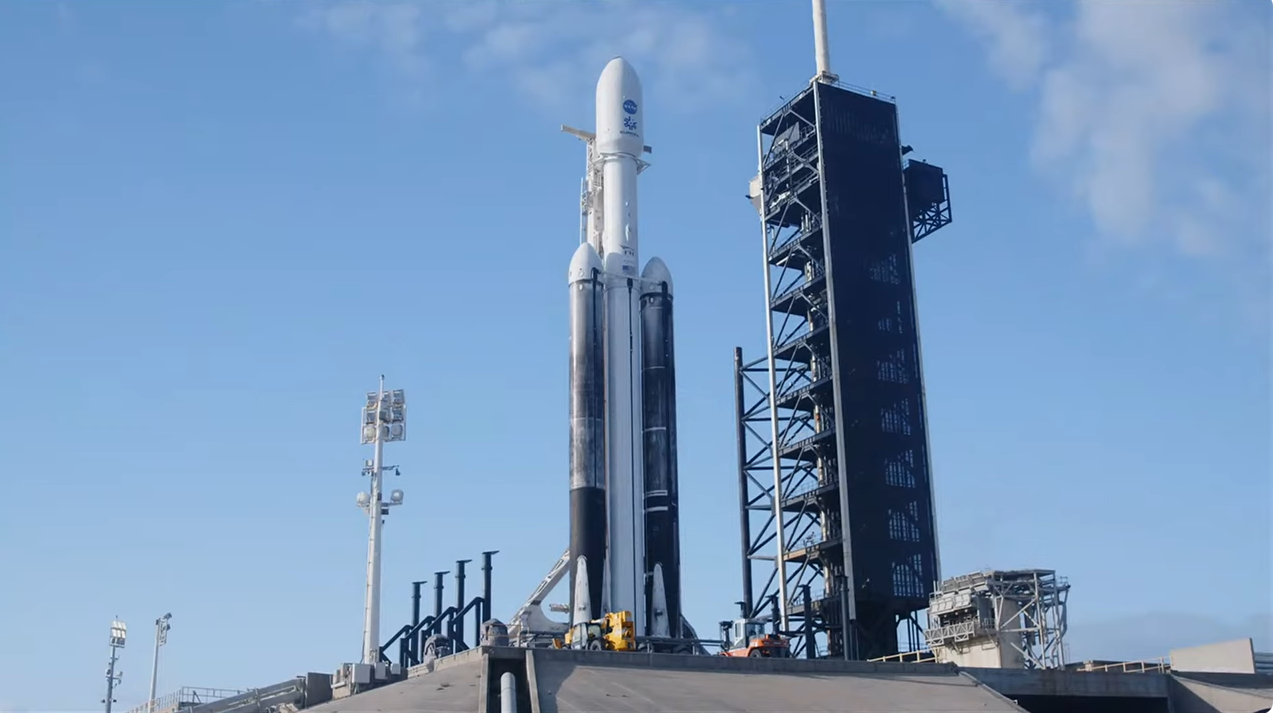
A SpaceX Falcon Heavy rocket with the Europa Clipper spacecraft aboard
A SpaceX Falcon Heavy rocket with the Europa Clipper spacecraft aboard is seen at Launch Complex 39A as preparations continue for the mission, Sunday, Oct. 13, at NASA’s Kennedy Space Center in Florida.
NASA

Find details about the launch sequences for the orbiter, which is targeting an Oct. 14 liftoff on its mission to search for ingredients of life at Jupiter’s moon Europa.

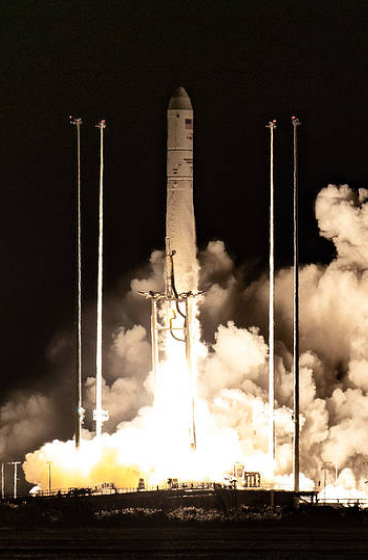
In less than 24 hours, NASA’s Europa Clipper spacecraft is slated to launch from the agency’s Kennedy Space Center in Florida aboard a Falcon Heavy rocket. Its sights are set on Jupiter’s ice-encased moon Europa, which the spacecraft will fly by 49 times, coming as close as 16 miles (25 kilometers) from the surface as it searches for ingredients of life. 

Launch is set for 12:06 p.m. EDT on Monday, Oct. 14, with additional opportunities through Nov 6. Each opportunity is instantaneous, meaning there is only one exact time per day when launch can occur. Plans to launch Europa Clipper on Oct. 10 were delayed due to impacts of Hurricane Milton.

Watch this video to learn more about NASA’s Europa Clipper, the first mission dedicated to studying Jupiter’s icy moon Europa. Evidence suggests that beneath Europa’s frozen surface is a global ocean of water, and scientists want to find out if there’s also the right chemistry and energy to sustain life. NASA/JPL-Caltech

With its massive solar arrays extended, Europa Clipper could span a basketball court (100 feet, or 30.5 meters, tip to tip). In fact, it’s the largest spacecraft NASA has ever built for a planetary mission. The journey to Jupiter is a long one — 1.8 billion miles (2.9 billion kilometers) — and rather than taking a straight path there, Europa Clipper will loop around Mars and then Earth, gaining speed as it swings past.

The spacecraft will begin orbiting Jupiter in April 2030, and in 2031 it will start making those 49 science-focused flybys of Europa while looping around the gas giant. The orbit is designed to maximize the science Europa Clipper can conduct and minimize exposure to Jupiter’s notoriously intense radiation.

But, of course, before any of that can happen, the spacecraft has to leave Earth behind. The orbiter’s solar arrays are folded and stowed for launch. Testing is complete on the spacecraft’s various systems and its payload of nine science instruments and a gravity science investigation. Loaded with over 6,060 pounds (2,750 kilograms) of the propellant that will get Europa Clipper to Jupiter, the spacecraft has been encapsulated in the protective nose cone, or payload fairing, atop a SpaceX Falcon Heavy rocket, which is poised for takeoff from historic Launch Complex 39A.

Launch Sequences

The Falcon Heavy has two stages and two side boosters. After the side boosters separate, the core stage will be expended into the Atlantic Ocean. Then the second stage of the rocket, which will help Europa Clipper escape Earth’s gravity, will fire its engine.
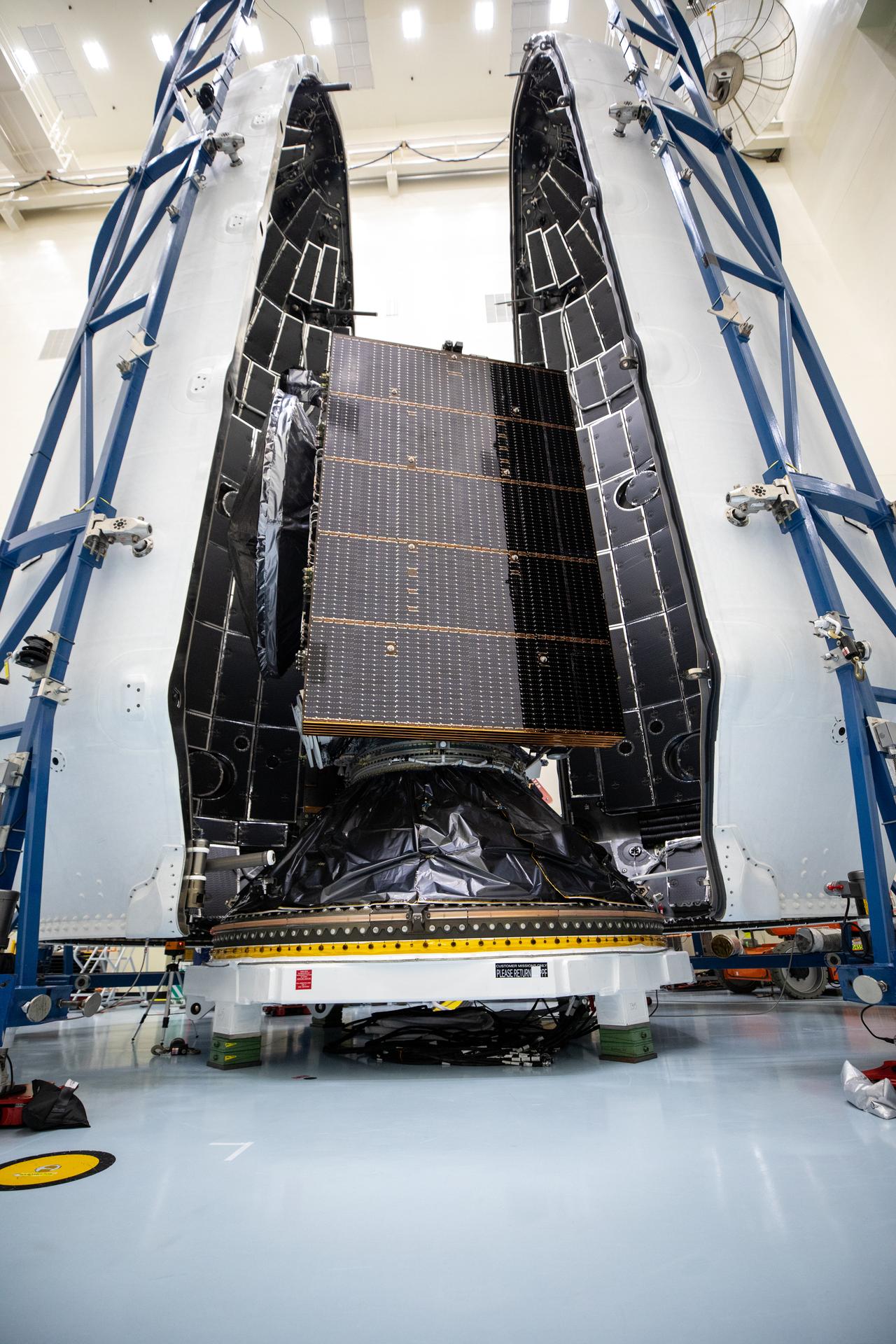
Technicians encapsulated NASA’s Europa Clipper spacecraft
Technicians encapsulated NASA’s Europa Clipper spacecraft inside payload fairings on Wednesday, Oct. 2, at NASA’s Kennedy Space Center in Florida. The fairings will protect the spacecraft during launch as it begins its journey to explore Jupiter’s icy moon Europa.
NASA/Ben Smegelsky

Once the rocket is out of Earth’s atmosphere, about 50 minutes after launch, the payload fairing will separate from its ride, split into two halves, and fall safely back to Earth, where it will be recovered and reused. The spacecraft will then separate from the upper stage about an hour after launch. Stable communication with the spacecraft is expected by about 19 minutes after separation from the rocket, but it could take somewhat longer.

About three hours after launch, Europa Clipper will deploy its pair of massive solar arrays, one at a time, and direct them at the Sun.

Mission controllers will then begin to reconfigure the spacecraft into its planned operating mode. The ensuing three months of initial checkout include a commissioning phase to confirm that all hardware and software is operating as expected.

While Europa Clipper is not a life-detection mission, it will tell us whether Europa is a promising place to pursue an answer to the fundamental question about our solar system and beyond: Are we alone?

Scientists suspect that the ingredients for life — water, chemistry, and energy — could exist at the moon Europa right now. Previous missions have found strong evidence of an ocean beneath the moon’s thick icy crust, potentially with twice as much liquid water as all of Earth’s oceans combined. Europa may be home to organic compounds, which are essential chemical building blocks for life. Europa Clipper will help scientists confirm whether organics are there, and also help them look for evidence of energy sources under the moon’s surface.

This artist’s concept depicts NASA’s Europa Clipper spacecraft in orbit at Jupiter
This artist’s concept depicts NASA’s Europa Clipper spacecraft in orbit at Jupiter as it passes over the gas giant’s icy moon Europa (lower right). Scheduled to arrive at Jupiter in April 2030, the mission will be the first to specifically target Europa for detailed science investigation.
NASA/JPL-Caltech

More About Europa Clipper

Europa Clipper’s three main science objectives are to determine the thickness of the moon’s icy shell and its interactions with the ocean below, to investigate its composition, and to characterize its geology. The mission’s detailed exploration of Europa will help scientists better understand the astrobiological potential for habitable worlds beyond our planet.

Managed by Caltech in Pasadena, California, NASA’s Jet Propulsion Laboratory leads the development of the Europa Clipper mission in partnership with the Johns Hopkins Applied Physics Laboratory (APL) for NASA’s Science Mission Directorate in Washington. APL designed the main spacecraft body in collaboration with JPL and NASA’s Goddard Space Flight Center in Greenbelt, Maryland; NASA’s Marshall Space Flight Center in Huntsville, Alabama; and NASA’s Langley Research Center in Hampton, Virginia. The Planetary Missions Program Office at Marshall executes program management of the Europa Clipper mission.

NASA’s Launch Services Program, based at Kennedy, manages the launch service for the Europa Clipper spacecraft, which will launch on a SpaceX Falcon Heavy rocket from Launch Complex 39A at Kennedy.

Find more information about Europa here:

europa.nasa.gov

News Media Contacts

Meira Bernstein / Karen Fox
NASA Headquarters, Washington
202-358-1600
meira.b.bernstein@nasa.gov / karen.c.fox@nasa.gov

Gretchen McCartney
Jet Propulsion Laboratory, Pasadena, Calif.
818-287-4115
gretchen.p.mccartney@jpl.nasa.gov 

2024-139

Share

Details

Last Updated

Oct 13, 2024

Powered by WPeMatico

Get The Details…
Anthony Greicius

NASA Welcomes Estonia as Newest Artemis Accords Signatory

NASA Welcomes Estonia as Newest Artemis Accords Signatory

Graphic of flags representing Artemis Accords signatory countries
Credit: NASA

While in Milan for international meetings, NASA Administrator Bill Nelson was among the witnesses as Estonia signed the Artemis Accords and became the 45th nation to join the United States and other signatories agreeing to the safe, transparent, and responsible exploration of the Moon, Mars, and beyond.

The signing ceremony took place ahead of Italy hosting the 75th International Astronautical Congress beginning Monday, Oct. 14, where government and space officials from signatory countries will discuss advancing implementation of the Artemis Accords, among other topics.

“We welcome Estonia’s signing of the Artemis Accords, which will open the door for more international collaboration,” said Nelson. “This decision also strengthens our family of nations, united by a common cause, and builds on our commitment to explore space for the benefit of humanity under the sound principles of the accords.”

Erkki Keldo, Estonia’s minister of economy and industry, signed the Artemis Accords. Rahima Kandahari, deputy assistant secretary for the U.S. State Department and Lisa Campbell, CSA (Canadian Space Agency) president, also participated in the event.

“Estonia is well known as the leading country in e-governance, and it is a great honor for us to enter a next level in space exploration, said Keldo. “We are more than interested to share our knowledge with the global space community to make future collaboration in space exploration a success for humankind. I am sure that joining the Artemis Accords will open attractive opportunities to Estonian enterprises too, to share their valuable knowledge and competences.”

In 2020, the United States and seven other nations were the first to sign the Artemis Accords, which identified an early set of principles promoting the beneficial use of space for humanity. The accords are grounded in the Outer Space Treaty and other agreements including the Registration Convention, the Rescue and Return Agreement, as well as best practices and norms of responsible behavior that NASA and its partners have supported, including the public release of scientific data. 

The commitments of the Artemis Accords and efforts by the signatories to advance implementation of these principles support the safe and sustainable exploration of space. More countries are expected to sign in the coming weeks and months.

Learn more about the Artemis Accords at:

https://www.nasa.gov/artemis-accords

-end-

Meira Bernstein / Elizabeth Shaw
Headquarters, Washington
202-358-1600
meira.b.bernstein@nasa.gov / elizabeth.a.shaw@nasa.gov

Share

Details

Last Updated

Oct 13, 2024

Editor
Jennifer M. Dooren

Powered by WPeMatico

Get The Details…
Jennifer M. Dooren

A Serendipitous NASA Family Reunion

A Serendipitous NASA Family Reunion

2 min read

Preparations for Next Moonwalk Simulations Underway (and Underwater)

A man in military uniform and woman in NASA polo shirt stand in front of a NASA F/A-18 hornet aircraft.
Yomayra Cruz-Diaz, technical project coordinator at NASA Langley with her son, Israel Martinez-Cruz. Martinez-Cruz is serving in the United States Marine Corps and is stationed at Marine Corps Air Station Miramar.
NASA / Jessica Arreola

Growing up in Puerto Rico, Yomayra Cruz-Diaz didn’t imagine that one day she would work at NASA. Today, she serves as technical project coordinator at NASA’s Langley Research Center in Virginia, supporting its Aeronautics Research Directorate

Cruz-Diaz’s position requires her to travel in support of public engagement events and recently she supported NASA’s presence at the Miramar Airshow in San Diego, California where the agency’s booth featured Spanish-language STEM materials.

Something, or rather, someone, made this event especially unique for Cruz-Diaz: Her son, Israel Martinez-Cruz, is currently serving in the United States Marine Corps and is stationed at Marine Corps Air Station Miramar. 

In a stroke of serendipity, they were both working the same event for their respective employers. Living on opposite sides of the country, they hadn’t seen each other in person for nearly a year. With surprise and joy, they hugged.

Growing up in a Puerto Rican household, conversations about core values revolved around family, Martinez-Cruz said. He recalled seeing his mom work at NASA and feeling inspired by her work ethic. That level of commitment ran in the family.

“Israel and I would carpool,” she said. “He would drop me off at Langley and then he would go on his way to his aircraft mechanic school.”

Martinez-Cruz serves as an air traffic controller, work that Cruz-Diaz knew about but had never seen in person.

“He’s explained to me what his job entails but taking a tour of his job site gives me a whole new understanding,” she said after a tour of the air traffic control tower.  

NASA is proud to celebrate National Hispanic Heritage Month, the annual observance honoring the wide and rich histories, cultures, and contributions of the Hispanic and Latino community. In the words of NASA Administrator Bill Nelson, “Adelante y hacia arriba,” or “Onward and upward!” 

Share

Details

Last Updated

Oct 12, 2024

Editor
Jim Banke
Contact
Jessica Arreola

Powered by WPeMatico

Get The Details…
Jim Banke

Una reunión familiar de la NASA por casualidad

Una reunión familiar de la NASA por casualidad

2 min read

Preparations for Next Moonwalk Simulations Underway (and Underwater)

A man in military uniform and woman in NASA polo shirt stand in front of a NASA F/A-18 hornet aircraft.
Yomayra Cruz-Díaz, coordinadora de proyectos técnicos en NASA Langley con su hijo, Israel Martínez-Cruz. Martínez sirve en los Marines de los Estados Unidos y está destinado en la Estación Aérea de los Marines en Miramar.
NASA / Jessica Arreola

Al crecer en Puerto Rico, Yomayra Cruz-Díaz no imaginó que algún día trabajaría en la NASA. En la actualidad, se desempeña como coordinadora de proyectos técnicos en el Centro de Investigación Langley de la NASA en Virginia, apoyando a su Dirección de Investigación Aeronáutica.

El puesto de Cruz-Díaz le requiere viajar para apoyar eventos de participación pública y recientemente apoyó la presencia de la NASA en una exhibición aérea, en San Diego, California, donde el puesto de la agencia presentó materiales STEM en español.

Algo, o, mejor dicho, alguien, hizo que este evento fuera especialmente único para Cruz-Díaz: su hijo, Israel Martínez-Cruz, actualmente sirve en los Marines de los Estados Unidos y está destinado en la Estación Aérea del Cuerpo de Marines de Miramar.

En un golpe de suerte, ambos trabajaban en el mismo evento para sus respectivos empleadores. Al vivir en lados opuestos del país, no se habían visto en persona durante casi un año. Con sorpresa y alegría, se abrazaron.

Al crecer en un hogar puertorriqueño, las conversaciones sobre los valores fundamentales giraban en torno a la familia, dijo Martínez-Cruz. El recuerda haber visto a su madre trabajar en la NASA y sentirse inspirado por su ética de trabajo. Ese nivel de compromiso era hereditario.

“Israel y yo compartiríamos el viaje”, ella dijo. “El me dejaba en Langley y luego seguía el camino a su escuela de mecánica aeronáutica”.

Martínez-Cruz se desempeña como controlador de tránsito aéreo, trabajo que Cruz-Díaz conocía pero que nunca había visto en persona.

Share

Details

Last Updated

Oct 12, 2024

Editor
Jim Banke
Contact
Jessica Arreola

Powered by WPeMatico

Get The Details…
Jim Banke

Can Life Exist on an Icy Moon? NASA’s Europa Clipper Aims to Find Out

Can Life Exist on an Icy Moon? NASA’s Europa Clipper Aims to Find Out

6 min read

Preparations for Next Moonwalk Simulations Underway (and Underwater)

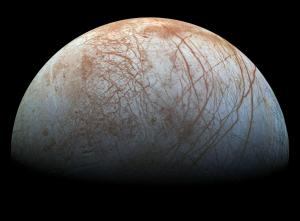
Europa looms large in this reprocessed color view
The puzzling surface of Jupiter’s icy moon Europa looms large in this reprocessed color view made from images taken by NASA’s Galileo spacecraft in the late 1990s. The images were assembled into a realistic color view of the surface that approximates how Europa would appear to the human eye.
NASA/JPL-Caltech/SETI Institute

With a spacecraft launching soon, the mission will try to answer the question of whether there are ingredients suitable for life in the ocean below Europa’s icy crust.

Deep down, in an ocean beneath its ice shell, Jupiter’s moon Europa might be temperate and nutrient-rich, an ideal environment for some form of life — what scientists would call “habitable.” NASA’s Europa Clipper mission aims to find out.

NASA now is targeting launch no earlier than Monday, Oct. 14, on a SpaceX Falcon Heavy rocket from Launch Complex 39A at NASA’s Kennedy Space Center in Florida.

Europa Clipper’s elongated, looping orbit around Jupiter will minimize the spacecraft’s exposure to intense radiation while allowing it to dive in for close passes by Europa. Using a formidable array of instruments for each of the mission’s 49 flybys, scientists will be able to “see” how thick the moon’s icy shell is and gain a deeper understanding of the vast ocean beneath. They’ll inventory material on the surface that might have come up from below, search for the fingerprints of organic compounds that form life’s building blocks, and sample any gases ejected from the moon for evidence of habitability.

Mission scientists will analyze the results, probing beneath the moon’s frozen shell for signs of a water world capable of supporting life.

This artist’s concept (not to scale) depicts what Europa’s internal structure could look like
This artist’s concept (not to scale) depicts what Europa’s internal structure could look like: an outer shell of ice, perhaps with plumes of material venting from beneath the surface; a deep, global layer of liquid water; and a rocky interior, potentially with hydrothermal vents on the seafloor.
NASA/JPL-Caltech

“It’s important to us to paint a picture of what that alien ocean is like — the kind of chemistry or even biochemistry that could be happening there,” said Morgan Cable, an astrobiologist and member of the Europa Clipper science team at NASA’s Jet Propulsion Laboratory in Southern California, which manages the mission.

Ice Investigation

Central to that work is hunting for the types of salts, ices, and organic material that make up the key ingredients of a habitable world. That’s where an imager called MISE (Mapping Imaging Spectrometer for Europa) comes in. Operating in the infrared, the spacecraft’s MISE divides reflected light into various wavelengths to identify the corresponding atoms and molecules.

The mission will also try to locate potential hot spots near Europa’s surface, where plumes could bring deep ocean material closer to the surface, using an instrument called E-THEMIS (Europa Thermal Emission Imaging System), which also operates in the infrared.

Capturing sharply detailed pictures of Europa’s surface with both a narrow and a wide-image camera is the task of the EIS (Europa Imaging System). “The EIS imagers will give us incredibly high-resolution images to understand how Europa’s surface evolved and is continuing to change,” Cable said.

Gases and Grains

NASA’s Cassini mission spotted a giant plume of water vapor erupting from multiple jets near the south pole of Saturn’s ice-covered moon Enceladus. Europa may also emit misty plumes of water, pulled from its ocean or reservoirs in its shell. Europa Clipper’s instrument called Europa-UVS (Europa Ultraviolet Spectrograph) will search for plumes and can study any material that might be venting into space.

Whether or not Europa has plumes, the spacecraft carries two instruments to analyze the small amount of gas and dust particles ejected from the moon’s surface by impacts with micrometeorites and high-energy particles: MASPEX (MAss SPectrometer for Planetary EXploration/Europa) and SUDA (SUrface Dust Analyzer) will capture the tiny pieces of material ejected from the surface, turning them into charged particles to reveal their composition.  

“The spacecraft will study gas and grains coming off Europa by sticking out its tongue and tasting those grains, breathing in those gases,” said Cable.

Inside and Out

The mission will look at Europa’s external and internal structure in various ways, too, because both have far-reaching implications for the moon’s habitability.

To gain insights into the ice shell’s thickness and the ocean’s existence, along with its depth and salinity, the mission will measure the moon’s induced magnetic field with the ECM (Europa Clipper Magnetometer) and combine that data with measurements of electrical currents from charged particles flowing around Europa — data provided by PIMS (Plasma Instrument for Magnetic Sounding).

In addition, scientists will look for details on everything from the presence of the ocean to the structure and topography of the ice using REASON (Radar for Europa Assessment and Sounding to Near-surface), which will peer up to 18 miles (29 kilometers) into the shell — itself a potentially habitable environment. Measuring the changes that Europa’s gravity causes in radio signals should help nail down ice thickness and ocean depth.

“Non-icy materials on the surface could get moved into deep interior pockets of briny water within the icy shell,” said Steve Vance, an astrobiologist and geophysicist who also is a member of the Europa Clipper science team at JPL. “Some might be large enough to be considered lakes, or at least ponds.”

Using the data gathered to inform extensive computer modeling of Europa’s interior structure also could reveal the ocean’s composition and allow estimates of its temperature profile, Vance said.

Whatever conditions are discovered, the findings will open a new chapter in the search for life beyond Earth. “It’s almost certain Europa Clipper will raise as many questions or more than it answers — a whole different class than the ones we’ve been thinking of for the last 25 years,” Vance said.

More About Europa Clipper

Europa Clipper’s three main science objectives are to determine the thickness of the moon’s icy shell and its interactions with the ocean below, to investigate its composition, and to characterize its geology. The mission’s detailed exploration of Europa will help scientists better understand the astrobiological potential for habitable worlds beyond our planet.

To learn more about the science instruments aboard Europa Clipper and the institutions provide them, visit:

https://europa.nasa.gov/spacecraft/instruments

Managed by Caltech in Pasadena, California, NASA’s Jet Propulsion Laboratory leads the development of the Europa Clipper mission in partnership with the Johns Hopkins Applied Physics Laboratory in Laurel, Maryland, for NASA’s Science Mission Directorate in Washington. APL designed the main spacecraft body in collaboration with JPL and NASA’s Goddard Space Flight Center in Greenbelt, Maryland, NASA’s Marshall Space Flight Center in Huntsville, Alabama, and NASA’s Langley Research Center in Hampton, Virginia. The Planetary Missions Program Office at Marshall executes program management of the Europa Clipper mission.

NASA’s Launch Services Program, based at Kennedy, manages the launch service for the Europa Clipper spacecraft, which will launch on a SpaceX Falcon Heavy rocket from Launch Complex 39A at Kennedy.

Find more information about Europa here:

https://europa.nasa.gov

News Media Contacts

Gretchen McCartney
Jet Propulsion Laboratory, Pasadena, Calif. 
818-393-6215 
gretchen.p.mccartney@jpl.nasa.gov 

Karen Fox / Molly Wasser
NASA Headquarters, Washington
202-358-1600
karen.c.fox@nasa.gov / molly.l.wasser@nasa.gov

Written by Pat Brennan

2024-138

Share

Details

Last Updated

Oct 12, 2024

Powered by WPeMatico

Get The Details…
Anthony Greicius