NASA Sets Coverage for Agency’s SpaceX Crew-12 Launch, Docking

NASA Sets Coverage for Agency’s SpaceX Crew-12 Launch, Docking
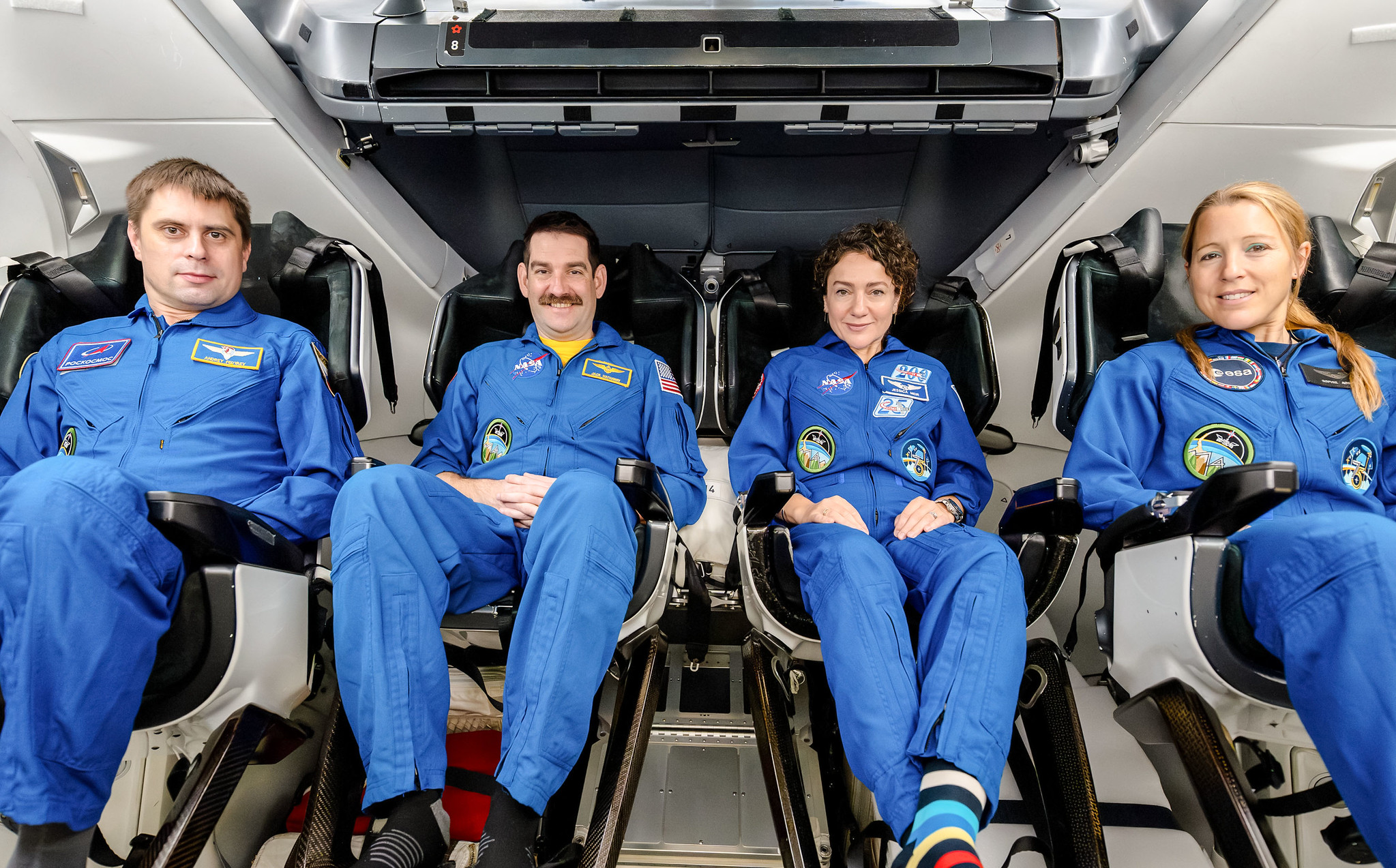
The four members of NASA's SpaceX Crew-12 mission to the International Space Station pose together for a crew portrait inside a SpaceX Dragon spacecraft at SpaceX headquarters in Hawthorne, California. From left are, Roscosmos cosmonaut and Mission Specialist Andrey Fedyaev, NASA astronauts Jack Hathaway and Jessica Meir, Pilot and Commander respectively, and ESA (European Space Agency) astronaut and Mission Specialist Sophie Adenot.
The four members of NASA’s SpaceX Crew-12 mission to the International Space Station pose together for a crew portrait inside a SpaceX Dragon spacecraft at SpaceX headquarters in Hawthorne, California. From left are, Roscosmos cosmonaut and Mission Specialist Andrey Fedyaev, NASA astronauts Jack Hathaway and Jessica Meir, Pilot and Commander respectively, and ESA (European Space Agency) astronaut and Mission Specialist Sophie Adenot.
SpaceX

NASA will stream live coverage of the upcoming prelaunch, launch, and docking activities for the agency’s SpaceX Crew-12 mission to the International Space Station.

Liftoff is targeted for no earlier than 6:01 a.m. EST on Wednesday, Feb. 11, from Space Launch Complex 40 at Cape Canaveral Space Force Station in Florida. The targeted docking time is approximately 10:30 a.m., Thursday, Feb. 12.

Watch agency launch coverage on NASA+, Amazon Prime, and the agency’s YouTube channel. Individual events on YouTube will have their own stream closer to their start time. Learn how to watch NASA content through a variety of online platforms, including social media.

The SpaceX Dragon spacecraft will carry NASA astronauts Jessica Meir and Jack Hathaway, ESA (European Space Agency) astronaut Sophie Adenot, and Roscosmos cosmonaut Andrey Fedyaev, to the orbiting laboratory for a science mission. This is NASA’s 12th crew rotation mission and the 13th human spaceflight mission to the space station supported by the Dragon spacecraft since 2020, as part of the agency’s Commercial Crew Program.

The deadline for media accreditation for in-person coverage of this launch has passed. The agency’s media credentialing policy is available online. For questions about media accreditation, please email: ksc-media-accreditat@mail.nasa.gov.

Media who need access to NASA live video feeds may subscribe to the agency’s media resources distribution list to receive daily updates and links.

NASA’s mission coverage is as follows (all times Eastern and subject to change based on real-time operations):

Sunday, Feb. 8

11 a.m. – Crew-12 virtual media event from Astronaut Crew Quarters at NASA’s Kennedy Space Center in Florida with the following participants:

  • Jessica Meir, commander, NASA
  • Jack Hathaway, pilot, NASA
  • Sophie Adenot, mission specialist, ESA
  • Andrey Fedyaev, mission specialist, Roscosmos

Watch live coverage of the virtual crew media event on NASA Kennedy’s YouTube account.

Media may ask questions via phone. For the dial-in number and passcode, media should contact the NASA Kennedy newsroom no later than one hour prior to the beginning of the news conference at: ksc-newsroom@mail.nasa.gov

Monday, Feb. 9

11 a.m. – Prelaunch news conference with the following participants:

  • Steve Stich, manager, Commercial Crew Program, NASA
  • Dana Weigel, manager, International Space Station Program, NASA
  • Andreas Mogensen, Human Exploration Group Leader, ESA
  • William Gerstenmaier, vice president, Build and Flight Reliability, SpaceX

NASA will provide live coverage of the news conference on the agency’s YouTube channel.

Media may ask questions in person and via phone. For the dial-in number and passcode, media should contact the NASA Kennedy newsroom no later than one hour prior to the beginning of the news conference at: ksc-newsroom@mail.nasa.gov.

Wednesday, Feb. 11

4 a.m. – Launch coverage begins on NASA+, Amazon Prime, and YouTube.

6:01 a.m. – Launch

Following the conclusion of launch coverage, NASA will distribute audio-only discussions between Crew-12, the space station, and flight controllers during Dragon’s transit to the orbital complex. NASA+ coverage resumes at the start of rendezvous and docking and continues through hatch opening and welcoming remarks. 

7:30 a.m. – Postlaunch news conference with the following participants:

  • NASA Administrator Jared Isaacman
  • Josef Aschbacher, director general, ESA
  • Steve Stich, manager, Commercial Crew Program, NASA
  • Dana Weigel, manager, International Space Station Program, NASA
  • Lee Echerd, senior mission manager, Human Spaceflight Mission Management, SpaceX

Live coverage of the postlaunch news conference will stream on the agency’s YouTube channel.

Media may ask questions in person and via phone. Limited auditorium space will be available for in-person participation. For the dial-in number and passcode, please contact the NASA Kennedy newsroom no later than one hour prior to the beginning of the news conference at ksc-newsroom@mail.nasa.gov.

Thursday, Feb. 12

8:30 a.m. – Arrival coverage begins on NASA+, Amazon Prime, and YouTube.

10:30 a.m. – Targeted docking to the space-facing port of the station’s Harmony module.

12:15 p.m. – Hatch opening followed by welcome remarks

All times are estimates and could be adjusted based on real-time operations after launch. Follow the space station blog for the most up-to-date operations information.

Live video coverage prior to launch

NASA will provide a live video feed of Space Launch Complex 40 approximately six hours prior to the planned liftoff of the Crew-12 mission. Pending unlikely technical issues, the feed will be uninterrupted until the prelaunch broadcast begins on NASA+, approximately two hours prior to launch. Once the feed is live, find it online at: http://youtube.com/kscnewsroom.

NASA website launch coverage
Launch day coverage of the mission will be available on the NASA website. Coverage will include live streaming at 4 a.m. Feb. 11, and blog updates as the countdown milestones occur. On-demand streaming video on NASA+ and photos of the launch will be available shortly after liftoff. For questions about countdown coverage, contact the NASA Kennedy newsroom at 321-867-2468. Follow countdown coverage on the commercial crew or Crew-12 blog.

Attend launch virtually

Members of the public may register to attend this launch virtually. NASA’s virtual guest program for this mission also includes curated launch resources, notifications about related opportunities or changes, and a stamp for the NASA virtual guest passport following launch.

Audio only coverage

Launch audio also will be available on Launch Information Service and Amateur Television System’s VHF radio frequency 146.940 MHz and KSC Amateur Radio Club’s UHF radio frequency 444.925 MHz, FM mode, heard within Brevard County on the Space Coast.

Watch, engage on social media

Follow the Crew-12 mission on X, Facebook, and Instagram by following and tagging these accounts:

X: @NASA, @NASAKennedy, @Space_Station, @ISS National Lab, @SpaceX

Facebook: NASA, NASAKennedy, ISS, ISS National Lab

Instagram: @NASA, @NASAKennedy, @ISS, @ISSNationalLab, @SpaceX

Coverage en Espanol

Did you know NASA has a Spanish section called NASA en Espanol? Check out NASA en Espanol on X, Instagram, Facebook, and YouTube for additional mission coverage.

Para obtener información sobre cobertura en español en el Centro Espacial Kennedy o si desea solicitar entrevistas en español, comuníquese con Antonia Jaramillo: 321-501-8425; antonia.jaramillobotero@nasa.gov; o Messod Bendayan: 256-930-1371; messod.c.bendayan@nasa.gov.

NASA’s Commercial Crew Program has delivered on its goal of safe, reliable, and cost-effective transportation to and from the International Space Station from the United States through a partnership with American private industry. This partnership is opening access to low Earth orbit and the International Space Station to more people, more science, and more commercial opportunities. For more than 25 years, humans have continuously lived and worked aboard the International Space Station, advancing scientific knowledge and demonstrating new technologies that enable us to prepare for human exploration of the Moon as we prepare for Mars.

To learn about the mission, visit:

https://www.nasa.gov/commercialcrew

-end-

Joshua Finch / Jimi Russell
Headquarters, Washington
202-358-1100
joshua.a.finch@nasa.gov / james.j.russell@nasa.gov

Steven Siceloff
Kennedy Space Center, Florida
321-867-2468
steven.p.siceloff@nasa.gov

Sandra Jones / Joseph Zakrzewski
Johnson Space Center, Houston
281-483-5111
sandra.p.jones@nasa.gov / joseph.a.zakrzewski@nasa.gov

Powered by WPeMatico

Get The Details…
Elizabeth Shaw

Strong Solar Flare

Strong Solar Flare

The Sun is blue, purple, and black with a bright purple line surrounding it. Scattered across it are some brighter purple spots where there is higher activity. Just above center is a bright red and white X: This is the solar flare.
NASA’s Solar Dynamics Observatory captured this image of a solar flare — seen as the bright flash toward the upper middle — on Feb. 4, 2026. The image shows a subset of extreme ultraviolet light that highlights the extremely hot material in flares and which is colorized in blue and red.
NASA/SDO

This Feb. 4, 2026, image from NASA’s Solar Dynamics Observatory (SDO) captures a strong solar flare erupting from the star. Solar flares are powerful bursts of energy that can, along with other types of solar eruptions, can impact radio communications, electric power grids, navigation signals, and pose risks to spacecraft and astronauts. The flare pictured was classified as an X4.2 flare. X-class denotes the most intense flares, while the number provides more information about its strength.

SDO measures the Sun’s properties and solar activity to help us better understand the Sun’s magnetic changes. By studying flares and how they affect our planet and nearby space, SDO helps us to better prepare for and deal with these potential disruptions.

Image credit: NASA/SDO

Powered by WPeMatico

Get The Details…
Monika Luabeya

Boreal Forests Are Shifting North

Boreal Forests Are Shifting North

For the first time, researchers have been able to confirm that our planet’s boreal forests are on the move.
NASA’s Goddard Space Flight Center/Chris Burns

The boreal forest—the world’s largest terrestrial biome—is warming faster than any other forest type. To understand the changing dynamics of boreal forests, Feng et al., 2026 analyzed the biome from 1985 to 2020, leveraging the longest and highest-resolution satellite record of calibrated tree cover to date. The study, published in February in Biogeosciences with four co-authors from NASA Goddard Space Flight Center, confirms a northward shift in boreal forest cover over the past four decades. Landsat imagery played a central role in this study: the researchers applied machine learning to process 224,026 scenes collected by Landsats 4, 5, 7, and 8 to create annual, 30-meter resolution maps of tree cover across the entire boreal biome. They downscaled and extended calibrated MODIS Vegetation Continuous Fields data to 30-meter resolution, creating a 36-year time series (1984-2020) that provided unprecedented spatial detail for tracking forest changes.

The analysis revealed that boreal forests both grew in size and moved northward. The forests expanded by 0.844 million km² (a 12% increase) and shifted northward by 0.29° mean latitude, with gains concentrated between 64-68°N. Their work also showcased the capacity of new growth to act as a carbon sink. Young boreal forests (up to 36 years) hold an estimated 1.1-5.9 petagrams of carbon (Pg C) with potential to sequester an additional 2.3-3.8 Pg C if allowed to mature. Landsat’s long time series of highly calibrated data allows researchers to study how ecosystems shift over decades, a crucial insight into our changing world. 

Explore More

Boreal Forests Are Shifting North

2 min read

The boreal forest—the world’s largest terrestrial biome—is warming faster than any other forest type. New research uses Landsat data to…

Article

Milano Cortina 2026

4 min read

About 2,900 Olympic athletes have converged on northern Italy to sort out who is the GOAT—or perhaps the stoat.

Article

Tracking Glacial Change with Landsat and Radar 

5 min read

NASA Scientist Alex Gardner highlights how Landsat made his research into the dynamics of glacial flow possible.

Article

Powered by WPeMatico

Get The Details…

A Winter Blanket Covers North Carolina

A Winter Blanket Covers North Carolina

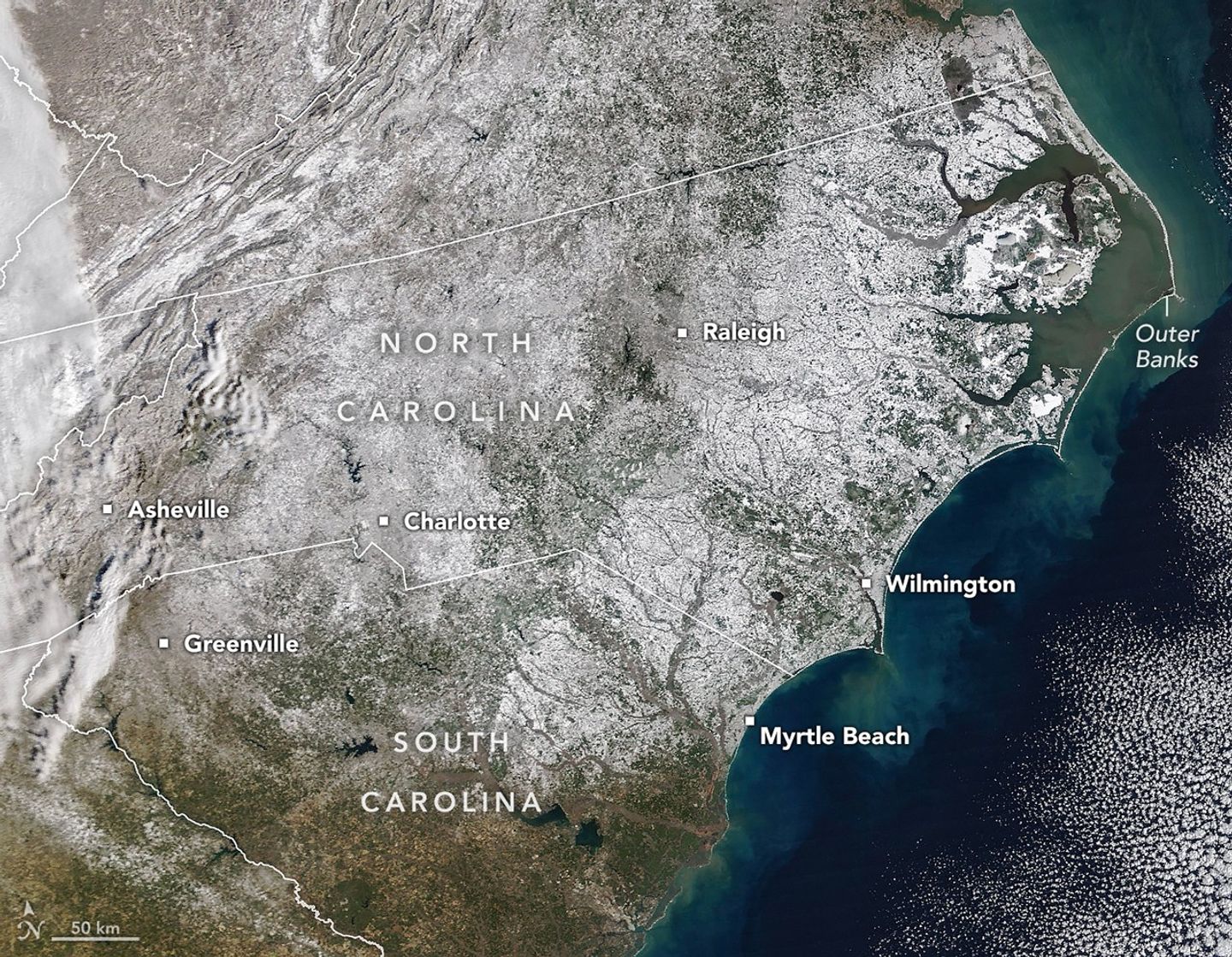
A satellite image centered on North Carolina shows white snow covering most of the state, with additional snowy patches in neighboring states. Some forested and urban areas appear gray. To the right, a strip of barrier islands appears white against the green and blue Atlantic Ocean.
February 2, 2026

A potent winter storm in late January 2026 left much of North Carolina dealing with significant snow accumulations. Though the state is no stranger to snow, such widespread coverage is unusual.

This image, acquired on February 2 with the MODIS (Moderate Resolution Imaging Spectroradiometer) on NASA’s Terra satellite, reveals a nearly continuous blanket of white stretching from mountain cities in the west to beachfront towns in the east. According to the North Carolina State Climate Office, measurable snow fell in all 100 counties for the first time in more than a decade.

Snowfall in North Carolina typically requires cold air funneled in from the north to combine with moisture supplied by a low-pressure system. During the January 31 weekend event, Arctic air from earlier in the week lingered across the state as a storm approached along a near-shore track, setting the stage for widespread snow.

Snow totals exceeded a foot in some of the state’s western, mountainous regions, following several years without significant snowfall events, though some locations such as Asheville saw smaller amounts. The storm even pushed south into Greenville, South Carolina, in the foothills of the Blue Ridge Mountains, where the downtown area saw about 5 inches (13 centimeters) by the evening of January 31, according to the National Weather Service.

In the Piedmont region, the hilly central part of the state, Charlotte received nearly a foot of snow—the most since 2004—while Raleigh saw a lighter accumulation of 2.8 inches, according to the state climate center.

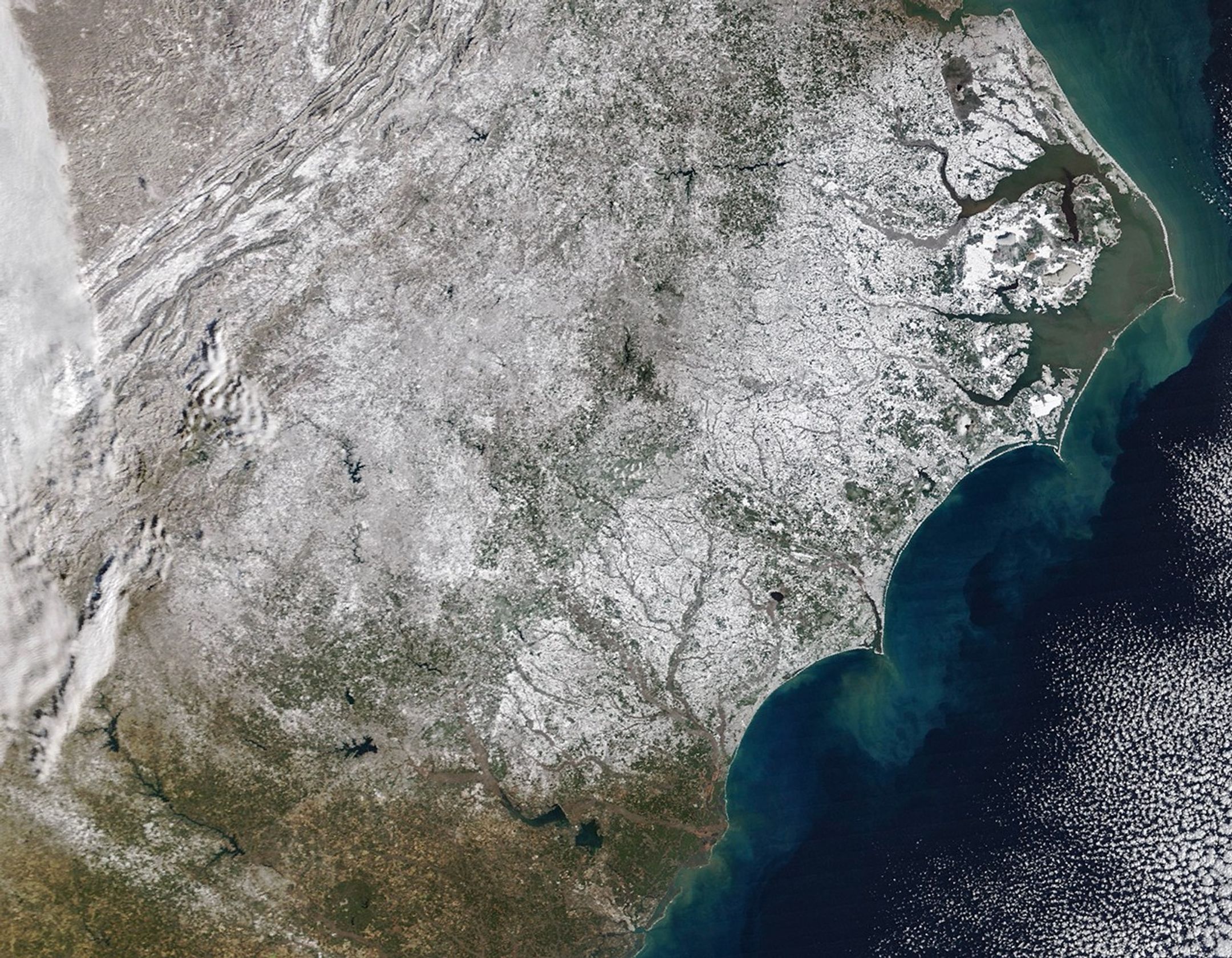
A detailed satellite image centered on eastern North Carolina shows white snow covering coastal areas along the blue-green Atlantic Ocean. Gray ice is visible on some rivers and lakes.
February 2, 2026

Even coastal parts of the state traded brown sandy beaches for a blanket of white, with more than a foot reported in parts of Carteret County. Beaufort, a mainland town in the southern Outer Banks area, experienced heavy blowing snow. Slightly inland, Greenville received 14 inches, an amount not seen since a large storm in March 1980.

Though appearing serene from space, the storm posed real hazards on the ground. Dangerous road conditions snarled traffic and caused collisions, according to local news reports, while coastal areas saw high winds and waves. Overwash on Highway 12 in the Outer Banks coated parts of the road in standing water and sand, while several homes along the shore of Hatteras Island collapsed into the sea.  

NASA Earth Observatory images by Michala Garrison, using MODIS data from NASA EOSDIS LANCE and GIBS/Worldview. Story by Kathryn Hansen.

References & Resources

You may also be interested in:

Stay up-to-date with the latest content from NASA as we explore the universe and discover more about our home planet.

Alaska’s Brand New Island

3 min read

A landmass that was once encased in the ice of the Alsek Glacier is now surrounded by water.

Article

Greenland Ice Sheet Gets a Refresh

3 min read

A moderately intense season of surface melting left part of the ice sheet dirty gray in summer 2025, but snowfall…

Article

Arctic Sea Ice Ties for 10th-Lowest on Record

3 min read

Satellite data show that Arctic sea ice likely reached its annual minimum extent on September 10, 2025.

Article

Powered by WPeMatico

Get The Details…

Dragon Preps, Artificial Intelligence, and Medical Gear Fill Crew’s Day

Dragon Preps, Artificial Intelligence, and Medical Gear Fill Crew’s Day

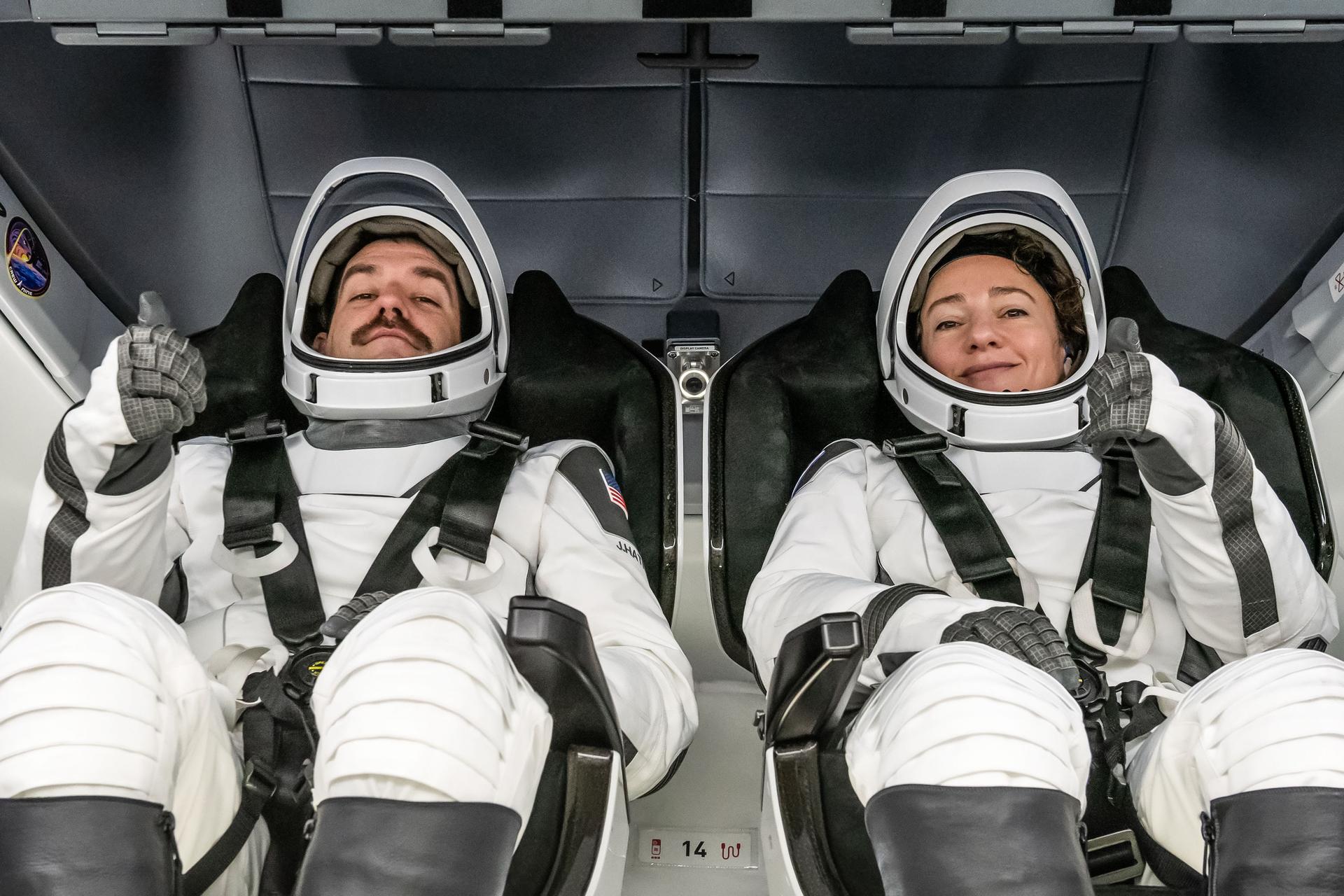
NASA astronauts (from left) Jack Hathaway and Jessica Meir, SpaceX Crew-12 Pilot and Commander respectively, are photographed in their pressure suits and inside the Dragon spacecraft during the Crew Equipment Interface Test at NASA’s Kennedy Space Center in Florida. The goal of the training is to rehearse launch day activities and get a close look at the spacecraft that will take them to the International Space Station.
NASA astronauts (from left) Jack Hathaway and Jessica Meir, SpaceX Crew-12 Pilot and Commander respectively, are photographed in their pressure suits and inside the Dragon spacecraft during the Crew Equipment Interface Test at NASA’s Kennedy Space Center on Jan. 12, 2026.
SpaceX

SpaceX Dragon arrival preparations and artificial intelligence research to improve crew operations continued aboard the International Space Station on Thursday. The Expedition 74 crew also checked out new medical hardware and trained to use emergency gear while keeping up orbital lab maintenance.

NASA’s SpaceX Crew-12 mission continues its countdown to a launch targeted for no earlier than 6:01 a.m. EST on Feb. 11, from Space Launch Complex 40 at Cape Canaveral Space Force Station in Florida. The four Crew-12 members Jessica Meir and Jack Hathaway, both from NASA, Sophie Adenot of ESA (European Space Agency), and Andrey Fedyaev of Roscosmos will dock to the orbital outpost’s space-facing port on the Harmony module the following day. They will spend nine months conducting advanced microgravity research aboard the orbital outpost benefitting humans living on and off the Earth.

Station Flight Engineer Chris Williams kept up his Dragon training and station configurations ahead of Crew-12’s planned arrival next week. Williams spent an hour continuing to review the procedures he will use while monitoring Dragon’s automated approach and rendezvous toward Harmony. Afterward, he began gathering and organizing standard spacecraft emergency hardware that will be transferred into Dragon shortly after it arrives.

Williams also checked out the new Ultrasound 3 biomedical device that is replacing the Ultrasound 2 scanner on the station. He powered on the device in the Columbus laboratory module and tested its configurations and electrical connections with a laptop computer and the Human Research Facility. The Ultrasound 3 was delivered to the orbital outpost on Sept. 18, 2025, aboard Northrop Grumman’s Cygnus XL spacecraft. It can be used for advanced imaging of a crew member’s cardiovascular, abdominal, and musculoskeletal systems in weightlessness with real-time guidance from doctors on the ground.

Roscosmos cosmonauts Sergey Kud-Sverchkov and Sergei Mikaev, station commander and flight engineer respectively, joined each other on Thursday exploring using artificial intelligence to boost crew efficiency aboard the orbital outpost. The duo tested AI-assisted tools to convert speech-to-text for speedier documentation and improve data handling and communications between the crew and ground controllers.

Kud-Sverchkov also conducted crew medical officer training familiarizing himself  a variety of emergency hardware, including an automated external defibrillator and respiratory support pack, to treat a crew member in the unlikely event of a medical situation aboard the space station. The two-time station resident continued experiment operations for the Plasma Kristall-4 investigation that explores complex plasmas to advance spacecraft designs, better understand planetary formation, and improve fundamental physics research.

Mikaev began his shift testing space-to-ground communications hardware with mission controllers in Russia. Afterward, the first-time space flyer checked the Elektron oxygen generator’s water tanks for air bubbles to ensure the life support device’s continuous operation.

Learn more about station activities by following the space station blog, @space_station on X, as well as the ISS Facebook and ISS Instagram accounts.

Get the latest from NASA delivered every week. Subscribe here.

Powered by WPeMatico

Get The Details…

Mark A. Garcia