Station Science Top News: Dec. 13, 2024

Station Science Top News: Dec. 13, 2024

Benchmarks for solidifying metal alloys

Researchers report benchmark data for modeling the growth of specific types of microstructures that form during solidification of metal alloys under different conditions. These microstructures affect the properties of materials and products such as refrigeration devices and solar cells.

The ESA (European Space Agency) Columnar-to-Equiaxed Transition in Solidification Processing (CETSOL) investigation studied the processes of metal alloy solidification and the crystal patterns that form as liquids transition to solids. Results could improve ground-based development of lightweight, high-performance structural materials for space and ground applications. Microgravity is key to this research because it eliminates influences of gravity during solidification and allows researchers to control turbulence and convection.

An astronaut aboard the International Space Station holds a metal bar with both hands while working in a space station module filled with cables, equipment, and storage compartments. He wears a light gray t-shirt and blue pants.
European Space Agency (ESA) astronaut Frank De Winne works on the Columnar-to-Equiaxed Transition in Solidification Processing (CETSOL) investigation in the U.S. Destiny Laboratory.
NASA

Composite materials shield against radiation, other hazards

Researchers found no degradation in two multifunctional radiation shielding composite materials after exposure to space. This finding suggests that composite materials with a surface layer and a coating could protect crews on future missions from radiation and other hazards of space.

Materials ISS Experiment Flight Facility (MISSE-FF) continued a series of investigations examining how exposure to space affects materials and material configurations used for space missions. The MISSE-13 suite of materials included a multifunctional composite material for shielding crew members in habitats and spacecraft beyond low Earth orbit against radiation, atomic oxygen, and temperature extremes.

An image of the Materials ISS Experiment Flight Facility (MISSE-FF) platform used for MISSE experiments.
NASA

Modeling the use of boiling to transfer heat

Researchers developed an algorithm to determine the amount of heat transferred via boiling of a liquid and showed that maximum heat flow occurs where the bubble contacts the surface and the liquid. This finding could inform design of thermal control systems for spacecraft and for cooling electronics and other applications on Earth.

ESA’s Multiscale Boiling examined the dynamics of heat transfer via boiling, which generates vapor bubbles that lift heat from a surface. This technique is less efficient in microgravity because boiling happens more slowly, and bubbles remain near the surface in the absence of buoyancy. But microgravity also makes it possible to observe effects that are too fast and too small to be measured under normal gravity conditions, helping scientists understand the dynamics of boiling heat transfer.

An astronaut aboard the International Space Station works with cables and tools while floating in a module filled with equipment, wires, and storage containers. The astronaut is wearing gloves, a black T-shirt, and green pants.
ESA astronaut Luca Parmitano works on the Multiscale Boiling hardware aboard the International Space Station.
ESA/Luca Parmitano

Powered by WPeMatico

Get The Details…
Sumer Loggins

NASA Sees Progress on Starlab Commercial Space Station Development

NASA Sees Progress on Starlab Commercial Space Station Development

3 min read

Preparations for Next Moonwalk Simulations Underway (and Underwater)

A digital rendering of the Starlab, which includes a large habitation and laboratory module with a smaller service module for power and propulsion (Credit: Starlab).
A digital rendering of the Starlab, which includes a large habitation and laboratory module with a smaller service module for power and propulsion.
Credits: Starlab

A NASA-funded commercial space station, Starlab, recently completed four key developmental milestones, marking substantial progress in the station’s design and operational readiness.

The four milestones are part of a NASA Space Act Agreement  awarded in 2021 and focused on reviews of the habitat structural test article preliminary design, systems integration, integrated operations, and a habitat structural test plan.

“These milestone achievements are great indicators to reflect Starlab’s commitment to the continued efforts and advancements of their commercial destination,” said Angela Hart, program manager for NASA’s Commercial Low Earth Orbit Development Program. “As we look forward to the future of low Earth orbit, every successful milestone is one step closer to creating a dynamic and robust commercialized low Earth orbit.”

The commercial space station is designed to launch on a single flight and includes a large habitation and laboratory module with a smaller service module for power and propulsion.

Earlier this year, Starlab Space completed a structural test article preliminary design review, supported by NASA. The structural test article is an engineering development unit of the station’s habitation module, which is where astronauts will spend most of their time living and working aboard the future commercial destination. An engineering development unit is a physical model that is used to test and verify the design of a project, such as a space station.

A digital rendering of the Starlab free-flying commercial destination, which continues to be developed as part of a Space Act Agreement with NASA (Credit: Starlab).
A digital rendering of the Starlab free-flying commercial destination, which continues to be developed as part of a Space Act Agreement with NASA
Credits: Starlab

Starlab also recently shared a test plan for the structural test article, which included defining qualification tests of the development unit from welding verifications to proof pressure and static load testing, among others. During proof pressure tests, a spacecraft component or system is pressurized to a significantly higher than normal operating pressure to verify its structural integrity, and a static load test measures the response of a component or system under an applied load.

In addition, Starlab completed integration operations and systems integration reviews. These reviews included updates on system and station architecture, segment interfaces, and program goals, as well as a comprehensive look into the program’s requirements.

Starlab also is set to complete a preliminary design review and phase 1 safety review by the end of the year. This review is meant to demonstrate that the station’s design meets system requirements, including human spaceflight verification, with acceptable risk. The safety review will summarize the current design and general safety approach for the destination.

NASA is supporting the design and development of multiple commercial space stations, including Starlab, through funded and unfunded agreements. The current design and development phase will be followed by the procurement of services from one or more companies, where NASA aims to be one of many customers for low Earth orbit destinations.

NASA’s low Earth orbit microgravity strategy builds on the agency’s extensive human spaceflight experience to advance future scientific and exploration goals. As the International Space Station nears the end of operations, NASA plans to transition to a new low Earth orbit model to continue leveraging microgravity benefits. Through commercial partnerships, NASA aims to maintain its leadership in microgravity research and ensure continued benefits for humanity.

Learn more about NASA’s low Earth orbit microgravity strategy at:

https://www.nasa.gov/leomicrogravitystrategy

News Media Contacts:

Claire O’Shea
Headquarters, Washington
202-358-1100
claire.a.o’shea@nasa.gov

Anna Schneider
Johnson Space Center, Houston
281-483-5111
anna.c.schneider@nasa.gov

Powered by WPeMatico

Get The Details…
Roger Weiss

NASA Finalizes Strategy for Sustaining Human Presence in Low Earth Orbit

NASA Finalizes Strategy for Sustaining Human Presence in Low Earth Orbit

Caption: An artist’s concept of the International Space Station orbiting Earth. In the distance is the Moon, and a red star representing Mars.
Credit: NASA

As part of the agency’s efforts to enable broader use of space, NASA has released its final goals and objectives for low Earth orbit, defining the long-term approach toward advancing microgravity science, technology, and exploration for the benefit of all. Developed with input from a wide range of stakeholders, NASA’s Low Earth Orbit Microgravity Strategy will guide the agency toward the next generation of continuous human presence in orbit, enable greater economic growth, and maintain international partnerships.

“As we near the retirement of the International Space Station in 2030, these objectives are a pivotal next step in solidifying U.S. leadership in space,” said NASA Deputy Administrator Pam Melroy. “Our consultation with industry, academia, and international partners has helped refine a visionary roadmap for our future in low Earth orbit, which will be enabled by a continuous human presence. Together, we are ensuring that the benefits of exploring space continue to grow – advancing science, innovation, and opportunities for all, while preparing for humanity’s next giant leap of exploring the Moon, Mars and beyond.”

In early 2024, NASA initiated a planning process that included drafting an initial set of goals and objectives for the low Earth orbit microgravity environment and seeking feedback from its workforce, government partners, industry, academia, international space agencies, and the public. The agency reviewed more than 1,800 comments and hosted two workshops, resulting in essential adjustments to the goals and objectives to better align with its partners. The final framework includes 13 goals and 44 objectives across seven key areas: commercial low Earth orbit infrastructure, operations, science, research and technology development for exploration, international cooperation, workforce development and science, technology, engineering, and mathematics (STEM) engagement, and public engagement.

The agency’s efforts in low Earth orbit are integral to its broader ambitions for deep space exploration. The microgravity environment in low Earth orbit provides a cost-effective, easily accessible proving ground for technologies and research necessary for human missions to explore the solar system. With most of the journey to Moon and Mars occurring in microgravity, the objectives give the opportunity to continue vital human research, test future exploration systems, and retain the critical skills needed to operate in the microgravity environment.

“These finalized objectives represent a clear path forward as NASA transitions from the International Space Station to a new era of commercial space stations,” said Robyn Gatens, director of the International Space Station and acting director of commercial spaceflight. “Low Earth orbit will remain a hub for scientific discovery, technological advancement, and international cooperation, while making strategic investments in a commercial space ecosystem that benefits not just NASA, but the entire space community.”

The low Earth orbit microgravity goals and objectives, combined with significant stakeholder engagement, drive NASA’s need to maintain an unbroken, continuous heartbeat of humans in the commercial low Earth orbit destinations era. NASA requires long-duration flights to mitigate risk for future trips to the Red Planet. To ensure reliable access to and use of low Earth orbit, a diversity of providers operating on a regular cadence is essential. The objectives will also guide the development of requirements for future commercial space stations that will support NASA’s missions, while reducing risk for human missions to Mars, preserving operational skills, advancing critical scientific research, and sustaining engagement with international and commercial partners.

“Collaboration and consultation remain a cornerstone of our low Earth orbit strategy,” said John Keefe, director of cross-agency strategy integration at NASA. “The objectives we’ve established will help NASA craft a work plan that ensures NASA is positioned to meet current and future needs and prioritizes the development of critical capabilities for low Earth orbit.”

The low Earth orbit microgravity goals and objectives are available online at:

https://go.nasa.gov/3DsMtNI

-end-

Amber Jacobson
Headquarters, Washington
202-358-1600
amber.c.jacobson@nasa.gov

Share

Details

Last Updated

Dec 16, 2024

Powered by WPeMatico

Get The Details…
Roxana Bardan

Sols 4393-4395: Weekend Work at the Base of Texoli Butte

Sols 4393-4395: Weekend Work at the Base of Texoli Butte

2 min read

Sols 4393-4395: Weekend Work at the Base of Texoli Butte

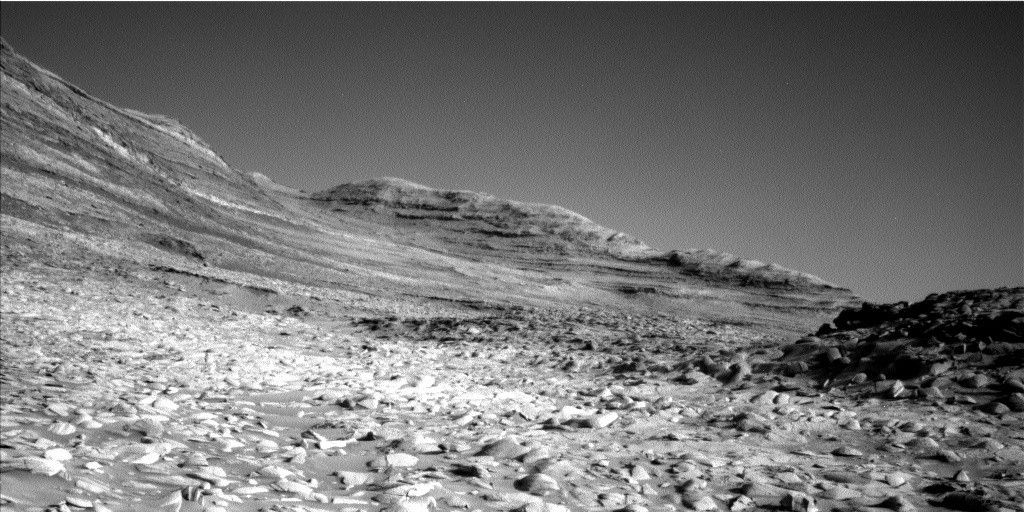
A brightly lit, grayscale landscape image from the Martian surface shows three rocky elevations. At the center of the image is a hill in the foreground, with extremely uneven and rocky terrain, rising in the foreground from the left and right sides of the image and peaking at image center. Behind it to the left is another gentle slope, appearing lighter-toned and smoother than the foreground hill, almost like a sand dune, rising from the center of the image toward the left side of the frame about 60% of the way up. On the right, beyond the foreground hill, is a much darker gray butte, appearing as stacked layers of rock, rising from the image center to the rights side of the frame, about two-thirds of the way up.
Caption: NASA’s Mars rover Curiosity acquired this image using its Left Navigation Camera on Dec. 12, 2024, at 23:15:47 UTC — sol 4391, or Martian day 4,391, of the Mars Science Laboratory mission.
NASA/JPL-Caltech

Earth planning date: Friday, Dec. 13, 2024

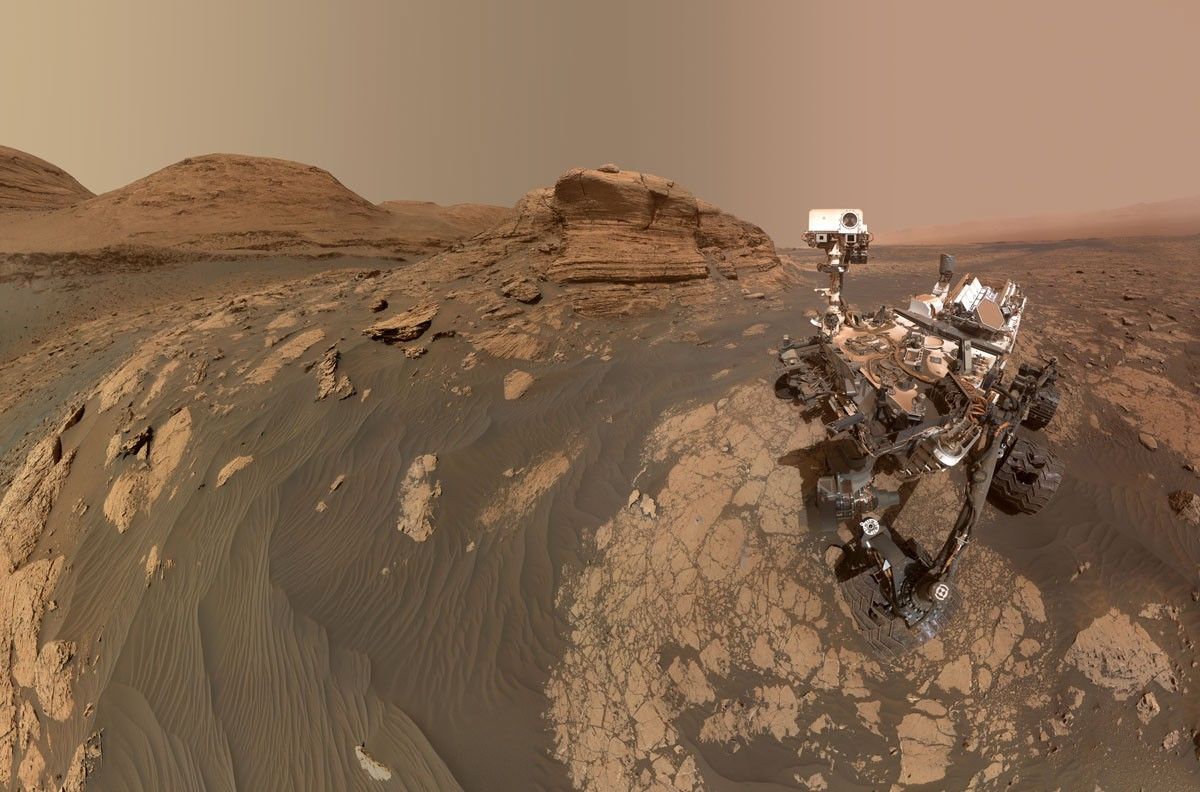
Curiosity continues to make great progress over the Mount Sharp bedrock and will spend the weekend investigating the northern base of the “Texoli” butte. The science team back on Earth enjoyed taking in the beautiful views of nearby “Wilkerson” butte and “Gould Mesa” while digging into the workspace in front of us to create a hefty to-do list for our roving geologist on Mars.

The rocks at the rover’s wheels today consisted of dusty, pale-colored bedrock that had a range of textures. We used the dust removal tool (DRT), MAHLI, and APXS instruments to characterize lighter, smooth bedrock at “Calabasas Peak,” and slightly darker, rougher bedrock at “Triunfo Canyon.” The ChemCam team used the Laser-Induced Breakdown Spectroscopy (LIBS) to analyze the composition of the rougher bedrock at “Chilao” and a vein that cuts through the bedrock at “Ojai,” and Mastcam provided the supporting documentation images of each target.

The Mastcam team assembled a variety of images and mosaics in the workspace and beyond. Two stereo mosaics documented the network of fractures in the bedrock at “Fern Dell” while a stereo mosaic of “Amir’s Garden” will be used to observe possible deformation in the rocks. A few single-frame images of troughs in the workspace will be used to investigate active surface processes. Further in the distance, Mastcam created a stereo mosaic of “Jawbone Canyon” to image potential aeolian ripples, and supported a ChemCam long-distance RMI image of a crater in the drive direction called “Grant Lake.” Lastly, ChemCam planned a long-distance RMI image to get a closer look at the structures within Gould Mesa.

Curiosity will drive 44 meters (about 144 feet) to the west over the weekend as we continue to close in on the intriguing boxwork structures. Lastly, the environmental group rounded out the plan with activities including cloud observations, dust-devil monitoring, and surveys of the amount of dust in the atmosphere.

Written by: Sharon Wilson Purdy, Planetary Geologist at the Smithsonian National Air and Space Museum

Share

Details

Last Updated
Dec 16, 2024

Related Terms

Powered by WPeMatico

Get The Details…

NASA Welcomes Thailand as Newest Artemis Accords Signatory

NASA Welcomes Thailand as Newest Artemis Accords Signatory

From left to right, Thailand’s Minister of Higher Education, Science, Research and Innovation Supamas Isarabhakdi, Executive Director of GISTDA Pakorn Apaphant, U.S. Ambassador to Thailand Robert Godec, and Pol. Gen. Suwat Jangyodsuk, Chairman of GISTDA, pose for a photo after the signing of the Artemis Accords at a signing ceremony in Bangkok, Thailand on Monday, Dec. 16, 2024. Credit: State Department
From left to right, Thailand’s Minister of Higher Education, Science, Research and Innovation Supamas Isarabhakdi, Executive Director of GISTDA Pakorn Apaphant, U.S. Ambassador to Thailand Robert Godec, and Pol. Gen. Suwat Jangyodsuk, Chairman of GISTDA, pose for a photo after the signing of the Artemis Accords at a signing ceremony in Bangkok, Thailand on Monday, Dec. 16, 2024.
Credit: U.S. State Department

Following a signing ceremony Monday in Thailand’s capital city, Bangkok, NASA congratulates Thailand as the 51st nation to commit to the safe and responsible exploration of space that benefits humanity.

“Thailand’s commitment to the Artemis Accords will enhance the country’s engagement with NASA and the international community,” said NASA Administrator Bill Nelson. “By signing the accords, Thailand builds upon an important foundation and shows great leadership for the open, responsible and peaceful exploration of space.”

Pakorn Apaphant, the executive director of Thailand’s Geo-Informatics and Space Technology Development Agency (GISTDA) signed the Artemis Accords on behalf of Thailand. Thailand’s Minister of Higher Education, Science, Research and Innovation Supamas Isarabhakdi and U.S. Ambassador to Thailand Robert Godec also participated in the ceremony. Nelson contributed the final remarks in a pre-recorded video message.

“Thailand will enter the golden age of space exploration in full force,” said Apaphant of the country’s signing.

In 2020, the United States, led by NASA and the U.S. Department of State, and seven other initial signatory nations established the Artemis Accords, a set of principles promoting the beneficial use of space for humanity.

The Artemis Accords are grounded in the Outer Space Treaty and other agreements including the Registration Convention, the Rescue and Return Agreement, as well as best practices and norms of responsible behavior that NASA and its partners have supported, including the public release of scientific data. 

On Dec. 11, NASA celebrated 50 countries signing the Artemis Accords at NASA Headquarters with the signing of Austria. More countries are expected to sign in the weeks and months ahead.

Learn more about the Artemis Accords at:

https://www.nasa.gov/artemis-accords

-end-

Meira Bernstein / Elizabeth Shaw
Headquarters, Washington
202-358-1600
meira.b.bernstein@nasa.gov / elizabeth.a.shaw@nasa.gov

Share

Details

Last Updated

Dec 16, 2024

Powered by WPeMatico

Get The Details…
Roxana Bardan