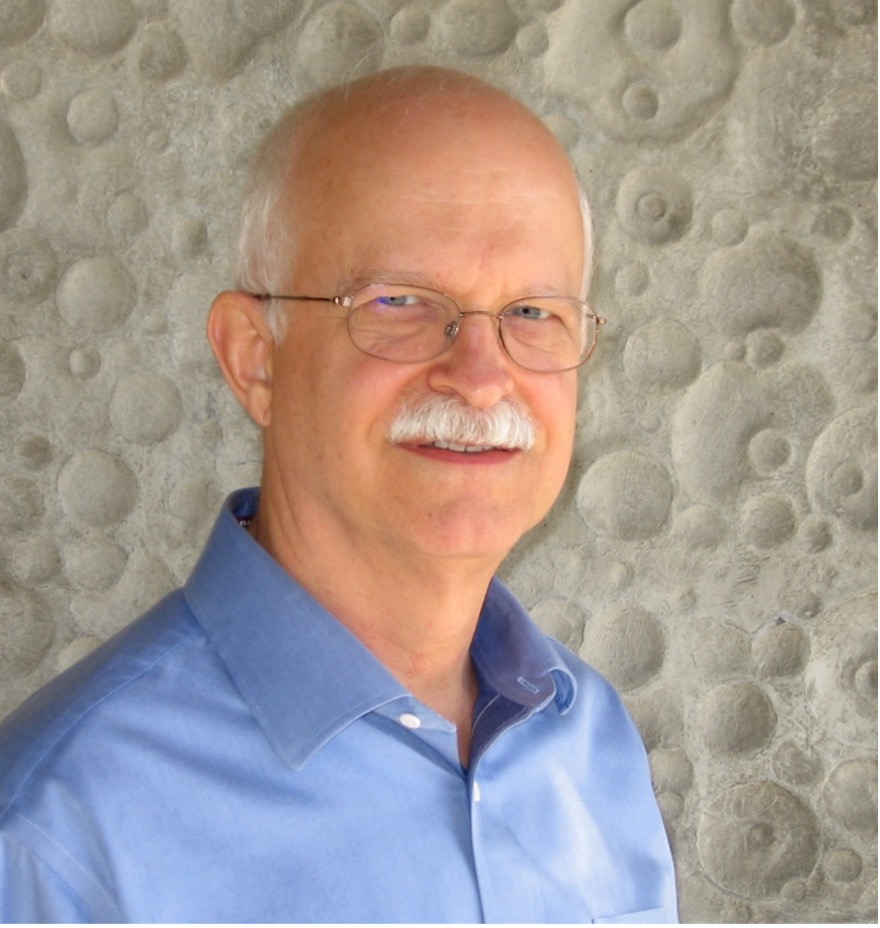
Interview with Dave Des Marais
Let’s start with your childhood, where you’re from, your family at the time, if you have siblings, your early years, and when it was that you became interested in what has developed into your career as an astrophysicist or research scientist?
I was born in Richmond, Virginia in 1948, the youngest of four siblings – two brothers, a sister and myself. My father was a civil engineer for DuPont chemical company and designed HVAC systems for plants built in the late 30’s and early 40’s for the war effort. Our family moved around frequently back then, so my siblings and I were born in different states. When our father transferred to DuPont headquarters in Wilmington, Delaware, we moved to nearby Kennett Square, Pennsylvania, about 30 miles southwest of Philadelphia. During my childhood, my participation in outdoor activities with the Boy Scouts and my motivation by excellent high school chemistry and physics teachers stimulated my interest in the natural sciences.
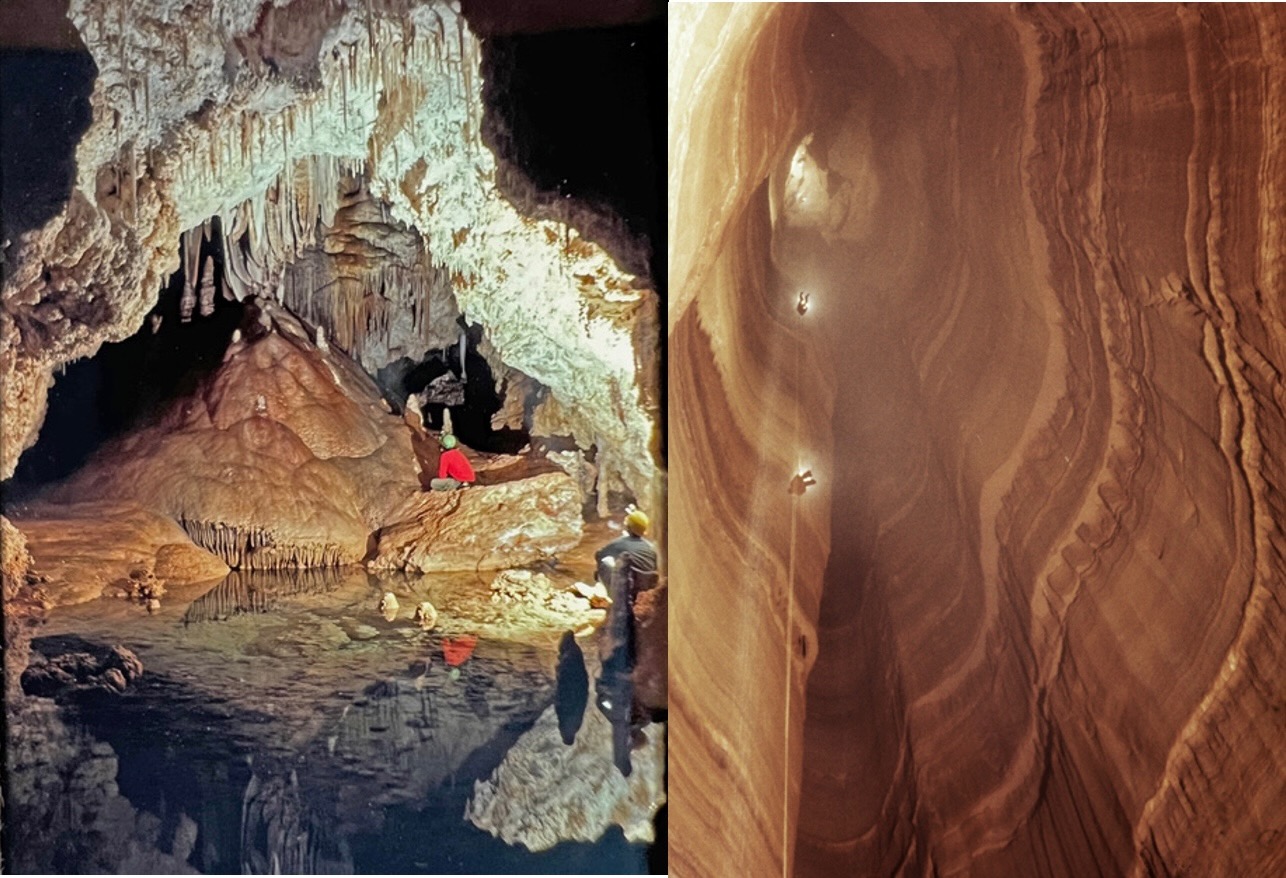
I attended Purdue University in Indiana in part because Purdue had an excellent chemistry curriculum and because my second older brother, whom I had always admired, received his chemical engineering degree there. As an undergraduate, I was particularly fascinated by the periodic table of the elements and analytical chemistry. Experiences outside the classroom were also important. I noticed that another student in my dormitory had a little miner’s carbide headlamp on his desk. He explored caves as a member of the Purdue Outing Club and invited me to join. When we took caving and climbing trips in southern Indiana, I developed a fascination with geology, particularly about how caves form and about rocks generally. This kindled my interest in geochemistry, which ultimately guided my choices of graduate school and career. Three factors led to my decision in 1970 to attend Indiana University. One was IU’s strong geology and geochemistry programs. I also wanted to remain as near as possible to Shirley, my future spouse. The third reason was to continue exploring caves!
While at IU I indeed continued cave exploration. I joined the Cave Research Foundation (CRF), which maps caves and supports research in the national parks, particularly in Mammoth Cave, Kentucky, which is the longest cave in the world, with 250 miles of mapped passageways. My involvement with CRF deepened my interest in other aspects of geology and geochemistry.
My NASA connection began when Dr. John Hayes became my graduate advisor in geochemistry. Hayes’ graduate dissertation had addressed organic compounds in meteorites. He was also involved with the Viking mission as a member of Klaus Bieman’s MIT research group, which created the mass spectrometer for the Mars Viking mission. I took Hayes’ class on mass spectrometry, and fortunately he liked my term paper! Soon after, I chose to do my dissertation with him on lunar sample analyses, focusing on carbon and other elements relevant to life. I first presented my work in 1972 at the third Lunar Science Conference, where I met Sherwood Chang, then chief of the Ames Exobiology branch. Sherwood was also investigating carbon and other elements in lunar samples. Sherwood, John, and others inspired me to continue in the space sciences.
That’s an Interesting path because many of our researchers had a postdoc with somebody or attended a conference and met someone through that network and found their way to Ames that way.
I then did a postdoctoral fellowship at UCLA with Dr. Isaac (Ian) Kaplan, whose biogeochemistry group also had analzed lunar samples. I continued developing methods for carbon isotopic analyses of very small samples. The carbon-13 to carbon-12 abundance ratios of molecules can offer clues about how they are formed. Isotopic measurements also help to identify contamination in meteorites and other extraterrestrial samples. Sherwood Chang wanted to create an isotope geochemistry laboratory in the Ames Exobiology Branch, and that led to my being hired at Ames in 1976.
You mentioned contamination of the meteorites. Was it geo-contamination or contamination from elsewhere that concerned you?
The basic analytical goal is to decipher the entire history of an extraterrestrial sample, starting with understanding the contents of an object when it was formed, which in most cases was billions of years ago. When an object was still in space, other events happened that altered its composition. But our major concern has been about what happens after a meteorite arrives here. Life has become so pervasive that its chemical ‘fingerprints’ are on virtually everything. It’s difficult to avoid these substances anywhere in the shallow Earth’s crust. Also, Earth is an inhospitable place for meteorites because its surface environments are relatively hot and moist compared to conditions in space. So our environment can alter the meteorites and add organic contamination.
What has been your most interesting work here at Ames?
I have had a near-unique opportunity to explore the biogeochemistry of carbon across a wide range of processes and environments that sustain our biosphere. I investigated the isotope geochemistry of carbon and nitrogen in lunar samples, meteorites, and oceanic basalts. Our molecular isotopic measurements of hydrocarbons in carbonaceous chondrites confirmed their extraterrestrial origins and provided clues about their synthesis. My measurements of mid-oceanic basalts and hydrocarbon gases in geothermal systems chracterized components from the mantle and from sedimentary organic carbon.
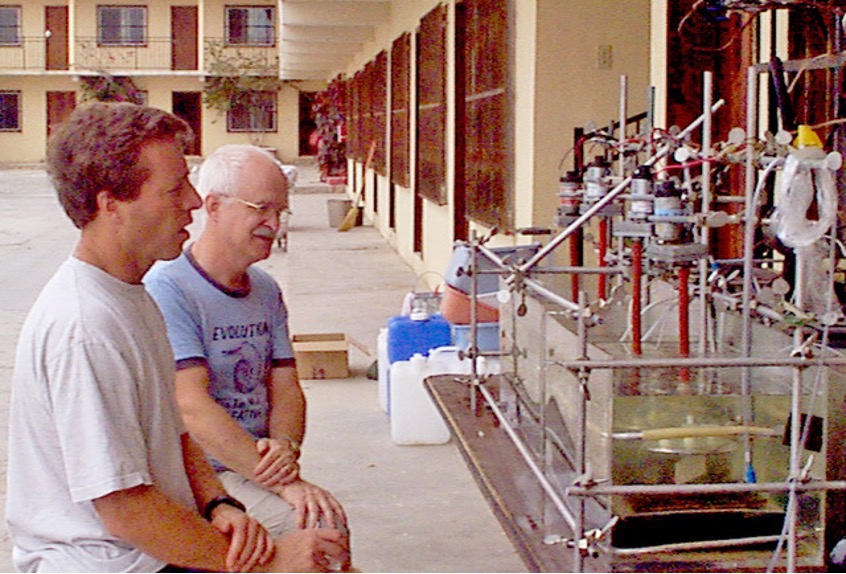
I participated in the Precambrian Paleobiology Research Group at U.C.L.A., led by Dr. J. W. Schopf. For example, we documented carbon isotopic evidence for the long-term evolution and oxygenation of Earth’s early environment. Later, I coordinated a long-term project to study the biogeochemistry of marine benthic microbial communities as modern analogs of Earth’s oldest known (>3 billion yr.-old) ecosystems. We characterized their enormous microbial diversity, their highly efficient harvesting of sunlight, their cycling of life-sustaining elements, and mechanisms for their fossilization in sedimentary rocks. These experiences, among others, informed me as I chaired the development of NASA’s Astrobiology Roadmaps in 2003 and 2008, and as I served as PI of Ames’ NASA Astrobiology Institute team from 1998 to 2014. These roles also informed my participation in NASA’s Mars Exploration Rover and Curiosity rover missions.
Now that you’ve described what your pursuit is, what your discipline or research interests are, how would you justify that to people who are not scientists as to why taxpayers should be funding this particular research for NASA?
NASA’s research programs are uniquely positioned to explore and compare multiple planets, including Earth. All life depends critically upon interactions between organisms and the geological processes and climate of their host planet. My career has addressed these interactions in multiple ways. Studies such as these are important for understanding the future of life on Earth, and they also guide our search for evidence of life elsewhere and for planning human missions to other bodies in our solar system.
A more specific answer to your question is that the public has been interested in any life on Mars. Searching for evidence of past or present life there requires environmental surveys and analyses to identify the most promising locations. NASA’s Viking mission illustrated why most of the Martian surface is really not suitable to look for evidence of life. At least 70% of the surface of Mars is clearly unsuitable, but the remaining more promising 30% is still a lot of territory. The surface area of Mars is equal to that of all the continents on Earth. Much of my research has related to an assessment of habitability, namely, assessing the resources that an environment must provide to sustain life. Where are the best places to look? Our rovers have now visited places that we are convinced could have supported life some three or more billion years ago. The next questions are: did any fossils survive and can we actually bring the right samples back to Earth to confirm any findings?
Also, could a human mission sustain itself there? Again, we must look for resources that might support life today. Geochemical analyses are a key aspect of that search. If we have any future interest in Mars related to astrobiology or to human missions, we need to assess the past habitability and the present life-sustaining resources of potential landing sites. The public generally supports these exploration goals.
They do, that is true, and that’s really the answer to why NASA does what it does. It’s directed by Congress, and they are influenced by the public, by what the public wants. I’ve always thought, or at least for a long time, that robotic exploration is much more practical, but the country wants astronauts, that’s where the public support is.
I agree totally!
And so, we continue to do that, and they’ve done wonderful things. But the time will come when it’s not feasible to do astronautic things because we humans don’t live long enough given the distances involved.
Certainly that’s applies for destinations beyond our solar system. And even if there is a human mission to Mars, astronauts are going to be in a station, with robots going out in all directions. So robots will be with us in many ways for the future.
It’s a very fascinating career you’ve described and the work that has followed from it.
Thanks! It’s certainly been very fulfilling personally.
What advice might you give to a young person who sees what you’re doing, is intrigued by it, and would like to pursue it as a career, would like to become a researcher for NASA?
The advice I would give a young person is just engage in multiple experiences. You don’t know what what will stimulate and motivate you until you try it. And once you find something in particular, like astrobiology, then apply to institutions, like universities or institutes that are involved. Go to a place where they’re doing stuff that’s related to astrobiology in some way. Secondly, see if you can get yourself in a lab and get some undergraduate research experience.
As an example, what worked for my son? He’s not in astrobiology. He went to Berkeley as an undergraduate and wanted to be a physician. But then he had an opportunity to work in someone’s plant biology lab. By the time he was applying for graduate schools he was identifying professors with whom he might want to work. Now, years later, he’s a professor in plant genetics at a major university. When I applied to graduate schools, my approach wasn’t nearly as rigorous as my son’s strategy! So, perhaps get an undergraduate experience in a lab and, in any case, get a sense of what’s interesting by giving yourself multiple experiences and not necessarily focusing too soon. That’s the most general advice.
That is similar to what parents do with their children. They don’t know what their children are going to be interested in or would do well, so they expose them to music, to art, and to all kinds of things and with some of them there won’t be any connection, but at some point, they’ll be interested in something and want to pursue it. So, you’re right, get a broad exposure to a variety of things and something will resonate.
Yes, the more experiences, the better chance you might hit something that really resonates for you.
You’ve talked about your professional work and research interests but what do you do for fun?
Well, along with a lot of the things I’ve already described, my interest in the outdoors has always been high. Our family has done a lot of hiking and travel.
Do you still do caving or spelunking?
I was still active after joining Ames in 1976. I got CRF involved at Sequoia-Kings Canyon National Park, and CRF is still working there. I’ve been fortunate to participate in this collaboration between CRF and the National Park Service at Mammoth Cave, Kentucky, Carlsbad Caverns, New Mexico, and Sequoia-Kings Canyon National Park, California. My active participation tapered off about the same time my involvement with Mars picked up in the 1990’s.
Earlier, I mentioned a little miner’s carbide cap lamp in another student’s dormitory room that led me to the Outing Club, geology, and ultimately my career. So, over the years I’ve collected artifacts related to mining and interacted with folks who explore the history of mining and its economic importance. That has made me realize just how difficult were the lives of miners. What I hadn’t anticipated was how grateful I became that I am alive today and not 100+ years ago, or that I live in the US and not many other places today.
I often feel that. There are a lot of places in the world where you can’t just go over to the wall and dial up the temperature you want. We are certainly blessed in that regard. So, the collecting has been kind of a hobby for you. Do you have any musical interest or talent, anything like that?
I was pretty proficient at the piano until I got into high school. But I took up the saxophone and got into the high school band. Later, I joined the Purdue Marching Band and played at football games. That was a great experience but I didn’t continue beyond my college sophomore year. My daughter and son have continued on piano intermittently as an effective form of relaxation. This reminds me of Carl Pilcher (former NASA Senior Scientist for Astrobiology and Director of the NASA Astrobiology Institute) who was a really good pianist.
I didn’t know that and that’s interesting to me because I knew Carl. This is one reason why we do these interviews, because there will be a number of people who will read this and they won’t have known that about Carl if they knew him, and that’s how these little things that we don’t know about people come out as we sit down and talk with each other. You’ve mentioned your wife, Shirley, and your son and your daughter. Would you like to say anything else about your family? Or your pets, or things you like to do together or vacations, anything like that?
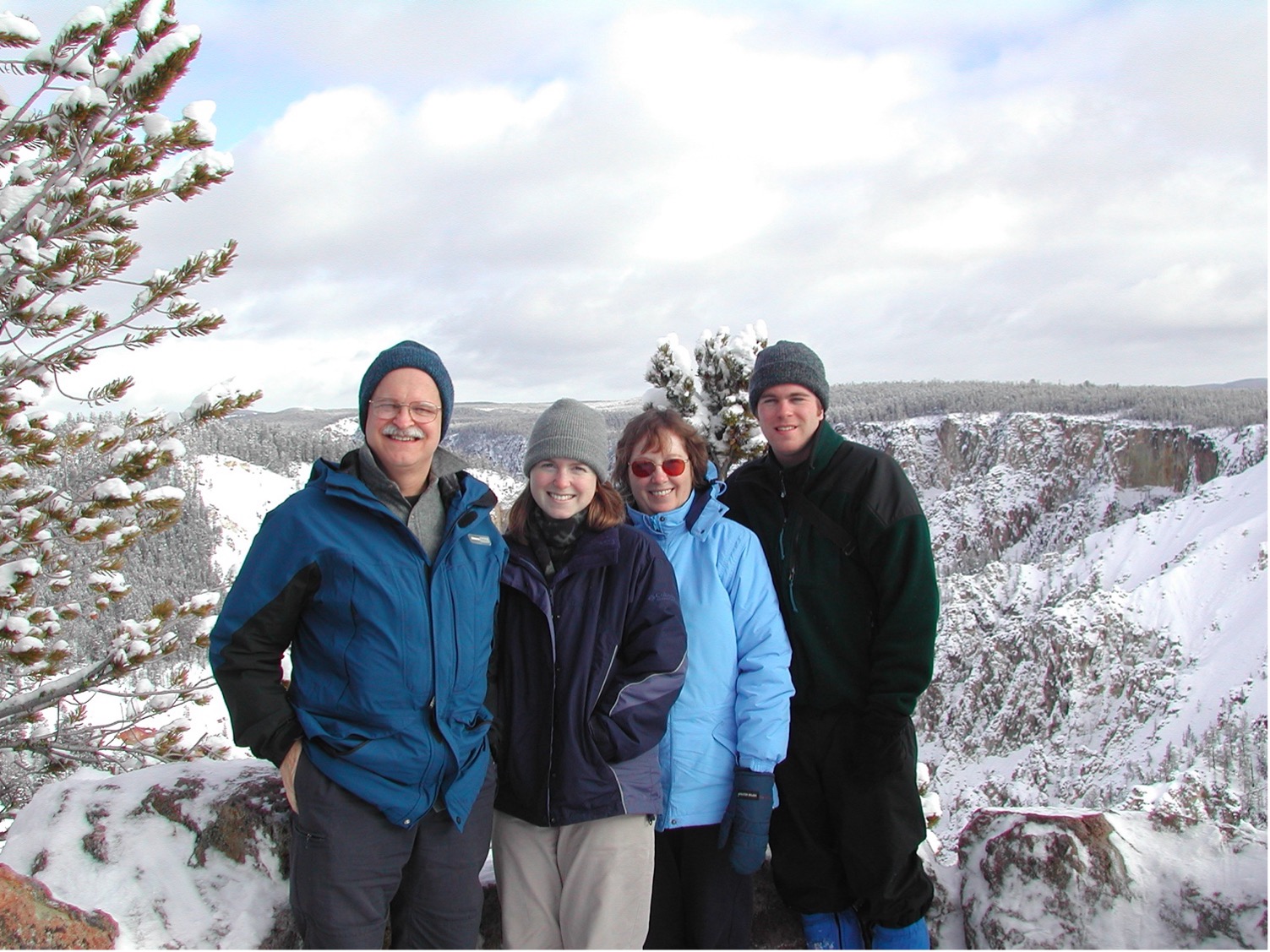
Shirley and I have been married 54 years as of this interview. She was an elementary school teacher for more than 25 years. Her support was crucial while I was in graduate school. She became a full-time parent for our pre-school children but then returned to Redwood City schools for most of her teaching career. She then became deeply involved in the local chapter of the League of Women Voters, serving both as its chairman and in other leadership positions. Shirley is the keystone of our family and she has enabled my career achievements immeasurably.
Our son is a is a molecular biologist. He went to Berkeley first aspiring to be a doctor probably because his high school biology teacher emphasized human physiology. At Berkeley he ventured from one interest to the next. He had not been inspired by plant biology in high school, probably because his teachers focused on rote memorization of facts. But later he gained research experience in a Berkeley plant lab and got really interested in them. He attended graduate school at Duke University and is now an assistant professor in plant genetics with the MIT civil engineering department. Why, you ask, is a civil engineering department interested in plant genetics? MIT started a major climate change project and one key concern is how crops must adapt. His specialty is plant water use efficiency, response to CO2 levels, and temperature, factors that would be affected by a changing climate.
Our daughter also attended Berkeley. She studied international economics of developing countries. She is good at math and also interested in social issues, so that curriculum motivated her. But her ultimate career choice arose from the focus on developing countries and her experiences in South America when she spent a semester at a university in Chile, and then worked with nonprofit organizations in Brazil. She then got a master’s degree in public health at the University of North Carolina. She’s still involved in public health in North Carolina, working with a foundation that advises county health departments about treatments for drug addiction. The government has provided funds for counties, especially rural counties. She leads a group that’s advising them on how to administer these funds effectively.
That’s very commendable. You should be proud of her as well.
Yeah, we certainly are.
We also had cats from the early ‘70’s up until maybe 2010 or something like that. We eventually achieved ‘parental freedom’ when the kids moved away and the pets passed away. But our our family’s legacy lives on: both our son and our daughter have multiple cats in their houses! (laughs)
We had cats too, and enjoyed them. My wife used to have to go away for a week or so every month to tend her parents, who were getting elderly, because she wanted to keep them in their home. I used to think it was funny that people talked to their pets, but when she was away, I talked to the cat all the time! I really enjoyed having her around. She would curl up on my lap if I was watching TV. She was good company.
Yeah, no kidding. Dogs especially are like little kids that never grow up!
Yes!
One of the questions we like to ask is who or what has inspired you along your life path?
My high school chemistry teacher inspired me about chemistry. He was also an outdoorsman type. My older brother was involved in Boy Scouts, and that also nurtured my interest in Scouts and the outdoors.
At the time I was enrolled at Purdue University, a geology department had recently started and three faculty occupied the basement of an engineering building. Dr. Levandowski advocated that geochemistry might actually be a good match for me. At Indiana University, John Hayes, my thesis advisor, was very accomplished, charismatic, and inspirational. He was recognized internationally and ultimately inducted into the National Academy of Sciences. And, of course, Sherwood Chang and Chuck Klein helped inspire and guide my early career at Ames.
Do you read for pleasure and if so, what do you like to read? What genre do you enjoy?
I do not read fiction for pleasure. I frequently read popular science and technology articles, so I guess that’s my pleasure reading. It’s still science, but it’s science that extends well beyond my own work, and I find that interesting.
Absolutely it is. I don’t read enough for pleasure. I buy a lot of books that I intend to read, but I just never get around to them. My wife says, in jest I think, when I’m gone, she’s going to have a big bonfire and burn all of them because they take up a lot of space. I would like to live to be 200 and read all of them, but I know I won’t! (laughs)
One of the things that we like to do is add pictures to these interviews, of things we talked about, or any images that you particularly like. What picture might you have on the wall there in your office, or perhaps in your home? You could add something later after thinking about it a bit. I had a map of the world, a satellite image of the world at night, in my office for a time. You’ve probably seen it. I was fascinated by it because you could tell so much about the countries by the lighting, the different colors, where it was and where it wasn’t.
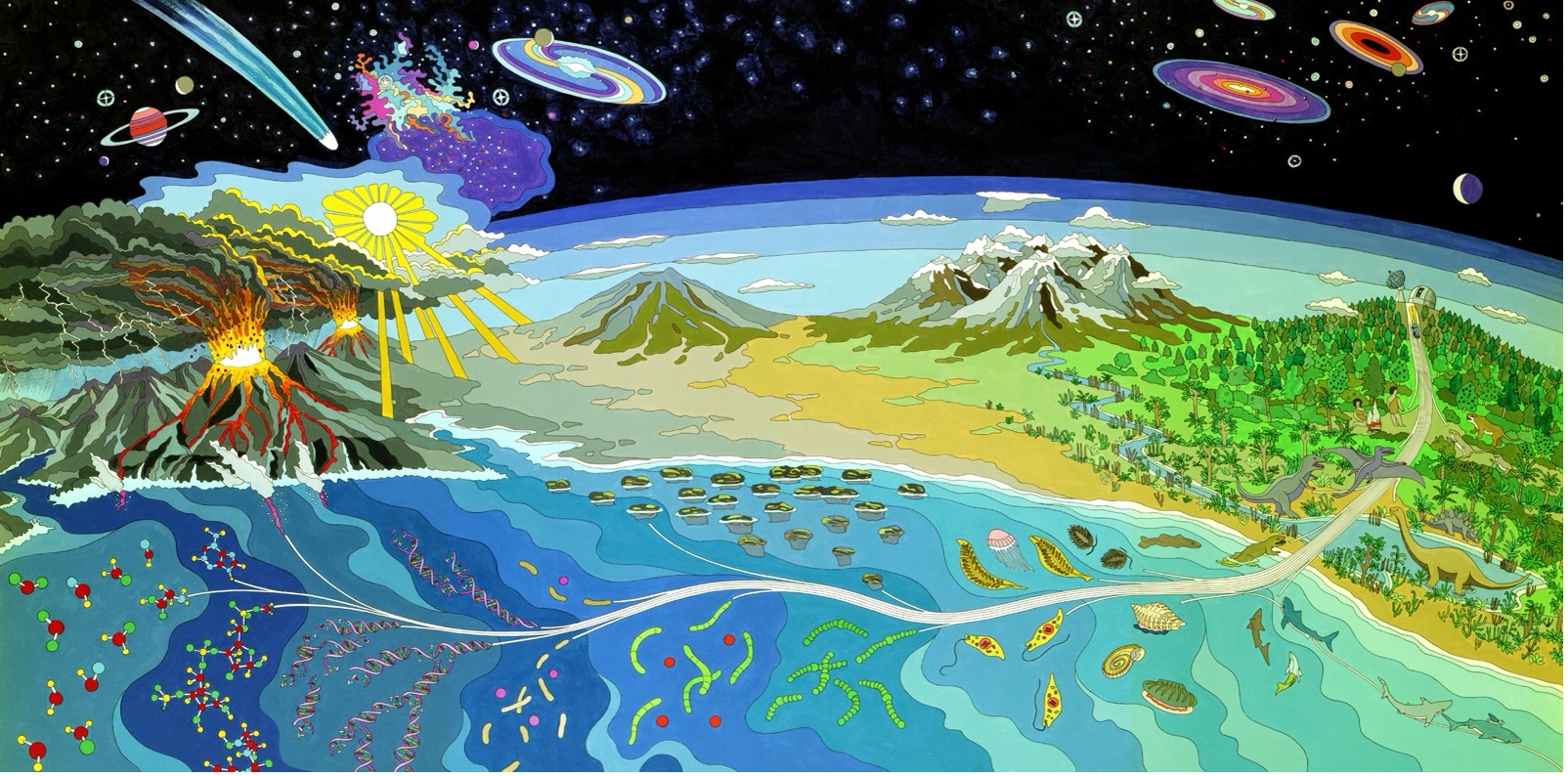
I have a big map of the world that emphasizes geology and particularly shows a lot of details about the ocean floor, especially with the volcanoes and all the features there. And you’ve probably seen the exobiology mural? it was in building N-200.
I think I know which one you’re talking about. It has sea life coming up from the ocean on one side across the land and up to the stars on the other side.
That’s right. Linda Jahnke, Tom Scattergood, and I created that back in 1980’s.
You did?
Yeah. When the art department made copies, I got one for my office, and several others have copies also.
Oh, that’s wonderful. If you have an image of that you could include it when you send me back your edited transcript, and we could put it in and attribute it to you, Linda, and Tom.
OK. That mural touches on several research topics I’ve addressed during my career. So, it would be a good one to include.
We also ask if there is a favorite quote that has been particularly meaningful to you. We can put that in, too.
‘Life is what happens while you are busy making other plans’ (John Lennon)
‘We make a living by what we get, but we make a life by what we give.’ (the attribution to Winston Churchill is controversial)
Thank you for getting in touch with me and for sitting down for an hour to do this. I will get this into a format where you can edit it. And then we’ll make a post out of it. And I think you’ll be pleased. And if not, you’ll have only yourself to blame! (laughs)
That’s very cagey of you! (laughs) But then again, you’ve done this for quite a while.
Your approach is quite sophisticated, so I appreciate that. I also appreciate your effort because so often stuff like this just disappears from history.
Well, thank you, Dave. I’ve appreciated the chat and thank you for your time. We’ll make something out of it.
Thanks for your commitment and for pursuing me to do this. Take care.
You’re welcome.
________________________________________________
Interview conducted by Fred Van Wert on January 13, 2025
Powered by WPeMatico
Get The Details…
Ciara C. Fitzpatrick