


A New Hybrid System Could Enable Spacecraft Attitude Control Systems to Perform Scientific Measurements
A NASA-sponsored team is creating a new approach to measure magnetic fields by developing a new system that can both take scientific measurements and provide spacecraft attitude control functions. This new system is small, lightweight, and can be accommodated onboard the spacecraft, eliminating the need for the boom structure that is typically required to measure Earth’s magnetic field, thus allowing smaller, lower-cost spacecraft to take these measurements. In fact, this new system could not only enable small spacecraft to measure the magnetic field, it could replace the standard attitude control systems in future spacecraft that orbit Earth, allowing them to provide the important global measurements that enable us to understand how Earth’s magnetic field protects us from dangerous solar particles.

Photo of the aurora (taken in Alaska) showing small scale features that are often present. Credit: NASA/Sebastian Saarloos
Solar storms drive space weather that threatens our many assets in space and can also disrupt Earth’s upper atmosphere impacting our communications and power grids. Thankfully, the Earth’s magnetic field protects us and funnels much of that energy into the north and south poles creating aurorae. The aurorae are a beautiful display of the electromagnetic energy and currents that flow throughout the Earth’s space environment. They often have small-scale magnetic features that affect the total energy flowing through the system. Observing these small features requires multiple simultaneous observations over a broad range of spatial and temporal scales, which can be accomplished by constellations of small spacecraft.
To enable such constellations, NASA is developing an innovative hybrid magnetometer that makes both direct current (DC) and alternating current (AC) magnetic measurements and is embedded in the spacecraft’s attitude determination and control system (ADCS)—the system that enables the satellite to know and control where it is pointing. High-performance, low SWAP+C (low-size, weight and power + cost) instruments are required, as is the ability to manufacture and test large numbers of these instruments within a typical flight build schedule. Future commercial or scientific satellites could use these small, lightweight embedded hybrid magnetometers to take the types of measurements that will expand our understanding of space weather and how Earth’s magnetic field responds to solar storms
It is typically not possible to take research-quality DC and AC magnetic measurements using sensors within an ADCS since the ADCS is inside the spacecraft and near contaminating sources of magnetic noise such as magnetic torque rods—the electromagnets that generate a magnetic field and push against the Earth’s magnetic field to control the orientation of a spacecraft. Previous missions that have flown both DC and AC magnetometers placed them on long booms pointing in opposite directions from the satellite to keep the sensors as far from the spacecraft and each other as possible. In addition, the typical magnetometer used by an ADCS to measure the orientation of the spacecraft with respect to the geomagnetic field does not sample fast enough to measure the high-frequency signals needed to make magnetic field observations.
A NASA-sponsored team at the University of Michigan is developing a new hybrid magnetometer and attitude determination and control system (HyMag-ADCS) that is a low-SWAP single package that can be integrated into a spacecraft without booms. HyMag-ADCS consists of a three-axis search coil AC magnetometer and a three-axis Quad-Mag DC magnetometer. The Quad-Mag DC magnetometer uses machine learning to enable boomless DC magnetometery, and the hybrid search-coil AC magnetometer includes attitude determination torque rods to enable the single 1U volume (103 cm) system to perform ADCS functions as well as collect science measurements.
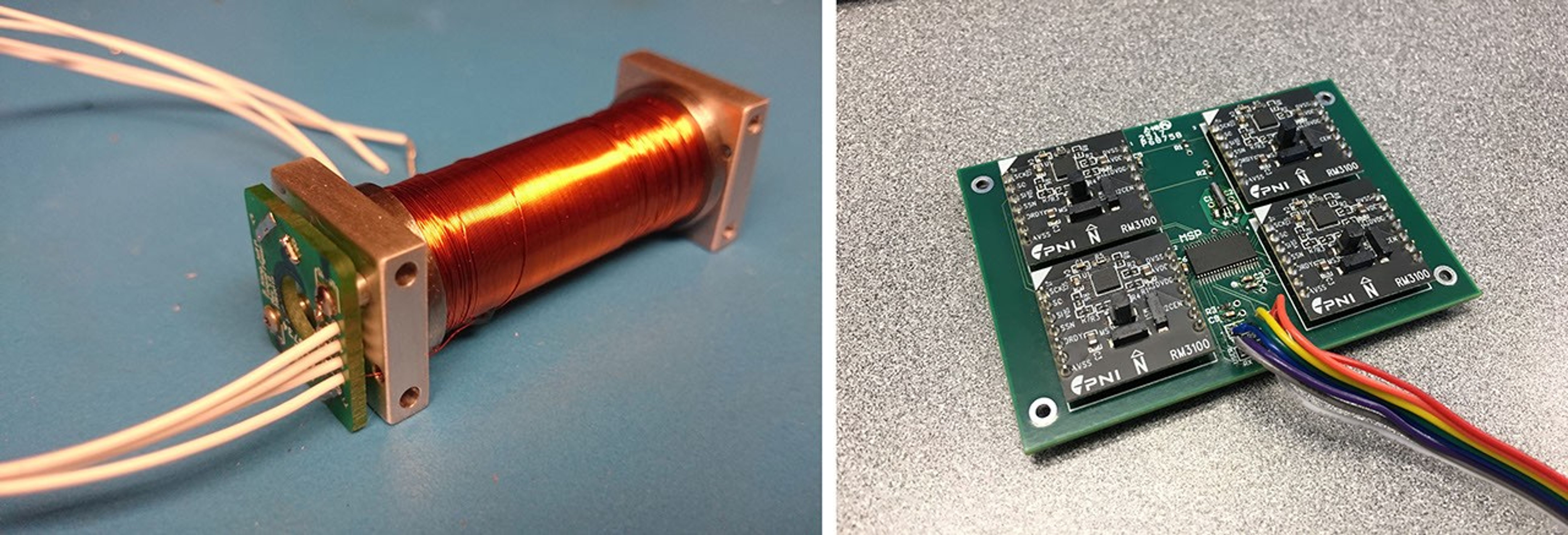
The HyMag-ADCS team is incorporating the following technologies into the system to ensure success.
Quad-Mag Hardware: The Quad-Mag DC magnetometer consists of four magneto-inductive magnetometers and a space-qualified micro-controller mounted on a single CubeSat form factor (10 x 10 cm) printed circuit board. These two types of devices are commercially available. Combining multiple sensors on a single board increases the instrument’s sensitivity by a factor of two compared to using a single sensor. In addition, the distributed sensors enable noise identification on small satellites, providing the science-grade magnetometer sensing that is key for both magnetic field measurements and attitude determination. The same type of magnetometer is part of the NASA Artemis Lunar Gateway Heliophysics Environmental and Radiation Measurement Experiment Suite (HERMES) Noisy Environment Magnetometer in a Small Integrated System (NEMISIS) magnetometer scheduled for launch in early 2027.
Dual-use Electromagnetic Rods: The HyMag-ADCS team is using search coil electronics and torque rod electronics that were developed for other efforts in a new way. Use of these two electronics systems enables the electromagnetic rods in the HyMag-ADCS system to be used in two different ways—as torque rods for attitude determination and as search coils to make scientific measurements. The search coil electronics were designed for ground-based measurements to observe ultra-low frequency signals up to a few kHz that are generated by magnetic beacons for indoor localization. The torque rod electronics were designed for use on CubeSats and have flown on several University of Michigan CubeSats (e.g., CubeSat-investigating Atmospheric Density Response to Extreme driving [CADRE]). The HyMag-ADCS concept is to use the torque rod electronics as needed for attitude control and use the search coil electronics the rest of the time to make scientific AC magnetic field measurements.
Machine Learning Algorithms for Spacecraft Noise Identification: Applying machine learning to these distributed sensors will autonomously remove noise generated by the spacecraft. The team is developing a powerful Unsupervised Blind Source Separation (UBSS) algorithm and a new method called Wavelet Adaptive Interference Cancellation for Underdetermined Platforms (WAIC-UP) to perform this task, and this method has already been demonstrated in simulation and the lab.
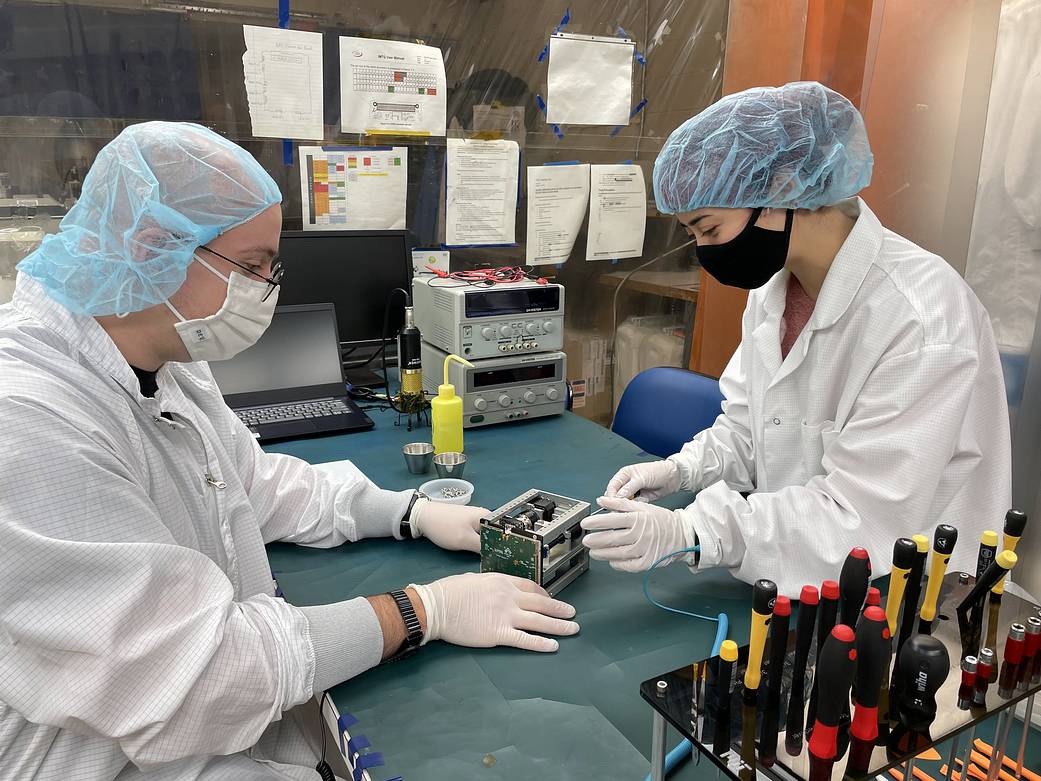
The HyMag-ADCS system is early in its development stage, and a complete engineering design unit is under development. The project is being completed primarily with undergraduate and graduate students, providing hands-on experiential training for upcoming scientists and engineers.
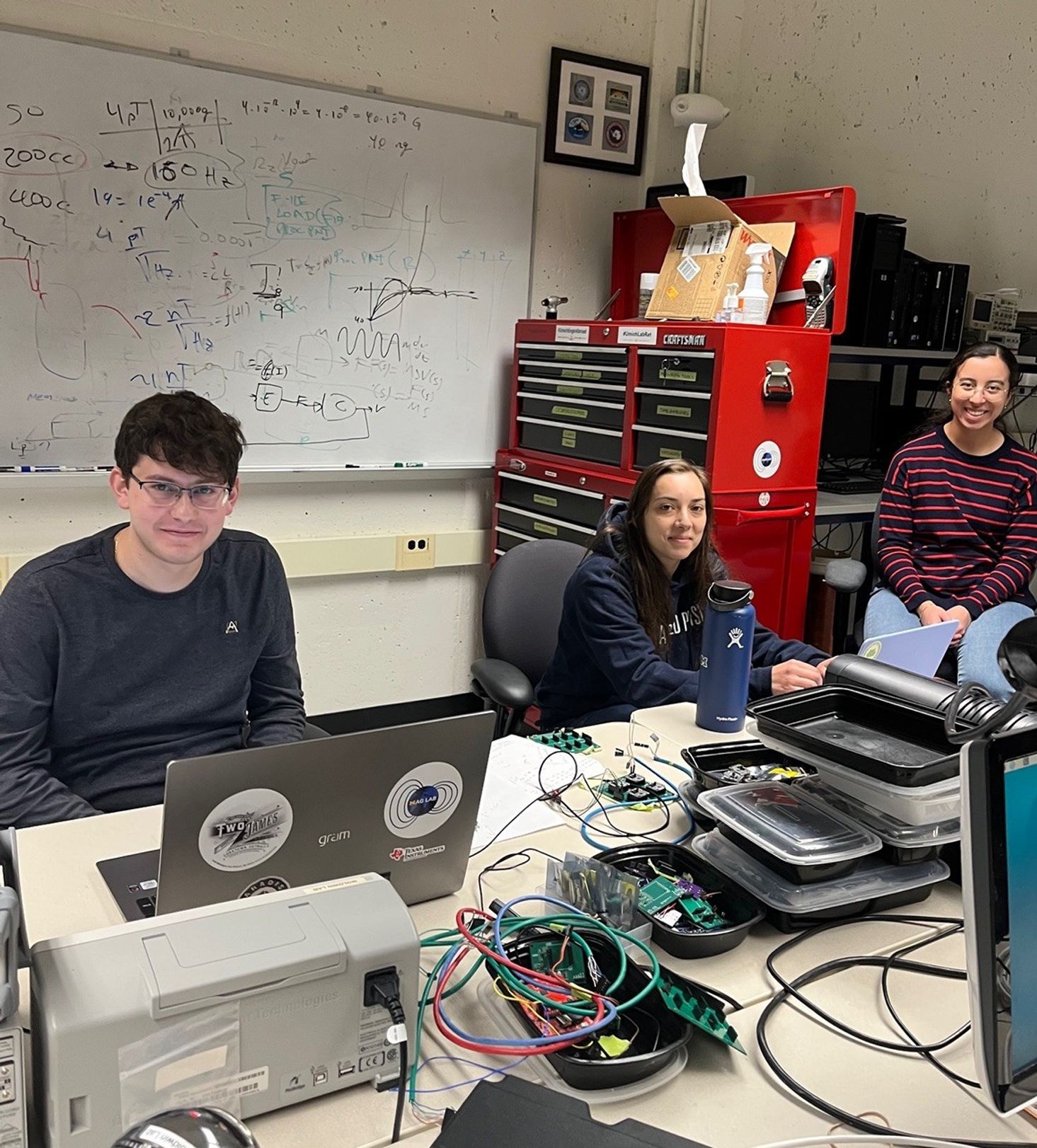
For additional details, see the entry for this project on NASA TechPort .
Project Lead: Prof. Mark Moldwin, University of Michigan
Sponsoring Organization: NASA Heliophysics Division’s Heliophysics Technology and Instrument Development for Science (H-TIDeS) program.
Share
Details
Related Terms
Explore More
Powered by WPeMatico






.jpg?w=5438&h=3638&fit=clip&crop=faces%2Cfocalpoint)
