Understanding Cosmic Explosions: StarBurst Arrives at NASA for Testing

Understanding Cosmic Explosions: StarBurst Arrives at NASA for Testing

Six people in white clean suits stand around a metal box holding Starburst, a wide-field gamma ray observatory.
From left to right, NASA Marshall engineers Carlos Diaz and John Luke Bili, U.S. Naval Research Laboratory mechanical engineer contractor Eloise Stump, and Marshall engineers Tomasz Liz, David Banks, and Elise Doan observe StarBurst in the cleanroom environment before it’s unboxed from its shipping container. The cleanroom environment at Marshall is designed to minimize contamination and protect the observatory’s sensitive instruments.
Image Credit: NASA /Daniel Kocevski  

StarBurst, a wide-field gamma ray observatory, arrived at NASA’s Marshall Space Flight Center in Huntsville, Alabama, March 4 for environmental testing and final instrument integration. The instrument is designed to detect the initial emission of short gamma-ray bursts, a key electromagnetic indicator of neutron star mergers.

“Gamma-ray bursts are among the most powerful explosions in the universe, and they serve as cosmic beacons that help us understand extreme physics, including black hole formation and the behavior of matter under extreme conditions,” said Dr. Daniel Kocevski, principal investigator of the StarBurst mission at NASA Marshall.

According to Kocevski, neutron star mergers are particularly exciting because they produce gamma-ray bursts and gravitational waves, meaning scientists can study these events using two different signals – light and ripples in space time.

Starburst Principal Investigator Dr. Daniel Kocevski, left, and Integration and Test Engineer Elise Doan, right, pose with the StarBurst instrument after it was unboxed in the cleanroom environment at NASA Marshall. The Naval Research Lab transferred the instrument to NASA in early March.
Image Credit: NASA/Davy Haynes

The merging of neutron stars forges heavy elements such as gold and platinum, revealing the origins of some of Earth’s building blocks.

“By studying these gamma-ray bursts and the neutron star mergers that produce them, we gain insights into fundamental physics, the origins of elements, and even the expansion of the universe,” Kocevski said. “Neutron star mergers and gamma-ray bursts are nature’s laboratories for testing our understanding of the cosmos.”

StarBurst will undergo flight vibration and thermal vacuum testing at Marshall in the Sunspot Thermal Vacuum Testing Facility. These tests ensure it can survive the rigors of launch and harsh environment of space.

Final instrument integration will happen in the Stray Light Facility, which is a specialized environment to help identify and reduce unwanted light in certain areas of the optical systems.

The StarBurst Multimessenger Pioneer is a wide-field gamma-ray observatory designed to detect the initial emission of short gamma-ray bursts, important electromagnetic indicators of neutron star mergers. With an effective area over five times that of the Fermi Gamma-ray Burst Monitor and complete visibility of the unobscured sky, StarBurst will conduct sensitive observations.
NASA/Daniel Kocevski

StarBurst is a collaborative effort led by NASA’s Marshall Space Flight Center, with partnerships with the U.S. Naval Research Laboratory, the University of Alabama Huntsville, the Universities Space Research Association, and the UTIAS Space Flight Laboratory. StarBurst was selected for development as part of the NASA Astrophysics Pioneers program, which supports lower-cost, smaller hardware missions to conduct compelling astrophysics science.

To learn more about StarBurst visit:

https://science.nasa.gov/mission/starburst/

Media Contact:

Lane Figueroa
Marshall Space Flight Center
Huntsville, Alabama
256.544.0034
lane.e.figueroa@nasa.gov

Powered by WPeMatico

Get The Details…
Beth Ridgeway

NASA’s Dust Shield Successfully Repels Lunar Regolith on Moon

NASA’s Dust Shield Successfully Repels Lunar Regolith on Moon

NASA’s Electrodynamic Dust Shield (EDS) successfully demonstrated its ability to remove regolith, or lunar dust and dirt, from its various surfaces on the Moon during Firefly Aerospace’s Blue Ghost Mission 1, which concluded on March 16. Lunar dust is extremely abrasive and electrostatic, which means it clings to anything that carries a charge. It can damage everything from spacesuits and hardware to human lungs, making lunar dust one of the most challenging features of living and working on the lunar surface. The EDS technology uses electrodynamic forces to lift and remove the lunar dust from its surfaces. The “before” image highlights the glass and thermal radiator surfaces covered in a layer of regolith, while the “after” image reveals the results following EDS activation. Dust was removed from both surfaces, proving the technology’s effectiveness in mitigating dust accumulation.

This milestone marks a significant step toward sustaining long-term lunar and interplanetary operations by reducing dust-related hazards to a variety of surfaces for space applications ranging from thermal radiators, solar panels, and camera lenses to spacesuits, boots, and helmet visors. The EDS technology is paving the way for future dust mitigation solutions, supporting NASA’s Artemis campaign and beyond. NASA’s Electrodynamic Dust Shield was developed at Kennedy Space Center in Florida with funding from NASA’s Game Changing Development Program, managed by the agency’s Space Technology Mission Directorate.

Image Credit: NASA

Powered by WPeMatico

Get The Details…
Stephanie Plucinsky

NASA, NSIDC Scientists Say Arctic Winter Sea Ice at Record Low

NASA, NSIDC Scientists Say Arctic Winter Sea Ice at Record Low

3 min read

Preparations for Next Moonwalk Simulations Underway (and Underwater)

Ice cover ebbs and flows through the seasons in the Arctic (left) and the Antarctic (right). Overall, ice cover has declined since scientists started tracking it half a century ago. Download this visualization from NASA’s Scientific Visualization Studio: https://svs.gsfc.nasa.gov/5099
Trent Schindler/NASA’s Scientific Visualization Studio

Winter sea ice cover in the Arctic was the lowest it’s ever been at its annual peak on March 22, 2025, according to NASA and the National Snow and Ice Data Center (NSIDC) at the University of Colorado, Boulder. At 5.53 million square miles (14.33 million square kilometers), the maximum extent fell below the prior low of 5.56 million square miles (14.41 million square kilometers) in 2017. 

In the dark and cold of winter, sea ice forms and spreads across Arctic seas. But in recent years, less new ice has been forming, and less multi-year ice has accumulated. This winter continued a downward trend scientists have observed over the past several decades. This year’s peak ice cover was 510,000 square miles (1.32 million square kilometers) below the average levels between 1981 and 2010. 

In 2025, summer ice in the Antarctic retreated to 764,000 square miles (1.98 million square kilometers) on March 1, tying for the second lowest minimum extent ever recorded. That’s 30% below the 1.10 million square miles (2.84 million square kilometers) that was typical in the Antarctic prior to 2010. Sea ice extent is defined as the total area of the ocean with at least 15% ice concentration.

The reduction in ice in both polar regions has led to another milestone — the total amount of sea ice on the planet reached an all-time low. Globally, ice coverage in mid-February of this year declined by more than a million square miles (2.5 million square kilometers) from the average before 2010. Altogether, Earth is missing an area of sea ice large enough to cover the entire continental United States east of the Mississippi. 

“We’re going to come into this next summer season with less ice to begin with,” said Linette Boisvert, an ice scientist at NASA’s Goddard Space Flight Center in Greenbelt, Maryland. “It doesn’t bode well for the future.”

Observations since 1978 show that ice cover has declined at both poles, leading to a downward trend in the total ice cover over the entire planet. In February 2025, global ice fell to the smallest area ever recorded. Download this visualization from NASA’s Scientific Visualization Studio: https://svs.gsfc.nasa.gov/5521
Mark Subbaro/NASA’s Scientific Visualization Studio

Scientists primarily rely on satellites in the Defense Meteorological Satellite Program, which measure Earth’s radiation in the microwave range. This natural radiation is different for open water and for sea ice — with ice cover standing out brightly in microwave-based satellite images. Microwave scanners can also penetrate through cloud cover, allowing for daily global observations. The DMSP data are augmented with historical sources, including data collected between 1978 and 1985 with the Nimbus-7 satellite that was jointly operated by NASA and the National Oceanic and Atmospheric Administration. 

“It’s not yet clear whether the Southern Hemisphere has entered a new norm with perennially low ice or if the Antarctic is in a passing phase that will revert to prior levels in the years to come,” said Walt Meier, an ice scientist with NSIDC.

Credits: Charles Connell / NASA Goddard Space Flight Center

By James Riordon
NASA’s Earth Science News Team

Media contact: Elizabeth Vlock
NASA Headquarters

Share

Details

Last Updated

Mar 27, 2025

Location
NASA Goddard Space Flight Center

Powered by WPeMatico

Get The Details…
James R. Riordon

Finding Clues in Ruins of Ancient Dead Star With NASA’s Chandra

Finding Clues in Ruins of Ancient Dead Star With NASA’s Chandra

This artist's impression shows the effects of the collapse and supernova explosion of a massive star. A black hole (right) was formed in the collapse and debris from the supernova explosion is raining down onto a companion star (left), polluting its atmosphere.
X-ray: NASA/CXC/Technion/N. Keshet et al.; Illustration: NASA/CXC/SAO/M. Weiss

People often think about archaeology happening deep in jungles or inside ancient pyramids. However, a team of astronomers has shown that they can use stars and the remains they leave behind to conduct a special kind of archaeology in space.

Mining data from NASA’s Chandra X-ray Observatory, the team of astronomers studied the relics that one star left behind after it exploded. This “supernova archaeology” uncovered important clues about a star that self-destructed – probably more than a million years ago.

Today, the system called GRO J1655-40 contains a black hole with nearly seven times the mass of the Sun and a star with about half as much mass. However, this was not always the case.

Originally GRO J1655-40 had two shining stars. The more massive of the two stars, however, burned through all of its nuclear fuel and then exploded in what astronomers call a supernova. The debris from the destroyed star then rained onto the companion star in orbit around it, as shown in the artist’s concept.

This artist's impression shows the effects of the collapse and supernova explosion of a massive star. A black hole (right) was formed in the collapse and debris from the supernova explosion is raining down onto a companion star (left), polluting its atmosphere.
This artist’s impression shows the effects of the collapse and supernova explosion of a massive star. A black hole (right) was formed in the collapse and debris from the supernova explosion is raining down onto a companion star (left), polluting its atmosphere.
CXC/SAO/M. Weiss

With its outer layers expelled, including some striking its neighbor, the rest of the exploded star collapsed onto itself and formed the black hole that exists today. The separation between the black hole and its companion would have shrunk over time because of energy being lost from the system, mainly through the production of gravitational waves. When the separation became small enough, the black hole, with its strong gravitational pull, began pulling matter from its companion, wrenching back some of the material its exploded parent star originally deposited.

While most of this material sank into the black hole, a small amount of it fell into a disk that orbits around the black hole. Through the effects of powerful magnetic fields and friction in the disk, material is being sent out into interstellar space in the form of powerful winds.

This is where the X-ray archaeological hunt enters the story. Astronomers used Chandra to observe the GRO J1655-40 system in 2005 when it was particularly bright in X-rays. Chandra detected signatures of individual elements found in the black hole’s winds by getting detailed spectra – giving X-ray brightness at different wavelengths – embedded in the X-ray light. Some of these elements are highlighted in the spectrum shown in the inset.

The team of astronomers digging through the Chandra data were able to reconstruct key physical characteristics of the star that exploded from the clues imprinted in the X-ray light by comparing the spectra with computer models of stars that explode as supernovae. They discovered that, based on the amounts of 18 different elements in the wind, the long-gone star destroyed in the supernova was about 25 times the mass of the Sun, and was much richer in elements heavier than helium in comparison with the Sun.

This analysis paves the way for more supernova archaeology studies using other outbursts of double star systems.

paper describing these results titled “Supernova Archaeology with X-Ray Binary Winds: The Case of GRO J1655−40” was published in The Astrophysical Journal in May 2024. The authors of this study are Noa Keshet (Technion — Israel Institute of Technology), Ehud Behar (Technion), and Timothy Kallman (NASA’s Goddard Space Flight Center).

NASA’s Marshall Space Flight Center in Huntsville, Alabama, manages the Chandra program. The Smithsonian Astrophysical Observatory’s Chandra X-ray Center controls science operations from Cambridge, Massachusetts, and flight operations from Burlington, Massachusetts.

Read more from NASA’s Chandra X-ray Observatory.

Learn more about the Chandra X-ray Observatory and its mission here:

https://www.nasa.gov/chandra

https://chandra.si.edu

Visual Description

This release features an artist’s rendering of a supernova explosion, inset with a spectrum graph.

The artist’s illustration features a star and a black hole in a system called GRO J1655-40. Here, the black hole is represented by a black sphere to our upper right of center. The star is represented by a bright yellow sphere to our lower left of center. In this illustration, the artist captures the immensely powerful supernova as a black hole is created from the collapse of a massive star, with an intense burst of blurred beams radiating from the black sphere. The blurred beams of red, orange, and yellow light show debris from the supernova streaking across the entire image in rippling waves. These beams rain debris on the bright yellow star.

When astronomers used the Chandra X-ray Observatory to observe the system in 2005, they detected signatures of individual elements embedded in the X-ray light. Some of those elements are highlighted in the spectrum graph shown in the inset, positioned at our upper lefthand corner.

The graph’s vertical axis, on our left, indicates X-ray brightness from 0.0 up to 0.7 in intensity units. The horizontal axis, at the bottom of the graph, indicates Wavelength from 6 to 12 in units of Angstroms. On the graph, a tight zigzagging line begins near the top of the vertical axis, and slopes down toward the far end of the horizontal axis. The sharp dips show wavelengths where the light has been absorbed by different elements, decreasing the X-ray brightness. Some of the elements causing these dips have been labeled, including Silicon, Magnesium, Iron, Nickel, Neon, and Cobalt.

News Media Contact

Megan Watzke
Chandra X-ray Center
Cambridge, Mass.
617-496-7998
mwatzke@cfa.harvard.edu

Lane Figueroa
Marshall Space Flight Center, Huntsville, Alabama
256-544-0034
lane.e.figueroa@nasa.gov

Powered by WPeMatico

Get The Details…
Lee Mohon

Sols 4491-4492: Classic Field Geology Pose

Sols 4491-4492: Classic Field Geology Pose

2 min read

Sols 4491-4492: Classic Field Geology Pose

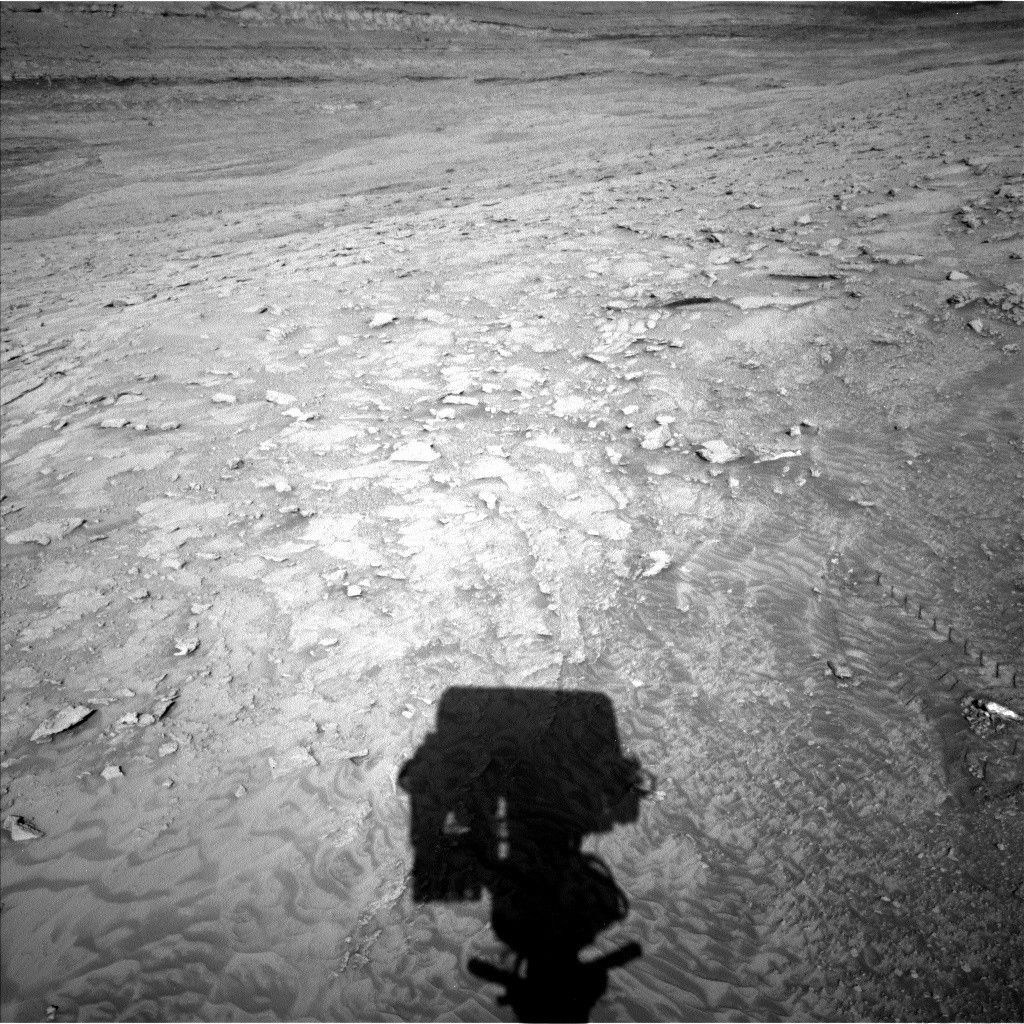
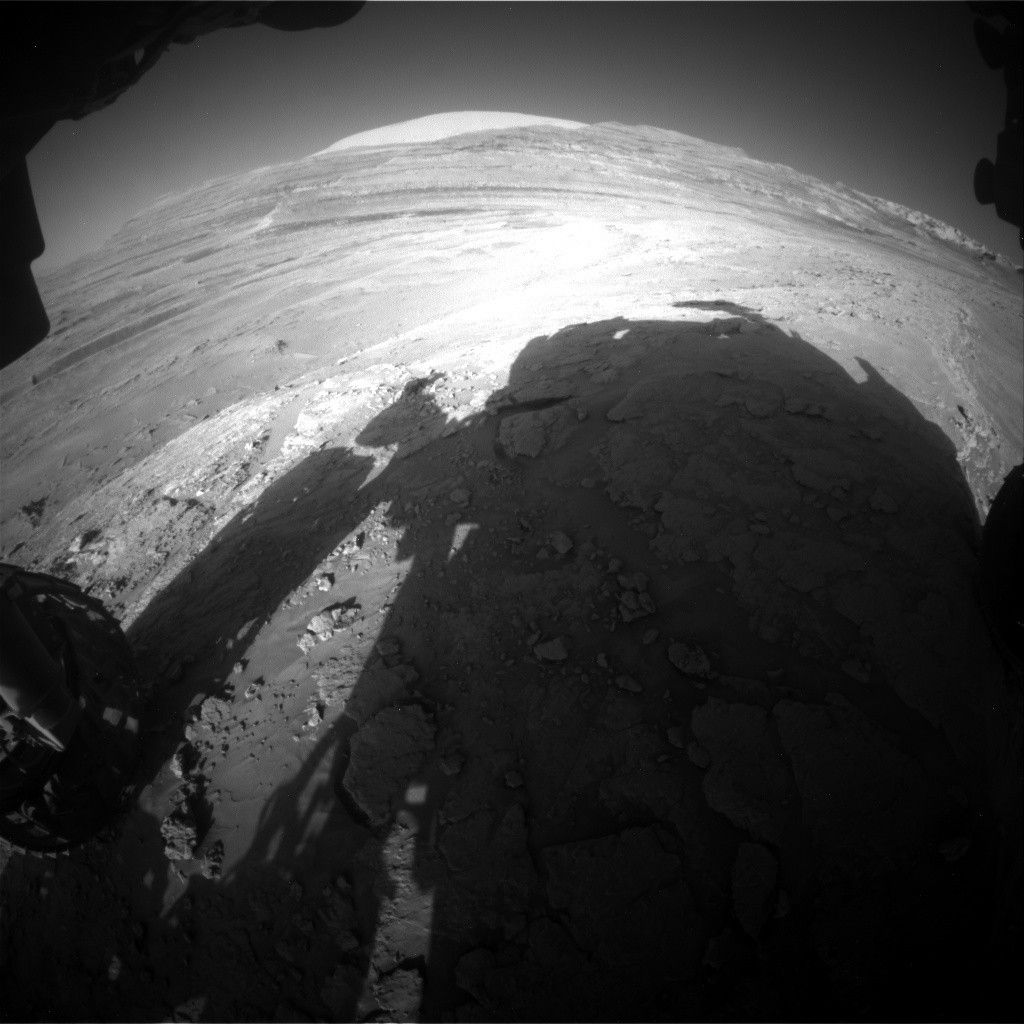
A grayscale, extreme wide-angle image of Martian terrain shows an exaggerated, curved horizon in the distance, where mesas rise from the ground. The entire field between that and the image foreground is covered in rocks of varying sizes poking out of the ground at various angles, with very few patches of flat ground. Many of the rocks are sunlit and very light gray, compared to the medium gray of the soil. Some of the soil in between the rocks appears wavy, as if sculpted by wind or water. Parts of the Curiosity rover are visible, but shadowed, in the four corners of the image, and the rover is casting a shadow covering most of the lower left corner of the image. One wheel is visible at the far right, perched atop a rock in the lower right corner.
NASA’s Mars rover Curiosity acquired this image using its Front Hazard Avoidance Camera (Front Hazcam), showing the rover’s right-front wheel perched on a small, angular block, where it ended its weekend drive of about 75 feet (23 meters). In the interest of stability, the Curiosity team prefers to have all six rover wheels on the ground before deploying its 7-foot-long robotic arm (2.1 meters), so they opted for remote sensing observations instead, then another drive higher in the canyon. Curiosity captured this image on March 23, 2025 — sol 4489, or Martian day 4,489 of the Mars Science Laboratory mission — at 15:24:49 UTC.
NASA/JPL-Caltech

Written by Lauren Edgar, Planetary Geologist at USGS Astrogeology Science Center

Earth planning date: Monday, March 24, 2025

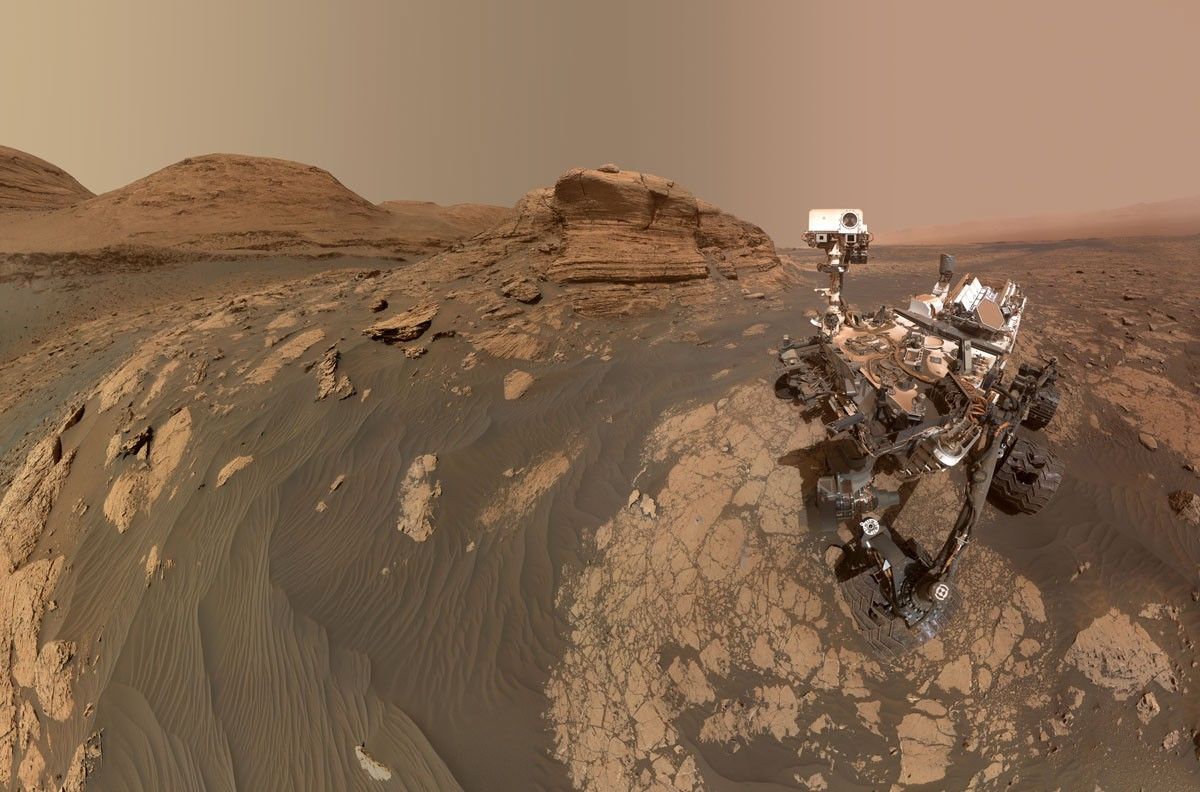
If you’ve ever seen a geologist in the field, you may have seen a classic stance: one leg propped up on a rock, knee bent, head down looking at the rocks at their feet, and arm pointing to the distant stratigraphy. Today Curiosity decided to give us her best field geologist impression. The weekend drive went well and the rover traversed about 23 meters (about 75 feet), but ended with the right front wheel perched on an angular block. In the Front Hazcam image above, you can see the right front wheel on a small block, and the rover’s shadow with the mast staring out at all the exciting rocks to explore. Great pose, but not what we want for planning contact science! We like to have all six wheels on the ground for stability before deploying the robotic arm. So instead of planning contact science today, the team pivoted to a lot of remote sensing observations and another drive to climb higher in this canyon.

I was on shift as Long Term Planner today, and it was fun to see the team quickly adapt to the change in plans. Today’s two-sol plan includes targeted remote sensing and a drive on the first sol, followed by an untargeted science block on the second sol.
On Sol 4491, ChemCam will acquire a LIBS observation of a well-laminated block in our workspace named “Big Narrows,” followed by long-distance RMI observations coordinated with Mastcam to assess an interesting debris field at “Torote Bowl.” The team planned a large Mastcam mosaic to characterize the stratigraphy at Texoli butte from a different viewing geometry than we have previously captured. Mastcam will also be used to investigate active surface processes in the sandy troughs nearby, and an interesting fracture pattern at “Bronson Cave.” Then Curiosity will drive further to the south and take post-drive imaging to prepare for the next plan. On the second sol the team added an autonomously selected ChemCam AEGIS target, along with Navcam movies to monitor clouds, wind direction, and dust.

Keep on roving Curiosity, and please watch your step!

Share

Details

Last Updated
Mar 26, 2025

Related Terms

Powered by WPeMatico

Get The Details…