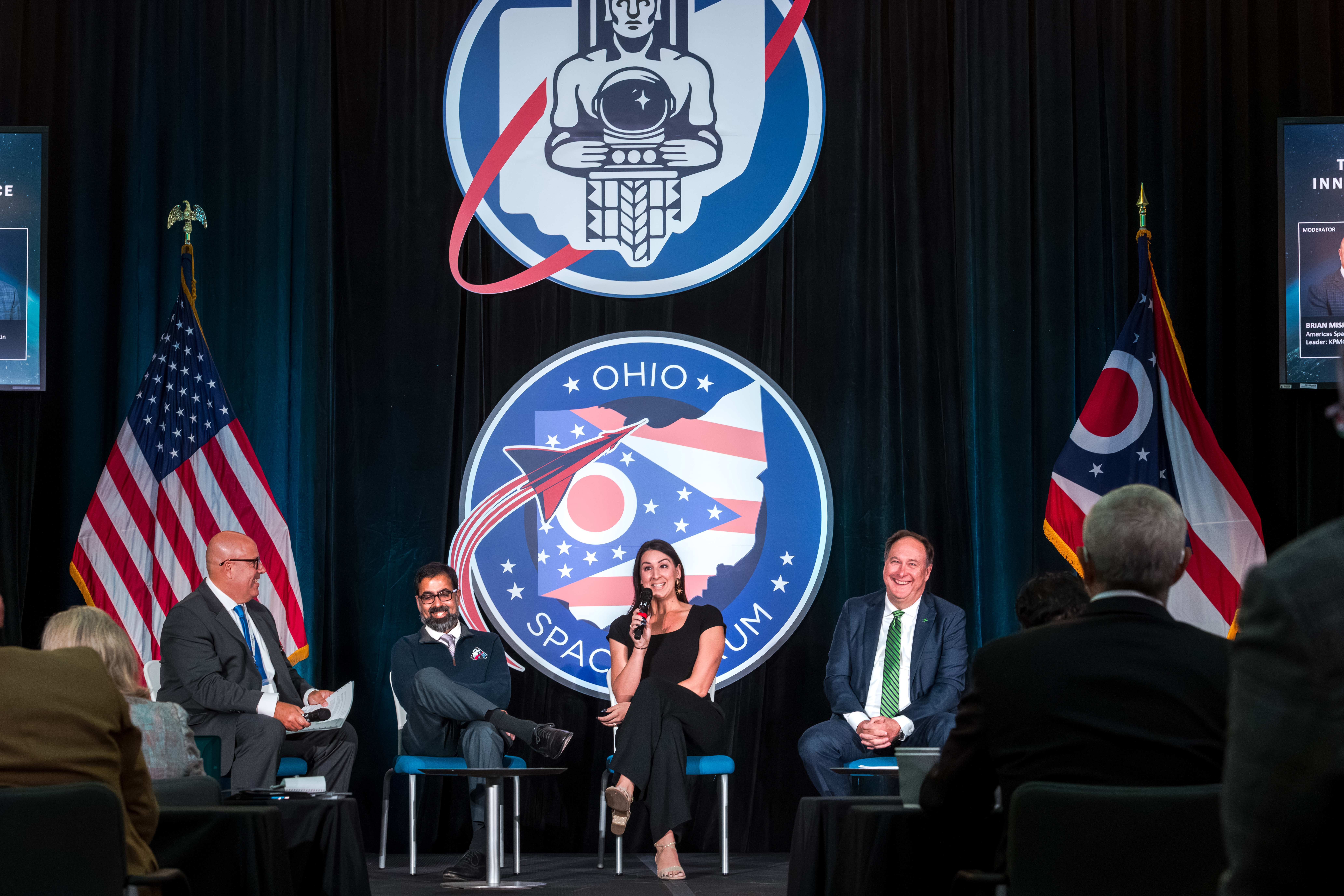
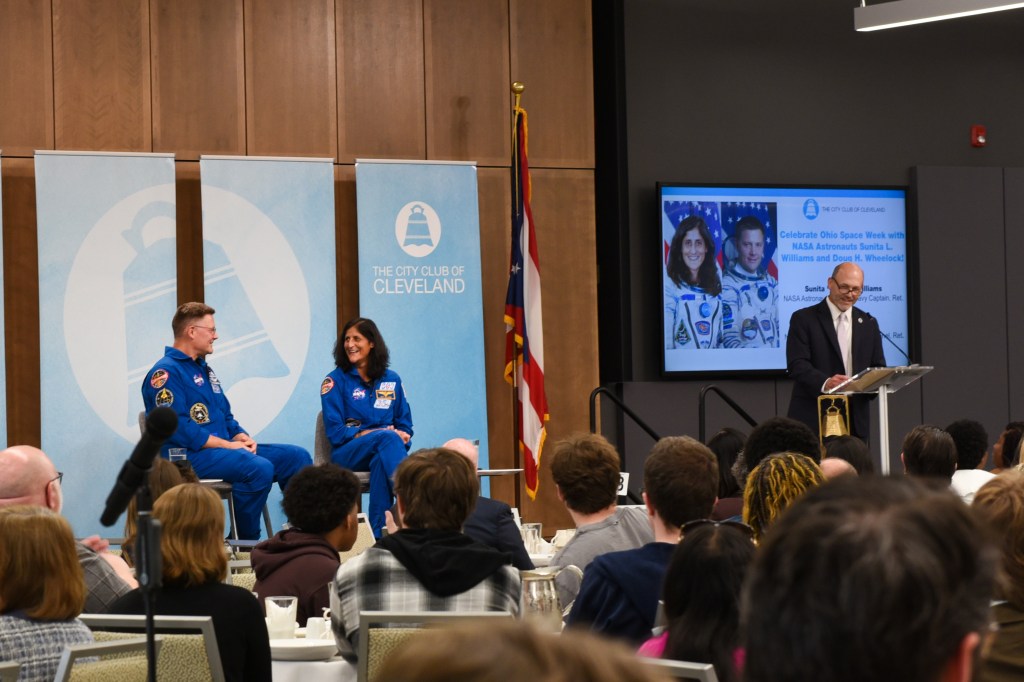
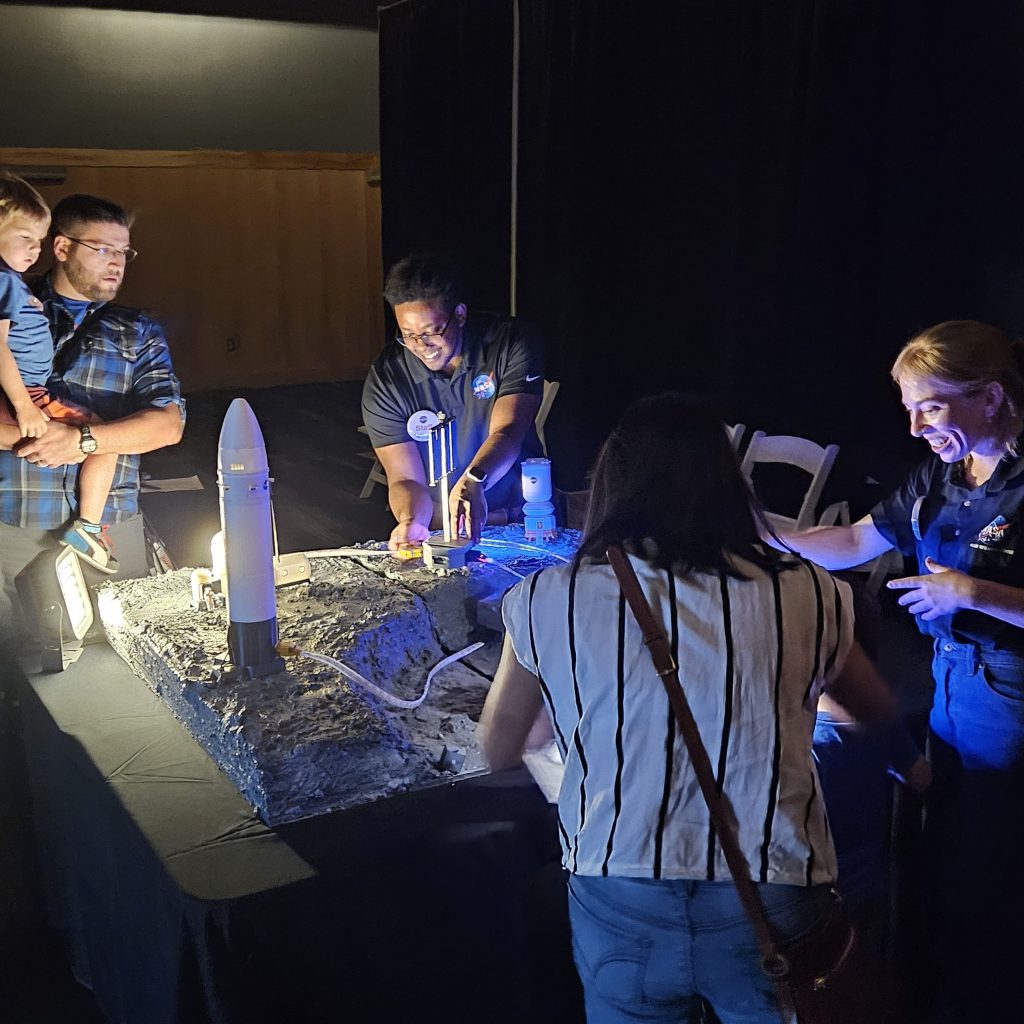
A specialty license plate showcasing NASA’s Glenn Research Center in Cleveland is now available on the Ohio Bureau of Motor Vehicles website.
Credit:Courtesy of Ohio Bureau of Motor Vehicles
Ohio residents can now take their vehicle to new heights with a specialty license plate showcasing NASA’s Glenn Research Center in Cleveland.
It is available on the Ohio Bureau of Motor Vehicles (BMV) website under the “Special Interest Plates” section. Click the “Organizational Plates” drop-down tab for details on NASA Glenn’s plate.
The Ohio BMV will collect an additional $10 above the regular license plate fee. NASA will not receive any money from the sale.
NASA Glenn makes space exploration and aviation possible. This incredible work is happening right here in Northeast Ohio. The specialty license plate allows fans to show support for their community and Ohio’s NASA center.
NASA Glenn Shows Students Temperature-Cooling Technology
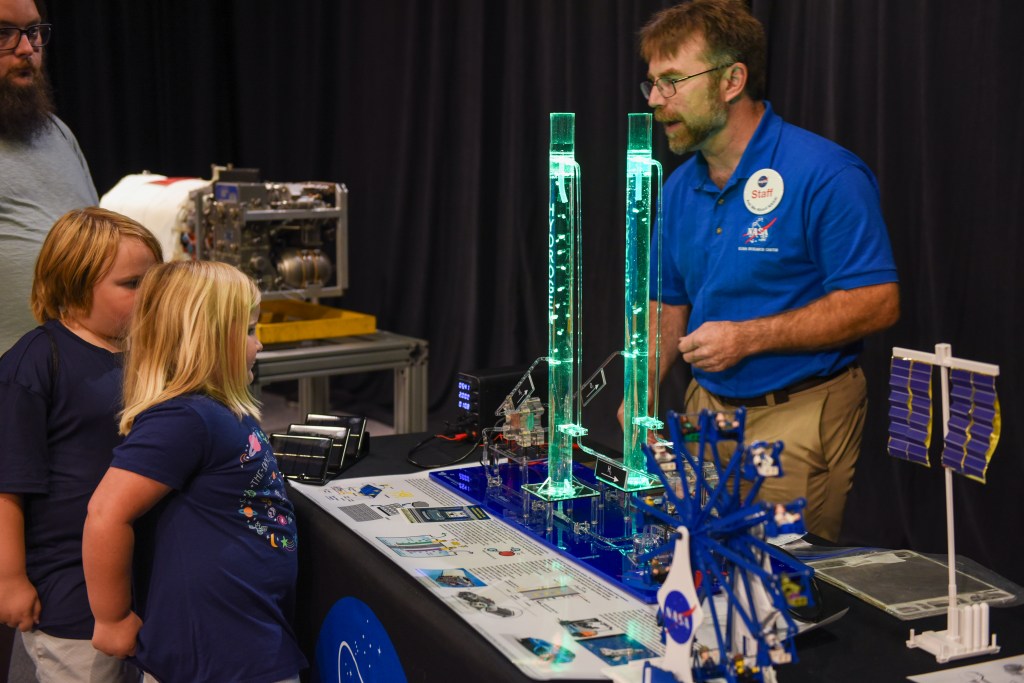
During World Water Day at Great Lakes Science Center in Cleveland on Friday, March 21, 2025, NASA’s Glenn Research Center staff, left to right, Heather Roe, Debbie Welch, and Jacqueline Minerd show how NASA’s Liquid Cooling and Ventilation Garment uses water to regulate the body temperatures of astronauts during spacewalks.
Credit: NASA/Lillianne Hammel
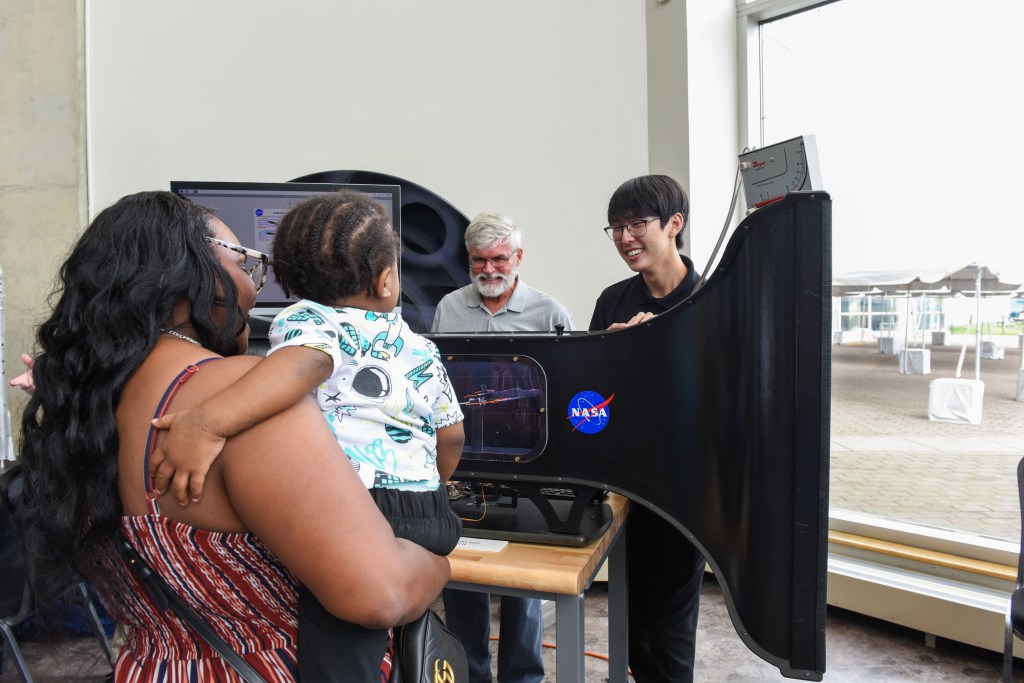
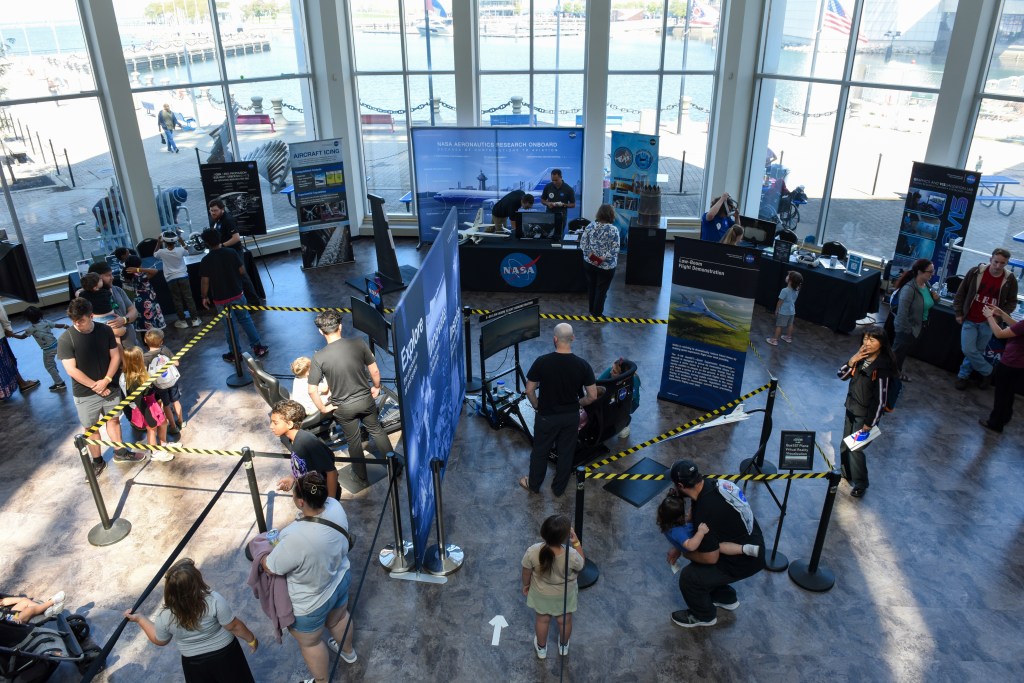
Water is essential for life, and it is an important engineering tool as well. On March 21, NASA’s Glenn Research Center staff joined Great Lakes Science Center in celebrating World Water Day at the science center, home of the NASA Glenn Visitor Center, in downtown Cleveland. Staff conducted hands-on demonstrations highlighting NASA’s Liquid Cooling and Ventilation Garment during the free day for students.
A NASA Glenn Research Center staff member demonstrates how NASA’s Liquid Cooling and Ventilation Garment cools down the body using water during World Water Day at Great Lakes Science Center in Cleveland on Friday, March 21, 2025.
Credit:NASA/Lillianne Hammel
This interactive activity helped students discover how NASA uses water to regulate the body temperatures of astronauts during spacewalks.
Approximately 450 students and educators attended the event.
NASA Glenn Champions FIRST Robotics Competition Buckeye Regional
NASA Glenn Research Center’s Director Dr. Jimmy Kenyon, left, talks with a Youth Tech Academy Red Dragon participant at the FIRST Robotics Competition Buckeye Regional in Cleveland on Friday, April 4, 2025.
Credit:NASA/Sara Lowthian-Hanna
NASA’s Glenn Research Center in Cleveland supported the 26th annual FIRST Robotics Competition Buckeye Regional, April 3-6, at Cleveland State University’s Wolstein Center. This international engineering design challenge combines the excitement of sports with the rigors of STEM.
Mavericks Team participants adjust their robot prior to their turn to compete at the FIRST Robotics Competition Buckeye Regional in Cleveland on Friday, April 4, 2025.
Credit:NASA/Sara Lowthian-Hanna
NASA Glenn Center Director Dr. Jimmy Kenyon helped kick off this year’s event by addressing the student participants. He shared that NASA Glenn specializes in propulsion and communications, that the center is vital to the region and country, and that “the road to Moon and Mars goes through Ohio” thanks to the center’s contributions to the agency’s missions. He also highlighted several aerospace projects underway at the center and explained how engineering and math skills used in robotics apply to real-life engineering challenges.
Fifty-six teams of high school students competed in the robotics competition, which aims to inspire young people to be STEM leaders and innovators by engaging them in mentor-based engineering.
Members from the Argonauts Team cheer as their robot competes in the FIRST Robotics Competition Buckeye Regional at Cleveland State University in Cleveland on Friday, April 4, 2025.
Credit:NASA/Sara Lowthian-Hanna
NASA Glenn employees offered their time and expertise as mentors, machinists, or volunteers supporting FIRST Robotics teams leading up to the event as well as on competition day.
Webb’s Titan Forecast: Partly Cloudy With Occasional Methane Showers
7 Min Read
Webb’s Titan Forecast: Partly Cloudy With Occasional Methane Showers
These images of Titan were taken by NASA’s James Webb Space Telescope on July 11, 2023 (top row) and the ground-based W.M. Keck Observatories on July 14, 2023 (bottom row). They show methane clouds appearing at different altitudes in Titan’s northern hemisphere. Full image and description below.
Credits: NASA, ESA, CSA, STScI, and W.M. Keck Observatories
Saturn’s moon Titan is an intriguing world cloaked in a yellowish, smoggy haze. Similar to Earth, the atmosphere is mostly nitrogen and has weather, including clouds and rain. Unlike Earth, whose weather is driven by evaporating and condensing water, frigid Titan has a methane cycle.
NASA’s James Webb Space Telescope, supplemented with images from the Keck II telescope, has for the first time found evidence for cloud convection in Titan’s northern hemisphere, over a region of lakes and seas. Webb also has detected a key carbon-containing molecule that gives insight into the chemical processes in Titan’s complex atmosphere.
Titan’s Weather
On Titan, methane plays a similar role to water on Earth when it comes to weather. It evaporates from the surface and rises into the atmosphere, where it condenses to form methane clouds. Occasionally it falls as a chilly, oily rain onto a solid surface where water ice is hard as rocks.
“Titan is the only other place in our solar system that has weather like Earth, in the sense that it has clouds and rainfall onto a surface,” explained lead author Conor Nixon of NASA’s Goddard Space Flight Center in Greenbelt, Maryland.
The team observed Titan in November 2022 and July 2023 using both Webb and one of the twin ground-based W.M. Keck Observatories telescopes. Those observations not only showed clouds in the mid and high northern latitudes on Titan – the hemisphere where it is currently summer – but also showed those clouds apparently rising to higher altitudes over time. While previous studies have observed cloud convection at southern latitudes, this is the first time evidence for such convection has been seen in the north. This is significant because most of Titan’s lakes and seas are located in its northern hemisphere and evaporation from lakes is a major potential methane source. Their total area is similar to that of the Great Lakes in North America.
On Earth the lowest layer of the atmosphere, or troposphere, extends up to an altitude of about 7 miles (12 kilometers). However, on Titan, whose lower gravity allows the atmospheric layers to expand, the troposphere extends up to about 27 miles (45 kilometers). Webb and Keck used different infrared filters to probe to different depths in Titan’s atmosphere, allowing astronomers to estimate the altitudes of the clouds. The science team observed clouds that appeared to move to higher altitudes over a period of days, although they were not able to directly see any precipitation occurring.
Image A: Titan (Webb and Keck Image)
These images of Titan were taken by NASA’s James Webb Space Telescope on July 11, 2023 (top row) and the ground-based W.M. Keck Observatories on July 14, 2023 (bottom row). They show methane clouds (denoted by the white arrows) appearing at different altitudes in Titan’s northern hemisphere.
On the left side are representative-color images from both telescopes. In the Webb image light at 1.4 microns is colored blue, 1.5 microns is green, and 2.0 microns is red (filters F140M, F150W, and F200W, respectively). In the Keck image light at 2.13 microns is colored blue, 2.12 microns is green, and 2.06 microns is red (H2 1-0, Kp, and He1b, respectively).
In the middle column are single-wavelength images taken by Webb and Keck at 2.12 microns. This wavelength is sensitive to emission from Titan’s lower troposphere. The rightmost images show emission at 1.64 microns (Webb) and 2.17 microns (Keck), which favor higher altitudes, in Titan’s upper troposphere and stratosphere (an atmospheric layer above the troposphere). It demonstrates that the clouds are seen at higher altitudes on July 14 than earlier on July 11, indicative of upward motion.
NASA, ESA, CSA, STScI, and W.M. Keck Observatories
Titan’s Chemistry
Titan is an object of high astrobiological interest due to its complex organic (carbon-containing) chemistry. Organic molecules form the basis of all life on Earth, and studying them on a world like Titan may help scientists understand the processes that led to the origin of life on Earth.
The basic ingredient that drives much of Titan’s chemistry is methane, or CH4. Methane in Titan’s atmosphere gets split apart by sunlight or energetic electrons from Saturn’s magnetosphere, and then recombines with other molecules to make substances like ethane (C2H6) along with more complex carbon-bearing molecules.
Webb’s data provided a key missing piece for our understanding of the chemical processes: a definitive detection of the methyl radical CH3. This molecule (called “radical” because it has a “free” electron that is not in a chemical bond) forms when methane is broken apart. Detecting this substance means that scientists can see chemistry in action on Titan for the first time, rather than just the starting ingredients and the end products.
“For the first time we can see the chemical cake while it’s rising in the oven, instead of just the starting ingredients of flour and sugar, and then the final, iced cake,” said co-author Stefanie Milam of the Goddard Space Flight Center.
Image B: Chemistry in Titan’s Atmosphere
This four-panel infographic demonstrates a key chemical process believed to occur in the atmosphere of Saturn’s moon Titan. 1. Titan has a thick, nitrogen (N2) atmosphere that also contains methane (CH4). 2. Molecules known as methyl radicals (CH3) form when methane is broken apart by sunlight or energetic electrons from Saturn’s magnetosphere. 3. It then recombines with other molecules or with itself to make substances like ethane (C2H6). 4. Methane, ethane, and other molecules condense and rain out of the atmosphere, forming lakes and seas on Titan’s surface. NASA’s James Webb Space Telescope detected the methyl radical on Titan for the first time, providing a key missing piece for our understanding of Titan’s chemical processes.
NASA, ESA, CSA, and Elizabeth Wheatley (STScI)
The Future of Titan’s Atmosphere
This hydrocarbon chemistry has long-term implications for the future of Titan. When methane is broken apart in the upper atmosphere, some of it recombines to make other molecules that eventually end up on Titan’s surface in one chemical form or another, while some hydrogen escapes from the atmosphere. As a result, methane will be depleted over time, unless there is some source to replenish it.
A similar process occurred on Mars, where water molecules were broken up and the resulting hydrogen lost to space. The result was the dry, desert planet we see today.
“On Titan, methane is a consumable. It’s possible that it is being constantly resupplied and fizzing out of the crust and interior over billions of years. If not, eventually it will all be gone and Titan will become a mostly airless world of dust and dunes,” said Nixon.
Video: Webb Spies Rain Clouds, New Molecule on Titan
Of all the alien worlds in our solar system, one in particular resembles our home planet. Titan, the largest moon of Saturn, is the only other place we know of where you could walk along the seashore or stand in the rain. However, Titan’s exotic seas and its oily raindrops are not made of water, but of the natural gases methane and ethane, super-chilled into liquid form. Now, NASA’s James Webb Space Telescope has revealed a crucial, missing step in how ethane is formed, and its discovery could tell us about the future of Titan’s atmosphere.
Credit: NASA’s Goddard Space Flight Center. Producer/Editor: Dan Gallagher. Lead Scientist/Narrator: Conor Nixon. Lead Animator: Jenny McElligott. Lead Visualizer: Andrew J Christensen. Scientist: Nicholas Lombardo. Animator/Art Director: Michael Lentz. Animation Lead: Walt Feimer. Animators: Jonathan North, Wes Buchanan, Kim Dongjae, Chris Meaney, Adriana Manrique Gutierrez. Data Visualizers: Mark SubbaRao, Kel Elkins, Ernie Wright. Data Provider: Juan Lora. Executive Producer: Wade Sisler. Social Media Support: Kathryn Mersmann. Public Affairs: Laura Betz.
Complementing the Dragonfly Mission
More of Titan’s mysteries will be probed by NASA’s Dragonfly mission, a robotic rotorcraft scheduled to land on Saturn’s moon in 2034. Making multiple flights, Dragonfly will explore a variety of locations. Its in-depth investigations will complement Webb’s global perspective.
“By combining all of these resources, including Webb, NASA’s Hubble Space Telescope, and ground-based observatories, we maintain continuity between the former Cassini/Huygens mission to Saturn and the upcoming Dragonfly mission,” added Heidi Hammel, vice president of the Association of Universities for Research in Astronomy and a Webb Interdisciplinary Scientist.
The James Webb Space Telescope is the world’s premier space science observatory. Webb is solving mysteries in our solar system, looking beyond to distant worlds around other stars, and probing the mysterious structures and origins of our universe and our place in it. Webb is an international program led by NASA with its partners, ESA (European Space Agency) and CSA (Canadian Space Agency).
Biotech, Fire Safety Research and Station Maintenance topped Tuesday’s Schedule for the Expedition 73 Crew
This long-duration photograph taken from the International Space Station as it orbited 259 miles above the Andaman Sea reveals the city lights of Southeast Asia and the typical green lights of the fishing boats underneath Earth’s atmospheric glow. In the background, a star-filled sky and the Milky Way sparkle above the planet.
NASA/Don Pettit
Biotechnology research exploring DNA-inspired nanomaterials and researching how fire behaves in microgravity to expand on station fire safety topped the science schedule for the Expedition 73 crew aboard the International Space Station on Tuesday. The crew also scheduled in time for more station maintenance.
A Bio-Monitor garment and headband were donned by NASA astronaut Anne McClain as part of an experiment that monitors astronauts’ psychological responses before, during, and after a mission to the International Space Station to assess the effect of space travel on heart health.
McClain and NASA astronaut Nichole Ayers experimented with the Life Sciences Glovebox and the DNA Nano Therapeutics Mission 2 which produces a special type of molecule formed by DNA-inspired nanomaterials. Together these flight engineers were mixing mRNA and/or protein solutions as part of the nanomaterials mixing operations. This investigation could help identify the best formulations and methods for cost-effective in-space production. These nanomaterials also could be used to create new ways of targeting therapy delivery that improve patient outcomes with fewer side effects.
Ayers continued her work with the Life Sciences Glove Box and worked to plug-in the spectrophotometer to perform light wave measurements as part of the DNA Nano Therapeutics Mission 2 Spectrophotometer setup. Throughout her day she also checked and charged the batteries in the Astrobees, which are cube-shaped robots designed to help scientists and engineers develop and test technologies for use in microgravity and to assist astronauts with routine chores, and give ground controllers additional eyes and ears on the space station.
NASA astronaut Jonny Kim worked on installing the Solid Fuel Ignition and Extinction (SoFIE) experiment mist hardware used to extinguish flames. He also worked with the Combustion Integrated Rack (CIR) which enables investigators to perform combustion research to understand the fundamentals of the combustion process, understand fire safety, and methods for suppression of fires in space.
Station commander Takuya Onishi of JAXA (Japan Aerospace Exploration Agency) performed work in the Japanese Experiment Module with fire safety as well as some station maintenance. Onishi worked with the Solid Combustion Experiment Module (SCEM) exchanging gas bottles in the Multi-Purpose Small Payload Rack to perform leak checks as well as exchanged samples. Onishi also worked on orbital plumbing installing recycle tanks and configuring drain valves.
Maintenance was at the forefront of the station’s three cosmonauts Sergey Ryzhikov, Alexey Zubritskiy, and Kirill Peskov’s day while working in the Russian segment. Zubritskiy removed Russian cargo, completed replacing and repairing thermal sensors as well and verifying a flow sensor installation position. Peskov completed an ethernet cables audit as well as worked on the intermodular ventilation system that connects the Russian module to the U.S. module.