Bone Cell Research Advances as Dragon Adjusts Station’s Orbit

Bone Cell Research Advances as Dragon Adjusts Station’s Orbit

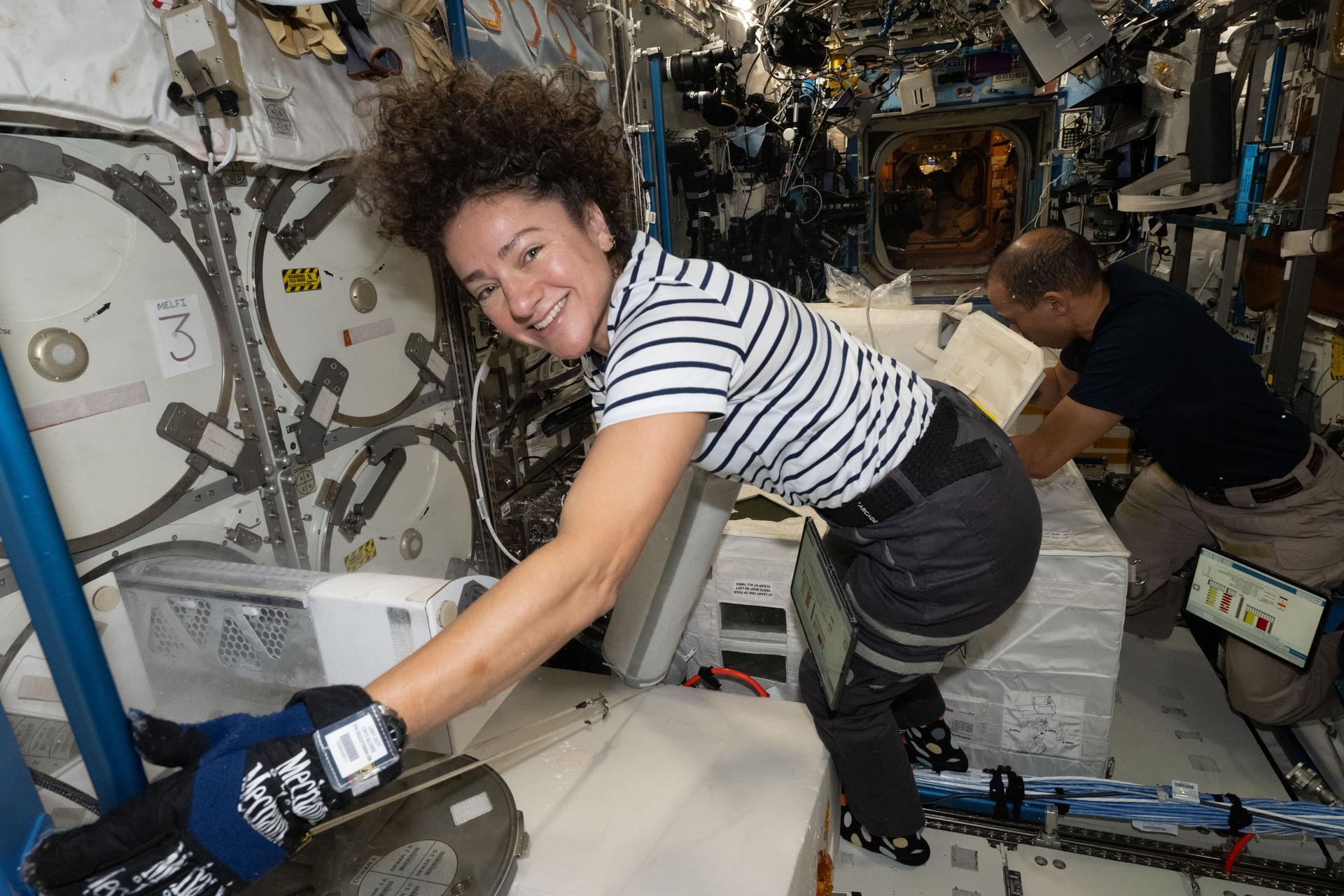
Expedition 73 Flight Engineers Kimiya Yui of JAXA (Japan Aerospace Exploration Agency) and Zena Cardman of NASA unpack some of the science, supplies, and hardware delivered aboard the SpaceX Dragon cargo spacecraft and begin installing the new gear inside the International Space Station.
Astronauts Kimiya Yui of JAXA (Japan Aerospace Exploration Agency) and Zena Cardman of NASA unpack some of the science, supplies, and hardware delivered aboard the SpaceX Dragon cargo spacecraft and begin installing the new gear inside the International Space Station.

Expedition 73 continued observing bone stem cells on Wednesday to learn how to protect the skeletal system in microgravity and ensure crew health on long duration space missions. The International Space Station residents also installed advanced computer hardware and practiced an emergency drill as a SpaceX Dragon cargo spacecraft boosted the orbital outpost’s altitude.

NASA Flight Engineer Jonny Kim was back inside the Kibo laboratory module processing bone stem cell samples to help doctors understand the molecular changes crew member’s bones experience during a spaceflight. The human-provided samples were delivered recently aboard a SpaceX Dragon cargo craft and are being treated with a therapeutic agent for a closer look and a better understanding of space-caused bone loss. After a period of incubation during the research activities, the specimens are stowed in a science freezer to be returned back to Earth aboard Dragon for retrieval and analysis.

Before the start of the bone study, Flight Engineer Kimiya Yui of JAXA (Japan Aerospace Exploration Agency) activated the Life Science Glovebox for Kim to begin his experimental work. Yui then moved on and set up an artificial gravity-generating incubator to study the fermentation and brewing process of sake yeast. At the end of his shift, the two-time station visitor installed the Axiom Data Center Unit-1 in the Destiny laboratory module to test processing and data storage and advanced manufacturing applications on orbit.

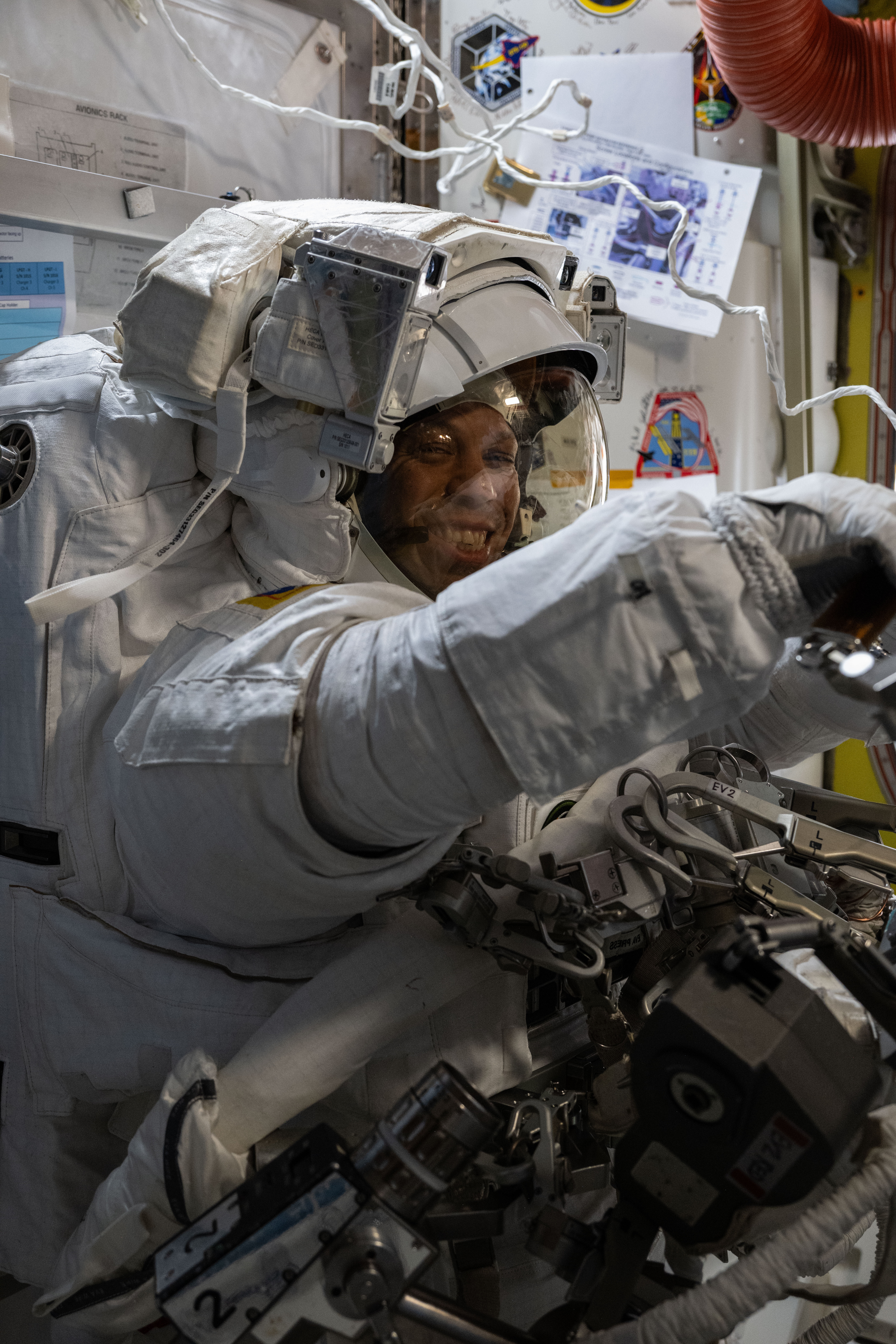
Flight Engineers Zena Cardman and Mike Fincke continued unpacking some of the science, supplies, and hardware packed inside Dragon on Wednesday. As the crew worked during the second half of its shift, the external reboost kit installed inside Dragon’s trunk, an independent propellant system, powered the spacecraft’s two Draco engines for several minutes in a demonstration of its ability to maintain the station’s altitude.

Cardman and Fincke also partnered together clearing up space and organizing cargo inside the Permanent Multipurpose Module. Cardman later replaced and repaired hardware on the cupola’s robotics workstation. Fincke reviewed procedures and gathered hardware for an upcoming physics study to develop and design new materials, such as pharmaceuticals, in space.

Station Commander Sergey Ryzhikov and Flight Engineer Alexey Zubritsky, both from Roscosmos, started their shift practicing an emergency evacuation drill with Kim. The three crewmates, who launched to the orbital outpost aboard the Soyuz MS-27 spacecraft, trained on a computer the procedures they would use to quickly board their Soyuz and undock from the station in the unlikely event of an emergency.

Afterward, Ryzhikov and Zubritsky joined fellow Roscosmos cosmonaut Oleg Platonov and photographed crew activities documenting research work, exercise, maintenance duties, and more. Platonov spent the majority of his shift inside the Nauka science module cleaning components on its ventilation system.

Learn more about station activities by following the space station blog, @space_station on X, as well as the ISS Facebook and ISS Instagram accounts.

Get the latest from NASA delivered every week. Subscribe here.

Powered by WPeMatico

Get The Details…

Mark A. Garcia

NASA, SpaceX Complete Dragon Space Station Reboost

NASA, SpaceX Complete Dragon Space Station Reboost

A SpaceX Dragon cargo spacecraft with its nosecone open and carrying over 5,000 pounds of science, supplies, and hardware for NASA's SpaceX CRS-33 mission approaches the International Space Station for an automated docking to the Harmony module's forward port. Both spacecraft were flying 262 miles above the Atlantic Ocean east of the Canadian province of Newfoundland at the time of this photograph.
A SpaceX Dragon cargo spacecraft carrying over 5,000 pounds of science, supplies, and hardware for NASA’s SpaceX CRS-33 mission approaches the International Space Station for an automated docking on Aug. 25, 2025.
NASA

On Wednesday, Sept. 3, SpaceX’s Dragon completed an initial burn to test the spacecraft’s new capability to help maintain the altitude of the International Space Station. Two Draco engines located in the trunk of Dragon, which contains an independent propellant system, were used to adjust the space station’s orbit through a maneuver lasting five minutes, three seconds. The initial test burn increased the station’s altitude by around one mile at perigee, or low point of station’s orbit, leaving the station in an orbit of 260.9 x 256.3 miles. The new boost kit in Dragon will help sustain the orbiting lab’s altitude through a series of longer burns planned periodically throughout the fall of 2025.

This Dragon spacecraft, which is supporting NASA’s SpaceX 33rd commercial resupply mission, arrived at the orbital complex on Aug. 25. Dragon is scheduled to remain at the space station until late December or early January before returning to Earth with research and cargo, splashing down off the coast of California.

Learn more about station activities by following the space station blog, @space_station on X, as well as the ISS Facebook and ISS Instagram accounts.

Get the latest from NASA delivered every week. Subscribe here.

Powered by WPeMatico

Get The Details…

Mark A. Garcia

Thinning Arctic Sea Ice

Thinning Arctic Sea Ice

Aerial view of fractured sea ice floating in the Arctic Ocean. Large white ice sheets are broken into irregular shapes, with deep blue melt ponds and dark open water channels visible between them.
NASA/Rachel Tilling

Sea ice is frozen seawater that floats in the ocean. This photo, taken from NASA’s Gulfstream V Research Aircraft on July 21, 2022, shows Arctic sea ice in the Lincoln Sea north of Greenland.

This image is the NASA Science Image of the Month for September 2025. Each month, NASA’s Science Mission Directorate chooses an image to feature, offering desktop wallpaper downloads, as well as links to related topics, activities, and games.

Text and image credit: NASA/Rachel Tilling

Powered by WPeMatico

Get The Details…
Monika Luabeya

Rock and Roll with NASA Challenge

Rock and Roll with NASA Challenge

Depiction of a NASA rover on the lunar surface with an astronaut facing the front of the vehicle walking toward it.
Image Credit: HeroX

The next era of lunar exploration demands a new kind of wheel – one that can sprint across razor-sharp regolith, shrug off extremely cold nights, and keep a rover rolling day after lunar day. The Rock and Roll with NASA Challenge seeks that breakthrough. If you can imagine a lightweight, compliant wheel that stays tough at higher speeds while carrying lots of  cargo, your ideas could set the pace for surface missions to follow. For this phased Challenge, Phase 1 rewards the best concepts and analyses, Phase 2 funds prototypes, and Phase 3 puts the best wheels through a live obstacle course simulating the lunar terrain. Along the way, you’ll receive feedback from NASA mobility engineers and the chance to see your hardware pushed to its limits.  In Phase 3, to prove concepts, NASA is using MicroChariot, a nimble, 45 kg test rover that will test the best designs from Phase 1 & Phase 2 at the Johnson Space Center Rockyard in Houston, Texas. Whether you’re a student team, a garage inventor, or a seasoned aerospace firm, this is your opportunity to rewrite the playbook of planetary mobility and leave tread marks on the future of exploration. Follow the challenge, assemble your crew, and roll out a solution that takes humanity back to the Moon.

Award: $155,000 in total prizes

Open Date: Phase 1 – August 28, 2025; Phase 2 – January 2026; Phase 3 – May 2026

Close Date: Phase 1 – November 4, 2025; Phase 2 – April 2026; Phase 3 – June 2026

For more information, visit: https://www.herox.com/NASARockandRoll

Powered by WPeMatico

Get The Details…
Sarah Douglas

Acting NASA Administrator Duffy Selects Exploration-Focused Associate Administrator

Acting NASA Administrator Duffy Selects Exploration-Focused Associate Administrator

Amit Kshatriya
Amit Kshatriya
Credit: NASA

Acting NASA Administrator Sean P. Duffy Wednesday named Amit Kshatriya as the new associate administrator of NASA, the agency’s top civil service role.

A 20-year NASA veteran, Kshatriya was most recently the deputy in charge of the Moon to Mars Program in the Exploration Systems Development Mission Directorate (ESDMD) at NASA Headquarters in Washington. In this role, Kshatriya was responsible for program planning and implementation for crewed missions to the Moon through the Artemis campaign in preparation for humanity’s first mission to Mars.

Promoting Kshatriya to NASA’s top ranks puts America’s return to the Moon through Artemis at the very core of our agency. The move exemplifies President Donald J. Trump and Duffy’s seriousness about returning Americans to the Moon and before China.

“Amit has spent more than two decades as a dedicated public servant at NASA, working to advance American leadership in space. Under his leadership, the agency will chart a bold vision to return to the Moon during President Trump’s term,” said Duffy. “Amit’s knowledge, integrity, and unwavering commitment to pioneering a new era of exploration make him uniquely qualified to lead our agency as associate administrator. With Amit we’ll continue to push the boundaries of what’s possible.”

Kshatriya’s promotion also signals how the Trump Administration sees the commercial space sector as an American economic engine. By putting a proven leader at the top, NASA is set to partner even more closely with America’s booming space industry, grow the space economy, and ensure the future of exploration is built in the United States.

Born in Wisconsin, educated at California Institute of Technology and the University of Texas at Austin, Kshatriya is one of only about 100 people in history to serve as a mission control flight director. He brings unparalleled operational and strategic experience to NASA’s executive leadership team.

-end-

Bethany Stevens
Headquarters, Washington
771-216-2606
bethany.c.stevens@nasa.gov

Share

Details

Last Updated

Sep 03, 2025

Powered by WPeMatico

Get The Details…
Cheryl Warner