NASA, Sierra Space Modify Commercial Resupply Services Contract

NASA, Sierra Space Modify Commercial Resupply Services Contract

The Sierra Space Dream Chaser winged spacecraft is seen stacked atop its Shooting Star cargo module on the vibration table at NASA’s Armstrong Test Facility in Sandusky, Ohio, while undergoing testing to simulate launch and re-entry conditions.
NASA

In 2016, NASA awarded a Commercial Resupply Services-2 contract to Sierra Space, formerly part of Sierra Nevada Corporation, to resupply the International Space Station with its Dream Chaser spaceplane and companion Shooting Star cargo module. As part of its contract, Sierra Space was awarded a minimum seven flights, and the agency previously issued firm-fixed price task orders for four Dream Chaser resupply missions based on the needs of the space station.

After a thorough evaluation, NASA and Sierra Space have mutually agreed to modify the contract as the company determined Dream Chaser development is best served by a free flight demonstration, targeted in late 2026. Sierra Space will continue providing insight to NASA into the development of Dream Chaser, including through the flight demonstration. NASA will provide minimal support through the remainder of the development and the flight demonstration. As part of the modification, NASA is no longer obligated for a specific number of resupply missions, however, the agency may order Dream Chaser resupply flights to the space station from Sierra Space following a successful free flight as part of its current contract. 

“Development of new space transportation systems is difficult and can take longer than what’s originally planned.  The ability to perform a flight demonstration can be a key enabler in a spacecraft’s development and readiness, as well as offering greater flexibility for NASA and Sierra Space,” said Dana Weigel, manager of NASA’s International Space Station Program. “As NASA and its partners look toward space station deorbit in 2030, this mutually agreed to decision enables testing and verification to continue on Dream Chaser, as well as demonstrating the capabilities of the spaceplane for future resupply missions in low Earth orbit.”

NASA, and its commercial and international partners, will continue to supply the orbital complex with critical science, supplies, and hardware as the agency prepares to transition to commercial space stations in low Earth orbit.   NASA continues to work with a variety of private companies to develop a competitive, space industrial base for cargo services, which will be needed for future commercial space stations. With a strong economy in low Earth orbit, NASA will be one of many customers of private industry as the agency explores the Moon under the Artemis campaign and Mars along with commercial and international partners.

Powered by WPeMatico
Get The Details…
Mark A. Garcia

3-in-1 Launch

3-in-1 Launch

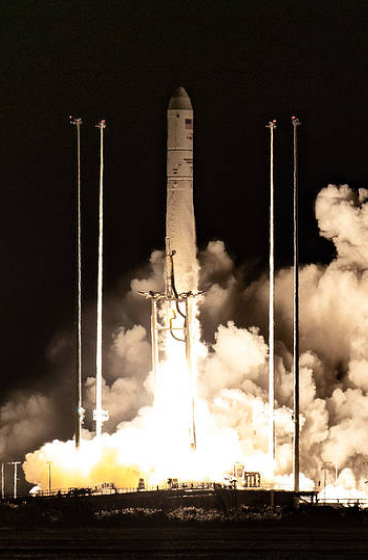
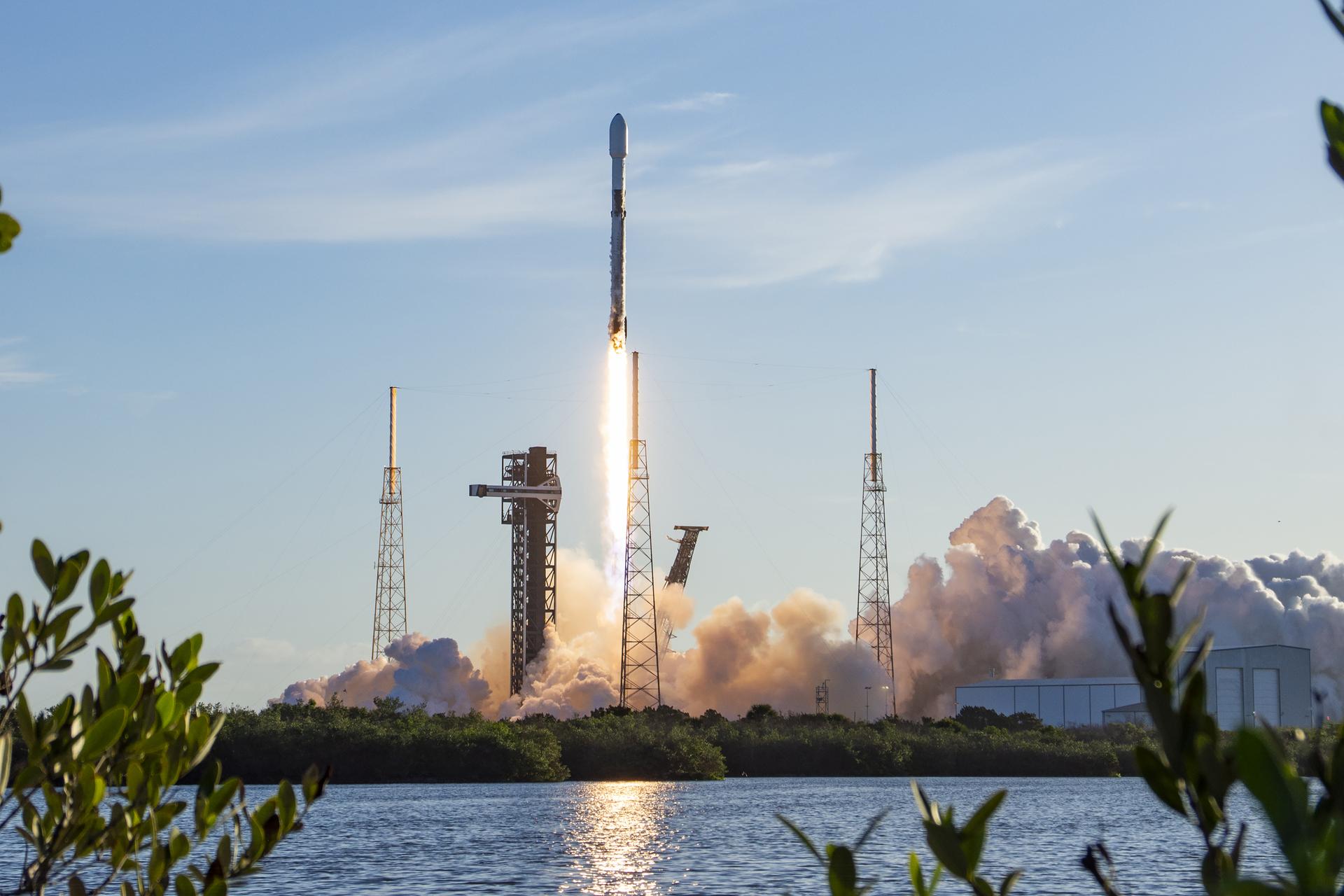
A rocket lifts off into the sky, leaving a bright trail of flame in its wake. White vapor clouds billow out along the ground. There are also various structures in the image, including a gantry and a white structure that looks like a water tower.
NASA/Kim Shiflett

A SpaceX Falcon 9 rocket lifts off from NASA’s Kennedy Space Center in Florida on Sept. 24, 2025, carrying three missions that will investigate the Sun’s influence across the solar system.

NASA’s IMAP (Interstellar Mapping and Acceleration Probe), the agency’s Carruthers Geocorona Observatory, and National Oceanic and Atmospheric Administration’s (NOAA) Space Weather Follow On–Lagrange 1 (SWFO-L1) spacecraft will each focus on different effects of the solar wind – the continuous stream of particles emitted by the Sun – and space weather – the changing conditions in space driven by the Sun – from their origins at the Sun to their farthest reaches billions of miles away at the edge of our solar system.

Image credit: NASA/Kim Shiflett

Powered by WPeMatico

Get The Details…
Monika Luabeya

NASA-ISRO Satellite Sends First Radar Images of Earth’s Surface

NASA-ISRO Satellite Sends First Radar Images of Earth’s Surface

Captured on Aug. 21, this image from NISAR’s L-band radar shows Maine’s Mount Desert Island. Green indicates forest; magenta represents hard or regular surfaces, like bare ground and buildings. The magenta area on the island’s northeast end is the town of Bar Harbor.
Credit: NASA/JPL-Caltech

The NISAR (NASA-ISRO Synthetic Aperture Radar) Earth-observing radar satellite’s first images of our planet’s surface are in, and they offer a glimpse of things to come as the joint mission between NASA and ISRO (Indian Space Research Organisation) approaches full science operations later this year.

“Launched under President Trump in conjunction with India, NISAR’s first images are a testament to what can be achieved when we unite around a shared vision of innovation and discovery,” said acting NASA Administrator Sean Duffy. “This is only the beginning. NASA will continue to build upon the incredible scientific advancements of the past and present as we pursue our goal to maintain our nation’s space dominance through Gold Standard Science.”

Images from the spacecraft, which was launched by ISRO on July 30, display the level of detail with which NISAR scans Earth to provide unique, actionable information to decision-makers in a diverse range of areas, including disaster response, infrastructure monitoring, and agricultural management.

“By understanding how our home planet works, we can produce models and analysis of how other planets in our solar system and beyond work as we prepare to send humanity on an epic journey back to the Moon and onward to Mars,” said NASA Associate Administrator Amit Kshatriya. “The successful capture of these first images from NISAR is a remarkable example of how partnership and collaboration between two nations, on opposite sides of the world, can achieve great things together for the benefit of all.”

On Aug. 21, the satellite’s L-band synthetic aperture radar (SAR) system, which was provided by NASA’s Jet Propulsion Laboratory in Southern California, captured Mount Desert Island on the Maine coast. Dark areas represent water, while green areas are forest, and magenta areas are hard or regular surfaces, such as bare ground and buildings. The L-band radar system can resolve objects as small as 15 feet (5 meters), enabling the image to display narrow waterways cutting across the island, as well as the islets dotting the waters around it.

Then, on Aug. 23, the L-band SAR captured data of a portion of northeastern North Dakota straddling Grand Forks and Walsh counties. The image shows forests and wetlands on the banks of the Forest River passing through the center of the frame from west to east and farmland to the north and south. The dark agricultural plots show fallow fields, while the lighter colors represent the presence of pasture or crops, such as soybean and corn. Circular patterns indicate the use of center-pivot irrigation.

On Aug. 23, NISAR imaged land adjacent to northeastern North Dakota’s Forest River. Light-colored wetlands and forests line the river’s banks, while circular and rectangular plots throughout the image appear in shades that indicate the land may be pasture or cropland with corn or soy.
Credit: NASA/JPL-Caltech

The images demonstrate how the L-band SAR can discern what type of land cover — low-lying vegetation, trees, and human structures — is present in each area. This capability is vital both for monitoring the gain and loss of forest and wetland ecosystems, as well as for tracking the progress of crops through growing seasons around the world.

“These initial images are just a preview of the hard-hitting science that NISAR will produce — data and insights that will enable scientists to study Earth’s changing land and ice surfaces in unprecedented detail while equipping decision-makers to respond to natural disasters and other challenges,” said Nicky Fox, associate administrator, Science Mission Directorate at NASA Headquarters in Washington. “They are also a testament to the years of hard work of hundreds of scientists and engineers from both sides of the world to build an observatory with the most advanced radar system ever launched by NASA and ISRO.”

The L-band system uses a 10-inch (25-centimeter) wavelength that enables its signal to penetrate forest canopies and measure soil moisture and motion of ice surfaces and land down to fractions of an inch, which is a key measurement in understanding how the land surface moves before, during, and after earthquakes, volcanic eruptions, and landslides.

The preliminary L-band images are an example of what the mission team will be able to produce when the science phase begins in November. The satellite was raised into its operational 464-mile (747-kilometer) orbit in mid-September.

The NISAR mission also includes an S-band radar, provided by ISRO’s Space Applications Centre, that uses a 4-inch (10-centimeter) microwave signal that is more sensitive to small vegetation, making it effective at monitoring certain types of agriculture and grassland ecosystems.

The spacecraft is the first to carry both L- and S-band radars. The satellite will monitor Earth’s land and ice surfaces twice every 12 days, collecting data using the spacecraft’s drum-shaped antenna reflector, which measures 39 feet (12 meters) wide — the largest NASA has ever sent into space.

The NISAR mission is a partnership between NASA and ISRO spanning years of technical and programmatic collaboration. The successful launch and deployment of NISAR builds on a strong heritage of cooperation between the United States and India in space.

The Space Applications Centre provided the mission’s S-band SAR. The U R Rao Satellite Centre provided the spacecraft bus. The launch vehicle was provided by Vikram Sarabhai Space Centre, and launch services were through Satish Dhawan Space Centre. Key operations, including boom and radar antenna reflector deployment, are now being executed and monitored by the ISRO Telemetry, Tracking and Command Network’s global system of ground stations.

Managed by Caltech in Pasadena, NASA JPL leads the U.S. component of the project. In addition to the L-band SAR, reflector, and boom, JPL also provided the high-rate communication subsystem for science data, a solid-state data recorder, and payload data subsystem. NASA’s Goddard Space Flight Center in Greenbelt, Maryland, manages the Near Space Network, which receives NISAR’s L-band data.

To learn more about NISAR, visit:

https://nisar.jpl.nasa.gov

-end-

Liz Vlock
Headquarters, Washington
202-358-1600
elizabeth.a.vlock@nasa.gov

Andrew Wang / Jane J. Lee
Jet Propulsion Laboratory, Pasadena, Calif.
626-379-6874 / 818-354-0307
andrew.wang@jpl.nasa.gov / jane.j.lee@jpl.nasa.gov

Powered by WPeMatico

Get The Details…
Gerelle Q. Dodson

NASA & STEM Learning Ecosystems: Opportunities & Benefits for Everyone

NASA & STEM Learning Ecosystems: Opportunities & Benefits for Everyone

2 min read

NASA & STEM Learning Ecosystems: Opportunities & Benefits for Everyone

STEM learning ecosystems are intentionally designed, community-wide partnerships that enable all Americans to actively participate in science, technology, engineering, and math (STEM) throughout their lifetimes. Lifelong STEM learning helps people build critical knowledge and skills, access economic opportunities, drive innovation, and make informed decisions in a changing world. STEM learning ecosystems draw on expertise and resources to provide access to these benefits for the entire community.

NASA’s Science Activation (SciAct) program, a competitively-selected network of collaborative projects that connect NASA science with people of all ages and backgrounds, includes new and growing STEM learning ecosystems in American communities from Alaska to Maine and creates free, high-quality resources that educators across the country can use to share the excitement of Earth and space science.

To further support connections among STEM learning ecosystems and NASA, the SciAct STEM Ecosystems project held a meeting in Saint Paul, Minnesota on August 4-6, 2025. Approximately 100 educators, evaluators, subject matter experts, and other STEM learning facilitators from around the nation participated to share approaches, learn about resources, and build relationships. The gathering offered an opportunity to connect NASA SciAct teams with each other and with external networks and learning ecosystems for mutual benefit.

Meeting goals included sharing ways to create effective partnerships and engage learners in Earth and space science, discovering NASA resources and assets to use in STEM education efforts, and strengthening connections among participants. To accomplish these goals, meeting activities included plenaries, breakout sessions, and networking opportunities.

Led by Arizona State University, the SciAct STEM Ecosystems project is a collaboration among several regional partnerships/SciAct project teams: Arctic and Earth SIGNs, Learning Ecosystems Northeast, Rural Activation and Innovation Network, and the Smoky Mountains STEM Collaborative. The project also partners with the National Informal STEM Education Network to create professional resources.

For those who were unable to attend in person, the STEM Ecosystems project makes a variety of resources available online: https://www.nisenet.org/stem-learning-ecosystems.

SciAct STEM Ecosystems is supported by NASA under cooperative agreement award number 80NSSC21M0007 and is part of NASA’s Science Activation Portfolio. Learn more about how Science Activation connects NASA science experts, real content, and experiences with community leaders to do science in ways that activate minds and promote deeper understanding of our world and beyond: https://science.nasa.gov/learn/about-science-activation/.

Several small groups of people talking.
Meeting participants took advantage of opportunities to network and strengthen their relationships.
Emily Maletz/NISE Network

Share

Details

Last Updated
Sep 25, 2025
Editor
NASA Science Editorial Team

Powered by WPeMatico

Get The Details…

NASA Astronaut Chris Williams to Discuss Upcoming Launch, Mission

NASA Astronaut Chris Williams to Discuss Upcoming Launch, Mission

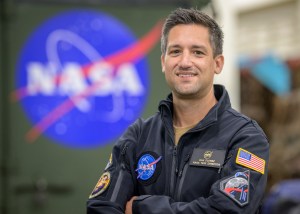
NASA astronaut Chris Williams poses for an official portrait at the agency’s Johnson Space Center in Houston.
Credit: NASA

NASA will host a news conference at 2 p.m. EDT Wednesday, Oct. 1, from the agency’s Johnson Space Center in Houston to highlight the upcoming mission of astronaut Chris Williams to the International Space Station.

The news conference will stream live on NASA’s website and YouTube channel. Learn how to watch NASA content through a variety of platforms, including social media.

The Soyuz MS-28 spacecraft, targeted to launch Nov. 27 from the Baikonur Cosmodrome in Kazakhstan, will carry Williams on his first flight, as well as Sergey Kud-Sverchkov and Sergey Mikaev of Roscosmos, to the space station for an eight-month mission as part of Expeditions 73/74.

Media interested in participating must contact the newsroom at NASA Johnson no later than 5 p.m., Monday, Sept. 29, at 281-483-5111 or jsccommu@mail.nasa.gov. A copy of NASA’s media accreditation policy is online. Media interested in participating by phone must contact the Johnson newsroom by 10 a.m. the day of the event.

Selected as a candidate in 2021, Williams graduated with the 23rd astronaut class in 2024. He began training for his first space station flight assignment immediately after completing initial astronaut candidate training.

Williams was born in New York City, and considers Potomac, Maryland, his hometown. He holds a bachelor’s degree in physics from Stanford University in California and a doctorate in physics from the Massachusetts Institute of Technology in Cambridge, where his research focused on astrophysics. Williams completed medical physics residency training at Harvard Medical School in Boston. He was working as a clinical physicist and researcher at the Brigham and Women’s Hospital in Boston when he was selected as an astronaut candidate.

The International Space Station is a convergence of science, technology, and human innovation enabling research not possible on Earth. For nearly 25 years, NASA has supported a continuous U.S. human presence aboard the orbiting laboratory, where astronauts have learned to live and work in space for extended periods of time. The space station is a springboard for developing a low Earth economy and NASA’s next great leaps in human exploration at the Moon under the Artemis campaign and Mars.

Learn more about the International Space Station:

https://www.nasa.gov/international-space-station

-end-

Jimi Russell / Joshua Finch
Headquarters, Washington
202-358-1100
james.j.russell@nasa.gov / joshua.a.finch@nasa.gov

Shaneequa Vereen
Johnson Space Center, Houston
281-483-5111
shaneequa.y.vereen@nasa.gov

Powered by WPeMatico

Get The Details…
Tiernan P. Doyle