Heart Health, Stem Cells, and Physics Keep Crew Busy on Tuesday

Heart Health, Stem Cells, and Physics Keep Crew Busy on Tuesday

This tranquil view from the International Space Station captures the Kibo laboratory module with its Exposed Facility, a portion of the station’s main solar arrays (right), and part of the Canadarm2 robotic arm (left). The photograph was taken during an orbital sunset as the station soared 270 miles above a cloudy Atlantic Ocean off the coast of South Africa.
This tranquil view from the International Space Station captures the Kibo laboratory module with its Exposed Facility, a portion of the station’s main solar arrays (right), and part of the Canadarm2 robotic arm (left), during an orbital sunset above a cloudy Atlantic Ocean.
NASA

Life science and physics topped the research schedule aboard the International Space Station on Tuesday as the Expedition 73 crew studied heart health, stem cells, fluid physics, and spacecraft fire safety. The orbital residents also completed work on a spacesuit and inspected ventilation and electrical systems while continuing other scientific operations.

NASA Flight Engineer Jonny Kim kicked off his shift wearing a sensor-packed vest and headband that measured his cardiovascular data as he worked out on the advanced resistive exercise device then jogged on the COLBERT treadmill. Doctors will use the medical data to track Kim’s health in space, assess the value of portable health monitoring devices, and treat space-caused health conditions. Later, Kim processed stem cell samples for a study investigating how microgravity affects their conversion to cardiac or brain cells. Results may lead to personalized treatments for astronauts on future missions and advanced therapies for Earth-based conditions such as heart and neurological diseases.

Physics is a critical research subject aboard the orbital outpost since materials behave differently in weightlessness. Flight Engineers Mike Fincke of NASA and Kimiya Yui of JAXA (Japan Aerospace Exploration Agency) split their shift working on a pair of different physics studies, one looking at particles attach themselves to fluids and another observing how flames spread in space. Fincke set up research hardware inside a fluorescence microscope to observe particle-laden droplets potentially informing commercial in-space manufacturing techniques. Yui swapped sample hardware inside the Solid Combustion Experiment Module that enables safe observations of materials burning in weightlessness to improve fire safety on spacecraft.

NASA Flight Engineer Zena Cardman completed several days of spacesuit work and verified the successful installation of ventilation and cooling gear, conducted leak checks, and inspected suit hardware. Next, Cardman checked out the operations of the new Ultrasound 3 device, recently delivered aboard the Cygnus XL cargo spacecraft, used for crew heart and vein scans, as well as internal imaging of bones, organs, and issues.

Roscosmos cosmonauts Sergey Ryzhikov and Alexey Zubritsky, station Commander and Flight Engineer respectively, began their day with mental and physical assessments to understand how they are adjusting to the stresses of long-duration spaceflight. Next, the duo took turns wearing virtual reality googles and sensors while responding to visual signals to observe how their vision and sense of balance adjusts to microgravity.

Roscosmos Flight Engineer Oleg Platonov wrapped up an overnight Earth photography session uninstalling and stowing hardware that photographed landmarks on the ground in a wide variety of wavelengths. Platonov then spent the rest of his day servicing orbital plumbing and ventilation systems throughout the station’s Roscosmos segment.

Learn more about station activities by following the space station blog, @space_station on X, as well as the ISS Facebook and ISS Instagram accounts.

Get the latest from NASA delivered every week. Subscribe here.

Powered by WPeMatico

Get The Details…

Mark A. Garcia

Curiosity Blog, Sols 4716-4722: Drilling Success at Nevado Sajama

Curiosity Blog, Sols 4716-4722: Drilling Success at Nevado Sajama

2 min read

Curiosity Blog, Sols 4716-4722: Drilling Success at Nevado Sajama

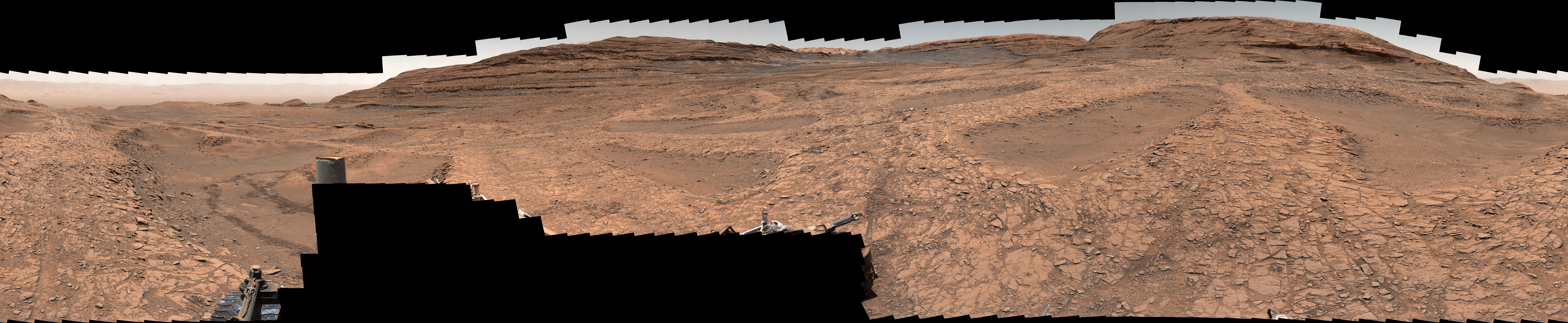
A grayscale photo from the Martian surface shows uneven terrain of mostly flat, fractured rock on the ground ahead of the rover. A small drill hole and its surrounding dust is visible near the center of the image. Parts of the rover are visible at the bottom and left sides of the frame, including part of the rover arm and its joint along the left side of the image.
NASA’s Mars rover Curiosity acquired this image of the “Nevado Sajama” drill hole, using its Left Navigation Camera on Nov. 13, 2025 — Sol 4718, or Martian day 4,718 of the Mars Science Laboratory mission — at 19:46:43 UTC.
NASA/JPL-Caltech

Written by Michelle Minitti, MAHLI Deputy Principal Investigator at Framework

Earth planning date: Friday, Nov. 14, 2025

From Curiosity’s ridge-top perch among the boxwork unit, the highlight of the week was the successful drilling of the “Nevado Sajama” target. The data collected by APXS, ChemCam, and MAHLI from the rover workspace and its immediate vicinity gave the team confidence to proceed with sampling. APXS and ChemCam data from two targets cleared by the DRT — Nevado Sajama (before it was drilled) and “Tesoro del Pangal” — demonstrated that the chemistry of the workspace was in family with the many ridge-top targets analyzed during the boxwork unit campaign. MAHLI imaging revealed the presence of fine veins in both targets, and also confirmed the structural soundness of the drill target after the rover engineers tested the strength of Nevado Sajama by pressing down on it with the drill tip. The types of veins observed by MAHLI were investigated by ChemCam on broken bedrock faces that exposed both bright white and gray materials. These targets, “Arenas Blancas,” “Camarones,” and “Exaltación,” will provide more insight into the fluids that penetrated the boxwork ridges, perhaps contributing to their erosion resistance. DAN collected data for long stretches across the sols over which all these activities occurred, gaining data on the hydrogen (and by extrapolation, water) content of the ridge. Mastcam began and will continue to build a large mosaic of our location which will include both Nevado Sajama and the drill target “Valle de la Luna” within an adjacent hollow. 

The rover payload was not only focused on studying the ridge and drill target, but also added to the systematic environmental dataset Curiosity has built over the last 13 years. REMS and RAD regularly recorded Martian and space weather, respectively, throughout the week. Mastcam and Navcam measured dust loading in the atmosphere, and looked for clouds and dust devils while ChemCam and APXS took turns measuring different chemical components in the atmosphere. 

The drill activity itself completed on Sol 4718. This weekend, the first portions of the drilled material will be delivered to and analyzed by CheMin. The whole team is anxiously awaiting the CheMin results in order to compare them to the Valle de la Luna mineralogy derived from the hollow below us. We hope their comparison will provide us with new insights into how the boxwork unit came to be. 

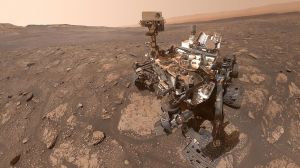
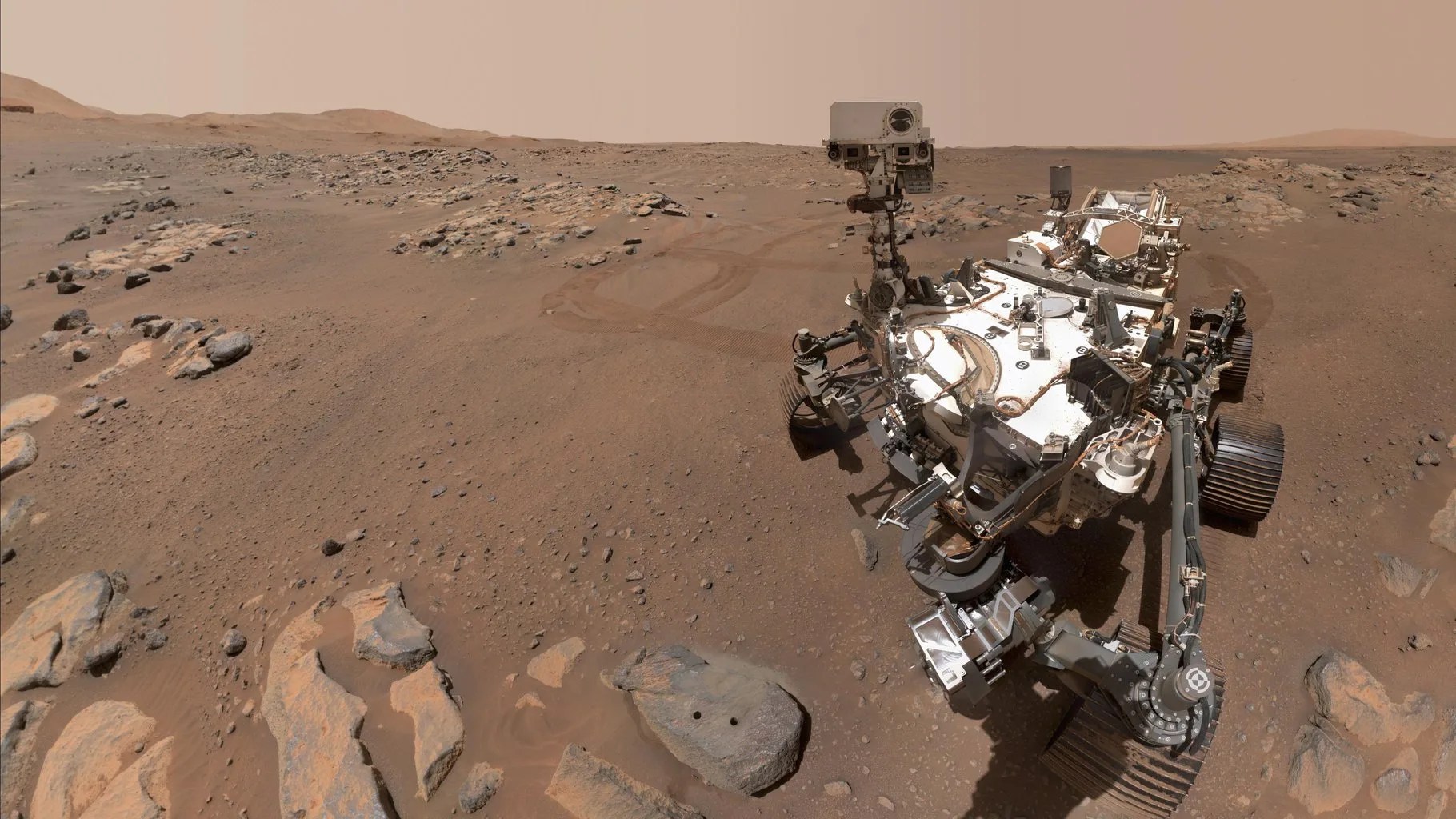
A rover sits on the hilly, orange Martian surface beneath a flat grey sky, surrounded by chunks of rock.
NASA’s Mars rover Curiosity at the base of Mount Sharp
NASA/JPL-Caltech/MSSS

Share

Details

Last Updated
Nov 18, 2025

Related Terms

Powered by WPeMatico

Get The Details…

Curiosity Blog, Sols 4709-4715: Drilling High and Low in the Boxwork Unit

Curiosity Blog, Sols 4709-4715: Drilling High and Low in the Boxwork Unit

3 min read

Curiosity Blog, Sols 4709-4715: Drilling High and Low in the Boxwork Unit

A grayscale photo from the Martian surface shows a landscape with light gray and uneven terrain composed of layered, chipped rock that looks like a dried-out mud flat. At the upper right-center of the frame is a large depression in the ground, holding what looks like dark, smooth sand.
NASA’s Mars rover Curiosity acquired this image of the “Nevado Sajama” drill site workspace, which is on the patch of more coherent ridge bedrock in front of the hollow, towards the right-hand side of the image. Curiosity used its Left Navigation Camera on Nov. 4, 2025 — Sol 4709, or Martian day 4,709 of the Mars Science Laboratory mission — at 15:10:44 UTC.
NASA/JPL-Caltech

Written by Catherine O’Connell-Cooper, APXS Strategic Planner and Payload Uplink/Downlink Lead, University of New Brunswick, Canada

Earth planning date: Friday, Nov. 7, 2025

We are in the most intensive phase of the boxwork structures investigation — the drill campaign. The boxwork campaign group requested a pair of drilled targets — one in a hollow (the topographic low) and one on an adjacent ridge, surrounding the hollow.

As we noted in a previous blog, finding a drill target in the hollows proved to be tricky, as the hollow floors are often covered by sand and pebbles, with minimal bedrock exposed. But over the past two weeks, we successfully drilled the bedrock target “Valle de la Luna” in a large hollow called “Monte Grande.” We finished up at Valle de la Luna on Monday and moved quickly up onto the ridge to get our second target, about 10 meters away (about 33 feet).

We wanted to name our targets to reflect the difference in location — from the topographic low to the (relatively speaking) high point on the nearby ridge. Our hollow target, Valle de la Luna, was named after an area of valleys in the Atacama Desert, in Chile. This area is one of the driest on Earth, with a unique environment and an incredible sculpted landscape with geological formations that would not look out of place in Gale crater.

Although there is a mere 2-meter difference in elevation (about 6½ feet) between the hollow floor and the ridge top, we decided to name our ridge target “Nevado Sajama,” which is an extinct volcano and the highest peak in Bolivia. Go big or go home!

Wednesday’s plan centered around our “Drill Sol Zero” activities. We use this day to finesse our position for drilling with a small drive (we refer to this kind of positioning drive as a “bump” as it is usually less than a couple of meters, which is less than 6 feet) to the most suitable potential drill target. On Wednesday, we bumped our way forward very slightly on the workspace, and this morning (Friday) the best potential target for drilling was in the perfect location. Today we do our Drill Sol 1 activities, which focus on triaging the Nevado Sajama bedrock block for drilling (the center of this Mastcam image; the lower block in this Navcam image). The Rover Planners (RPs) will test the coherency of the rock, to assess how it will hold up under the pressure of drilling. APXS and ChemCam will analyze the brushed bedrock in the intended drill area. We can compare this to targets from the very nearby Wednesday workspace (“Volcan Isluga” for APXS and “Luna Muerte” for ChemCam), so we can determine how homogenous or heterogenous this area is. MAHLI will image the bedrock here too, and again compare to targets from the Wednesday workspace (Volcan Isluga and the MAHLI-only target “Sipe Sipe,” which was an area of freshly broken rock, broken as we drove over it).

The drill campaign for the boxwork area has been two years in the planning. Over those years, the boxwork campaign focus group (including me) have had regular meetings and presentations and brainstorming sessions. It is so rewarding to finally be here, in the middle of this active drill campaign.

A rover sits on the hilly, orange Martian surface beneath a flat grey sky, surrounded by chunks of rock.
NASA’s Mars rover Curiosity at the base of Mount Sharp
NASA/JPL-Caltech/MSSS

Share

Details

Last Updated
Nov 18, 2025

Related Terms

Powered by WPeMatico

Get The Details…

NASA Telescopes View Spiral Galaxy

NASA Telescopes View Spiral Galaxy

A gold and blue spiral galaxy swirls in the darkness of space. There is a bright spot of light at its center.
Image credit: X-ray: NASA/CXC/SAO; Optical/IR: NASA/ESA/CSA/STScI (HST and JWST); Radio: NSF/NRAO/VLA; Image Processing: NASA/CXC/SAO/J. Schmidt and N. Wolk

NGC 1068, a relatively nearby spiral galaxy, appears in this image released on July 23, 2025. The galaxy contains a black hole at its center that is twice as massive as the Milky Way’s. NASA’s Chandra X-ray Observatory data shows a million-mile-per-hour wind is being driven from NGC 1068’s black hole and lighting up the center of the galaxy in X-rays.

The image contains X-rays from Chandra (blue), radio data from the U.S. National Science Foundation’s Karl G. Jansky Very Large Array (pink), and optical data from NASA’s Hubble Space Telescope and NASA’s James Webb Space Telescope (yellow, grey and gold).

Image credit: X-ray: NASA/CXC/SAO; Optical/IR: NASA/ESA/CSA/STScI (HST and JWST); Radio: NSF/NRAO/VLA; Image Processing: NASA/CXC/SAO/J. Schmidt and N. Wolk

Powered by WPeMatico

Get The Details…
Monika Luabeya

Guiding Artemis: Brian Alpert Turns Lessons Learned Into Lunar Progress

Guiding Artemis: Brian Alpert Turns Lessons Learned Into Lunar Progress

Brian Alpert’s path was always destined for the aerospace industry, but his journey turned toward NASA’s Johnson Space Center during his sophomore year in college. That was when Tricia Mack, who works in NASA’s Transportation Integration Office within the International Space Station Program, spoke to his aerospace seminar about planning spacewalks, training crews, and supporting operations from the Mission Control Center in Houston.

Alpert was inspired to join the agency and later earned a spot as an engineering co-op student at Johnson. “My first stop after new employee orientation was Tricia’s office,” he said.

A man wearing a headset sits at a computer console in the Mission Control Center at Johnson Space Center.
Brian Alpert supports a spacewalk outside of the International Space Station from the Mission Control Center at Johnson Space Center in 2015.
NASA/Bill Stafford

Eighteen years later, Alpert is the cross-program integration deputy for NASA’s human landing system (HLS) – the mode of transportation that will take astronauts to the lunar surface as part of the Artemis campaign. In his role, Alpert is responsible for coordinating with other Artemis programs, like the Orion Program, on issue resolution, joint agreements, data exchanges, hardware integration, and reviews. He also co-leads the Exploration Atmospheres Issue Resolution Team, assessing risks to and impacts on space vehicle atmosphere, spacesuit pressure, and operational timelines for Artemis missions.

Alpert has enjoyed the opportunity to participate in several proposal reviews for Artemis program contracts as well. “NASA’s model of embracing public-private partnerships to achieve its strategic goals and objectives is exciting and will continue to expand opportunities in space,” he said.

He applies lessons learned and skills gained from his previous roles as a spacewalk crew instructor, flight controller, and systems engineer to his current work on HLS. “I hope to pass on to the next generation that skills and lessons you learn as a student or a young employee can and will help you in your future work,” he said.

Underwater image of a man wearing scuba gear, smiling at the camera, with a mockup of the International Space Station in the background.
Brian Alpert routes cables in the Johnson Space Center’s Neutral Buoyancy Laboratory in preparation for a crew training run in 2011.
Image courtesy of Brian Alpert

Alpert’s prior NASA roles involved memorable experiences like working to address spacesuit and vehicle failures that occurred during a spacewalk on International Space Station Expedition 32. He was serving as the lead spacewalk systems flight controller in the Mission Control Center at the time and played a key role in getting NASA astronaut Suni Williams and JAXA (Japan Aerospace Exploration Agency) astronaut Aki Hoshide safely back aboard the space station. Since Williams and Hoshide did not complete the spacewalk’s primary objective – replacing a Main Bus Switching Unit – a backup spacewalk was scheduled several days later. Alpert was on console for that spacewalk, too.

“One important lesson that I have learned through my career to date is how exceptionally talented, passionate, and hard-working everyone is here at NASA,” he said. “Whenever work gets stressful or problems get hard, there are teams of people that have your back, are willing to problem-solve with you, and can bring another perspective to finding a solution that you may not have considered.” He added that his colleagues are the best part of his job. “As much as I love what we do at NASA, what really gets me excited to come to work is all the outstanding people I get to work with every day.”

A man wears a full spacesuit underwater while conducting a test dive at NASA's Neutral Buoyancy Laboratory.
Brian Alpert completes a dive in NASA Johnson Space Center’s Neutral Buoyancy Laboratory for a spacesuit familiarization exercise in 2009.
Image courtesy of Brian Alpert

Learning how to navigate change has been an important lesson for Alpert, as well. “NASA has been through a lot of change since I became a full-time employee in 2009,” he said. “Making sure that I have clear goals for myself, my work, and my team helps us all stay focused on the mission and the work at hand and helps us prioritize projects and tasks as questions or challenges inevitably arise.”

One challenge Alpert especially enjoys? Johnson’s annual Chili Cookoff. He has participated in many cookoffs as part of the Cosmic Chili team, noting that he often dons a Wolverine costume as part of the festive fun. He also welcomes a space trivia challenge – and a chance to add to his collection of trivia trophies.

Powered by WPeMatico

Get The Details…
Linda E. Grimm