
Research into Fluid Dynamics, Astronaut Health and Earth Wraps Up Science-Centered Week

Research into Fluid Dynamics, Astronaut Health and Earth Wraps Up Science-Centered Week
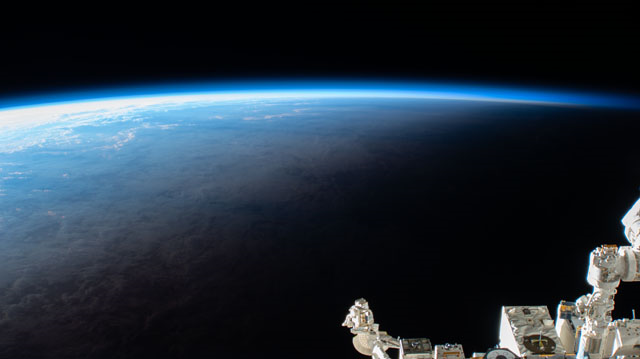
A view of Earth from the International Space Station, taken using an external high-definition camera. Credits: NASA

Aboard the International Space Station, a flurry of research activity is underway before the Expedition 63 crew winds down to the weekend, along with essential maintenance tasks to ensure the longevity of the orbiting laboratory.

Commander Chris Cassidy crossed off a few housekeeping items, like replacing the carbon dioxide sensor for the Cell Biology Experiment Facility and stowing Rodent Research hardware for return on a future SpaceX mission, in addition to completing additional tests runs and closeout activities in support of the Fluidics experiment. Future spacecraft and their fuel systems will get a boost from this investigation, which uses the measurement of liquid displacement within a sphere to gather observations in how fluids behave inside a fuel tank.

Cassidy also spent time working with the Advanced Plant Habitat mounted in the station’s EXPRESS rack to gather sound-level measurements. The habitat itself provides a large and enclosed chamber with stringent environmental controls, designed to give commercial and other bioscience research suitable conditions in which to grow despite the hostile environment to the station’s exterior: space.

Flight Engineers Anatoly Ivanishin and Ivan Vagner, cosmonauts from the Russian space agency Roscosmos, worked together to complete life-support hardware maintenance tasks such as inspecting and inventorying the gear. Ivanishin continued the routine chores, cleaning out the ventilation system within the Zvezda service module and also doing a check of Russian video-recording equipment.

After setting up an electrocardiogram for a 24-hour survey of his own heart health, Vagner terminated the test. In addition to investigating the effects of long-duration space travel on astronauts, he continued with setup and observation of our own planet using Earth photography. While the universe remain the ultimate unknown, there are still phenomena on Earth that scientists do not fully understand. For those particular mysteries, observations from station could prove eminently useful.

Learn more about station activities by following the space station blog, @space_station and @ISS_Research on Twitter, as well as the ISS Facebook and ISS Instagram accounts.

Get The Details…

Catherine Williams

Powered by WPeMatico
NASA Astronaut Kate Rubins Available for Interviews Before Her Return to Space

NASA Astronaut Kate Rubins Available for Interviews Before Her Return to Space

NASA astronaut and biologist Kate Rubins is participating on Friday, Sept. 25, in a final round of media interviews before her October launch to the International Space Station, the second space mission of her NASA career.

Get The Details…

Powered by WPeMatico

Hubble Stows a Pocketful of Stars

Hubble Stows a Pocketful of Stars

Globular cluster NGC 1805, a tight grouping of thousands of stars is, located near the edge of the Large Magellanic Cloud, a satellite galaxy of our own Milky Way. In the dense center of one of these clusters, stars are 100 to 1,000 times closer together than the nearest stars are to our Sun.

Get The Details…

Powered by WPeMatico

NASA, NOAA to Discuss Solar Cycle Prediction During Media Teleconference

NASA, NOAA to Discuss Solar Cycle Prediction During Media Teleconference

NASA and the National Oceanic and Atmospheric Administration (NOAA) will discuss predictions for the upcoming solar cycle during a media teleconference at 1 p.m. EDT Tuesday, Sept. 15. Tracking the solar cycle is a key part of better understanding the Sun and mitigating its impacts on human technology and infrastructure.

Get The Details…

Powered by WPeMatico

Space Station Upkeep a Priority as Astrobee Sweeps the Interior

Space Station Upkeep a Priority as Astrobee Sweeps the Interior

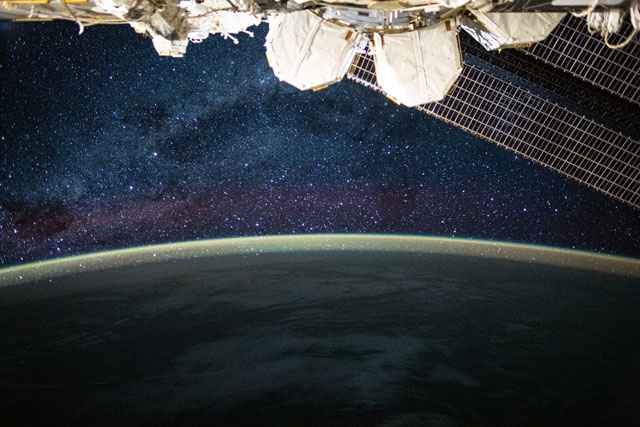
This long-exposure photograph from the International Space Station was taken during an orbital night period and reveals the Milky Way glittering above a bright but exaggerated atmospheric glow that blankets the Earth's horizon. Credits: NASA
This long-exposure photograph from the International Space Station was taken during an orbital night period and reveals the Milky Way glittering above a bright but exaggerated atmospheric glow that blankets the Earth’s horizon. Credits: NASA

As a free-flying, cube-shaped robot dubbed Astrobee zipped through the International Space Station today, the Expedition 63 trio aboard was occupied with upkeep and experiment maintenance tasks.

Astrobee is autonomous, and therefore no additional burden to the busy schedule of Commander Chris Cassidy of NASA and Russian cosmonauts Anatoly Ivanishin and Ivan Vagner. Masterminded to assist the spare-faring crew with routine chores and give controllers on the ground an easy way to survey the station’s interior, the robot is currently flying about to capture additional video and imagery for later study.

Cassidy spent significant time in the Columbus laboratory module installing Fluidics hardware and setting it up for test runs. The experiment itself consists of three small transparent spheres with a centrifuge to move the liquids within. Data compiled from the investigation will one day improve applications in space, optimizing fuel systems, as well as on Earth, providing insight into how oceans work and the phenomenon of “rogue waves.” In addition, Cassidy replaced components in the Waste and Hygiene Compartment and performed life-support maintenance.

Vagner, meanwhile, helped with the life-support maintenance and serviced the Russian oxygen generator. With Ivanishin accompanying, they tackled cleaning air vents and dust filters to ensure the smooth running of the orbiting outpost. Smoke detectors within the Zarya module were also changed out during the housekeeping work.

The Russian crewmates contributed to the space station’s legacy as a microgravity testbed by furthering research objectives, with Ivanishin monitoring and identifying catastrophic events through the aid of Earth photography. Vagner added to the heart health study his counterpart had completed earlier in the week by setting up his own wearable monitor for a 24-hour electrocardiogram evaluation.

At 4:32 p.m. EDT, a planned reboost will put the orbiting laboratory in the proper positioning for the anticipated Soyuz launch of Expedition 64 on Oct. 14, followed by the landing of the current crew on Oct. 21.

Learn more about station activities by following the space station blog, @space_station and @ISS_Research on Twitter, as well as the ISS Facebook and ISS Instagram accounts.

Get The Details…

Catherine Williams

Powered by WPeMatico