


March 18, 1978: Space Shuttle Enterprise Arrives for Vibration Testing
On March 18, 1978, space shuttle Enterprise arrived at NASA’s Marshall Space Flight Center for mated vertical ground vibration testing.
Powered by WPeMatico
On March 18, 1978, space shuttle Enterprise arrived at NASA’s Marshall Space Flight Center for mated vertical ground vibration testing.
Powered by WPeMatico
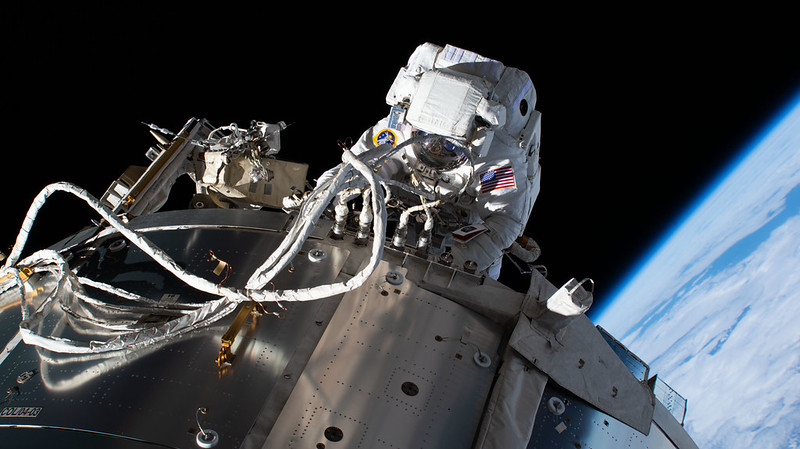
The crew of Expedition 64 took time to catch up on maintenance tasks for the International Space Station during a week bookended by some major activities: a spacewalk including NASA astronauts Victor Glover and Michael Hopkins the previous Saturday and a Soyuz relocation maneuver coming up on Friday.
NASA astronaut Shannon Walker worked with Astrobee, a technology demonstration starring small, free-flying cube-shaped robots, for the Astrobatics investigation. Like the name implies, the handy robots demonstrate what kind of acrobatics they are capable of performing using robotic manipulators to execute “hopping,” or self-toss maneuvers, as a means of propulsion. The increasingly complex moves attempted within the safe confines of the orbiting laboratory show what future robotic explorers may be capable of doing not only for advanced human space exploration missions, but as mechanical assistants to the astronauts.
In the Russian segment, Commander Sergey Ryzhikov tested space station circuitry while Flight Engineer Sergey Kud-Sverchkov conducted an eye examination — part of an ongoing effort track changes that occur to the shape of the crew members’ eyes during and after extended stays in microgravity.
Hopkins, along with crewmate Kate Rubins, performed additional upkeep for the spacesuits used during the latest excursion outside the station — this the fifth spacewalk of 2021. The pair stowed spacewalking tools and took care to scrub and disinfect the tubing that moves water throughout the suits.
Another duo hard at work aboard the orbiting outpost — Glover and Soichi Noguchi of JAXA (Japan Aerospace Exploration Agency) — performed maintenance to the Water Recovery System-1 Rack to regain functionality of its water-processing capability, also switching out a smoke detector in the midst of their efforts. The pair later returned the T2 treadmill to its normal configuration.
Learn more about station activities by following the space station blog, @space_station and @ISS_Research on Twitter as well as the ISS Facebook and ISS Instagram accounts.
Catherine Williams
Powered by WPeMatico
NASA will hold a virtual media briefing at 1:30 p.m. EDT (10:30 a.m. PDT) Tuesday, March 23, to discuss upcoming activities for the agency’s Ingenuity Mars helicopter.
Powered by WPeMatico
An illustration of NASA’s Ingenuity Helicopter flying on Mars.
Powered by WPeMatico

In between ongoing investigations to further our understanding of how spaceflight impacts the human body, the Expedition 64 crew devoted time to brushing up on procedures to relocate the Soyuz MS-17 to another port on the International Space Station — a reconfiguration maneuver that hasn’t been done since August 2019.
Commander Sergey Ryzhikov and Flight Engineer Sergey Kud-Sverchkov, both of Roscosmos, as well as NASA astronaut Kate Rubins, reviewed the timeline and operations plan to accomplish the port relocation, which will free up the Rassvet port for the docking of Soyuz MS-18. That vehicle will carry three Expedition 65 crew members to the orbiting laboratory after launch April 9 from the Baikonur Cosmodrome in Kazakhstan: NASA’s Mark Vande Hei and Roscosmos’ Oleg Novitsky and Pyotr Dubrov. Live coverage of the Soyuz flight around the space station may be seen beginning at 12:15 p.m. EDT Friday, March 19, on NASA Television, the NASA app, and the agency’s website.
Later, Rubins joined fellow NASA astronaut Victor Glover in the Kibo laboratory module to field questions from students during a Senate Youth Forum event involving multiple members of Congress, allowing participants a glimpse of some of the cutting-edge research being performed around the clock in space.
Glover also teamed up with crewmates Michael Hopkins and Shannon Walker to work with Myotones, a study that observes how long-term exposure to a spaceflight environment influences the biochemical properties of muscles — qualities like muscle tone, stiffness, and elasticity.
Soichi Noguchi of JAXA (Japan Aerospace Exploration Agency), meanwhile, worked to unfreeze samples as part of the Ribosome Profiling investigation. This experiment uses a state-of-the-art technique to decode gravity’s role in gene expression, and will one day help scientists understand how space impacts age-related changes in astronauts.
Learn more about station activities by following the space station blog, @space_station and @ISS_Research on Twitter as well as the ISS Facebook and ISS Instagram accounts.
Catherine Williams
Powered by WPeMatico
