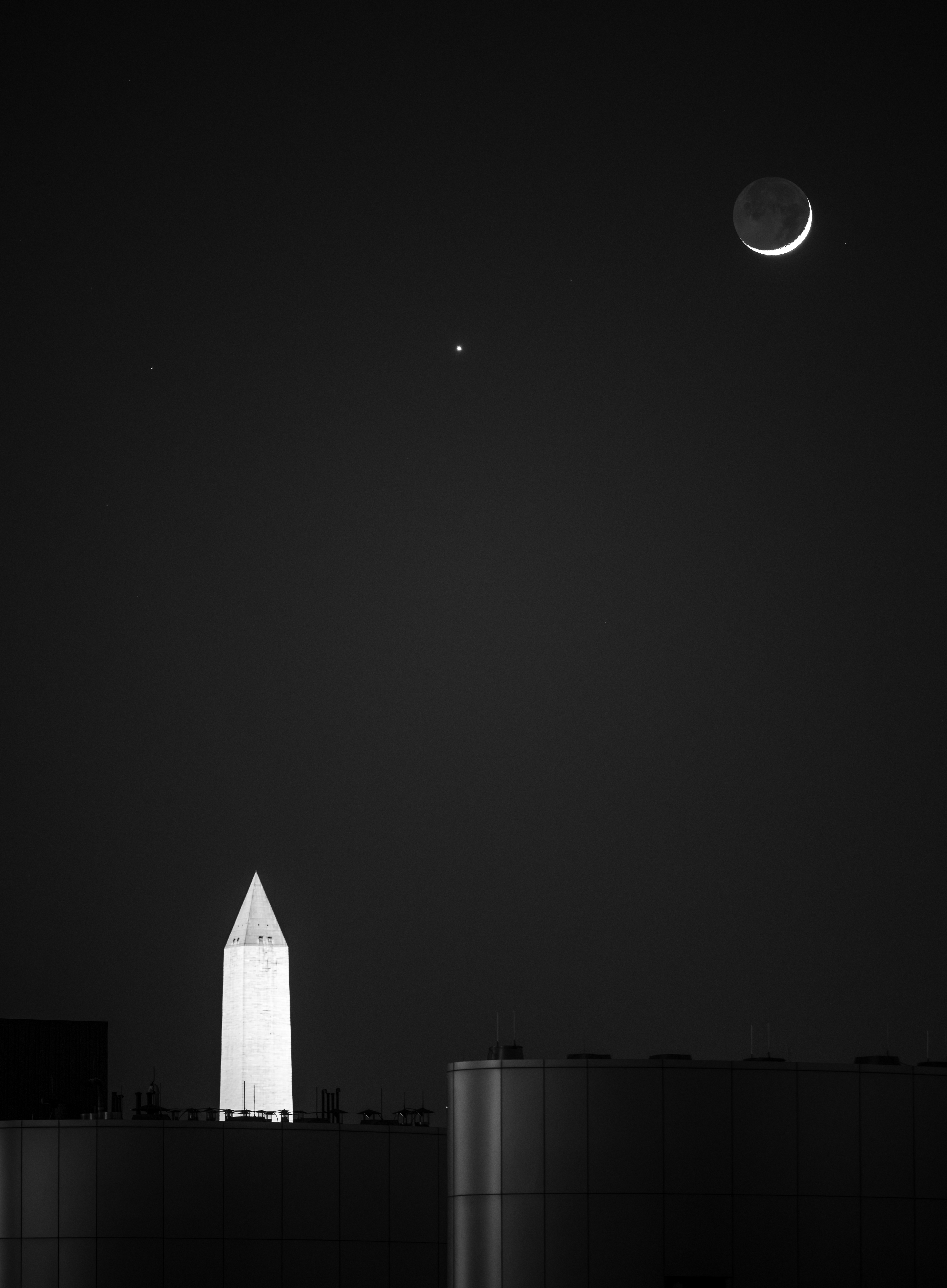
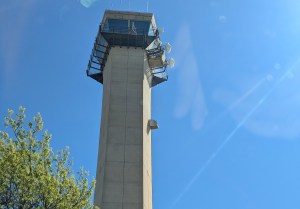
The Moon and Venus, center, are seen in conjunction above the Washington Monument, Monday, May 18, 2026, as viewed from the Mary W. Jackson NASA Headquarters Building in Washington.
NASA/Bill Ingalls
The Moon and Venus, center, are seen in conjunction above the Washington Monument, Monday, May 18, 2026, as viewed from the Mary W. Jackson NASA Headquarters Building in Washington.
The Moon and Venus look close together because they line up from our point of view on Earth. In reality, they are separated by millions of miles in space.
Johnson’s Cindy Evans Prepares Artemis Teams for Lunar Science
4 Min Read
Johnson’s Cindy Evans Prepares Artemis Teams for Lunar Science
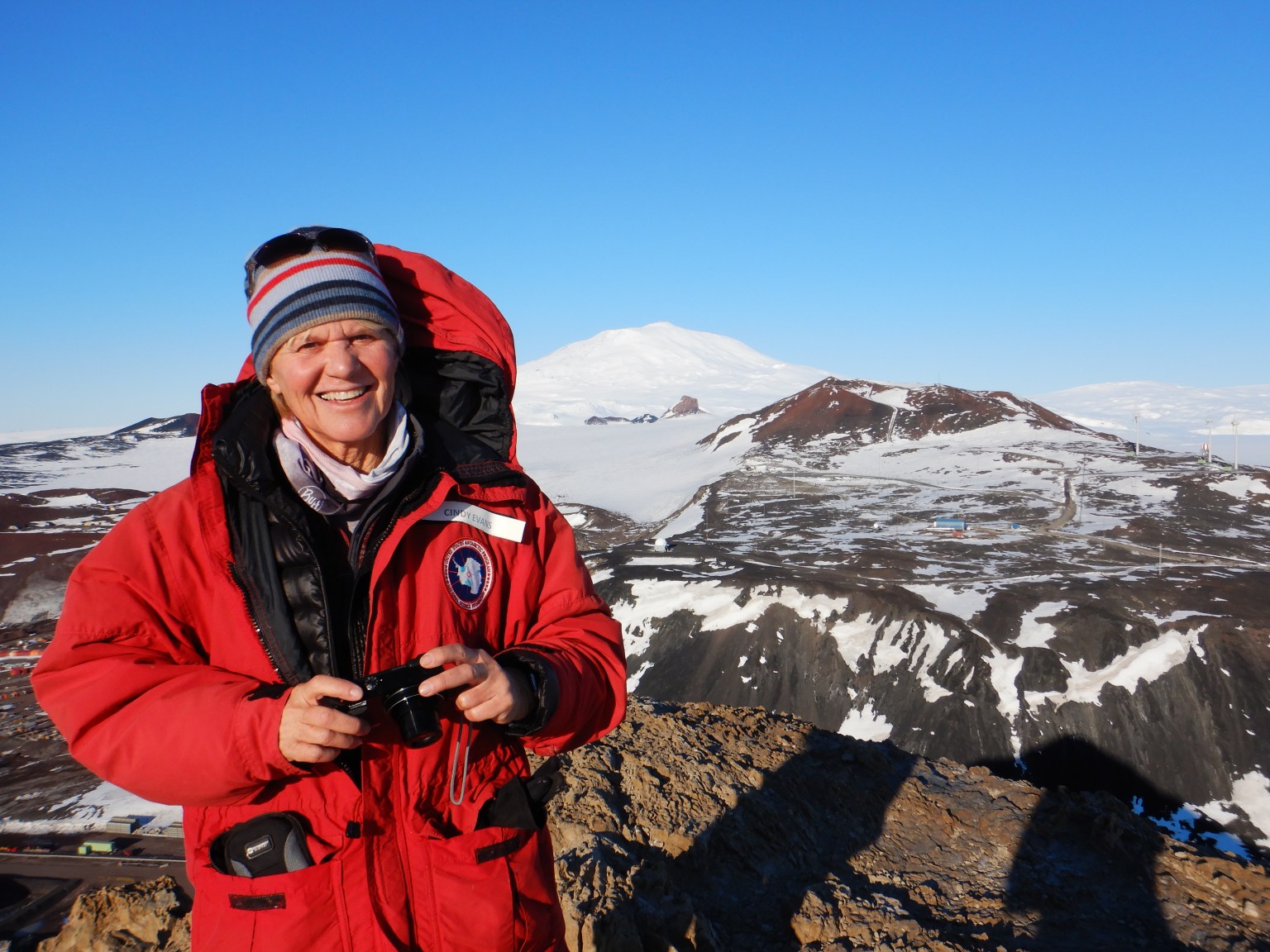
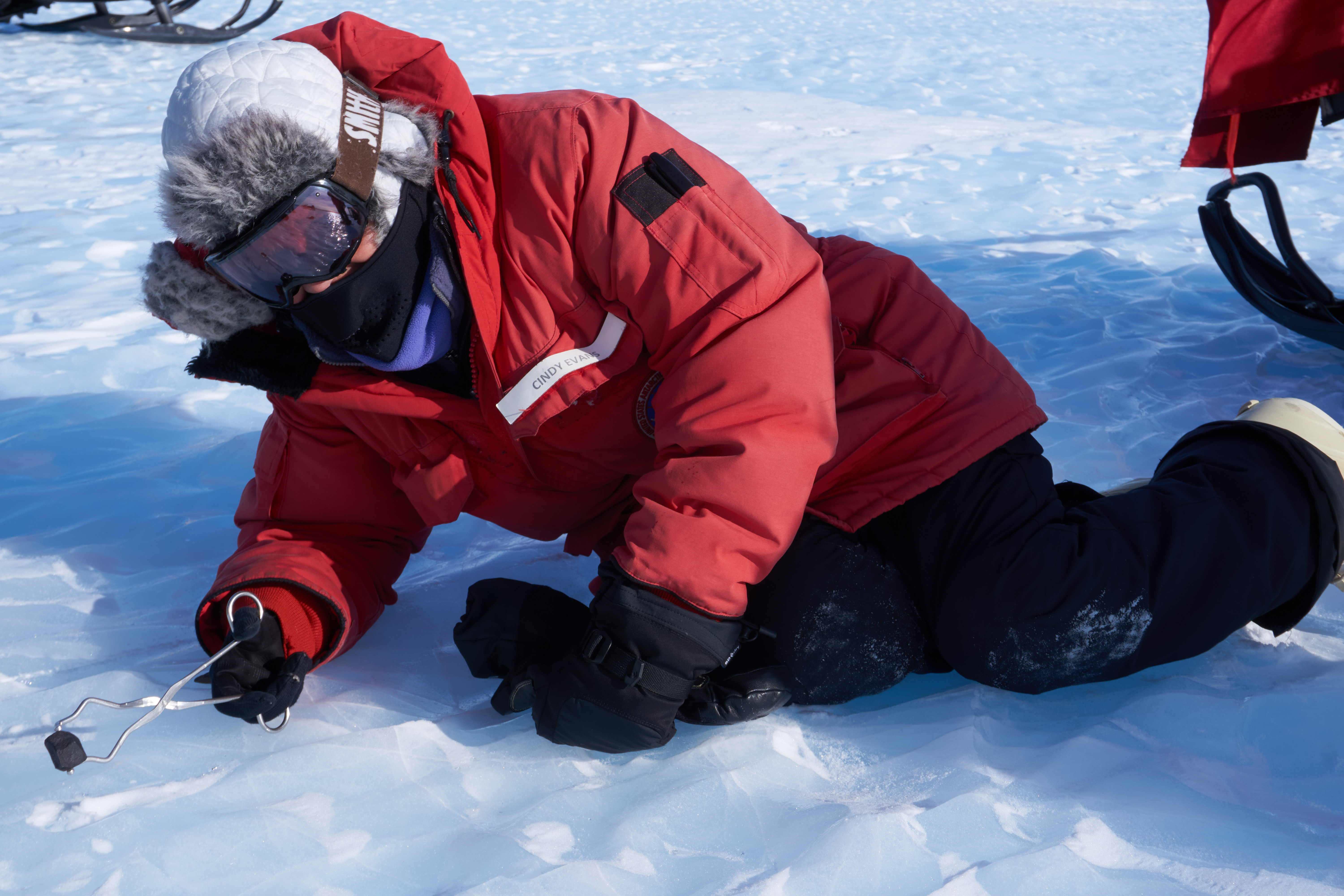
Cindy Evans, Artemis exploration scientist and geology training lead at NASA’s Johnson Space Center in Houston, preparing for a deep-field deployment to collect meteorites in Antarctica.
Credits: Cindy Evans
NASA’s Artemis II crew had many technical and operational responsibilities during their historic mission to the Moon, but they also served an important role as scientific ambassadors to Earth’s nearest neighbor.
On their 10-day journey, the crew flew by the far side of the Moon, analyzing and photographing geologic features such as impact craters and ancient lava flows. Their observations will help pave the way for science activities on future Artemis missions to the Moon’s surface and contribute to lunar and planetary science. The crew relied on the extensive geology training they received on Earth to describe nuances in shapes, textures, and colors — the type of information that reveals the geologic history of an area.
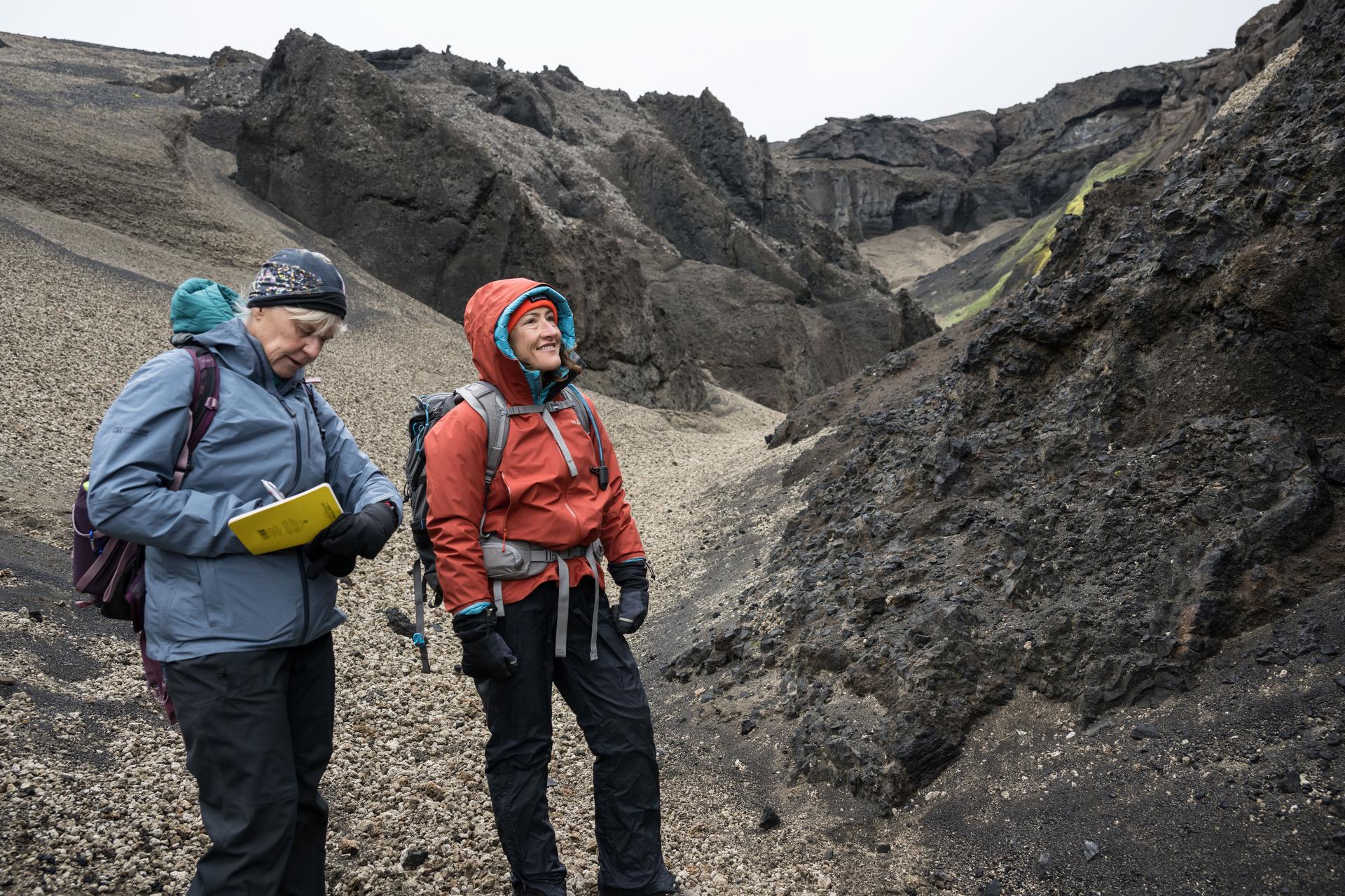
Artemis geology training lead at NASA’s Johnson Space Center in Houston, Cindy Evans (left) and NASA astronaut and Artemis II mission specialist Christina Koch study geologic features in Iceland during Artemis II crew geology training in August 2024.
NASA/Robert Markowitz
Cindy Evans, Artemis exploration scientist and geology training lead, was one of the crew’s instructors. Based at NASA’s Johnson Space Center in Houston in the Astromaterials Research and Exploration Science (ARES) Division, Evans is part of the Artemis Internal Science Team and spearheads geology training for crew members, mission managers, engineers, and flight controllers. That effort centers around a core curriculum of geology, lunar, and planetary classroom science as well as a progression of geology-focused field classes.
“As the scientists ‘on the ground,’ Artemis crew members require geology and field skills so that they can execute the mission science requirements from lunar orbit and on the surface of the Moon,” Evans explained. “Whether they’re looking out the spacecraft’s windows or walking the surface, Artemis astronauts are working on behalf of all scientists to collect clues to the ancient geologic processes that shaped the Moon and our solar system. They need to have the muscle memory and confidence in their geology knowledge to conduct the geology observations, sampling, and other scientific tasks.”
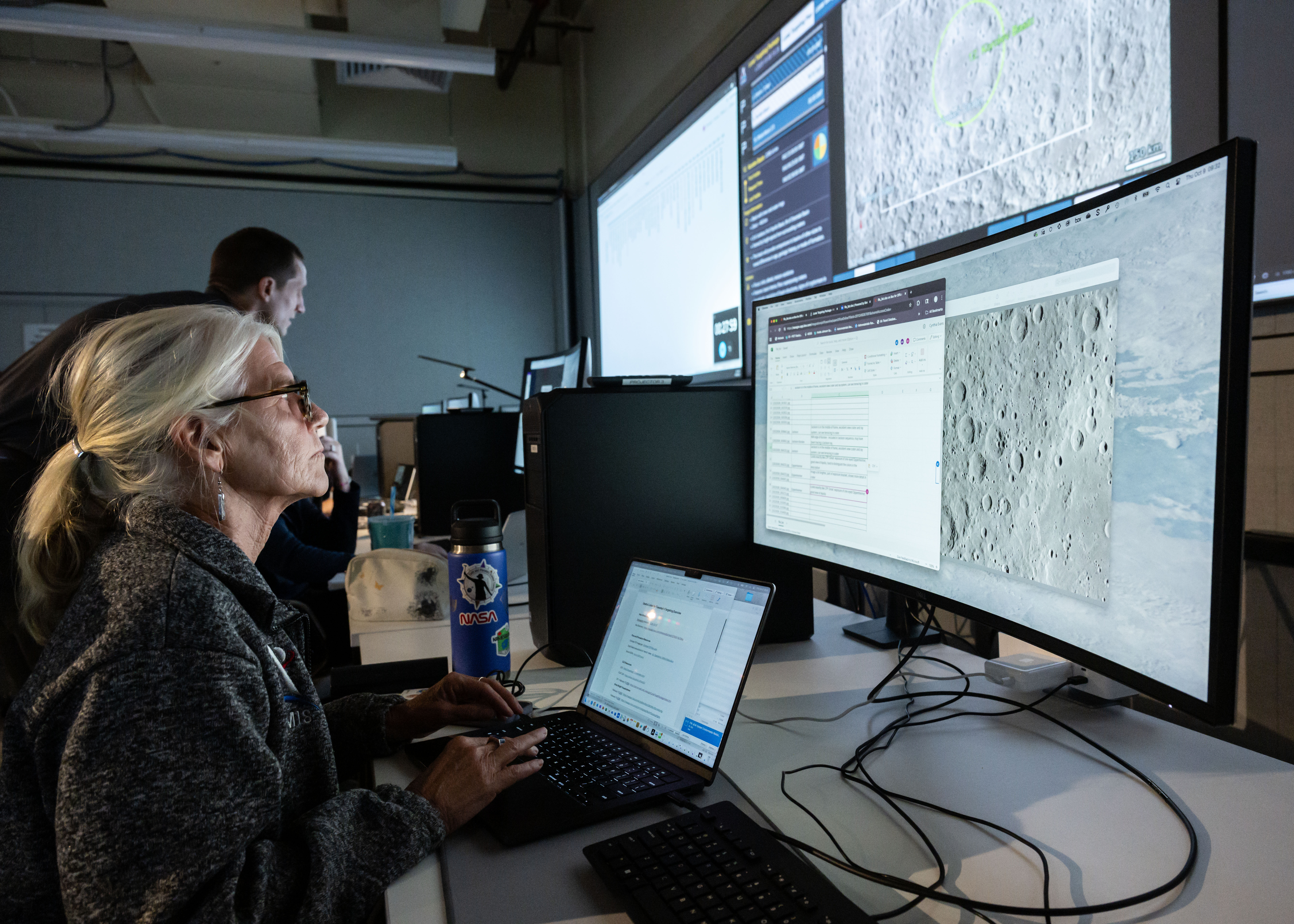
Cindy Evans during an Artemis II Lunar Science Team simulation at Johnson Space Center. The team used simulations to practice mission operations support for real-time assessment of imagery and observations made by the Artemis II crew.
NASA/James Blair
A former oceanographer who studied the rocks comprising oceanic crust, Evans imagined that she would explore the Moon as a NASA astronaut one day. That dream led her to Johnson, even if it did not result in her donning a flight suit.
In her 37 years with the agency, Evans contributed to the Space Shuttle Program, Shuttle-Mir Program, and the International Space Station before transitioning to NASA’s Artemis campaign. Some of her notable achievements include establishing the Crew Earth Observations effort for Shuttle-Mir, which equipped crews to photograph the Earth as it changed below them. As part of the imagery team investigating the Columbia accident, she helped to develop and integrate the space shuttle’s Return to Flight imagery inspection process. “I have been both honored and incredibly fortunate to have participated in a wide variety of human spaceflight programs,” Evans said. “And I am very proud of the work my team is doing right now.”
Evans also had two opportunities to travel to Antarctica to participate in deep-field geology sessions. “Few things in this world are as wonderful as camping on blue ice just a couple hundred miles from Earth’s South Pole and collecting rocks from space,” she said.
Cindy Evans collects a meteorite from the Davis Ward Icefield during a deep-field deployment to Antarctica.
Cindy Evans
Collaborating with professionals across a variety of fields has been an integral part of Evans’ work since the start of her career. “In graduate school I was trained as an oceanographer – an interdisciplinary field where geology meets biology, chemistry, and physical oceanography,” she said. “As a planetary scientist at Johnson, I am challenged to work in a world of engineers, and embrace the complex teamwork between hardware engineers, operations engineers, management – many of whom are engineers – and scientists. It has been an incredible opportunity.”
Those interdisciplinary experiences taught Evans to embrace flexibility. “Human spaceflight is a dynamic endeavor,” she said. “I have enjoyed many different roles, and each and every position taught me new things and stretched my perspective.”
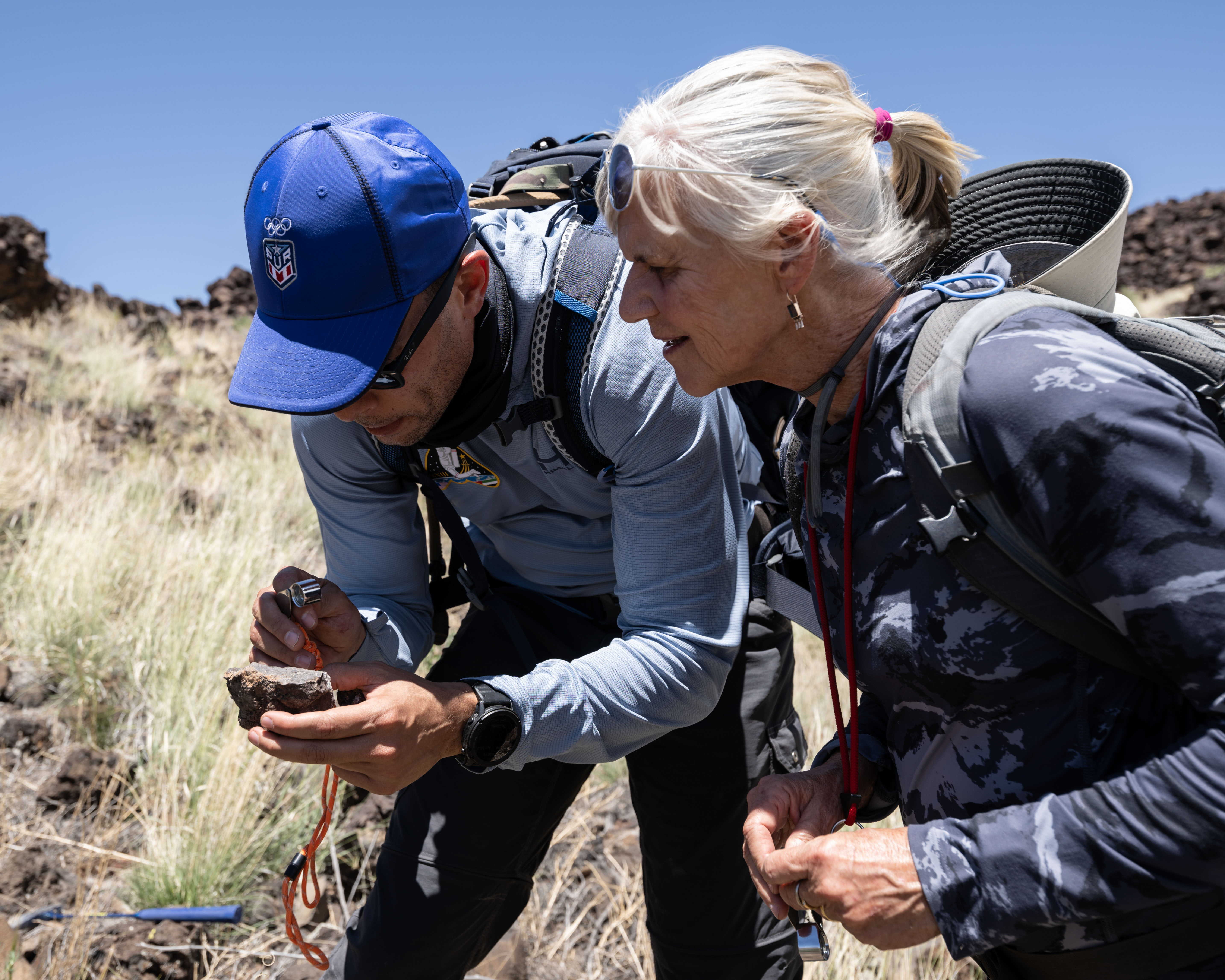
Cindy Evans mentors NASA astronaut Marcos Berríos in observing and describing rock samples during an in-field geology training in Flagstaff, Arizona.
NASA/Riley McClenaghan
Another important lesson? “As a former lab rat, I have learned that it’s all about the people. A common thread throughout my career at NASA is the professional fulfillment brought by relationships with and the talents of colleagues and teammates,” she said.
Evans encourages early-career and aspiring NASA team members to reach out to colleagues in different organizations to build connections. “You never know where a pathway will lead,” she said. “Plans can change – don’t pass up opportunities! Even if an opportunity isn’t an obvious or intuitive next step, it’s worth your consideration.”
NASA’s New Shock Detectives Project Invites Volunteers to Help Study Solar Wind
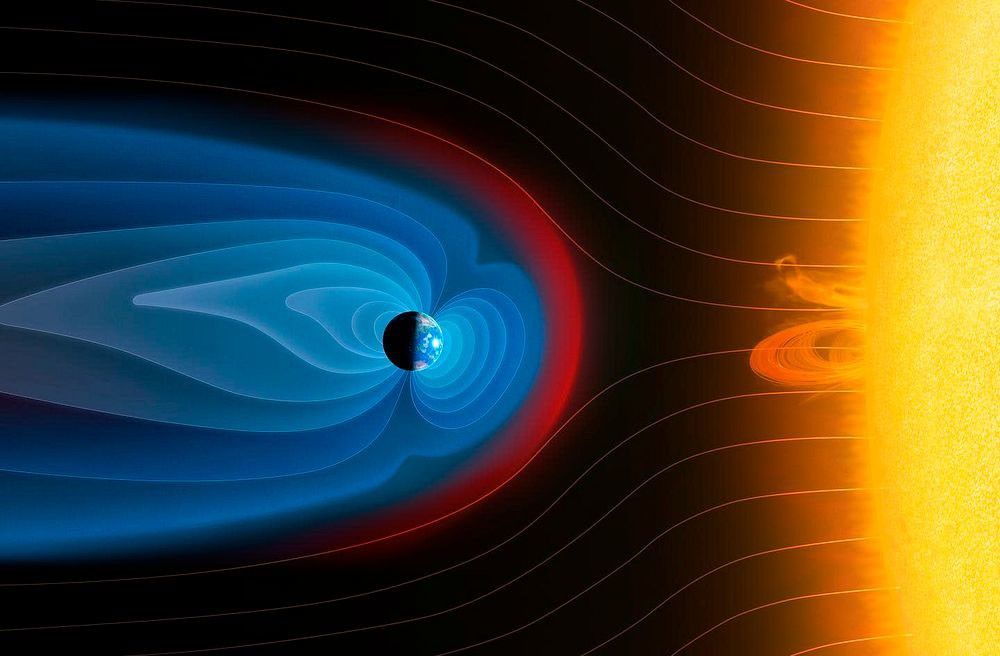
The Sun sprays an extremely fast stream of charged particles called the solar wind. At approximately 56,000 miles (90,000 kilometers) in front of the Earth toward the Sun, the solar wind collides with the Earth’s protective magnetic field, generating a long-lasting shock wave that stretches for hundreds of thousands of miles. Now, you can help scientists examine data about this “bow shock” to better understand how the solar wind affects the Earth by joining a new research project: Shock Detectives.
At this enormous shock wave boundary, the ever-changing magnetic field can either make the solar wind messy and dynamic (“chaotic”) or leave it smooth and stable (“peaceful”).
When “chaotic” plasma dominates, more energy can reach Earth’s magnetosphere, possibly leading to disruptions in GPS signals, communications, and power grids. Scientists don’t yet fully understand when the plasma changes between “peaceful” and “chaotic” states or how those changes affect energy transfer to Earth.
You can help solve this mystery. NASA’s Magnetospheric Multiscale (MMS) mission has collected more than ten years of data from this zone – more than scientists can analyze alone. As Shock Detectives, you’ll help sort the chaotic from peaceful regions of the data, giving researchers a crucial set of clues.
The value of this new knowledge doesn’t end at Earth – what scientists learn about the Earth-Sun bow shock will help them understand how the solar wind of other stars impacts their orbiting planets. Your contributions may help take Shock Detectives ‘out of this world’!
This project is closely connected to another NASA-supported project, Space Umbrella, which also relies on MMS data and imagery. While Space Umbrella focuses on the broad boundary between Earth’s magnetic shield and the surrounding solar wind, Shock Detectives zooms in just outside that boundary on the transition region, which can be upwards of 10 miles (17 kilometers) in thickness, to better understand how plasma behaves near the shock. Together, these efforts build a more complete picture of Earth’s space environment.
The Earth’s magnetosphere (blue) interacts with the solar wind,, creating a shock wave (red), like a sonic boom in space. Join the Shock Detectives project and help scientists study this region and better understand how the solar wind affects our lives
Mark Garlick/Science Photo Library via Getty Images
Editor’s Note: Today’s story is the answer to the May Puzzler.
About 15,000 years ago, southeastern Manitoba sat beneath tens of meters of frigid water. Lake Agassiz—which once encompassed present-day Lake Manitoba, Lake Winnipeg, and Lake of the Woods—covered an area larger than all of the Great Lakes combined. It formed in front of the retreating Laurentide Ice Sheet, which dammed rivers that otherwise might have drained into Hudson Bay, producing an expansive body of water 1,100 kilometers (700 miles) long by 300 kilometers wide that spanned parts of today’s Manitoba, Ontario, Saskatchewan, North Dakota, and Minnesota.
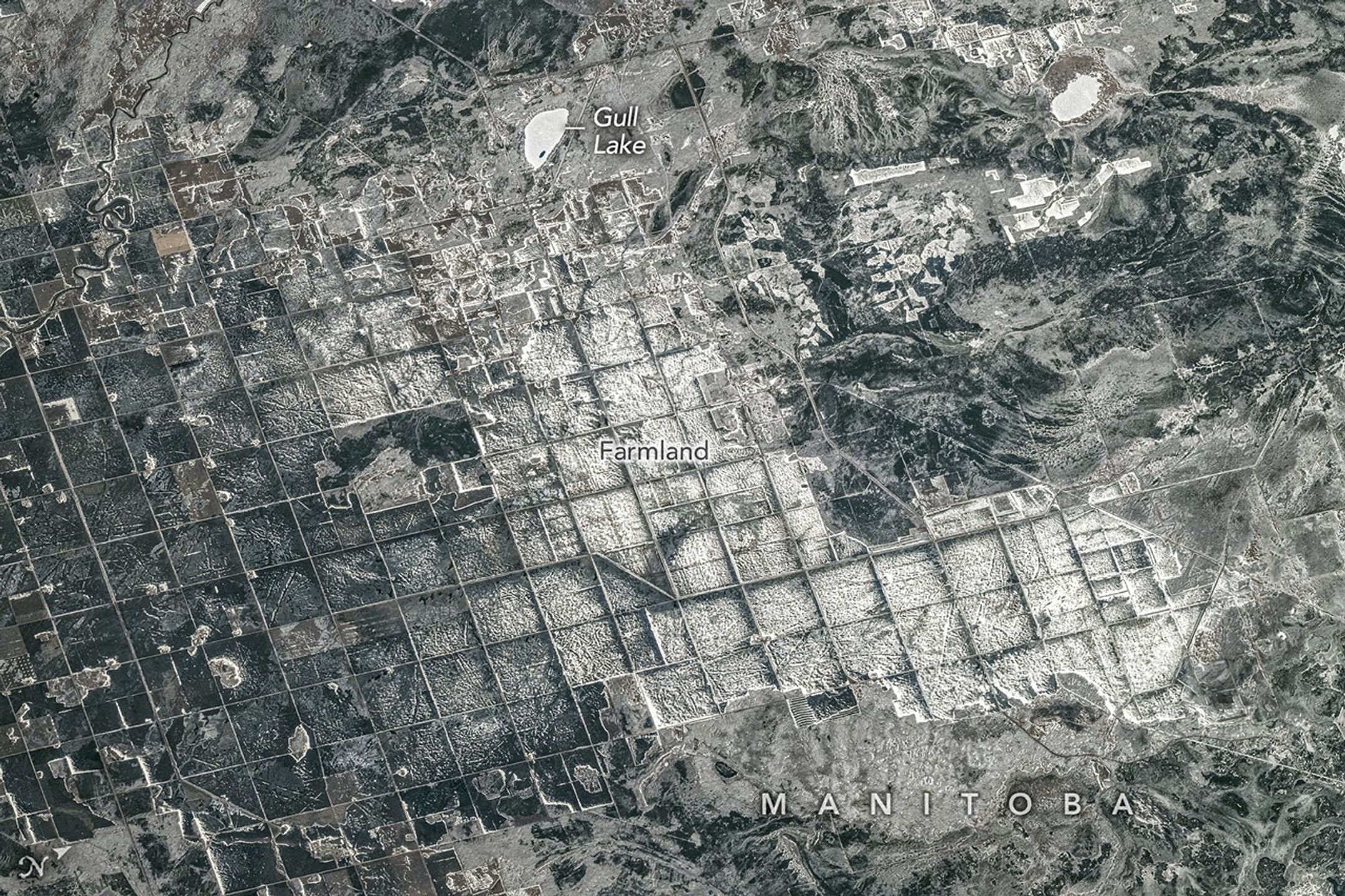
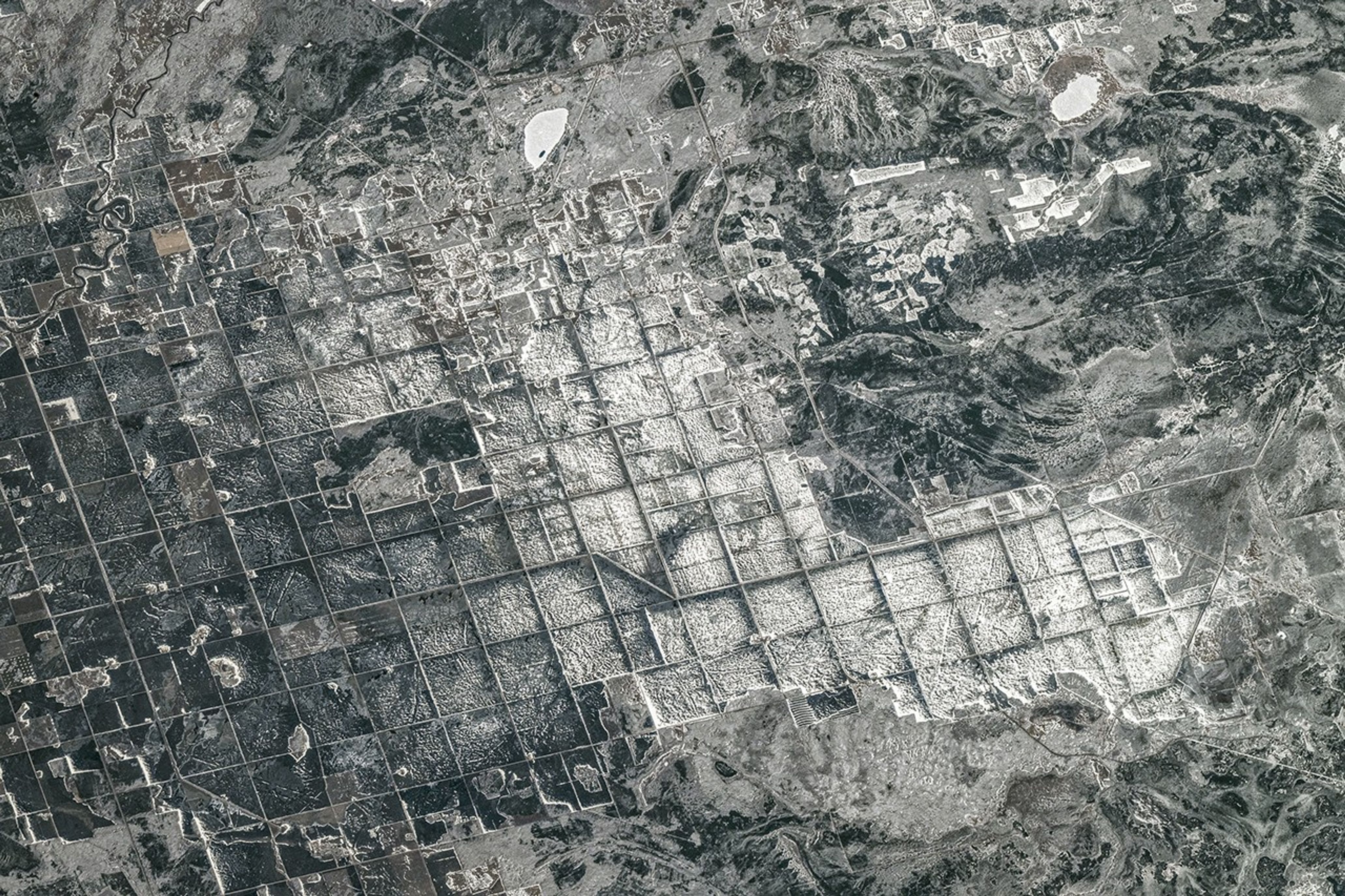
The lake began draining roughly 12,000 years ago, but its legacy remains visible across the region. In April 2026, an astronaut aboard the International Space Station snapped this photograph of farmland along the southern shore of Lake Winnipeg, where Lake Agassiz once deposited a thick, nearly flat bed of nutrient-rich silt and clay. Former lakebed areas like this one now support some of Canada’s most productive agricultural landscapes.
A grid-based land survey has also left its mark. The Dominion Land Survey, one of the world’s largest and most systematic surveying efforts, divided much of western Canada into one-square-mile sections after the Canadian government purchased Rupert’s Land from the Hudson’s Bay Company in 1869. The grid continues to define the layout of farm fields, roads, shelterbelts, and drainage channels.
When the photo was taken late in the afternoon on April 19, a layer of snow and ice covered the landscape. The brightest, whitest blocks appear to be snow-covered farmland or icy ponds, while the darker areas are forests, wetlands, or exposed ground with less uniform snow cover.
Wheat, barley, oats, and canola are among the crops often grown in the area. In the upper part of the image, cottages and lake houses are clustered around Gull Lake, a popular site for boating, fishing, and other water sports. Common fish species found in the lake include northern pike, walleye, and yellow perch.
Astronaut photograph ISS074-E-494130 was acquired on April 19, 2026, with a Nikon Z9 digital camera using a focal length of 560 millimeters. It is provided by the ISS Crew Earth Observations Facility and the Earth Science and Remote Sensing Unit at NASA Johnson Space Center. The image was taken by a member of the Expedition 74 crew. The image has been cropped and enhanced to improve contrast, and lens artifacts have been removed. The International Space Station Program supports the laboratory as part of the ISS National Lab to help astronauts take pictures of Earth that will be of the greatest value to scientists and the public, and to make those images freely available on the Internet. Additional images taken by astronauts and cosmonauts can be viewed at the NASA/JSC Gateway to Astronaut Photography of Earth.Story by Adam Voiland.
Curiosity Blog, Sols 4893-4899: Drilling at Campo Marte and a Visit From the Psyche Spacecraft
3 min read
Curiosity Blog, Sols 4893-4899: Drilling at Campo Marte and a Visit From the Psyche Spacecraft
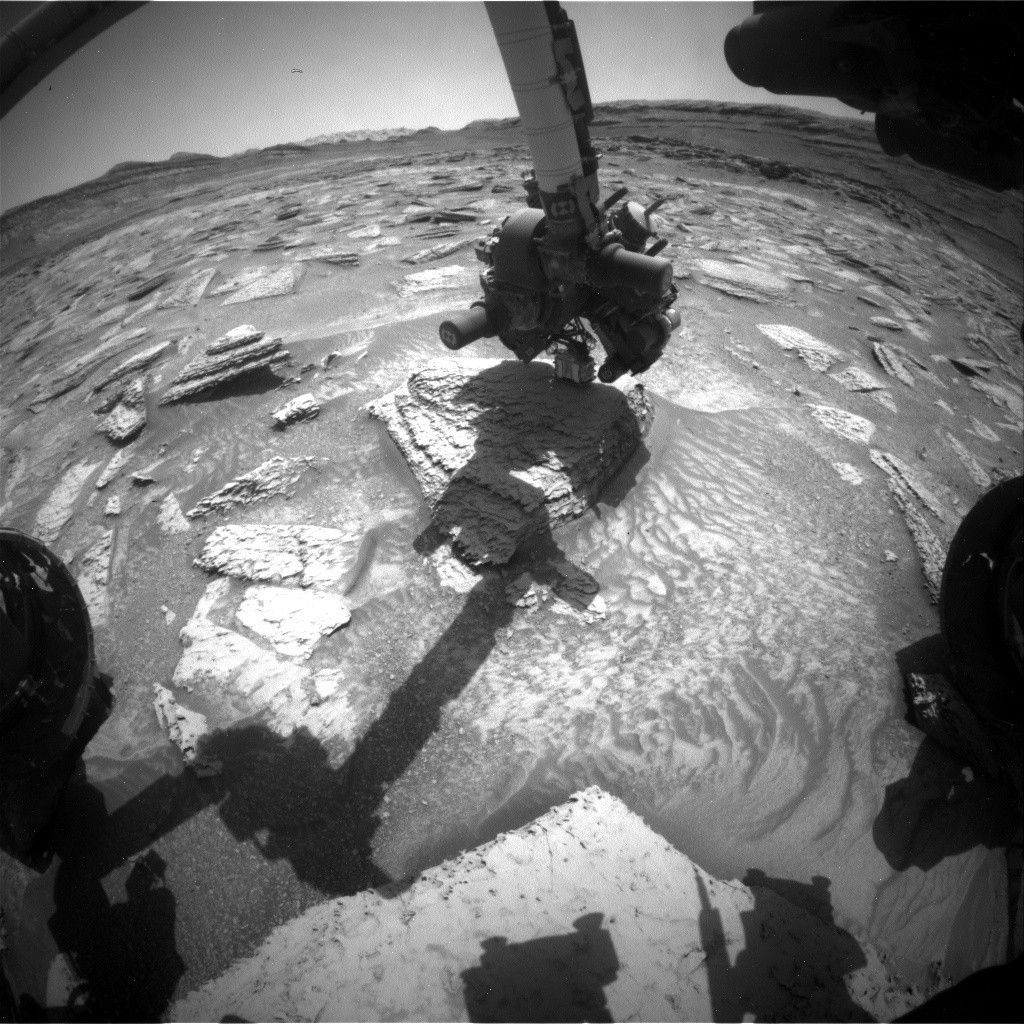
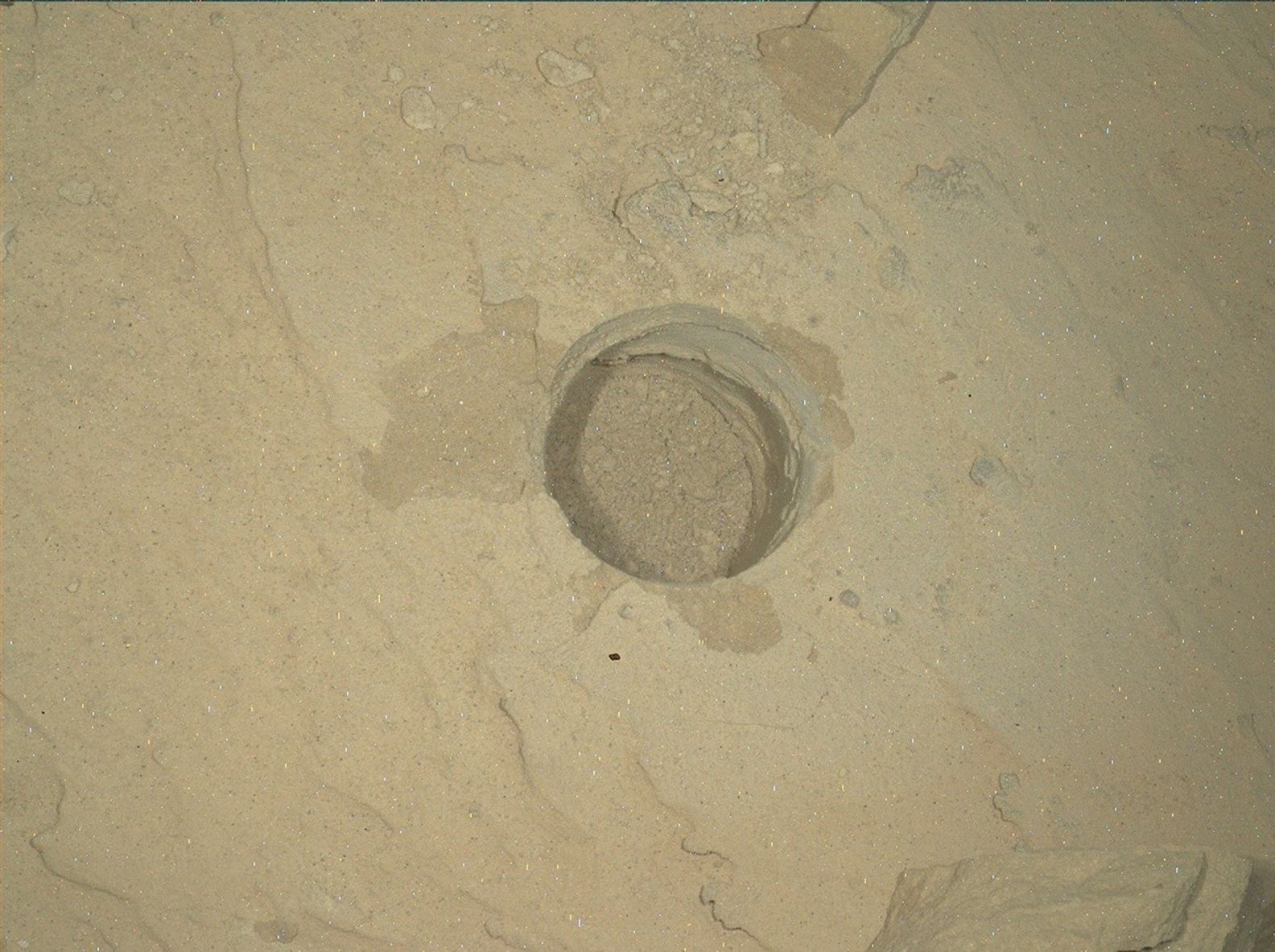
NASA’s Mars rover Curiosity acquired this image, as the rover used its APXS instrument to measure the composition of the “Campo Marte” block in preparation for drilling. Curiosity captured the image using its Front Hazard Avoidance Camera (Front Hazcam) on May 14, 2026 — Sol 4895, or Martian day 4,895 of the Mars Science Laboratory mission — at 16:29:02 UTC.
NASA/JPL-Caltech
Written by Lucy Lim, Planetary Scientist at NASA Goddard Space Flight Center
Earth planning date: Friday, May 15, 2026
After freeing the rover’s arm from the “Atacama” block, we are ready to drill again! The new drill target will represent the same geologic stratum as Atacama, which is the layered sulfate unit above the boxwork structures. We’ve named the new block “Campo Marte” after a natural red sandstone feature in Bolivia, following the theme of choosing target names in this Martian quadrangle from locations near the Uyuni region in South America. The name can be literally translated from Spanish as “Field of Mars” or “Mars Field,” appropriate for a target on Mars. In preparation for drilling, we measured the composition of Campo Marte with the ChemCam LIBS and the APXS as well as obtaining close-up imaging with MAHLI. Additional LIBS rasters provided geochemical data on nearby blocks, including a couple of vein and nodule-like features. As we’ve seen in several rover stops in this unit, the “Paso Malo” block and several others are covered in a prominent polygonal texture.
We’ve also imaged the Campo Marte block from several angles and determined that it’s substantially thicker than the Atacama block, so we’re hoping that its greater mass will keep it on the ground after drilling so that we can withdraw the drill bit normally this time. The team did get some interesting data on the volume and density of the Atacama block from our little adventure but we don’t feel the need to repeat that particular experiment.
In the meantime, we had a chance to support another solar system exploration mission as the Psyche spacecraft flew close by Mars in order to pick up a gravitational boost on its way to the main asteroid belt.
The Psyche spacecraft’s eventual destination is the asteroid 16 Psyche, one of the largest members of an unusual spectral category of asteroids that hasn’t yet been visited by a spacecraft. Although 16 Psyche is expected to be quite different from Mars as a science target (for example, it is too small to maintain a Mars-like atmosphere) this flyby was still a valuable opportunity to exercise the spacecraft’s instruments and data analysis pipelines, and validate their calibration. Because of this the Curiosity team planned an extra set of atmospheric observations timed to coordinate with the Psyche flyby: a zenith movie with Navcam to document clouds and a Mastcam solar observation to measure atmospheric opacity. The Mastcam was also supported by a fresh set of calibration data. Together with other coordinated observations from the Mars orbiters and Perseverance rover, these are intended to contribute to the Psyche instrument validation effort.