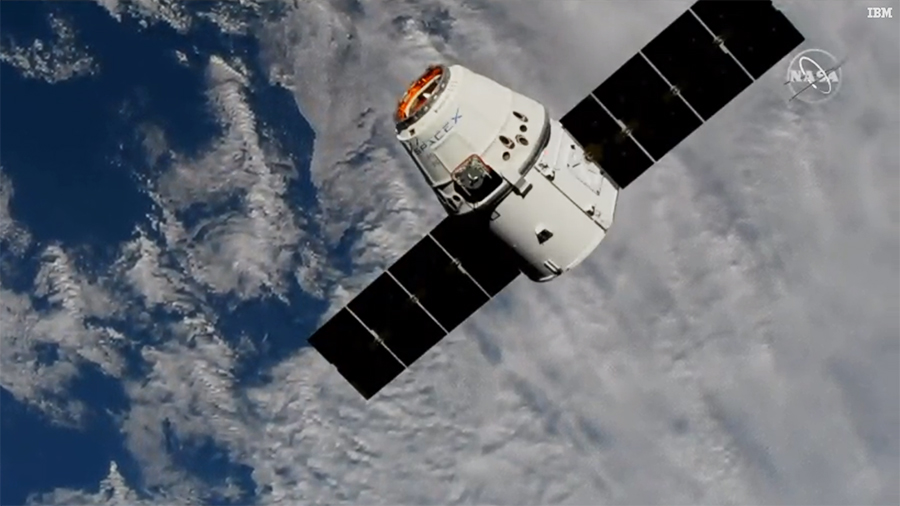
The 20th SpaceX Dragon resupply mission approaches the space station.
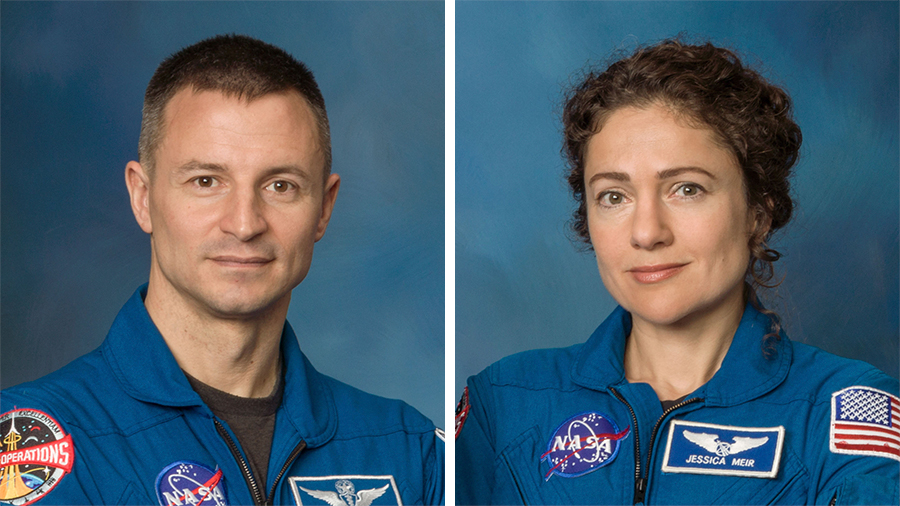
While the International Space Station was traveling more than 262 miles over the Northeast Pacific near Vancouver, British Columbia, Expedition 62 Flight Engineer Jessica Meir of NASA grappled Dragon at 6:25 a.m. EDT using the space station’s robotic arm Canadarm2 with NASA astronaut Andrew Morgan acting as a backup.
Ground controllers will now send commands to begin the robotic installation of the spacecraft on bottom of the station’s Harmony module. NASA Television coverage of installation is now scheduled to begin at 8:00 a.m. Watch online at www.nasa.gov/live.
Here’s some of the research arriving at station:
New Facility Outside the Space Station
The Bartolomeo facility, created by ESA (European Space Agency) and Airbus, attaches to the exterior of the European Columbus Module. Designed to provide new scientific opportunities on the outside of the space station for commercial and institutional users, the facility offers unobstructed views both toward Earth and into space. Potential applications include Earth observation, robotics, material science and astrophysics.
Studying the Human Intestine On a Chip
Organ-Chips as a Platform for Studying Effects of Space on Human Enteric Physiology (Gut on Chip) examines the effect of microgravity and other space-related stress factors on biotechnology company Emulate’s human innervated Intestine-Chip (hiIC). This Organ-Chip device enables the study of organ physiology and diseases in a laboratory setting. It allows for automated maintenance, including imaging, sampling, and storage on orbit and data downlink for molecular analysis on Earth.
Growing Human Heart Cells
Generation of Cardiomyocytes From Human Induced Pluripotent Stem Cell-derived Cardiac Progenitors Expanded in Microgravity (MVP Cell-03) examines whether microgravity increases the production of heart cells from human-induced pluripotent stem cells (hiPSCs). The investigation induces stem cells to generate heart precursor cells and cultures those cells on the space station to analyze and compare with cultures grown on Earth.
NASA TV Broadcasts Station Astronauts Capturing Dragon Monday
NASA astronauts Andrew Morgan and Jessica Meir will be on duty in the cupola to capture the SpaceX Dragon resupply ship.
SpaceX Dragon is on track to arrive at the International Space Station tomorrow morning March 9, with an expected capture of the cargo spacecraft around 7 a.m. EDT. NASA Television coverage will begin at 5:30 a.m. Watch live at http://www.nasa.gov/live.
When it arrives to the space station, Expedition 62 Flight Engineers Jessica Meir of NASA will grapple Dragon, with Andrew Morgan of NASA acting as a backup. The station crew will monitor Dragon vehicle functions during rendezvous. After Dragon capture, ground commands will be sent from mission control in Houston for the station’s arm to rotate and install it on the bottom of the station’s Harmony module. Coverage of robotic installation to the Earth-facing port of the Harmony module will begin at 8:30 a.m.
Dragon lifted off on Friday, March 6, atop a SpaceX Falcon 9 rocket from Space Launch Complex 40 at Cape Canaveral Air Force Station in Florida. The cargo spacecraft with more than 4,300 pounds of research, equipment, cargo and supplies that will support dozens of investigations aboard the orbiting laboratory. Dragon will join three other spacecraft currently at the space station
A Celebration of Life service was held on Saturday, March 7, 2020 for NASA mathematician Katherine Johnson at the Hampton University Convocation Center.