Crew Packs Cargo Ship for Departure and Preps for Spacewalk

Crew Packs Cargo Ship for Departure and Preps for Spacewalk
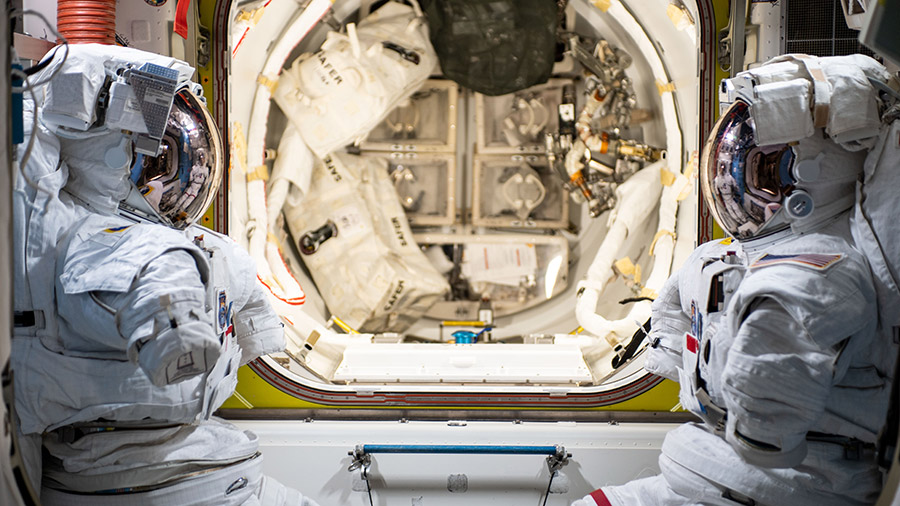
A pair of U.S. spacesuits that will be worn by NASA astronauts Thomas Marshburn and Kayla Barron are pictured in the station's Quest airlock.
A pair of U.S. spacesuits that will be worn by NASA astronauts Thomas Marshburn and Kayla Barron are pictured in the station’s Quest airlock.

The Expedition 66 crew is turning its attention to the U.S. Cygnus space freighter as it nears departure this weekend after 100 days berthed to the station’s Unity module. The astronauts are also preparing for a spacewalk to replace a faulty antenna system on the International Space Station.

NASA astronauts Thomas Marshburn, Raja Chari and Mark Vande Hei spent Wednesday afternoon packing Cygnus with trash and obsolete gear. ESA (European Space Agency) astronaut Matthias Maurer continued the cargo loading on Thursday. He will be at the robotics workstation monitoring its departure on Saturday at 11 a.m. EST. Robotics controllers remotely operating the Canadarm2 robotic arm from Earth will command Cygnus’ release live on NASA TV starting at 10:45 a.m.

Cygnus will have one more mission as it re-enters Earth’s atmosphere for a fiery, but safe destruction above the Pacific Ocean. The Kentucky Re-entry Probe Experiment will deploy three capsules from Cygnus to collect and transmit thermal data from sensors embedded in heat shields. The data may help validate thermal protection systems in space and heat shield materials on Earth.

Meanwhile, Marshburn and NASA Flight Engineer Kayla Barron are due to exit the U.S. Quest airlock soon to swap the S-Band Antenna System with a spare already attached outside the station. Maurer will be at the controls of the Canadarm2 assisting the duo during the planned six-and-a-half hour spacewalk.

Marshburn and Barron were joined by NASA Flight Engineers Raja Chari and Mark Vande Hei inside Quest on Thursday as they tried on their U.S. spacesuits for a fit check. Chari and Vande Hei will be on duty monitoring the two astronauts during the spacewalk and helping them in and out of their spacesuits. A news conference to discuss the spacewalk activities has been scheduled for Monday, Nov. 29.

Science was back on track Thursday with the crew exploring human research, botany, and space physics. Chari and Barron tested how astronauts perceive up and down movements and grip and manipulate objects In microgravity. Vande Hei cleaned up debris around chile peppers growing inside the Advanced Plant Habitat. Finally, station Commander Anton Shkaplerov of Roscosmos swapped samples inside the Microgravity Science Glovebox for a physics study seeking to improve the production of higher quality semiconductor crystals.

Get the latest from NASA delivered every week. Subscribe here: www.nasa.gov/subscribe

Get The Details…

Norah Moran

Powered by WPeMatico

Crew Operations Aboard Space Station Return to Normal

Crew Operations Aboard Space Station Return to Normal

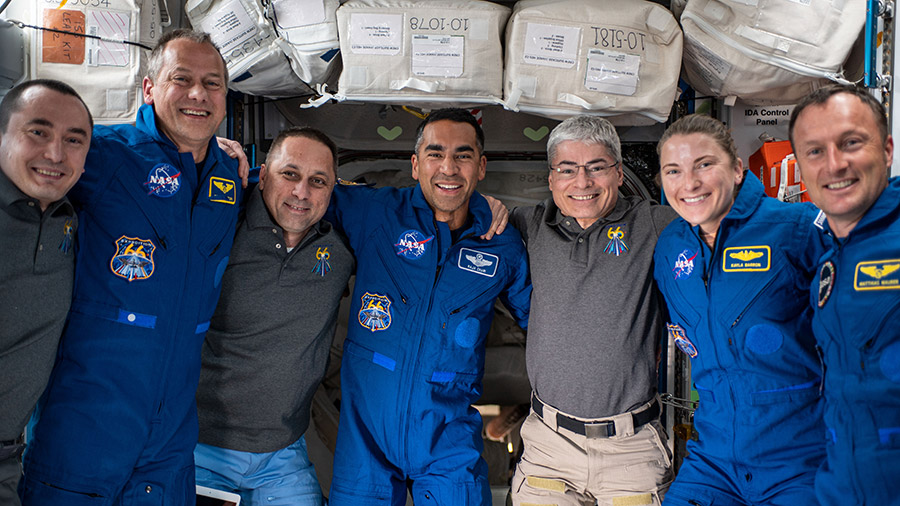
From left are, Expedition 66 crew members Pyotr Dubrov of Roscosmos; Thomas Marshburn of NASA; Anton Shkaplerov of Roscosmos; Raja Chari, Mark Vande Hei and Kayla Barron, all from NASA; and Matthias Maurer from ESA (European Space Agency).

NASA and U.S. Space Command continue to monitor the debris cloud created by a recent Russian anti-satellite test. The International Space Station and crew members are safe and have resumed normal operations. The largest risk from the debris was in the first 24 hours and telemetry from the space station indicates no issues during that time. About 1:20 a.m. EST today, radial hatches extending from the space station’s center, including Kibo, Columbus, the Permanent Multipurpose Module, Bigelow Expandable Activity Module, and Quest Joint Airlock, were reopened.

Following the incident, crew members were awoken, notified of the debris and asked to close specific hatches based on the space station’s safe haven procedures. Hatches between the U.S. and Russian segments also were closed initially, but were later opened when the higher risk period passed. Crew members’ daily tasks were adjusted during this time to accommodate the hatch closure. After closing the hatches, the crew then entered their Soyuz and Crew Dragon spacecraft for approximately two hours, from 2 a.m. – 4 a.m. EST. No debris avoidance maneuver was performed.

Space debris is tracked by Space Command and conjunction analysis is performed by NASA, with mitigations available for debris clouds and individual conjunction threats (such as debris avoidance maneuvers). If orbital debris were to strike the station and cause an air leak, the crew would close hatches to the affected module. If crew members do not have time to close the affected module, they would enter their respective spacecraft and, if necessary, undock from the space station to return to Earth.

This debris cloud that was just created has increased the risk to the station. The cataloging of the total number of identifiable pieces of debris is ongoing. Once the debris cloud is dispersed and items are tracked and catalogued, NASA will receive notifications of potential conjunction threats to the station and perform maneuvers as necessary. In addition, NASA will continue to perform visual inspections and review telemetry data to ensure vehicle health.

Teams are assessing the risk levels to conduct various mission activities. Any changes to launches, spacewalks, and other events will be updated as needed.

Get The Details…

Mark Garcia

Powered by WPeMatico