Space Physics and Biology Top Research Schedule Today

Space Physics and Biology Top Research Schedule Today
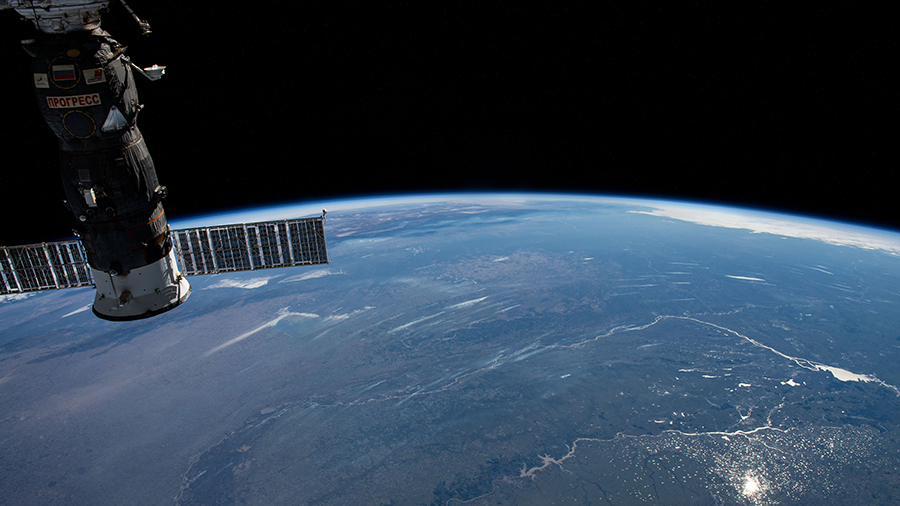
The Earth's horizon looking back towards Uruguay
The International Space Station was orbiting off the Atlantic coast of the South American nation of Uruguay with the Progress 75 cargo craft in the left foreground.

The Expedition 63 crew spent Friday setting up advanced science hardware to explore a wide variety of space phenomena. The International Space Station residents also worked spacesuit maintenance and conducted more eye checks.

NASA Flight Engineer Bob Behnken spent the morning swapping furnaces inside the Materials Science Laboratory (MSL) research rack. Fellow NASA  astronaut Doug Hurley joined Behnken and installed the specialized device, known as the Solidification and Quench Furnace (SQF), in the MSL. The SQF will enable scientists to discover new applications for metals, alloys, polymers and more, or design advanced materials for industrial usage.

Hurley started his day configuring a laptop computer for the Hyperspectral Imaging Suite (HISUI) from JAXA (Japan Aerospace Exploration Agency). HISUI is located outside the Kibo laboratory module and images Earth in visible and infrared wavelengths providing valuable geological and environmental data.

Behnken then joined Commander Chris Cassidy for another eye exam at the end of the work day. Cassidy was in charge this time using optical coherence tomography to image his crewmate’s retinas. Doctors on the ground monitor the exam in real-time to understand how microgravity affects eye health.

Just before lunchtime, Cassidy dumped water and purged gas from a pair of U.S. spacesuits ahead of two more battery swap spacewalks he and Behnken will embark on July 16 and 21. During the afternoon, the commander researched microfluidics to improve medical diagnostic devices and explored how astronauts visually interpret their microgravity environment.

Roscosmos cosmonauts Anatoly Ivanishin and Ivan Vagner juggled their set of lab upkeep and Russian science today. Vagner investigated how space impacts bone mass and the immune system to prepare for return to Earth’s gravity. Ivanishin charged up laptop computer and camera batteries then spent the afternoon servicing the Zvezda service module’s ventilation system.

Get The Details…

Mark Garcia

Powered by WPeMatico

Emergency Training, Eye Checks Ahead of Spacewalks

Emergency Training, Eye Checks Ahead of Spacewalks

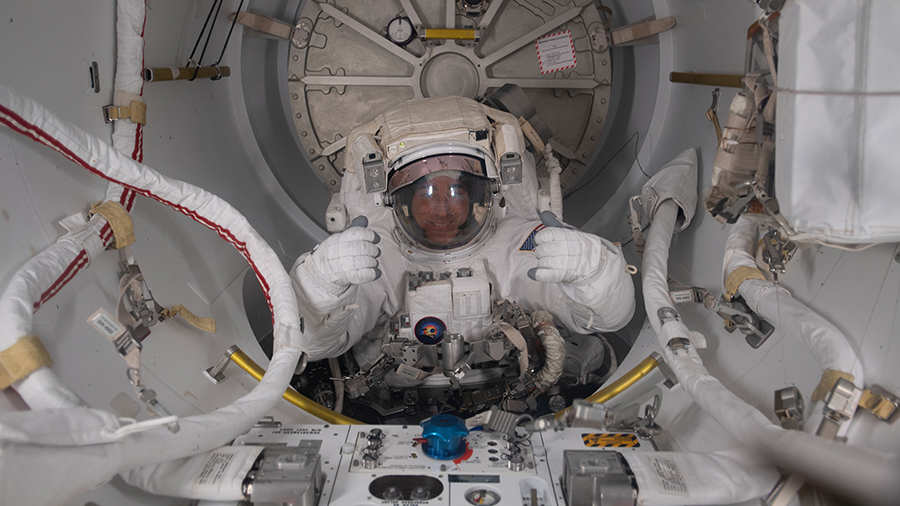
Expedition 63 Commander Chris Cassidy is pictured in his U.S. spacesuit halfway inside the crew lock portion of the Quest airlock during a spacewalk on July 1, 2020.
Astronaut Chris Cassidy is pictured in his U.S. spacesuit halfway inside the crew lock portion of the Quest airlock during a spacewalk on July 1, 2020.

The International Space Station was a hive of activity today with the Expedition 63 crew practicing emergency skills, examining eyes and studying water conservation. Two astronauts also will continue more battery swaps in a pair of spacewalks set to begin next week.

Living 260 miles above the Earth and orbiting the planet 16 times a day presents a unique set of risks that space residents must be prepared for. Today, NASA Commander Chris Cassidy joined Roscosmos Flight Engineers Anatoly Ivanishin and Ivan Vagner for a simulated emergency evacuation of the station. The trio spent the afternoon practicing quickly entering their Soyuz MS-16 crew ship for a rapid undocking and Earth re-entry.

Afterward, Cassidy partnered up with his fellow NASA astronauts Doug Hurley and Bob Behnken for eye exams at the end of the day. Hurley led the effort as the Crew Medical Officer and used optical coherence tomography gear to scan the retinas of his two crewmates.

Behnken and Cassidy are set to go out on two more spacewalks scheduled for July 16 and 21. The duo will continue replacing aging nickel-hydrogen batteries with new lithium-ion batteries on the starboard portion of the station’s truss structure. The batteries store and release power collected from the orbiting lab’s main solar arrays.

Robotics controllers overnight commanded the Canadarm2 robotic arm to replace a failed remote power control module (RPCM) on the port truss segment. The replacement restores redundancy to the solar alpha rotary joint after the old RPCM failed last week.

In the Russian side of the station, Vagner primarily worked on housekeeping chores as he checked water tanks and cleaned air filters. Ivanishin spent some time photographing the effects of Earth catastrophes and exploring how international crews and ground controllers communicate with each other.

Get The Details…

Mark Garcia

Powered by WPeMatico