NASA Hosts SpaceX Crew-11 Astronauts for Public Event at Headquarters
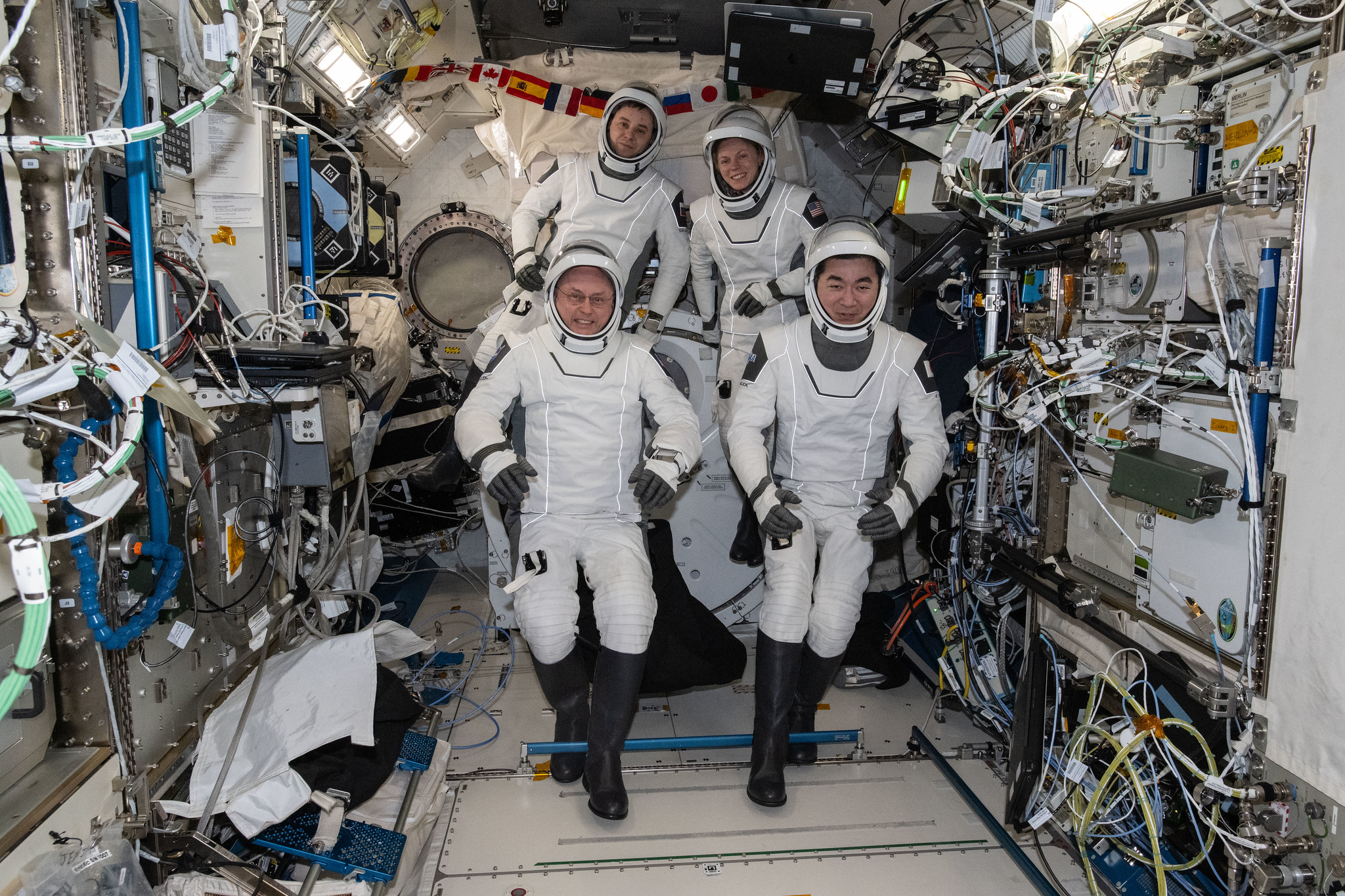
NASA’s SpaceX Crew-11 astronauts gather together for a crew portrait wearing their Dragon pressure suits during a suit verification check inside the International Space Station’s Kibo laboratory module. Clockwise from bottom left are, NASA astronaut Mike Fincke, Roscosmos cosmonaut Oleg Platonov, NASA astronaut Zena Cardman, and JAXA (Japan Aerospace Exploration Agency) astronaut Kimiya Yui.
Credit: NASA
NASA will host a public event featuring three crew members from the agency’s SpaceX Crew-11 mission at 11 a.m. EDT Monday, June 1. The event, which takes place during the crew’s standard postflight visit, will be held in the Webb Auditorium at NASA Headquarters in the Mary W. Jackson building, 300 E. Street SW in Washington.
The crew members, including NASA astronauts Zena Cardman and Mike Fincke and JAXA (Japan Aerospace Exploration Agency) astronaut Kimiya Yui, will discuss their recent 167-day mission aboard the International Space Station, where they conducted a wide range of science experiments to benefit life on Earth and advance human space exploration as part of International Space Station Expedition 73/74.
The Crew-11 mission lifted off on Aug.1, 2025, from Launch Complex 39A at NASA’s Kennedy Space Center in Florida. The crew’s SpaceX Dragon spacecraft docked to the orbital outpost on Aug. 2.
During their mission, the three astronauts, along with crewmate Roscosmos cosmonaut Oleg Platonov, traveled nearly 71 million miles and completed more than 2,670 orbits around Earth. The Crew-11 mission was Fincke’s fourth spaceflight, Yui’s second, and the first for Cardman and Platonov. Fincke has logged 549 days in space, ranking him fourth among all NASA astronauts for cumulative days in space. The crew members returned to Earth on Jan. 15, splashing down off the coast of San Diego.
Along the way, Crew-11 logged hundreds of hours of research, maintenance, and technology demonstrations. The crew members also celebrated the 25th anniversary of continuous human presence aboard the orbiting laboratory on Nov. 2, 2025. Research conducted aboard the space station advances scientific knowledge and demonstrates new technologies that enable us to prepare for human exploration of the Moon and Mars.
Media interested in attending the event must RSVP by 8 a.m., June 1, by emailing the NASA Headquarters newsroom at hq-media@mail.nasa.gov. NASA’s media accreditation policy is online. Based on the crew’s schedule, NASA will not be able to accommodate interviews.
This opportunity also is part of NASA’s Frontiers Forum: Voices Shaping the Future of Space speaking series designed to convene bold thinkers and senior leaders at the forefront of exploration and innovation. The series will spotlight mission-critical priorities from advancing the Artemis campaign and strengthening commercial partnerships to shaping the future workforce and accelerating breakthrough technologies. The agency will share more details soon.
To learn more about the International Space Station and its research and crews, visit:
NASA’s Roman Space Telescope Primary Mirror Gets Last Look
4 Min Read
NASA’s Roman Space Telescope Primary Mirror Gets Last Look
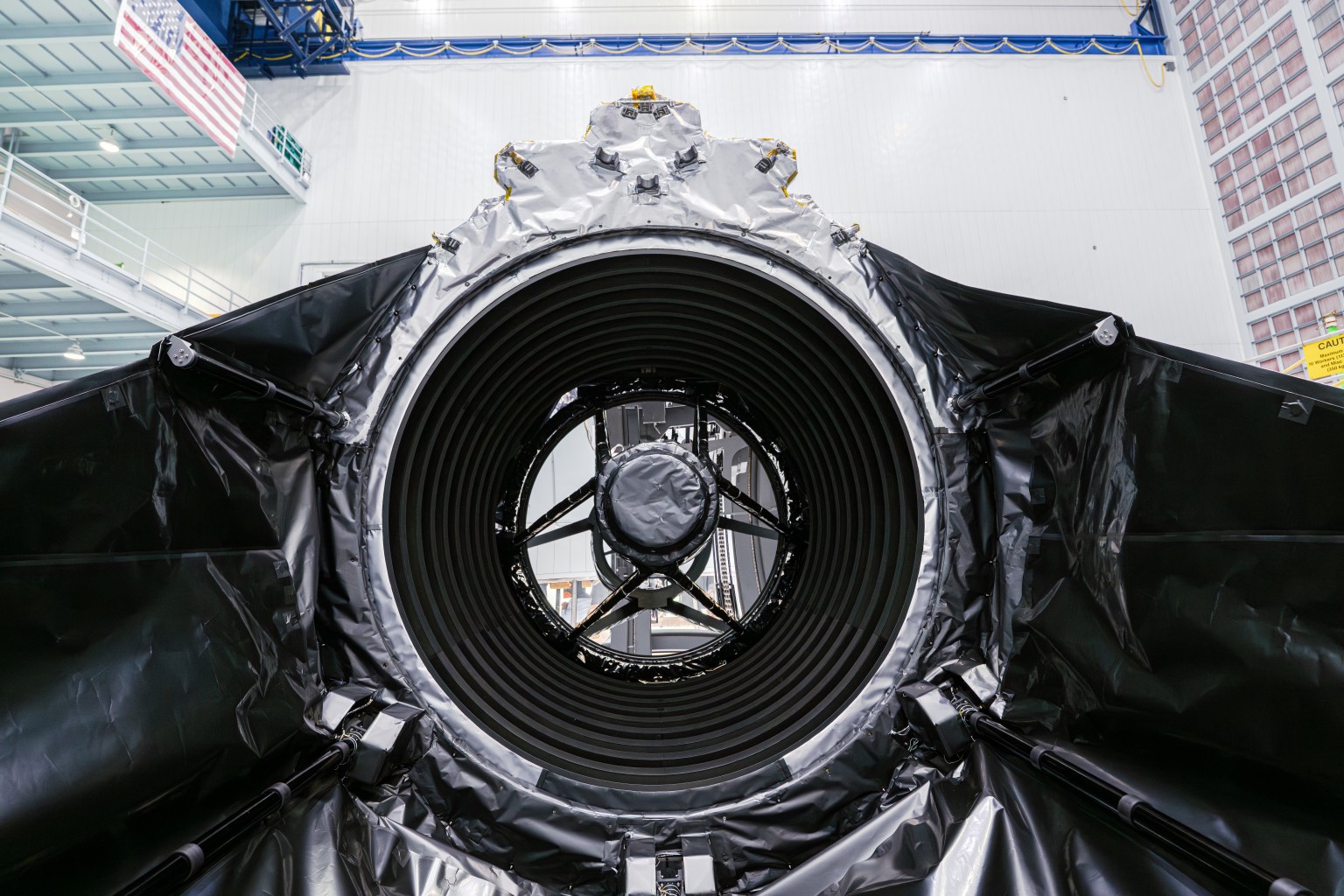
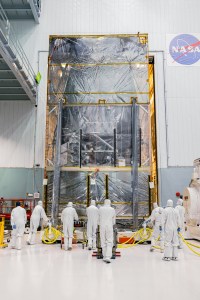
This photo peers down the barrel of the Roman telescope with its visor-like sunshade deployed.
Credits: NASA/Sydney Rohde
Engineers at NASA’s Goddard Space Flight Center in Greenbelt, Maryland, have completed their final inspection of a key element for the agency’s Nancy Grace Roman Space Telescope: the primary mirror. This 7.9-foot (2.4-meter) mirror will collect and focus light from cosmic objects near and far, helping Roman capture stunning panoramas of space.
The primary mirror for NASA’s Nancy Grace Roman Space Telescope has passed its final inspection. On May 20 and 21, engineers at NASA’s Goddard Space Flight Center in Greenbelt, Md., confirmed that no specks fell onto the mirrors during testing and that there are no defects in the coating or alignment. With this milestone complete, the primary mirror is ready for its next view: space. NASA’s Goddard Space Flight Center
“The Roman engineering team laid eyes on the telescope for the final time before it, in turn, becomes the eyes of humanity, revealing the wonders of the cosmos,” said J. Scott Smith, the Roman telescope manager at NASA Goddard. “It is a profoundly humbling moment to witness the culmination of hard work from so many dedicated individuals, teams, and partner organizations, including L3Harris.”
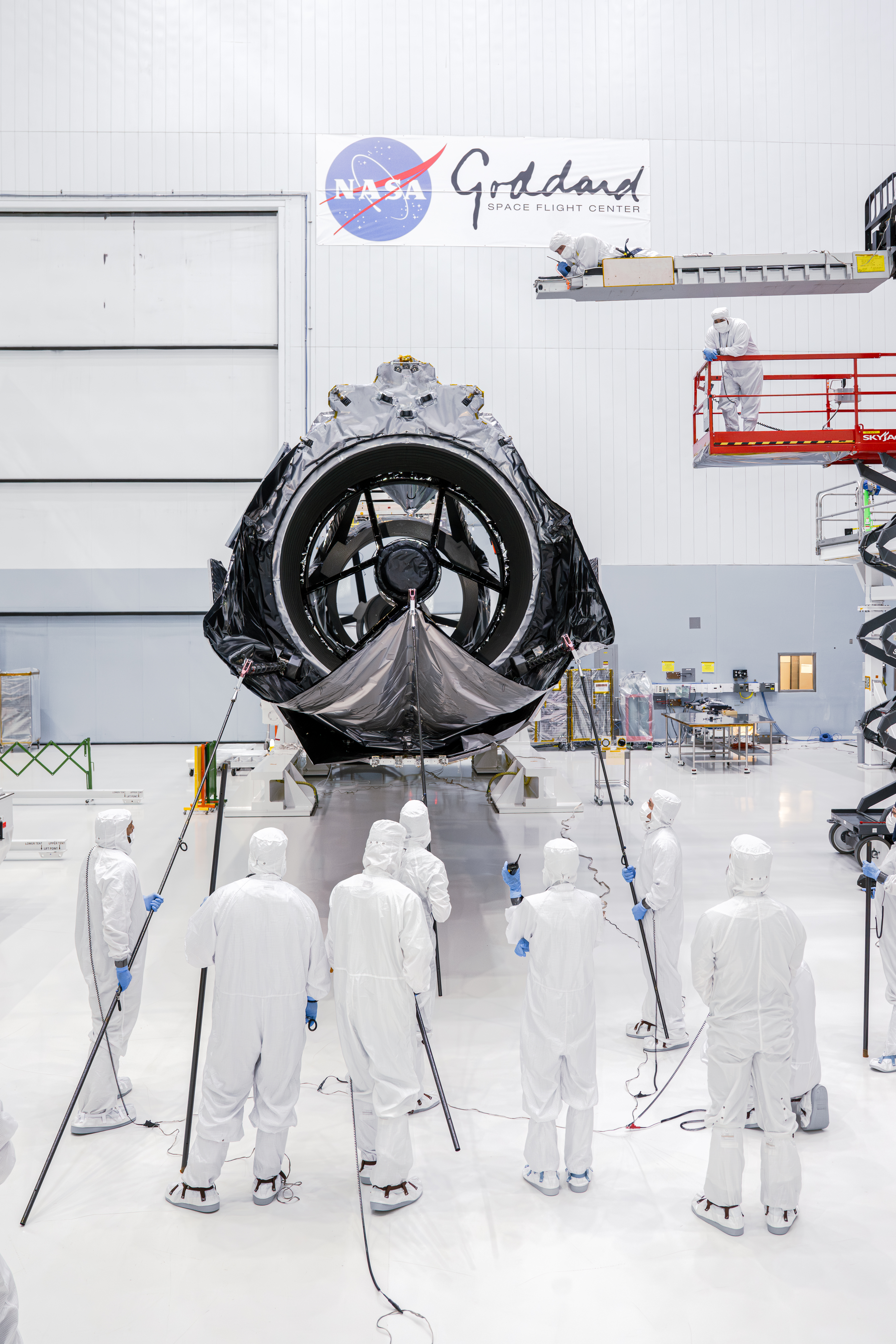
On May 20, engineers turned the Roman observatory onto its side and deployed the “hood” that will be stowed for launch to protect the mirror. Then the team conducted a meticulous visual inspection to ensure no specks fell onto the mirrors during testing and confirm there are no defects in the coating or alignment.
“We developed a method of using a high-resolution camera equipped with a very powerful zoom lens to do a multi-purpose inspection,” said Bente Eegholm, optics lead for Roman’s Optical Telescope Assembly at NASA Goddard. “The mirror passed with flying colors, keeping the mission on track for an early September launch.”
Technicians stow Roman’s deployable aperture cover, a large sunshade designed to keep unwanted light out of the telescope.
NASA/Sydney Rohde
The team carefully observed the optics along the path light will follow to the Wide Field Instrument detector array and confirmed it remains in proper alignment following the observatory shake test.
“In order to gather very sensitive measurements of objects strewn throughout space, all of Roman’s components have to be ultraprecise,” Eegholm said. “The primary mirror certainly delivers on that precision.”
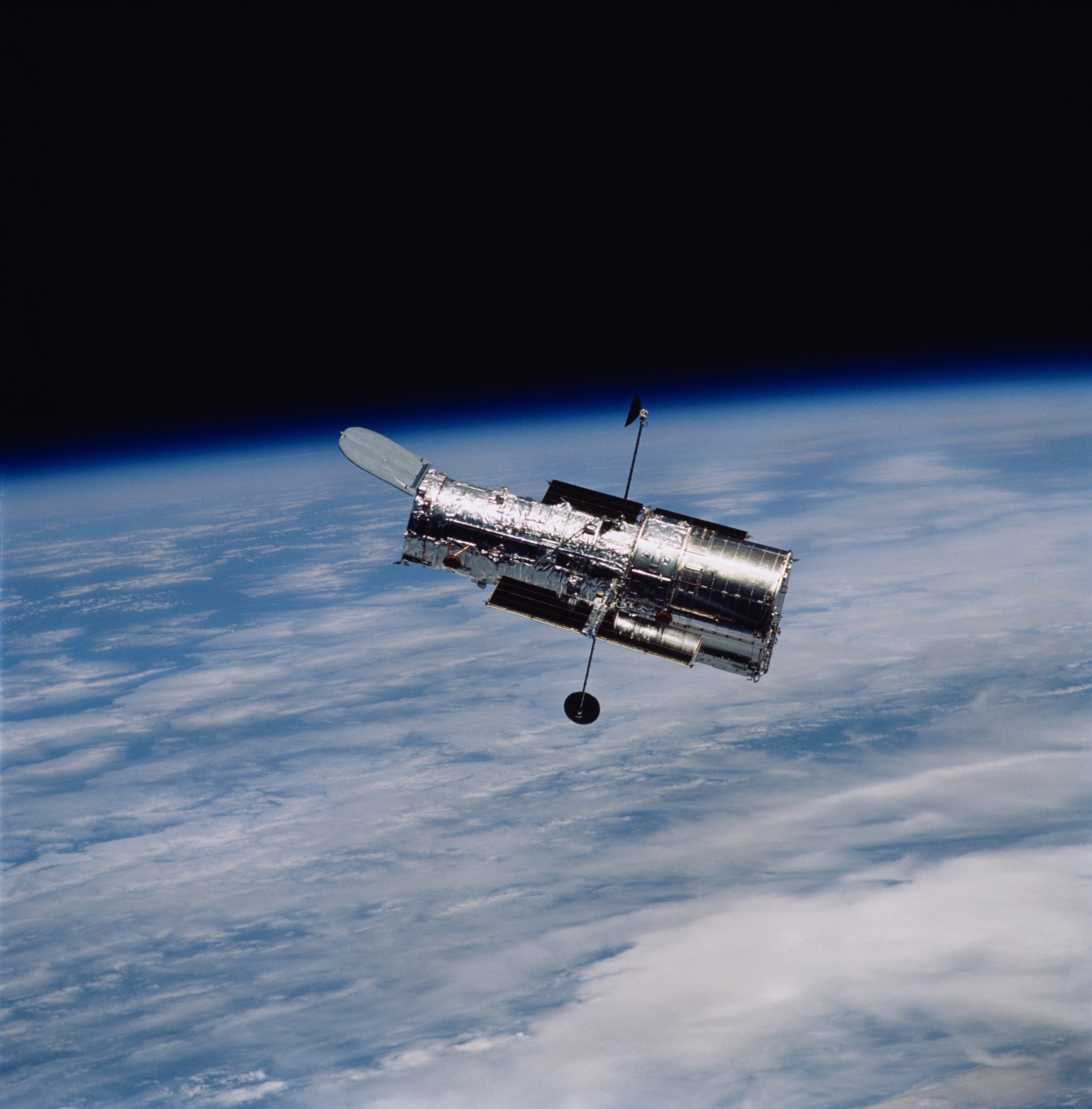
Roman’s primary mirror sports a layer of silver less than 400 nanometers thick — about 200 times thinner than a human hair. The silver coating was specifically chosen for Roman because of how well it reflects near-infrared light. By contrast, the Hubble Space Telescope’s mirror is coated with layers of aluminum and magnesium fluoride to optimize visible and ultraviolet light reflectivity. Likewise, the James Webb Space Telescope’s mirrors have a gold coating to suit its longer wavelength infrared observations.
The Roman mirror is so finely polished that the average bump on its surface is only 1.2 nanometers tall — more than twice as smooth as the mission requires. If the mirror were scaled up to Earth’s size, these bumps would be just a quarter of an inch high.
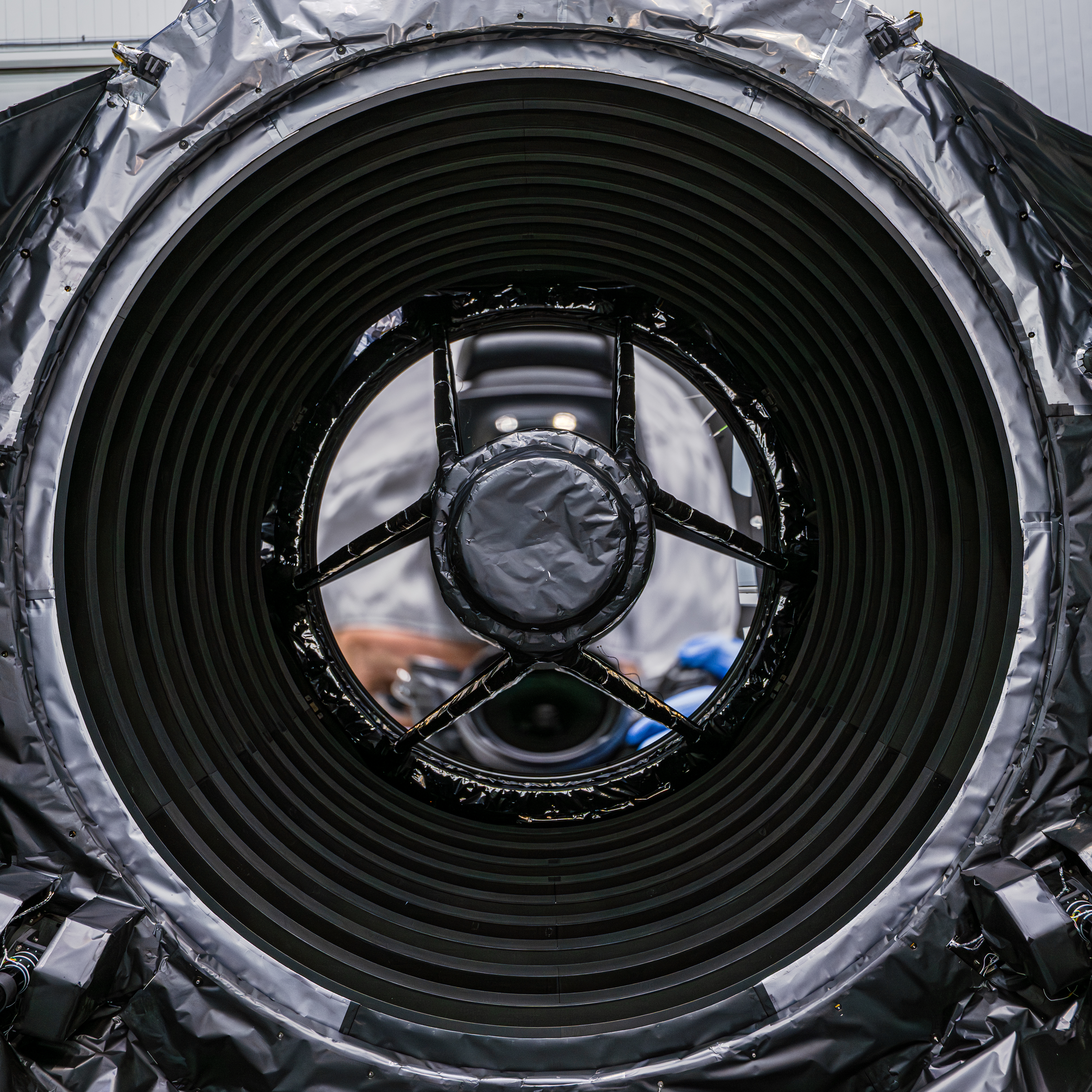
In this photo, which peers directly down the barrel of Roman’s telescope, the photographer’s camera is reflected in the primary mirror.
NASA/Sydney Rohde
Since it’s made of a specialty ultralow-expansion glass, the mirror will resist flexing, which can happen to materials during temperature changes (like going from balmy Earth conditions to the deep freeze of space). This preserves Roman’s image quality, because if the primary mirror changed shape, it would distort the images from the telescope.
“We’re really proud of the amazing optical system we’ve delivered for the Roman mission alongside our partners at L3Harris,” said Josh Abel, lead Optical Telescope Assembly systems engineer at NASA Goddard. “Now that it’s assembled, aligned, and all shined up, we’re ready to go.”
Now, the Roman team is preparing to ship the observatory to the launch site at NASA’s Kennedy Space Center in Florida in the coming weeks. NASA expects the mission to begin returning incredible cosmic vistas within several months after launch.
The Nancy Grace Roman Space Telescope is managed at NASA’s Goddard Space Flight Center in Greenbelt, Maryland, with participation by NASA’s Jet Propulsion Laboratory and Caltech/IPAC in Southern California, the Space Telescope Science Institute (STScI) in Baltimore, and scientists from various research institutions.
Hubble Captures M88 on Journey to Center of Virgo Cluster
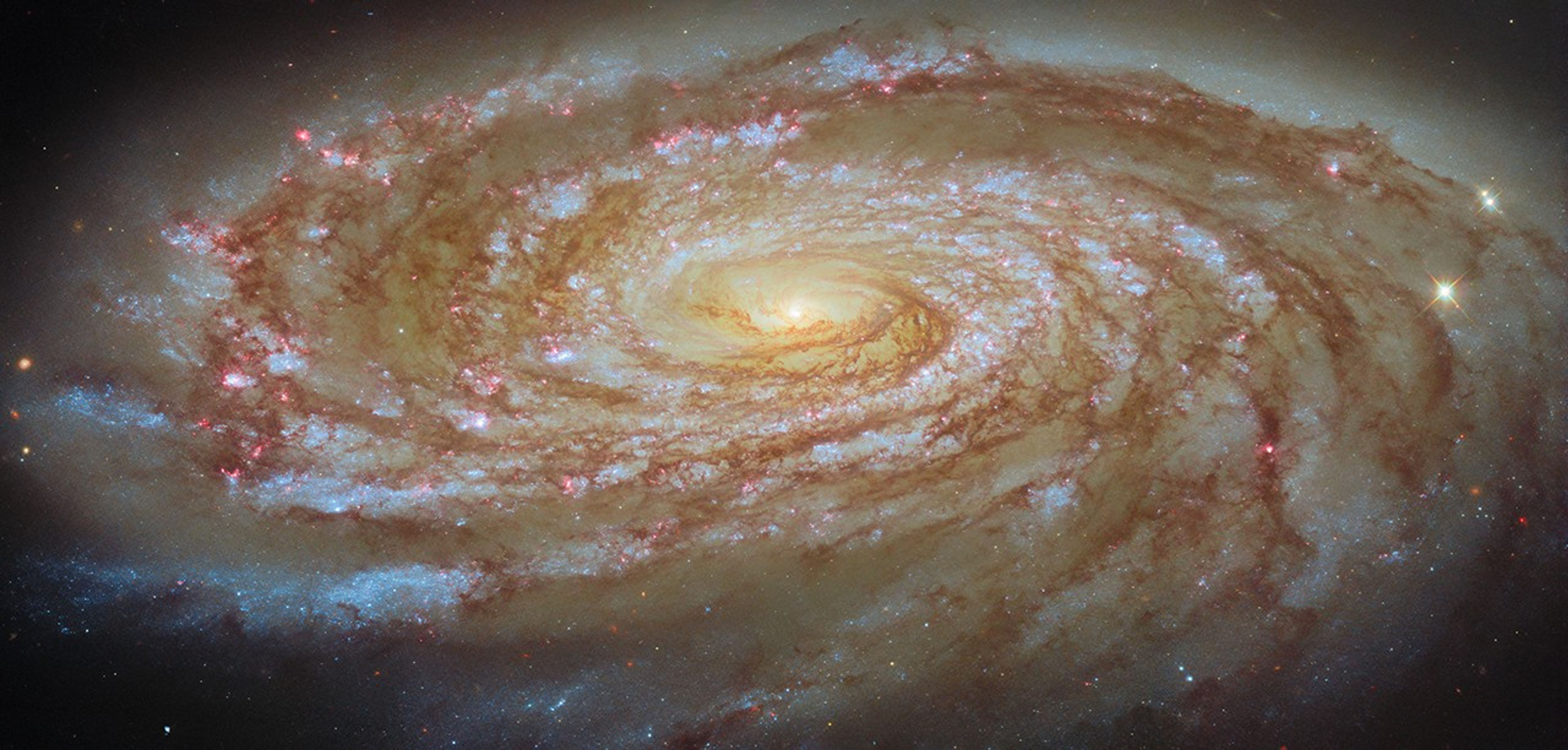
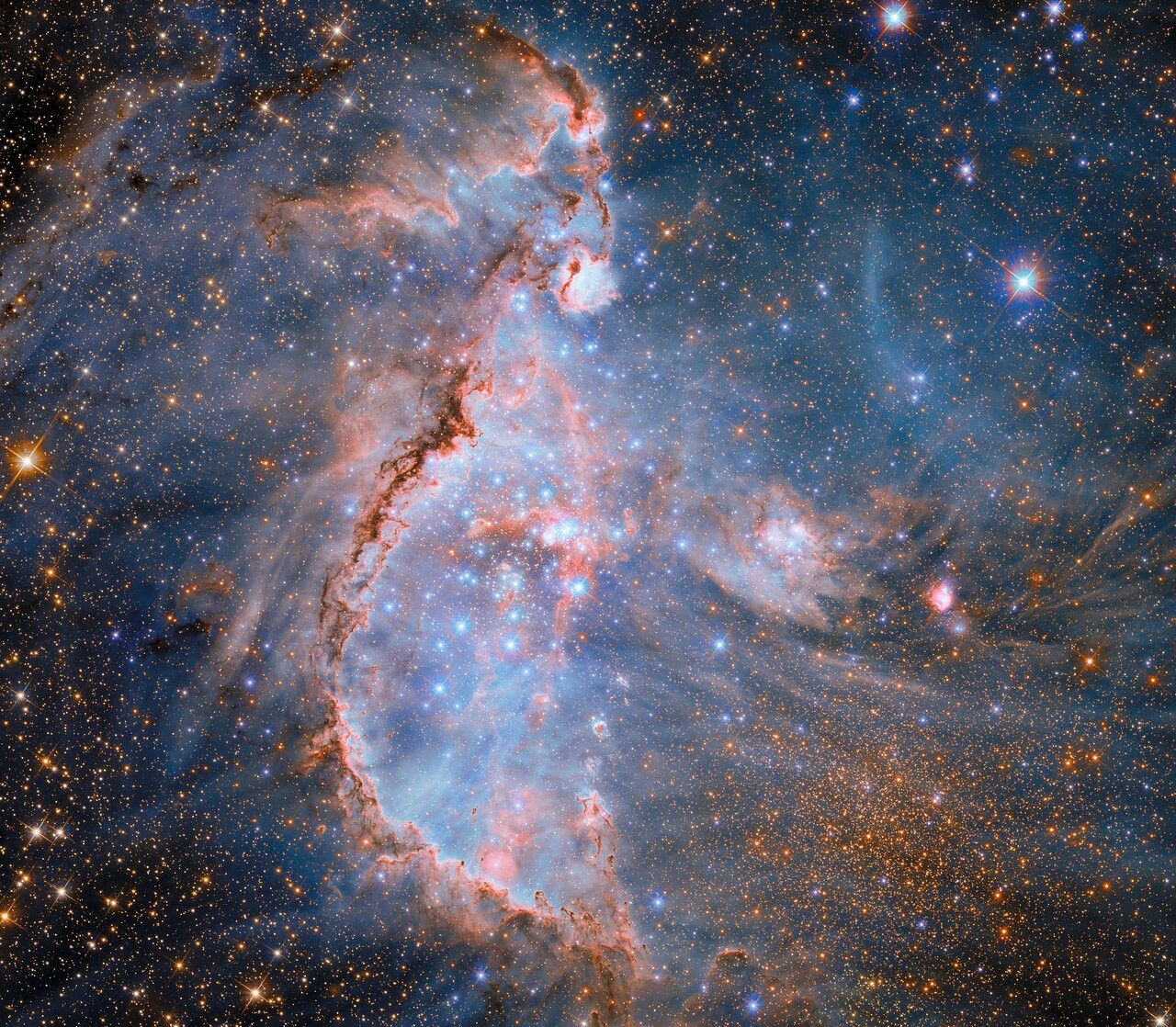
This NASA/ESA Hubble Space Telescope image features the spiral galaxy Messier 88 (M88).
ESA/Hubble & NASA, D. Thilker
The focus of this NASA/ESA Hubble Space Telescope image is an active spiral galaxy on a journey lasting hundreds of millions of years. The galaxy Messier 88 (M88), also known as NGC 4501, is located about 63 million light-years away in the constellation Coma Berenices (Berenice’s Hair).
M88 is an active galaxy, which means that its center harbors a supermassive black hole that is snacking on gas and dust. Astronomers estimate the black hole is around 100 million times as massive as the Sun, and it appears to be powering outflows of gas from the galaxy’s center.
A population of old, reddish stars around the black hole give M88 its warmly glowing heart. Spreading out from the galaxy’s center are several tightly wound, symmetrical spiral arms, each outlined by sparkling pink and blue star clusters and knotted clouds of dust. We see M88 from an angle that makes it appear elongated, and its spiral arms delicately fan out before it.
M88 is a member of the Virgo Cluster, a collection of more than a thousand galaxies held together by gravity. As this massive galaxy group moves through space, the galaxies themselves are in constant motion as they orbit the cluster’s center of gravity. M88 itself is on a long and somewhat perilous cosmic journey that will bring it to the innermost reaches of the cluster.
As is the case with any epic journey, M88 will be fundamentally changed by its trek to the center of the Virgo Cluster, about two million light-years from where it is today. In 200–300 million years, M88 will make its closest approach to Messier 87, the massive elliptical galaxy that anchors the entire cluster. As it draws close to this gravitational behemoth, M88 will experience intense ram pressure stripping. Ram pressure stripping is a process through which a galaxy’s gas is swept away as it pushes through the ever-present gas between the galaxies in a cluster.
Researchers have already seen this process at work in M88. The galaxy’s swirling disk of gas is truncated and appears compressed on the leading edge of the galaxy, piling up gas and dust like snow before a plough. In fact, M88 appears to have considerably less cold gas — the raw fuel for star formation — than expected for a galaxy of its size, especially in its outer regions. This is a clear sign that M88 will be altered by its journey, which will affect its ability to form stars and alter the course of its evolution.
Astronomers observed M88 with Hubble as part of an observing program (#18103; PI: D. Thilker) dedicated to understanding the lives of spiral galaxies in crowded environments. This program uses Hubble’s Wide Field Camera 3, which can finely resolve individual star clusters and nebulae in galaxies tens of millions of light-years away. By studying galaxies on these scales, astronomers can understand how a journey through a cluster impacts a galaxy’s evolution and ability to form new stars.
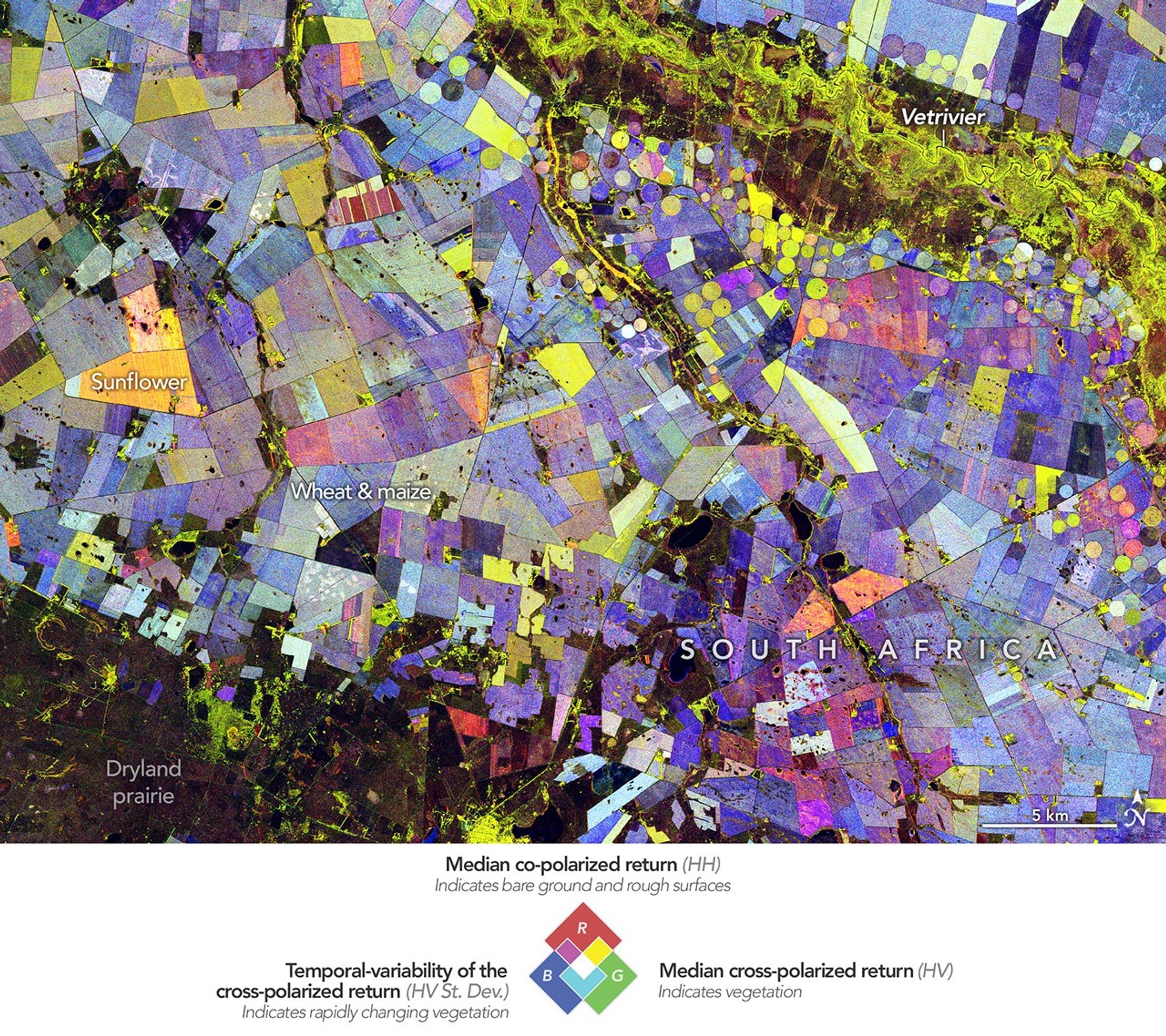
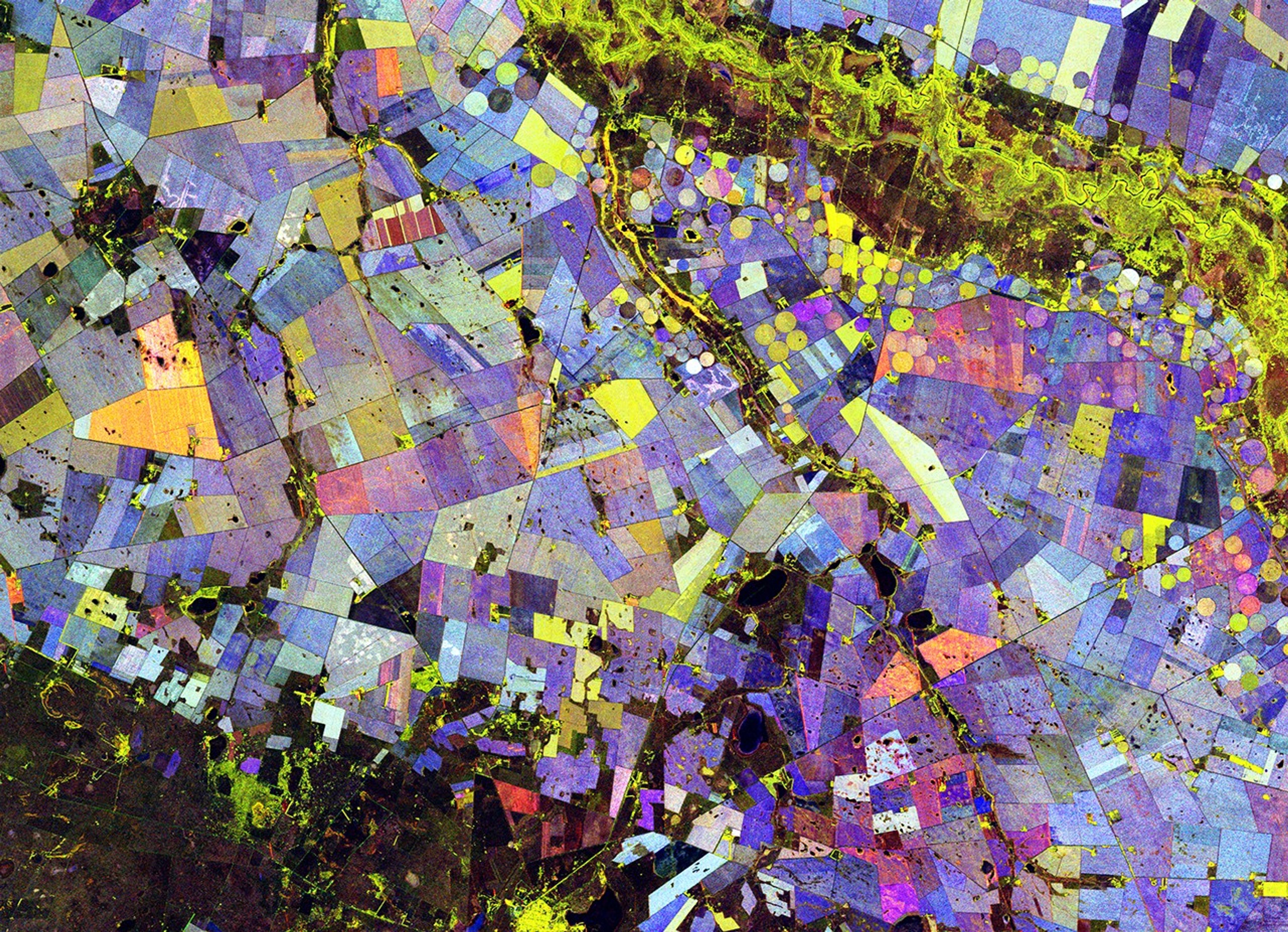
A false-color composite derived from NISAR data highlights vegetated areas (green), unvegetated surfaces (red), and how rapidly vegetated areas changed (blue) during the 2025-2026 growing season in an agricultural region of South Africa. Most pixels contain a mix of these colors, producing the visualization’s rich and varied color palette.
Along the Vetrivier (Vet River) in South Africa, a patchwork of circular and rectangular fields spreads across what is otherwise a semi-arid part of the Free State province. The water brings life to an array of crops, contributing to the agricultural productivity of the wider Maize Triangle.
The agricultural area shown in this image lies about 110 kilometers (70 miles) north of Bloemfontein. The scene is reminiscent of a modern abstract painting. Colorful circles mingle with straight-edged fields in combinations of red, green, and blue. But each color carries physical meaning, providing clues about crop types and revealing how they changed over the course of the Southern Hemisphere’s growing season.
Data for the visualization were acquired by the NISAR (NASA-ISRO Synthetic Aperture Radar) satellite during 10 passes over the area between November 2025 and March 2026. L-band radar observations, which can “see” vegetation’s structure instead of its color, were analyzed to produce per-pixel statistical measures across the scene. By combining radar scattering behaviors observed across multiple dates into a single composite, scientists built a compact summary of seasonal agricultural activity and change.
“It’s a pretty picture, but there are also important things that it communicates to us,” said Paul Siqueira, a scientist at the University of Massachusetts Amherst, and ecosystems lead of the NISAR science team. “With NISAR, crops like maize and sunflower appear differently than forests because of their size differences and period of growth.”
In this false-color composite, green indicates a vegetated area; red represents an unvegetated surface; and blue indicates how rapidly a vegetated area changed over the season. For instance, stable vegetation—such as forested areas—display a light blue component. Plants that change structure throughout the season, such as wheat and maize (corn), have a darker blue component.
In practice, most pixels contain a mix of these colors, producing the visualization’s rich and varied palette. For example, plants that grow rapidly (contributing some green) and are harvested early (contributing a large red component) make fields appear orange. Sunflowers are known to exhibit this pattern in the region, though ground validation would be needed to confirm their presence in any given field.
The processing behind the visualization is relatively straightforward, but it is based on a large amount of data. NISAR sends radar signals to Earth and measures how they bounce back; the orientation of the returned radar waves (cross-polarized or co-polarized) carries information about the structure of vegetation and surfaces. By combining radar measurements from multiple satellite passes and calculating statistics for each pixel, scientists built the detailed map of the landscape’s characteristics throughout the growing season.
The technique provides a repeatable way to monitor crop development, the impacts of irrigation, and land-use change across large regions. As NISAR collects more data, researchers will be able to compare seasons, track field-to-field differences in growth patterns, and better understand how agricultural systems respond to water availability and climate variability.
Image by Paul Siqueira (UMass Amherst) of the NISAR science team using data from the NISAR GCOV product, and prepared for NASA Earth Observatory by Michala Garrison. Story by Kathryn Hansen.
Preparations for Next Moonwalk Simulations Underway (and Underwater)
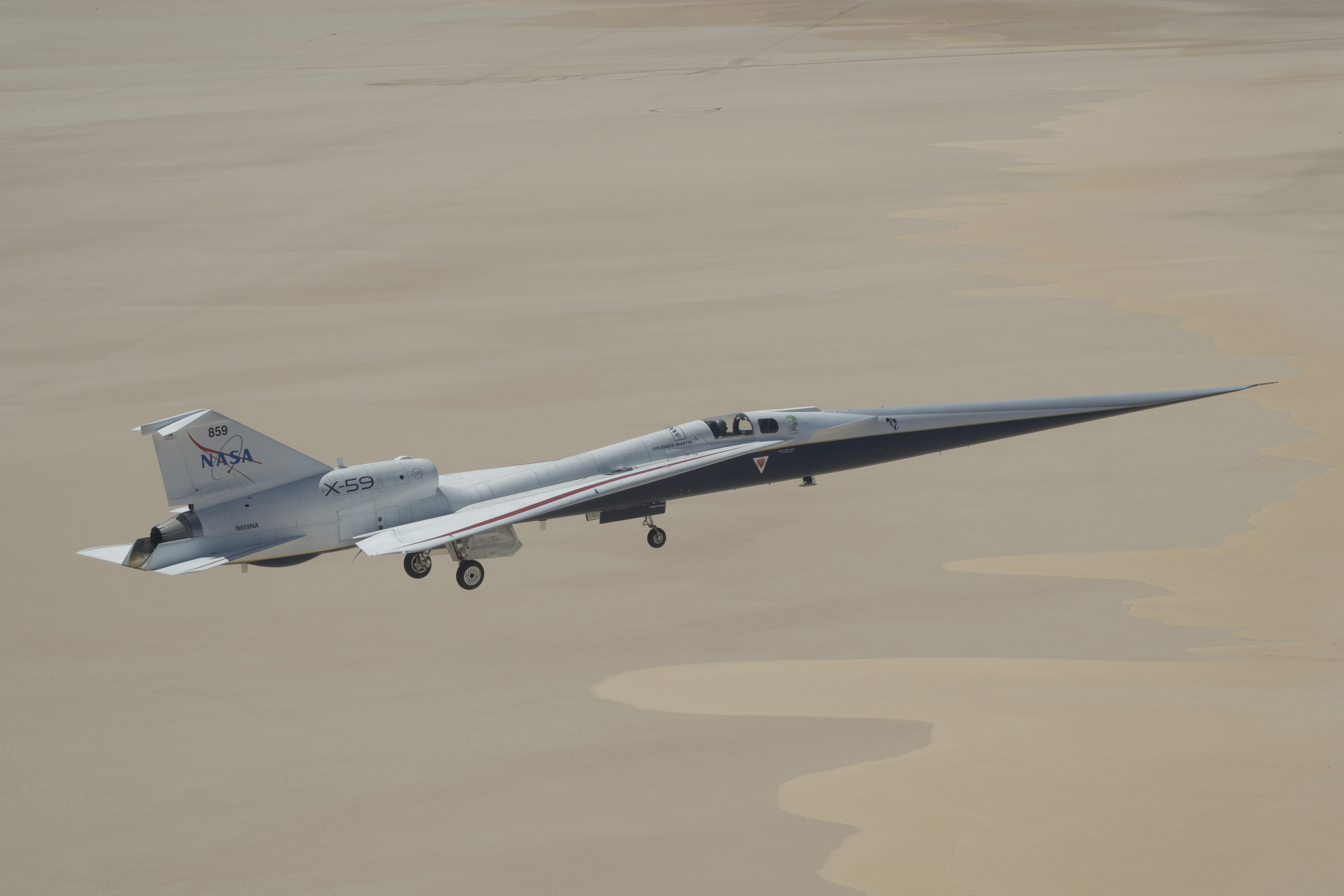
NASA’s X-59 quiet supersonic research aircraft flies over Rogers Dry Lake near NASA’s Armstrong Flight Research Center in Edwards, California, on Tuesday, May 12, 2026. NASA continues expanding the aircraft’s flight envelope through a series of lower-altitude and slower-speed flights ahead of upcoming flight tests at speeds faster than the speed of sound.
NASA/Jim Ross
NASA’s X-59 quiet supersonic research aircraft is preparing for some of its most significant flights yet. The X-plane is about to begin a new block of test flights that will include its first time flying faster than the speed of sound and other mission-critical objectives.
“What comes next is the first time this one-of-a-kind aircraft will fly supersonic,” said Cathy Bahm, project manager for NASA’s Low Boom Flight Demonstrator. “We are starting toward the mission conditions test point that X-59 was designed for.”
After months of flights, the X-59 team reviewed their progress in late May and now look toward the aircraft’s next series of flight tests, including higher altitudes and faster speeds. This will give engineers a look at how the X-59 handles under required operational conditions for NASA’s Quesst mission to eventually gather data on quiet supersonic flight.
The team expects the X-59 to fly supersonic – over 630 mph – for the first time at approximately 43,000 feet altitude during a series of test flights in early June, a major milestone for the aircraft. After that, it will conduct a “mission conditions” flight, where it will hit Mach 1.4 (925 mph) at approximately 55,000 feet. That speed and altitude are important because they’re NASA’s performance targets for the X-59 to eventually fly over U.S. communities to demonstrate quiet supersonic flight and collect feedback data about the aircraft’s quiet sonic “thump” from the public.
While the X-59 is designed to fly at supersonic speeds without producing a loud sonic boom, these early flights are not yet intended to demonstrate its quiet supersonic capabilities. The X-59 will be accompanied by a traditional supersonic chase plane, so any quiet thump it produces in the current phase of testing will be obscured by louder, traditional sonic booms from the chase. In supersonic flights this summer, the chase aircraft will also be outfitted with a specialized shock-sensing probe to take initial measurements of the X-59’s shock waves.
Completed flights
The X-59’s first block of flights successfully met several test goals, generating data for its team to analyze. After making its first flight in October 2025, it entered a scheduled period of maintenance before returning to the skies in March 2026. It has since completed 14 additional flights, marking milestones including:
Its first gear swing, or the retraction of its landing gear to show off its sleek design for the first time.
Reaching altitudes up to 43,000 feet and near supersonic speeds at Mach 0.95, approximately 627 mph.
Marking its first dual-flight day and then making those increasingly routine as the X-59 team increased flight cadence.
After a period of moving higher and faster, transitioning into lower and slower test flight conditions so engineers could gather information on the X-59’s behavior across a range of flight conditions.
Data collected during the X-59’s first block of test flights helped teams better assess critical systems, including fuel, hydraulics, environmental controls, and the eXternal Vision System, which is the aircraft’s unique series of cameras that feed into a monitor that allows the pilot to see forward instead of using a traditional windshield. Teams monitored how the aircraft behaved during takeoff, landing, and throughout flight. Strain gauges installed throughout the X-59 collected detailed information on the forces it experienced, and how its structure responded to them.
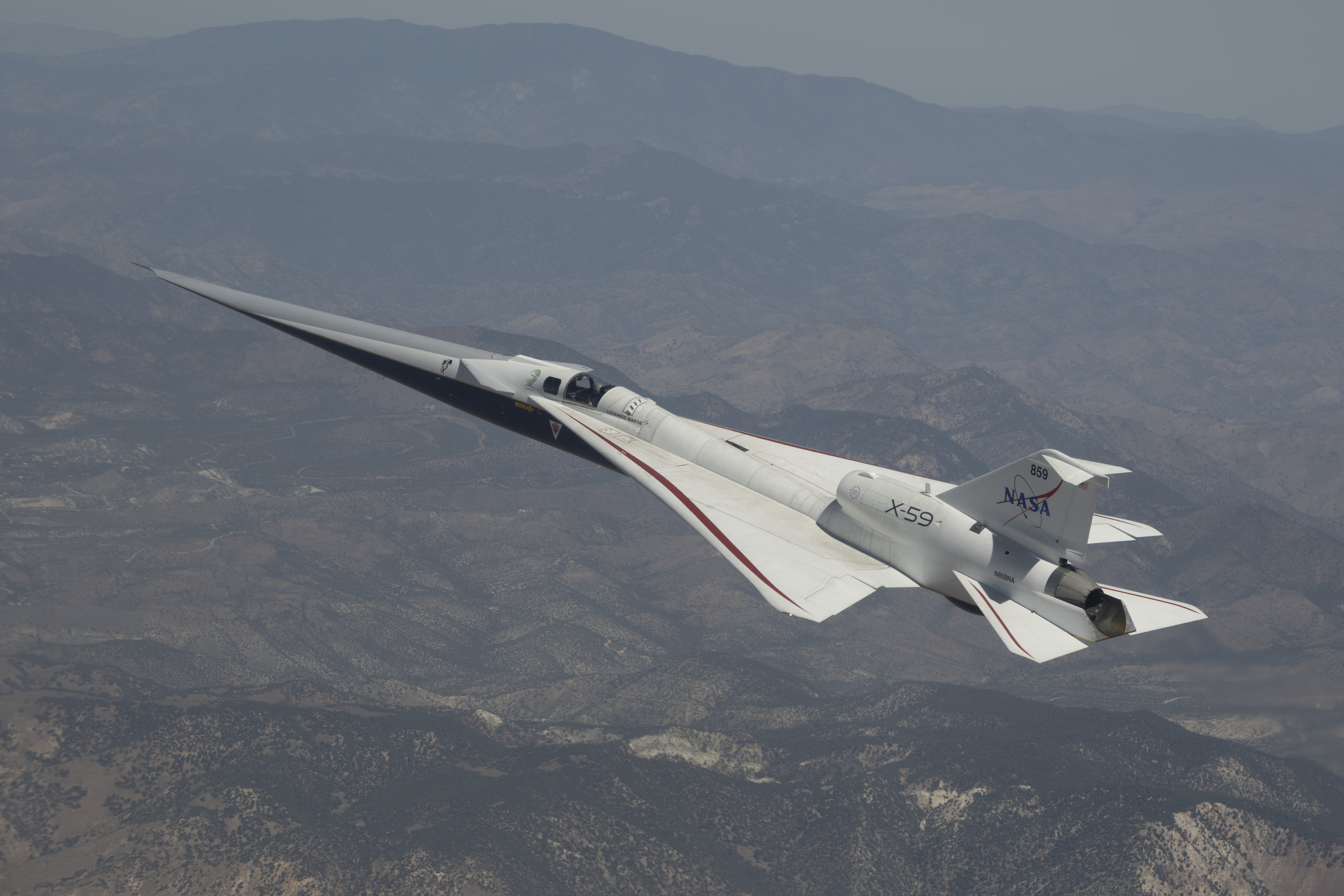
NASA’s X-59 quiet supersonic research aircraft flies above mountains near NASA’s Armstrong Flight Research Center in Edwards, California, on Tuesday, May 12, 2026. NASA continues expanding the aircraft’s flight envelope to evaluate how it performs across a range of flight conditions ahead of upcoming flight tests at speeds faster than the speed of sound in support of the agency’s Quesst mission.
NASA/Jim Ross
Next steps
During the X-59’s upcoming flights, pilots will run through test points while engineers watch the aircraft’s performance — but now in supersonic flight conditions.
“Flying at supersonic speeds is a major milestone for the X-59 team,” Bahm said. “Every step of envelope expansion brings us closer to demonstrating the quiet supersonic capability that is at the heart of the Quesst mission. Completing the first mission-conditions flight is especially meaningful – it’s the moment where we begin validating the aircraft in the environment it was designed for.”
In addition to reaching mission condition during this block of flight tests, the X-59 will also achieve its maximum speed of Mach 1.6 (1,218 mph) and altitude of 60,000 feet.
But just because the aircraft can go that fast doesn’t mean it always will fly supersonic. Testing will continue, including a mix of subsonic and lower-altitude flights so the team can continue monitoring it in varied conditions.
“These flights not only deepen our confidence in the X-59’s performance – they mark our progression toward the future phases of the mission that will ultimately help shape the future of supersonic travel,” Bahm said.
All flights so far and in the upcoming test block are part of Phase 1 of the X-59’s Quesst mission, focused on proving the performance and airworthiness of the aircraft. Some of those flights will include early deployment of equipment, including a probe mounted to one of NASA’s F-15 research aircraft that can measure the X-59’s unique shock wave signature.
Data gathered during those early probing flights will allow engineers to prepare for a new stage of work set to begin later this year: Quesst Phase 2, when teams will begin to measure the aircraft’s supersonic flight signature to verify that it’s producing a quiet supersonic thump, as designed.
“Aviation pioneer Otto Lilienthal said, ‘To design a flying machine is nothing. To build one is something. But to fly is everything.’ The 15 X-59 flights we’ve accomplished since March have been everything to this team and the mission,” Bahm said. “Every flight has pushed the boundaries of what’s possible, steadily expanding the envelope and strengthening our confidence in the aircraft.”
But, she said, rather than focusing on past progress, the team is already looking ahead.
“As we look ahead to the upcoming flights, we’re poised to open the envelope even further – moving boldly toward the mission test point this aircraft was built to achieve,” Bahm said. “Flying supersonic and reaching these milestones isn’t just progress; it’s the realization of years of perseverance, innovation, and teamwork. Each step brings us closer to Phase 2, and to the future of commercial supersonic flight.”