La NASA busca experimentos de estudiantes para remontarse en el segundo reto TechRise
La NASA hace un llamamiento a estudiantes de secundaria y preparatoria para que participen en el segundo reto estudiantil TechRise de la agencia, que invita a equipos de estudiantes a desarrollar, construir y lanzar experimentos científicos y tecnológicos en globos de gran altitud.
NASA Seeks Student Experiments to Soar in Second TechRise Challenge
NASA is calling on middle and high school students to join the second NASA TechRise Student Challenge, which invites student teams to develop, build, and launch science and technology experiments on high-altitude balloons.
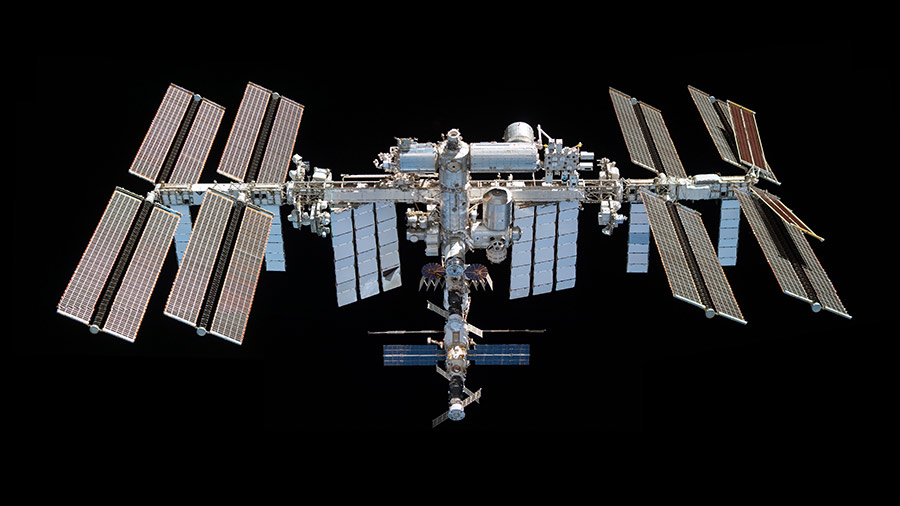
This mosaic depicts the space station pictured from the SpaceX Crew Dragon Endeavour on Nov. 8, 2021.
The International Space Station Multilateral Coordination Board met Friday, July 29, to discuss the status of the combined work aboard the microgravity laboratory. Partner representatives from NASA, the Canadian Space Agency, the European Space Agency, the Ministry of Education, Culture, Sports, Science and Technology of Japan / the Japan Aerospace Exploration Agency, and Roscosmos discussed a variety of topics including space station utilization, operations, and research, and transition planning and partnership in low-Earth orbit in the post-space station era. The board, tasked with coordinating the management of the space station, also discussed extension of space station operations beyond 2024. Each partner confirmed it will continue to work through respective government processes on station extension and utilization beyond 2024.
Biology, Botany Research on Station Promoting Healthy Humans
Astronaut Kjell Lindgren processes samples to explore the immunological aging of cells in microgravity possibly informing immun system therapies on Earth and in space.
Understanding how microgravity affects humans and plants is key to supporting not only astronauts on long-term space missions but also improving life on Earth. The Expedition 67 crew explored those very subjects today while also working on U.S. cargo activities and checking Russian spacewalking gear aboard the International Space Station.
NASA Flight Engineers Kjell Lindgren and Bob Hines worked a pair of different experiments on Tuesday with benefits for humans living on and off the Earth. Lindgren processed samples and explored how the immune system ages in microgravity to learn how to keep astronauts healthy on long term missions and treat immunity conditions on Earth. The two-time station visitor conducted the unique research operations using the Life Science Glovebox located in the Kibo laboratory module.
Hines replaced life support components inside the Plant Habitat, a space botany research device helping NASA and its international partners learn how to sustain crews on future missions to the Moon, Mars, and beyond. He worked in the Harmony module swapping carbon dioxide bottles and filters inside the Plant Habitat ensuring ongoing commercial and fundamental plant experiments in weightlessness.
Astronauts Jessica Watkins of NASA and Samantha Cristoforetti of ESA (European Space Agency) partnered together swapping cargo inside the SpaceX Dragon space freighter expected to depart the station in mid-August. Watkins also processed samples for an investigation exploring how space affects the skin healing process. Cristoforetti, on her second spaceflight, tested a specialized vest that wirelessly transmits health data then participated in a cognitive assessment aboard the orbiting lab.
Cosmonauts Oleg Artemyev and Denis Matveev continued maintenance on a pair of Russian Orlan spacesuits on Tuesday. The duo conducted leak checks and valve tests before testing the suit’s communications systems. Roscosmos Flight Engineer Sergey Korsakov photographed microbe samples growing inside the station’s Russian segment. Korsakov also continued ventilation maintenance inside the Nauka and Zvezda modules.