Following the Artemis I launch scrub Saturday from Launch Complex 39B at NASA’s Kennedy Space Center in Florida, the agency will hold a media briefing no earlier than 4 p.m. EDT on Saturday Sept. 3, to discuss mission status.
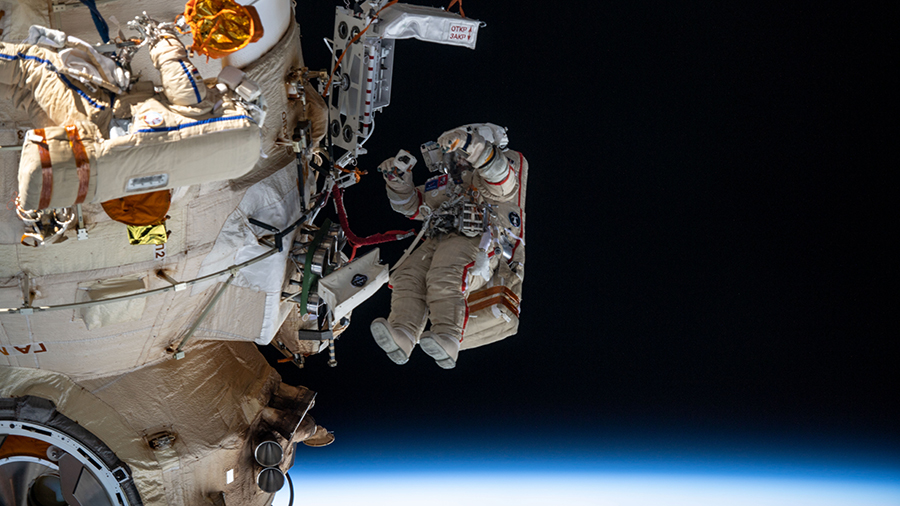
Spacewalkers Oleg Artemyev (bottom left) and Denis Matveev (right) extend the Russian Strela cargo crane from the Zarya module toward the Poisk module following work on the European robotic arm. Credit: NASA TV
Expedition 67 Commander Oleg Artemyev and Flight Engineer Denis Matveev, both of Roscosmos, concluded their spacewalk at 5:12 p.m. EDT after 7 hours and 47 minutes.
Artemyev and Matveev completed their major objectives, which included relocating an external control panel for the European robotic arm from one operating area to another and testing a rigidizing mechanism on the arm that will be used to facilitate the grasping of payloads. In addition, the duo extended a Strela telescoping boom from the Zarya module to the Poisk module.
Additional spacewalks are planned to continue outfitting the European robotic arm and to activate Nauka’s airlock for future spacewalks. The work on the European robotic arm will be used to move spacewalkers and payloads around the Russian segment of the station.
This was the eighth spacewalk in Artemyev’s career, and the fourth for Matveev. It was the eighth spacewalk at the station in 2022 and the 253rd spacewalk for space station assembly, maintenance, and upgrades.
Three impact craters are displayed in this three-dimensional perspective view of the surface of Venus taken NASA’s Magellan, the first deep space probe launched by a space shuttle.
Crew Preps for Friday Spacewalk and Conducts Skin Healing Research
Roscosmos cosmonauts (from left) Denis Matveev and Oleg Artemyev are pictured during a spacewalk on April 18, 2022, to configure the European robotic arm.
Two cosmonauts are finalizing preparations for a spacewalk to configure the European robotic arm (ERA) for payload operations on the outside of the International Space Station. The rest of the Expedition 67 crew is continuing to research how to heal wounds in the microgravity environment.
Roscosmos Commander Oleg Artemyev and Flight Engineer Denis Matveev have been given the go to exit the space station’s Poisk airlock on Friday at 9:20 a.m. EDT beginning a spacewalk to continue outfitting Europe’s robotic arm. The duo was joined today by Flight Engineer Sergey Korsakov for a final procedures review and last minute Orlan spacesuit checks ahead of the planned six-hour spacewalk.
The spacewalkers will complete the tasks left unfinished during the previous spacewalk that took place on Aug. 17. The tasks Artemyev and Matveev are scheduled to complete include relocating the ERA’s external control panel and testing the arm’s ability to grasp payloads. Korsakov will help the two cosmonauts in and out of their spacesuits, monitor the spacewalking activities, and maneuver the ERA on Friday.
The orbiting lab’s four other astronauts spent the entire day in the Kibo laboratory module learning how to heal wounds in weightlessness. A key characteristic of living and working in space is the accelerated aging of skin that astronauts experience. Researchers are studying those molecular processes and how they affect the healing process potentially advancing wound treatments both in space and on Earth.
Using Kibo’s Life Science Glovebox, NASA astronauts Kjell Lindgren, Bob Hines, and Jessica Watkins, along with Samantha Cristoforetti of ESA (European Space Agency) practiced surgical techniques including biopsies, suture splints, and wound dressing. The quartet will continue the biomedical research on Friday helping NASA and its international partners keep astronauts safe and healthy on long-term space missions while improving health conditions on Earth.
NASA, NOAA Invite Media to Polar Orbiting Weather Satellite Launch
NASA is accepting media requests for launch coverage of the National Oceanic and Atmospheric Administration (NOAA) Joint Polar Satellite System-2 (JPSS-2) satellite. This is the third satellite in the JPSS series, which will capture data to improve weather forecasts, helping scientists predict and prepare for extreme weather events and climate chan