Deputy director for technology and research investments at NASA’s Goddard Space Flight Center, Dr. Christyl Johnson, speaks during a panel discussion as part of a Women’s History Month program, “Celebrating Women Who Tell Our Stories,” Wednesday, March 22, 2023.
Crew Focuses on Experiments and Equipment to Maintain Health While in Space
The southern coast of Turkey on the Mediterranean Sea near Syria is pictured from the International Space Station as it orbited 264 miles above on Feb. 14, 2023.
The Expedition 68 crew members conducted experiments and maintained equipment aboard the International Space Station while activities for cargo transfers continued.
NASA Flight Engineer Frank Rubio performed microscopy and video recordings on eight BioCell tissue chambers for the Cardinal Heart 2.0 in the Life Sciences Glovebox. This investigation uses heart organoids to test whether clinically approved drugs reduce microgravity-induced changes in heart cell function. Rubio also removed the Advanced Resistive Exercise Device’s (ARED) cylinder flywheel and inspected the treadmill as part of monthly maintenance. The ARED exercises all major muscle groups while focusing on the primary resistive exercise: squats, deadlifts, and heel raises. Crew members exercise daily on ARED to maintain preflight muscle and bone strength during long periods in space.
Flight Engineer Sultan Alneyadi from UAE (United Arab Emirates) recorded a video of Cardinal Heart 2.0 tissue chambers. The investigation tests clinically approved pharmaceutical drugs to reverse the negative effects on heart cells and tissues caused by prolonged exposure to the space environment. Afterward, Alneyadi removed the Bio-Monitor garment and headband and synchronized the unit to the controller for data transfer. Alneyadi donned the Dry-EEG Headband overnight for sleep studies in space. Considering the central role of sleep in human behavior and health, sleep quality is a key factor for current and future exploration missions. The investigation monitors crew members’ quality of sleep by measuring duration, sleep stages, heart rate, and the number of awakenings.
Additionally, Rubio and Alneyadi spent the evening continuing to transfer the 6,200 pounds of research hardware and supplies between the space station and the uncrewed SpaceX CRS-27, which arrived at the orbital outpost on March 16.
Flight Engineer Andrey Fedyaev of Roscosmos continued to replace the condensate evacuation lines that carry away excess moisture from the cabin atmosphere. Meanwhile, Roscosmos cosmonauts Sergey Prokopyev and Dmitri Petelin prepared cargo to return in the Soyuz MS-22 spacecraft, slated to undock from the station’s Rassvet module on March 28.
Crew Spends Day Investigating Astrobiology and Continuing Cargo Operations
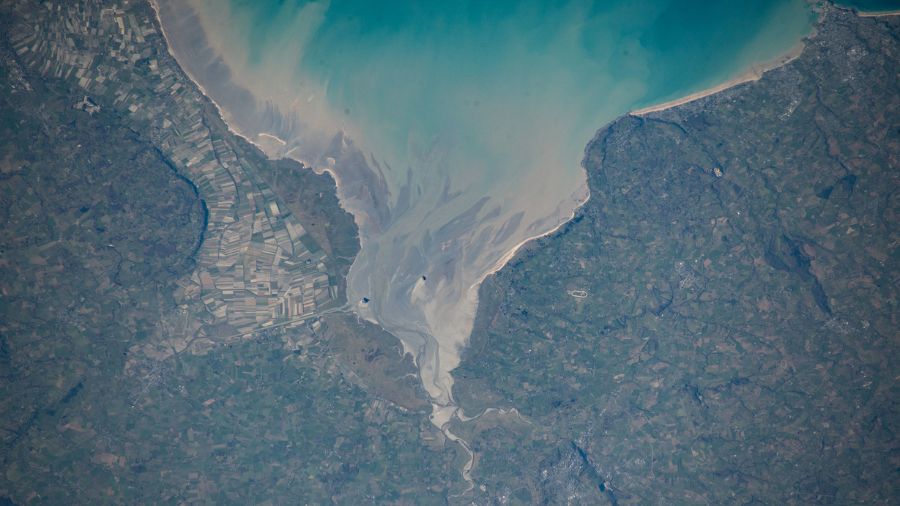
The northwestern coastal regions of Brittany and Normandy in France meet on the English Channel in this photograph from the International Space Station as it orbited 264 miles above on Feb. 12, 2023.
The Expedition 68 crew members are busy investigating astrobiology and continuing to transfer the 6,200 pounds of research hardware and supplies between the International Space Station and the uncrewed SpaceX CRS-27, which arrived to the space station on March 16.
NASA flight engineer Frank Rubio conducted the Cardinal Heart 2.0 media change and sample collection operations in the Life Sciences Glovebox, a sealed work area in the space station where crew members perform developmental biology experiments. The investigation will test whether clinically approved drugs reduce microgravity-induced changes. Microgravity exposure can cause changes in heart cell function and gene expression that may lead to long-term damage or muscle atrophy.
NASA flight engineer Woody Hoburg took over the operations after participating in a cell biology experiment and collecting water samples from the potable water dispenser. The water recycling system reclaims wastewater into potable drinking water aboard the orbiting laboratory.
Flight Engineer Sultan Alneyadi from UAE (United Arab Emirates) installed rhodium science chambers in the variable gravity simulator for the Rhodium DARPA Biomanufacturing 01 investigation. Results may help reduce the costs of future missions by improving space biomanufacturing, the process of using microbes in the space station to produce materials and biomolecules like biopolymers, food, and pharmaceuticals.
Flight Engineer Andrey Fedyaev of Roscosmos spent the evening replacing the condensate evacuation lines that carry away excess moisture from the cabin atmosphere. Meanwhile, Roscosmos cosmonauts Sergey Prokopyev and Dmitri Petelin spent the day performing an eye ultrasound exam with a remote guide after gathering cargo items to return in the Soyuz MS-22 spacecraft, slated to undock from the station’s Rassvet module on March 28.