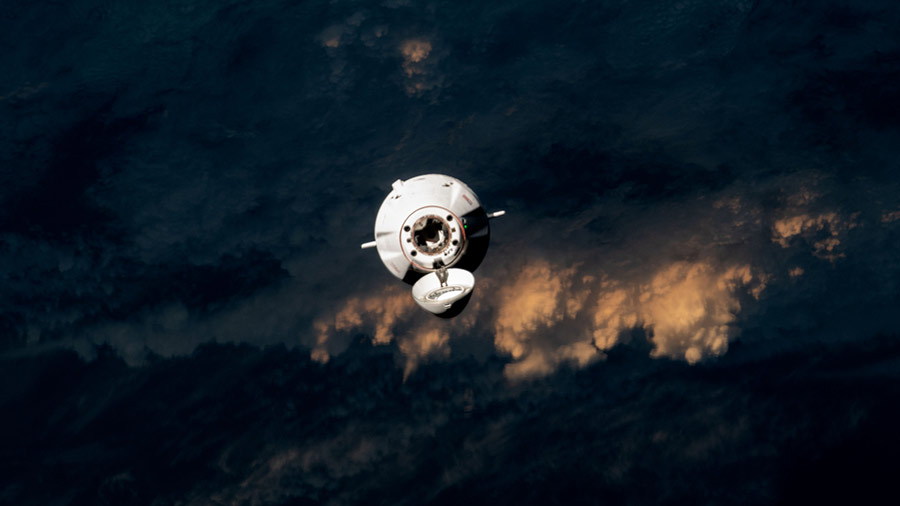
The last rays of an orbital sunset illuminate the cloud tops above the Pacific Ocean off the coast of Japan, providing a dramatic background for the SpaceX CRS-28 Dragon cargo craft as it approached the International Space Station for docking on June 6, 2023.
Astronauts Make Final Preparations for Friday’s Spacewalk
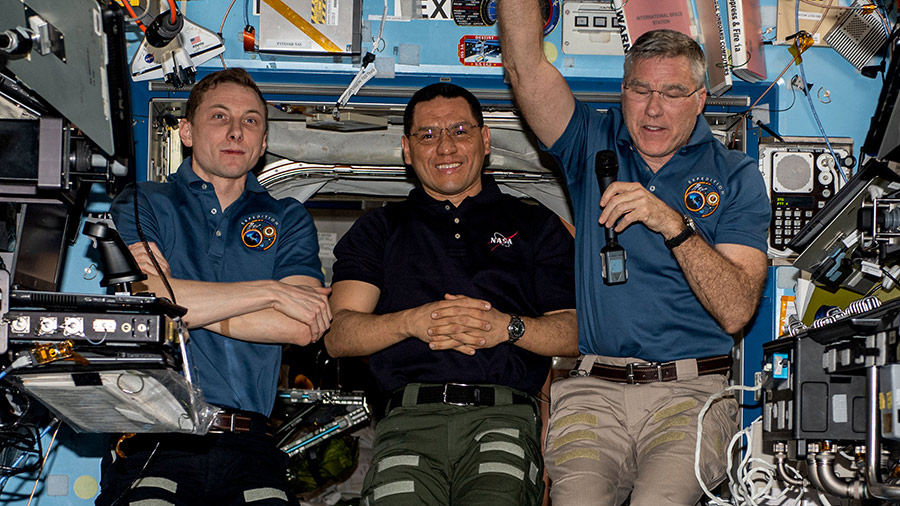
NASA astronauts (from left) Woody Hoburg, Frank Rubio, and Stephen Bowen talk to elementary and junior high school students on Earth.
Four Expedition 69 astronauts are making final preparations ahead of Friday’s spacewalk to continue upgrading the International Space Station’s power generation system. Meanwhile, the orbital outpost’s three cosmonauts focused on heart research and plasma physics while ensuring station systems remain in tip-top shape.
NASA Flight Engineers Stephen Bowen and Woody Hoburg are scheduled to set their Extravehicular Mobility Units (EMUs), or spacesuits, to battery power at 9:15 a.m. EDT on Friday officially beginning a spacewalk to install roll-out solar arrays on the station’s starboard truss structure. Ahead of the spacewalk, the duo staged their EMUs and spacewalking tools inside the Quest airlock where they will exit the station into the vacuum of space. The two astronauts were also joined by Flight Engineers Frank Rubio of NASA and Sultan Alneyadi of UAE (United Arab Emirates) for a final review of their spacewalking tasks and robotic support procedures. Rubio and Alneyadi will assist Bowen and Hoburg from inside the station on Friday.
The roll-out solar arrays arrived on Tuesday after the SpaceX Dragon cargo vehicle docked to the orbital lab following its Monday launch. Ground engineers on Wednesday remotely-commanded the Canadarm2 robotic arm to remove the solar arrays from Dragon’s unpressurized trunk and attach them to a pallet on the starboard truss in preparation for Friday’s installation spacewalk. This will be the station’s fifth roll-out solar array improving its power-generating capability by 30%.
On the Roscosmos side of the space station, Commander Sergey Prokopyev and Flight Engineer Dmitri Petelin partnered together for a long-running study into the effects of weightlessness on the human heart. Prokopyev later disconnected hardware that supported a plasma study that explores electrically-charged micro-particles such as electrons, ions, and neutral gases. Petelin investigated ways to improve communications with international crews and mission controllers from around the world. Flight Engineer Andrey Fedyaev worked throughout the day on computer and power systems maintenance.
Dragon Delivers Solar Arrays Setting Up Friday’s Spacewalk
The SpaceX Dragon cargo craft approaches the station for an automated docking above the Pacific Ocean off the coast of Japan on June 6, 2023.
Expedition 69 crew members have opened the hatch to the SpaceX Dragon cargo craft and begun unpacking several tons of cargo packed inside. Stowed inside the resupply ship is a pair of roll-out solar arrays that will soon be removed for installation on the International Space Station during the next spacewalk.
Dragon craft docked to the orbital outpost’s Harmony module at 5:54 a.m. EDT on Monday less than a day after launching from NASA’s Kennedy Space Center. Dragon’s hatch was opened less than two hours later following the completion of standard air and pressure leaks. Soon after, Flight Engineers Frank Rubio, Stephen Bowen, and Woody Hoburg, all from NASA, and Sultan Alneyadi from UAE (United Arab Emirates) entered Dragon and began offloading some of the more than 7,000 pounds of science experiments, station hardware, and crew supplies packed inside.
Controllers on the ground will also command the Canadarm2 robotic arm to extract a pair of roll-out solar arrays stowed inside Dragon’s unpressurized trunk. The remotely-controlled Canadarm2 will gently maneuver the solar arrays and temporarily stow them on a pallet attached to the station’s starboard-side truss structure. The robotic transfer work prepares the solar arrays for installation and activation on the starboard truss structure during a spacewalk planned to start at 9:15 a.m. on Friday.
Bowen and Hoburg will be the two spacewalkers installing the station’s fifth set of roll-out solar arrays on Friday. The two astronauts began Wednesday morning organizing tools and reviewing the procedures they will use during the seven-hour spacewalk. Rubio and Alneyadi, who will assist the spacewalkers from inside the station, also participated in the tool work and procedure reviews. The quartet will get back together on Thursday for final preparations including a last look at the spacewalk procedures, a final robotics review, and a conference with mission specialists on the ground.
In the midst of Wednesday’s spacewalk preparations, the four astronauts fit in other duties including running science experiments and maintaining lab operations. Bowen set up standard optometry gear found in a doctor’s office on Earth and imaged Hoburg’s eyes for a human research study. Rubio continued unpacking Dragon while Alneyadi conducted test runs of an Astrobee robotic free-flying assistant.
The station’s three cosmonauts had their day full of research, electronics maintenance, and cargo duties in the Roscosmos segment of the orbiting lab. Commander Sergey Prokopyev and Flight Engineer Andrey Fedyaev took turns wearing a cap packed with sensors that monitored their brain activity while practicing futuristic robotic and spacecraft piloting techniques on a computer. Flight Engineer Dmitri Petelin worked throughout the day testing power and data cables in the Zvezda service module before transferring cargo from the ISS Progress 84 space freighter.
NASA Awards $5 Million to Women’s Colleges Tackling STEM Gender Gap
As part of a Biden/Harris initiative, NASA will award more than $5 million in funding to seven Women’s Colleges and Universities (WCUs) to research and develop strategies that increase retention of women in STEM degree programs and careers.
NASA Invites Media to View Asteroid Sample Recovery Rehearsal
NASA invites media to attend the first major asteroid sample recovery rehearsal for its OSIRIS-REx (Origins, Spectral Interpretation, Resource Identification, and Security – Regolith Explorer) mission on Tuesday, June 27, to Thursday, June 28, at Lockheed Martin in Littleton, Colorado.