NASA Selects Futuristic Space Technology Concepts for Early Study
An astronaut steps into a body scanner and, hours later, walks on Mars in a custom-made spacesuit, breathing oxygen that was extracted from Mars’ carbon dioxide-rich atmosphere.
This striking image from the NASA/ESA Hubble Space Telescope showcases Arp 298, a stunning pair of interacting galaxies. Arp 298 – which comprises the two galaxies NGC 7469 and IC 5283 – lies roughly 200 million light-years from Earth in the constellation Pegasus.
Station Gears Up for Spacewalks While Conducting Cancer Research
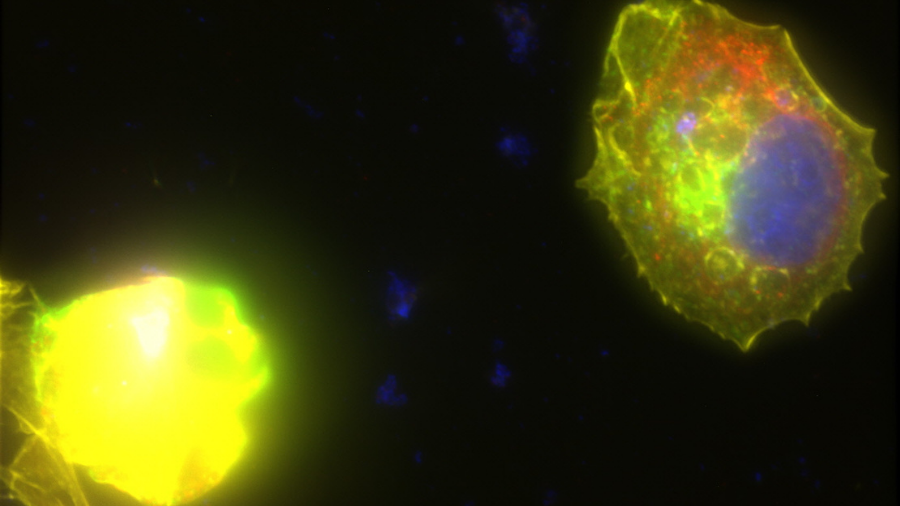
This image shows immunofluorescence of breast cancer cells treated with a MicroQuin therapeutic. Staining shows a normal nucleus (blue) and the therapeutic (green) localized to the cell’s endoplasmic reticulum (red). The drug forces the cytoskeleton (yellow) to collapse, inducing cell death. Credits: Scott Robinson, MicroQuin.
Spacewalk preparations and cancer research were among the activities scheduled aboard the International Space Station on Thursday. The Expedition 66 crew also unpacked a U.S. cargo craft and explored using virtual reality while exercising.
NASA astronauts Raja Chari and Kayla Barron began readying the U.S. Quest airlock and collecting tools ahead of a pair of spacewalks planned for mid-March. The duo also reviewed step-by-step spacewalk procedures on a computer using 3D graphics. NASA is continuing to set up the space station’s truss structure for a third set of roll out solar arrays augmenting the orbiting lab’s power system.
Chari earlier partnered with ESA (European Space Agency) Flight Engineer Matthias Maurer investigating how living in space affects visual function. NASA Flight Engineer Thomas Marshburn assisted the duo with the research in the morning before spending the afternoon troubleshooting components on the COLBERT treadmill. Maurer ended his day wearing virtual reality goggles while pedaling on an exercise cycle to learn how to improve the work out experience in space.
A new cancer study started this week after arriving aboard the Cygnus space freighter on Monday. NASA Flight Engineer Mark Vande Hei set up the Life Science Glovebox on Wednesday and began observing tumor cells shipped inside a Cygnus science freezer. On Thursday, Vande Hei continued servicing those samples to better understand the onset and progression of cancer and potentially improve treatments on Earth.
Commander Anton Shkaplerov of Roscosmos was back on plasma physics research Thursday and also transferred cargo from Russia’s ISS Progress 80 cargo craft. Flight Engineer Pyotr Dubrov inspected Russian station modules before exploring ways to maximize space exercise. The duo rounded out the day with eye scans using the Ultrasound 2 device with remote guidance from doctors on the ground.
Crew Kicks Off Skin Aging, Cancer Research and Unloads New Cargo Craft
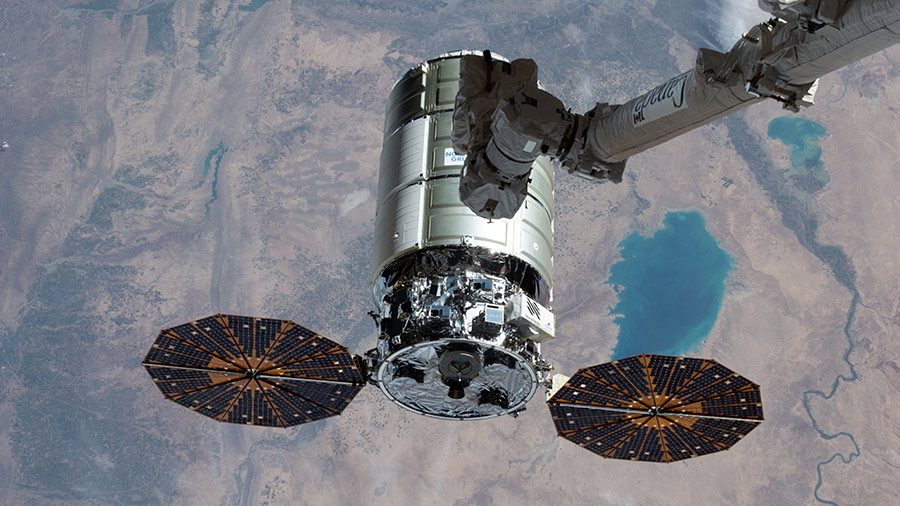
The Cygnus space freighter is pictured moments away from being captured with the Canadarm2 robotic arm above northern Iraq on Feb. 21, 2022.
New human research is underway aboard the International Space Station using the microgravity environment to gain unique insights into aging skin cells and cancer tumors. The Expedition 66 crew also continues to unpack cargo from a U.S. cargo craft while keeping up with eye checks to ensure the crew stays healthy in space.
Weightlessness provides scientists a unique opportunity to observe phenomena not possible in Earth’s gravity. Biology including microbes, plants, and humans, changes in response to microgravity and observations are helping NASA plan longer missions farther into space. Doctors on Earth also use the information to improve numerous treatments and conditions on the ground.
Two new biology experiments delivered on Monday aboard the Cygnus space freighter are already being activated on the orbital lab. NASA Flight Engineer Thomas Marshburn set up the Microgravity Science Glovebox and began exploring the cellular and molecular alterations taking place in samples of skin cells. NASA Flight Engineer Mark Vande Hei is observing tumor cells in the Life Science Glovebox to better understand the onset and progression of cancer. Both investigations have the potential to inform space research techniques and improve therapies on Earth.
Astronauts Raja Chari of NASA and Matthias Maurer of ESA (European Space Agency) worked throughout Wednesday continuing to offload the 8,300 pounds of cargo delivered Monday inside Cygnus. NASA Flight Engineer Kayla Barron Barron deactivated space botany hardware then photographed cotton cell samples being harvested for the Plant Habitat-05 space agriculture study.
Working in the orbiting lab’s Russian segment, Commander Anton Shkaplerov studied plasma physics while Flight Engineer Pyotr Dubrov recorded his heart activity wearing a portable electrocardiogram. The duo from Roscosmos then wrapped up the day with more eye and retina checks using medical imaging gear.