Four Crewmates Prepare to Leave Station in Dragon Live on NASA TV
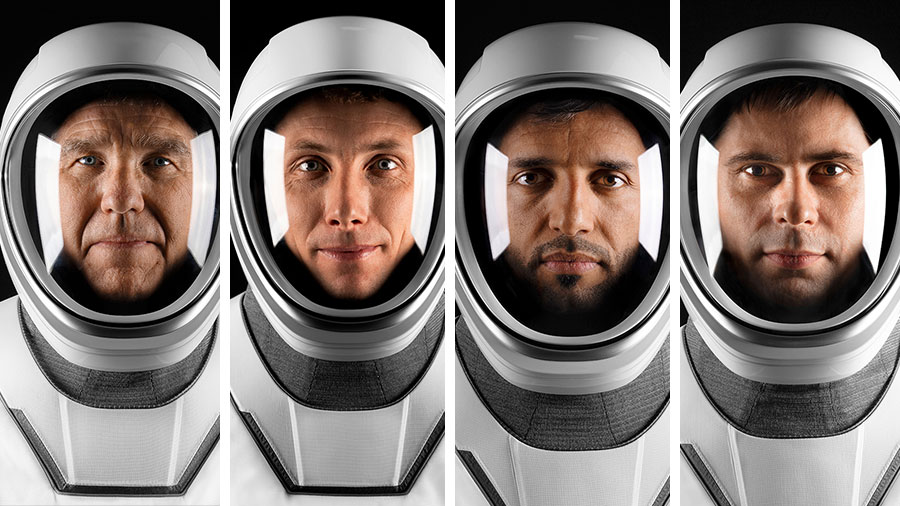
From left, are SpaceX Crew-6 Mission Specialist Andrey Fedyaev, Commander Stephen Bowen, Pilot Woody Hoburg, and Mission Specialist Sultan Alneyadi. Credit: SpaceX
Watch live coverage now on NASA TV, the NASA app and the agency’s website as hatch closure and undocking preparations are underway for the return of NASA’s SpaceX Crew-6 mission.
NASA astronauts Stephen Bowen and Woody Hoburg, along with UAE (United Arab Emirates) astronaut Sultan Alneyadi and Roscosmos cosmonaut Andrey Fedyaev are in the process of boarding the SpaceX Dragon for departure from the International Space Station.
Crew-6 is targeting a return to Earth at about 12:07 a.m. EDT Monday, Sept. 4, with a splashdown off the coast of Florida. The Dragon spacecraft, named Endeavour, is scheduled to undock from the International Space Station at 7:05 a.m. EDT Sunday, Sept. 3 to begin the journey home.
Dragon will autonomously undock, depart the space station, and splash down off the coast of Florida. Endeavour also will return important and time-sensitive research to Earth.
Coverage Set as NASA’s SpaceX Crew-6 Prepares for Splashdown
NASA will provide coverage of the agency’s SpaceX Crew-6 mission return to Earth from the International Space Station, beginning with hatch closure coverage live at 5 a.m. EDT on Sunday, Sept. 3.
The official SpaceX Crew-6 portrait with (from left), Mission Specialist and UAE (United Arab Emirates) astronaut Sultan Alneyadi; Pilot Woody Hoburg and Commander Stephen Bowen, both NASA astronauts; and Mission Specialist and Roscosmos cosmonaut Andrey Fedyaev.
NASA and SpaceX met Friday evening to continue close evaluations of weather conditions around Florida’s coastline as they consider the best options for Crew-6 to return to Earth. Teams are working toward an undocking opportunity of no earlier than 7:05 a.m. EDT on Sunday, Sept. 3, with the first potential splashdown opportunity no earlier than 12:07 a.m. on Monday, Sept. 4. Teams are proceeding to the next weather briefing scheduled for Saturday morning to continue assessing weather for the primary target. Additional undock and splashdown opportunities are available early next week if weather conditions continue to be unfavorable over the weekend.
The Dragon spacecraft, named Endeavour, remains healthy while currently docked to the International Space Station. Dragon has been cleared for departure and re-entry by the space station and Dragon mission management teams. Pre-departure checkouts of the spacecraft were conducted Friday with normal performance across all systems. Operations teams are not working any major issues and there are currently no constraints to flight.
For the current undocking opportunity, NASA TV coverage can be found of the agency’s television schedule.
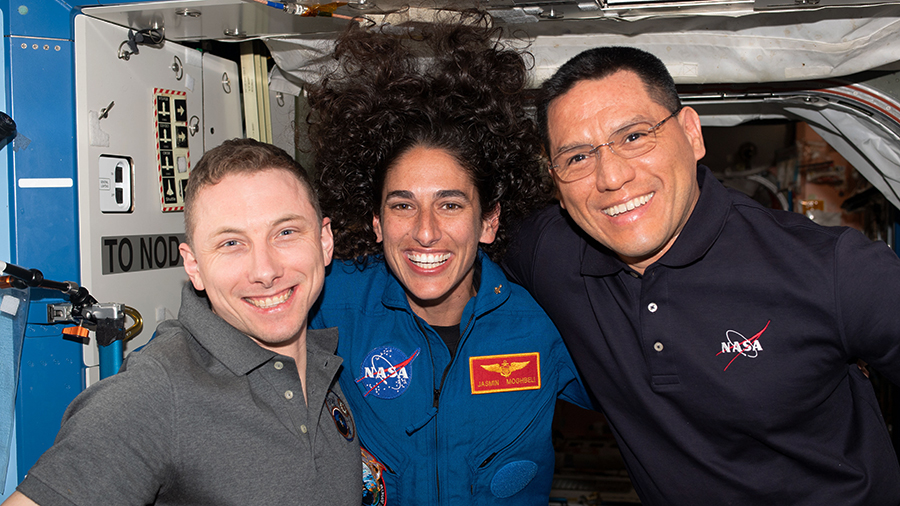
NASA astronauts Woody Hoburg, Jasmin Moghbeli, and Frank Rubio pose for a portrait aboard the International Space Station. The three crewmates were selected as part of NASA’s 2017 class of astronauts.
The Expedition 69 crew is expected to split up soon when four flight engineers return to Earth aboard the SpaceX Dragon Endeavour spacecraft. Meanwhile, all crew members on the International Space Station spent Friday keeping up their orbital research and maintenance tasks.
Unfavorable weather conditions off the coast of Florida have pushed back Saturday’s planned undocking and splashdown of four station crew members at least 24 hours. Mission managers from SpaceX and NASA are now targeting the undocking of Endeavour with four crewmates inside for no earlier than 7:05 a.m. EDT on Sunday.
Endeavour, commanded by Stephen Bowen and piloted by Woody Hoburg, both NASA astronauts, is targeted to splash down in the waters off Florida’s coast at 12:07 a.m. on Monday. Flanking the NASA duo during the 19-hour ride back to Earth will be UAE (United Arab Emirates) astronaut Sultan Alneyadi and Roscosmos cosmonaut Andrey Fedyaev. The quartet will be completing a six-month space research mission that began with a launch from NASA’s Kennedy Space Center on March 2.
New station flight engineers Jasmin Moghbeli of NASA, Andreas Mogensen of ESA (European Space Agency), Satoshi Furukawa of JAXA (Japan Aerospace Exploration Agency), and Konstantin Borisov of Roscosmos have been familiarizing themselves with station systems all week. They are turning their attention now to full-time science, cargo, and health activities having been living on the space station since Aug. 27.
Moghbeli transferred research samples to science freezers that will be returned to Earth inside the Endeavour spacecraft with the departing crewmates. Mogensen set up a pair of Kubik research incubators that support studies of seeds, cells, and small mammals inside the Columbus laboratory module. Furukawa worked in the Kibo laboratory module removing a microbiology experiment from a research incubator that can generate artificial gravity. Finally, Borisov unpacked cargo from the Roscosmos Progress 85 cargo craft and tested ways future crews might pilot spacecraft and robots on planetary missions.
The space station’s other three crewmates are due to leave the orbital lab at the end of September completing just over one year orbiting Earth. In the meantime, the trio from NASA and Roscosmos has continued its research and lab upkeep tasks. Astronaut and Flight Engineer Frank Rubio configured and stowed emergency masks and had his eyes scanned by Mogensen using standard medical imaging hardware. Cosmonaut and Commander Sergey Prokopyev partnered with Borisov for the Progress 85 cargo unpacking duties. Flight Engineer Dmitri Petelin also participated in the futuristic piloting study, then inspected windows in the Zvezda service module, and inventoried cargo in the Poisk module.
NASA to Discuss Psyche Asteroid Mission, Optical Communications Demo
NASA will host a news conference at 1 p.m. EDT Wednesday, Sept. 6, to discuss the agency’s upcoming Psyche mission, which will be its first to visit a metal-rich asteroid. Riding along with Psyche is a laser transceiver for NASA’s Deep Space Optical Communications (DSOC) technology demonstration.