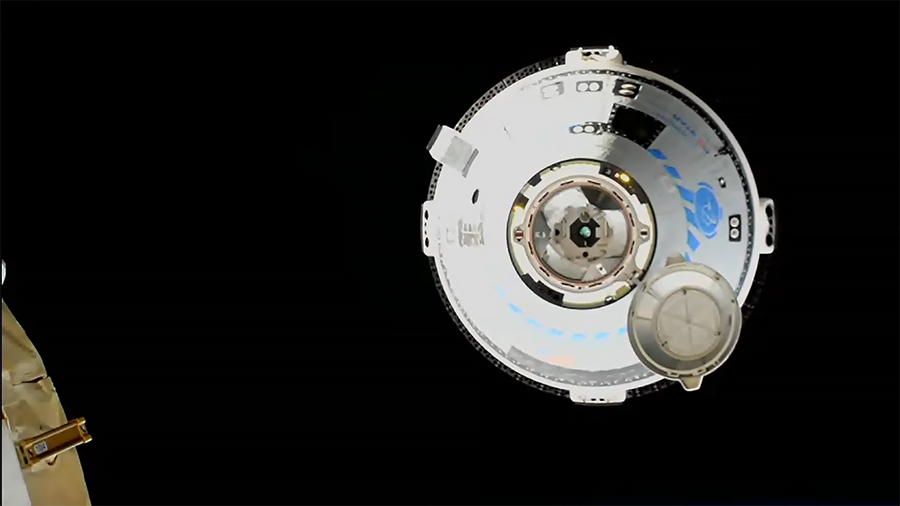
Boeing’s Starliner spacecraft approaches the International Space Station on the Orbital Flight Test-2 mission. Credit: NASA TV
Starliner is continuing a methodical march toward the International Space Station with an updated docking time of 7:57 p.m. EDT. Live coverage continues on NASA Television, the NASA app, and the agency’s website.
The updated time for docking will enable flight controllers to process navigation data and ensure that Starliner remains on a precise track to link up to the forward port of the Harmony module.
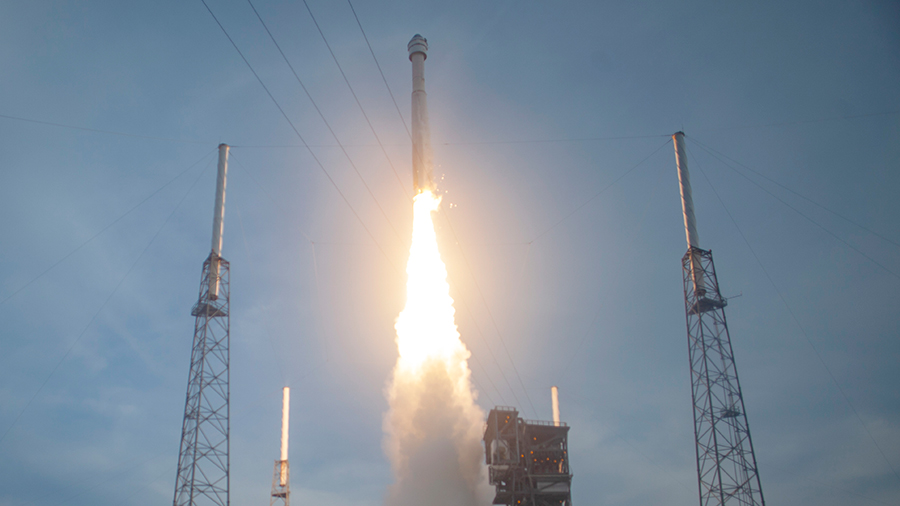
Boeing’s Starliner spaceship launches atop the United Launch Alliance Atlas-V rocket from Cape Canaveral Space Force Station in Florida on May 19, 2022. Credit: United Launch Alliance
Boeing’s CST-100 Starliner is proceeding toward the International Space Station on the NASA-Boeing Orbital Flight Test-2 (OFT-2).
Boeing and NASA met as an International Space Station Mission Management Team (IMMT) this afternoon to review the status of the flight test and approved a plan to proceed toward the final phase of rendezvous and docking, which remains scheduled at for 7:10 p.m. EDT.
Docking broadcast coverage begins at 3:30 p.m. ET on NASA Television, the NASA app, and the agency’s website.
Friday, May 20
3:30 p.m. – NASA TV rendezvous and docking coverage begins.
7:10 p.m. (approximately) – Docking
Saturday, May 21
11:30 a.m. – NASA TV hatch opening coverage begins
11:45 a.m. – (approximately) Hatch opening and welcoming remarks
Starliner successfully executed all of its autonomous demonstration burns as well as rendezvous and docking maneuvers, including:
An abort maneuver demonstration
Reaction Control System (RCS) attitude hold demonstration
Abort execution maneuvers
Phasing burn
Far-field demonstration
Vision-based, Electro-Optical Sensor Tracking Assembly (VESTA) system checkout
NASA Docking System (NDS) cover open and system checkout
Flight control teams continue to learn more about the vehicle and about how it is operating in space, and it continues to perform well as it makes its way toward the station. The Guidance, Navigation and Control (GN&C) systems are performing nominally. Flight software is executing as designed. Power generation is positive. The spacecraft has good link connection with TDRS for commanding of the vehicle. Teams are investigating off-nominal behavior of a thermal cooling loop, however, the thermal subsystem is maintaining stable temperatures.
The teams also looked into the two Orbital Maneuvering and Attitude Control (OMAC) thrusters that shut off early during the orbital insertion (OI) burn. The teams have concluded that a chamber drop in pressure caused the cutoff. That system operated normally during all of the propulsion system demonstrations, and with redundancies in place, does not pose a risk to the rest of the flight test.
Starliner Launches to Space Station on Uncrewed Flight Test for NASA
Boeing’s CST-100 Starliner is in orbit, heading for the International Space Station following launch Thursday of the next-generation spacecraft on a United Launch Alliance (ULA) Atlas V rocket on a mission designed to test the end-to-end capabilities of the crew-capable system as part of NASA’s Commercial Crew Program.
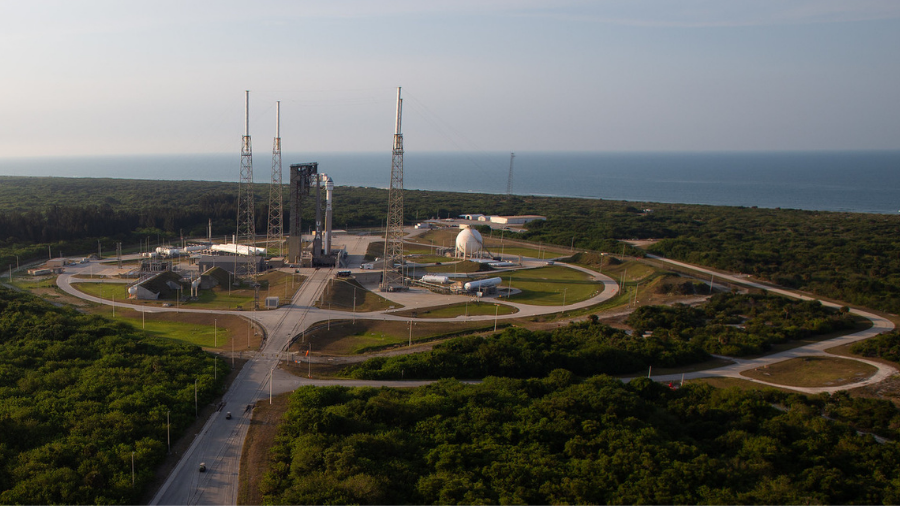
A United Launch Alliance Atlas V rocket with Boeing’s CST-100 Starliner spacecraft aboard is seen on the launch pad at Space Launch Complex 41 ahead of the Orbital Flight Test-2 mission. Credit: NASA/Joel Kowsky.
Launch preparations are proceeding toward a liftoff of Boeing’s CST-100 Starliner spacecraft on a United Launch Alliance Atlas V rocket on a flight test to the International Space Station at 6:54 p.m. on Thursday, May 19.
Watch on NASA Television, the NASA app, and the agency’s website.
Known as Orbital Flight Test-2 (OFT-2), this is the second uncrewed flight for Boeing’s Starliner spacecraft as part of the agency’s Commercial Crew Program. OFT-2 will demonstrate the end-to-end capabilities of the Starliner spacecraft and Atlas V rocket from launch to docking to a return to Earth in the desert of the western United States. The mission will provide valuable data toward NASA certifying Boeing’s crew transportation system for regular flights with astronauts to and from the space station.