Crew Studies Fire in Microgravity, Tests a Medical Device, and Transfers Cargo from Dragon

Crew Studies Fire in Microgravity, Tests a Medical Device, and Transfers Cargo from Dragon
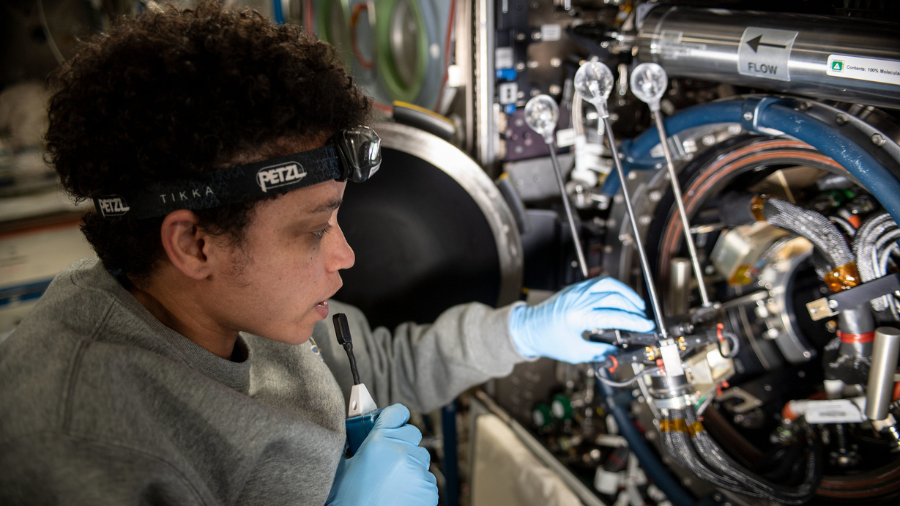
Expedition 67 Flight Engineer and NASA astronaut Jessica Watkins services components that support the Solid Fuel Ignition and Extinction (SOFIE) fire safety experiment inside the International Space Station's Combustion Integrated Rack on June 24, 2022.
Expedition 67 Flight Engineer and NASA astronaut Jessica Watkins services components that support the Solid Fuel Ignition and Extinction (SOFIE) fire safety experiment inside the International Space Station’s Combustion Integrated Rack on June 24, 2022.

The seven-member Expedition-67 crew split their time studying burning in microgravity, space manufacturing, testing an ultrasound device, and more, in addition to conducting some maintenance work aboard the International Space Station.

NASA Flight Engineer Jessica Watkins focused on setting up the Combustion Integrated Rack inside the U.S. Destiny laboratory module to support the operations for the SoFIE-GEL, or Solid Fuel Ignition and Extinction – Growth and Extinction Limit, study. The investigation measures the amount of heating in a fuel sample to determine how fuel temperature affects material flammability. Results could improve understanding of early fire growth behavior and help determine optimal fire suppression techniques, improving crew safety in future space facilities.

NASA Flight Engineer Kjell Lindgren opened the Cell Biology Experiment Facility to set up the Rodent Research-22 experiment. He also completed a Robotic On-Board Trainer for Research (ROBoT-r) session as part of the Behavioral Core Measures experiment. Later in the day, Lindgren performed the fourth medical technology demonstration of the Butterfly IQ Ultrasound device, focused on testing the effectiveness of a portable ultrasound device used in conjunction with a mobile device in the space environment. Such commercial off-the-shelf technology could provide essential medical capabilities for future deep space exploration missions.

ESA (European Space Agency) Flight Engineer Samantha Cristoforetti conducted public affairs activities for ESA and moved cargo from the SpaceX CRS-25 Dragon spacecraft. NASA Flight Engineer Bob Hines worked on the Genes in Space-9 investigation,  Space Fibers-3 space manufacturing study, and transferred supplies from the Dragon spacecraft.

The station’s three cosmonauts focused mainly on maintenance and exercise. Commander Oleg Artemyev spent his morning searching for leaks in the Zvezda service module while cosmonaut Sergey Korsakov checked the brakes on the European Robotic Arm. Cosmonaut Denis Matveev set up an electrocardiogram for a 24-hour survey of his heart health. He rested for 20 minutes before using the Tranquility module’s advanced resistive exercise device (ARED) to perform exercises such as bench presses, squats, and deadlifts.


Learn more about station activities by following the space station blog, @space_station and @ISS_Research on Twitter, as well as the ISS Facebook and ISS Instagram accounts.

Get weekly video highlights at: http://jscfeatures.jsc.nasa.gov/videoupdate/

Get the latest from NASA delivered every week. Subscribe here: www.nasa.gov/subscribe

Get The Details…

Heidi Lavelle

Powered by WPeMatico

Crew’s Wednesday Schedule Focuses on Exercise, Science, and Maintenance

Crew’s Wednesday Schedule Focuses on Exercise, Science, and Maintenance

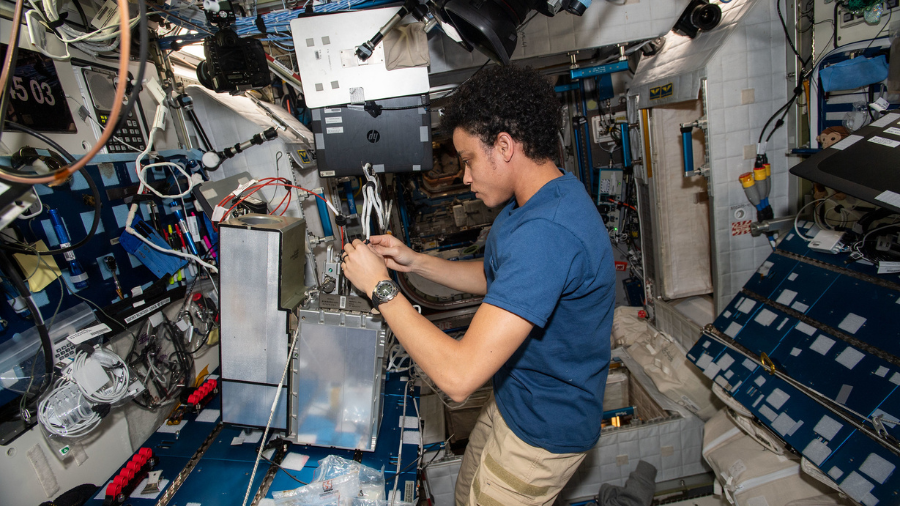
Expedition 67 Flight Engineer and NASA astronaut Jessica Watkins works on electrical system components inside the International Space Station's Harmony module on July 7, 2022.
Expedition 67 Flight Engineer and NASA astronaut Jessica Watkins works on electrical system components inside the International Space Station’s Harmony module on July 7, 2022.

The Expedition 67 crew members focused on exercise, science beneficial to humans on Earth and future crews in space, and routine maintenance checks as part of their activities aboard the International Space Station today.

The seven station residents prioritized space exercise and took turns working out. They used the Tranquility module’s advanced resistive exercise device (ARED) to perform exercises such as bench presses, squats, and deadlifts. Crews workout on average two hours per day in space. Routine exercise helps astronauts counter the bone and muscle loss that accompanies living and working in microgravity.

NASA Flight Engineer Bob Hines worked on the new Genes in Space-9 (GIS-9) study. Cell-free technology is a platform for protein production that does not include living cells. GIS-9 evaluates two approaches for using this technology in microgravity: cell-free protein production and biosensors that can detect specific target molecules. The technology could provide a portable, low-resource, and low-cost tool with potential applications for medical diagnostics, on-demand production of medicine and vaccines, and environmental monitoring on future space missions.

NASA Flight Engineer Jessica Watkins checked on the AC inverters in the laboratory and transferred cargo from the SpaceX CRS-25 Dragon spacecraft. Later, Hines and Watkins took turns completing a Robotic On-Board Trainer for Research (ROBoT-r) session as part of the Behavioral Core Measures experiment.

Meanwhile, NASA Flight Engineer Kjell Lindgren spent most of his morning installing material sample carriers onto the Japanese Experiment Module (JEM) airlock slide table. Lindgren followed up his ARED exercise session with a fitness test on an exercise cycle. He attached sensors to his chest and pedaled for an hour on a device more formally known as the Cycle Ergometer with Vibration Isolation and Stabilization, or CEVIS. He also transferred supplies from the Dragon spacecraft.

ESA (European Space Agency) Flight Engineer Samantha Cristoforetti harvested radishes and mizuna greens growing without soil for the XROOTS space gardening study today. The experiment uses hydroponic and aeroponic techniques to grow edible plants so future crews can sustain themselves on deep space missions.

In the station’s Russian segment, the three cosmonauts exercised and completed maintenance duties. Station Commander Oleg Artemyev of Roscosmos replaced hardware in the exercise bike while Flight Engineer Denis Matveev completed monthly maintenance checks of routers in the Zvezda service module. Cosmonaut Sergey Korsakov worked on testing the European Robotic Arm manipulator.


Learn more about station activities by following the space station blog, @space_station and @ISS_Research on Twitter, as well as the ISS Facebook and ISS Instagram accounts.

Get weekly video highlights at: http://jscfeatures.jsc.nasa.gov/videoupdate/

Get the latest from NASA delivered every week. Subscribe here: www.nasa.gov/subscribe

Get The Details…

Heidi Lavelle

Powered by WPeMatico