Cobertura de la misión Soyuz con tripulación a la estación espacial
La NASA ofrecerá cobertura en directo el miércoles 21 de septiembre de los principales acontecimientos del lanzamiento y acoplamiento de una misión con un astronauta de la NASA y dos cosmonautas a la Estación Espacial Internacional.
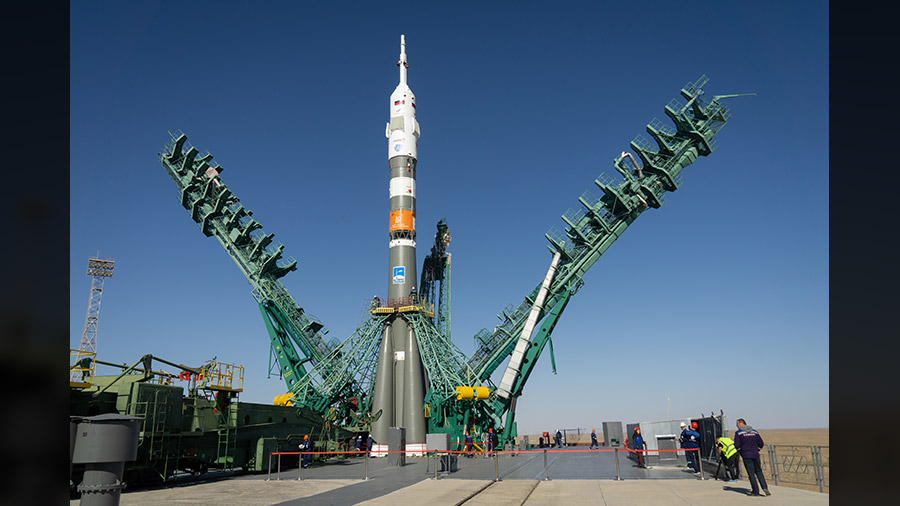
Rocket Launching New Station Crew Rolls Out to Kazakhstan Pad
The Soyuz rocket that will launch three new crew members to the space station stands at its Baikonur Cosmodrome launch pad in Kazakhstan. Credit: NASA/Bill Ingalls
The rocket to launch the next crew to the International Space Station has rolled out to its launch pad and is counting down to its lift off in the middle of the week. Meanwhile aboard the orbiting lab on Monday, the Expedition 67 crew studied tele-robotics and fluid physics while preparing for the upcoming crew arrival and next week’s crew departure.
NASA astronaut Frank Rubio is preparing for his first spaceflight set to begin at 9:54 a.m. EDT on Wednesday when he launches to the station aboard the Soyuz MS-22 crew ship. He will be riding along with Soyuz Commander Sergey Prokopyev and Flight Engineer Dmitri Petelin, both from Roscosmos. The trio will dock to the Rassvet module less than three-and-a-half hours after blasting off from the Baikonur Cosmodrome in Kazakhstan beginning a six-month space station research mission.
View photographs of the Soyuz rocket rolling out to the launch pad.
Just over a week after the new crew’s arrival, three cosmonauts who have been on the station since March 18 will return to Earth. Station Commander Oleg Artemyev will board the Soyuz MS-21 crew ship with Flight Engineers Denis Matveev and Sergey Korsakov, undock from the Prichal module, then reenter Earth’s atmosphere, and parachute to a landing in the steppe of Kazakhstan. The threesome spent Monday readying their launch and entry suits for the ride home, packing gear for loading into their Soyuz spaceship, and reviewing Soyuz undocking and descent procedures.
ESA (European Space Agency) astronaut Samantha Cristoforetti will take over as station commander from Artemyev before he departs during the traditional Change of Command ceremony. The leadership change will be seen live on NASA TV, the agency’s app, and its website at 9:35 a.m. on Sept. 28.
Back in space, NASA Flight Engineer Bob Hines spent his day peering at foam samples inside the KERMIT microscope to observe characteristics only possible in microgravity. The Foams and Emulsions study looks at how weightlessness affects microstructures and the dispersion of bubbles in liquid possibly expanding commercial opportunities both in space and on Earth.
Robotics activities are critical both inside and outside of the orbiting lab. With NASA and its international partners planning human missions to the Moon, Mars, and beyond, researchers are also exploring the ability to control ground-based robots, also known as tele-robotics, from a spacecraft. NASA Flight Engineer Jessica Watkins powered up the Surface Avatar laptop computer on Monday morning and studied a variety of methods, such as haptic controls, user interfaces, and virtual reality, to command robot vehicles from long distances. Watkins later participated in a cognition test that seeks to measure a crew member’s ability to perform robotic activities in microgravity conditions.
NASA Flight Engineer Kjell Lindgren was next to participate in the robotics cognition study for the Behavioral Core Measures investigation that may inform future spacecraft and space habitat designs. Lindgren also spent the day on space station chores including servicing U.S. spacesuit parts and cleaning crew quarters. Cristoforetti focused on lab maintenance activities as well, inspecting biology research gear and replacing components on the station’s toilet, also known as the Waste and Hygiene Compartment.
Crew Works Space Agriculture, Physics Research as Station Orbits Higher
Astronaut Bob Hines explores how a crew member’s cognition and perception are affected in microgravity for the GRIP expleriment.
Farming, foam, and fire research kept the astronauts busy at the end of the week aboard the International Space Station. The pace of microgravity research is picking up with the Expedition 67 crew spending more time studying a wide array of space phenomena to promote the well-being of humans on and off the Earth.
NASA Flight Engineer Kjell Lindgren harvested vegetables on Friday after a 30-day growing period inside the Veggie botany facility for the XROOTS space agriculture study. Researchers are investigating using soilless methods, specifically hydroponic and aeroponic techniques, to produce crops in microgravity and feed crews on missions beyond low-Earth orbit.
NASA astronaut Bob Hines looked at foams, or dispersions of bubbles in a liquid, inside the KERMIT microscope today using the microgravity environment to reveal microstructures not possible on Earth. Observations may lead to more advanced space research opportunities and improved consumer products and materials design on Earth.
Robotics is a very important part of the space station with three external manipulators, or robotic arms, for payload operations outside the station and experimental gear inside the station to assist the astronauts. One investigation is researching the ability to control robots on a planetary surface from a spacecraft in orbit. NASA Flight Engineer Jessica Watkins set up the Surface Avatar laptop computer in the Columbus laboratory module on Friday to begin studying ways, such as haptic controls, user interfaces, and virtual reality, to command and control surface-bound robots from long distances.
Astronaut Samantha Cristoforetti of ESA (European Space Agency) spent her day servicing combustion research and other lab hardware. She first opened up the Combustion Integrated Rack and connected components that support the Solid Fuel Ignition and Extinction fire growth and suppression investigation. The two-time station resident also reloaded software on a laptop computer, worked on orbital plumbing tasks, and took a cognition test for the Standard Measures study.
The space station is orbiting higher after the docked ISS Progress 81 cargo craft fired its engines for one minute and 46 seconds on Thursday. The orbital reboost places the station at the correct altitude for the upcoming departure and arrival of a pair of Soyuz crew ships.
Commander Oleg Artemyev will soon lead the ride back to Earth with Flight Engineers Denis Matveev and Sergey Korsakov inside the Soyuz MS-21 crew ship. The trio have been aboard the orbiting lab since March 18 docking to the Prichal module less than three-and-a-half hours after launching from the Baikonur Cosmodrome in Kazakhstan. The three cosmonauts spent Friday checking communications systems inside the Soyuz vehicle and conditioning their bodies for the return to Earth’s gravity after six months living and working in weightlessness.
Just over a week before the cosmonaut threesome returns home, NASA astronaut Frank Rubio will blast off from Baikonur with Roscosmos cosmonauts Sergey Prokopyev and Dmitri Petelin. The three crewmates will take a short trip to the station’s Rassvet module inside the Soyuz MS-22 crew ship and begin a six-month station mission as Expedition 68 Flight Engineers.