Astronauts are Go for Wednesday’s Spacewalk

Astronauts are Go for Wednesday’s Spacewalk

(From left) Astronauts Jasmin Moghbeli and Loral O'Hara pose for portraits in their spacesuits at the Johnson Space Center in Houston, Texas.
(From left) Astronauts Jasmin Moghbeli and Loral O’Hara pose for portraits in their spacesuits at the Johnson Space Center in Houston, Texas.

Final preparations are underway as the Expedition 70 crew gets ready for a maintenance spacewalk on Wednesday. Meanwhile, human research and a manufacturing study continued aboard the International Space Station on Tuesday.

Mission managers have given the go for NASA astronauts Jasmin Moghbeli and Loral O’Hara to conduct a near seven-hour spacewalk beginning at 8:05 a.m. EDT Wednesday. The duo will remove radio communications gear and swap hardware that enables the orbiting lab’s solar arrays to track the Sun. NASA TV will begin its spacewalk coverage at 6:30 a.m. on the agency’s app and website.

The duo was joined today by Commander Andreas Mogensen of ESA (European Space Agency) and Satoshi Furukawa of JAXA (Japan Aerospace Exploration) for the daylong spacewalk preparations. Moghbeli and O’Hara kicked off the day with standard medical exams as Mogensen assisted the pair during the temperature, blood pressure, pulse, and respiratory checks. Furukawa gathered with the three astronauts reviewing the spacewalk procedures and calling down to ground specialists for a final readiness conference.

Moghbeli and O’Hara also readied their tools and spacesuits inside the Quest airlock where they will begin tomorrow’s spacewalk. This will be the first spacewalk for both astronauts and the 12th at the space station this year.

The space station’s three cosmonauts stayed focused on their daily schedule of science and maintenance in the Roscosmos segment of the station. The trio also finalized their clean up tasks following last Wednesday’s spacewalk.

Flight Engineer Oleg Kononenko attached sensors to himself in the morning for a 24-hour session measuring his cardiac and blood pressure activity. Afterward, he swapped samples inside a 3D printer for a study exploring space manufacturing techniques. Flight Engineer Nikolai Chub opened the hatch between the Poisk module and Progress 84 cargo craft and stowed spacewalk tools he and Kononenko used last week. Flight Engineer Konstantin Borisov handed over radiation detectors the astronauts will wear on their spacesuits on Wednesday then spent the rest of the day on life support and maintenance tasks.


Learn more about station activities by following the space station blog, @space_station and @ISS_Research on X, as well as the ISS Facebook and ISS Instagram accounts.

Get weekly video highlights at: https://roundupreads.jsc.nasa.gov/videoupdate/

Get the latest from NASA delivered every week. Subscribe here: www.nasa.gov/subscribe

Powered by WPeMatico

Get The Details…

Mark Garcia

NASA Kennedy Awards Operational, Institutional Support Contract

NASA Kennedy Awards Operational, Institutional Support Contract

A graphic of the NASA "meatball" insignia, a blue circle crossed by a red V-shaped swoosh, against a black background.

NASA has awarded the Kennedy Operational and Institutional Support (KOIS) contract to Chiricahua-Logical Joint Venture of Albuquerque, New Mexico, to provide services at the agency’s Kennedy Space Center in Florida.

KOIS is an Indefinite-Delivery Indefinite-Quantity, Level of Effort contract that includes a one-month phase-in period beginning Nov. 1, 2023, followed by a 22-month base period and three 1-year option periods. The maximum total award value is not to exceed $20 million.

The scope includes a broad range of operational and institutional support services including internal controls for property, logistics, American Sign Language interpreter, institutional training and development, and export control support.

The contract covers onsite and offsite work at Kennedy, Cape Canaveral Space Force Station, and other locations authorized by the contracting officer, including other NASA Centers if the need arises.

For more information about NASA and agency programs, visit:

https://www.nasa.gov

-end-

Patti Bielling
Kennedy Space Center, Florida
321-501-7575
patricia.a.bielling@nasa.gov

Powered by WPeMatico

Get The Details…
Patricia A. Bielling

Halloween on the International Space Station

Halloween on the International Space Station

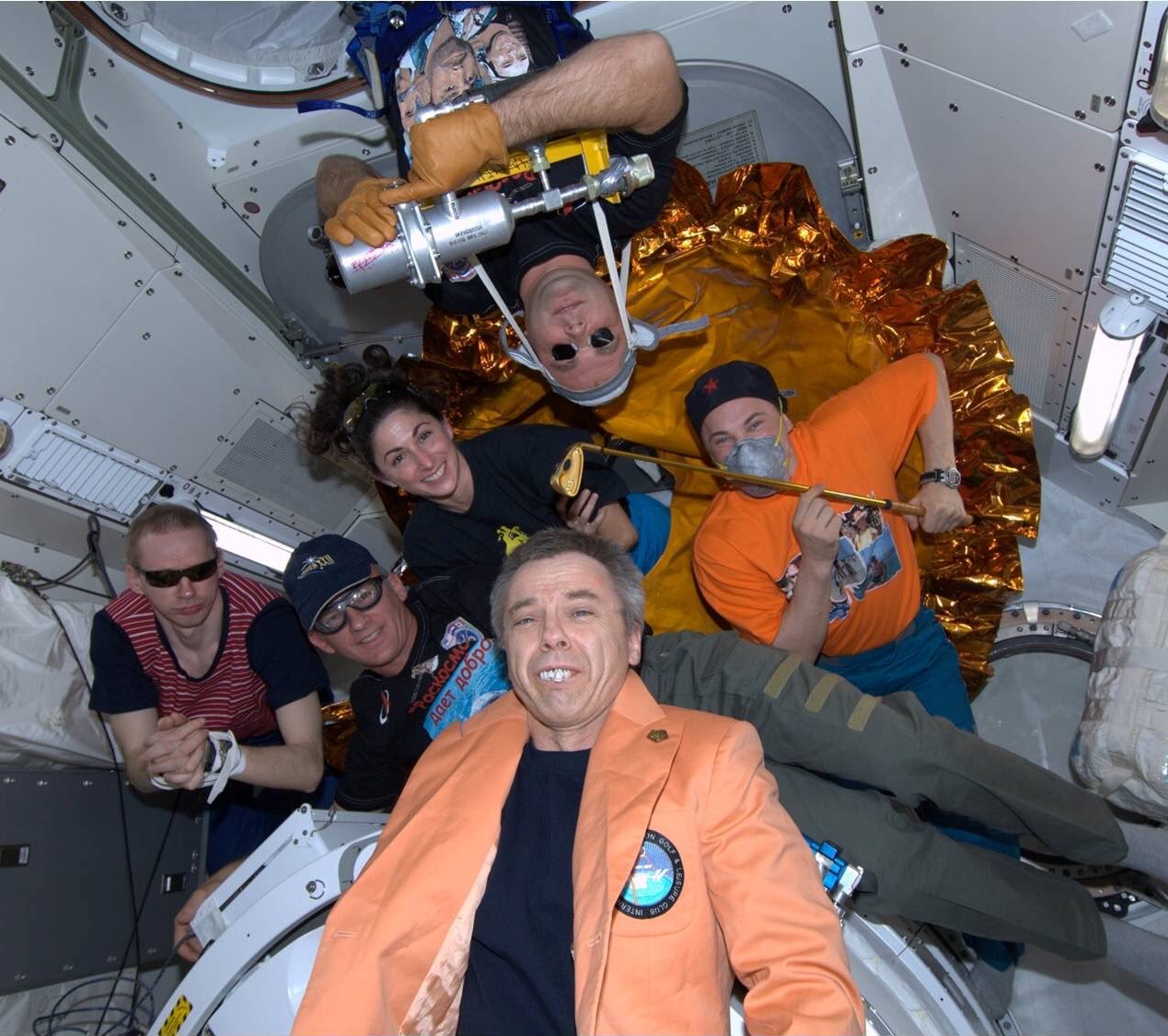
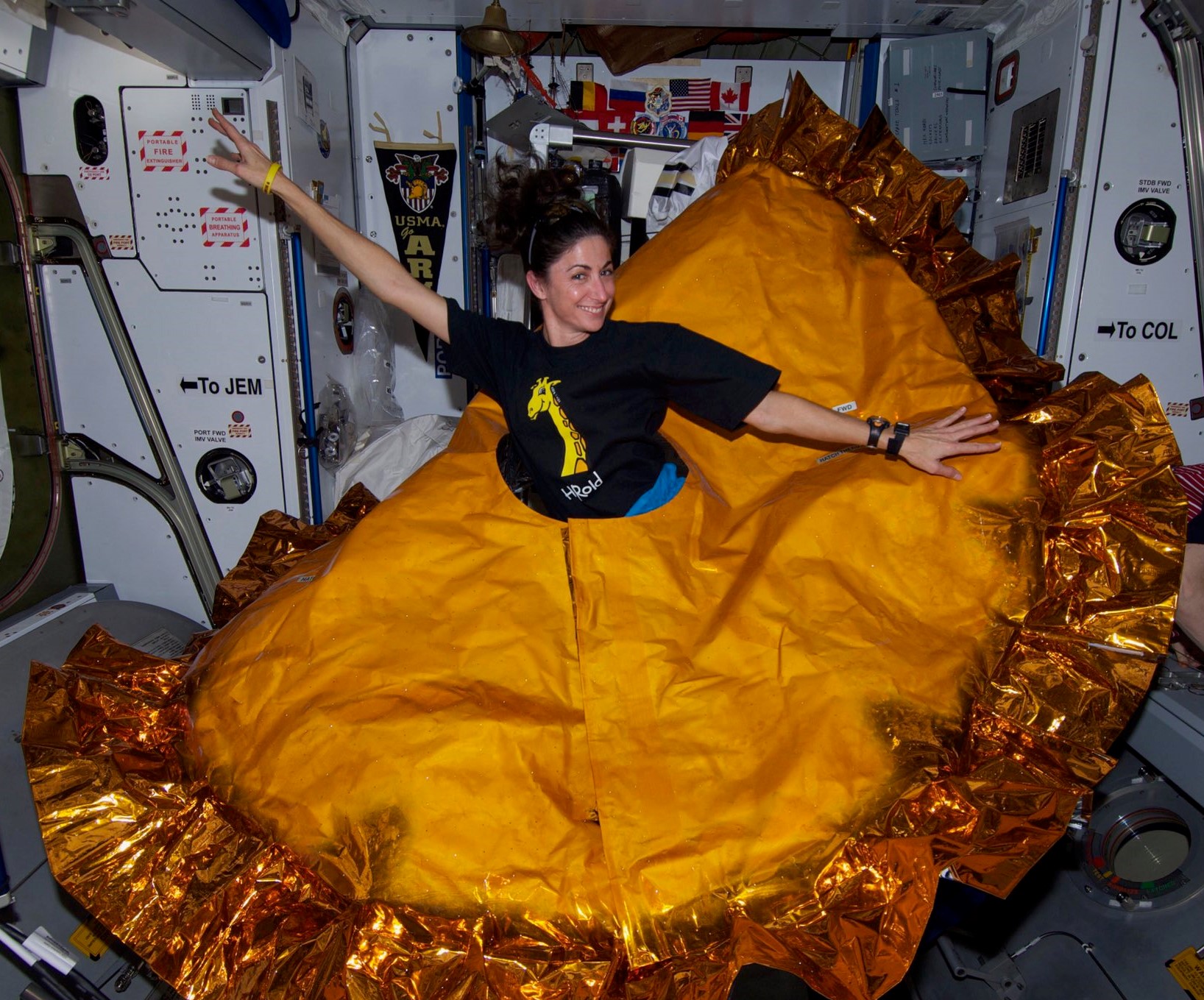
Although no ghouls or goblins or trick-or-treaters come knocking at the International Space Station’s front hatch, crew members aboard the orbiting facility still like to get in the Halloween spirit. Whether individually or as an entire crew, they dress up in sometimes spooky, sometimes scary, but always creative costumes, often designed from materials available aboard the space station. Please enjoy the following scenes from Halloweens past even as we anticipate the costumes of the future.

Wearing a black cape, Expedition 16 NASA astronaut Clayton C. Anderson channels his inner vampire for Halloween 2007 The Expedition 21 crew shows off its costumes Expedition 21 Flight Engineer NASA astronaut Nicole P. Stott shows off her Halloween costume
Left: Wearing a black cape, Expedition 16 NASA astronaut Clayton C. Anderson channels his inner vampire for Halloween 2007. Image credit: courtesy Clayton C. Anderson. Middle: For Halloween 2009, the Expedition 21 crew shows off its costumes. Right: Expedition 21 Flight Engineer NASA astronaut Nicole P. Stott shows off her Halloween costume.

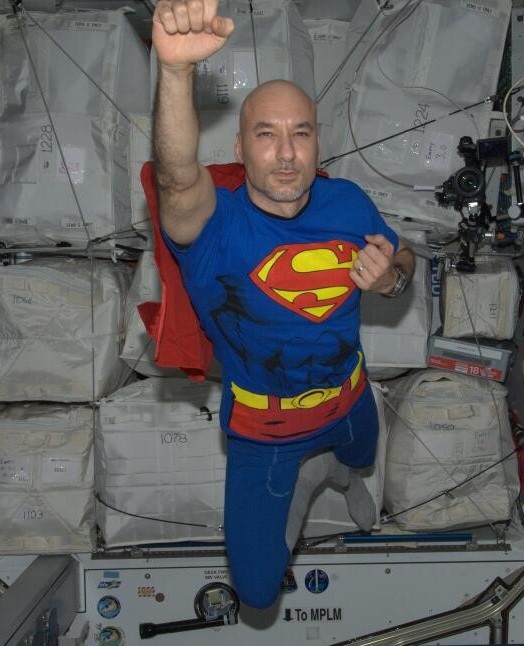
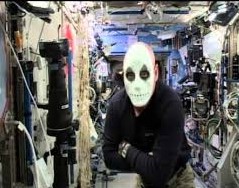
Italian Space Agency astronaut Luca S. Parmitano finally gets his wish to fly like Superman during Expedition 37 NASA astronaut Scott J. Kelly celebrating Halloween in 2015 during his one-year mission
Left: Italian Space Agency astronaut Luca S. Parmitano finally gets his wish to fly like Superman during Expedition 37. Right: Who’s that behind the scary mask? None other than NASA astronaut Scott J. Kelly celebrating Halloween in 2015 during his one-year mission.

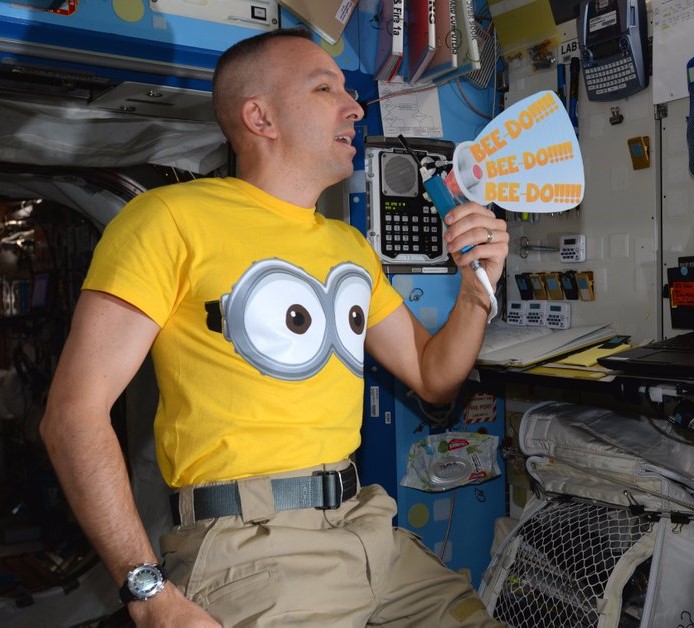
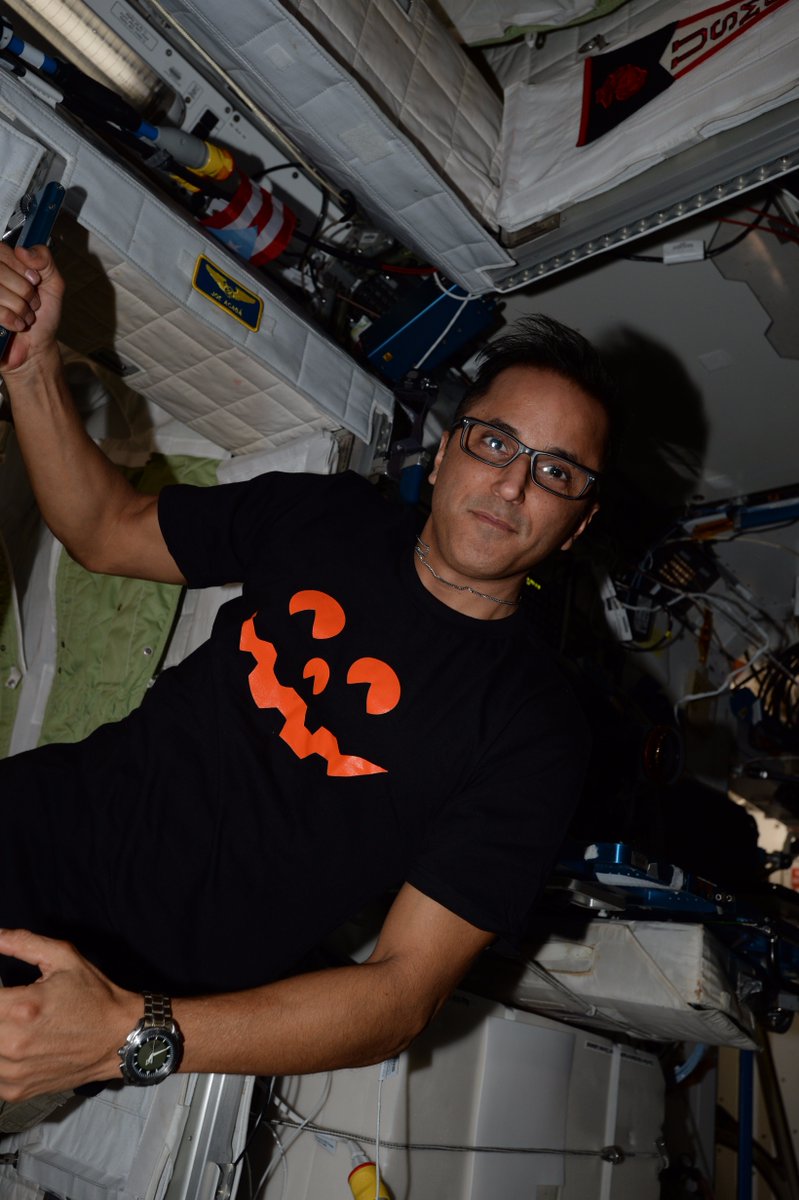
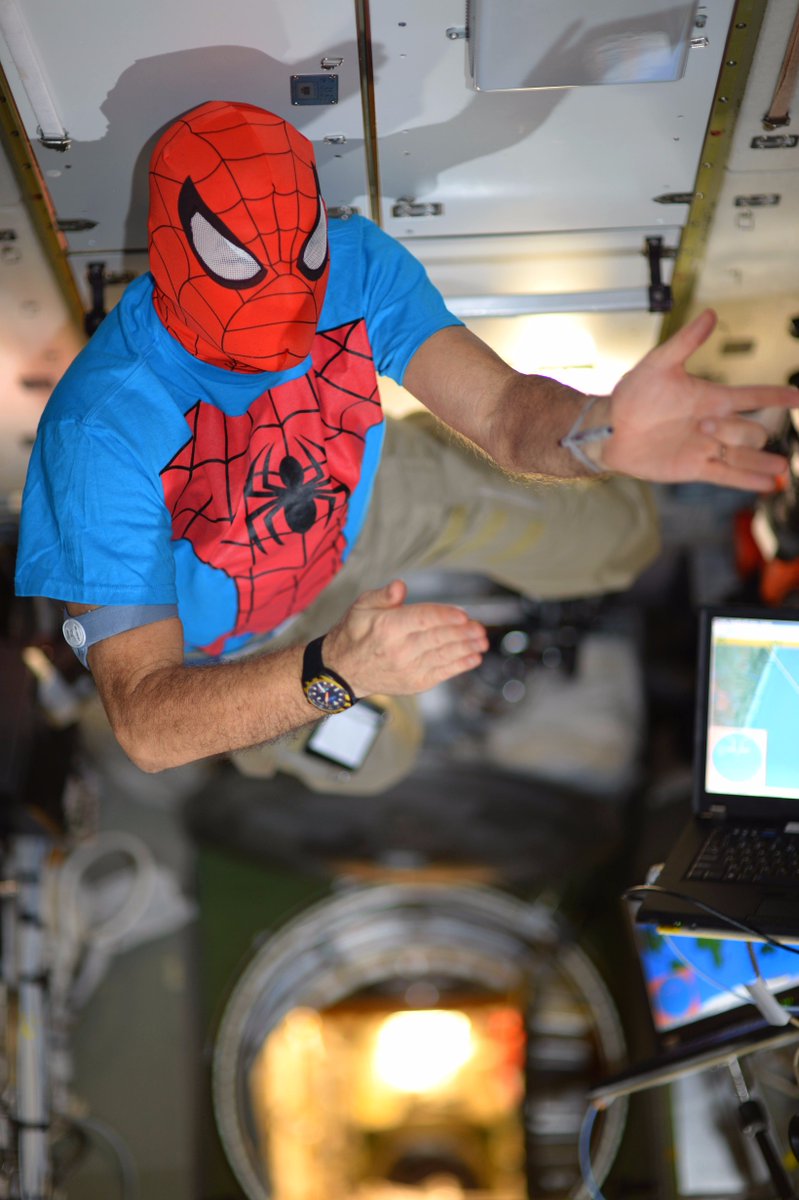
Expedition 53 Commander NASA astronaut Randolph J. “Randy” Bresnik showing off his costume Expedition 53 Flight Engineer NASA astronaut Joseph M. Acaba wearing Halloween colors Expedition 53 European Space Agency astronaut Paolo A. Nespoli showing off his Spiderman skills
Left: Expedition 53 Commander NASA astronaut Randolph J. “Randy” Bresnik showing off his costume. Middle: Expedition 53 Flight Engineer NASA astronaut Joseph M. Acaba wearing Halloween colors. Right: Expedition 53 European Space Agency astronaut Paolo A. Nespoli showing off his Spiderman skills.

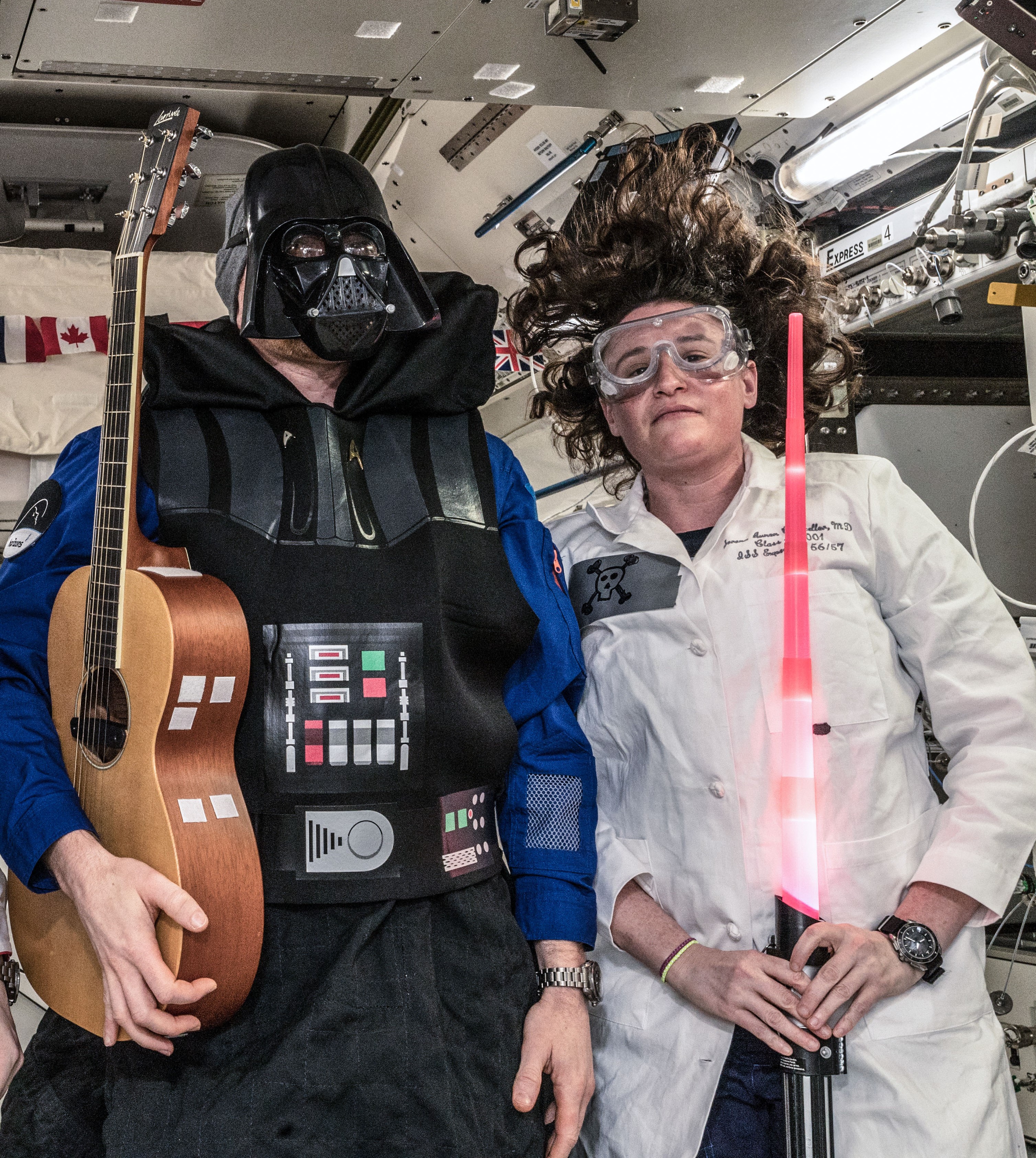
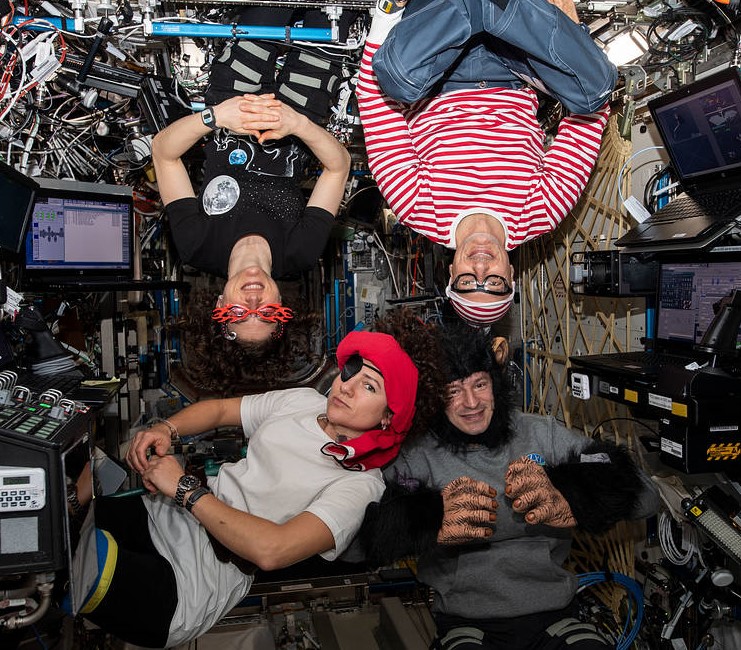
Expedition 57 crewmembers in their Halloween best – European Space Agency astronaut and Commander Alexander Gerst, left, and NASA astronaut Serena M. Auñón-Chancellor Members of Expedition 61, NASA astronaut Christina H. Koch, top left, European Space Agency astronaut Luca S. Parmitano, NASA astronaut Andrew R. “Drew” Morgan, and NASA astronaut Jessica U. Meir, show off their Halloween spirit in 2019
Left: Expedition 57 crewmembers in their Halloween best – European Space Agency astronaut and Commander Alexander Gerst, left, and NASA astronaut Serena M. Auñón-Chancellor. Right: Members of Expedition 61, NASA astronaut Christina H. Koch, top left, European Space Agency astronaut Luca S. Parmitano, NASA astronaut Andrew R. “Drew” Morgan, and NASA astronaut Jessica U. Meir, show off their Halloween spirit in 2019.

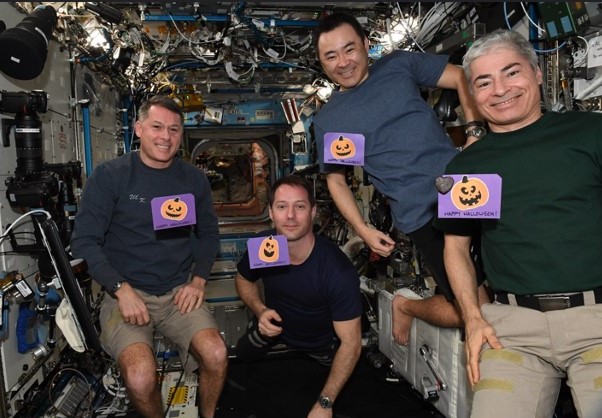
Expedition 66 crewmembers NASA astronaut R. Shane Kimbrough, left, Thomas G. Pesquet of the European Space Agency, Akihiko Hoshide of the Japan Aerospace Exploration Agency, and NASA astronaut Mark T. Vande Hei showing off their Halloween cards hallowwen on iss
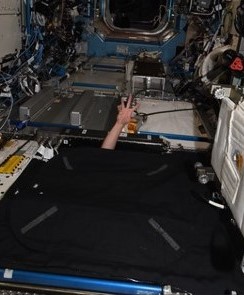
Left: Expedition 66 crewmembers NASA astronaut R. Shane Kimbrough, left, Thomas G. Pesquet of the European Space Agency, Akihiko Hoshide of the Japan Aerospace Exploration Agency, and NASA astronaut Mark T. Vande Hei showing off their Halloween cards. Right: A hand rising from the grave?

In October 2021, Crew-3 NASA astronauts Raja J. Chari, Thomas H. Marshburn, Kayla S. Barron, and Matthias J. Maurer of the European Space Agency (ESA), had some undisclosed plans for when they reached the space station just before Halloween. However, bad weather at NASA’s Kennedy Space Center in Florida thwarted those super-secret spooky Halloween plans, delaying their launch until Nov. 11. Undeterred, Expedition 66 crewmembers who awaited them aboard the station held their own Halloween shenanigans. ESA astronaut Thomas G. Pesquet posted on social media that “Strange things were happening on ISS for Halloween. Aki rising from the dead (or is it from our observation window?),” referring to fellow crew member Akihiko Hoshide of the Japan Aerospace Exploration Agency.

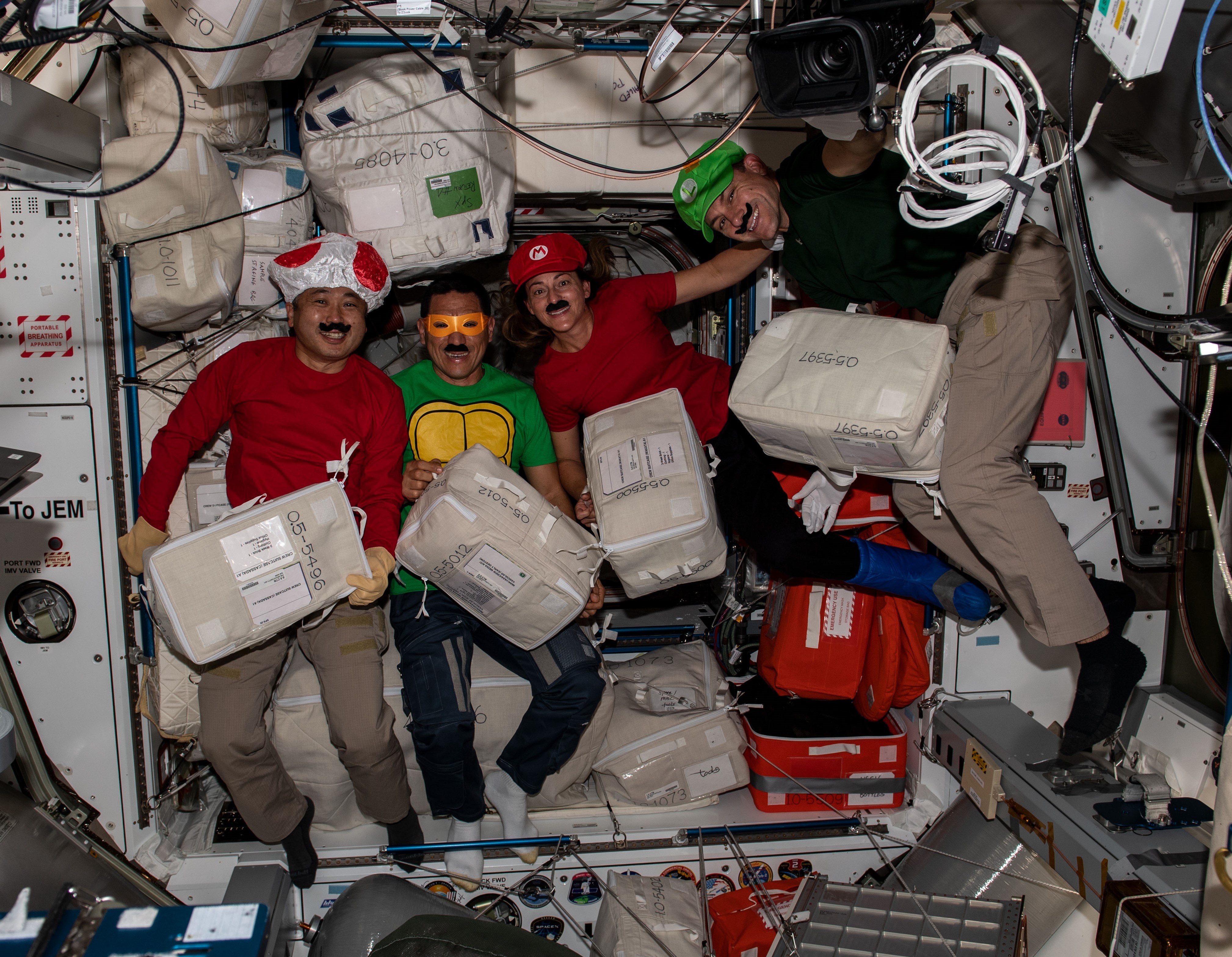
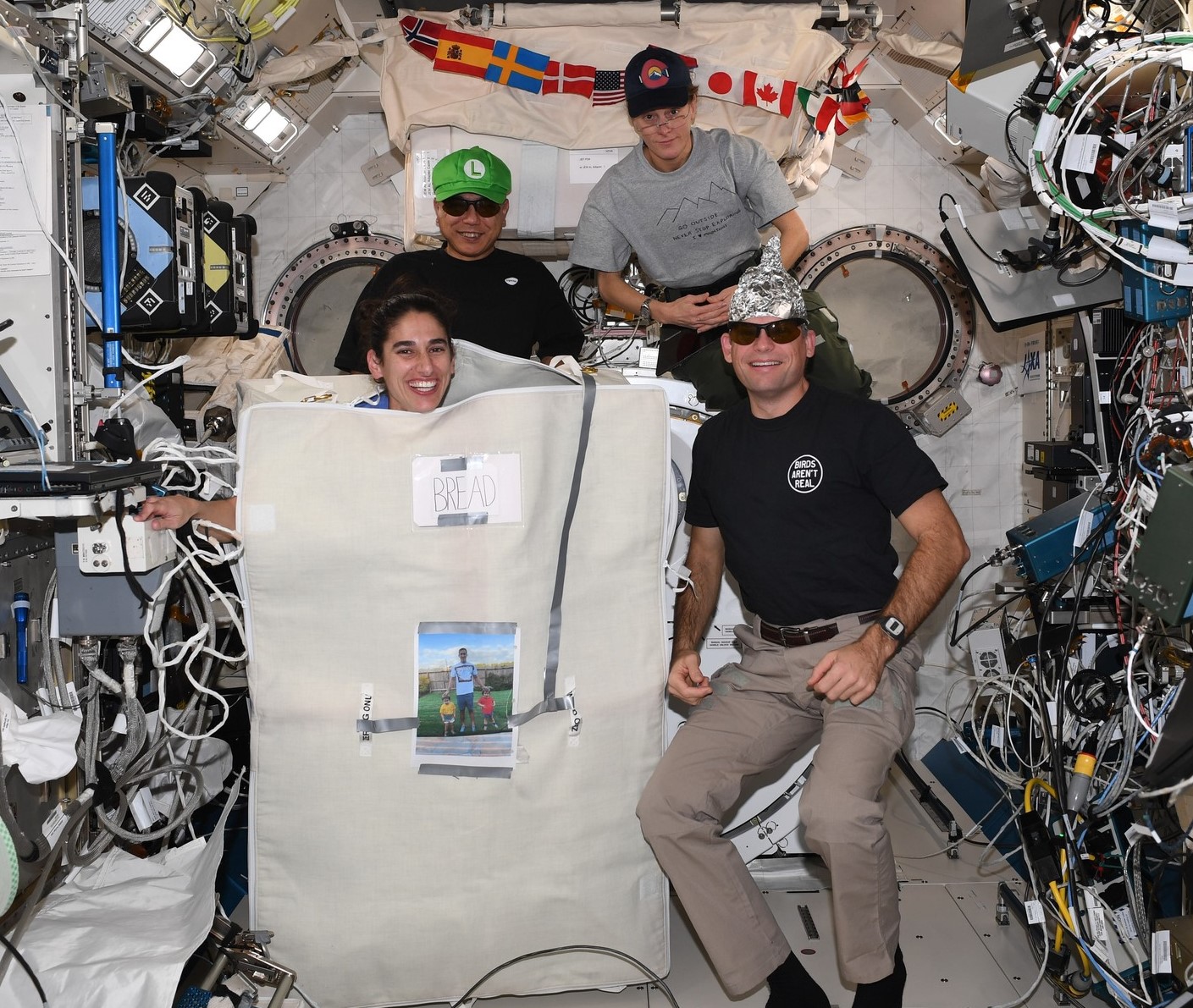
In 2022, Expedition 68 astronauts Koichi Wakata of the Japan Aerospace Exploration Agency, left, and NASA astronauts Francisco “Frank” C. Rubio, Nicole A. Mann, and Josh A. Cassada dressed as popular video game and cartoon characters, using stowage containers in their Halloween costumes and holding improvised trick-or-treat bags Expedition 70 astronauts Jasmin Moghbeli of NASA, left, Satoshi Furakawa of the Japan Aerospace Exploration Agency, NASA astronaut Loral O’Hara, and European Space Agency astronaut Andreas Mogensen celebrate Halloween 2023
Left: In 2022, Expedition 68 astronauts Koichi Wakata of the Japan Aerospace Exploration Agency, left, and NASA astronauts Francisco “Frank” C. Rubio, Nicole A. Mann, and Josh A. Cassada dressed as popular video game and cartoon characters, using stowage containers in their Halloween costumes and holding improvised trick-or-treat bags. Right: Expedition 70 astronauts Jasmin Moghbeli of NASA, left, Satoshi Furakawa of the Japan Aerospace Exploration Agency, NASA astronaut Loral O’Hara, and European Space Agency astronaut Andreas Mogensen celebrate Halloween 2023.

The spookiness continues…

Powered by WPeMatico

Get The Details…
Kelli Mars

InSPA Inter-Agency Collaboration Goals

InSPA Inter-Agency Collaboration Goals

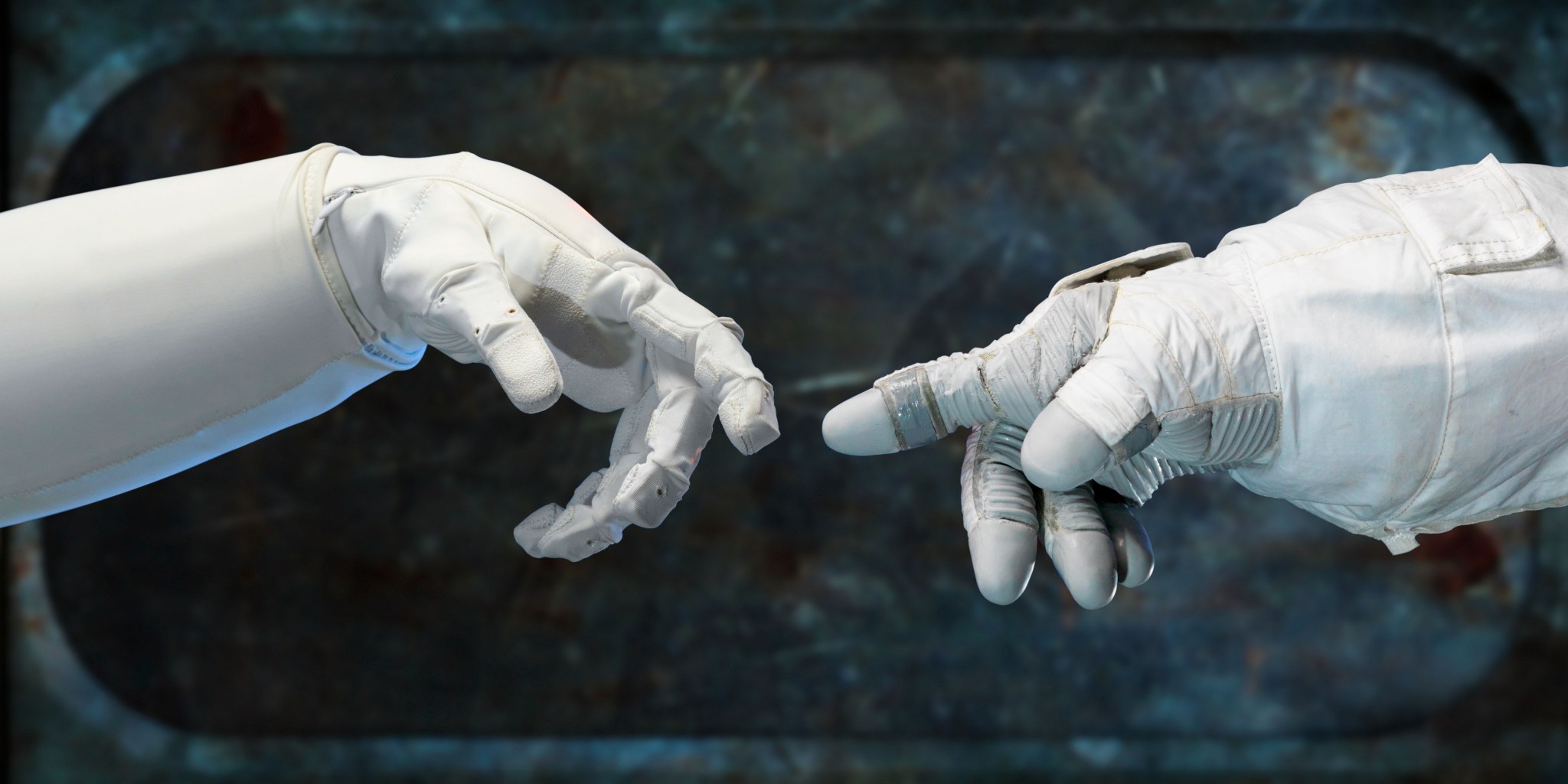
Robotic hand reaching out to touch a human's hand wearing a spacesuit glove
High quality production photos of Robonaut (R2) in Building 14 EMI chamber and R1/EMU photos in Building 32 – Robonaut Lab. Photo Date: June 1, 2010. Location: Building 14 – EMI Chamber/Building 32 – Robonaut Lab.
NASA / Robert Markowitz & Bill Stafford

NASA knows it takes a village to make commercial manufacturing in space a reality. NASA is collaborating with experts from industry, academia and other U.S. Government agencies on the technologies in play with the InSPA portfolio.  By joining forces with these experts, NASA can better support its commercial partners, accelerating the transition from proof-of-concept demonstrations on the International Space Station to commercial operations in future commercial low Earth orbit (LEO) destinations. NASA’s InSPA awards help the selected companies raise the technological readiness level of their products and move them to market, propelling U.S. industry toward the development of a sustainable, scalable, and profitable non-NASA demand for services and products manufactured in the microgravity environment of LEO for use on Earth.

NASA is recruiting agency, government and industry experts to inform NASA’s InSPA priorities, accelerate learning and increase commercialization success.

Establishing Priorities

We will provide input on NASA Technology Roadmaps and/or evaluate proposals to inform awards for applications that serve national needs and U.S. competitiveness. We will also participate in working group discussions.

CHIPS and Science Act

Concepts that support the goals of the “CHIPS and Science Act” through semiconductor manufacturing in microgravity are of special interest to NASA. Those selected for further assessment will be invited to submit full proposals. NASA is seeking funding from the CHIPS and Science Act through the National Institute of Standards and Technology (NIST) to ensure US leadership in semiconductor manufacturing in microgravity. To support this initiative, NASA’s InSPA program may grant awards that come with funding for facilities, workforce development, academic support, and program development.

SHERPA Support

Space Hardware Experts for Research, Production, and Applications (SHERPA) shares knowledge as subject matter experts on science, technology, manufacturing, markets, and investors. Provide support directly to principal investigators or through NASA Technical Monitors to accelerate learning.

Specific SHERPA activities:

  • Identify new InSPA candidates important to other government agencies where gravity is impeding development.
  • Assist in prioritization and decisions on down-selects.
  • Peer review at major milestones (design reviews, science requirements, ground and in-flight testing).
  • Develop performance goals and metrics that must be met to exceed current state-of-the-art.
  • Leverage artificial intelligence and machine learning (AI/ML) and expand space databases to improve models and increase value from each flight, across the years and programs.
  • Perform independent analysis and validation of flight results.
  • Conduct outreach to industry and other government agencies for Phase 2 and 3 sponsorships.

Points of Contact

Powered by WPeMatico

Get The Details…
Ana Guzman

NASA Implementation Strategy for In Space Production Applications

NASA Implementation Strategy for In Space Production Applications

NASA’s In Space Production Applications (InSPA) implementation strategy consists of a multi-phase award process to demonstrate proof-of-concept, advance to high production quality, and ultimately to achieve scalability on a commercial low Earth orbit (LEO) destination or platform. InSPA seeks to identify awardees who propose promising manufacturing efforts in microgravity that will invigorate markets on Earth. These InSPA awards help the selected companies raise the technological readiness level of their products and move them to market, propelling U.S. industry toward the development of a sustainable, scalable, and profitable non-NASA demand for services and products manufactured in the microgravity environment of LEO for use on Earth.

NASA Award Process

On an annual and ongoing basis, NASA releases two calls for white papers by U.S. entities through Special Focus Area #1 (In Space Production Applications) of the NASA Research Announcement (NRA) NNJ13ZBG001N, “Research Opportunities for International Space Station Utilization.” Those entities with the highest rated white papers are then invited to submit a full proposal. After the proposal evaluation period, NASA makes selections, and awardees sign a Firm Fixed Price contract with NASA to develop and demonstrate their concept on the ISS National Laboratory. NRA white paper and proposal submissions are required at each phase of the lifecycle.

Access to ISS National Laboratory

Awardees are provided access to the ISS National Laboratory and all necessary on-orbit resources: upmass, downmass, U.S. Operating Segment (USOS) crew time, data transmission, and power, including flight manifesting and increment operations planning, at no cost. Payloads are subject to review and approval by the Center for the Advancement of Science in Space (CASIS), the operator of the ISS National Laboratory.

Award Phases

NASA has identified three InSPA phases (reference Figure 1) to characterize technology maturation from early concept studies through financially self-sustaining LEO production technologies.

image of flowchart showing the proposal submission process

InSPA Phase 1

Enable early proof-of-concept studies and/or basic flight hardware development and test through multiple demonstrations on parabolic, sub-orbital, and orbital missions on the ISS to achieve TRL of 6 and MRL of 3. Proposals should identify the improvements sought and describe the number and type of demonstration tests appropriate to achieve exit criteria for the Phase. The goals of Phase 1 (i.e., exit criteria) are:

  1. To demonstrate hardware performance and validate the scientific basis for the technology benefit in a LEO space environment. 
  2. To establish a minimum level of production control to repeatedly produce the intended product to a quality or performance level comparable to Earth-based controls or state of the art. 
  3. To refine the business case with preliminary revenue forecasts based on actual microgravity demonstrations and gain support from potential partners or investors to capture a moderate level of non-NASA investment for Phase 2.

InSPA Phase 2

Enable design maturation and advanced flight hardware development with additional demonstrations on ISS to achieve a TRL of 8 and MRL of 7. NASA has an expectation of some degree of cost-sharing in this phase (reference Cost Sharing guideline in section 1.2.3 of the NRA). The goals of Phase 2 (i.e., exit criteria) are:

  1. To demonstrate full control of hardware, environments, and processes to meet specific performance standards for the application.  These standards are often set by the customer and should be to a level of performance or quality within the application setting that is significantly better than possible on Earth. 
  2. To refine the business case to a level that successfully captures significant investor commitment for Phase 3.

InSPA Phase 3

Enable scaled flight hardware production on ISS or an alternative commercial LEO destination/platform to demonstrate commercial operations and end-to-end logistics model producing sufficient quantities to achieve a TRL of 9 and MRL of 9 and to close the business case. NASA expects a significant degree of cost-sharing by industry for a Phase 3 award (reference Cost Sharing guideline in Section 1.2.3 of the NRA). The goals of Phase 3 are:

  • Demonstrate scaling to commercial quantities and quality to support market demand, including supply chain and regulatory approvals. 
  • To establish formal agreements with U.S. LEO transportation and destination partners for transition to commercial operations. 
  • Begin transition to commercial platform(s) and achieve sustainable revenues. 
image of diagram showing three phases of proposal submission

Reference

NASA Research Announcement (NRA) NNJ13ZBG001N, “Research Opportunities for International Space Station Utilization”

Powered by WPeMatico

Get The Details…
Ana Guzman