
Crew Trains for Next Cargo Mission, Picks Tomatoes, and Fixes New Toilet

Crew Trains for Next Cargo Mission, Picks Tomatoes, and Fixes New Toilet
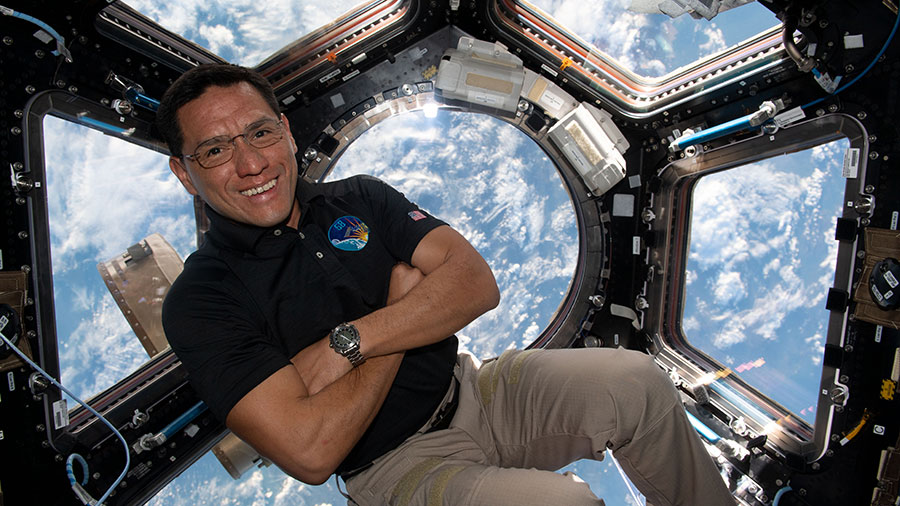
NASA astronaut Frank Rubio is pictured inside the cupola, the space station's
NASA astronaut Frank Rubio is pictured inside the cupola, the space station’s “window to the world,” as the orbiting lab flew above southeastern England.

The Expedition 68 crew kicked off the work week preparing for a U.S. cargo mission delivering new science experiments and unpacking a recently arrived resupply ship. The International Space Station residents also picked a tomato crop today while working on a new toilet.

Northrop Grumman’s Cygnus space freighter is targeting a launch to the space station at 5:50 a.m. EST on Sunday, Nov. 6. It will arrive for a robotic capture at 5:50 a.m. on Nov. 8, carrying about 8,200 pounds of research gear, crew supplies, and station hardware. Some of the experiments arriving inside Cygnus will explore 3D bioprinting of human tissue, the impact of microgravity on ovaries, and growing repeated generations of space crops.

NASA Flight Engineers Nicole Mann and Josh Cassada trained on a computer today to monitor Cygnus’ automated approach and rendezvous and practice its robotic capture. The duo will be inside the seven-window cupola when the science-packed vehicle nears a point about 30 feet (10 meters) from the station’s Unity module. Mann will then command the Canadarm2 robotic arm to reach out and capture Cygnus as Cassada backs her up. Controllers on the ground will then take over and remotely maneuver Cygnus and install it on Unity where it will stay for 11 weeks of cargo activities.

It was harvest day aboard the orbiting lab as astronaut Koichi Wakata picked a small crop of tomato plants grown inside the Columbus laboratory module. The tomatoes were grown without soil using hydroponic and aeroponic nourishing techniques for the XROOTS botany study. The experiment is demonstrating space agricultural methods to sustain crews on long term space flights farther away from Earth where resupply missions become impossible.

NASA Flight Engineer Frank Rubio worked in the Tranquility module servicing a new toilet system, part of the station’s Waste and Hygiene Compartment. The advanced microgravity plumbing work required Rubio to swap and inspect several components and sensors prior to returning the space toilet to operations. Meanwhile, the older toilet inside Tranquility is still in operation.

The ISS Progress 82 resupply ship is still being unpacked after its docking to the Poisk module on Oct. 27. Commander Sergey Prokopyev and Flight Engineer Dmitri Petelin offloaded a variety of lab hardware, crew clothing, and medical kits on Monday for organizing and stowing throughout the station. Flight Engineer Anna Kikina worked on video and computer maintenance then photographed plume monitoring sensors attached to the Poisk module.


Learn more about station activities by following the space station blog@space_station and @ISS_Research on Twitter, as well as the ISS Facebook and ISS Instagram accounts.

Get weekly video highlights at: http://jscfeatures.jsc.nasa.gov/videoupdate/

Get the latest from NASA delivered every week. Subscribe here: www.nasa.gov/subscribe

Get The Details…

Mark Garcia

Powered by WPeMatico

Crew Works Biology, Botany, and Physics after Cargo Ship’s Arrival

Crew Works Biology, Botany, and Physics after Cargo Ship’s Arrival

The ISS Progress 82 cargo craft, packed with three tons of food, fuel, and supplies, is pictured shortly after docking to the space station's Poisk module.
The ISS Progress 82 cargo craft, packed with three tons of food, fuel, and supplies, is pictured shortly after docking to the space station’s Poisk module.

Life science, space gardening, and physics filled the Expedition 68 crew’s research schedule at the end of the week aboard the International Space Station. Meanwhile, three tons of new cargo are being unpacked after its arrival overnight.

A host of biomedical studies have been underway this week on the orbiting lab as scientists on the ground explore what happens to the human body when living in weightlessness. Insights help astronauts stay fit and healthy beyond Earth’s gravity and provide an array of solutions and innovations improving life for those back on Earth.

NASA Flight Engineer Josh Cassada took charge of eye scans on Friday imaging the retinas of crewmates Nicole Mann of NASA and Koichi Wakata of the Japan Aerospace Exploration Agency (JAXA). Mann then assumed control of the medical imaging hardware and scanned the eyes of NASA Flight Engineer Frank Rubio. The ocular examinations let doctors understand how microgravity affects the eye and provide countermeasures to protect a crew member’s sight.

Cassada and Mann started Friday morning collecting their blood samples and spinning them in a centrifuge before stowing the blood tubes in a science freezer. Researchers analyze the samples taken before, during, and after a space flight and compare them to samples from other astronauts adding to knowledge of the changes a crew member’s body goes through on and off the Earth.

Growing vegetables on spaceships and space habitats using soilless methods is a top research priority since cargo missions delivering food to the crews will be less feasible beyond low-Earth orbit. Rubio contributed to that research during the morning nourishing and tending to vegetables growing using hydroponic and aeroponic techniques for the XROOTS station botany study. Space agriculture is key to an astronaut’s health if crews are to sustain themselves farther away from Earth.

Space physics is also important as scientists and engineers observe what happens to a variety of materials exposed to ultra-high temperatures with implications for the development and manufacturing of new and advanced materials. The Electrostatic Levitation Furnace (ELF) in the Kibo laboratory module is a research device allowing safe thermophysical research in microgravity. Wakata opened up the ELF today servicing samples inside the device that uses lasers to heat specimens above 2,000 degrees Celsius to obtain data on a material’s density, surface tension, and viscosity.

The three cosmonauts aboard the station shifted their sleep schedules today following Thursday night’s arrival of the ISS Progress 82 resupply ship. Commander Sergey Prokopyev and Flight Engineer Dmitri Petelin were on duty when the Progress 82 with its three tons of food, fuel, and supplies docked to the Poisk module at 10:49 p.m. EDT on Thursday. The duo conducted standard leak checks and pressure equalization before opening the hatch to Progress and unpacking the new cargo. Flight Engineer Anna Kikina was also working overnight checking robotics components and maintaining lab systems.


Learn more about station activities by following the space station blog@space_station and @ISS_Research on Twitter, as well as the ISS Facebook and ISS Instagram accounts.

Get weekly video highlights at: http://jscfeatures.jsc.nasa.gov/videoupdate/

Get the latest from NASA delivered every week. Subscribe here: www.nasa.gov/subscribe

Get The Details…

Mark Garcia

Powered by WPeMatico

NASA to Provide Update on Artemis I Moon Mission

NASA to Provide Update on Artemis I Moon Mission

NASA will host a media teleconference at 12 p.m. EDT Thursday, Nov. 3, to discuss the status of its Artemis I flight test that will launch the Space Launch System (SLS) rocket from NASA’s Kennedy Space Center in Florida. The uncrewed mission will send the Orion spacecraft beyond the Moon and back to Earth before future missions with crew.

Get The Details…

Powered by WPeMatico