U.S. Cargo Rocket at Launch Pad as Crew Works Science, Exercise Gear

U.S. Cargo Rocket at Launch Pad as Crew Works Science, Exercise Gear
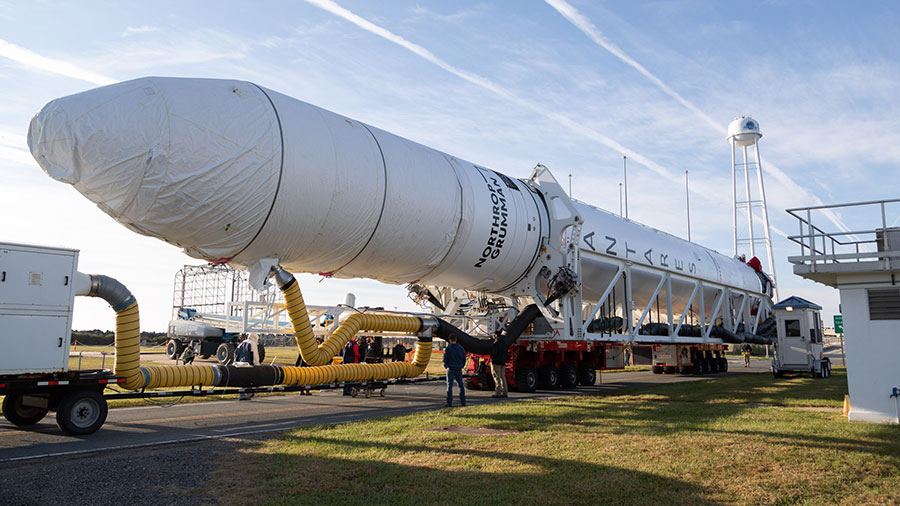
Northrop Grumman's Antares rocket carrying the Cygnus space freighter rolls out to the launchpad at NASA's Wallops Flight Facility in Virginia. Credit: NASA/Brian Bonsteel
Northrop Grumman’s Antares rocket carrying the Cygnus space freighter rolls out to the launchpad at NASA’s Wallops Flight Facility in Virginia. Credit: NASA/Brian Bonsteel

The Antares rocket carrying the Cygnus space freighter has rolled out to the launchpad in Virginia counting down to its launch toward the International Space Station. While the Expedition 68 crew members await the new cargo mission, they studied blood flow to the brain, inspected space exercise gear, and prepared for future spacewalks.

Northrop Grumman’s next cargo mission is due to launch to the orbiting lab from NASA’s Wallops Flight Facility in Virginia on Sunday at 5:50 a.m. EST. The company’s Cygnus resupply ship, atop its Antares rocket booster, is loaded with about 8,200 pounds of crew supplies and station hardware, including new microgravity experiments benefitting humans on and off the Earth.

NASA Flight Engineers Nicole Mann and Josh Cassada will be at the robotics controls ready to capture Cygnus with the Canadarm2 robotic arm when it arrives at 5:50 a.m. on Tuesday. Both astronauts have been preparing for the Cygnus mission reviewing and practicing robotic capture maneuvers on a computer. Mann will command the Canadarm2 to capture Cygnus, while Cassada backs her up monitoring its approach and rendezvous.

Mann started her day attaching sensors to herself and researching how the brain regulates blood flow in weightlessness. Observations may help crew members adjust quicker when returning to Earth’s gravity and provide insights into blood pressure conditions. Afterward, Mann joined Cassada and inspected the station’s COLBERT treadmill located in the Tranquility module which enables astronauts to maintain musculoskeletal and cardiovascular health in space.

Astronauts Frank Rubio of NASA and Koichi Wakata of the Japan Aerospace Exploration Agency (JAXA) partnered together on Wednesday servicing spacesuits in the Quest airlock. The duo cleaned the suits’ cooling loops, performed leak checks, and examined a variety of suit components. Rubio later rearranged the Unity module to make space for the arriving Cygnus cargo, while Wakata cleaned up the XROOTS space botany facility following this week’s tomato and pea harvest.

Two cosmonauts are reviewing procedures for upcoming spacewalks before the end of the year. Commander Sergey Prokopyev and Flight Engineer Dmitri Petelin spent a few hours today training to exit the station in their Orlan spacesuits and continue outfitting and readying the European robotic arm for future payload operations. Roscosmos Flight Engineer Anna Kikina spent her day on life support and electronics maintenance while practicing advanced Earth photography techniques.

Get The Details…

Mark Garcia

Powered by WPeMatico

NASA Invites Media to Discuss Space Station Science, Experiments

NASA Invites Media to Discuss Space Station Science, Experiments

NASA will host a media teleconference at 1 p.m. EST Wednesday, Nov. 9, to discuss the hardware, technology demonstrations, and science experiments headed to the International Space Station aboard SpaceX’s 26th commercial resupply mission for the agency.

Get The Details…

Powered by WPeMatico

Blood Work, Robotics Training, and Lab Upkeep Fill Station Crew’s Day

Blood Work, Robotics Training, and Lab Upkeep Fill Station Crew’s Day

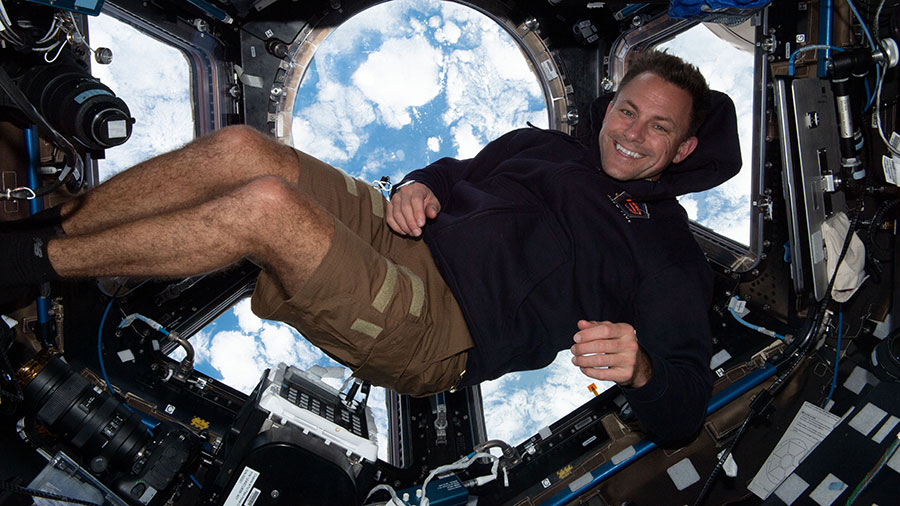
Astronaut Josh Cassada is pictured inside the cupola, the space station's
Astronaut Josh Cassada is pictured inside the cupola, the space station’s “window to the world,” 264 miles above the Pacific Ocean.

Tuesday’s main activities for the Expedition 68 crew included examining how the blood system is affected in weightlessness and working on a trio of different robotics activities. The four astronauts and three cosmonauts aboard the International Space Station also inspected a new toilet system and continued unpacking a new cargo craft.

The human body must adjust to living and working long-term in microgravity for a spaceflight mission to be successful. Astronauts exercise for about two hours every day and participate in a variety of tests their physiological adaptation, and to prepare their bodies for the return to Earth. Biomedical examinations are conducted before, during, and after a spaceflight, to learn how the human body changes on and off the Earth and to provide countermeasures against the adverse effects of living in orbit.

Tuesday’s human research looked at the cardiovascular system. NASA Flight Engineers Nicole Mann and Josh Cassada started their day drawing their blood samples, spinning the blood tubes in a centrifuge, and stowing them in a science freezer for future analysis. Afterward, Cassada attached sensors to himself for the Cerebral Autoregulation study measuring how the brain manages its own blood supply in space. Results may help crew members adjust quicker to gravity after returning to Earth and provide insights into blood pressure conditions.

Meanwhile, Tuesday was also a busy robotics day. The crew members practiced capturing a cargo craft, reviewed how to control free-flying assistants, and trained to operate a new robotic arm. Mann and Cassada studied on a computer the techniques required to capture the Northrop Grumman Cygnus space freighter, due to launch and arrive at the station next week, using the Canadarm2 robotic arm. Mann earlier turned on the Astrobee free-flyers in the Kibo laboratory module and learned how to maneuver the basketball-sized robotic assistants. Roscosmos Flight Engineer Anna Kikina continued getting up to speed with using the European robotic arm attached to the Nauka science module for upcoming cargo operations.

Astronauts Frank Rubio of NASA and Koichi Wakata of the Japan Aerospace Exploration Agency (JAXA) focused on lab maintenance cleaning science gear and preparing a new toilet for operations during Tuesday. Rubio opened up the Microgravity Science Glovebox, which hosts numerous science experiments from physics to biology, and cleaned its fans. filters, and components. Wakata worked on advanced orbital plumbing inside the Tranquility module checking the performance of a new toilet and its components and sensors.

Commander Sergey Prokopyev and Flight Engineer Dmitri Petelin were back inside the ISS Progress 82 cargo craft continuing to unpack some of the nearly 3,000 pounds of food, fuel, and supplies, less than a week after its arrival. The two cosmonauts also split their time working their contingent of space research, as well as, life support and electronic systems maintenance.


Learn more about station activities by following the space station blog@space_station and @ISS_Research on Twitter, as well as the ISS Facebook and ISS Instagram accounts.

Get weekly video highlights at: http://jscfeatures.jsc.nasa.gov/videoupdate/

Get the latest from NASA delivered every week. Subscribe here: www.nasa.gov/subscribe

Get The Details…

Mark Garcia

Powered by WPeMatico