Food Physiology Science, Station Upgrades Continue and CubeSats Deployed

Food Physiology Science, Station Upgrades Continue and CubeSats Deployed
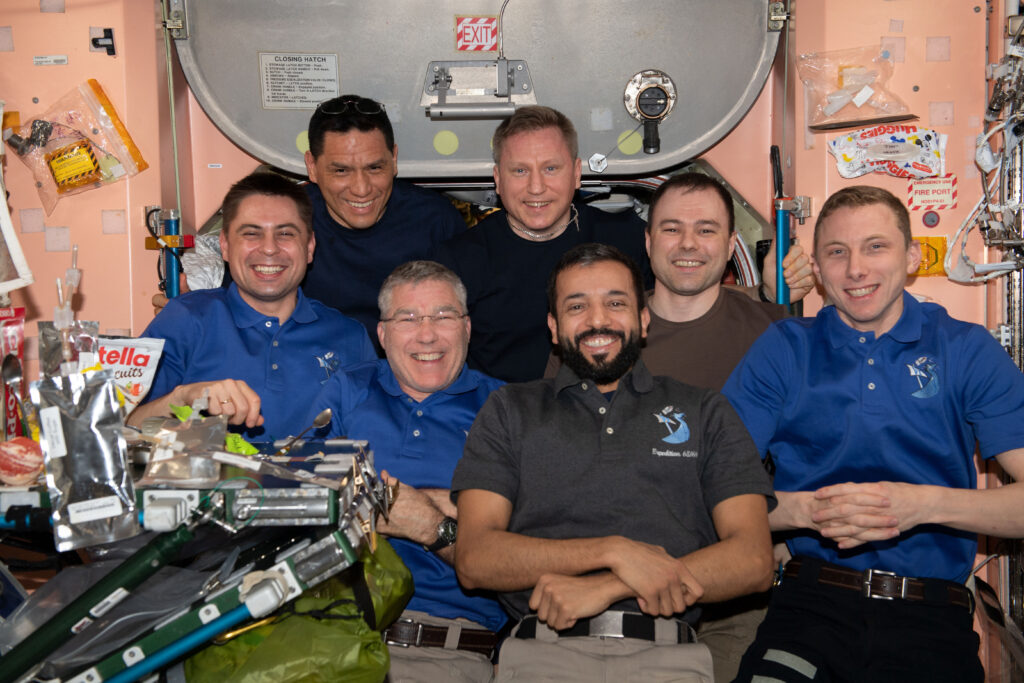
The seven-member Expedition 69 crew poses for a portrait during dinner time inside the International Space Station's Unity module. From left are, Roscosmos cosmonaut Andrey Fedyaev; NASA astronauts Frank Rubio and Stephen Bowen; Roscosmos cosmonaut Sergey Prokopyev; UAE (United Arab Emirates) astronaut Sultan Alneyadi; Roscosmos cosmonaut Dmitri Petelin; and NASA astronaut Woody Hoburg.
The seven-member Expedition 69 crew poses for a portrait during dinner time inside the International Space Station’s Unity module. From left are, Roscosmos cosmonaut Andrey Fedyaev; NASA astronauts Frank Rubio and Stephen Bowen; Roscosmos cosmonaut Sergey Prokopyev; UAE (United Arab Emirates) astronaut Sultan Alneyadi; Roscosmos cosmonaut Dmitri Petelin; and NASA astronaut Woody Hoburg.

Another busy day of Food Physiology science and station upgrades is underway today for the Expedition 69 crew on the International Space Station.

NASA Flight Engineer Frank Rubio spent most of his day continuing work for the Food Physiology investigation, collecting various samples and stowing them for future space and ground-based analysis, as well as processing samples taken earlier this week. This investigation is an ongoing series of experiments designed to understand the effects of spaceflight diet on astronauts.

NASA astronaut Stephen Bowen spent his morning working with a 3D chamber that investigates growth of organ buds from human stem cells in microgravity. Most of his day was spent preparing, rotating and verifying system operations throughout the day. Later on, Bowen deployed six CubeSats—mini satellites—into low-Earth orbit outside the Kibo airlock. The CubeSats will explore and monitor Earth’s atmosphere, study orbital conditions to learn more about space weather effects and observe material changes in space.

NASA astronaut Woody Hoburg spent the morning reconfiguring, rotating and monitoring the Life Support Rack which helps generate water and oxygen. Additionally, he measured acoustic levels of the station’s living quarters. United Arab Emirates (UAE) Flight Engineer Sultan Alneyadi rebooted Lumina, a device that monitors radiation. The two then worked together to install new communications hardware in the station’s Tranquility module.

Cosmonaut Commander Sergey Prokopyev and Flight Engineer Dmitri Petelin continued performing station maintenance, while Flight Engineer Andrey Fedyaev continued experimental research. Fedyaev donned a sensor-packed cap to practice piloting techniques through Pilot-T, an experiment that explores how spacefarers may react and control spacecraft on future planetary missions.


Learn more about station activities by following the space station blog@space_station and @ISS_Research on Twitter, as well as the ISS Facebook and ISS Instagram accounts.

Get weekly video highlights at: https://roundupreads.jsc.nasa.gov/videoupdate/

Get the latest from NASA delivered every week. Subscribe here: www.nasa.gov/subscribe

Powered by WPeMatico

Get The Details…

Abby Graf

Station Reboost, Food Physiology, and Hearing Assessments for Crew Mid-Week

Station Reboost, Food Physiology, and Hearing Assessments for Crew Mid-Week

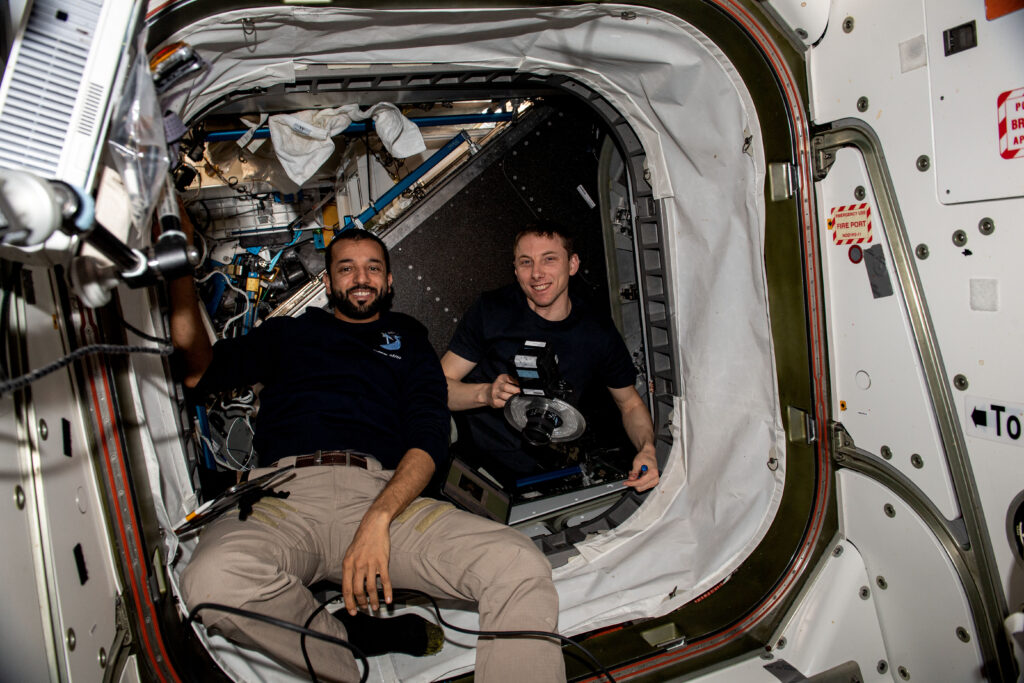
Expedition 69 Flight Engineers (from left) Sultan Alneyadi of UAE (United Arab Emirates) and Woody Hoburg of NASA pose for a portrait inside the vestibule between the Unity module and the Tranquility module during maintenance activities aboard the International Space Station.

Three Expedition 69 crew members spent their day on the International Space Station performing work in the Bigelow Expandable Activity Module, or BEAM, while other crew members completed a variety of Food Physiology experiments and hearing assessments.

NASA astronauts Stephen Bowen and Woody Hoburg, and United Arab Emirates (UAE) Flight Engineer Sultan Alneyadi performed maintenance and prepped BEAM for a mid-day entry. The seven-year-old module is an expandable capsule attached to the station’s Tranquility module and allows an additional space for crews to work.

Bowen spent his morning temporarily stowing items and cleaning BEAM, while Alneyadi and Hoburg completed maintenance in tandem. Hoburg later collected atmospheric and surface microbe samples from BEAM for future analysis. Bowen then entered BEAM for inspection, and later, exited and stowed tools and materials. In addition, Alneyadi moved MATISS samples that investigate antibacterial properties of materials in space while Hoburg cleaned vents that monitor the station’s air quality.

NASA Flight Engineer Frank Rubio spent his day performing connection checks of data management systems and completing a round of sample collections for the Food Physiology investigation. Rubio also conducted a hearing test, regular assessments such as this measure hearing function while exposed to the environment of microgravity in long-duration spaceflight.

Cosmonaut Flight Engineer Dmitri Petelin and Commander Sergey Prokopyev also conducted hearing assessments, while Flight Engineer Andrey Fedyaev performed station maintenance.

Following the July 4 holiday, the space station is orbiting slightly higher after the 83P fired its engines for 18 minutes and 52 seconds Tuesday afternoon. The orbital reboost sets up the correct phasing for the ISS Progress 85 resupply mission next month.


Learn more about station activities by following the space station blog@space_station and @ISS_Research on Twitter, as well as the ISS Facebook and ISS Instagram accounts.

Get weekly video highlights at: https://roundupreads.jsc.nasa.gov/videoupdate/

Get the latest from NASA delivered every week. Subscribe here: www.nasa.gov/subscribe

Powered by WPeMatico

Get The Details…

Abby Graf

Crew Starts Week With Experiment Preps, Daily Exercise and System Maintenance

Crew Starts Week With Experiment Preps, Daily Exercise and System Maintenance

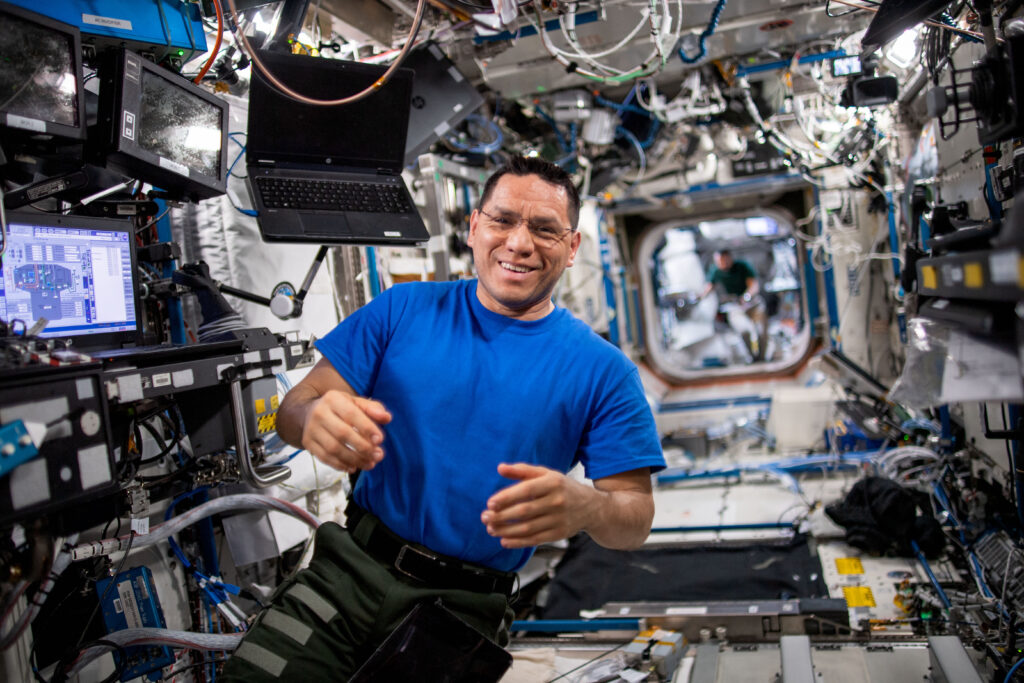
NASA astronaut and Expedition 69 Flight Engineer Frank Rubio poses for a portrait while working inside the International Space Station's Destiny laboratory module.
NASA astronaut and Expedition 69 Flight Engineer Frank Rubio poses for a portrait while working inside the International Space Station’s Destiny laboratory module.

After a weekend off-duty, the Expedition 69 crew is kicking off their week with a variety of experiment preparations and system maintenance on the International Space Station.

NASA astronaut Stephen Bowen started his day removing HICARI-2 samples from the Gradient Heating Furnace (GHF) in the Japanese Experiment Module, Kibo. Hicari is an experiment led by the Japan Aerospace Exploration Agency (JAXA) to investigate high-quality crystal growth of semiconductors.

While Bowen separated Hicari samples for return, NASA Flight Engineer Frank Rubio refreshed internal computer systems on the station. The two then took turns exercising on the station’s Cycle Ergometer with Vibration Isolation and Stabilization System (CEVIS) bicycle and the Advanced Resistive Exercise Device (ARED), which is a machine that simulates free weights for resistive exercise to help astronauts maintain bone and muscle strength in microgravity.

Rubio ended his day setting up hardware for the crew to collect saliva samples. The samples will be monitored and stored for future analysis on Earth to better understand crew health in space. Following Rubio’s earlier computer refresh, Bowen ended his day stowing items and hardware after the refresh was completed.

NASA astronaut Woody Hoburg performed EVA battery maintenance following his and Bowen’s spacewalk on June 15. United Arab Emirates (UAE) Flight Engineer Sultan Alneyadi prepped and turned on Astrobee, which are free-flying robots aboard the station that are used to assist astronauts with their daily duties. He also spent time surveying the Unity and Harmony modules for future hardware relocation. Hoburg and Alneyadi then took turns exercising on ARED and the station’s treadmill.

Cosmonaut Flight Engineers Dmitri Petelin and Andrey Fedyaev worked in tandem to perform sampling of microflora while Commander Sergey Prokopyev performed maintenance in the Zvezda service module.


Learn more about station activities by following the space station blog@space_station and @ISS_Research on Twitter, as well as the ISS Facebook and ISS Instagram accounts.

Get weekly video highlights at: https://roundupreads.jsc.nasa.gov/videoupdate/

Get the latest from NASA delivered every week. Subscribe here: www.nasa.gov/subscribe

Powered by WPeMatico

Get The Details…

Abby Graf

A Full Moon Illuminates Artemis I

A Full Moon Illuminates Artemis I

A full moon was visible behind the Artemis I SLS (Space Launch System) rocket and Orion spacecraft at Launch Complex 39B at NASA’s Kennedy Space Center in Florida on June 14, 2022. The first in an increasingly complex series of missions, Artemis I tested SLS and Orion as an integrated system prior to crewed flights to the Moon.

Powered by WPeMatico

Get The Details…