Crew Packs Dragon, Conducts Life Sustaining Research at End of Week

Crew Packs Dragon, Conducts Life Sustaining Research at End of Week
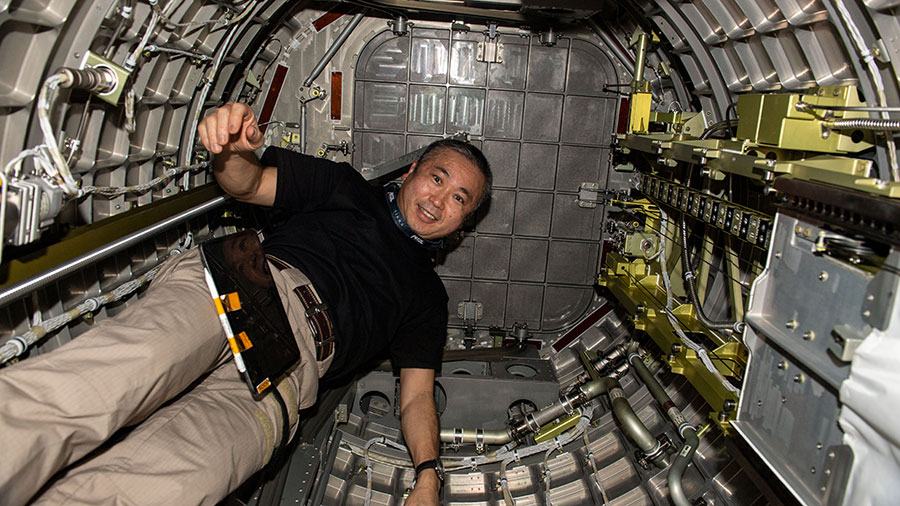
Astronaut Koichi Wakata is pictured inside the Kibo laboratory module's airlock where external payloads are placed into the outer space environment.
Astronaut Koichi Wakata is pictured inside the Kibo laboratory module’s airlock where external payloads are placed into the outer space environment.

The Expedition 68 crew will go into the weekend packing a U.S. resupply ship before it departs the International Space Station on Monday. In the meantime, the seven orbital residents concluded the work week researching a variety of space phenomena, maintaining advanced science hardware, and wrapping up three days of eye exams.

The SpaceX Dragon cargo craft will complete a 43-day mission at the orbital lab when it undocks from the Harmony module’s space-facing port at 5:05 p.m. EST on Monday. NASA astronauts Josh Cassada, Nicole Mann, and Frank Rubio will join astronaut Koichi Wakata of the Japan Aerospace Exploration Agency (JAXA) and spend Saturday and Sunday loading Dragon with critical research samples from completed station experiments for analysis on Earth after it splashes down off the coast of Florida. NASA TV will begin live coverage of Dragon’s undocking and departure at 4:45 p.m. on NASA’s website and the agency’s app.

However, the station’s four astronauts spent Friday servicing advanced research gear and conducting microgravity experiments. Three NASA astronauts also concluded several days of vision tests as Mann scanned the retinas of Cassada and Rubio using standard medical imaging hardware found in an optometrist’s office.

Wakata began his day taking photos of a set of nanosatellites as they were deployed outside the Kibo laboratory module into Earth orbit. The CubeSats will demonstrate a variety of technologies such as communications, propulsion systems, and Earth observations. He also assisted Rubio connecting communications gear and patching cables inside the Columbus laboratory module.

Mann researched ways to generate nutrients on demand by manipulating genetically engineered microbes. Cassada tended to tomatoes growing for a space botany study. Both experiments are informing ways NASA and its international partners can sustain crews on missions to the Moon, Mars, and beyond.

Commander Sergey Prokopyev from Roscosmos worked on several science projects at the end of the week as he tested a 3-D printer, explored futuristic spacecraft and robotic piloting techniques, and studied ways international crews and mission controllers can communicate better. Flight Engineers Dmitri Petelin and Anna Kikina took turns attaching sensors to themselves measuring their heart activity then downloading the data to researchers on Earth for a long-running cardiac study.


Learn more about station activities by following the space station blog@space_station and @ISS_Research on Twitter, as well as the ISS Facebook and ISS Instagram accounts.

Get weekly video highlights at: https://roundupreads.jsc.nasa.gov/videupdate/

Get the latest from NASA delivered every week. Subscribe here: www.nasa.gov/subscribe

Get The Details…

Mark Garcia

Powered by WPeMatico

Research Informing Deep Space Missions as Dragon Nears Departure

Research Informing Deep Space Missions as Dragon Nears Departure

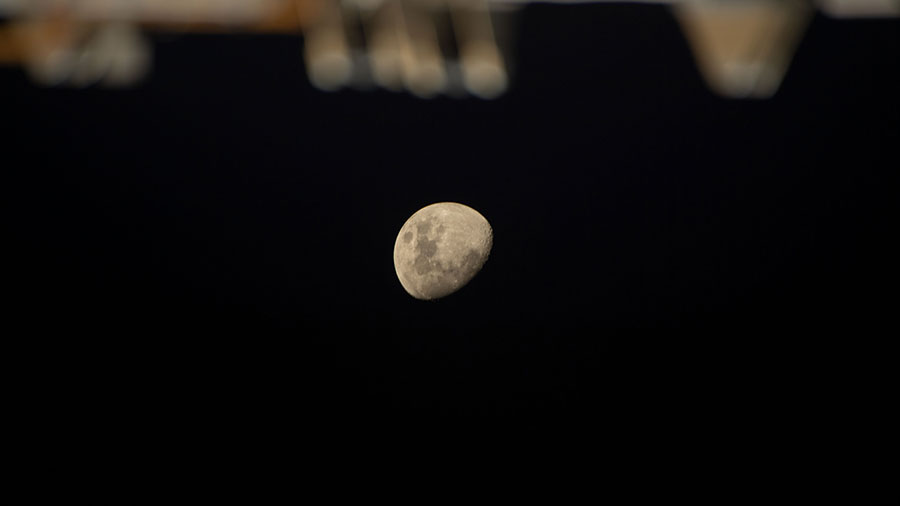
The Waxing Gibbous Moon is pictured from the space station as it orbited above the southern Indian Ocean.

Space science and spacesuits dominated the Expedition 68 crew’s work day aboard the International Space Station on Thursday. The orbital lab will also see the departure of a U.S. cargo ship early next week.

Sustaining crews farther away from Earth is a key objective as NASA and its international partners plan human missions to the Moon, Mars, and beyond. The BioNutrients-2 investigation taking place on the station seeks to provide nutrients in flight for astronauts to reduce reliance on visiting cargo missions. Food stowed for long periods of time also tends to lose its nutritional value. NASA astronauts Frank Rubio and Nicole Mann took turns today servicing and photographing genetically engineered yeast samples incubated in the Space Automated Bioproduct Laboratory for the study that could provide adequate nutrition on demand quickly using a minimal amount of equipment.

Mann also partnered with Flight Engineer Koichi Wakata of the Japan Aerospace Exploration Agency (JAXA) resizing a pair of spacesuits, also known as Extravehicular Mobility Units, or EMUs. Mann also installed lithium-ion batteries in the EMUs that power the spacesuit life support systems. The suits are being readied for an upcoming spacewalk planned to continue upgrading the station’s power generation system.

Wakata earlier joined NASA Flight Engineer Josh Cassada and continued packing the soon-to-depart SpaceX Dragon resupply ship. Dragon will complete a 43-day cargo mission and undock from the Harmony module’s space-facing port on Monday at 5:05 p.m. EST. It will splashdown off the coast of Florida packed with station hardware for inspection and finalized science experiments for analysis.

The orbiting lab’s three cosmonauts focused on their complement of microgravity research on Thursday benefiting humans on and off the Earth and providing insights on deep space exploration. Commander Sergey Prokopyev analyzed his blood samples using chromatography, a process for separating components of a mixture, then he studied how stress during a spaceflight may affect a cosmonaut’s immune system.

Roscosmos Flight Engineer Dmitri Petelin, wearing sensors, used a computer to explore how future crews may handle piloting spaceships or robots on planetary missions. Flight Engineer Anna Kikina pointed a camera outside a station window and photographed wildfires in South America. She then turned her attention to researching ways to improve communications between international crews and mission controllers from around the world.


Learn more about station activities by following the space station blog@space_station and @ISS_Research on Twitter, as well as the ISS Facebook and ISS Instagram accounts.

Get weekly video highlights at: https://roundupreads.jsc.nasa.gov/videupdate/

Get the latest from NASA delivered every week. Subscribe here: www.nasa.gov/subscribe

Get The Details…

Mark Garcia

Powered by WPeMatico