Biology, Physics Research Progress as Crews Hand Over Responsibilities

Biology, Physics Research Progress as Crews Hand Over Responsibilities
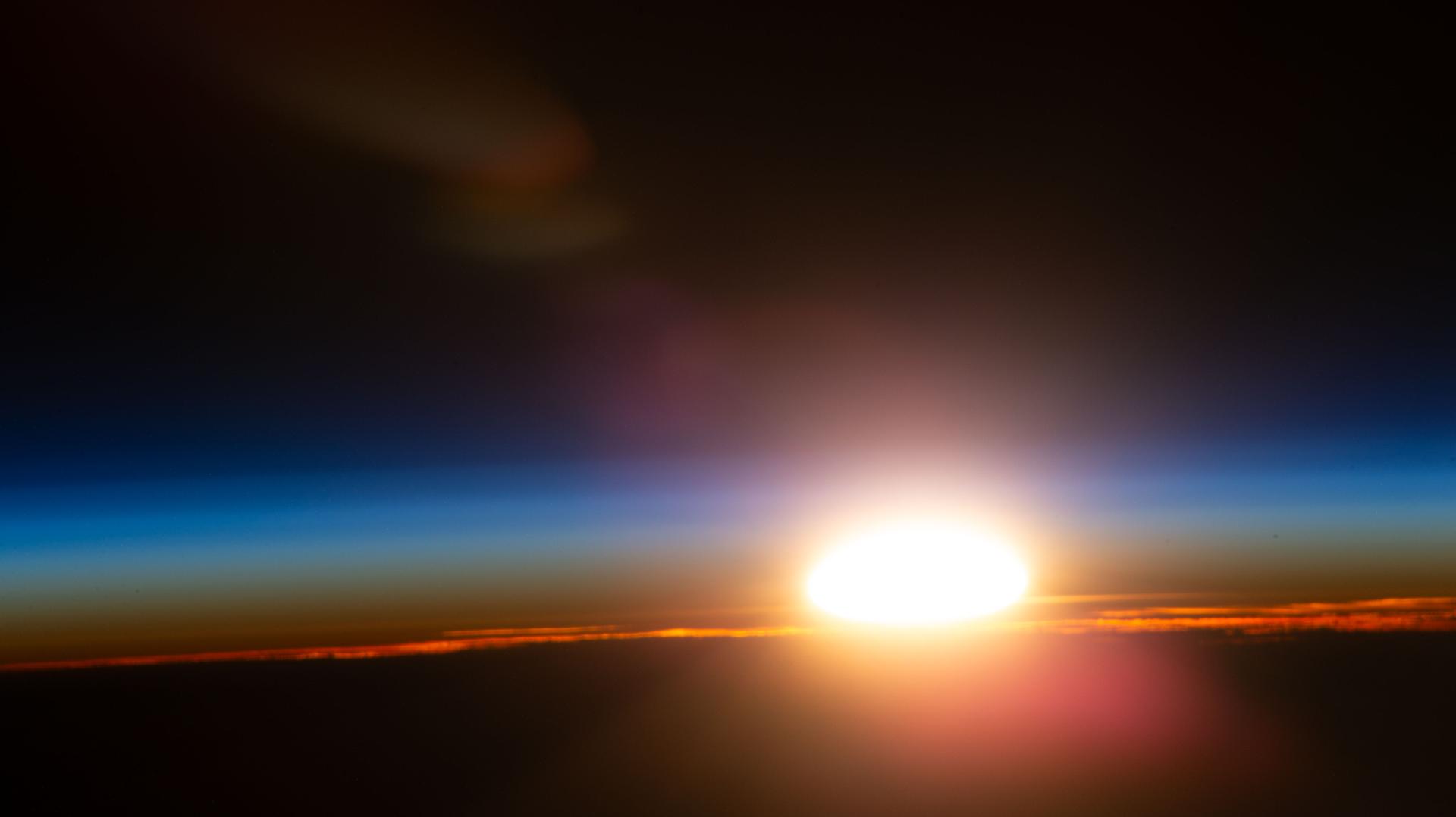
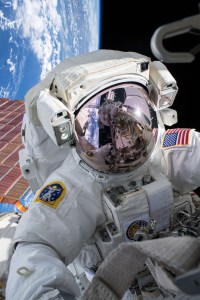
An orbital sunrise illuminates Earth's atmosphere and cloud tops in this photograph captured from the International Space Station as it orbited 264 miles above the Czech Republic in Eastern Europe.
An orbital sunrise illuminates Earth’s atmosphere and cloud tops in this photograph captured from the International Space Station as it orbited 264 miles above the Czech Republic in Eastern Europe.
NASA

Space biology and physics topped the research schedule aboard the International Space Station on Wednesday to improve human health and the space industry. The Expedition 73 residents also helped three new crewmates adapt to orbital life as another trio turns its attention to returning to Earth next week.

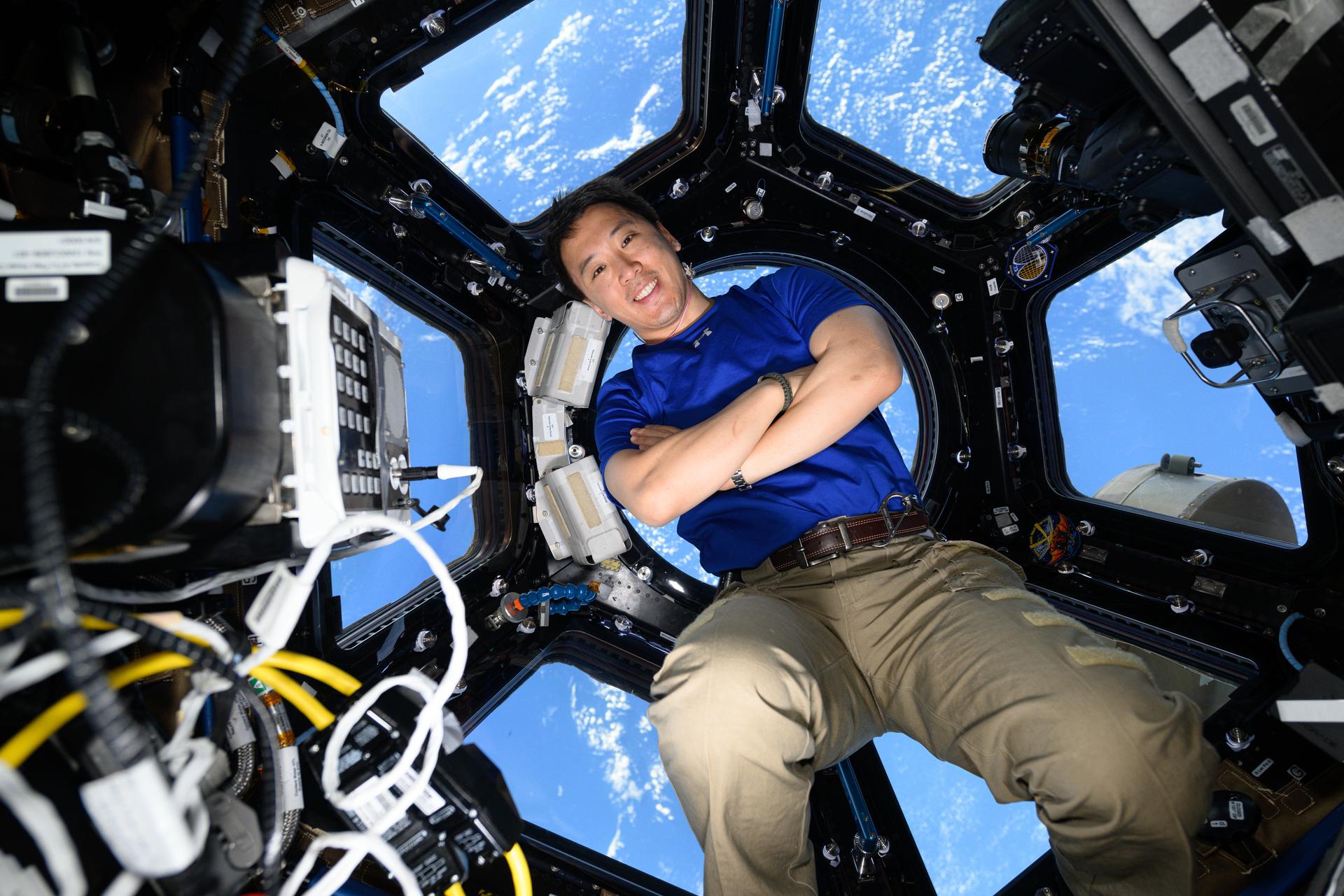
NASA Flight Engineer Zena Cardman spent her day processing blood samples, testing her cognition, and exercising for research. She first performed a blood draw with assistance from NASA Flight Engineer Jonny Kim. Afterward, she spun the samples in a centrifuge then stowed them inside a science freezer for future analysis. Next, she took a computerized test measuring how she understands and navigates the microgravity environment, also called spatial cognition. Both activities were for the CIPHER human research study tracking astronaut health before, during, and after a spaceflight. Finally, she worked out on the advanced resistive exercise device (ARED) and pedaled on the exercise cycle while wearing the sensor-packed Bio-Monitor headband and vest measuring her aerobic and cardiovascular health.

Kim configured the Astrobee robotic free-flying assistants for ground controlled remote operations. Scientists are studying Astrobee’s ability to operate both autonomously and remotely freeing astronauts to conduct more research. He then trained Roscosmos Flight Engineer Sergey Kud-Sverchkov, who just began his second space station mission, on how to operate and exercise on the ARED. Kim also continued packing his personal items as he gets ready to return to Earth inside the Soyuz MS-27 crew spacecraft on Dec. 8 with Roscosmos cosmonauts Sergey Ryzhikov and Alexey Zubritsky.

Ryzhikov helped Kud-Sverchkov and new Roscosmos cosmonaut Sergei Mikaev get up to speed with life on orbit showing the duo tools, operations, and procedures in the station’s Roscosmos segment. Ryzhikov was also back inside the Soyuz MS-27 stowing cargo, while Zubritsky continued packing his gear inside the spacecraft and cleaning his crew quarters.

NASA Flight Engineer Mike Fincke swapped cameras inside the Microgravity Science Glovebox to photograph how cryogenic fluids behave in microgravity to improve the design of spacecraft fuel tanks. Later, he helped new NASA Flight Engineer Chris Williams familiarize himself with station hardware, operations, and systems. At the end of his shift, Fincke inspected the condition of thermal insulation throughout the Tranquility module.

JAXA (Japan Aerospace Exploration Agency) astronaut Kimiya Yui started his shift inside the Kibo laboratory module troubleshooting an experimental carbon dioxide removal device that is informing the development of Artemis spacecraft life support systems. Afterward, he continued cargo operations inside the Cygnus XL space freighter unpacking and stowing new science experiments and crew supplies.

Roscosmos Flight Engineer Oleg Platonov began his shift downloading Earth imagery captured automatically while the crew was asleep. Afterward, he wore acoustic sensors that measured his airflow and lung function as he exhaled rapidly for a Roscosmos breathing in space investigation. Finally, he collected station radiation exposure data then analyzed station air samples for ammonia and carbon dioxide.

Learn more about station activities by following the space station blog, @space_station on X, as well as the ISS Facebook and ISS Instagram accounts.

Get the latest from NASA delivered every week. Subscribe here.

Powered by WPeMatico

Get The Details…

Mark A. Garcia
Student Art Murals at Johnson Celebrate 25 Years of Humanity in Space 

Student Art Murals at Johnson Celebrate 25 Years of Humanity in Space 

Select walls at NASA’s Johnson Space Center have been transformed into works of art. Each piece reflects creativity, collaboration, and the spirit of discovery. Painted by Texas students, the murals honor the legacy of the International Space Station and 25 years of continuous human presence in space. 

The International Space Station Program Mural Project began in 2022 as part of a broader effort to bring color and inspiration into the workplace while connecting classrooms to NASA’s mission. 

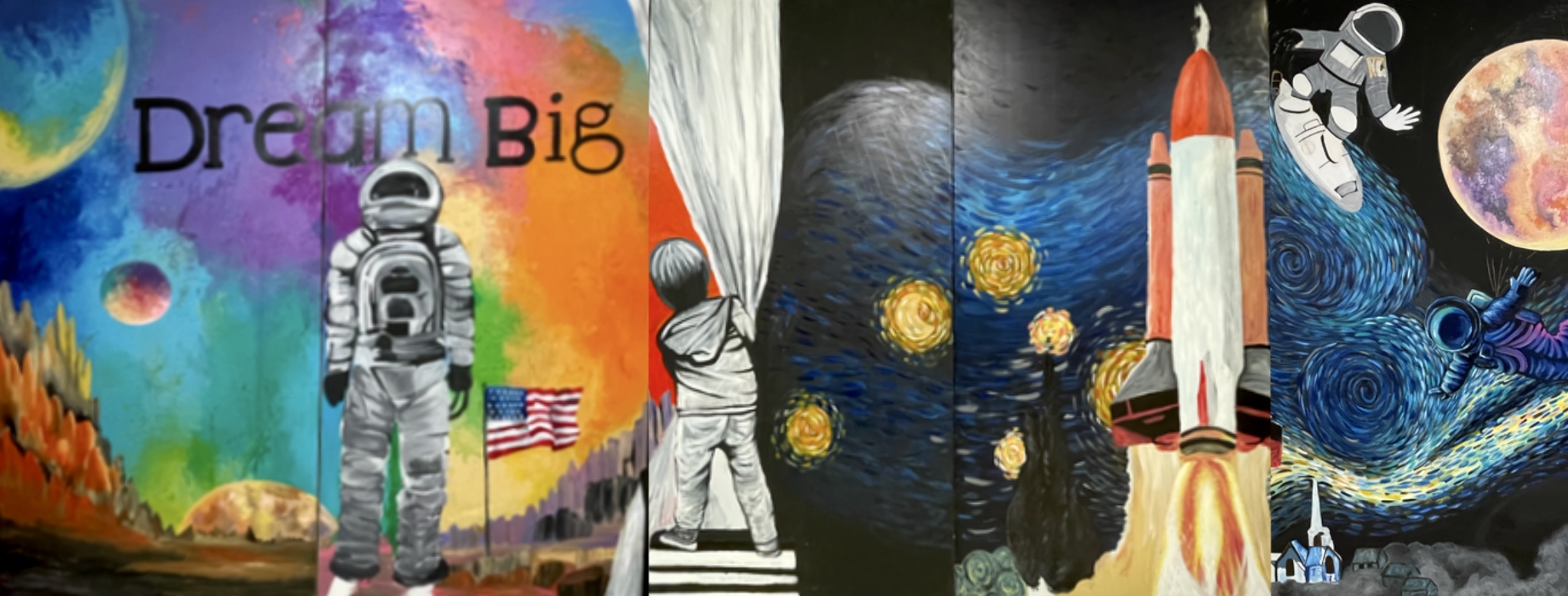
A colorful art mural representing space exploration. The words "Dream Big" appear in the upper left corner.
“Dream Big,” created by Texas City High School students with the International Space Station Program Mission and Program Integration team in 2025, symbolizes imagination becoming exploration.

“The mural collection is a reminder that today’s dreams can be tomorrow’s realities,” said Space Operations Mission Directorate Deputy Associate Administrator Joel Montalbano. “The future of space exploration depends on the imagination of our students.” 

As NASA prepares for the next giant leap through Artemis, the art on the walls serves as a reminder that every mission begins with creativity and courage. This initiative continues to inspire the next generation to Dare | Unite | Explore. While art allows for interpretation, each mural required careful planning, communication, and problem-solving, just like the work behind human spaceflight.  

The most recent mural, “Dream Big,” was installed in the hallway leading to the International Space Station Program suite on the fifth floor of building 1. Created by Texas City High School students with the International Space Station Program Mission Integration and Operations team, the artwork shows a grayscale child pulling back a curtain to reveal rockets, astronauts, and bright planetary landscapes.  

The mural’s design draws from both classic and modern art influences. The students were inspired by Van Gogh’s impressionistic style and Banksy’s Behind the Curtain, combining movement and curiosity to reflect how imagination can open the door to exploration. 

“The National Art Honor Society was honored to take on this inspiring project,” said Texas City High School art teacher Jennifer Massie. “They chose ‘Where Creativity Meets Reality’ to show how a child’s creative mind keeps moving and evolving—and that with big dreams and hard work, kids can follow in their heroes’ footsteps.” 

What started as an idea between Gary Johnson, technical manager in the International Space Station Mission Integration and Operations Office, and Raul Tijerina, then the program’s building graphics lead, has grown into a gallery-sized initiative that bridges science and creativity. 

“We want students to have the unique opportunity to contribute to NASA’s legacy through their artwork,” Johnson said. “These murals show that every mission begins with imagination and that the next generation of explorers is already helping paint humanity’s future among the stars.”  

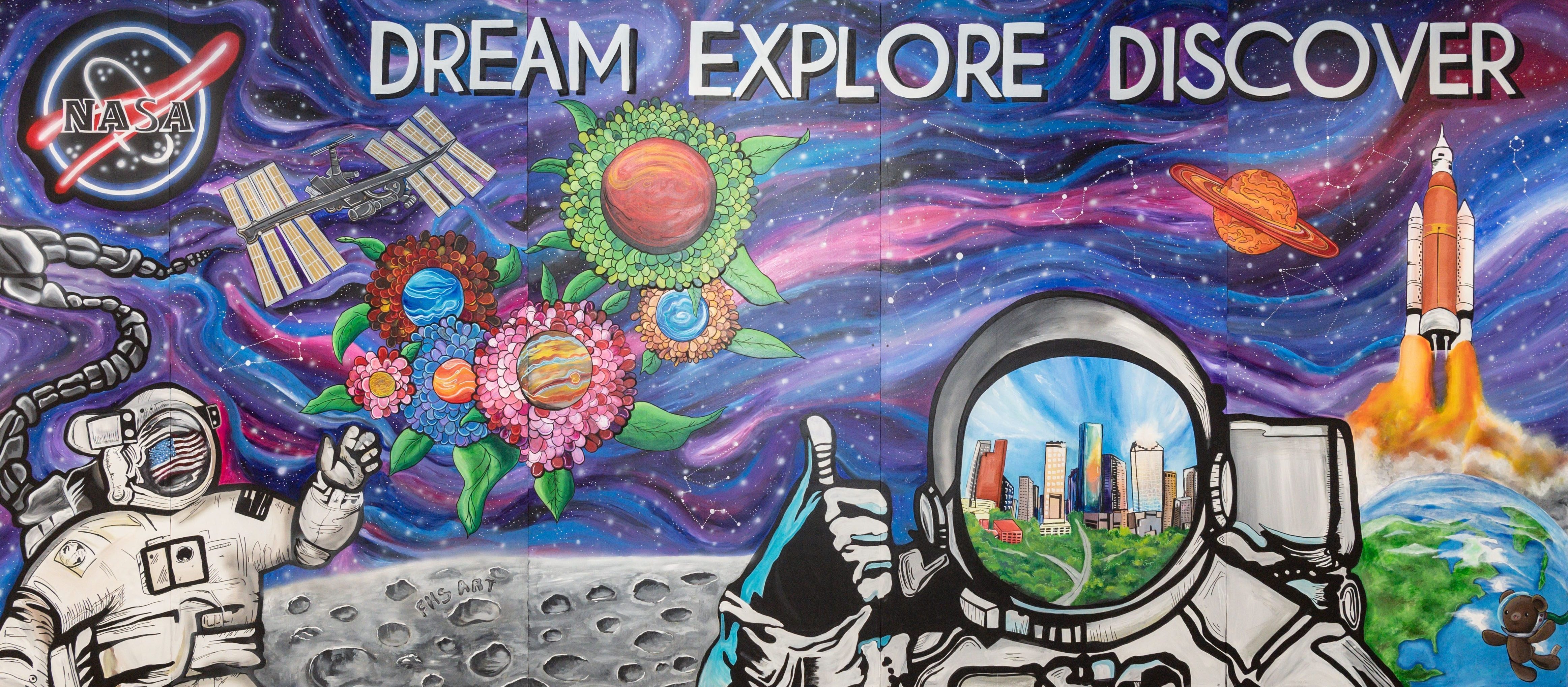
A colorful art mural featuring two astronauts on a lunar landscape with the Earth and a rocket in the background. The NASA meatball insignia is in the top left corner.
“Dream Explore Discover” was the first art mural created by Friendswood High School students in 2022.
NASA/Bill Stafford

Two murals are now housed in the hallway of the Neutral Buoyancy Laboratory’s International Space Development Integration Laboratory, known as the SDIL. The first, “Dream Explore Discover,” created by Friendswood High School students, was originally displayed in building 4 south. Under the guidance of art teacher Mandy Harris, more than 30 students designed and painted the 8-by-18-foot mural, starting with sketches and brainstorming sessions that considered how art could reflect human space exploration. The students combined their ideas into a single design celebrating the beauty and excitement of discovery. 

Elements of the mural include an astronaut’s visor reflecting the Houston skyline, zinnias symbolizing life and science connecting beyond Earth, and a small floating teddy bear representing both the dreams of children who look up to the stars and the generations of explorers who carried small tokens of home into space. It serves as a reminder of the human heart behind every mission.  

The mural also features the launch of NASA’s SLS (Space Launch System) rocket with NASA’s Orion spacecraft riding on top, heading for the next giant leap in exploration. Beside the capsule, the Orion constellation appears in the sky, symbolizing how the stars continue to guide humanity’s journey to the Moon, Mars, and beyond.  

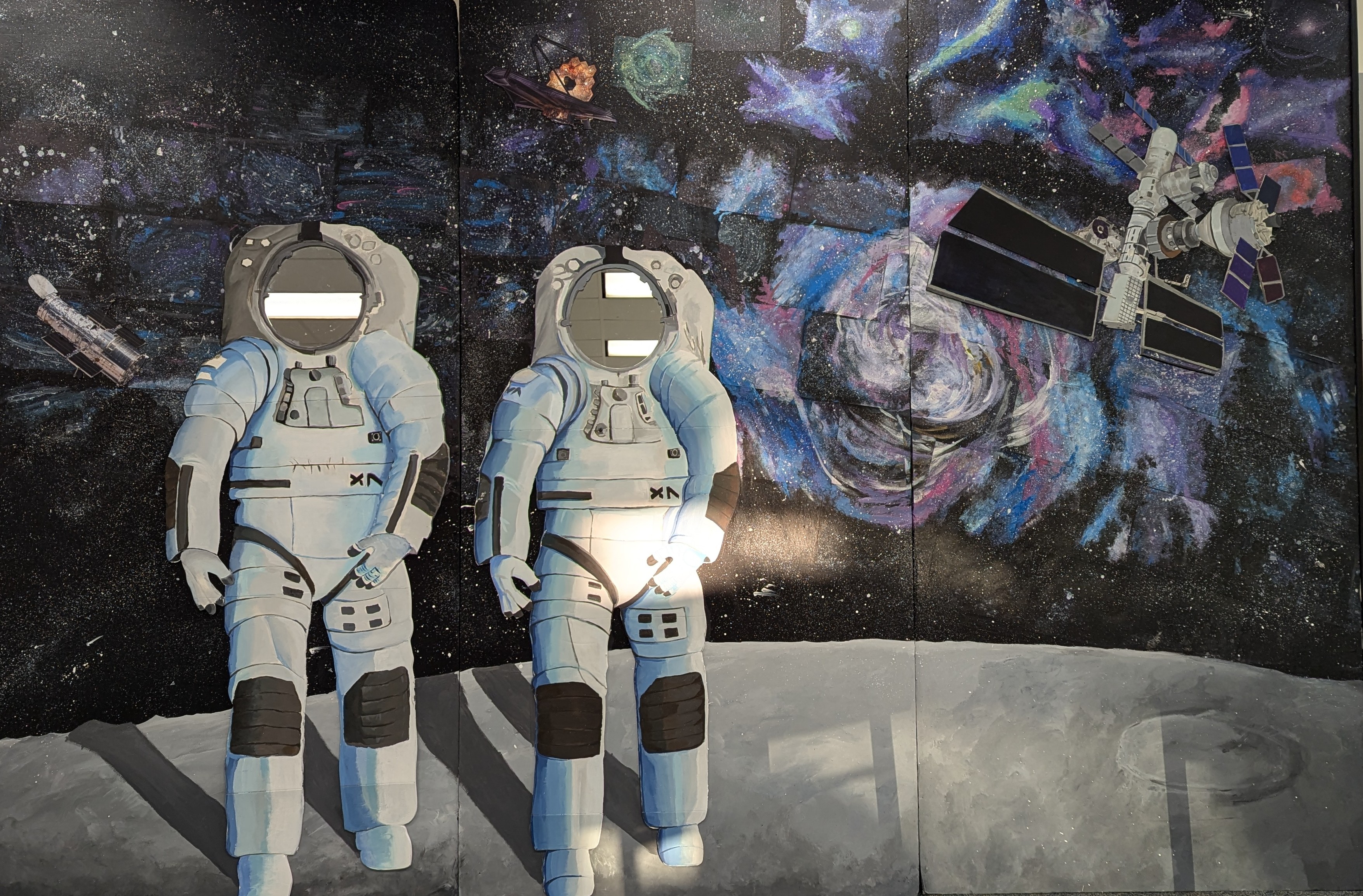
A mural showcases two spacesuit cutouts on a lunar surface, allowing visitors to pose as astronauts. The backdrop features a depiction of space, with colorful galaxies, the Hubble Space Telescope, and a satellite orbiting a distant planet.
“The Moon Now,” created by La Marque High School students, depicts two astronauts on the lunar surface in Axiom spacesuits with mirrored visors.

“The Moon Now,” created by students from La Marque High School, Blocker Middle School, and Giles Middle School, is also housed at the SDIL. The artwork depicts two astronauts on the lunar surface wearing Axiom spacesuits with mirrored visors that reflect the faces of the next generation who will carry humanity back to the Moon. Individual student artworks of the Milky Way and celestial objects were collaged into the final piece, creating a tapestry of imagination and exploration. 

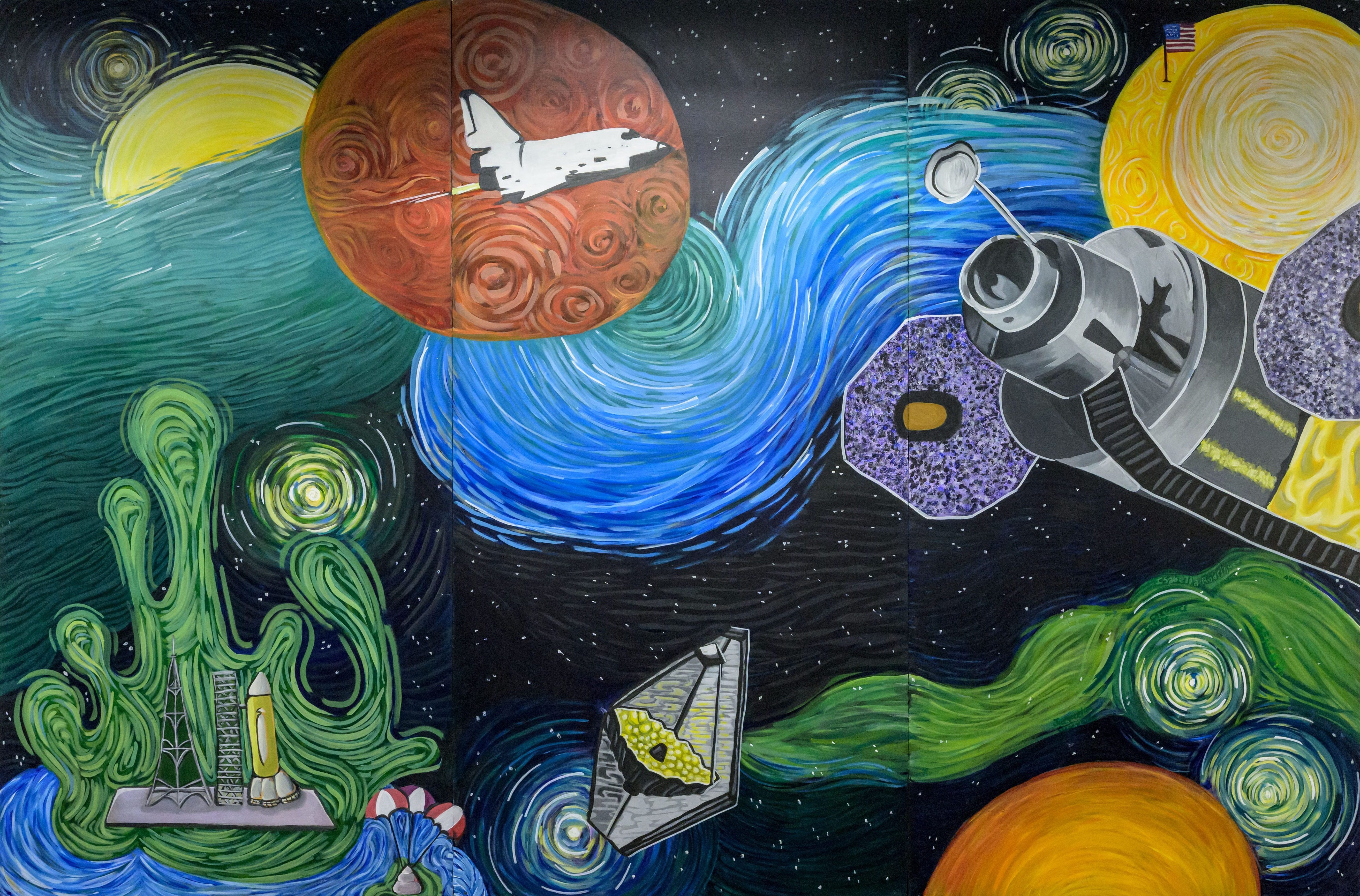
A colorful art mural with a Van Gogh style depicting space exploration.
Dickinson High School’s “A Starry Night” reimagines classic artistry through the lens of modern spaceflight.
NASA/Josh Valcarcel

The remaining murals are installed in building 4 south at Johnson. In 2023, the program expanded to include Dickinson High School, whose students created “A Starry Night,” a blend of Renaissance-style painting and modern space imagery. “Everyone wanted to be involved,” said art teacher Jennifer Sumrall. “The kids loved it and did their own research on how each of NASA’s missions impacts the world.” 

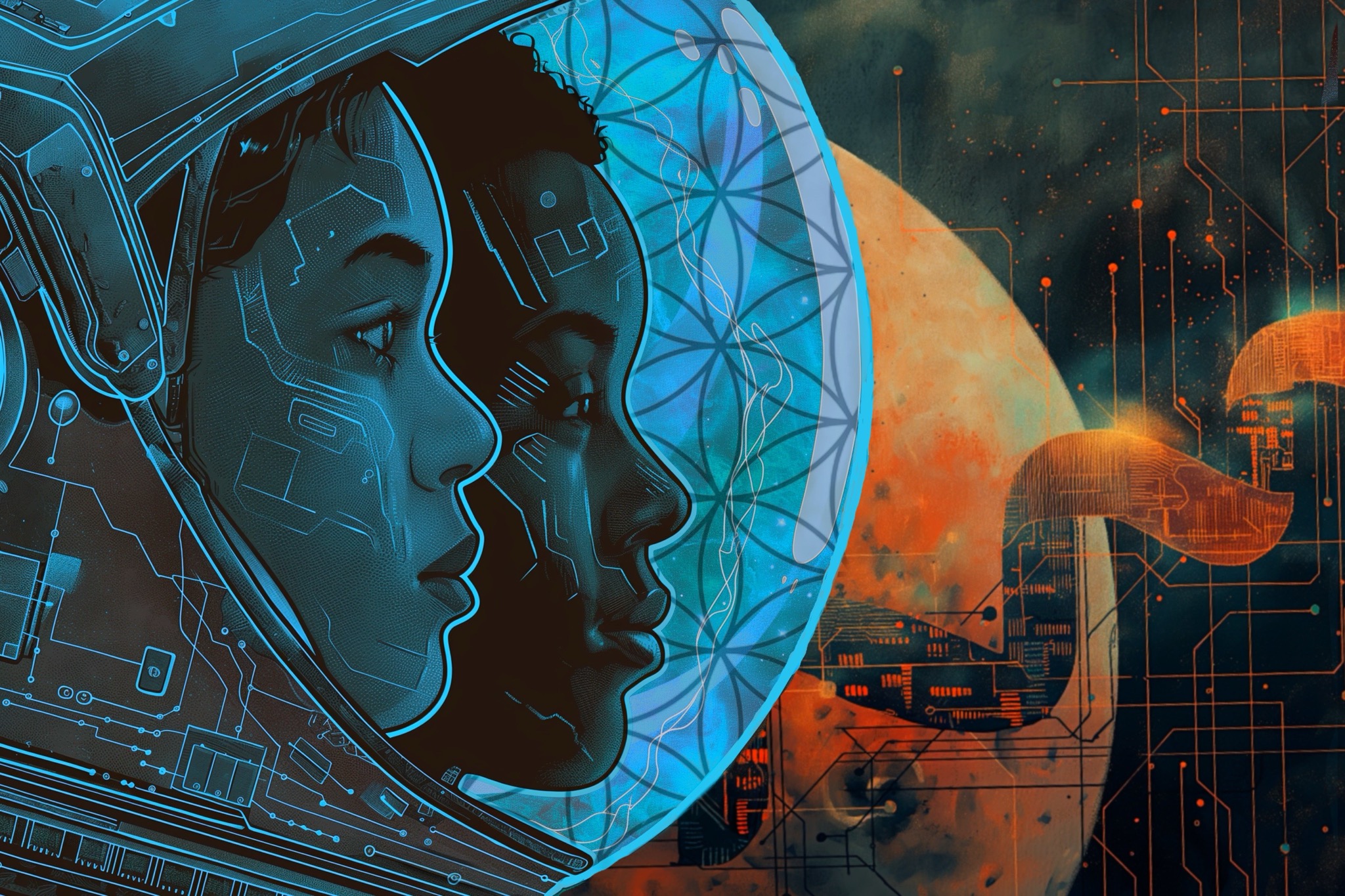
A stylized digital artwork featuring two individuals in profile within an astronaut helmet. The helmet’s design incorporates circuitry patterns. In the background, Mars looms with orange and red hues, surrounded by abstract geometric lines and digital elements.
“Absolute Equality: Breaking Boundaries” by Reginald C. Adams, symbolizes unity and humanity’s collective future in space exploration.

“Absolute Equality: Breaking Boundaries” by Houston artist Reginald C. Adams symbolizes unity and humanity’s shared future in space exploration. Two figures share a single helmet. Patterns inspired by circuitry surround the faces and suggest the role of technology in connecting people around the world and beyond it. 

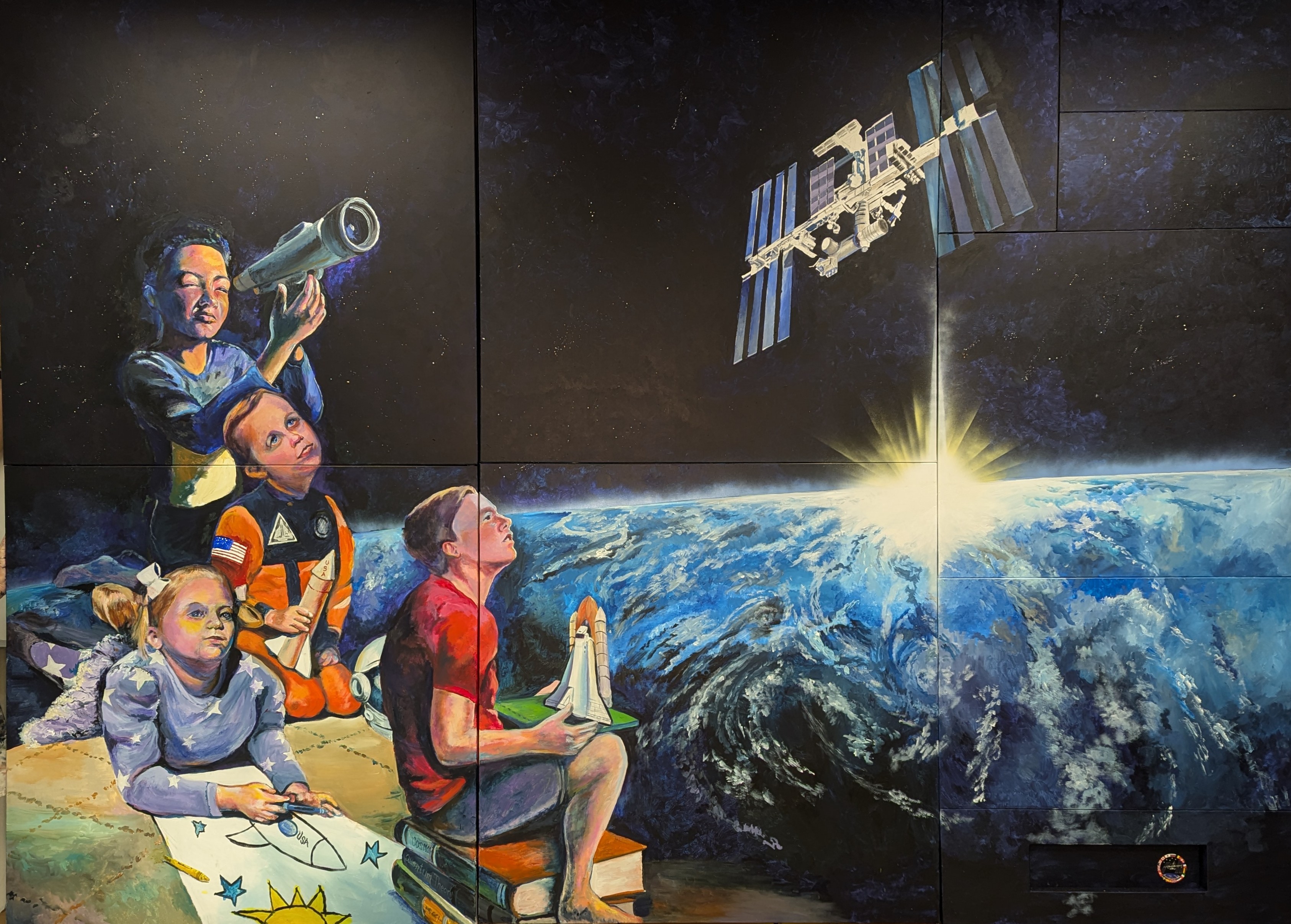
A mural depicts children gazing at the night sky. One child looks through a telescope, while others hold models of rockets and spacecraft. The International Space Station orbits above Earth.
La Marque High School students, art teacher Joan Finn, and artist Cheryl Evans painted “Collaboration” to illustrate the interconnected roles in space exploration.

“Collaboration” was painted by La Marque High School students with art teacher Joan Finn and artist Cheryl Evans to depict the interconnected roles of visionaries, engineers, artists, and astronauts in exploration. Built from 10 stretched canvases bolted together — a nod to the station’s assembly across more than 40 missions — the mural includes the space station patch at the bottom to represent the collaboration of the 15 countries involved.

NASA Johnson thanks Joel Montalbano, who championed student engagement that connects classrooms to mission work during his tenure as International Space Station Program manager. The center also acknowledges Gary Johnson for conceiving the mural project and guiding its partnerships, Raul Tijerina for early design leadership that set the standard, Gordon Andrews for opening doors through behind-the-scenes tours, and art educators for mentoring the students who brought each mural to life.  

Powered by WPeMatico

Get The Details…
Sumer Loggins

NASA Rover Detects Electric Sparks in Mars Dust Devils, Storms

NASA Rover Detects Electric Sparks in Mars Dust Devils, Storms

Three Martian dust devils can be seen near the rim of Jezero Crater in this short video made of images taken by a navigation camera aboard NASA’s Perseverance rover on Sept. 6, 2025. The microphone on the rover’s SuperCam previously captured audio when a dust devil passed over.
NASA/JPL-Caltech/SSI

Perseverance confirmed a long-suspected phenomenon in which electrical discharges and their associated shock waves can be born within Red Planet mini-twisters.

NASA’s Perseverance Mars rover has recorded the sounds of electrical discharges —sparks — and mini-sonic booms in dust devils on Mars. Long theorized, the phenomenon has now been confirmed through audio and electromagnetic recordings captured by the rover’s SuperCam microphone. The discovery, published Nov. 26 in the journal Nature, has implications for Martian atmospheric chemistry, climate, and habitability, and could help inform the design of future robotic and human missions to Mars.

A frequent occurrence on the Red Planet, dust devils form from rising and rotating columns of warm air. Air near the planet’s surface becomes heated by contact with the warmer ground and rises through the denser, cooler air above. As other air moves along the surface to take the place of the rising warmer air, it begins to rotate. When the incoming air rises into the column, it picks up speed like spinning ice skaters bringing their arms closer to their body. The air rushing in also picks up dust, and a dust devil is born.

SuperCam has recorded 55 distinct electrical events over the course of the mission, beginning on the mission’s 215thMartian day, or sol, in 2021. Sixteen have been recorded when dust devils passed directly over the rover.

Decades before Perseverance landed, scientists theorized that the friction generated by tiny dust grains swirling and rubbing against each other in Martian dust devils could generate enough of an electrical charge to eventually produce electrical arcs. Called the triboelectric effect, it’s the phenomenon at play when someone walks over a carpet in socks and then touches a metal doorknob, generating a spark. In fact, that is about the same level of discharge as what a Martian dust devil might produce.

“Triboelectric charging of sand and snow particles is well documented on Earth, particularly in desert regions, but it rarely results in actual electrical discharges,” said Baptiste Chide, a member of the Perseverance science team and a planetary scientist at L’Institut de Recherche en Astrophysique et Planétologie in France. “On Mars, the thin atmosphere makes the phenomenon far more likely, as the amount of charge required to generate sparks is much lower than what is required in Earth’s near-surface atmosphere.”

Perseverance’s SuperCam instrument carries a microphone to analyze the sounds of the instrument’s laser when it zaps rocks, but the team has also captured the sounds of wind and even the first audio recording of a Martian dust devil. Scientists knew it could pick up electromagnetic disturbance (static) and sounds of electrical discharges in the atmosphere. What they didn’t know was if such events happened frequently enough, or if the rover would ever be close enough, to record one. Then they began to assess data amassed over the mission, and it didn’t take long to find the telltale sounds of electrical activity.

The SuperCam microphone on NASA’s Perseverance captured this recording of the sounds of electrical discharge as a dust devil passed over the Mars rover on Oct. 12, 2024. The three crackles can be heard in between the sounds of the dust devil’s front and trailing walls.
Credit: NASA/JPL-Caltech/LANL/CNES/CNRS/ISAE-Supaero

Crackle, pop

“We got some good ones where you can clearly hear the ‘snap’ sound of the spark,” said coauthor Ralph Lorenz, a Perseverance scientist at the Johns Hopkins Applied Physics Lab in Laurel, Maryland. “In the Sol 215 dust devil recording, you can hear not only the electrical sound, but also the wall of the dust devil moving over the rover. And in the Sol 1,296 dust devil, you hear all that plus some of the particles impacting the microphone.”

Thirty-five other discharges were associated with the passage of convective fronts during regional dust storms. These fronts feature intense turbulence that favor triboelectric charging and charge separation, which occurs when two objects touch, transfer electrons, and separate — the part of the triboelectric effect that results in a spark of static electricity.

Researchers found electrical discharges did not seem to increase during the seasons when dust storms, which globally increase the presence of atmospheric dust, are more common on Mars. This result suggests that electrical buildup is more closely tied to the localized, turbulent lifting of sand and dust rather than high dust density alone.

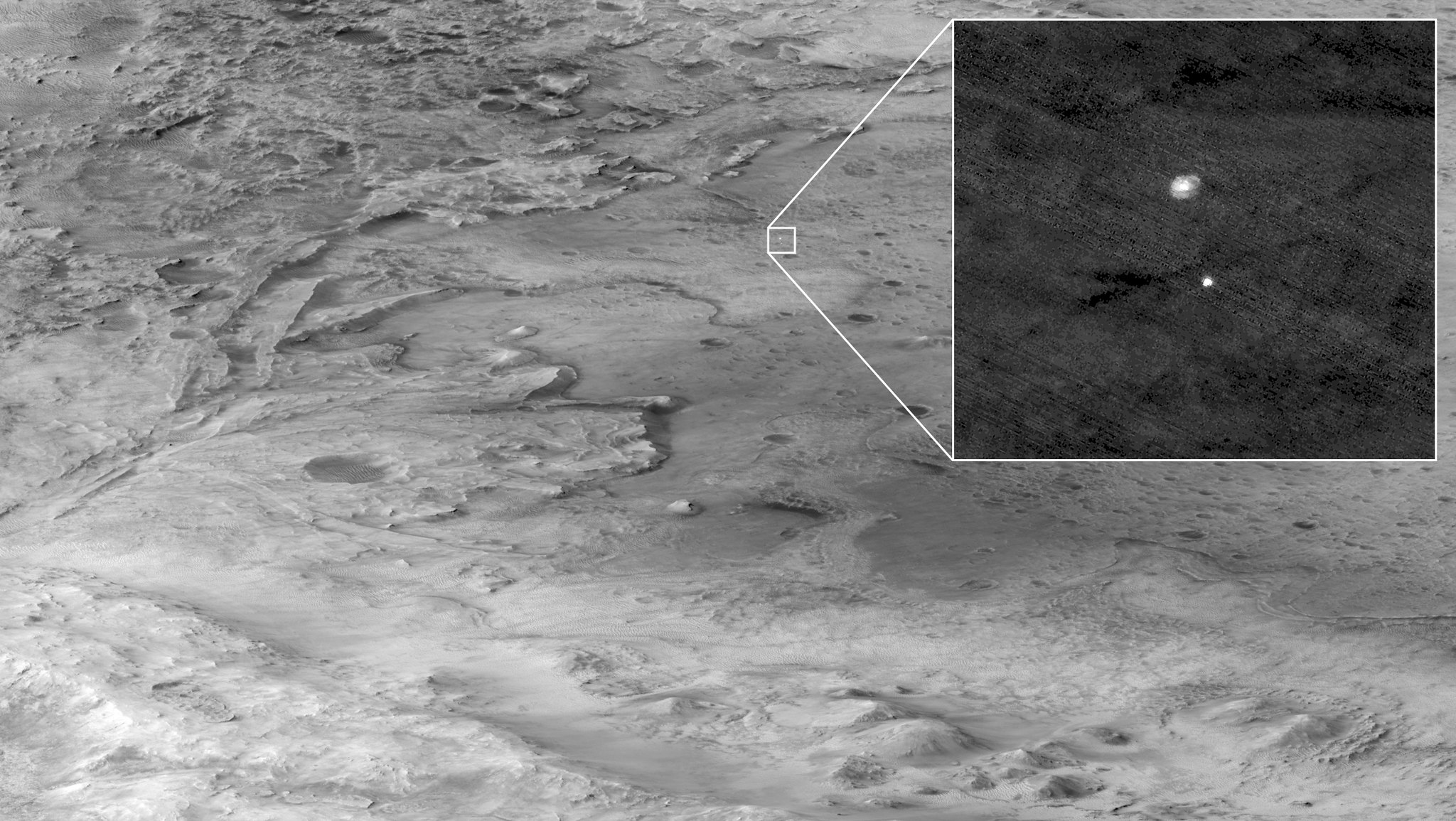
While exploring the rim of Jezero Crater on Mars, NASA’s Perseverance rover captured new images of multiple dust devils in January 2025. These captivating phenomena have been documented for decades by the agency’s Red Planet robotic explorers.
Credit: NASA/JPL-Caltech/LANL/CNES/CNRS/INTA-CSIC/Space Science Institute/ISAE-Supaero/University of Arizona

Profound effects

The proof of these electrical discharges is a discovery that dramatically changes our understanding of Mars. Their presence means that the Martian atmosphere can become sufficiently charged to activate chemical reactions, leading to the creation of highly oxidizing compounds, such as chlorates and perchlorates. These strong substances can effectively destroy organic molecules (which constitute some of the components of life) on the surface and break down many atmospheric compounds, completely altering the overall chemical balance of the Martian atmosphere.

This discovery could also explain the puzzling ability of Martian methane to vanish rapidly, offering a crucial piece of the puzzle for understanding the constraints life may have faced and, therefore, the planet’s potential to be habitable.

Given the omnipresence of dust on Mars, the presence of electrical charges generated by particles rubbing together would seem likely to influence dust transport on Mars as well. How dust travels on Mars plays a central role in the planet’s climate but remains poorly understood.

Confirming the presence of electrostatic discharges will also help NASA understand potential risks to the electronic equipment of current robotic missions. That no adverse electrostatic discharge effects have been reported in several decades of Mars surface operations may attest to careful spacecraft grounding practices. The findings could also inform safety measures developed for future astronauts exploring the Red Planet.

More about Perseverance

Managed for NASA by Caltech, the Jet Propulsion Laboratory in Southern California built and manages operations of the Perseverance rover on behalf of the agency’s Science Mission Directorate as part of NASA’s Mars Exploration Program portfolio.

To learn more about Perseverance visit:
https://science.nasa.gov/mission/mars-2020-perseverance

News Media Contacts

DC Agle
Jet Propulsion Laboratory, Pasadena, Calif.
818-393-9011
agle@jpl.nasa.gov

Karen Fox / Molly Wasser
NASA Headquarters, Washington
202-358-1600 / 240-419-1732
karen.c.fox@nasa.gov / molly.l.wasser@nasa.gov

2025-132

Share

Details

Last Updated

Dec 03, 2025

Powered by WPeMatico

Get The Details…
Chelsea Gohd

Hubble Seeks Clusters in ‘Lost Galaxy’

Hubble Seeks Clusters in ‘Lost Galaxy’

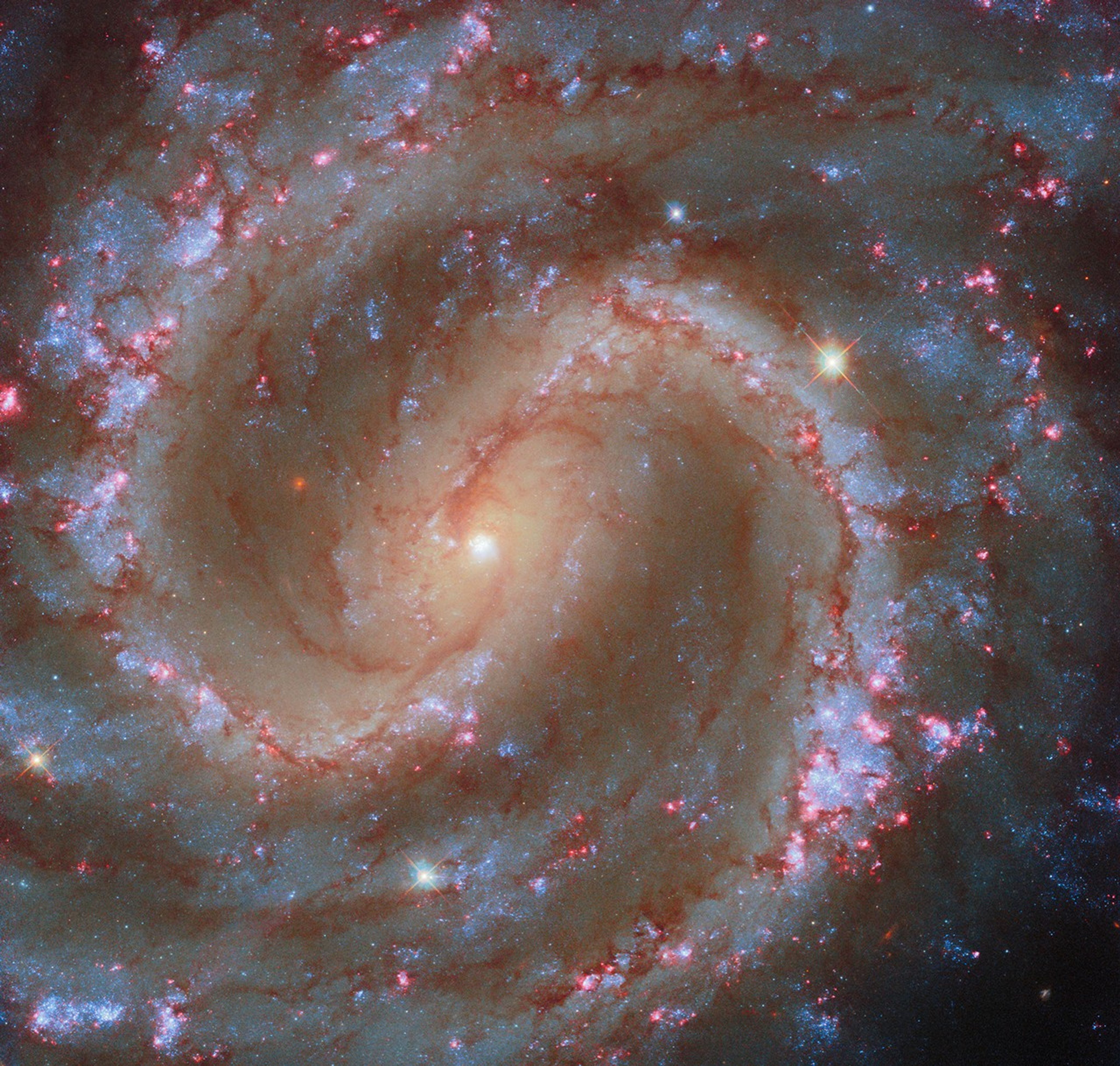
A close-in view of a spiral galaxy that faces the viewer. Brightly lit spiral arms swing outward through the galaxy’s disk, starting from an elliptical region in its center. Thick strands of dark reddish dust spread across the disk, primarily along the spiral arms. The arms also contain many glowing, pink-red spots where stars form and clumps of bright-blue star clusters. Beyond its spiral arms, the galaxy is a bit fainter and speckled with blue stars.
ESA/Hubble & NASA, F. Belfiore, J. Lee and the PHANGS-HST Team

This NASA/ESA Hubble Space Telescope image features the spiral galaxy NGC 4535, which is situated about 50 million light-years away in the constellation Virgo (the Maiden). Through a small telescope, this galaxy appears extremely faint, giving it the nickname ‘Lost Galaxy’. With a mirror spanning nearly eight feet (2.4 meters) across and its location above Earth’s light-obscuring atmosphere, Hubble can easily observe dim galaxies like NGC 4535 and pick out features like its massive spiral arms and central bar of stars.

This image features NGC 4535’s young star clusters, which dot the galaxy’s spiral arms. Glowing-pink clouds surround many of these bright-blue star groupings. These clouds, called H II (‘H-two’) regions, are a sign that the galaxy is home to especially young, hot, and massive stars that blaze with high-energy radiation. Such massive stars shake up their surroundings by heating their birth clouds with powerful stellar winds, eventually exploding as supernovae.

The image incorporates data from an observing program designed to catalog roughly 50,000 H II regions in nearby star-forming galaxies like NGC 4535. Hubble released a previous image of NGC 4535 in 2021. Both the 2021 image and this new image incorporate observations from the PHANGS observing program, which seeks to understand the connections between young stars and cold gas. Today’s image adds a new dimension to our understanding of NGC 4535 by capturing the brilliant red glow of the nebulae that encircle massive stars in their first few million years of life.

Image credit: ESA/Hubble & NASA, F. Belfiore, J. Lee and the PHANGS-HST Team

Powered by WPeMatico

Get The Details…
Monika Luabeya

Hazardous Material Summary Tables (HMSTs)

Hazardous Material Summary Tables (HMSTs)

3 min read

Preparations for Next Moonwalk Simulations Underway (and Underwater)

space toxicologist
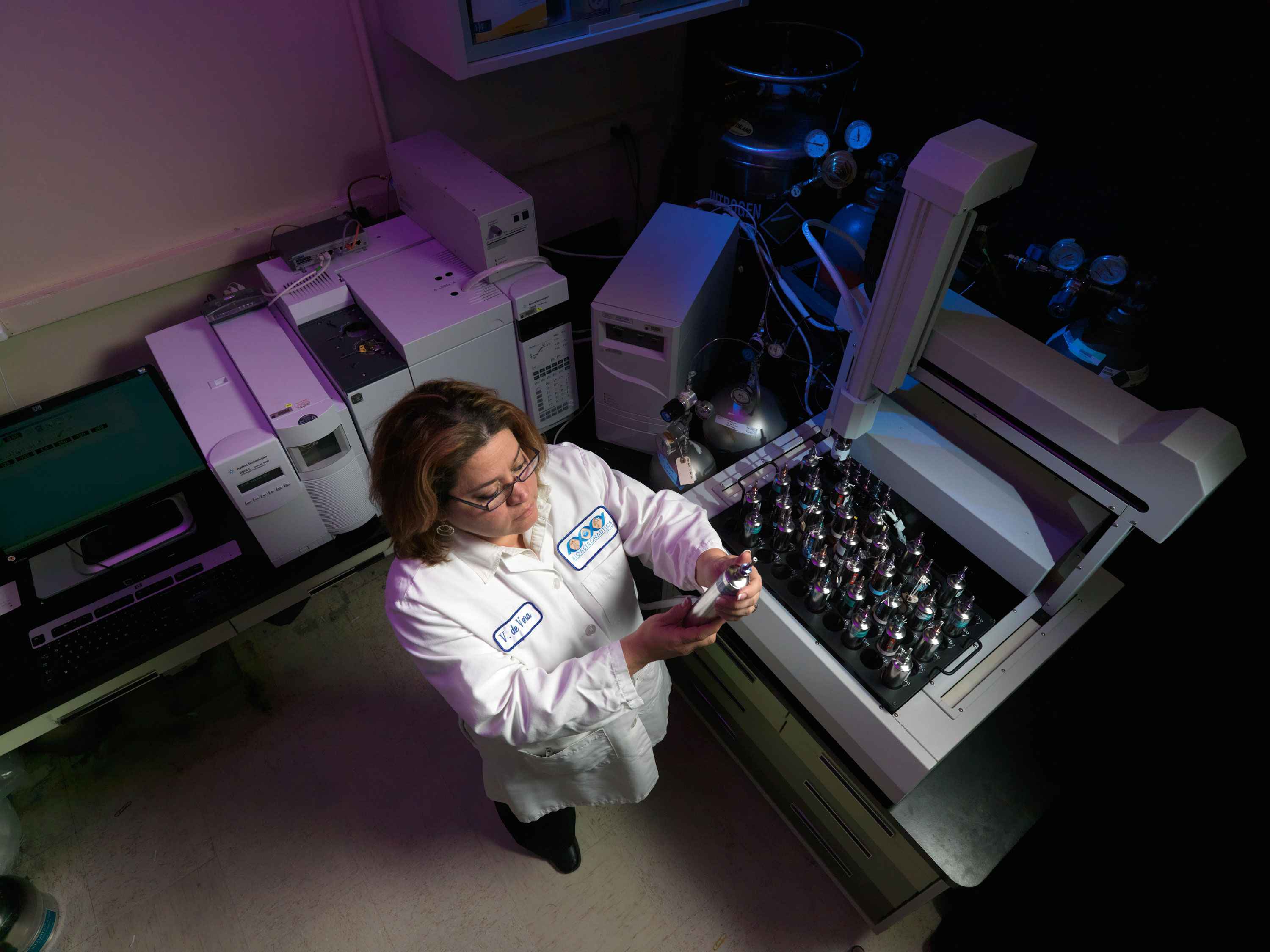
A space toxicologist at NASA JSC.
NASA

Hazardous Materials Summary Tables (HMSTs) are a compilation of the chemical, biological, and flammability hazards of materials on a given flight or mission. HMSTs are required by Safety for all Programs, including but not limited to ISS, Commercial Crew Program (CCP), Multi Purpose Crew Vehicle (MPCV), and Gateway. Johnson Space Center (JSC) toxicologists evaluate the toxic hazard level of all liquids, gases, particles, or gels flown on or to any manned U.S. spacecraft. The biosafety hazard level and flammability levels are assigned by JSC microbiologists and materials experts and are documented in an HMST and in a computerized in-flight version of the HMST called the HazMat (Hazardous Materials) database.

How To Obtain Toxicological Hazard Assessments

“Requirements for Submission of Data Needed for Toxicological Assessment of Chemical and Biologicals to be Flown on Manned Spacecraft”

  • JSC 27472 (PDF, 766KB) defines the terms “chemicals” and “biological materials” as applied to items being flown on or to any U.S. spacecraft. It explains who must submit information to the JSC toxicologists concerning the materials to be flown and specifies what information is needed. It provides schedules, formats, and contact information.
  • Additional US requirements for biological materials can be found on the Biosafety Review Board (BRB) page.
  • Additional US requirements for environmental control and life support (ECLS) assessments can be found in JSC 66869 (PDF, 698KB).

Data Submission

For all flights to ISS and all Artemis requests (Orion, Gateway, Human Lander System (HLS)), please submit data via the electronic hazardous materials summary table (eHMST) tool. If you do not have access to this tool, please submit a NAMS request for access to JSC – CMC External Tools. Please reference eHMST training for more information

NOTE:  For experimental payloads/hardware planned for launch on a Russian vehicle, stowed and/or operated on the Russian Segment of ISS, or planned for return or disposal on a Russian vehicle, we strongly encourage payload providers to submit biological and chemical data to the Russian Institute for Biomedical Problems (moukhamedieva@imbp.ru OR barantseva@imbp.ru).

Hazard Assessments

Toxicological hazard assessments are conducted according to JSC 26895 – Guidelines for Assessing the Toxic Hazard of Spacecraft Chemicals and Test Materials. The resulting Toxicity Hazard Level (THL) in combination with the BioSafety Level (BSL) and Flammability Hazard Level (FHL) form the basis for the combined Hazard Response Level (HRL) used for labeling and operational response per flight rule B20-16.

Share

Details

Last Updated

Dec 03, 2025

Editor
Robert E. Lewis

Powered by WPeMatico

Get The Details…
Ahmed El-Rasheedy