NASA Flies Drones Autonomously for Air Taxi Research

NASA Flies Drones Autonomously for Air Taxi Research

3 min read

Preparations for Next Moonwalk Simulations Underway (and Underwater)
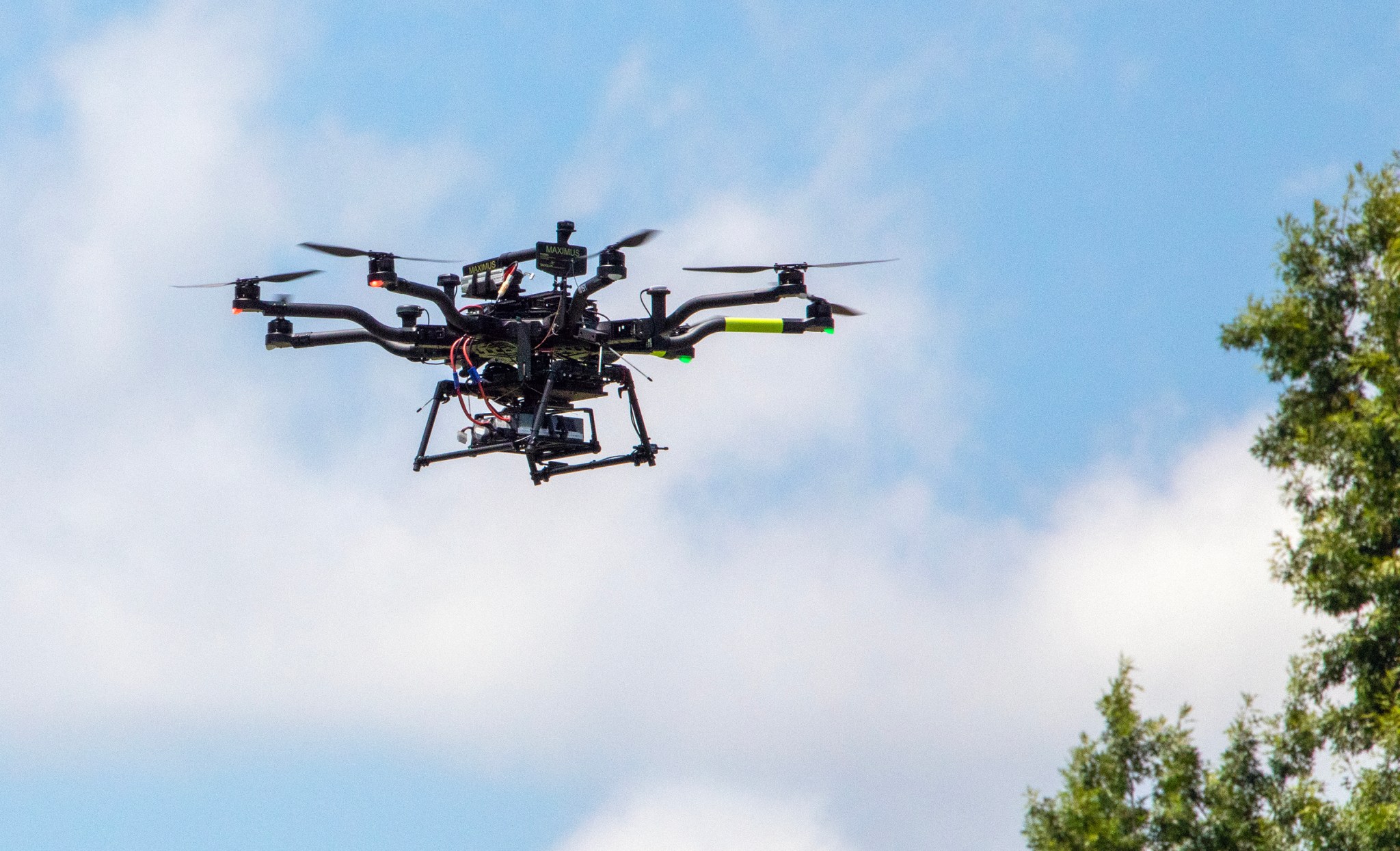
A small, black drone with multiple helicopter-like blades hovers over some trees during a bright, partly cloudy day in Virginia.
An Alta-8 small Unmanned Aircraft System testbed vehicle flies above NASA’s Langley Research Center in Hampton, Virginia. Flying beyond visual line of sight from observers on the ground required special approval from the Federal Aviation Administration and NASA.
NASA / Bowman

Researchers at NASA’s Langley Research Center in Hampton, Virginia recently flew multiple drones beyond visual line of sight with no visual observer. The drones successfully flew around obstacles and each other during takeoff, along a planned route, and upon landing, all autonomously without a pilot controlling the flight. This test marks an important step towards advancing self-flying capabilities for air taxis.

“Flying the vehicles beyond visual line of sight, where neither the vehicle nor the airspace is monitored using direct human observation, demonstrates years of research into automation and safety systems, and required specific approval from the Federal Aviation Administration and NASA to complete,” said Lou Glaab, branch head for the aeronautics systems engineering branch at NASA Langley.

It is safer and more cost effective to test self-flying technology meant for larger, passenger carrying air taxis on smaller drones to observe how they avoid each other and other obstacles.

NASA also is testing elements of automation technology using helicopters. These stand-in aircraft help NASA mature the autonomy well before self-flying air taxis are integrated into the skies.

“When you have multiple vehicles, all coming and going from a vertiport that is located adjacent to an airport or deep within a community, we have to ensure the automation technologies of these vehicles are capable of safely handling a high volume of air traffic in a busy area,” said Glaab.

Building upon past tests, the team successfully performed multiple flights using purchased ALTA 8 Uncrewed Aircraft Systems, also known as drones, with no visual observer and flew the drones beyond visual line of sight, referred to as “NOVO-BVLOS” flights.

The software loaded onto the small drones performed airspace communications, flight path management, avoidance with other vehicles, and more skills needed to operate in a busy airspace. This is imperative for what is envisioned with Advanced Air Mobility (AAM), where drones and air taxis will be operating at the same time on a routine basis.

The flight tests were observed from NASA Langley’s Remote Operations for Autonomous Missions control center while the drones took off and landed at the City Environment for Testing Autonomous Integrated Navigation test range.
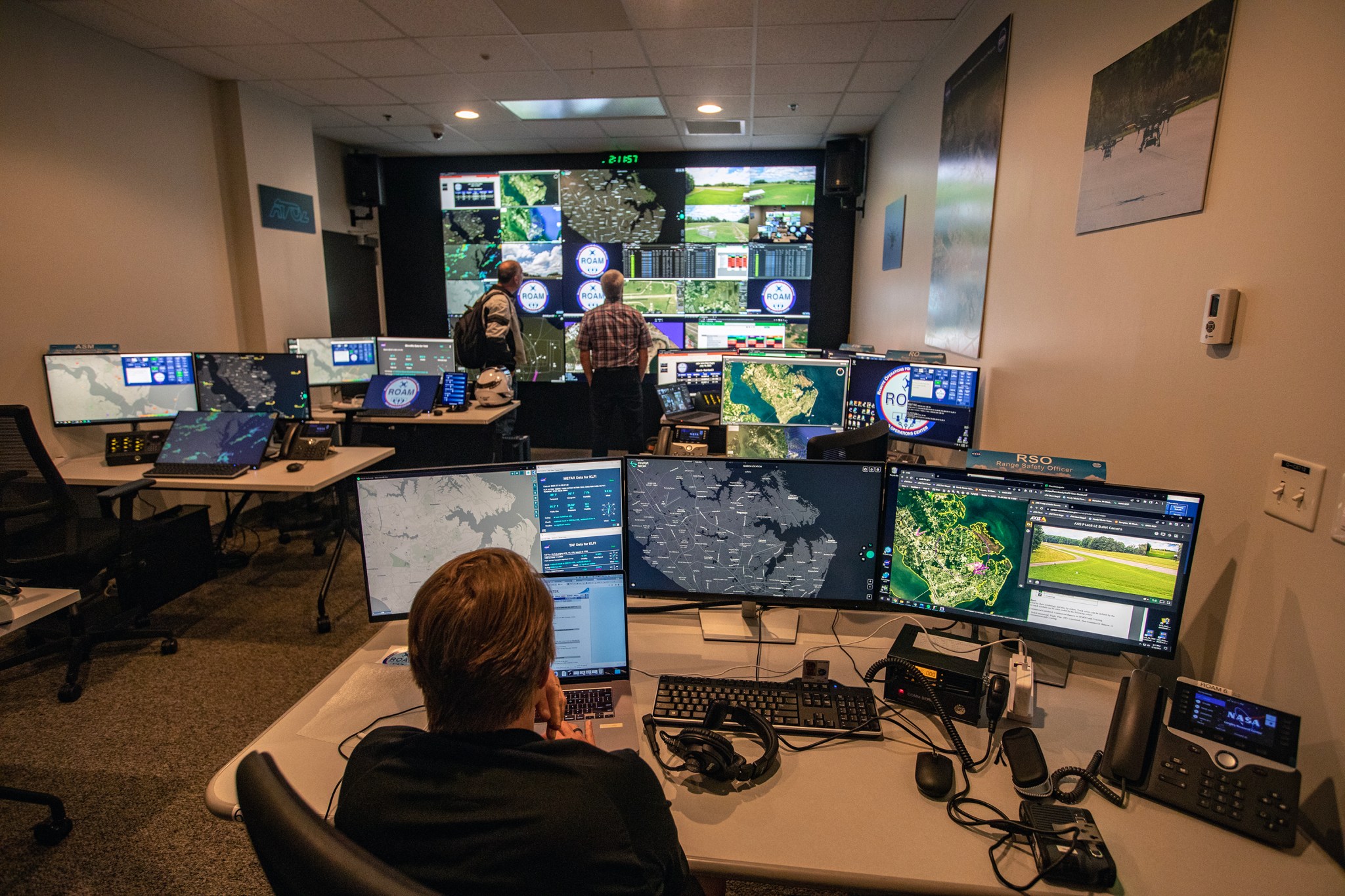
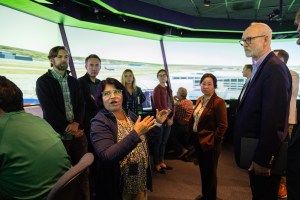
A room full of computer screens on tables and a far wall are watched by researchers monitoring the flight of small drones.
NASA researchers monitor the flight of an autonomous vehicle from the Remote Operations for Autonomous Missions UAS Operations Center at NASA’s Langley Research Center in Hampton, Virginia. the center facilitates “beyond visual line of sight” flight operations of small uncrewed aircraft system vehicles, also known as drones.
NASA / David Bowman

NASA will transfer the new technology created during this project to the public to ensure industry manufacturers can access the software while designing their vehicles.

“NASA’s ability to transfer these technologies will significantly benefit the industry,” said Jake Schaefer, flight operations lead for the project. “By conducting flight tests within the national airspace, in close proximity to airports and an urban environment, we are table to test technologies and procedures in a controlled but relevant environment for future AAM vehicles.”

One of these technologies was ICAROURS, which stands for NASA’s Integrated Configurable Architecture for Reliable Operations of Unmanned Systems. This software provides an autonomous detect-and-avoid function and is part of the overall system to maintain “well clear” from other air traffic.

Another technology used was NASA’s Safe2Ditch system, which allows the vehicle to observe the ground below and make an autonomous decision on the safest place to land in the event of an in-flight emergency.

NASA’s AAM mission has multiple projects contributing to various research areas. This project, called the High Density Vertiplex, was specifically focused on testing and evaluating where these future vehicles will take off and land at high frequency, called vertiports, or vertiplexes, for multiple vertiports near each other, and the technology advancements needed to make this successful.

Share

Details

Last Updated

Dec 21, 2023

Editor
Jim Banke
Contact
Location
Langley Research Center

Powered by WPeMatico

Get The Details…
Jim Banke

Live Coverage Underway of SpaceX Dragon Cargo Spacecraft Departure

Live Coverage Underway of SpaceX Dragon Cargo Spacecraft Departure

Thrusters on the SpaceX Dragon cargo spacecraft fire automatically while adjusting the vehicle's slow, methodical approach toward the International Space Station for a docking to the Harmony module's forward port.
Thrusters on the SpaceX Dragon cargo spacecraft fire automatically while adjusting the vehicle’s slow, methodical approach toward the International Space Station for a docking to the Harmony module’s forward port.

Live coverage of the departure of SpaceX’s Dragon cargo spacecraft from the International Space Station is underway on NASA Television, the agency’s website, and the NASA app.

Following commands from ground controllers at SpaceX in Hawthorne, California, Dragon will undock at 5:05 p.m. EST from the forward port of the station’s Harmony module and fire its thrusters to move a safe distance away from the station.

After re-entering Earth’s atmosphere, the spacecraft will make a parachute-assisted splashdown off the coast of Florida on Friday, Dec. 22. NASA will not broadcast the splashdown, but updates will be posted on the agency’s space station blog.


Watch Dragon undock live on the NASA+ streaming service via the web or the NASA app. Docking coverage also will air live on NASA Television, YouTube, and on the agency’s website. Learn how to stream NASA TV through a variety of platforms including social media.

Learn more about station activities by following the space station blog, @space_station and @ISS_Research on X, as well as the ISS Facebook and ISS Instagram accounts.

Get weekly video highlights at: https://roundupreads.jsc.nasa.gov/videoupdate/

Get the latest from NASA delivered every week. Subscribe here: www.nasa.gov/subscribe

Powered by WPeMatico

Get The Details…

Abby Graf

Dragon, Cygnus Cargo Missions Nearing End This Week

Dragon, Cygnus Cargo Missions Nearing End This Week

A SpaceX Dragon cargo spacecraft (left) approaches the station on Nov. 11. The Cygnus resupply ship (right) awaits a robotic capture on Aug. 4.

A SpaceX Dragon cargo spacecraft is targeting its undocking from the International Space Station for 5:05 p.m. EST today. The Expedition 70 crew finished packing Dragon on Wednesday with a variety of research samples and lab hardware for retrieval and analysis on Earth.

The orbital residents now turn their attention to the departure of a second U.S. resupply ship set for 8:05 a.m. on Friday. Northrop Grumman’s Cygnus space freighter was grappled with the Canadarm2 robotic arm and will soon be detached from the Unity module’s Earth-facing port before being released into Earth orbit completing a four-and-a-half month stay at the orbiting lab. Cygnus will stay in space until early January when it will enter the atmosphere above the Pacific Ocean for a fiery, but safe demise.

NASA, Axiom Space, and SpaceX teams now are targeting no earlier than Wednesday, Jan. 17, to launch Axiom Mission-3 to the space station from Kennedy Space Center’s Launch Complex 39A due to recent unfavorable weather conditions and changes in SpaceX’s launch manifest.

Astronauts Jasmin Moghbeli and Satoshi Furukawa completed preparations for Cygnus’ departure today closing the hatch and configuring the vehicle to end its mission. NASA’s Moghbeli earlier installed the SAFFIRE-VI experiment inside Cygnus that will be remotely activated to explore spacecraft fire safety. Furukawa from JAXA (Japan Aerospace Exploration Agency) ensured the disposable cargo was securely strapped inside the departing spacecraft.

Science and maintenance activities were still ongoing throughout Thursday advancing knowledge and keeping the orbital outpost in tip-top shape. Scientists use the microgravity environment to discover new phenomena impossible to observe in Earth’s gravity.

NASA Flight Engineer Loral O’Hara opened up the Combustion Integrated Rack and configured research components supporting an experiment that is observing how fuel temperatures affect material flammability. Results from the study may improve fire safety techniques on Earth and in space. Commander Andreas Mogensen of ESA (European Space Agency) activated a series of coding studies to interest students in science, swapped out optical fiber samples for a manufacturing experiment, then replaced filters in the Advanced Plant Habitat for a new space botany investigation.

Working in the orbital lab’s Roscosmos segment, veteran cosmonaut Oleg Kononenko once again tested the 3D printing of tools and supplies in weightlessness then set up an Earth atmosphere monitoring experiment. Flight Engineer Konstantin Borisov installed a secondary atmospheric study that is observing Earth’s nighttime environment in near-ultraviolet wavelengths. Flight Engineer Nikolai Chub attached sensors to his chest monitoring how his heart is adapting to the lack of gravity.


Learn more about station activities by following the space station blog, @space_station and @ISS_Research on X, as well as the ISS Facebook and ISS Instagram accounts.

Get weekly video highlights at: https://roundupreads.jsc.nasa.gov/videoupdate/

Get the latest from NASA delivered every week. Subscribe here: www.nasa.gov/subscribe

Powered by WPeMatico

Get The Details…

Mark Garcia

NASA Astronauts Test SpaceX Elevator Concept for Artemis Lunar Lander

NASA Astronauts Test SpaceX Elevator Concept for Artemis Lunar Lander

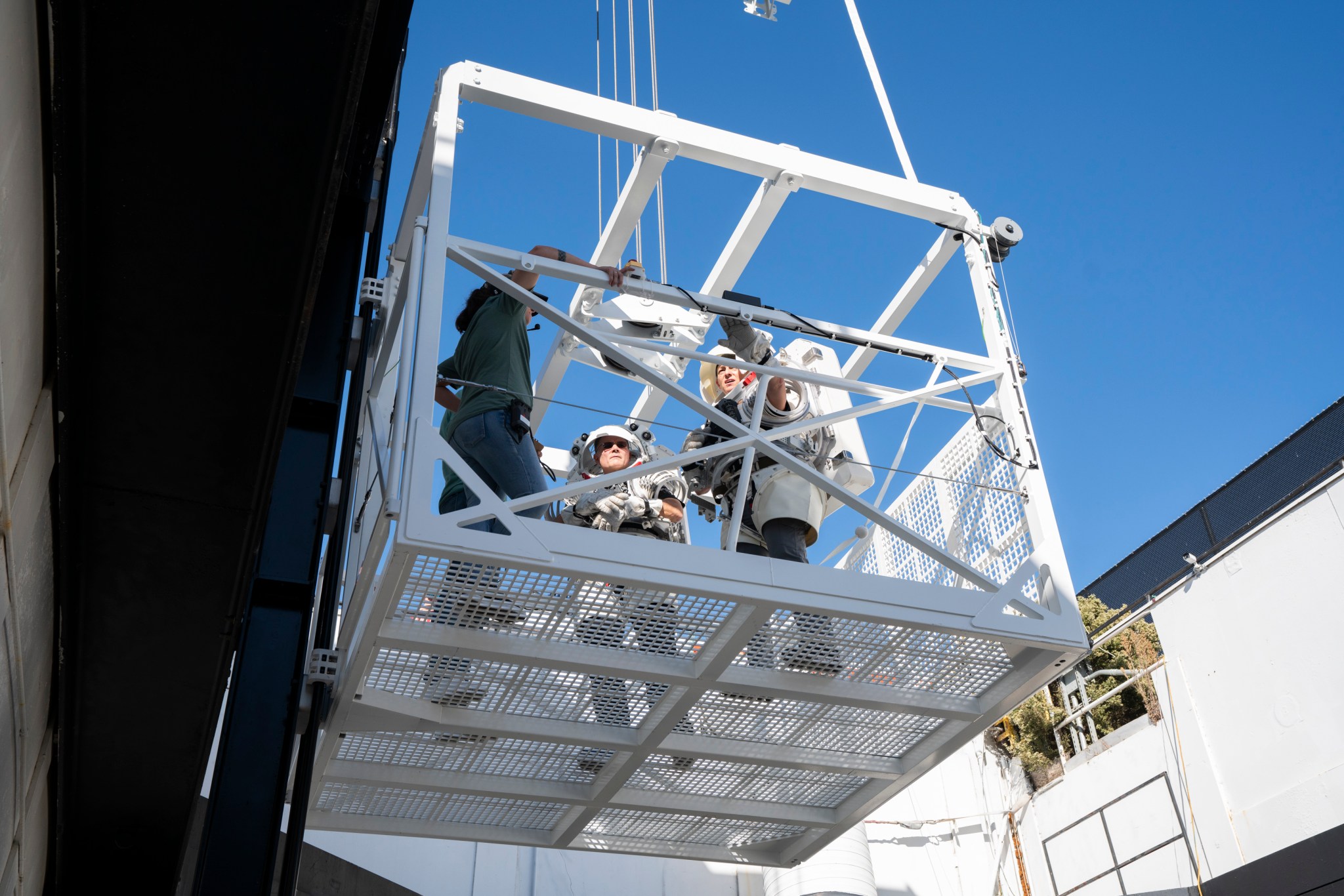
NASA astronauts Nicole Mann and Doug “Wheels” Wheelock participated in a recent test of a sub-scale mockup elevator for SpaceX’s Starship human landing system that will be used for NASA’s Artemis III and IV missions to the Moon.
SpaceX

NASA astronauts Nicole Mann and Doug “Wheels” Wheelock participated in a recent test of a sub-scale mockup elevator for SpaceX’s Starship human landing system that will be used for NASA’s Artemis III and IV missions to the Moon. The Starship human landing system will carry two astronauts from the Orion spacecraft in lunar orbit to the surface, serve as a habitat for crew members’ approximately one week stay on the Moon, and transfer them from the surface back to Orion.

The elevator will transport equipment and crew between Starship’s habitable area, located near the top of the lander, and the lunar surface, as they exit for moonwalks. The test allowed the astronauts to interact with a flight-like design of the elevator system, serving as both a functional demonstration of the hardware and providing the chance to receive valuable feedback from a crew perspective.

Built at SpaceX’s facility in Hawthorne, California, the elevator mockup has a full-scale basket section with functioning mechanical assemblies and crew interfaces for testing. During the demonstration, NASA astronauts wore spacesuits that simulate the suit size and mobility constraints that crew will face on the Moon. For Artemis III, the crew will wear new advanced spacesuits being developed by Axiom Space.

The suited crew provided feedback on elevator controls, such as gate latches, ramp deployment interfaces for moving into and out of the elevator basket, available space for cargo, and dynamic operations while the basket moved along a vertical rail system.

NASA is working to land the first woman and first person of color on the Moon under Artemis to explore more of the lunar surface than ever before and prepare to send humans to Mars for the benefit of all. The human landing system is a critical piece of deep space exploration architecture, along with the Space Launch System rocket, Orion spacecraft, advanced spacesuits and rovers, and the Gateway in orbit around the Moon.

Read more about Artemis:

https://www.nasa.gov/humans-in-space/artemis

News Media Contact

Jenalane Rowe
Marshall Space Flight Center
Huntsville, Ala.
256-544-0034

Powered by WPeMatico

Get The Details…
Lee Mohon

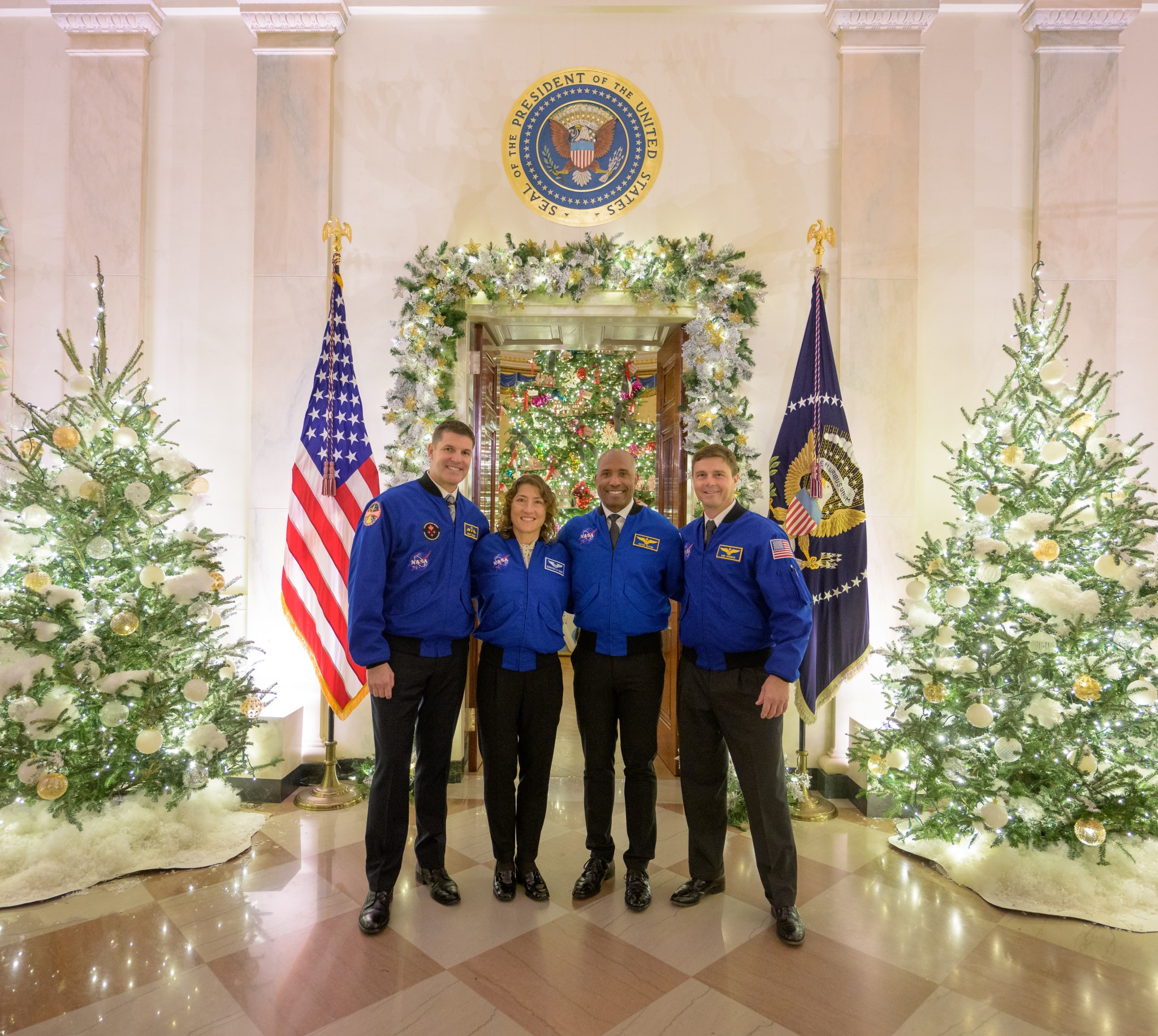
Artemis II Crew Visits White House

Artemis II Crew Visits White House

Four astronauts, wearing blue jackets and black pants, pose for a photo at the White House in front of decorations like trees, wreaths, and boughs. The astronauts, members of the Artemis II mission, have their arms around each other's shoulders. Behind them are two flags, and a seal high on the wall that reads
NASA / Bill Ingalls

Artemis II crew members (from left) CSA (Canadian Space Agency) astronaut Jeremy Hansen and NASA astronauts Christina Koch, Victor Glover, and Reid Wiseman pose for a group photograph after their meetings with U.S. President Joe Biden and U.S. Vice President Kamala Harris at the White House on Dec. 14, 2023.

The crew will travel aboard NASA’s Orion spacecraft on a 10-day mission around the Moon, testing spacecraft systems for the first time with astronauts for long-term exploration and scientific discovery.

Image Credit: NASA/Bill Ingalls

Powered by WPeMatico

Get The Details…
Monika Luabeya