NASA Selects 12 Companies for Space Station Services Contract
NASA
NASA has selected 12 companies to provide research, engineering, and mission integration services for the International Space Station Program.
The $478 million Research, Engineering & Mission Integration Services-2 or REMIS-2 contract will support the work of the International Space Station Program based at NASA’s Johnson Space Center in Houston. The companies will provide spaceflight, ground hardware and software, sustaining engineering functions and services, payload facility integration, and research mission integration operations services.
Each company will receive a multiple-award, indefinite-quantity contract with firm-fixed price and cost-plus-fixed-fee task orders. The seven-year contract begins Friday and extends through Sept. 30, 2030, with an option to extend through Sept. 30, 2032.
The companies selected are:
Aegis Aerospace, Inc., Houston
Axient Corp, Huntsville, Alabama
Cimarron Software Services, Houston
Consolidated Safety Services, Exploration Park, Florida
JES Tech, Houston
KBR Wyle, Fulton, Maryland
Leidos, Webster, Texas
Metis, Albuquerque, New Mexico
Oceaneering, Houston
Tec-Masters, Huntsville
Teledyne Brown Engineering, Huntsville
University of Alabama at Birmingham, Alabama
The majority of the work will take place at contractor facilities across the country. Services also may be required at other NASA centers, contractor or subcontractor locations, or vendor facilities as requirements warrant.
The contract also includes a small business reserve, which was fulfilled by selecting Aegis, Cimarron, Consolidated Safety Services, JES Tech, Metis, and Tec-Masters.
For more information about NASA and its programs, visit: https://www.nasa.gov.
NASA, Lockheed Martin Reveal X-59 Quiet Supersonic Aircraft
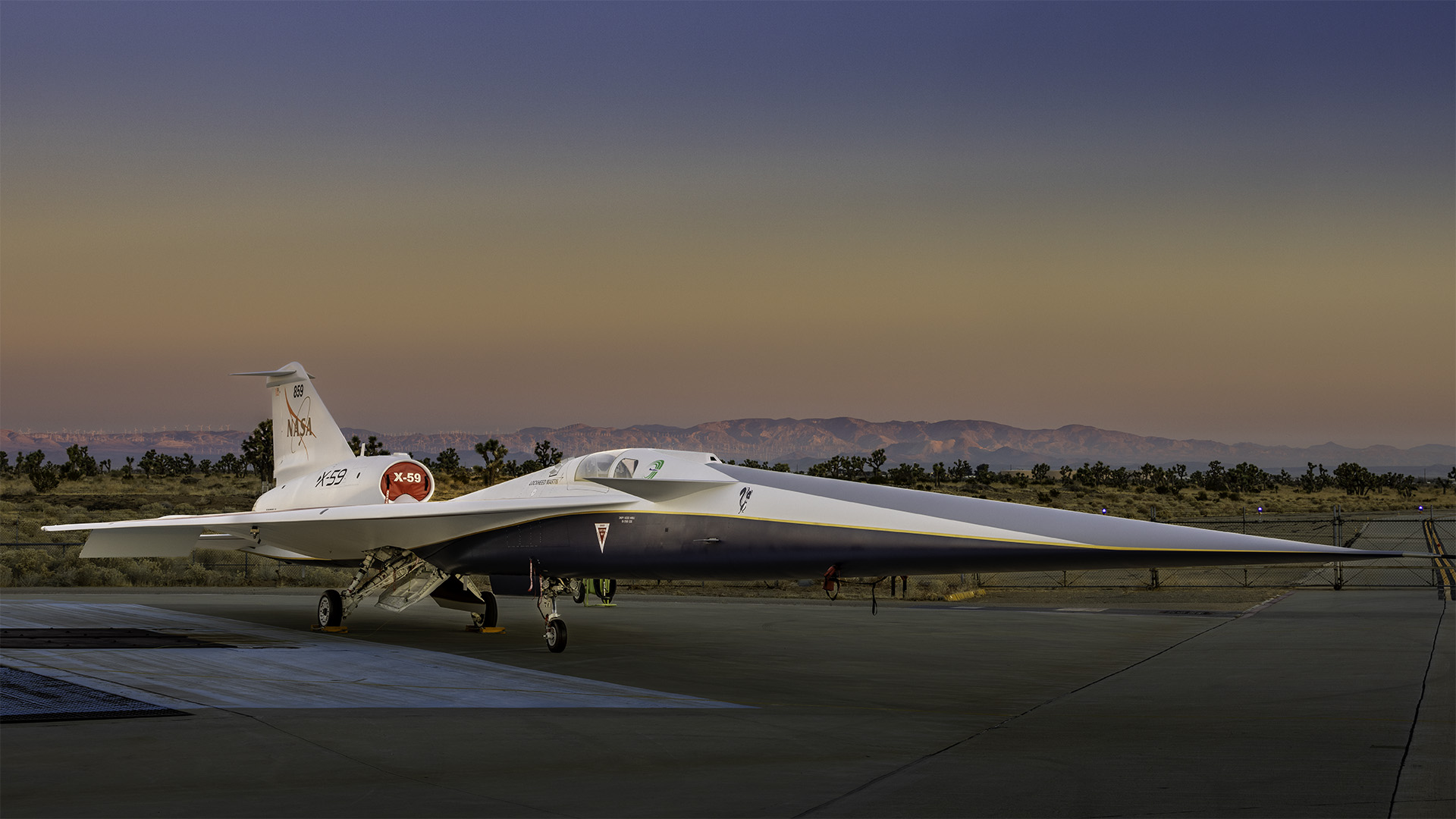
NASA’s X-59 quiet supersonic research aircraft sits on the apron outside Lockheed Martin’s Skunk Works facility at dawn in Palmdale, California. The X-59 is the centerpiece of NASA’s Quesst mission, which seeks to address one of the primary challenges to supersonic flight over land by making sonic booms quieter.
Lockheed Martin Skunk Works
NASA and Lockheed Martin formally debuted the agency’s X-59 quiet supersonic aircraft Friday. Using this one-of-a-kind experimental airplane, NASA aims to gather data that could revolutionize air travel, paving the way for a new generation of commercial aircraft that can travel faster than the speed of sound.
“This is a major accomplishment made possible only through the hard work and ingenuity from NASA and the entire X-59 team,” said NASA Deputy Administrator Pam Melroy. “In just a few short years we’ve gone from an ambitious concept to reality. NASA’s X-59 will help change the way we travel, bringing us closer together in much less time.”
Melroy and other senior officials revealed the aircraft during a ceremony hosted by prime contractor Lockheed Martin Skunk Works at its Palmdale, California facility.
The X-59 is at the center of NASA’s Quesst mission, which focuses on providing data to help regulators reconsider rules that prohibit commercial supersonic flight over land. For 50 years, the U.S. and other nations have prohibited such flights because of the disturbance caused by loud, startling sonic booms on the communities below. The X-59 is expected to fly at 1.4 times the speed of sound, or 925 mph. Its design, shaping and technologies will allow the aircraft to achieve these speeds while generating a quieter sonic thump.
“It’s thrilling to consider the level of ambition behind Quesst and its potential benefits,” said Bob Pearce, associate administrator for aeronautics research at NASA Headquarters in Washington. “NASA will share the data and technology we generate from this one-of-a-kind mission with regulators and with industry. By demonstrating the possibility of quiet commercial supersonic travel over land, we seek to open new commercial markets for U.S. companies and benefit travelers around the world.”
With rollout complete, the Quesst team will shift to its next steps in preparation for first flight: integrated systems testing, engine runs, and taxi testing for the X-59.
The aircraft is set to take off for the first time later this year, followed by its first quiet supersonic flight. The Quesst team will conduct several of the aircraft’s flight tests at Skunk Works before transferring it to NASA’s Armstrong Flight Research Center in Edwards, California, which will serve as its base of operations.
“Across both teams, talented, dedicated, and passionate scientists, engineers, and production artisans have collaborated to develop and produce this aircraft,” said John Clark, vice president and general manager at Lockheed Martin Skunk Works. “We’re honored to be a part of this journey to shape the future of supersonic travel over land alongside NASA and our suppliers.”
Once NASA completes flight tests, the agency will fly the aircraft over several to-be-selected cities across the U.S., collecting input about the sound the X-59 generates and how people perceive it. NASA will provide that data to the Federal Aviation Administration and international regulators.
The X-59 is a unique experimental airplane, not a prototype – its technologies are meant to inform future generations of quiet supersonic aircraft.
At 99.7 feet long and 29.5 feet wide, the aircraft’s shape and the technological advancements it houses will make quiet supersonic flight possible. The X-59’s thin, tapered nose accounts for almost a third of its length and will break up the shock waves that would ordinarily result in a supersonic aircraft causing a sonic boom.
Due to this configuration, the cockpit is located almost halfway down the length of the aircraft – and does not have a forward-facing window. Instead, the Quesst team developed the eXternal Vision System, a series of high-resolution cameras feeding a 4K monitor in the cockpit.
The Quesst team also designed the aircraft with its engine mounted on top and gave it a smooth underside to help keep shockwaves from merging behind the aircraft and causing a sonic boom.
Preparations for Next Moonwalk Simulations Underway (and Underwater)
January 15th, Martin Luther King, Jr. Day is a federal holiday designated as the National Day of Service. For the month of January, we will be celebrating OSBP in the Community! Join us as we spotlight how our advocacy extends beyond our commitment to small businesses.
Truphelia M. Parker- Program Specialist, NASA Headquarters
What organization do you volunteer with?
Loudoun County Public Schools (LCPS) Minority Student Academic Achievement Committee (MSAAC)
Why did you choose to volunteer with this organization?
I am the product of the Columbus Public School System in Ohio and a life-long supporter of public education. I come from a family committed to justice and social change. As a parent of two sons, I serve as their advocate and as the MSAAC Vice Chair and MSAAC Delegate for my son’s schools, I can do the same for more than 80K+ students in Loudoun County. Many parents do not know how to advocate for their children nor that they have the right to. My role is to help provide guidance, resources, and support in a family’s education journey.
What does volunteering mean to you?
“It takes a village to raise a child” is a proverb that means a community of people must interact positively with children them to experience and grow in a safe and healthy environment. That is what volunteering means to me. Making a conscious decision to be a part of “the village” and positively impact change.
Naeemah A. Lee- Program Specialist, NASA Headquarters
What organization do you volunteer with?
Meals on Wheels
Why did you choose to volunteer with this organization?
My faith and heart is dedicated to serving others that are in need. Volunteering with meals on wheels allows me to bring healthy food to seniors who are living independently without family and that are not mobile.
What does volunteering mean to you?
Volunteering is a voluntary act of an individual freely giving time to help the community.
Robert O. Betts- Small Business Specialist, ITPO/Langley Research Center
What organization do you volunteer with?
York County VA Board of Elections
Why did you choose to volunteer this organization?
Following the lead of my mother. She volunteered for years serving as a local election official in our hometown. She always felt it was so important as an American to exercise your right to vote.
What does volunteering mean to you?
Volunteering to work at the election polls has been a very rewarding experience and gives me the opportunity to give back to my community and country. My wife volunteers at the polls too so it gives me an opportunity to serve with her. I also think it has set a good example for our kids on the importance of exercising your right to vote and volunteering.
Djaataa Onanuga- Small Business Specialist, Goddard Space Flight Center
What organization do you volunteer with?
Lake Arbor Foundation
Why did you choose to volunteer with this organization?
I volunteer with the Lake Arbor Foundation because I am passionate about empowering the next generation. Through mentorship and support programs, I aim to contribute to the personal and educational development of young individuals. Witnessing their growth, resilience and enthusiasm is incredibly rewarding and I believe investing time in the youth today is an investment in a brighter future for our community.
What does volunteering mean to you?
Volunteering, to me, is a heartfelt commitment to making a positive impact without expecting anything in return. It embodies a sense of responsibility towards the well-being of others and the community. The act of volunteering allows me to contribute my time and skills to causes I care about, fostering a sense of connection, empathy, and fulfillment in the process.
NASA’s Wallops C-130 Plays Vital Role in Successful Parachute Airdrop Test
1 min read
Preparations for Next Moonwalk Simulations Underway (and Underwater)
NASA’s C-130 cargo aircraft releases a dart-shaped test vehicle above the U.S. Army’s Yuma Proving Ground on Jan. 9 to begin the testing sequence for a Boeing Starliner parachute system.
Credit: U.S. Army Yuma Proving Ground
NASA’s C-130 Hercules, managed at Wallops Flight Facility’s Aircraft Office in Virginia, provided aerial delivery support for a successful commercial crew parachute airdrop test Jan. 9 at the U.S. Army’s Yuma Proving Ground, Arizona. This week’s testing was in support of NASA’s Commercial Crew Program and partner, Boeing, which are developing crew transportation capability to and from the International Space Station.
Up for testing was a modified parachute system for Boeing’s Starliner spacecraft. The system, which involved two ringsail parachutes, required a demonstration set in stressed conditions to certify successful deployment.
During the demonstration, the Wallops C-130 team deployed a 27,000-pound payload comprised of the Parachute Compartment Drop Test Vehicle and Mid-Altitude Deployment System. The team released the payload from an altitude of 13,000 feet while coordinating and timing their efforts with U.S. Army UH-60s and a NASA AFRC B-200 aircraft used to capture photos and video documentation of the mission.
The Wallops C-130 team has supported 16 successful commercial crew parachute airdrop tests since 2018. For more information, visit nasa.gov/wallops.
El análisis de la NASA confirma que 2023 fue el año más cálido registrado
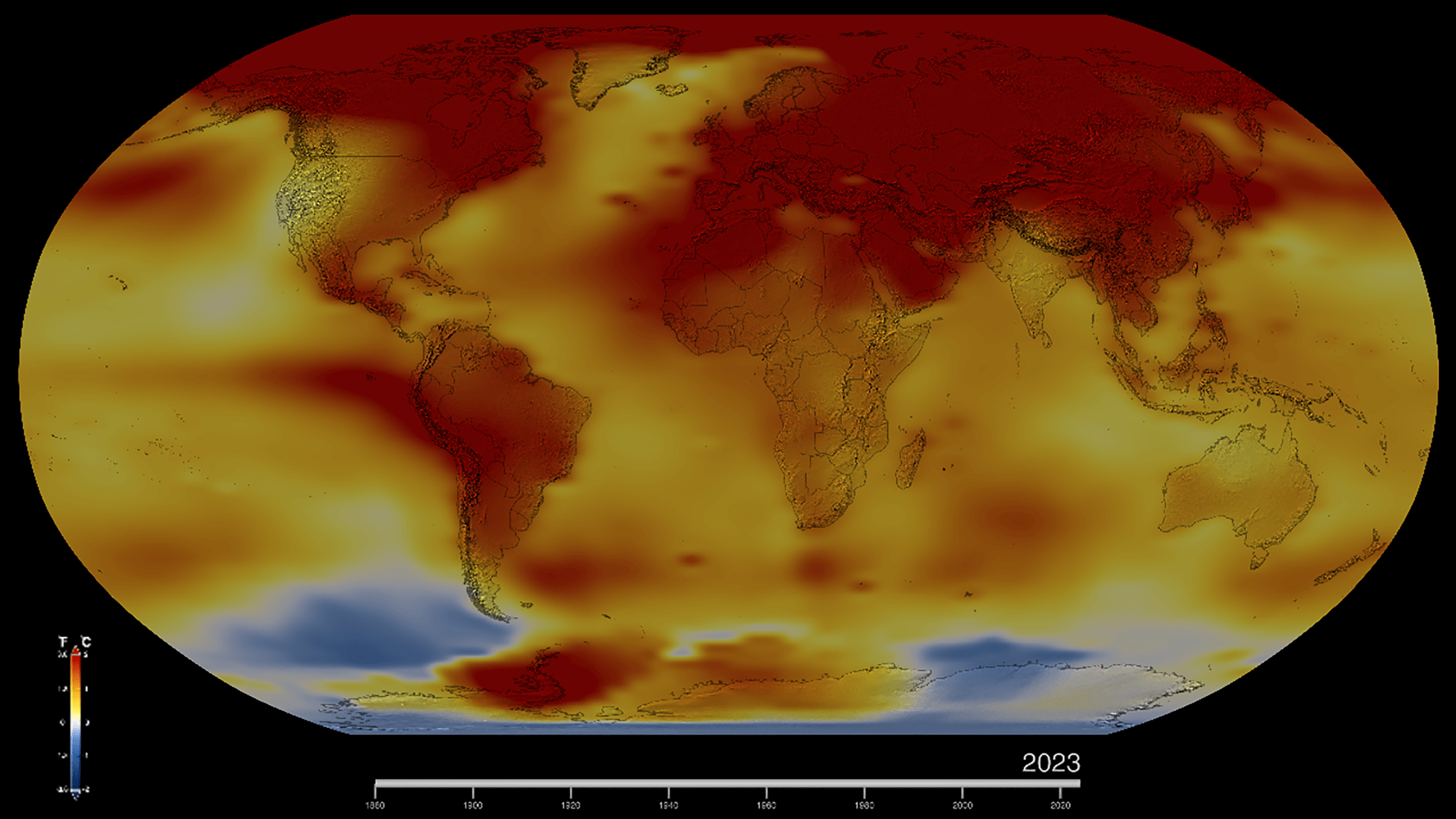
Este mapa de la Tierra en 2023 muestra las anomalías de la temperatura global de la superficie, es decir, cuánto más cálida o más fría estuvo cada región del planeta en comparación con el promedio del período de 1951 a 1980. Las temperaturas normales se muestran en blanco, las superiores a las normales en rojo y naranja, y las inferiores a las normales en azul. Una versión animada de este mapa muestra la evolución de las anomalías de la temperatura global a lo largo del tiempo, desde 1880. Descarga esta visualización del Estudio de Visualización Científica Goddard de la NASA: https://svsdev.gsfc.nasa.gov/5207.
Credits: Estudio de Visualización Científica del Centro Goddard de la NASA
En el año 2023, la temperatura promedio de la superficie de la Tierra fue la más cálida que se haya registrado, según un análisis de la NASA. Las temperaturas globales del año pasado estuvieron alrededor de 1,2 grados Celsius (2,1 grados Fahrenheit) por encima del promedio para el período de referencia de la NASA (de 1951 a 1980), informaron científicos del Instituto Goddard de Investigaciones Espaciales (GISS, por sus siglas en inglés) de la NASA en Nueva York.
“El informe de la temperatura global de la NASA y la NOAA confirma lo que miles de millones de personas alrededor del mundo experimentaron el año pasado: estamos frente a una crisis climática”, dijo el administrador de la NASA Bill Nelson. “Desde calor extremo, a incendios forestales, hasta el aumento del nivel del mar, podemos ver que nuestra Tierra está cambiando. Todavía queda trabajo por hacer, pero el presidente Biden y comunidades de todo Estados Unidos están tomando más medidas que nunca para reducir los riesgos climáticos y ayudar a las comunidades a ser más resistentes, y la NASA seguirá utilizando nuestra posición estratégica en el espacio para traer a la Tierra datos climáticos críticos que sean comprensibles y accesibles para todas las personas. La NASA y la Administración Biden-Harris están trabajando para proteger nuestro planeta y a sus habitantes, para esta generación y para la siguiente”.
En 2023, cientos de millones de personas en todo el planeta experimentaron calor extremo, y cada mes, de junio a diciembre, estableció un récord mundial para el mes respectivo. Julio fue el mes más caluroso jamás registrado. En general, la Tierra fue alrededor de 1,4 grados Celsius (o unos 2,5 grados Fahrenheit) más calurosa en 2023 que el promedio de finales del siglo XIX, cuando comenzó el mantenimiento de los registros modernos.
“El calentamiento excepcional que estamos experimentando no es algo que hayamos visto en la historia de la humanidad”, dijo Gavin Schmidt, director del GISS. “Se debe principalmente a nuestras emisiones de combustibles fósiles, y estamos observando sus impactos en las olas de calor, las lluvias intensas y las inundaciones costeras”.
Si bien los científicos tienen pruebas concluyentes de que la tendencia del planeta al calentamiento a largo plazo está impulsada por la actividad humana, siguen examinando otros fenómenos que pueden afectar los cambios anuales o plurianuales del clima, como El Niño, los aerosoles y la contaminación, y las erupciones volcánicas.
Normalmente, la mayor fuente de variabilidad interanual es el patrón climático oceánico El Niño-Oscilación del Sur, en el océano Pacífico. El patrón tiene dos fases, El Niño y La Niña, cuando las temperaturas de la superficie del mar a lo largo del ecuador cambian entre temperaturas más cálidas, promedio y más frías. En el período de 2020 a 2022, el océano Pacífico experimentó tres fenómenos consecutivos de La Niña, los cuales tienden a enfriar las temperaturas globales. En mayo de 2023, el océano pasó de La Niña a El Niño, lo que a menudo coincide con los años más calurosos en los registros.
Sin embargo, las temperaturas récord en la segunda mitad de 2023 ocurrieron antes del pico del actual fenómeno de El Niño. Los científicos esperan observar los mayores impactos de El Niño en febrero, marzo y abril.
Esta visualización de datos, que se actualiza mensualmente, muestra el ciclo estacional de variación de la temperatura en la superficie de la Tierra, y cómo esas temperaturas se desvían de la media entre 1951 y 1980. Los datos proceden del Análisis de la Temperatura Superficial del GISS y son de acceso público aquí. Las desviaciones estacionales de temperatura se basan en los datos del reanálisis MERRA-2 aquí. Credits: Estudio de Visualización Científica del Centro Goddard de la NASA
Los científicos también han investigado los posibles impactos de la erupción de enero de 2022 del volcán submarino Hunga Tonga-Hunga Ha’apai, el cual arrojó vapor de agua y partículas finas, o aerosoles, a la estratosfera. Un estudio reciente descubrió que los aerosoles volcánicos, al reflejar la luz solar lejos de la superficie de la Tierra, provocaron un ligero enfriamiento general de unos 0,1 grados Celsius (menos de 0,2 grados Fahrenheit) en el hemisferio sur después de la erupción.
“Incluso con factores de enfriamiento ocasionales, como volcanes o aerosoles, seguiremos batiendo récords mientras las emisiones de gases de efecto invernadero sigan aumentando”, afirmó Schmidt. “Y, desafortunadamente, el año pasado nuevamente volvimos a establecer un nuevo récord de emisiones de gases de efecto invernadero”.
“El año récord de 2023 subraya la importancia de tomar medidas urgentes y continuadas para hacer frente al cambio climático”, declaró Pam Melroy, administradora adjunta de la NASA. “La legislación reciente ha proporcionado la mayor inversión climática del gobierno de EE.UU., incluyendo miles de millones para fortalecer la resiliencia de EE.UU. a los crecientes impactos de la crisis climática. En su calidad de agencia centrada en el estudio de nuestro clima cambiante, la flota de satélites de observación de la Tierra de la NASA seguirá proporcionando datos críticos de nuestro planeta a escala para ayudar a toda la gente a tomar decisiones informadas”.
Ciencia abierta en acción
La NASA prepara su registro de temperaturas utilizando los datos de la temperatura del aire de la superficie recopilados de decenas de miles de estaciones meteorológicas, así como datos de la temperatura de la superficie del mar adquiridos por instrumentos en barcos y boyas. Estos datos son analizados utilizando métodos que toman en cuenta el variado distanciamiento de las estaciones de temperatura en todo el mundo y los efectos del calor urbano que podrían sesgar los cálculos.
Los análisis independientes de la Administración Nacional Oceánica y Atmosférica (NOAA, por sus siglas en inglés) y el Centro Hadley (parte de la Oficina Meteorológica del Reino Unido) concluyeron que las temperaturas globales de la superficie para 2023 fueron las más altas desde que comenzaron los registros modernos. Estos científicos utilizan gran parte de los mismos datos de temperatura en sus análisis, pero emplean diferentes metodologías. Aunque las clasificaciones pueden diferir ligeramente entre los registros, estos coinciden en términos generales y muestran el mismo calentamiento continuo a largo plazo en las últimas décadas.
Aprovechando medio siglo de investigaciones, observaciones, y modelos, la Administración Biden-Harris, incluyendo la NASA y varios socios federales, recientemente lanzaron el Centro de Gases de Efecto Invernadero de EE.UU. para que los responsables de la toma de decisiones y los ciudadanos puedan acceder fácilmente a datos climáticos críticos. Este centro apoya la colaboración entre agencias gubernamentales de EE.UU. y socios del sector privado y organizaciones sin fines de lucro, para poner a disposición en línea datos aéreos, terrestres y espaciales y recursos.
El conjunto completo de datos de la NASA sobre las temperaturas de la superficie global hasta 2023, así como los detalles con el código de cómo los científicos de la NASA llevaron a cabo sus análisis, están disponibles públicamente en el GISS. GISS es un laboratorio de la NASA administrado por la División de Ciencias de la Tierra en el Centro de Vuelo Espacial Goddard de la agencia en Greenbelt, Maryland. Este laboratorio está afiliado al instituto de la Tierra y la Escuela de Ingeniería y Ciencias Aplicadas de la Universidad de Columbia en Nueva York.