Artemis II Vehicle Manager Branelle Rodriguez Gets Orion Ready for “Go”

Artemis II Vehicle Manager Branelle Rodriguez Gets Orion Ready for “Go”

By the time the Artemis II Orion spacecraft launches to the Moon next year, its many components will already have traveled thousands of miles and moved across multiple facilities before coming together at NASA’s Kennedy Space Center. Branelle Rodriguez, Artemis II vehicle manager for the Orion Program, has overseen many parts of that journey. Her job is to ensure the spacecraft is ready for its historic mission – carrying humans to the Moon for the first time in over 50 years.
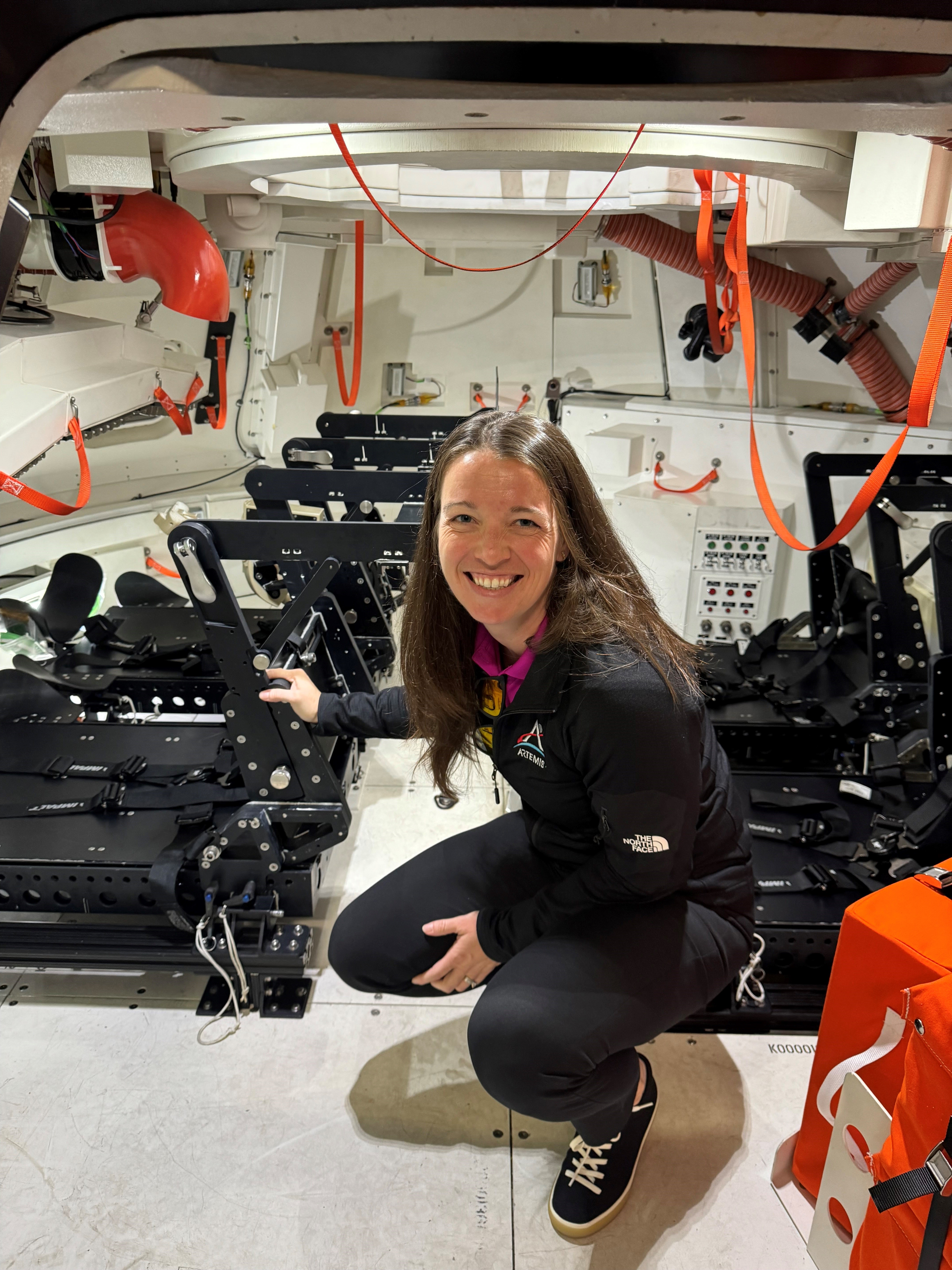
A woman crouches inside the mockup of a spacecraft that is equipped with seats for crewmembers.
Branelle Rodriguez crouches inside an Orion spacecraft training unit aboard the USS San Diego in March 2024. The training unit was used during a full recovery simulation with the Artemis II crew.
Image courtesy of Branelle Rodriguez

Based at NASA’s Johnson Space Center in Houston, Rodriguez has been involved in every stage of the spacecraft’s lifecycle – from development and production through testing and final launch readiness. Her program-level leadership focuses on ensuring the spacecraft’s hardware and subsystems are integrated and flight-ready. Most recently, she collaborated closely with Exploration Ground Systems at Kennedy to oversee the spacecraft’s move to the Vehicle Assembly Building, where it was mated with NASA’s SLS (Space Launch System) rocket. “We are getting our teams trained and ready so that we are GO for the Artemis II mission,” she said.

Her 21-year NASA career spans numerous roles at Johnson. She started in the center’s Engineering Directorate, developing and building life support and habitation hardware for the Space Shuttle Program and the International Space Station Program. She went on to lead teams of engineers and flight controllers tasked with real-time resolution of anomalies aboard the International Space Station before transitioning to the Orion Program in 2022.

“Looking back, every role I’ve held, every team I’ve been a part of, and every milestone we’ve achieved together has been truly remarkable,” she said. “I’m incredibly proud to have played a part in it all.”

Rodriguez has been fascinated by space since she was a little girl. “Growing up in northern Minnesota, I was lucky to experience the beauty of clear, starlit skies on a regular basis,” she recalled. When Rodriguez was a teenager, her family encouraged her to attend Space Academy in Huntsville, Alabama, where she participated in mock astronaut training, flight controller simulations, and hands-on engineering projects. “It was a pivotal experience that only deepened my passion for space exploration.”
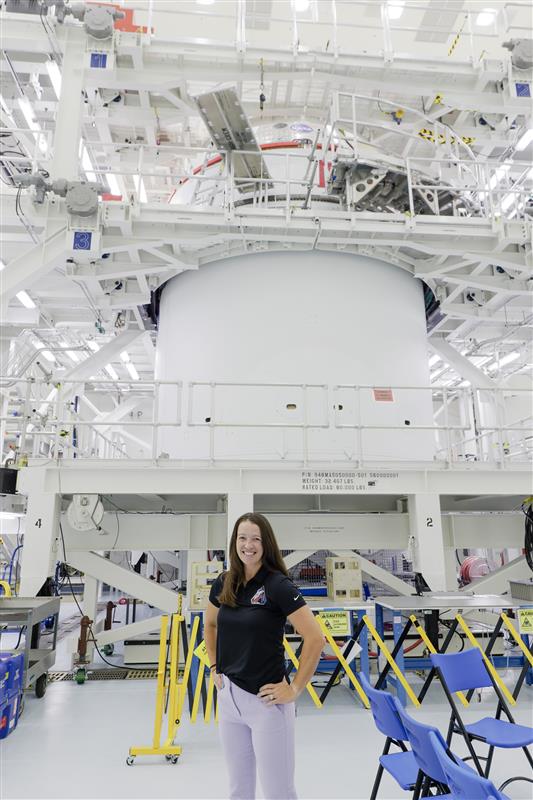
A woman stands in front of an Orion spacecraft that is elevated on a staging platform.
Branelle Rodriguez stands in front of the Artemis II Orion spacecraft as it completes processing in the Multi-Payload Processing Facility at NASA’s Kennedy Space Center in Florida.
Image courtesy of Branelle Rodriguez

Rodriguez applied to NASA’s internship program while studying mechanical engineering at the University of North Dakota. She was not accepted, but she did not give up. She spent a semester interning at Dow Chemical to gain more experience while continuing to apply for internships across multiple NASA centers. “On my eighth attempt, I was accepted at Johnson,” she said. Three internships and one graduation later, Rodriguez landed a full-time position in the Engineering Directorate’s Crew and Thermal Systems Division. “It’s been an incredible journey—and a dream realized,” she said.

As a student athlete, Rodriguez knew the importance of teamwork from a young age, but said its value really became clear after joining NASA. “Some goals take time. There will be setbacks and struggles, but when you stick together, you build the kind of trust and relationships that are the foundation for long-term success,” she said. “That’s exactly what NASA represents. We take on some of the most complex and ambitious challenges imaginable—and we do it as a team.”

She added, “Especially now, it’s more important than ever to remember what we’re capable of when we work together, and to celebrate the wins—big or small—because each one brings us closer to the extraordinary.”

Rodriguez also appreciates having a team outside of the office. One of the greatest challenges she has faced is balancing the demands of a fulfilling, high-impact career with the needs of her family. “Like many parents, there are days when everything feels in sync, and days when I know I’ve fallen short,” she said, acknowledging that she must continually adapt to shifting needs and prioritize tasks to remain focused on what matters most at any given moment. “I’m beyond grateful for my family,” she said. “They are my foundation, and they truly understand and support my passion for the work I do. Without their love, and the broader village that helps make it all possible, I wouldn’t be where I am today.”
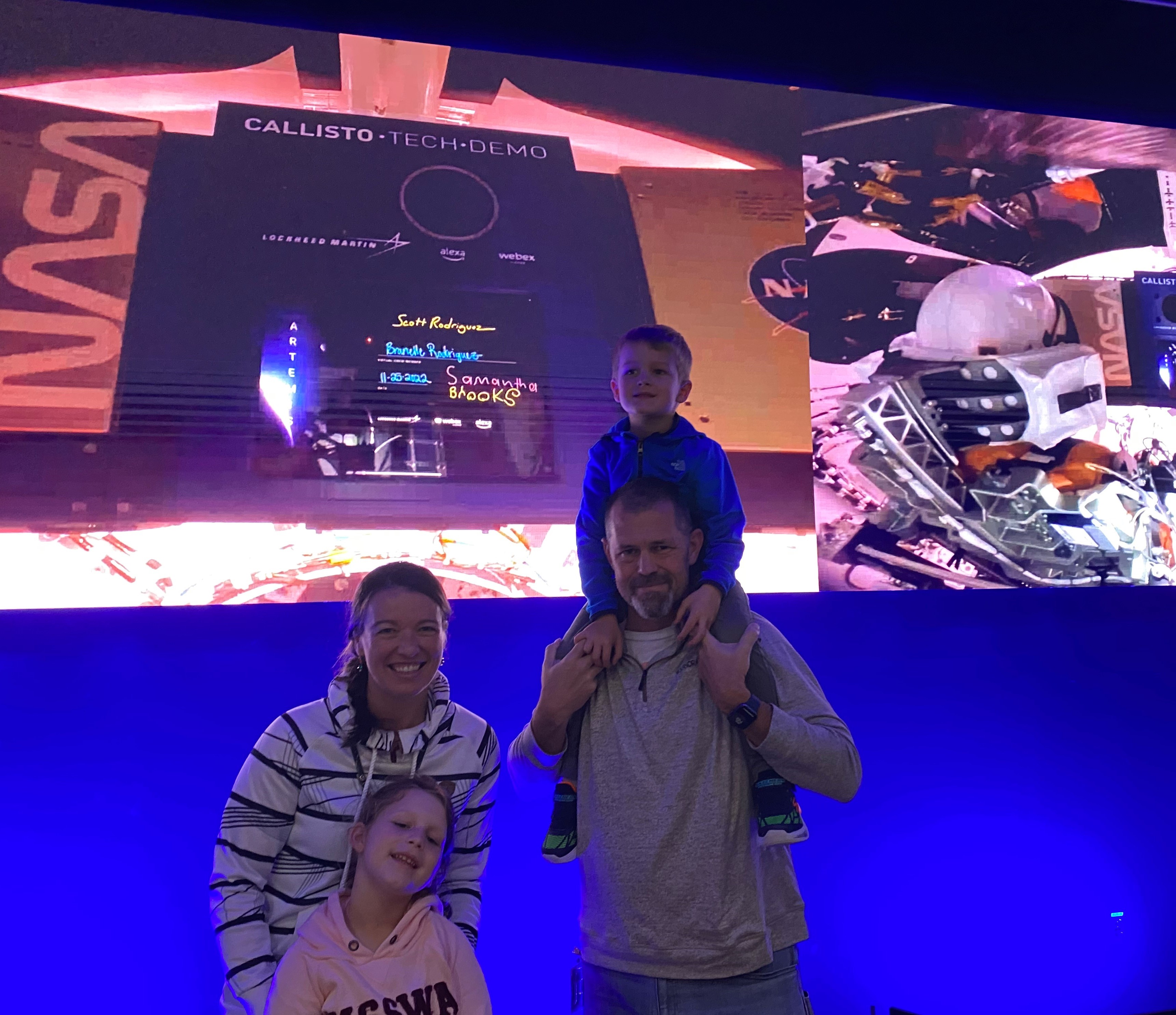
A family of four - mom, dad, and two young children - stand in front of a large screen showing video from inside the Artemis I spacecraft.
Branelle Rodriguez, her husband Scott, and her children Samantha and Brooks in the Mission Control Center at Johnson Space Center during the Artemis I mission in 2022. The family had an opportunity to ask the Artemis I Orion spacecraft questions via the Callisto technology demonstration carried aboard the 25-day mission.
Image courtesy of Branelle Rodriguez

To her children and future generations, Rodriguez hopes to pass on a desire to keep exploring. “As humans, we are naturally driven to grow, learn, and push beyond our limits,” she said. “Space exploration is still in its early stages when viewed through the lens of history, and the achievements of the next generation will be truly extraordinary. I want them to carry forward the curiosity, courage, and determination needed to reach new frontiers and unlock the unknown.”

Powered by WPeMatico

Get The Details…
Linda E. Grimm
Invention Challenge Brings Student Engineers to NASA JPL

Invention Challenge Brings Student Engineers to NASA JPL

Now in its 26th year, the event brings teams of middle and high school students to the lab to compete with home-built contraptions.

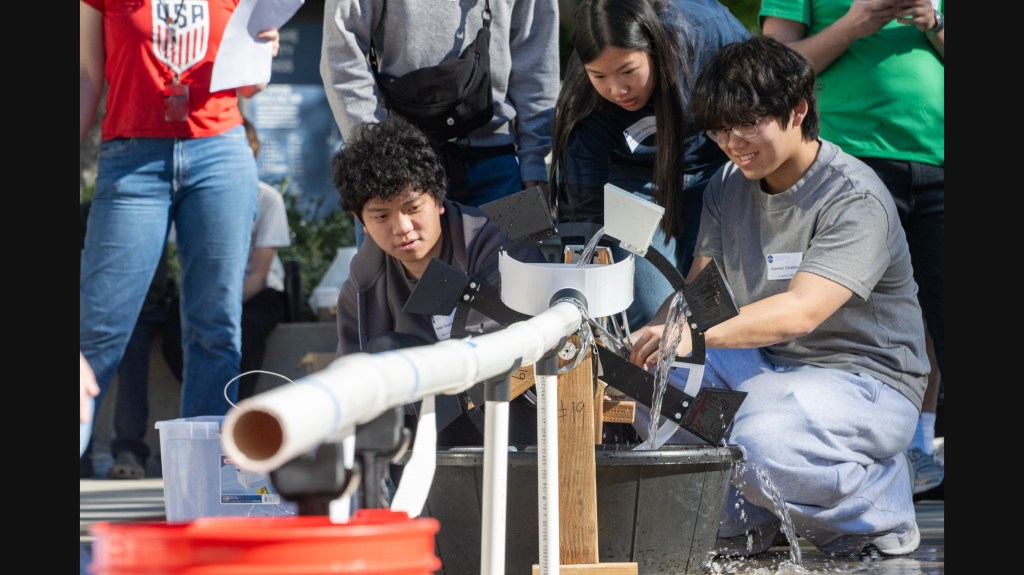
Teenagers wielding power tools and plywood demonstrated their engineering prowess at the annual Invention Challenge at NASA’s Jet Propulsion Laboratory in Southern California on Friday. Also in evidence: lots of small motors, 3D-printed gears, PVC pipe, and duct tape.

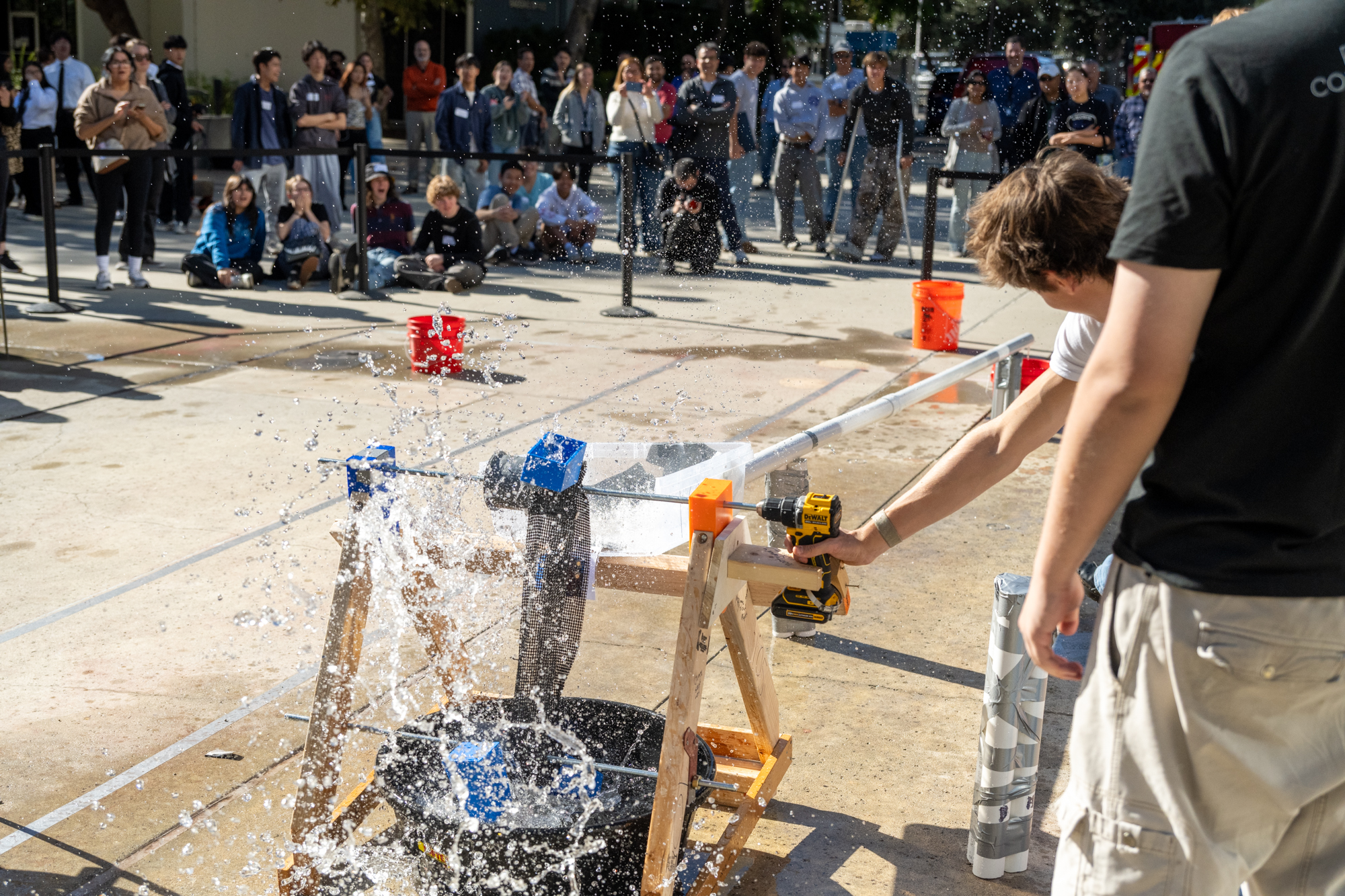
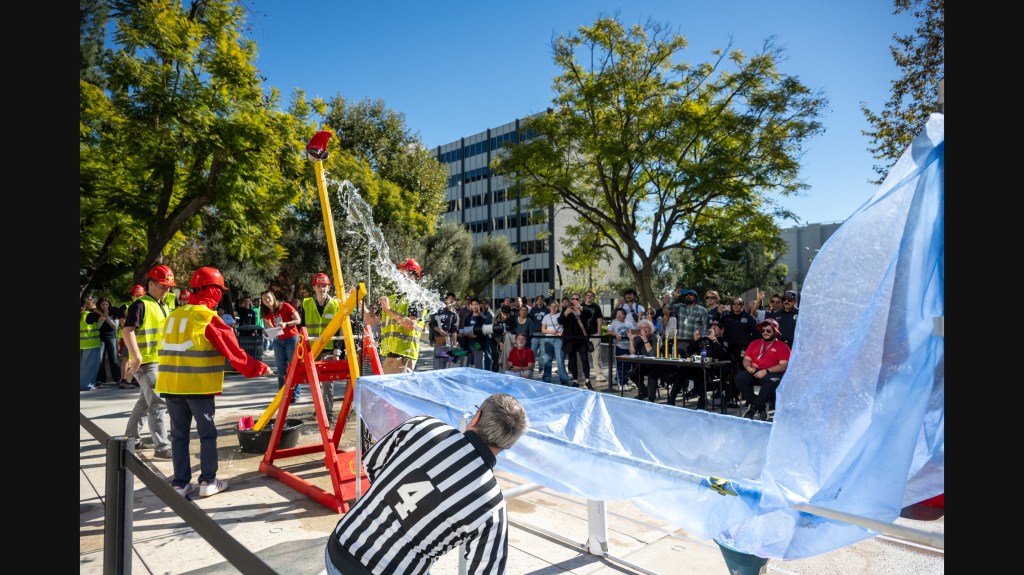
First held at JPL in 1998, the event pits middle and high school teams against each other as they try to get handmade devices to accomplish a task that changes annually. For this year’s challenge, dubbed the “Bucket Brigade Contest,” teams needed to create devices capable of moving about 2 gallons (8 liters) of water from a holding reservoir into a bucket about 16 feet (5 meters) away in 60 seconds while satisfying a long list of rules.

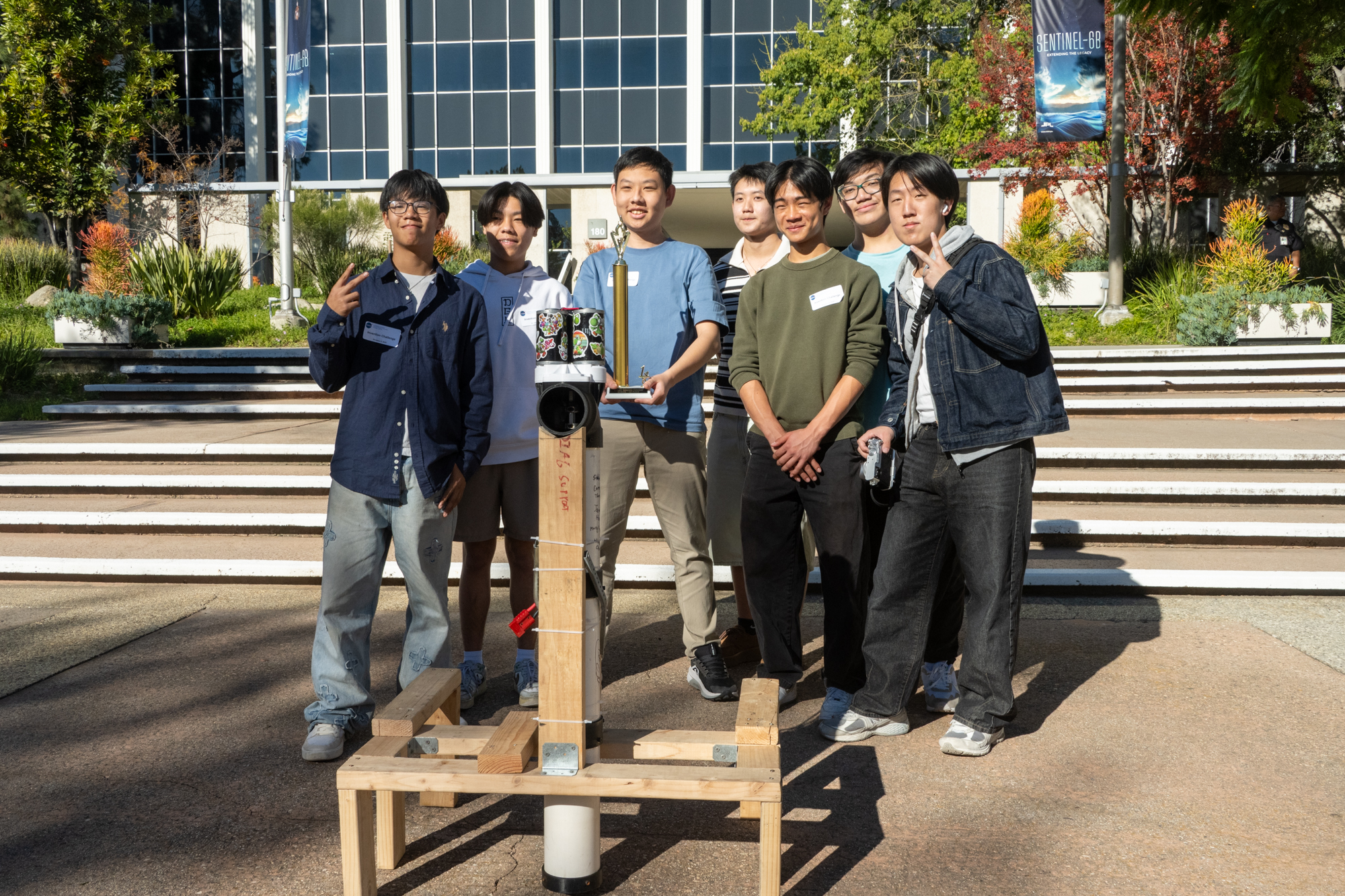
Arcadia High School’s Team Still Water won first place among student teams in the 2025 Invention Challenge at JPL.
NASA/JPL-Caltech

In all, 18 teams of students from middle and high schools across Los Angeles and Orange counties competed. First place went to Arcadia High School’s Team Still Water, which completed the task in just 6.45 seconds. Mission Viejo High’s Team Senior Citizens was close behind, finishing in 6.71 seconds. The Samo Seals of Santa Monica High came in third, at 9.18 seconds.

Five teams from outside the area — four from schools in Colorado and Massachusetts and one involving professional engineers — were invited to compete as well. Of those, the team led by retired JPL engineer Alan DeVault’s Team “Trial and Error Engineering” came in first (a repeat from last year). And “Team 6” from Pioneer Charter School of Science in the Boston area took second place (also a repeat performance from 2024). No team qualified for third place.

Some of the devices in the 2025 Invention Challenge at NASA JPL made a big splash.
NASA/JPL-Caltech

Judges named Team Clankers from Mission Viejo High most artistic, Team 6 from Pioneer Charter School of Science most unusual, and Team Winning Engineering Team (WET) from Temple City High most creative.

The event was supported by dozens of volunteers from JPL staff. JPL Fire Chief Dave Dollarhide, familiar with a bucket brigade, was a guest judge.

News Media Contact

Melissa Pamer
Jet Propulsion Laboratory, Pasadena, Calif.
626-314-4928
melissa.pamer@jpl.nasa.gov

2025-135

Share

Details

Last Updated

Dec 05, 2025

Powered by WPeMatico

Get The Details…
Naomi Hartono

Crew Swaps Commanders on Sunday as Trio Packs for Departure

Crew Swaps Commanders on Sunday as Trio Packs for Departure

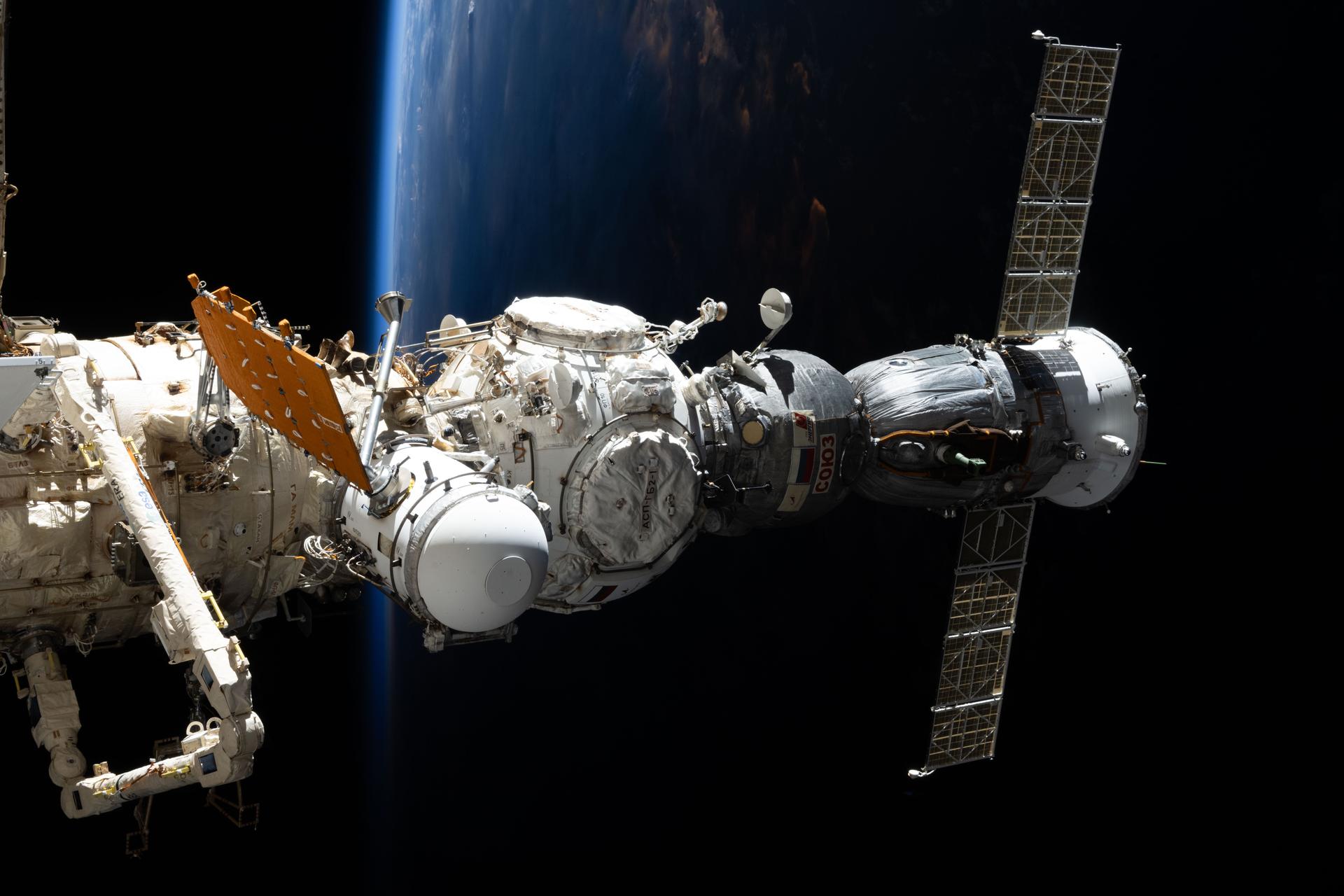
The Soyuz MS-27 spacecraft, which launched three Expedition 73 crew members to the International Space Station, is pictured docked to the Prichal module. Prichal is itself connected to the Nauka science module on the station’s Roscosmos segment. Below, the Pacific Ocean fades from view as an orbital sunset descends 258 miles beneath the orbiting complex.
The Soyuz MS-27 spacecraft is pictured docked to the Prichal module. Below, the Pacific Ocean fades from view as an orbital sunset descends 258 miles beneath the orbiting complex.
NASA

Expedition 73 will swap commanders this weekend before three crew members return to Earth on Monday. Expedition 74 officially begins once the home bound trio undocks from the Rassvet module inside the Soyuz MS-27 spacecraft the following day.

Veteran Roscosmos cosmonaut and station Commander Sergey Ryzhikov will hand over a symbolic key representing command of the orbital outpost to four-time space flyer NASA astronaut Mike Fincke at 10:30 a.m. EDT on Sunday, Dec. 7. Fincke will formally take responsibility of station operations  and lead the new Expedition 74 crew at the moment Ryzhikov and Flight Engineers Alexey Zubritsky of Roscosmos and Jonny Kim of NASA back away from the orbital outpost inside their Soyuz at 8:41 p.m. on Monday. Ryzhikov and Zubritsky spent Friday packing cargo and personal items inside the Soyuz MS-27 and making final preparations for their Monday night departure with Kim.

The trio aboard the Soyuz descent module will parachute to landing in Kazakhstan less than three-and-a-half hours later at 12:04 a.m. on Tuesday completing an eight-month space research journey orbiting over 250 miles above Earth. NASA’s live coverage of the crew’s return will be broadcast on NASA+Amazon Prime, and the agency’s YouTube channel beginning at 4:45 p.m. on Monday with farewell and hatch closure.

NASA Flight Engineer Chris Williams, who arrived at the station with Flight Engineers Sergey Kud-Sverchkov and Sergei Mikaev on Nov. 27,  has stepped into his new role as a first-time station astronaut and assisted Kim inside the Quest airlock on Friday installing lights, cameras, and straps on a pair of spacesuit helmets. Williams then wore electrodes around his eyes as computerized medical gear operated by NASA Flight Engineer Zena Cardman sent light signals to test his retinal response in microgravity.

Kim also cleaned his crew quarters and took airflow measurements as he prepares to end his stay in space. Cardman later checked out wireless high-definition camera hardware to be used inside the station when photographing future spacewalks.

Flight Engineers Sergey Kud-Sverchkov and Sergei Mikaev took turns measuring their blood pressure then getting up to speed with life on orbit during the first half of Friday. Next, Kud-Sverchkov and Mikaev collected a variety of station microbial and personal biological samples for stowage and analysis as part of ongoing research to keep crews healthy in space.

Flight Engineer Kimiya Yui of JAXA (Japan Aerospace Exploration Agency uninstalled the NanoRacks CubeSat deployer after it deployed several tiny satellites into Earth orbit for government, educational, and commercial research. Fincke spent his shift replacing orbital plumbing components and inspecting fire extinguishers and breathing masks. Roscosmos Flight Engineer Oleg Platonov completed the end of the week transferring fluids into a Progress cargo craft then assisted Kud-Sverchkov processing microbe samples swabbed from surfaces in the station’s Roscosmos segment.

Learn more about station activities by following the space station blog, @space_station on X, as well as the ISS Facebook and ISS Instagram accounts.

Get the latest from NASA delivered every week. Subscribe here.

Powered by WPeMatico

Get The Details…

Mark A. Garcia

NASA Wins Second Emmy Award for 2024 Total Solar Eclipse Broadcast

NASA Wins Second Emmy Award for 2024 Total Solar Eclipse Broadcast

3 min read

Preparations for Next Moonwalk Simulations Underway (and Underwater)

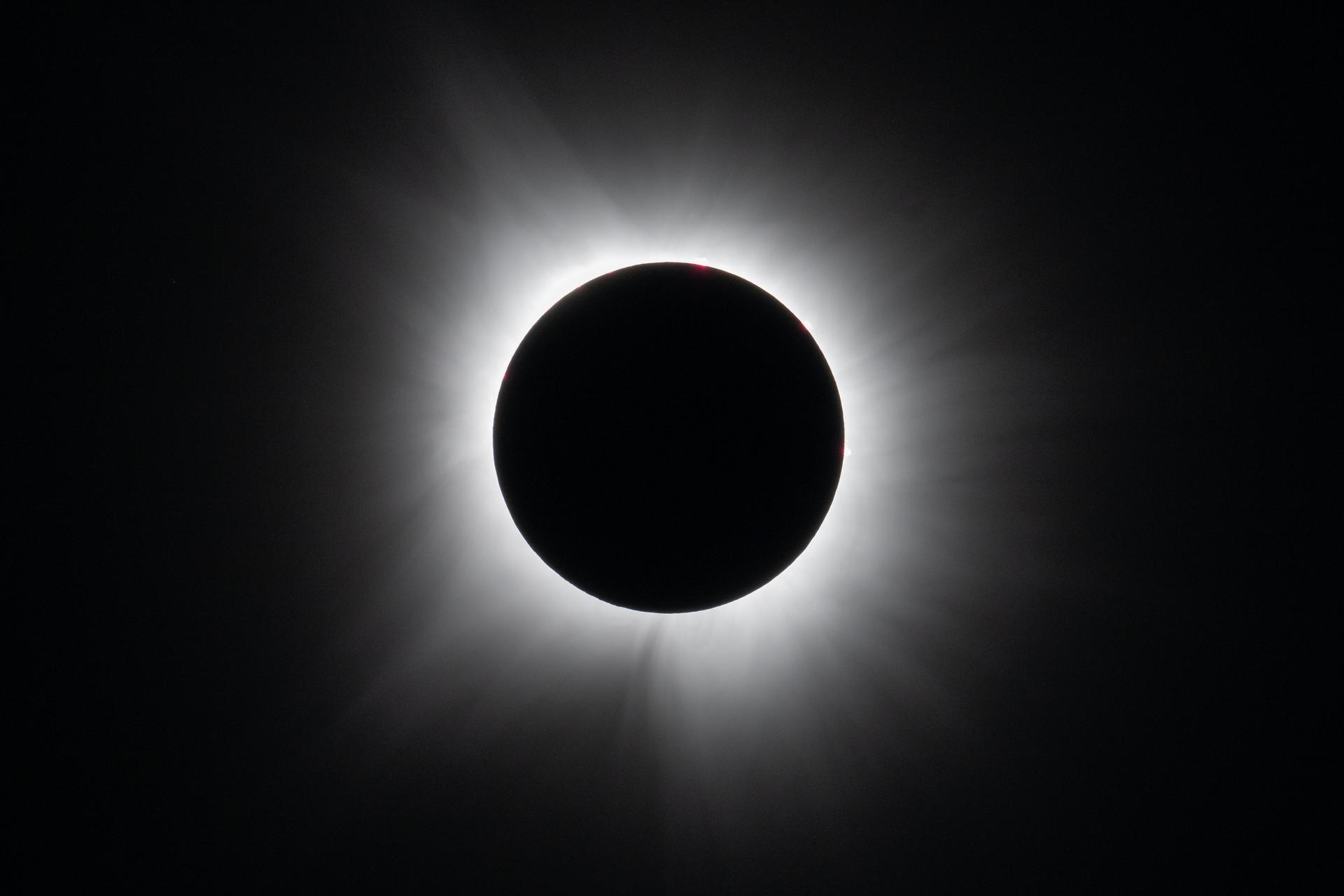
NASA’s broadcast of the April 8, 2024, total solar eclipse has won an Emmy Award for Excellence in Production Technology.

At the 76th Technology & Engineering Emmy Awards on Dec. 4, in New York City, the Academy of Television Arts & Sciences announced the win. Walt Lindblom and Sami Aziz accepted the award on behalf of the agency. For the broadcast, Lindblom served as the coordinating producer and Aziz served as the executive producer.

“By broadcasting the total solar eclipse, this team brought joy and wonder for our Sun, Moon, and Earth to viewers across America and the world,” said Will Boyington, associate administrator for the Office of Communications at NASA Headquarters in Washington. “Congratulations to the production team, whose efforts demonstrate the hard work and dedication to the sharing the marvel that makes our solar system something we strive to understand.” 

NASA’s live broadcast coverage of the 2024 total solar eclipse was the most complex live project ever produced by the agency. In total, NASA’s eclipse broadcasts garnered almost 40 million live and replay views across its own distribution channels, including on NASA+, the agency’s free streaming service. Externally, the agency’s main broadcast was picked up in 2,208 hits on 568 channels in 25 countries.

“Our unique place in the solar system allows us on Earth to witness one of the most spectacular science shows nature has to offer. NASA’s production team captured the action every step of the way across the path of totality, including the rare glimpse of the Sun’s corona,” said Nicky Fox, associate administrator for science at NASA Headquarters. “Congratulations to the NASA team for successfully showing the 2024 total solar eclipse through the eyes of NASA for the whole world to experience together.”

The broadcast spanned three hours, showcasing the eclipse across seven American states and two countries. From cities, parks, and stadiums, 11 hosts and correspondents provided on air commentary, interviews, and live coverage. Viewers tuned in from all over the world, including at watch parties in nine locations, from the Austin Public Library to New York’s Times Square. An interactive “Eclipse Board” provided real time data analysis as the Moon’s shadow crossed North America.

Live feeds from astronauts aboard the International Space Station and NASA’s WB-57 high-altitude research aircraft were brought in to provide rare and unique perspectives of the solar event. To make this possible, NASA deployed and enabled 67 cameras, 6 NASA Wide Area Network control rooms, 38 encoders, and 35 decoders. The team coordinated 20 live telescope feeds which represented 12 locations across the path of totality.

NASA’s eclipse broadcast won another Emmy award earlier this year at the 46th Annual News & Documentary Emmy Awards for Outstanding Live News Special. Additionally, the show received an Emmy nomination for Outstanding Show Open or Title Sequence – News. NASA’s eclipse communication and broadcast efforts also won two Webby Awards and two Webby People’s Voice Awards.

For more information about NASA, visit:

https://www.nasa.gov

Abbey Interrante / Karen Fox
Headquarters, Washington
301-201-0124 / 202-358-1600
abbey.a.interrante@nasa.gov / karen.c.fox@nasa.gov

Share

Details

Last Updated

Dec 05, 2025

Editor
Abbey Interrante

Powered by WPeMatico

Get The Details…
Abbey Interrante

Testing Drones for Mars in the Mojave Desert

Testing Drones for Mars in the Mojave Desert

Two people stand atop a sand dune, facing the camera. They are both looking at a drone flying in front of them. The person on the right holds a controller. Other sand dunes behind them make up the background of the entire image.
NASA/JPL-Caltech

Researchers from NASA’s Jet Propulsion Laboratory monitor a research drone in this September 2025 photo. This flight occurred in Dumont Dunes, an area of the Mojave Desert, as part of a larger test campaign to develop navigation software that would guide future rotorcraft on Mars. The work was among 25 projects funded by NASA’s Mars Exploration Program this past year to push the limits of future technologies.

Whether it’s new navigation software, slope-scaling robotic scouts, or long-distance gliders, the technology being developed by the Mars Exploration Program envisions a future where robots can explore all on their own — or even help astronauts do their work.

Read more about the drone flight software test.

Text credit: NASA/Andrew Good

Image credit: NASA/JPL-Caltech

Powered by WPeMatico

Get The Details…
Monika Luabeya