What You Need to Know about NASA’s SpaceX Crew-8 Mission

What You Need to Know about NASA’s SpaceX Crew-8 Mission
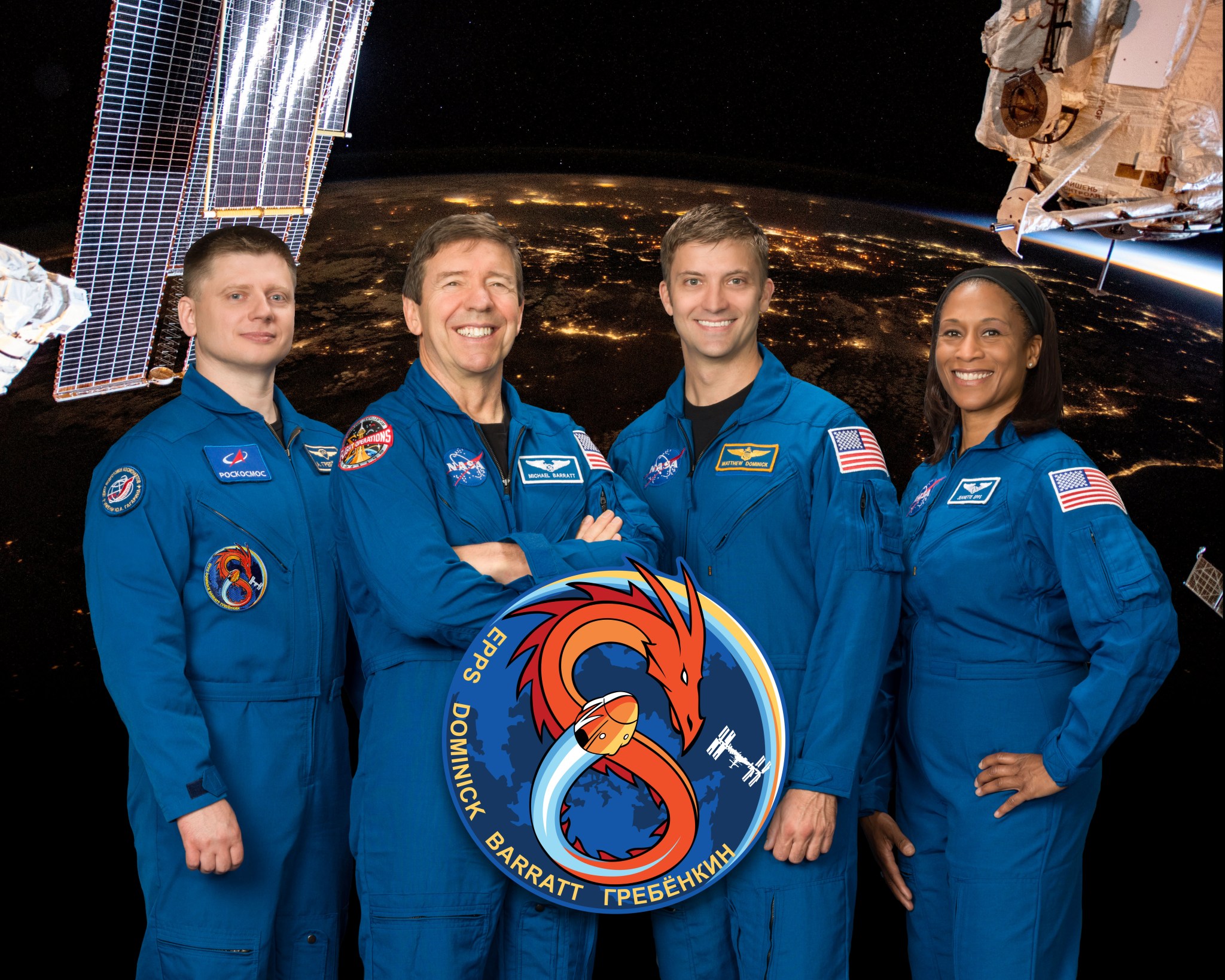
The official crew portrait for NASA's SpaceX Crew-8 crew members.
jsc2023e070781 (Oct. 4, 2023) — Official SpaceX Crew-8 portrait with Roscosmos cosmonaut and Mission Specialist Aleksandr Grebenkin, and Pilot Michael Barratt, Commander Matthew Dominick, and Mission Specialist Jeanette Epps, all three NASA astronauts.
NASA/Bill Stafford

Four new crew members are preparing to launch to the International Space Station as part of NASA’s SpaceX Crew-8 mission.

NASA astronauts Matthew Dominick, Michael Barratt, and Jeanette Epps, and Roscosmos cosmonaut Alexander Grebenkin will lift off from Launch Complex 39A at NASA’s Kennedy Space Center in Florida to perform research, technology demonstrations, and maintenance activities aboard the microgravity laboratory.

The flight is the eighth crew rotation mission with SpaceX to station, and the ninth human spaceflight as part of NASA’s Commercial Crew Program. The cadre will fly aboard the SpaceX Dragon spacecraft, named Endeavour, which previously flew NASA’s SpaceX Demo Mission-2, Crew-2 and Crew-6, in addition to Axiom Mission 1, the first commercial astronaut mission to the space station.

As teams progress through Dragon milestones for Crew-8, they also are preparing a first-flight Falcon 9 booster for the mission. Once all rocket and spacecraft system checkouts are complete and all components are certified for flight, teams will mate Dragon to the Falcon 9 rocket in SpaceX’s hangar at the launch site. The integrated spacecraft and rocket will then be rolled to the pad and raised to vertical for a dry dress rehearsal with the crew and an integrated static fire test prior to launch.

The Crew
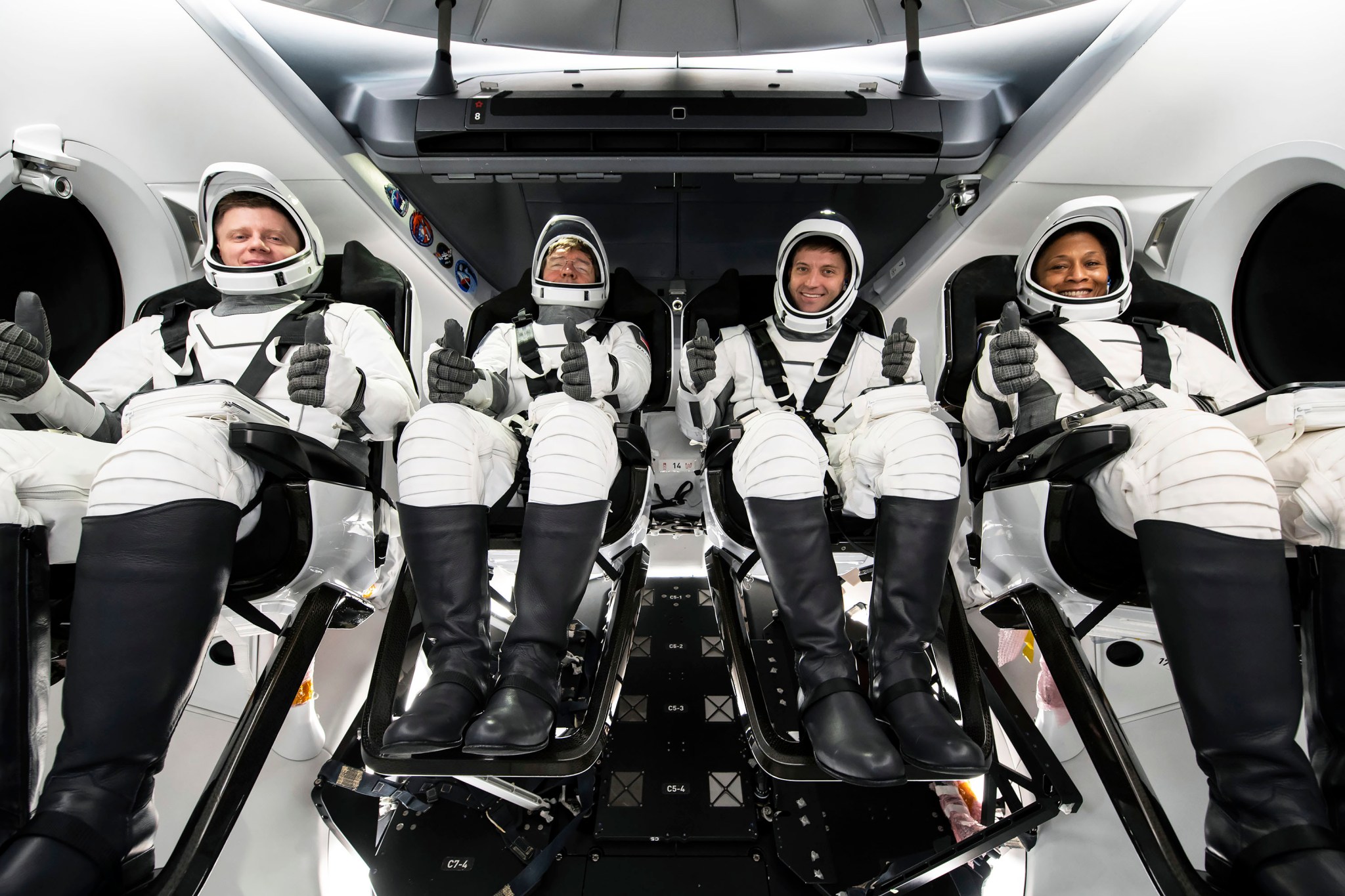
The crew of NASA’s SpaceX Crew-8 mission to the International Space Station poses for a photo during their Crew Equipment Interface Test at NASA’s Kennedy Space Center in Florida. The goal of the training is to rehearse launch day activities and get a close look at the spacecraft that will take them to the International Space Station.
jsc2024e005947 (Jan. 12, 2024) — The crew of NASA’s SpaceX Crew-8 mission to the International Space Station poses for a photo during their Crew Equipment Interface Test at NASA’s Kennedy Space Center in Florida. The goal of the training is to rehearse launch day activities and get a close look at the spacecraft that will take them to the International Space Station.
SpaceX

Matthew Dominick will serve as commander for Crew-8, his first spaceflight, after being selected as an astronaut by NASA in 2017. He is from Wheat Ridge, Colorado, and earned a bachelor’s degree in electrical engineering from the University of San Diego, California, and a master’s in systems engineering from the Naval Postgraduate School in Monterey, California. He is an active-duty U.S. Navy astronaut. He graduated from the U.S. Naval Test Pilot School in Patuxent River, Maryland, and then served as a test pilot specializing in testing aircraft carriers’ landings and catapult launches. Follow @dominickmatthew on X.

Michael Barratt is the Crew-8 pilot, making his third visit to the space station. In 2009, Barratt served as a flight engineer for Expeditions 19/20 as the station transitioned its standard crew complement from three to six and performed two spacewalks. He flew aboard the space shuttle Discovery in 2011 on STS-133, which delivered the Permanent Multipurpose Module and fourth Express Logistics Carrier. He has spent a total of 212 days in space. Born in Vancouver, Washington, he considers Camas, Washington, to be his hometown. Barratt earned a bachelor’s in zoology from the University of Washington, Seattle, and a Doctor of Medicine degree from Northwestern University in Chicago. He completed residencies in internal and aerospace medicine at Northwestern along with a master’s degree at Wright State University in Dayton, Ohio. After nine years as a NASA flight surgeon and project physician, Barratt joined the astronaut corps in 2000. During Expedition 70/71 on the International Space Station, he will serve as a mission specialist.

Jeanette Epps was selected by NASA as an astronaut in 2009 and is a mission specialist aboard Crew-8, her first spaceflight, working with the commander and pilot to monitor the spacecraft during the dynamic launch and re-entry phases of flight. She is from Syracuse, New York, and earned a bachelor’s in physics from LeMoyne College in Syracuse, and a master’s in science and a doctorate in aerospace engineering from the University of Maryland at College Park. Prior to joining NASA, she worked at Ford Motor Co. and the Central Intelligence Agency. She was selected as an astronaut in July 2009 and has served on the Generic Joint Operation Panel working on space station crew efficiency, as a crew support astronaut for two expeditions, and as lead capsule communicator at NASA Johnson. Epps previously was assigned to NASA’s Boeing Starliner-1 mission. NASA reassigned Epps to allow Boeing time to complete development of Starliner while also continuing plans for astronauts to gain spaceflight experience for future mission needs. Follow @Astro_Jeanette on X.

Roscosmos cosmonaut Alexander Grebenkin, who graduated from Irkutsk High Military Aviation School, Irkutsk, Russia, majoring in engineering, maintenance, and repair of aircraft radio navigation systems, also is flying on his first mission. He graduated from Moscow Technical University of Communications and Informatics with a degree in radio communications, broadcasting, and television. Grebenkin will serve as a flight engineer during Expeditions 70/71 aboard the International Space Station.

Mission Overview
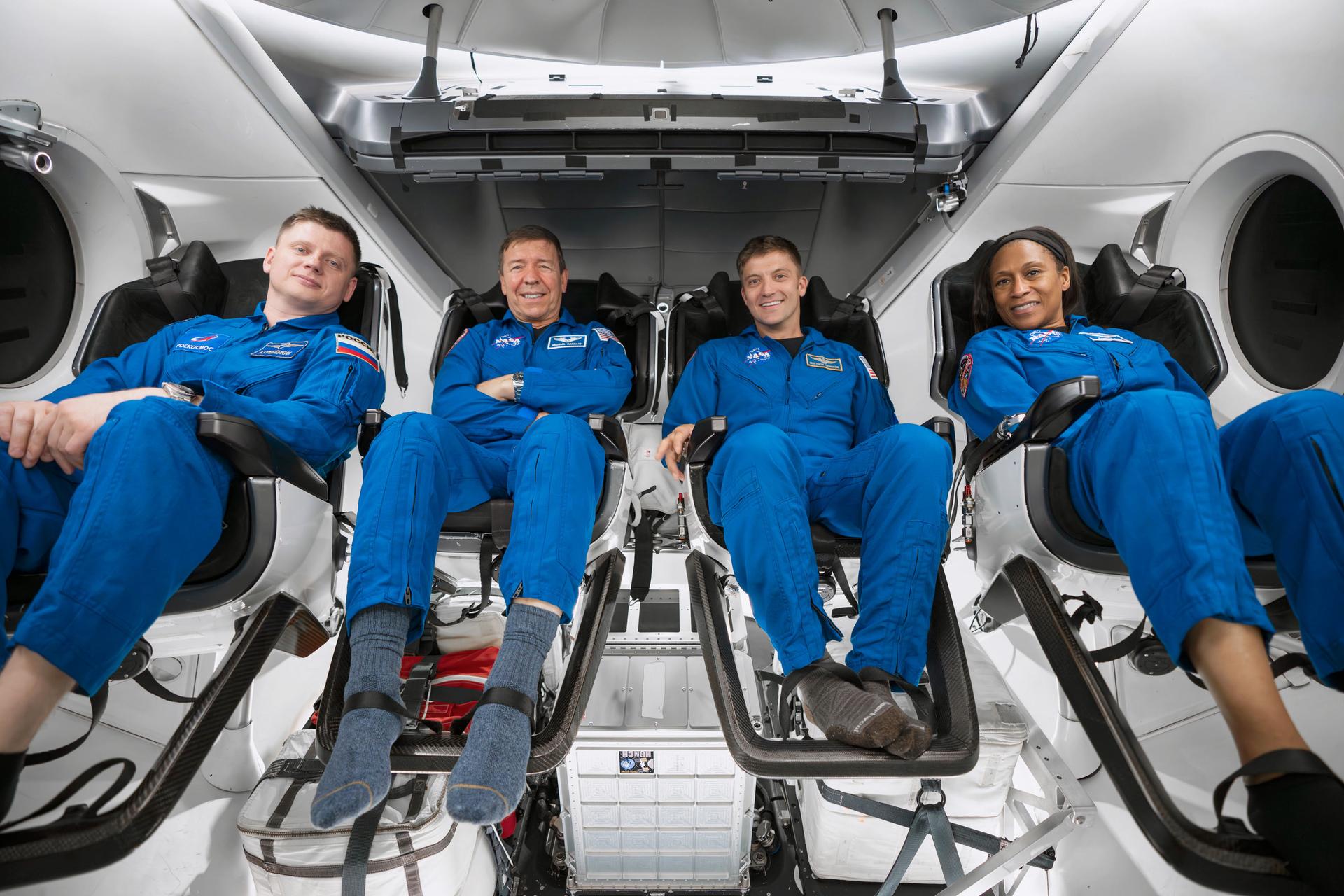
jsc2023e066245 (Oct. 15, 2023) --- The four SpaceX Crew-8 crew members (from left) Alexander Grebenkin from Roscosmos; Michael Barratt, Matthew Dominick, and Jeanette Epps, all NASA astronauts, are pictured training inside a Dragon mockup crew vehicle at SpaceX headquarters in Hawthorne, California.Four astronauts sit inside a SpaceX Dragon crew capsule.
jsc2023e066245 (Oct. 15, 2023) — The four SpaceX Crew-8 crew members (from left) Alexander Grebenkin from Roscosmos; Michael Barratt, Matthew Dominick, and Jeanette Epps, all NASA astronauts, are pictured training inside a Dragon mockup crew vehicle at SpaceX headquarters in Hawthorne, California.
SpaceX

Lifting off from Launch Pad 39A on a Falcon 9 rocket, Dragon will accelerate to approximately 17,500 mph, to dock with the space station.

Once in orbit, the crew and SpaceX mission control in Hawthorne, California, will monitor a series of automatic maneuvers that will guide Dragon to the forward-facing port of the station’s Harmony module. The spacecraft is designed to dock autonomously, but the crew can take control and pilot manually, if necessary.

After docking, Crew-8 will be welcomed inside the station by the seven-member crew of Expedition 70 and conduct several days of handover activities with the departing astronauts of NASA’s SpaceX Crew-7 mission. After a handover period, NASA astronaut Jasmin Moghbeli, ESA (European Space Agency) astronaut Andy Mogensen, JAXA (Japan Aerospace Exploration Agency) astronaut Satoshi Furukawa, and Roscosmos cosmonaut Konstantin Borisov of Crew-7 will undock from the space station and splash down off the coast of Florida.

Crew-8 will conduct new scientific research to prepare for human exploration beyond low Earth orbit and benefit humanity on Earth. Experiments include using stem cells to create organoid models to study degenerative diseases, studying the effects of microgravity and UV radiation on plants at a cellular level, and testing whether wearing pressure cuffs on the legs could prevent fluid shifts and reduce health problems in astronauts. These are just a few of the more than 200 scientific experiments and technology demonstrations taking place during their mission.

While aboard the orbiting laboratory, Crew-8 will see the arrival of both the SpaceX Dragon and the Roscosmos Progress cargo spacecraft. Crew-8 also is expected to welcome the agency’s Boeing Crew Flight Test astronauts and the first cargo flight of Sierra Space’s Dream Chaser. A Soyuz spacecraft with three new crew members, including NASA astronaut Tracy Dyson, will also launch during their stay, and the Soyuz carrying NASA astronaut Loral O’Hara will return to Earth.

After completing a short handover with Crew-9 at the completion of the mission, Dragon with the four crew members aboard will autonomously undock, depart the space station, and re-enter Earth’s atmosphere. After splashdown off Florida’s coast, a SpaceX recovery vessel will pick up the spacecraft and crew, who then will be helicoptered back to shore.

Commercial crew missions enable NASA to maximize use of the space station, where astronauts have lived and worked continuously for more than 23 years testing technologies, performing research, and developing the skills needed to operate future commercial destinations in low Earth orbit, and explore farther from Earth. Research conducted on the space station provides benefits for people on Earth and paves the way for future long-duration trips to the Moon and beyond through NASA’s Artemis missions.

Get breaking news, images, and features from the space station on Instagram, Facebook, and X.

Learn more about the space station, its research, and crew, at: https://www.nasa.gov/station

Powered by WPeMatico

Get The Details…
Mark A. Garcia
Astronaut Bob Hines

Astronaut Bob Hines

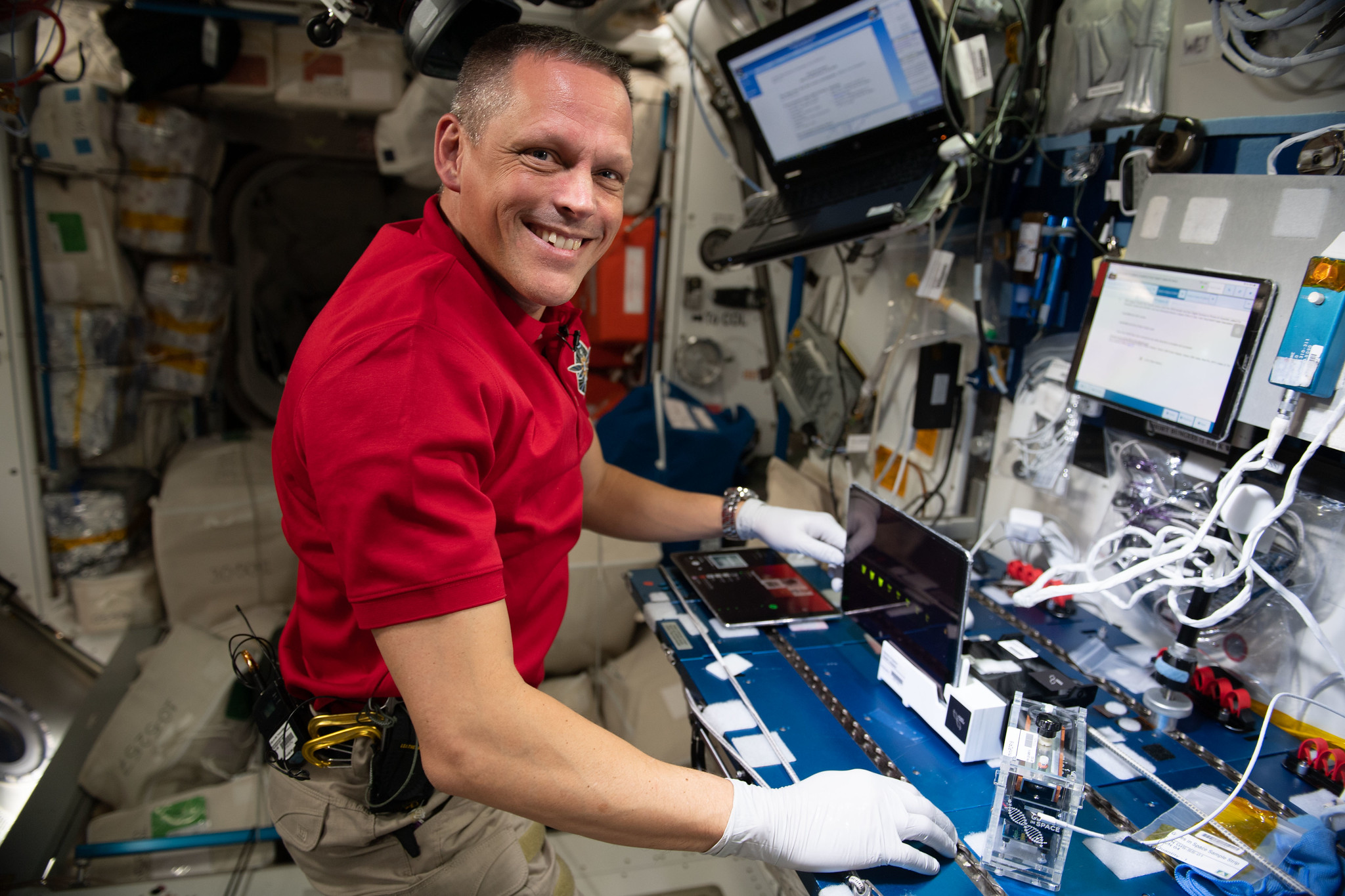
Bob Hines, wearing a red work polo and white gloves, smiles at the camera from his position at a workstation with many screens and wires aboard the International Space Station.

“I have been interested in aviation for as long as I can remember. There are pictures of me at two years old and younger with my face pinned against the window, watching airplanes taxi around the airport. I had never not known that I wanted to be a pilot. The amazing engineering that goes into [airplanes], but certainly the freedom of flight is just spectacular. Being able to see the world from a different perspective is incredible, and getting to fly in space was the culmination of that, seeing the world from an entirely new vantage point.

“One thing that surprised me was how emotional the launch piece is, especially for a first-time flier. One, it’s the culmination of these lifehood dreams where it’s taken so long to get here, and you’re finally getting to launch to space, which so few people have the privilege to do. Then, for a long-duration mission, you’re leaving your family and kids behind, and there’s that emotion as well. So, all those things piled up, it just makes for an incredibly special experience, and it’s amazing because eight and a half minutes later, after that engine lights, you’re in space, and you look back on it.”

— Bob Hines, Astronaut, NASA’s Johnson Space Center

Image Credit: NASA / Kjell Lindgren
Interviewer: NASA / Tahira Allen

Check out some of our other Faces of NASA.

Powered by WPeMatico

Get The Details…
Michelle Zajac

Hubble Studies a Sparkling Galaxy Pair

Hubble Studies a Sparkling Galaxy Pair

1 min read

Hubble Studies a Sparkling Galaxy Pair

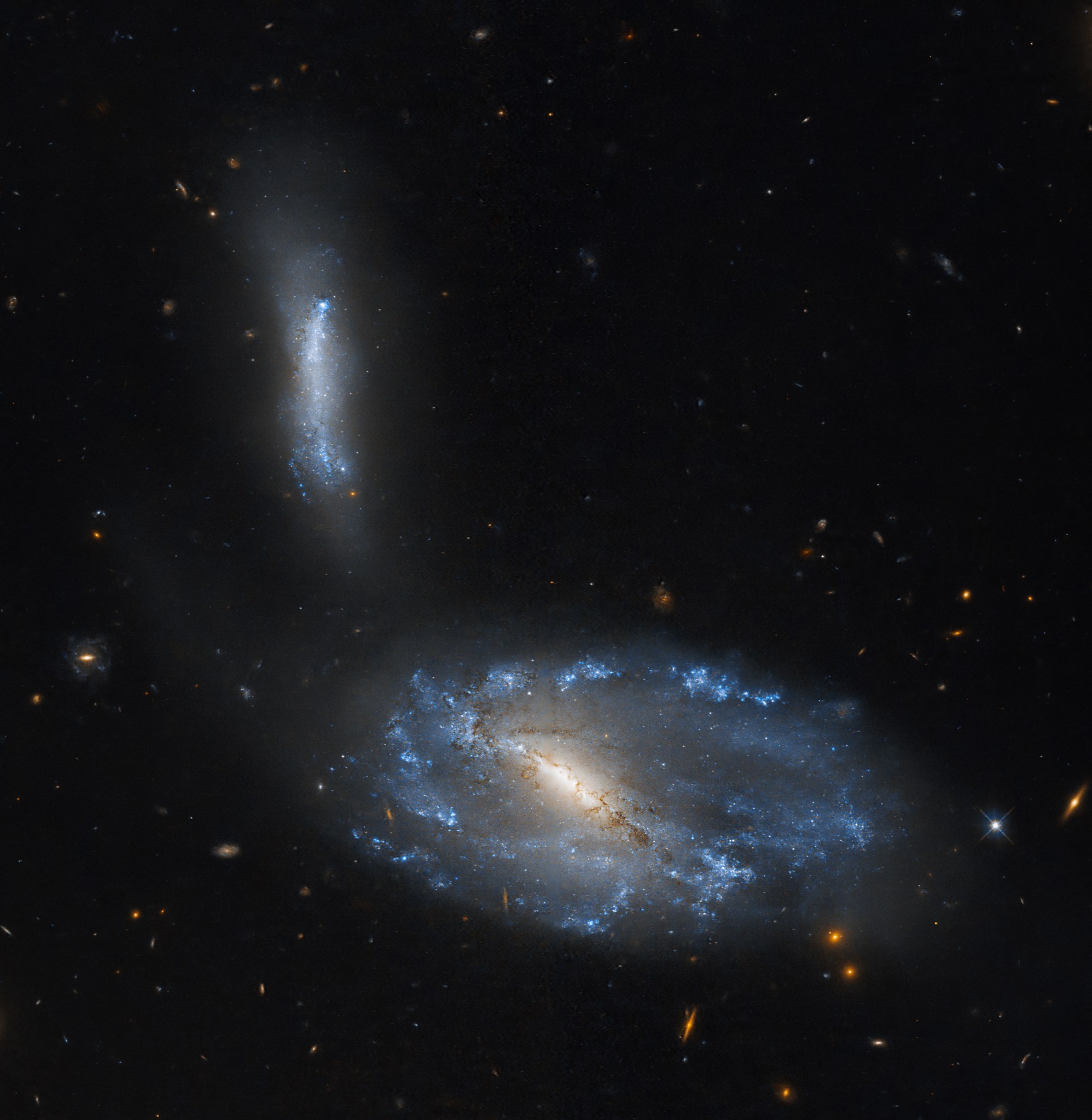
The lower half of the image is filled with a large spiral galaxy that has a bright white bar of stars at its center. To its upper left, a smaller galaxy shines with bright blue stars. It has an irregular shape, appearing almost like a vertical bar of stars. The rest of the image shows black space interspersed with more distant galaxies and stars.
This new NASA Hubble Space Telescope image features a pair of interacting galaxies called, NGC 5410 and UGC 8932/PGC 49896.
NASA/ESA/D. Bowen (Princeton University)/Processing: Gladys Kober (NASA/Catholic University of America)

A pair of small, interacting galaxies shine in this new NASA Hubble Space Telescope image. The larger of the two galaxies is named NGC 5410 and was discovered in 1787 by British astronomer William Herschel. It spans 80,000 light-years across and has a bright white bar of stars at its center. It is also a spiral galaxy with a medium-sized nucleus and spread-out arms. NGC 5410 contains many young, blue star clusters, especially along its arms.

The smaller of the two galaxies is called UGC 8932 or PGC 49896 and has a diameter of 60,000 light-years. It has a bright blue bar of stars at its core, indicating that it contains younger stars. Its shape is irregular, likely due to distortions from NGC 5410’s gravitational pull. 

The pair lies 180 million light-years away in the Canes Venatici constellation and can be seen from the northern hemisphere. Between the two galaxies lies a stream of stars, almost like a bridge, caused by their interaction.

Hubble imaged this galaxy in 2023 to examine if interactions between dwarf galaxies create reservoirs of particles that fuel star formation. 

LEARN MORE:

Media Contact:

Claire Andreoli
NASA’s Goddard Space Flight Center, Greenbelt, MD
claire.andreoli@nasa.gov

Share

Details

Last Updated
Jan 26, 2024
Editor
Andrea Gianopoulos
Location
Goddard Space Flight Center

Powered by WPeMatico

Get The Details…

Hubble Views a Galaxy Settling into Old Age

Hubble Views a Galaxy Settling into Old Age

1 min read

Hubble Views a Galaxy Settling into Old Age

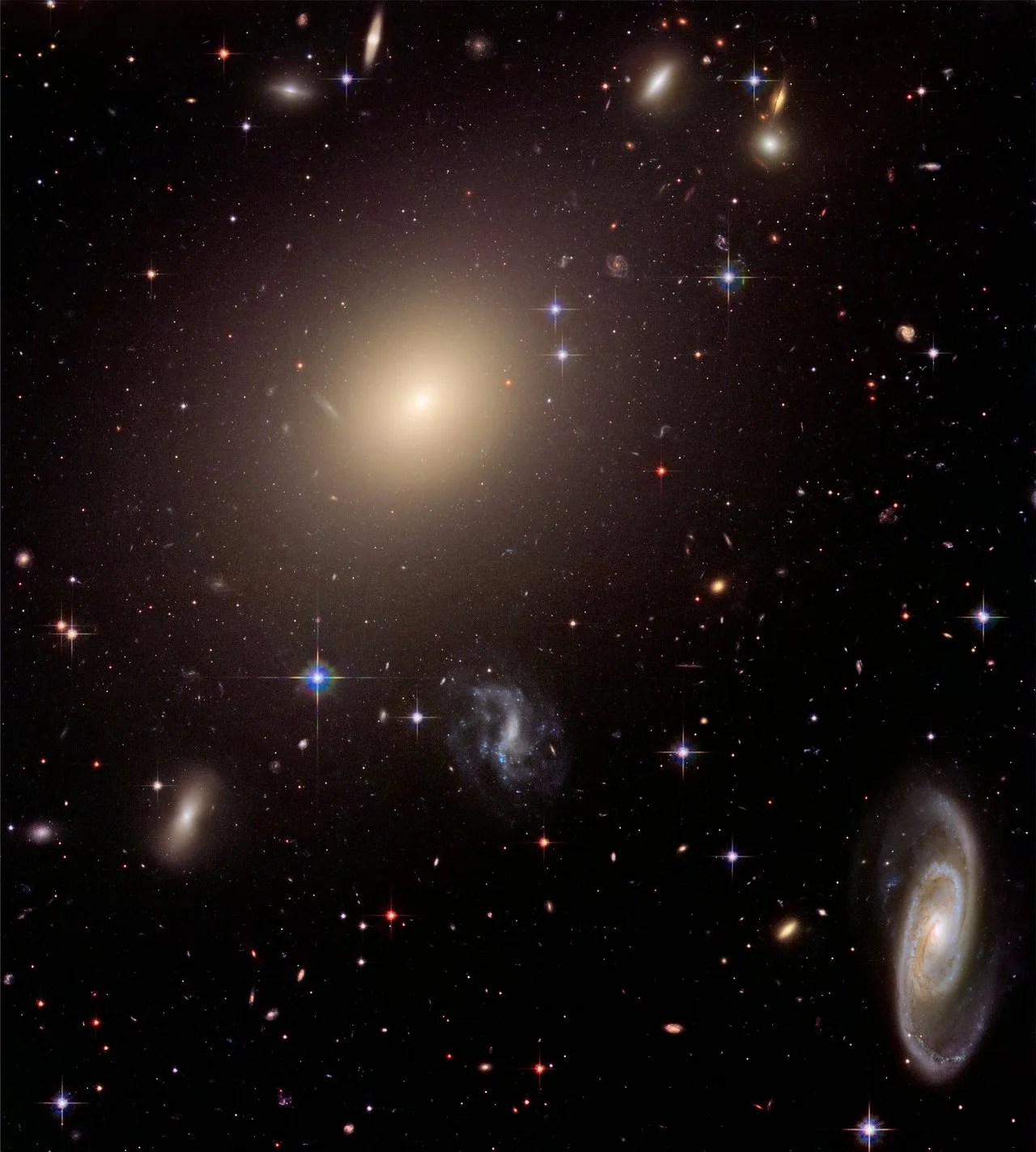
A black background dotted with galaxies. A bright galaxy is at image center. It looks like a diffuse ellipse that stretches from the lower-left corner to the upper-right corner, with a bright core at image center.
The galaxy NGC 3384 takes center stage in this NASA Hubble Space Telescope image.
ESA/Hubble & NASA/B. Lehmer et al.

NGC 3384, visible in this image, has many of the characteristic features of so-called elliptical galaxies. Such galaxies glow diffusely, are rounded in shape, display few visible features, and rarely show signs of recent star formation. Instead, they are dominated by old, aging, and red-hued stars. This stands in contrast to the liveliness of spiral galaxies such as our home galaxy, the Milky Way, which possess significant populations of young, blue stars in spiral arms swirling around a bright core.

However, NGC 3384 also displays a hint of disc-like structure towards its center, in the form of a central ‘bar’ of stars. Many spirals also boast such a bar, the Milky Way included; galactic bars are thought to funnel material through and around a galaxy’s core, which helps maintain and fuel the activities and processes occurring there.

NGC 3384 is located approximately 35 million light-years away in the constellation Leo (The Lion). This image was taken using the NASA/ESA Hubble Space Telescope’s Advanced Camera for Surveys.

Media Contact:

Claire Andreoli
NASA’s Goddard Space Flight Center, Greenbelt, MD
claire.andreoli@nasa.gov

Share

Details

Last Updated
Jan 25, 2024
Editor
Andrea Gianopoulos
Location
Goddard Space Flight Center

Powered by WPeMatico

Get The Details…

Landing On Mars: A Tricky Feat!

Landing On Mars: A Tricky Feat!

3 Min Read

Landing On Mars: A Tricky Feat!

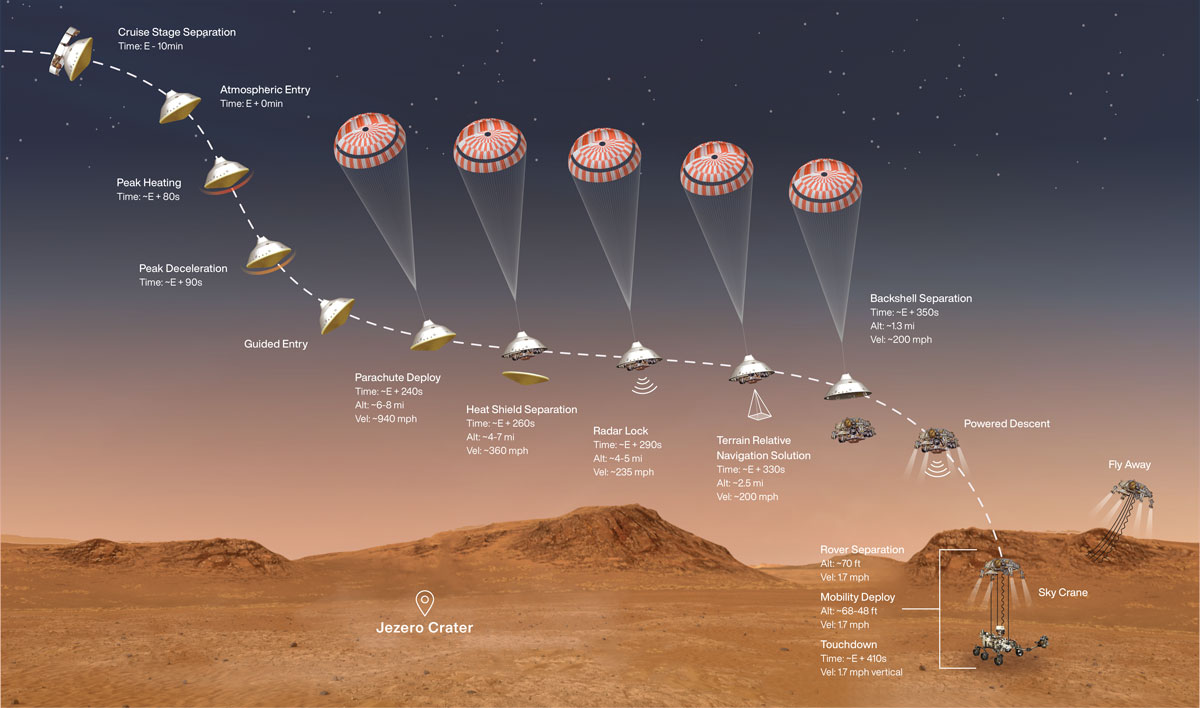
This illustration shows the events that occur in the final minutes of the nearly seven-month journey that NASA’s Perseverance rover takes to Mars.
Perseverance Rover’s Entry, Descent and Landing Profile: This illustration shows the events that occur in the final minutes of the nearly seven-month journey that NASA’s Perseverance rover takes to Mars.

In honor of Ingenuity’s final flight on The Red Planet, learn from Dave Prosper about what it takes to land on Mars.

The Perseverance rover and Ingenuity helicopter landed in Mars’s Jezero crater on February 18, 2021, NASA’s latest mission to explore the red planet. Landing on Mars is an incredibly difficult feat that has challenged engineers for decades: while missions like Curiosity have succeeded, its surface is littered with the wreckage of many failures as well. Why is landing on Mars so difficult?

Mars presents a unique problem to potential landers as it possesses a relatively large mass and a thin, but not insubstantial, atmosphere. The atmosphere is thick enough that spacecraft are stuffed inside a streamlined aeroshell sporting a protective heat shield to prevent burning up upon entry – but that same atmosphere is not thick enough to rely on parachutes alone for a safe landing, since they can’t catch sufficient air to slow down quickly enough. This is even worse for larger explorers like Perseverance, weighing in at 2,260 lbs (1,025 kg). Fortunately, engineers have crafted some ingenious landing methods over the decades to allow their spacecraft to survive what is called Entry, Descent, and Landing (EDL).

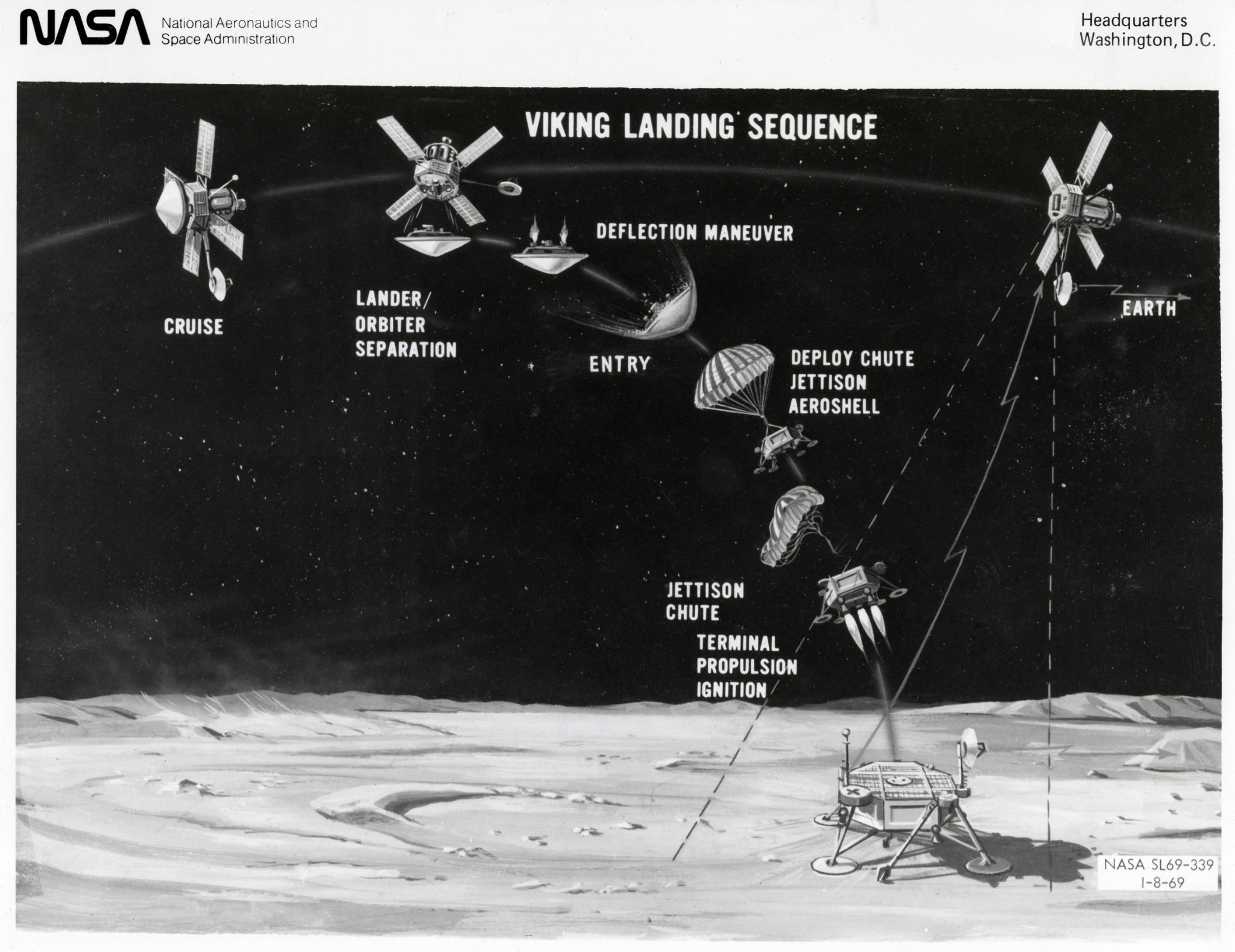
Black and white illustrations of the Entry, Descent, and Landing (EDL) sequences for the Viking lander on the surface of Mars.
Illustrations of the Entry, Descent, and Landing (EDL) sequences for Viking in 1976,
NASA

The Viking landers touched down on Mars in 1976 using heat shields, parachutes, and retrorockets. Despite using large parachutes, the large Viking landers fired retrorockets at the end to land at a safe speed. This complex combination has been followed by almost every mission since, but subsequent missions have innovated in the landing segment. The 1997 Mars Pathfinder mission added airbags in conjunction with parachutes and retrorockets to safely bounce its way to a landing on the Martian surface. Then three sturdy “petals” ensured the lander was pushed into an upright position after landing on an ancient floodplain. The Opportunity and Spirit missions used a very similar method to place their rovers on the Martian surface in 2004. Phoenix (2008) and Insight (2018) actually utilized Viking-style landings.

This illustration shows the events that occur in the final minutes of the nearly seven-month journey that NASA’s Perseverance rover takes to Mars.
Perseverance Rover’s Entry, Descent and Landing Profile: This illustration shows the events that occur in the final minutes of the nearly seven-month journey that NASA’s Perseverance rover takes to Mars.
NASA/JPL-Caltech

The large and heavy Curiosity rover required extra power at the end to safely land the car-sized rover, and so the daring “Sky Crane” deployment system was successfully used in 2012. After an initial descent using a massive heat shield and parachute, powerful retrorockets finished slowing down the spacecraft to about two miles per hour. The Sky Crane then safely lowered the rover down to the Martian surface using a strong cable. Its job done, the Sky Crane then flew off and crash-landed a safe distance away. Having proved the efficacy of the Sky Crane system, NASA used this same method to attempt a safe landing for Perseverance in February 2021!

To rediscover the Mars 2020 mission, visit: https://mars.nasa.gov/mars2020/

Originally posted by Dave Prosper: December 2021

Last Updated by Kat Troche: January 2024

Powered by WPeMatico

Get The Details…