Why NASA’s Roman Mission Will Study Milky Way’s Flickering Lights

Why NASA’s Roman Mission Will Study Milky Way’s Flickering Lights
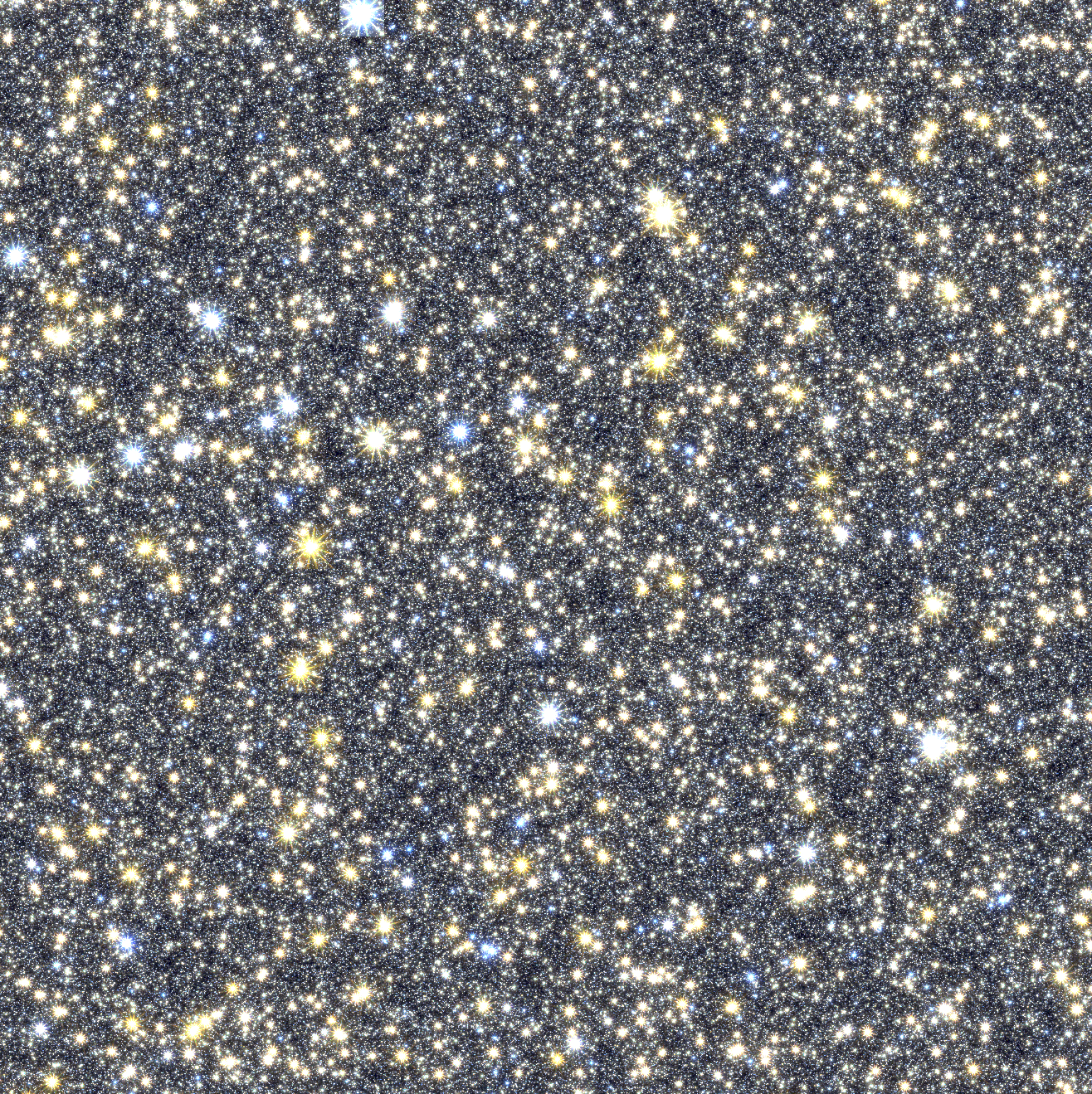
Many thousands of bright, explosive looking stars speckle the screen. The smallest ones are white pinpoints, strewn across the screen like spilled salt. Larger ones are yellow and bluish white and they have spiky outer edges like sea urchins.
A simulated image of Roman’s observations toward the center of our galaxy, spanning only less than 1 percent of the total area of Roman’s galactic bulge time-domain survey. The simulated stars were drawn from the Besançon Galactic Model.
Credit: Matthew Penny (Louisiana State University)

NASA’s Nancy Grace Roman Space Telescope will provide one of the deepest-ever views into the heart of our Milky Way galaxy. The mission will monitor hundreds of millions of stars in search of tell-tale flickers that betray the presence of planets, distant stars, small icy objects that haunt the outskirts of our solar system, isolated black holes, and more. Roman will likely set a new record for the farthest-known exoplanet, offering a glimpse of a different galactic neighborhood that could be home to worlds quite unlike the more than 5,500 that are currently known.

Roman’s long-term sky monitoring, which will enable these results, represents a boon to what scientists call time-domain astronomy, which studies how the universe changes over time. Roman will join a growing, international fleet of observatories working together to capture these changes as they unfold. Roman’s Galactic Bulge Time-Domain Survey will focus on the Milky Way, using the telescope’s infrared vision to see through clouds of dust that can block our view of the crowded central region of our galaxy.

Watch this video to learn about time-domain astronomy and how time will be a key element in the Nancy Grace Roman Space Telescope’s galactic bulge survey. Credit: NASA’s Goddard Space Flight Center

“Roman will be an incredible discovery machine, pairing a vast view of space with keen vision,” said Julie McEnery, the Roman senior project scientist at NASA’s Goddard Space Flight Center in Greenbelt, Maryland. “Its time-domain surveys will yield a treasure trove of new information about the cosmos.”

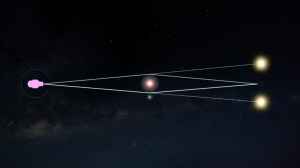
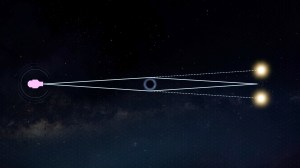
When Roman launches, expected by May 2027, the mission will scour the center of the Milky Way for microlensing events, which occur when an object such as a star or planet comes into near-perfect alignment with an unrelated background star from our viewpoint. Because anything with mass warps the fabric of space-time, light from the distant star bends around the nearer object as it passes close by. The nearer object therefore acts as a natural magnifying glass, creating a temporary spike in the brightness of the background star’s light. That signal lets astronomers know there’s an intervening object, even if they can’t see it directly.

In current plans, the survey will involve taking an image every 15 minutes around the clock for about two months. Astronomers will repeat the process six times over Roman’s five-year primary mission for a combined total of more than a year of observations.
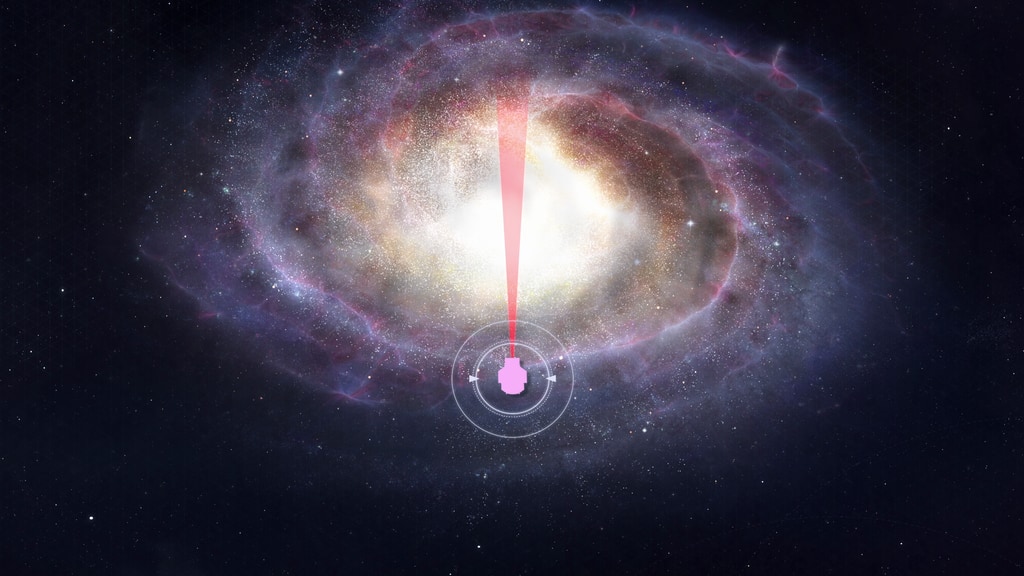
A galaxy with a large, warmly glowing circular center and several purplish spiral arms extending outward, wrapped around the center like a cinnamon roll. Stars speckle the entire galaxy, but they are most densely packed near the center where they're yellower. Toward the outer edges, the stars are whiter. Overlaid on top of the galaxy is a small pink outline of a spacecraft located a little more than halfway out toward the bottom edge of the galaxy. A reddish search beam extends across the galaxy, about to the same point on the opposite side of the center of the galaxy.
This artist’s concept shows the region of the Milky Way Roman’s galactic bulge time-domain survey will cover. The higher density of stars in this direction will yield more than 50,000 microlensing events, which will reveal planets, black holes, neutron stars, trans-Neptunian objects, and enable exciting stellar science. The survey will also cover relatively uncharted territory when it comes to planet-finding. That’s important because the way planets form and evolve may be different depending on where in the galaxy they’re located. Our solar system is situated near the outskirts of the Milky Way, about halfway out on one of the galaxy’s spiral arms. A recent Kepler Space Telescope study showed that stars on the fringes of the Milky Way possess fewer of the most common planet types that have been detected so far. Roman will search in the opposite direction, toward the center of the galaxy, and could find differences in that galactic neighborhood, too.
Credit: NASA’s Goddard Space Flight Center/CI Lab

“This will be one of the longest exposures of the sky ever taken,” said Scott Gaudi, an astronomy professor at Ohio State University in Columbus, whose research is helping inform Roman’s survey strategy. “And it will cover territory that is largely uncharted when it comes to planets.”

Astronomers expect the survey to reveal more than a thousand planets orbiting far from their host stars and in systems located farther from Earth than any previous mission has detected. That includes some that could lie within their host star’s habitable zone – the range of orbital distances where liquid water can exist on the surface – and worlds that weigh in at as little as a few times the mass of the Moon.

Roman can even detect “rogue” worlds that don’t orbit a star at all using microlensing. These cosmic castaways may have formed in isolation or been kicked out of their home planetary systems. Studying them offers clues about how planetary systems form and evolve.

Roman’s microlensing observations will also help astronomers explore how common planets are around different types of stars, including binary systems. The mission will estimate how many worlds with two host stars are found in our galaxy by identifying real-life “Tatooine” planets, building on work started by NASA’s Kepler Space Telescope and TESS (the Transiting Exoplanet Survey Satellite).

Some of the objects the survey will identify exist in a cosmic gray area. Known as brown dwarfs, they’re too massive to be characterized as planets, but not quite massive enough to ignite as stars. Studying them will allow astronomers to explore the boundary between planet and star formation.

Roman is also expected to spot more than a thousand neutron stars and hundreds of stellar-mass black holes. These heavyweights form after a massive star exhausts its fuel and collapses. The black holes are nearly impossible to find when they don’t have a visible companion to signal their presence, but Roman will be able to detect them even if unaccompanied because microlensing relies only on an object’s gravity. The mission will also find isolated neutron stars – the leftover cores of stars that weren’t quite massive enough to become black holes.

Astronomers will use Roman to find thousands of Kuiper belt objects, which are icy bodies scattered mostly beyond Neptune. The telescope will spot some as small as about six miles across (about 1 percent of Pluto’s diameter), sometimes by seeing them directly from reflected sunlight and others as they block the light of background stars.

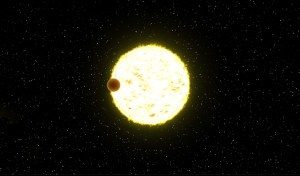
This animation compares signals from two planet detection methods: microlensing (top) and transit (bottom) for both high- and low-mass planets. Microlensing creates spikes in a star’s brightness, while transits have the opposite effect. Since both methods involve tracking the amount of light we receive from stars over time, astronomers will be able to use the same data set for both methods. Credit: NASA’s Goddard Space Flight Center/CI Lab

A similar type of shadow play will reveal 100,000 transiting planets between Earth and the center of the galaxy. These worlds cross in front of their host star as they orbit and temporarily dim the light we receive from the star. This method will reveal planets orbiting much closer to their host stars than microlensing reveals, and likely some that lie in the habitable zone.

Scientists will also conduct stellar seismology studies on a million giant stars. This will involve analyzing brightness changes caused by sound waves echoing through a star’s gaseous interior to learn about its structure, age, and other properties.

All of these scientific discoveries and more will come from Roman’s Galactic Bulge Time-Domain Survey, which will account for less than a fourth of the observing time in Roman’s five-year primary mission. Its broad view of space will allow astronomers to conduct many of these studies in ways that have never been possible before, giving us a new view of an ever-changing universe.

The Nancy Grace Roman Space Telescope is managed at NASA’s Goddard Space Flight Center in Greenbelt, Maryland, with participation by NASA’s Jet Propulsion Laboratory and Caltech/IPAC in Southern California, the Space Telescope Science Institute in Baltimore, and a science team comprising scientists from various research institutions. The primary industrial partners are Ball Aerospace and Technologies Corporation in Boulder, Colorado; L3Harris Technologies in Melbourne, Florida; and Teledyne Scientific & Imaging in Thousand Oaks, California.

Download high-resolution video and images from NASA’s Scientific Visualization Studio

By Ashley Balzer
NASA’s Goddard Space Flight Center, Greenbelt, Md.

​​Media Contact:
Claire Andreoli
NASA’s Goddard Space Flight Center
301-286-1940

Powered by WPeMatico

Get The Details…
Ashley Balzer
Follow NASA’s Starling Swarm in Real Time

Follow NASA’s Starling Swarm in Real Time

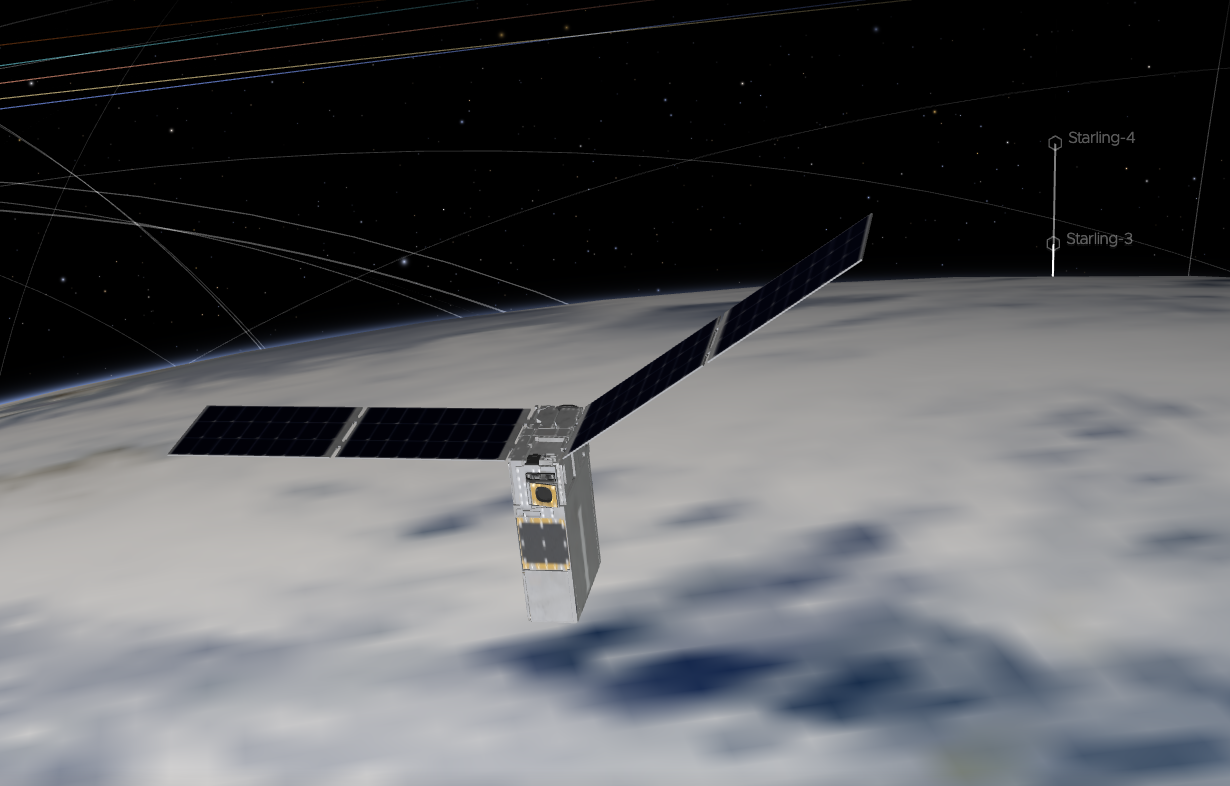
A computer rendering of a Starling spacecraft in orbit above the Earth.
The Starling spacecraft are digitally rendered in NASA’s Eyes on the Solar System interactive app, allowing users to track the swarm in real-time and observe their orbits relative to other space missions and celestial bodies.
NASA

NASA’s Starling CubeSats are zipping through low Earth orbit in the agency’s latest test of robotic swarm technologies for space.  The four Starling spacecraft, launched in July 2023, are testing a group of small satellites ability to coordinate and cooperate independently without real-time updates from mission control.

NASA invites the public to follow the Starling mission live in NASA’s Eyes on the Solar System 3D visualization, which uses real-time data in an interactive solar system simulation. The positions of the planets, moons, and spacecraft – including Starling – are shown as they travel through space.

The Starling mission, managed at NASA’s Ames Research Center in California’s Silicon Valley, will test multiple flight patterns and autonomous capabilities, including maneuvering to stay together as a group, creating and patching their own communications network, keeping track of each other’s relative position without use of GPS,  and autonomously changing their combined science data collection strategy based on the latest readings from onboard sensors.

Autonomous technologies are vital to NASA’s space science and exploration goals, especially when exploring environments far from Earth where signal delays make real-time maneuvering impractical or impossible. Satellites and spacecraft operating in a networked, autonomous, and coordinated capacity will help humanity explore the unknown and conduct better science than ever before.

NASA’s Ames Research Center leads the Starling project. NASA’s Small Spacecraft Technology program, based at Ames and within NASA’s Space Technology Mission Directorate (STMD), funds and manages the Starling mission. Blue Canyon Technologies designed and manufactured the spacecraft buses and is providing mission operations support. Rocket Lab USA, Inc. provided launch and integration services. Partners supporting Starling’s payload experiments include Stanford University’s Space Rendezvous Lab in Stanford, California, Emergent Space Technologies of Laurel, Maryland, CesiumAstro of Austin, Texas, L3Harris Technologies, Inc., of Melbourne, Florida, and NASA Ames – with funding support by NASA’s Game Changing Development program within STMD.

For news media:

Members of the news media interested in covering this topic should reach out to the NASA Ames newsroom.

Powered by WPeMatico

Get The Details…
Arezu Sarvestani

Spacewalk Prep Continues for Crew on Monday

Spacewalk Prep Continues for Crew on Monday

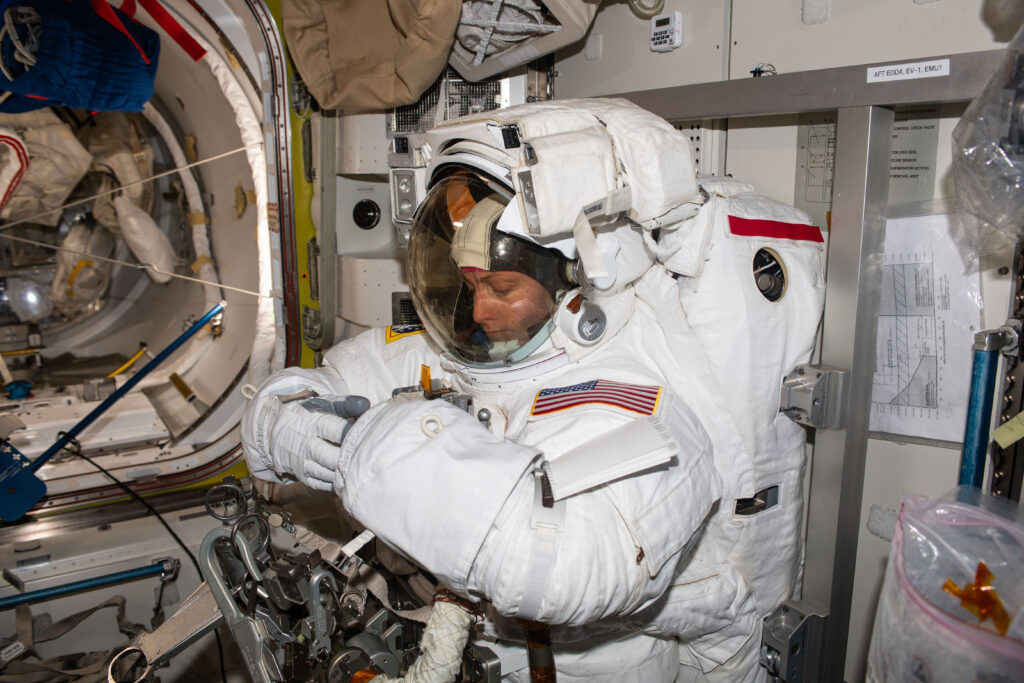
NASA astronaut and Expedition 70 Flight Engineer Loral O'Hara is pictured trying on her spacesuit and testing its components aboard the International Space Station's Quest airlock in preparation for an upcoming spacewalk.
NASA astronaut and Expedition 70 Flight Engineer Loral O’Hara is pictured trying on her spacesuit and testing its components aboard the International Space Station’s Quest airlock in preparation for an upcoming spacewalk.

Spacewalk preparations topped the Expedition 70 crew members’ schedule today as two Roscosmos cosmonauts gear up to exit the station on Wednesday, Oct. 25, and two NASA astronauts look ahead to their first spacewalk next week.

Flight Engineers Oleg Kononenko and Nikolai Chub will venture outside of the International Space Station’s Poisk module at 2:10 p.m. EDT on Wednesday to install communications hardware, deploy a nanosatellite, and inspect the external backup radiator that experienced a coolant leak. The duo worked together today prepping tools they’ll use during their seven-hour excursion and installing lights and video cameras to the helmets of the Orlan suits they will don.

NASA astronauts Jasmin Moghbeli and Loral O’Hara worked in tandem today as they prepare for their first spacewalk next week. The duo will exit the station on Monday at 8:05 a.m. to remove the Radio Frequency Group—an electronics box—and replace bearing assemblies on a solar array rotary joint. Today, their prep was geared towards procedure reviews and will continue to ramp up throughout the rest of the week. Later in the evening, they were joined by JAXA (Japan Aerospace Exploration Agency) Flight Engineer Satoshi Furukawa and ESA (European Space Agency) Commander Andreas Mogensen for a conference with grounds teams.

Last month, the final round of Arabidopsis plants was harvested from Plant Habitat-03, an investigation that aims to help researchers understand how adaptations in one generation of plants could transfer to the next, given the environmental stress of microgravity. Today, Mogensen cleaned the facility and prepped Seed Bags for future return to Earth. Meanwhile, Furukawa removed and replaced the filter assembly on an orbital system that processes wastewater.

While most of the station residents focused on prep and procedure reviews for the upcoming spacewalks, Roscosmos Flight Engineer Konstantin Borisov completed maintenance tasks and conducted an experiment that assesses the glow of Earth’s atmosphere at night in near ultraviolet.


Learn more about station activities by following the space station blog, @space_station and @ISS_Research on X, as well as the ISS Facebook and ISS Instagram accounts.

Get weekly video highlights at: https://roundupreads.jsc.nasa.gov/videoupdate/

Get the latest from NASA delivered every week. Subscribe here: www.nasa.gov/subscribe

Powered by WPeMatico

Get The Details…

Abby Graf

NASA Awards NOAA’s QuickSounder Spacecraft Contract

NASA Awards NOAA’s QuickSounder Spacecraft Contract

NASA meatball logo
NASA

NASA, on behalf of NOAA (National Oceanic and Atmospheric Administration), has awarded a delivery order under the Rapid Spacecraft Acquisition IV (Rapid-IV) contract to Southwest Research Institute of San Antonio for the QuickSounder spacecraft.

The firm-fixed-price delivery order covers all phases of QuickSounder’s operations to include spacecraft development, integration of NOAA’s Advanced Technology Microwave Sounder Engineering Development Unit, spacecraft shipment, supporting launch operations, three years of mission operations, and eventual spacecraft decommissioning.

The total value of the order is $54,973,400 with the period of performance beginning Wednesday, Oct. 25, and scheduled to run until May 2029.

QuickSounder is the first project in NOAA’s Near Earth Orbit Network. As a pathfinder mission, QuickSounder will support NOAA’s next generation satellite architecture for its future low Earth orbit program, which will provide mission-critical data to support NOAA’s National Weather Service and the nation’s weather industry.

Rapid IV contracts serve as a fast and flexible means for the government to acquire spacecraft and related components, equipment, and services in support of NASA missions and/or other federal government agencies. The spacecraft designs, related items, and services may be tailored, as needed, to meet the unique needs of each mission.

The Near Earth Orbit Network is a collaborative mission between NASA and NOAA. NASA will manage the development and launch of the satellites for NOAA, which will operate them and deliver data to users worldwide. NOAA, as the mission lead, provides funding, technical requirements, and post-launch operations. NASA and NOAA will work with commercial partners to design and build the network’s spacecraft and instruments.      

For information about NASA and agency programs, visit:

https://www.nasa.gov

-end-

Abbey Donaldson
Headquarters, Washington
202-358-1600
abbey.a.donaldson@nasa.gov

Jeremy Eggers
Goddard Space Flight Center, Greenbelt, Maryland
757-824-2958
jeremy.l.eggers@nasa.gov

Share

Details

Last Updated

Oct 23, 2023

Related Terms

Powered by WPeMatico

Get The Details…
Roxana Bardan

Dr. Natasha Schatzman Receives the Vertical Flight Society (VFS) 2023 Francois-Xavier Bagnoud Award 

Dr. Natasha Schatzman Receives the Vertical Flight Society (VFS) 2023 Francois-Xavier Bagnoud Award 

1 min read

Dr. Natasha Schatzman Receives the Vertical Flight Society (VFS) 2023 Francois-Xavier Bagnoud Award 

Portrait of female aerospace research engineer at NASA Ames Research Center Dr. Natasha Schatzman.
Dr. Natasha Schatzman, NASA Ames Research Center
NASA / Dominic Hart

In May 2023, Dr. Natasha Schatzman received the Vertical Flight Society Francois-Xavier Bagnoud Award for her vertical flight research at NASA Ames Research Center.  This annual award is given to a VFS member who is thirty-five years old or younger for outstanding contributions to vertical flight technology.  The award announcement notes that Dr. Schatzman “was recognized for outstanding vertical lift research (internationally recognized in rotorcraft acoustics and full-scale wind tunnel acoustics testing), for extensive contributions to the VFS technical community and local VFS San Francisco Bay Area Chapter, and for outstanding mentorship in the rotorcraft field.”  She began her work at NASA Ames Research Center in 2008 as an intern, and she now oversees various acoustic experimental and computational key aspects of Revolutionary Vertical Life Technology (RVLT) Project, which includes leading rotor acoustic tests in the 40-foot by 80-Foot Wind Tunnel at NASA Ames Research Center.  Dr. Schatzman holds a Ph.D. in Aeronautical and Astronautical Engineering from the Georgia Institute of Technology. 

More information on this award is at:https://gallery.vtol.org/image/APwYX/?fbclid=IwAR0vRoQybkYvWeLGzOuqRhmw7TKuYXD1-EZSYKtgijvxfhzmwP58WIlSzBY

About the Author

Suzanne Cisneros

Suzanne Cisneros

Management & Program Analyst

Share

Details

Last Updated

Oct 23, 2023

Related Terms

Powered by WPeMatico

Get The Details…
Suzanne Cisneros