An Unrelenting Tule Fog

An Unrelenting Tule Fog

November 24 – December 9, 2025

An atmospheric phenomenon occurring over much of California was unmistakable in satellite imagery in late autumn 2025. Fog stretching some 400 miles (640 kilometers) across the state’s Central Valley appeared day after day for more than two weeks in late November and early December. Known as tule (TOO-lee) fog, named after a sedge that grows in the area’s marshes, these low clouds tend to form in the valley in colder months when winds are light and soils are moist.  

This animation shows a sprawling blanket of white fog filling most or all of the valley from Redding to Bakersfield between November 24 and December 9, 2025. While the fog mostly remained hemmed in by the Coastal Range and the Sierra Nevada, it sometimes spilled through the Carquinez Strait toward San Francisco Bay. These images were acquired with the MODIS (Moderate Resolution Imaging Spectroradiometer) instrument on NASA’s Terra satellite and the VIIRS (Visible Infrared Imaging Radiometer Suite) on the NOAA-20 and Suomi NPP satellites.

The Central Valley is fertile ground for the formation of tule fog, a persistent radiation fog, in late autumn and winter. It occurs when air near the surface, laden with moisture from evaporation, cools and the water saturates the air. If winds are calm, water droplets accumulate into fog clouds near the ground.

Plenty of water was present in the valley’s soils following a very wet autumn. Across nearly all of central and southern California, precipitation totals from September through November 2025 were among the top 10 percent on record, California Institute for Water Resources climate scientist Daniel Swain noted on his Weather West blog. In late November, a very stable high-pressure system developed over the state, which acted like a lid that trapped moist air and confined the fog layer to the valley. With no major storms moving through to disrupt the stratification, the tule fog endured.

Temperatures have been notably cooler in the valley under the fog layer, in sharp contrast to the rest of the state, which was mostly warmer than normal. Despite the contrast, however, the ambient air mass has been warmer overall, Swain wrote. This may be due in part to warm ocean water offshore and a low Sierra Nevada snowpack sending less cold air downslope, he added.

The warmer overall temperatures could explain why fog has lingered at a slightly higher level—more like stratus clouds—at certain times and locations, said Swain. Colder temperatures would be necessary to produce the densest fog near the surface. The somewhat higher cloud in 2025 has differed from past events, when low visibility at ground level has caused major traffic incidents.

Central California has seen long stretches of cold, socked-in days in the past. In 1985, for example, Fresno experienced 16 consecutive days of dense fog, and Sacramento endured 17, according to news reports. Researchers have found, however, that tule fog has been forming less often in California in recent decades. Foggy days are beneficial for the valley’s fruit and nut trees, which need sufficient rest between growing seasons to be most productive. The fog typically comes with chilly weather that brings on a dormant period; it also shields trees from direct sunlight that would otherwise warm the plant buds.

NASA Earth Observatory images by Lauren Dauphin, using MODIS data from NASA EOSDIS LANCE and GIBS/Worldview, and VIIRS data from NASA EOSDIS LANCE, GIBS/Worldview, the Suomi National Polar-orbiting Partnership, and the Joint Polar Satellite System (JPSS). Story by Lindsey Doermann.

References & Resources

You may also be interested in:

Stay up-to-date with the latest content from NASA as we explore the universe and discover more about our home planet.

Cloud Streets Over the Laptev Sea

3 min read

The striking cloud formation developed over Arctic waters north of Siberia in July 2025 as frigid air met warmer open…

Article

Summer Heat Lingers in the West

3 min read

A prolonged high-pressure weather system brought unusually warm September temperatures to British Columbia and the Pacific Northwest.

Article

Fleeting Glimpse of Rare Snow

3 min read

A short-lived storm dropped some of the largest accumulations in decades on Australia’s Northern Tablelands.


Article

Powered by WPeMatico

Get The Details…

Expedition 74 Crew Promotes Innovation with Stem Cell and Space Tech Research

Expedition 74 Crew Promotes Innovation with Stem Cell and Space Tech Research

The official portrait of the Expedition 74 crew on the International Space Station. Top row from left, Commander Mike Fincke and Flight Engineer Zena Cardman, both NASA astronauts, JAXA (Japan Aerospace Exploration Agency) Flight Engineer Kimiya Yui, and Roscosmos Flight Engineer Oleg Platonov. Bottom row, Roscosmos Flight Engineer Sergey Kud-Sverchkov, NASA astronaut Chris Williams, and Roscosmos Flight Engineer Sergei Mikaev.

Stem cells, materials research, and a technology demo topped the research schedule for the Expedition 74 crew on Thursday. The seven International Space Station residents also worked on a host of lab maintenance including Japanese cargo operations and preparations for upcoming rack transfers.

NASA Flight Engineer Zena Cardman kicked off her day inside the Destiny laboratory module peering at stem cells through a microscope for the StemCellEx-IP1 investigation. She was helping investigators demonstrate the successful production of stem cells in space that are superior to those manufactured on Earth. Results may also advance regenerative medicine for damaged organs and tissues. Later she swapped a gas analyzer, that scans the station’s atmosphere for nitrogen, carbon dioxide, and more, inside the Tranquility module.

JAXA (Japan Aerospace Exploration Agency) Flight Engineer Kimiya Yui began his shift installing a materials exposure experiment inside the Kibo laboratory module’s airlock. The research hardware will be placed in the vacuum of space exposing a variety of materials to space radiation, extreme temperature changes, and more to benefit a range of Earth and space industries. Yui then installed an experimental carbon dioxide removal device in Kibo and wrapped it with soundproof insulation to reduce noise during its operation. The advanced hardware is being studied to inform advanced life support systems for Artemis lunar spacecraft.

NASA Flight Engineer Chris Williams, with a little bit of assistance from Cardman and Yui, spent most of his shift loading cargo inside JAXA’s HTV-X1 that is due to leave the station’s Earth-facing port on the Harmony module in late January. He also had time set aside to replace an air filter, turn on a fluorescent microscope, and swap out hardware on a portable computer tablet.

Station Commander Mike Fincke of NASA spent his shift deconfiguring and removing hardware from a science rack that will soon be transferred inside the HTV-X1. Shortly after waking up, Fincke took a test for an experiment documenting how crews sleep while living off the Earth and without the normal day-night cycle, also called circadian rhythm. Afterward, he performed a leak check on a recycle tank inside Tranquility.

Roscosmos cosmonaut Oleg Platonov started his shift measuring his mass attaching himself to a device that applies a known force with the resulting force providing an output using a form of Newton’s Second Law of Motion. Platonov then worked throughout the day on life support maintenance, inspecting cables, and uninstalling hardware that provides functionality to the European robotic arm.

Cosmonauts Sergey Kud-Sverchkov and Sergei Mikaev, who have been aboard the station since Nov. 27 with Williams, worked throughout the day on a variety of life support maintenance tasks. At the end of his shift, Kud-Sverchkov later installed Earth observation hardware programmed to automatically landmarks on the ground during the crew’s sleep shift. Mikaev wiped down surfaces inside the Roscosmos modules to prevent microbial growth.

Learn more about station activities by following the space station blog, @space_station on X, as well as the ISS Facebook and ISS Instagram accounts.

Get the latest from NASA delivered every week. Subscribe here.

Powered by WPeMatico

Get The Details…

Mark A. Garcia

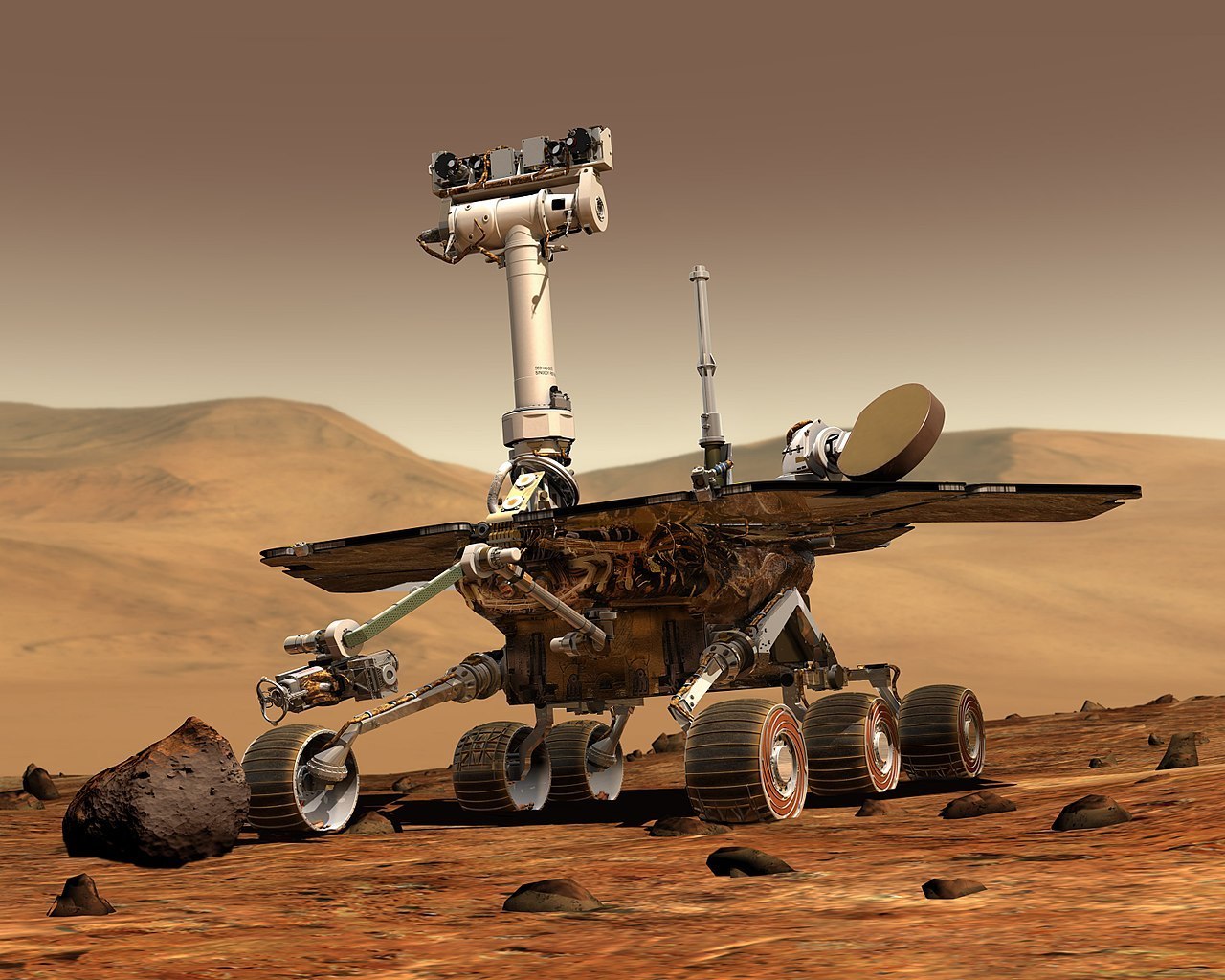
NASA JPL Unveils Rover Operations Center for Moon, Mars Missions

NASA JPL Unveils Rover Operations Center for Moon, Mars Missions

5 min read

Preparations for Next Moonwalk Simulations Underway (and Underwater)

This video highlights the Rover Operations Center at NASA’s Jet Propulsion Laboratory. A center of excellence for current and future rover, aerial, and other surface missions, the ROC will support partnerships and technology transfer to catalyze the next generation of Moon and Mars surface missions. Credit: NASA/JPL-Caltech

The center leverages AI along with JPL’s unique infrastructure, unrivaled tools, and years of operations expertise to support industry partners developing future planetary surface missions.  

NASA’s Jet Propulsion Laboratory in Southern California on Wednesday inaugurated its Rover Operations Center (ROC), a center of excellence for current and future surface missions to the Moon and Mars. During the launch event, leaders from the commercial space and AI industries toured the facilities, participated in working sessions with JPL mission teams, and learned more about the first-ever use of generative AI by NASA’s Perseverance Mars rover team to create future routes for the robotic explorer. 

The center was established to integrate and innovate across JPL’s planetary surface missions while simultaneously forging strategic partnerships with industry and academia to advance U.S. interests in the burgeoning space economy. The center builds on JPL’s 30-plus years of experience developing and operating Mars surface missions, including humanity’s only helicopter to fly at Mars as well as the only two active planetary surface missions. 

“The Rover Operations Center is a force multiplier,” said JPL Director Dave Gallagher. “It integrates decades of specialized knowledge with powerful new tools, and exports that knowledge through partnerships to catalyze the next generation of Moon and Mars surface missions. As NASA’s federally funded research and development center, we are chartered to do exactly this type of work — to increase the cadence, the efficiency, and the impact for our transformative NASA missions and to support the commercial space market as they take their own giant leaps.” 

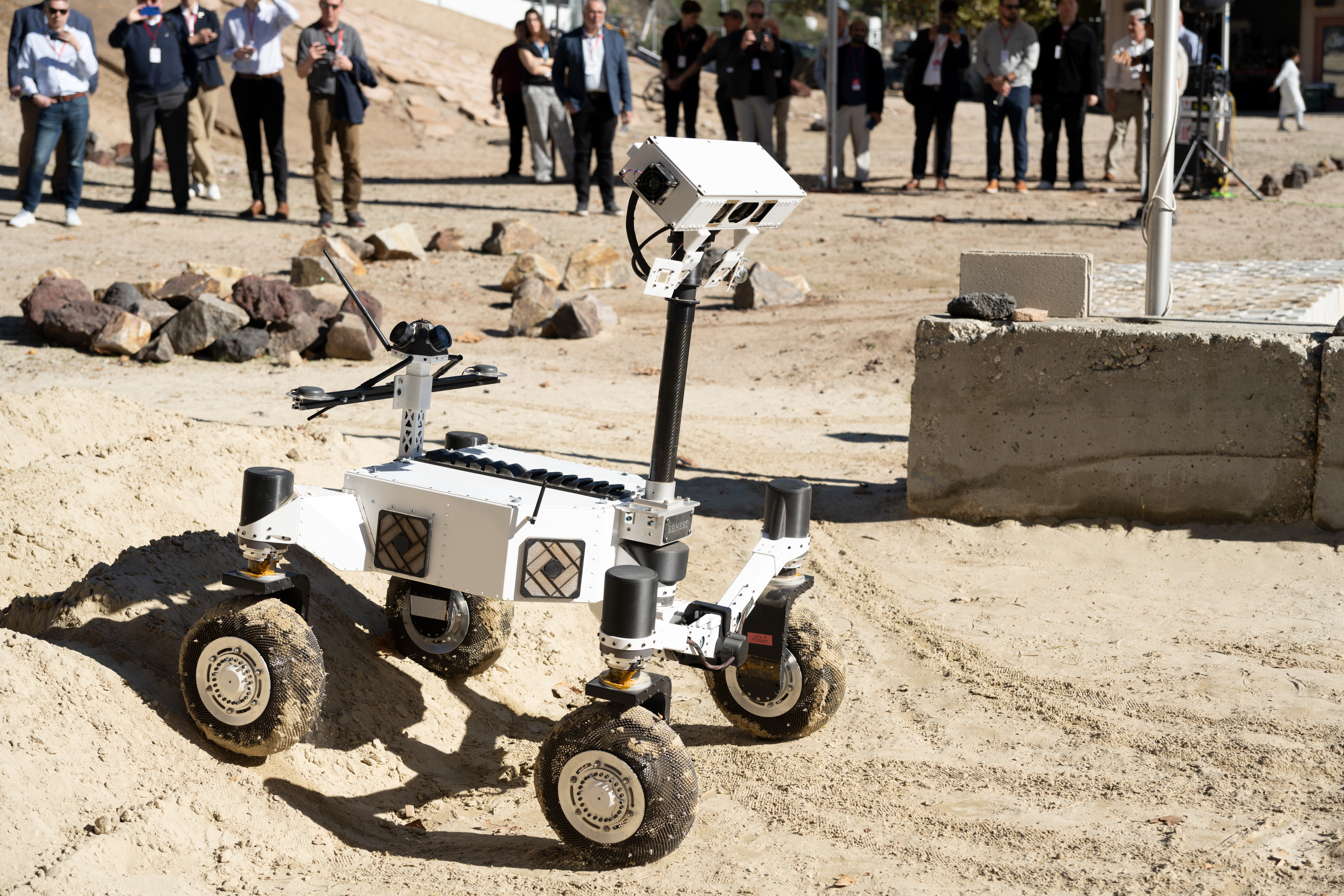
A rover drives down an incline as a group of people watch from a distance.
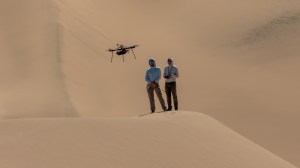
Rover prototype ERNEST (Exploration Rover for Navigating Extreme Sloped Terrain) demonstrates some of its advanced mobility and autonomy capabilities in JPL’s Mars Yard.
NASA/JPL-Caltech

Genesis of ROC 

Through decades of successful Mars rover missions, JPL has continuously improved the unique autonomy, robotic capabilities, and best practices that have been demanded by increasingly complex robotic explorers. The ROC offers an accessible centralized structure to facilitate future exploration efforts. 

“Our rovers are lasting longer and are more sophisticated than ever before. The scientific stakes are high, as we have just witnessed with the discovery of a potential biosignature in Jezero Crater by the Perseverance mission. We are starting down a decade of unprecedented civil and commercial exploration at the Moon, which will require robotic systems to assist astronauts and support lunar infrastructure,” said Matt Wallace, who heads JPL’s Exploration Systems Office. “Mobile vehicles like rovers, helicopters, and drones are the most dynamic and challenging assets we operate. It’s time to take our game up a notch and bring everybody we can with us.”  

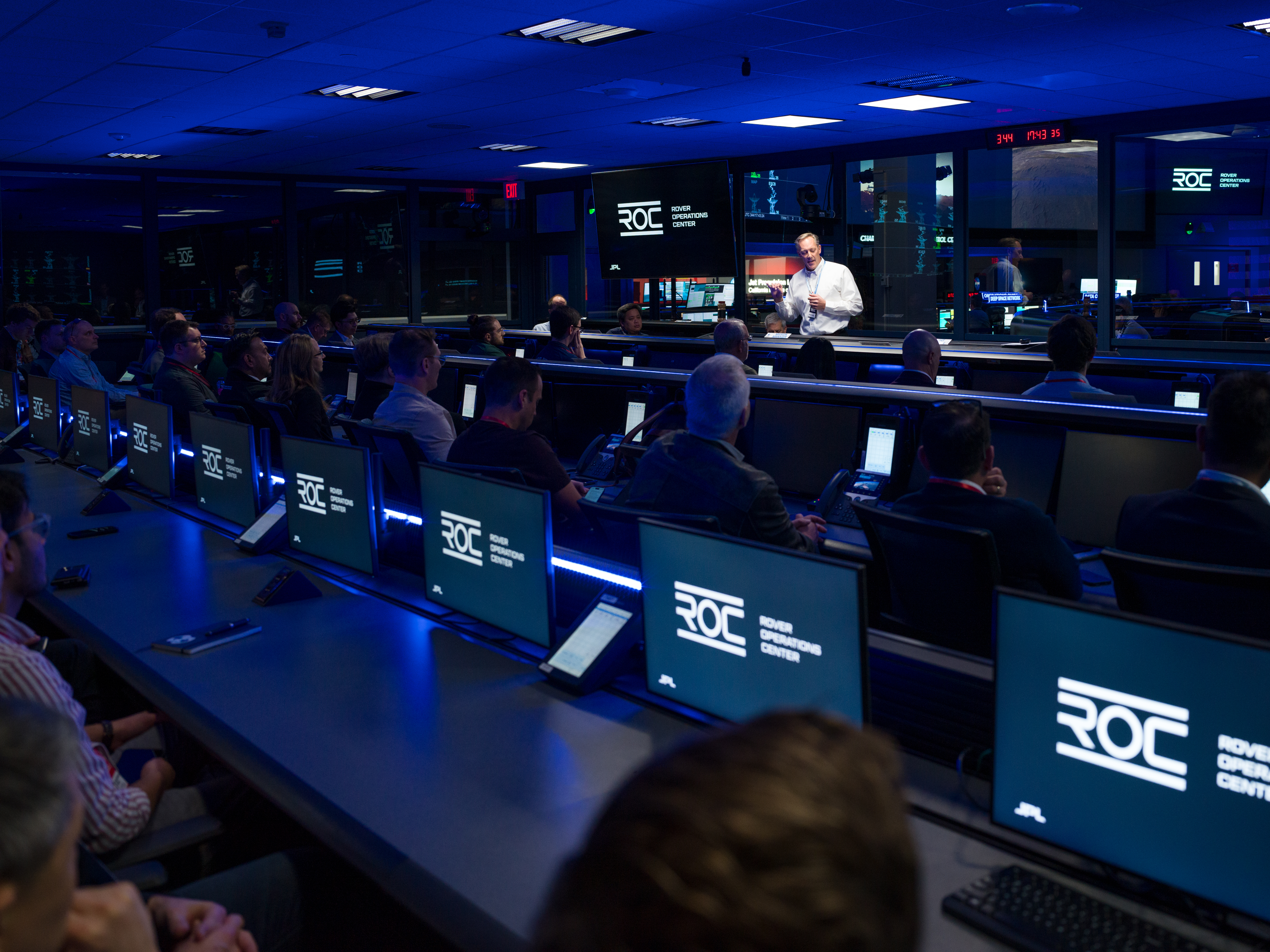
A man, illuminated by white light, talking to a group of people in a room that is otherwise dark and dimly lit with blue light.
Michael Thelen of JPL’s Exploration Systems Office discusses the newly inaugurated Rover Operations Center in JPL’s historic Space Flight Operations Facility on Dec. 10.
NASA/JPL-Caltech

Future forward  

A key focus of the ROC is on the more rapid infusion of higher-level autonomy into surface missions through partnerships with the AI and commercial space industries. The objective is to catalyze change to deliver next-generation science and exploration capabilities for the nation and NASA. 

As NASA’s only federally funded research and development center, JPL has been evolving vehicle autonomy since the 1990s, when JPL began developing Sojourner, the first rover on another planet. Improvements to vehicle independence over the years have included the evolution of autonomy in sampling activities, driving, and science-target selection. Most recently, those improvements have extended to the development of Perseverance’s ability to autonomously schedule and execute many commanded energy-intensive activities, like keeping warm at night, as it sees fit. This capability allows the rover to conserve power, which it can reallocate in real time to perform more science or longer drives. 

With the explosion of AI capabilities, the ROC rover team is leaving no Mars stone unturned in the hunt for future efficiencies.  

“We had a small team complete a ‘three-week challenge,’ applying generative AI to a few of our operational use cases. During this challenge, it became clear there are many opportunities for AI infusion that can supercharge our capabilities,” said Jennifer Trosper, ROC program manager at JPL. “With these new partnerships, together we will infuse AI into operations to path-find the next generation of capabilities for science and exploration.”  

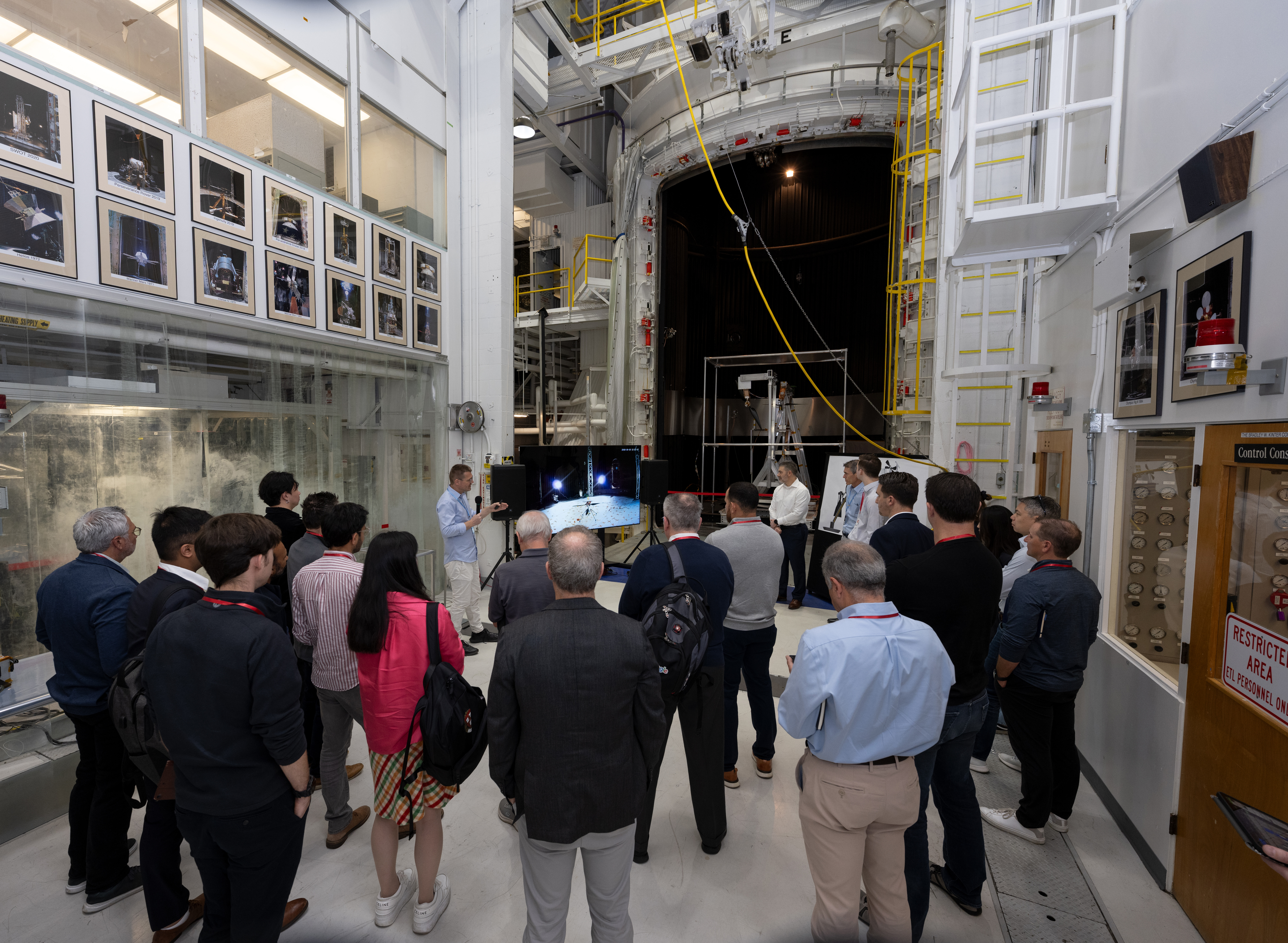
Håvard Grip, chief pilot of NASA’s Mars Ingenuity Helicopter — the only aircraft to fly on another planet — offers insights into aerial exploration of the Red Planet at the lab’s 25-Foot Space Simulator, which subjects spacecraft to the harsh conditions of space.

During the ROC’s inauguration, attendees toured JPL operations facilities, including where the rover drivers plan their next routes. They also visited JPL’s historic Mars Yard, which reproduces Martian terrain to test rover capabilities, and the massive 25-Foot Space Simulator that has tested spacecraft from Voyagers 1 and 2 to Perseverance to America’s next generation of lunar landers. A panel discussion explored the historical value of rovers and aerial systems like the Ingenuity Mars Helicopter in planetary surface exploration. Also discussed was the promise of a new public-private partnership opportunity across a virtual network of operational missions.  

Attendees were briefed on tiered engagement options for partners, from mission architecture support to autonomy integration, testing, and operations. These opportunities extend to science and human precursor robotic missions, as well as to human-robotic interaction and spacewalks for astronauts on the Moon and Mars. 

A highlight for event participants came when the Perseverance team showcased how the ROC’s generative AI can assist rover planners in creating future routes for the rover. The AI analyzed high-resolution orbital images of Jezero Crater and other relevant data and then generated waypoints that kept Perseverance away from hazardous terrain. 

Managed for NASA by Caltech, JPL is the home of the Rover Operations Center (ROC).  

To learn more about the ROC, visit:

https://www.jpl.nasa.gov/roc

News Media Contact

DC Agle
Jet Propulsion Laboratory, Pasadena, Calif.
818-393-9011
agle@jpl.nasa.gov

2025-137

Share

Details

Last Updated

Dec 10, 2025

Powered by WPeMatico

Get The Details…
scarney1

Station Trio Back on Earth; Expedition 74 Keeps Up Science, Maintains Systems

Station Trio Back on Earth; Expedition 74 Keeps Up Science, Maintains Systems

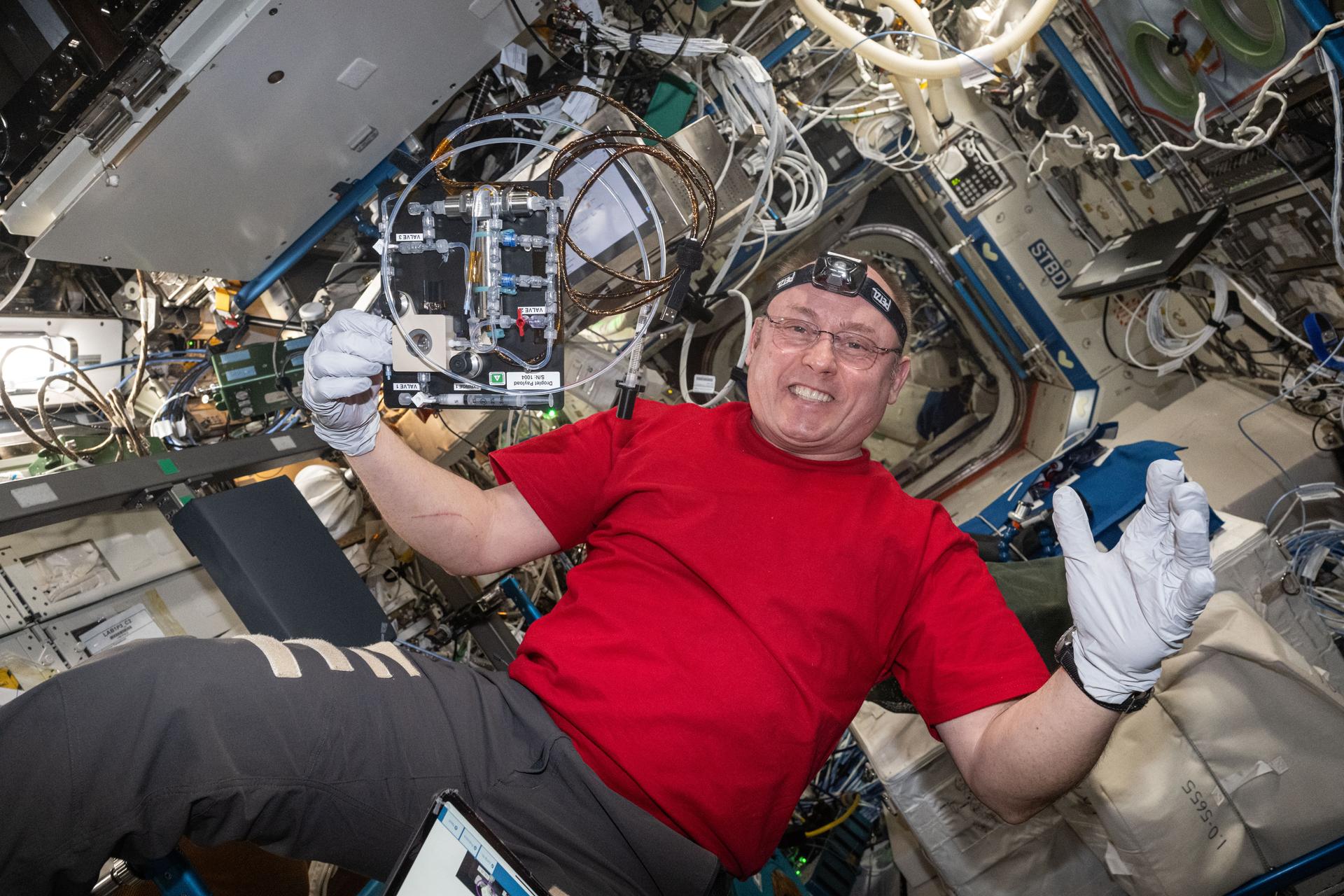
NASA astronaut and Expedition 73 Flight Engineer Mike Fincke smiles for a portrait during research operations for the Droplets fluid physics investigation. Fincke was inside the International Space Station's Destiny laboratory module exploring how particles behave inside fluids. The microgravity study may inform commercial in-space manufacturing techniques and improve optical materials and pollution removal operations.
NASA astronaut Mike Fincke smiles for a portrait during research operations for the Droplets fluid physics investigation that explores how particles behave inside fluids. The study may inform commercial in-space manufacturing techniques and improve optical materials and pollution removal operations.
NASA

Expedition 73 has ended and NASA astronaut Jonny Kim has returned to Houston and Roscosmos cosmonauts Sergey Ryzhikov and Alexey Zubritsky have returned to Moscow. The trio is now readapting to Earth’s gravity after living aboard the International Space Station in weightlessness for 245 days.

Expedition 74 is now underway with veteran NASA astronaut Mike Fincke as commander leading six flight engineers including NASA astronauts Zena Cardman and Chris Williams, JAXA (Japan Aerospace Exploration Agency) astronaut Kimiya Yui, and Roscosmos cosmonauts Oleg Platonov, Sergey Kud-Sverchkov and Sergei Mikaev.

Fincke spent his Wednesday primarily inside the Tranquility module replacing orbital plumbing components on the waste and hygiene compartment, the station’s restroom. The veteran astronaut also prepared cargo and life support racks for removal and reinstallation throughout the orbital outpost’s U.S. segment. The rack transfer work will continue into next week.

Cardman processed stem cell samples for stowage in a science freezer ahead of their return to Earth next year for a study demonstrating on-orbit pharmaceutical manufacturing and regenerative medicine. She also measured air flow throughout the U.S. modules and printed out an updated spacewalking checklist.

Williams exercised for research while pedaling on the Destiny laboratory module’s exercise cycle. He worked out wearing breathing gear and electrodes measuring his aerobic output and cardiovascular health. Afterward, he powered on a fluorescent research microscope then collected carbon dioxide waste samples from an atmospheric cleaner for analysis.

Yui reviewed the rack removal and replacement steps that he Cardman and Williams will assist Fincke with over the next several days. He then worked inside the Kibo laboratory module servicing an experimental carbon  dioxide removal device.

Flight Engineers Kud-Sverchkov and Mikaev, who have been aboard the station with Williams since Nov. 27, had a light duty day on Wednesday with some time set aside for photographic inspections and Elektron oxygen generator maintenance. Flight Engineer Oleg Platonov began his shift on orbital plumbing tasks in the station’s Roscosmos segment. Next, he assisted Mikaev with the Elektron job then wrapped up his shift installing hardware that enables the European robotic arm to be remotely controlled from Earth.

Learn more about station activities by following the space station blog, @space_station on X, as well as the ISS Facebook and ISS Instagram accounts.

Get the latest from NASA delivered every week. Subscribe here.

Powered by WPeMatico

Get The Details…

Mark A. Garcia