Backyard Worlds Volunteers Complete Ten Million Classifications in an Epic Search for New Objects Among the Nearest Stars
2 min read
Backyard Worlds Volunteers Complete Ten Million Classifications in an Epic Search for New Objects Among the Nearest Stars
A few Backyard Worlds volunteers. Credit: Backyard Worlds
Top (l-r): Arttu Sainio, Frank Kiwy, Jean Marc Gantier, Marianne Michaels, Les Hamlet, Melina Thévenot, 2nd row (l-r): Kevin Apps, Nikolaj Stevnbak Andersen, Rebekah Russwurm, Jörg Schümann, Guoyou Sun, Tom Bickle 3rd row (l-r): Michiharu Hyogo, Katharina Doll, Hugo Durantini-Luca, Yadukrishna Raghu, Hiro Higashimura, 4th row (l-r): Ben Pumphrey, Zbigniew Wedracki, Guillaume Colin, Anya Frazer, Dan Caselden 4th row (l-r): Kristin Grant, Maurizio Ventura, Harshdeep Singh, Celso Pessanha Machado, Austin Rothermich 6th row (l-r): Edoardo Antonini, Peter Jalowiczor, Leopold Gramaize, Hunter Brooks, William Pendrill
The Backyard Worlds: Planet 9 and Backyard Worlds: Cool Neighbors projects invite members of the public to search images from NASA’s Wide-Field Infrared Survey Explorer (WISE) mission to find new objects among the nearest stars. These projects share a science team and many volunteers–a total of more than 175,000 participants from more than 167 countries. Last week, the combined efforts of this giant Backyard Worlds team reached an incredible milestone: a total of 10,000,000 classifications of WISE mission image sets.
Since 2017, when the first Backyard Worlds project (Planet 9) launched, these projects have discovered more than 3800 nearby objects, including 12% of all the known stellar and substellar objects out to a distance of 60 light years. Those objects include many rare brown dwarfs, balls of gas that are not massive enough to become stars. Among them are roughly 15 Y dwarfs–the rarest kind of brown dwarf (only about 50 are known). The discoveries also include an entirely new kind of object, the “extreme T subdwarfs,” relics from our Galaxy’s earliest days.
This work has resulted in 20 refereed publications, with more than 40 volunteers named as co-authors on those refereed publications. It has also led to 11 research notes and 25 presentations at meetings of the American Astronomical Society. Several project volunteers have participated in observing runs at NASA’s Infrared Telescope Facility and even won time on NASA’s James Webb Space Telescope.
Best of all, there’s much more data to explore, and the WISE mission continues to scan the skies! So come join the fun and make your own discoveries at backyardworlds.org and coolneighbors.org!
From childhood stargazing to building a lunar space station
Even growing up in the heart of Washington, D.C., stargazer Oliver Ortiz felt a connection to space from a young age and always wondered what was beyond the city lights. Now a seasoned engineer with Northrop Grumman, he is contributing to a new era of space exploration with Gateway, humanity’s first space station in lunar orbit, and a critical part of NASA’s Artemis missions that will establish a long-term presence at the Moon.
Oliver Ortiz poses for a portrait, Wednesday, Aug. 23, 2023, at the NASA Headquarters Mary W. Jackson Building in Washington. Photo Credit: (NASA/Bill Ingalls)
Ortiz leads Northrop Grumman’s systems engineering team focused on the integration of Gateway’s foundational elements, HALO (Habitation and Logistics Outpost) and the Power and Propulsion Element. HALO is set to launch with the Power and Propulsion Element on a SpaceX Falcon Heavy rocket ahead of the Artemis IV mission, providing living quarters and the space station’s power and orbital control.
He embarked on his engineering journey at the University of Maryland College Park, obtaining both his undergraduate and master’s degrees in aerospace engineering. He joined Northrop Grumman as an intern in 2014 and quickly rose through the ranks, shaping his career in systems engineering while making significant contributions to various space programs, including commercial resupply missions to the International Space Station.
Ortiz’s path to the world of space engineering was not clear. He first set out to be an astronomer, but changed course toward a career in engineering that now has him leading a team of engineers responsible for ensuring the systems of Gateway’s first two elements are well-integrated and ready to be the building blocks of the lunar outpost.
“I’ve loved space since I was in elementary school and initially wanted to be an astronomer,” said Ortiz. “My undergrad English professor was married to an astronomer and offered to introduce me to her husband. It was in that coffee shop meet and greet that I realized I did not want to be an astronomer. I wanted to be an aerospace engineer and I’m forever grateful that he and fate pointed me in the direction of my true passion.”
It was Ortiz’s involvement in designing Next Step-1, a precursor to HALO, that defined his current trajectory when Northrop Grumman was chosen as Gateway’s prime contractor responsible for designing and fabricating HALO. Since 2016, Ortiz has dedicated his career to the creation of the world’s first habitat designed to support sustainable life outside Earth orbit.
“Sustainability for me means we can learn enough from living on and around the Moon that we can ultimately go to Mars,” Ortiz said. “The Moon is the steppingstone to what’s next and we have to learn how to build a safe environment in an economically efficient way.”
Built with commercial and international partnerships, Gateway is a vital component of the Artemis missions, helping NASA and its partners test the technologies and capabilities for a sustained human presence in deep space.
NASA Selects Awardees for New Aviation Maintenance Challenge
2 min read
NASA Selects Awardees for New Aviation Maintenance Challenge
NASA is addressing a key challenge for sustaining the future of aviation – the skills that will be needed by aviation maintenance technicians working on new kinds of aircraft with new technologies.
NASA / Lillian Gipson / Getty Images
NASA has selected three university-led teams for the first round of a new technical challenge pursuing innovative aviation maintenance practices.
These university teams will receive funding from NASA for a two-year research term exploring aviation maintenance challenges related to NASA’s strategic vision for aeronautics.
The awardees will research new maintenance techniques and procedures, as well as how aviation maintenance technical schools could amend or expand their activities to educate students on these new practices.
Their work will culminate in a final report outlining potential solutions for future aviation maintenance including new educational curricula, new standards and technologies, and other anticipated challenges associated with new types of aircraft such as drones, air taxis, or ultra-efficient airliners.
In the spirit of similar NASA awards, the university teams will engage students from multiple levels and include them in meaningful work and research. Not only will graduate and undergraduate students be included, but also students at aviation maintenance technical schools.
Each awardee must also collaborate with industry partners to best understand the needs of the aviation industry and maintenance ecosystem, as well as work with real-world technology.
“This new award expands NASA’s university research partnerships,” said Koushik Datta, manager for the University Innovation project overseeing the awards. “Now even more students, including those from aviation maintenance schools, can participate in NASA’s aeronautics research.”
The three teams and their topics are:
Clemson University
“Revolutionizing the Future of Aviation Maintenance: A Workforce Development Plan to Navigate the Complexities of a New Aviation Maintenance Ecosystem”
University of California, Davis
“Future Aviation Maintenance Technical Challenges for Electric and Hybrid-Powered Fixed Wing and Electric Vertical Takeoff and Landing Aircraft”
Wichita State University
“Adoption of Transformative Technologies and Workforce Development for Maintenance and Repair of Advanced Air Mobility Airframe Structures”
Complete details on this award and other solicitations, such as what to include in a proposal and how to submit it, can be found on the NASA Aeronautics Research Mission Directorate solicitations page.
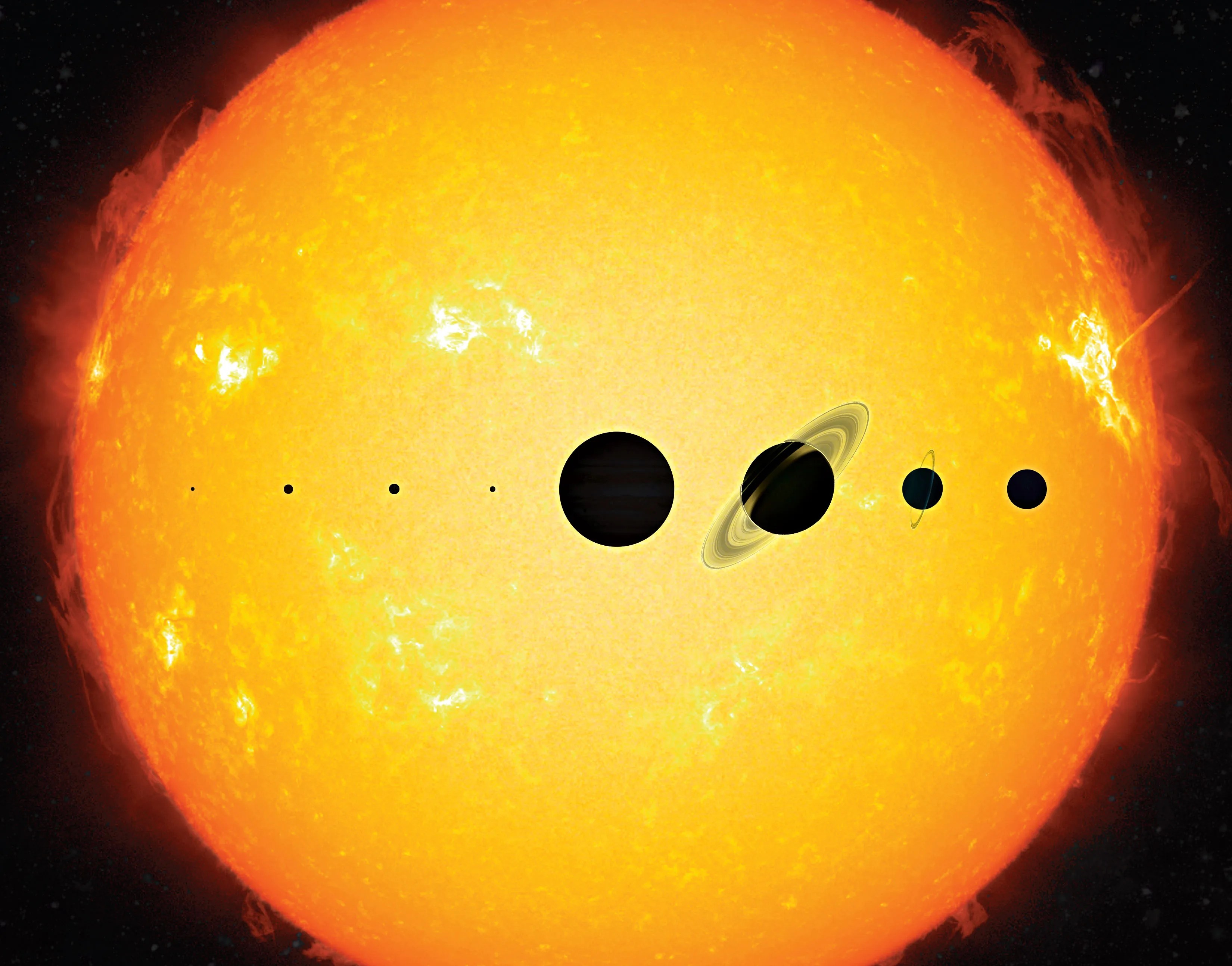
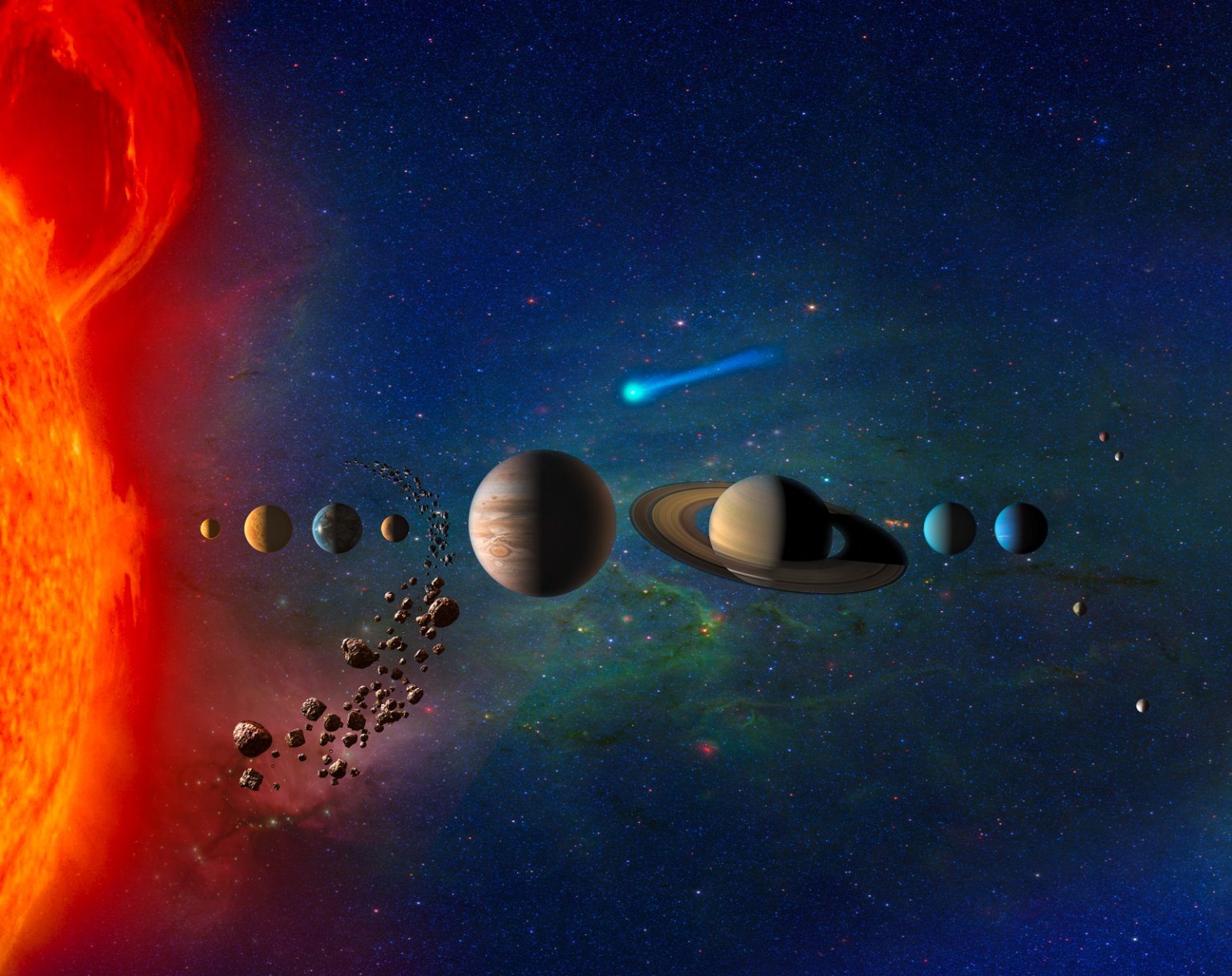
An illustration of our solar system. Planets and other objects are not to scale.
Credits: NASA
What’s the weather like out there? We mean waaaay out there in our solar system – where the forecast might not be quite what you think.
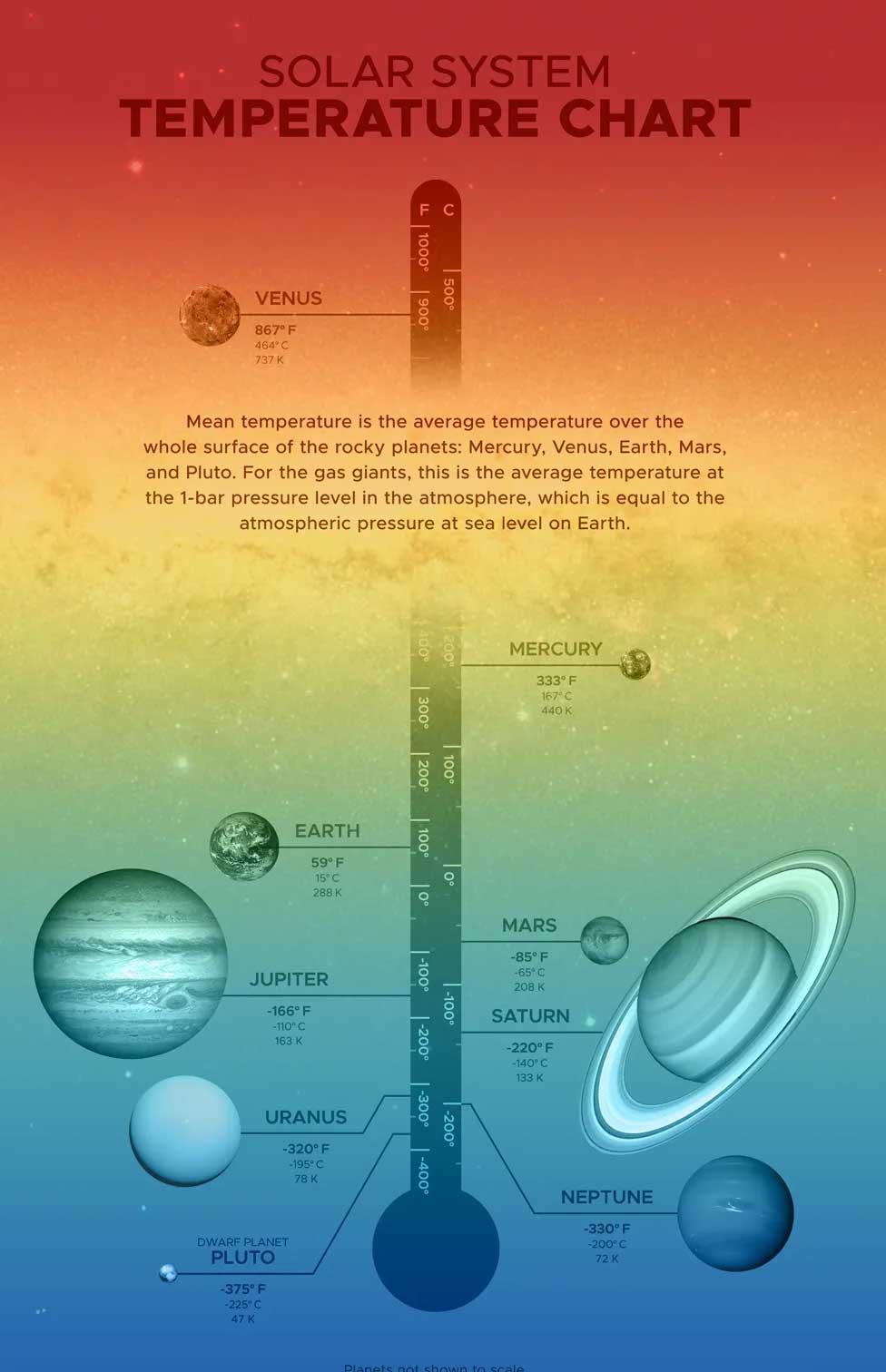
Let’s look at the mean temperature of the Sun, and the planets in our solar system. The mean temperature is the average temperature over the surface of the rocky planets: Mercury, Venus, Earth, and Mars. Dwarf planet Pluto also has a solid surface. But since the gas giants don’t have a surface, the mean is the average temperature at what would be equivalent at sea level on Earth.
An illustration of planets in our solar system showing their mean temperatures. Planets and dwarf planet Pluto are not to scale.
NASA
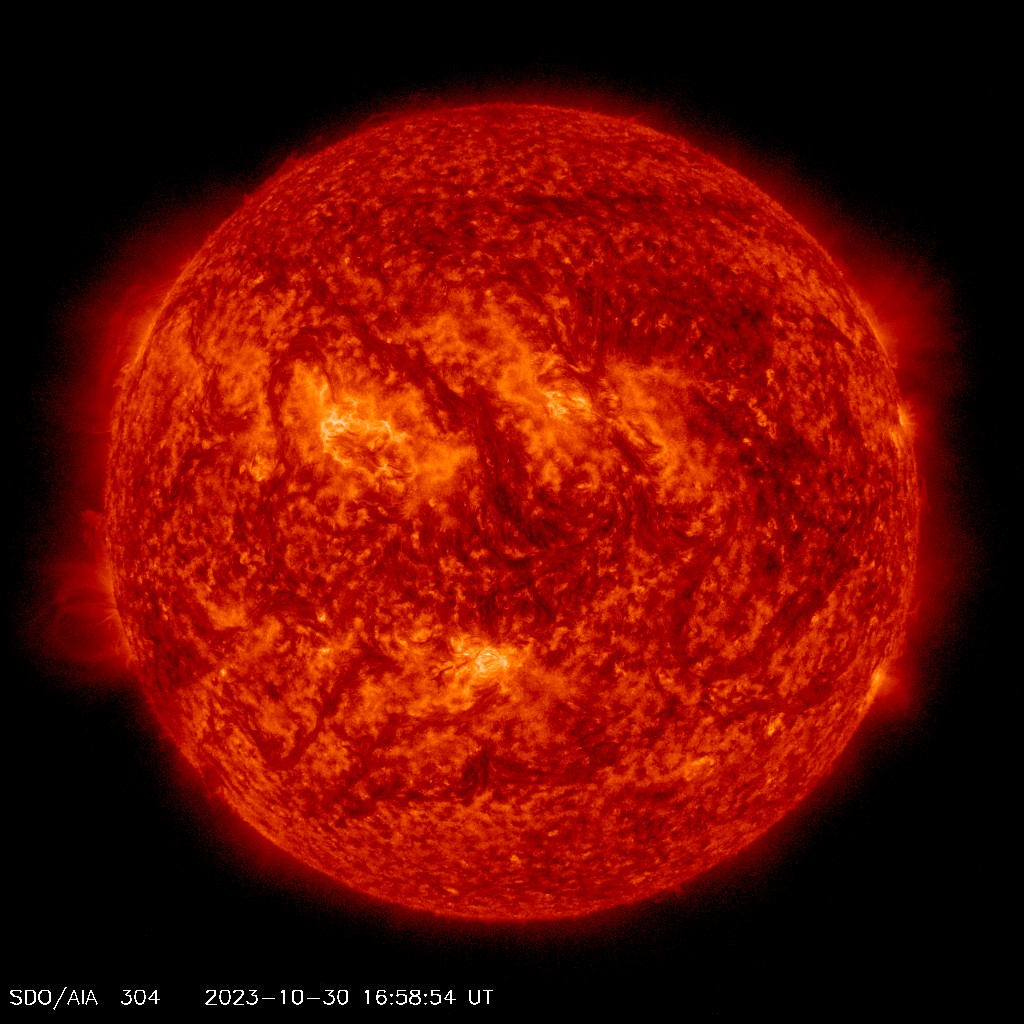
Let’s start with our Sun. You already know the Sun is hot. OK, it’s extremely hot! But temperatures on the Sun also are a bit puzzling.
An image of the Sun taken Oct. 30, 2023, by NASA’s Solar Dynamics Observatory.
NASA/SDO
The hottest part of the Sun is its core, where temperatures top 27 million°F (15 million°C). The part of the Sun we call its surface – the photosphere – is a relatively cool 10,000° F (5,500°C). In one of the Sun’s biggest mysteries, the Sun’s outer atmosphere, the corona, gets hotter the farther it stretches from the surface. The corona reaches up to 3.5 million°F (2 million°C) – much, much hotter than the photosphere.
So some temperatures on the Sun are a bit upside down. How about the planets? Surely things are cooler on the planets that are farther from the Sun.
Well, mostly. But then there’s Venus.
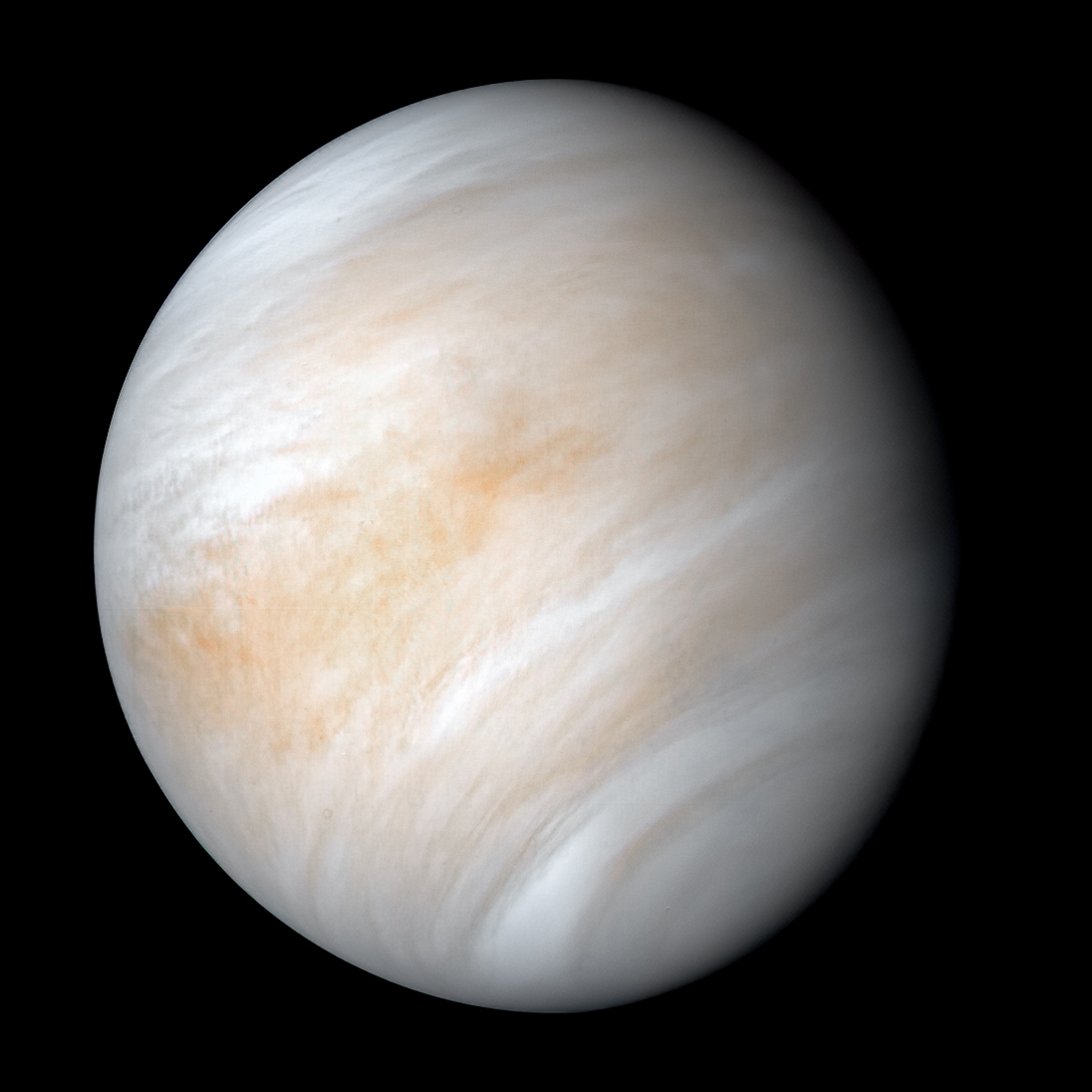
As it sped away from Venus, NASA’s Mariner 10 spacecraft captured this seemingly peaceful view of a planet the size of Earth, wrapped in a dense, global cloud layer. But, contrary to its serene appearance, the clouded globe of Venus is a world of intense heat, crushing atmospheric pressure and clouds of corrosive acid.
NASA/JPL-Caltech
Venus is the second closest planet to the Sun after Mercury, with an average distance from the Sun of about 67 million miles (108 million kilometers). It takes sunlight about six minutes to travel to Venus.
Venus also is Earth’s closest neighbor and is similar in size. It has even been called Earth’s twin. But Venus is shrouded in clouds and has a dense atmosphere that acts as a greenhouse and heats the surface to above the melting point of lead. It has a mean surface temperature of 867°F (464°C).
So Venus – not Mercury – is the hottest planet in our solar system. Save that bit of info for any future trivia contests.
Maybe Venus is hotter, but Mercury is the closest planet to the Sun. Surely it gets hot, too?
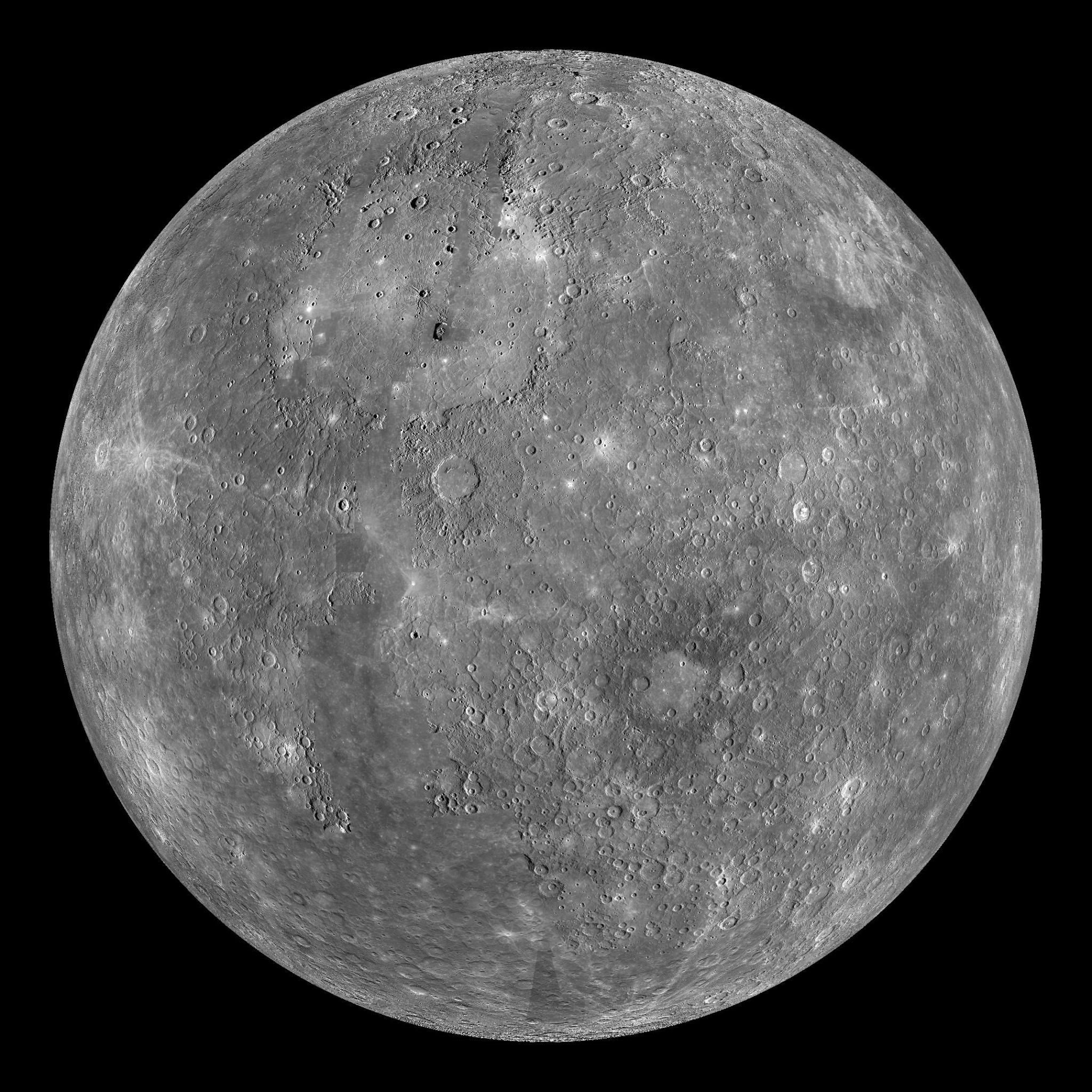
Mercury as seen from NASA’s MESSENGER, the first spacecraft to orbit Mercury.
NASA/Johns Hopkins University Applied Physics Laboratory/Carnegie Institution of Washington
Mercury is about 36 million miles (57 million kilometers) from the Sun. From this distance, it takes sunlight about three minutes to travel to Mercury. Even though it’s sitting right next to the Sun – relatively speaking – Mercury gets extremely cold at night. It has a mean surface temperature of 333°F (167°C). Daytime temperatures get much hotter than the mean, and can reach highs of 800°F (430°C). But without an atmosphere thick enough to hold in the heat at night, temperatures can dip as low as -290°F (-180°C).
Ahhh, Earth. We know about the weather here, right? Even Earth has some temperatures you may not have heard about.
An image of Earth from the Deep Space Climate Observatory, or DSCOVR.
NASA
Earth is an average of 93 million miles (150 million kilometers) from the Sun. It takes about eight minutes for light from the Sun to reach our planet.
Our homeworld is a dynamic and stormy planet with everything from clear, sunny days, to brief rain showers, to tornados, to raging hurricanes, to blizzards, and dust storms. But in spite of its wide variety of storms – Earth generally has very hospitable temperatures compared to the other planets. The mean surface temperature on Earth is 59°F (15°C). But Earth days have some extreme temperatures. According to NOAA, Death Valley holds the record for the world’s highest surface air temperature ever recorded on Earth: 134°F (56.7°C) observed at Furnace Creek (Greenland Ranch), California, on July 10, 1913. Earth’s lowest recorded temperature was -128.6°F (-89.2°C) at Vostok Station, Antarctica, on July 21, 1983, according to the World Meteorological Organization.
NASA missions have found lots of evidence that Mars was much wetter and warmer, with a thicker atmosphere, billions of years ago. How about now?
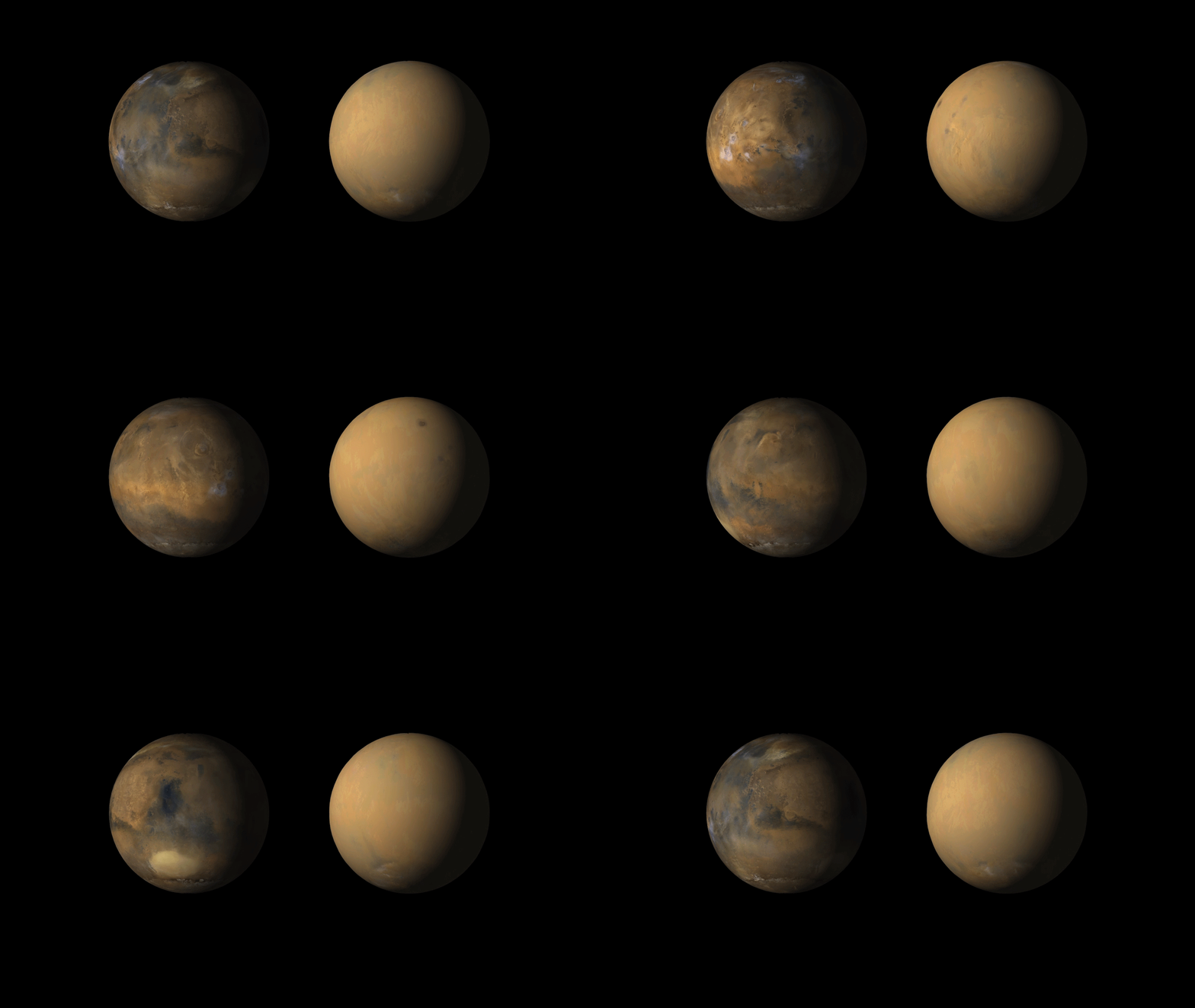
Side-by-side animated images show how a 2018 global dust storm enveloped the Red Planet. The images were taken by NASA’s Mars Reconnaissance Orbiter (MRO).
NASA/JPL-Caltech/MSSS
Mars is an average distance of 142 million miles (228 million kilometers) from the Sun. From this distance, it takes about 13 minutes for light to travel from the Sun to Mars.
The median surface temperature on Mars is -85°F (-65°C). Because the atmosphere is so thin, heat from the Sun easily escapes Mars. Temperatures on the Red Planet range from the 70s°F (20s°C) to -225°F (-153°C). Occasionally, winds on Mars are strong enough to create dust storms that cover much of the planet. After such storms, it can be months before all of the dust settles.
Two NASA rovers on Mars have weather stations. You can check the daily temps at their locations:
The ground temperature around the Perseverance rover ranges from about -136°F to 62°F (-93°C to 17°C). The air temperature near the surface ranges from about -118°F to 8°F (-83°C to -13°C).
As planets move farther away from the Sun, it really cools down fast! Since gas giants Jupiter and Saturn don’t have a solid surface, temperatures are taken from a level in the atmosphere equal in pressure to sea level on Earth. The same goes for the ice giants Uranus and Neptune.
NASA’s Juno spacecraft took this image during a flyby of Jupiter. This view highlights Jupiter’s most famous weather phenomenon, the persistent storm known as the Great Red Spot. Citizen scientist Kevin M. Gill created this image using data from the spacecraft’s JunoCam imager.
Enhanced image by Kevin M. Gill (CC-BY) based on images provided courtesy of NASA/JPL-Caltech/SwRI/MSSS
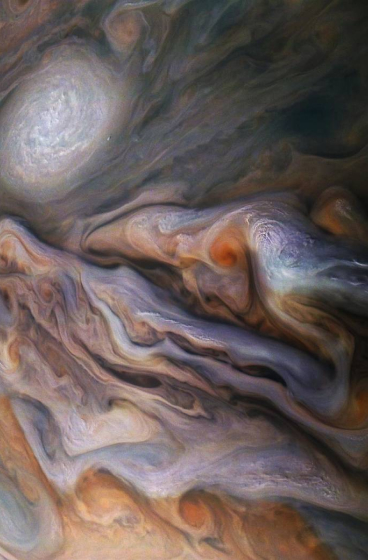
Jupiter’s stripes and swirls are beautiful, but they are actually cold, windy clouds of ammonia and water, floating in an atmosphere of hydrogen and helium. The planet’s iconic Great Red Spot is a giant storm bigger than Earth that has raged for hundreds of years. The mean temperature on Jupiter is -166°F (-110°C).
Jupiter is an average distance of 484 million miles (778 million kilometers) from the Sun. From this distance, it takes sunlight 43 minutes to travel from the Sun to Jupiter. Jupiter has the shortest day in the solar system. One day on Jupiter takes only about 10 hours (the time it takes for Jupiter to rotate or spin around once), and Jupiter makes a complete orbit around the Sun (a year in Jovian time) in about 12 Earth years (4,333 Earth days).
Jupiter’s equator is tilted with respect to its orbital path around the Sun by just 3 degrees. This means the giant planet spins nearly upright and does not have seasons as extreme as other planets do.
As we keep moving out into the solar system, we come to Saturn – the sixth planet from the Sun and the second largest planet in our solar system. Saturn orbits the Sun from an average distance of 886 million miles (1.4 billion kilometers). It takes sunlight 80 minutes to travel from the Sun to Saturn.
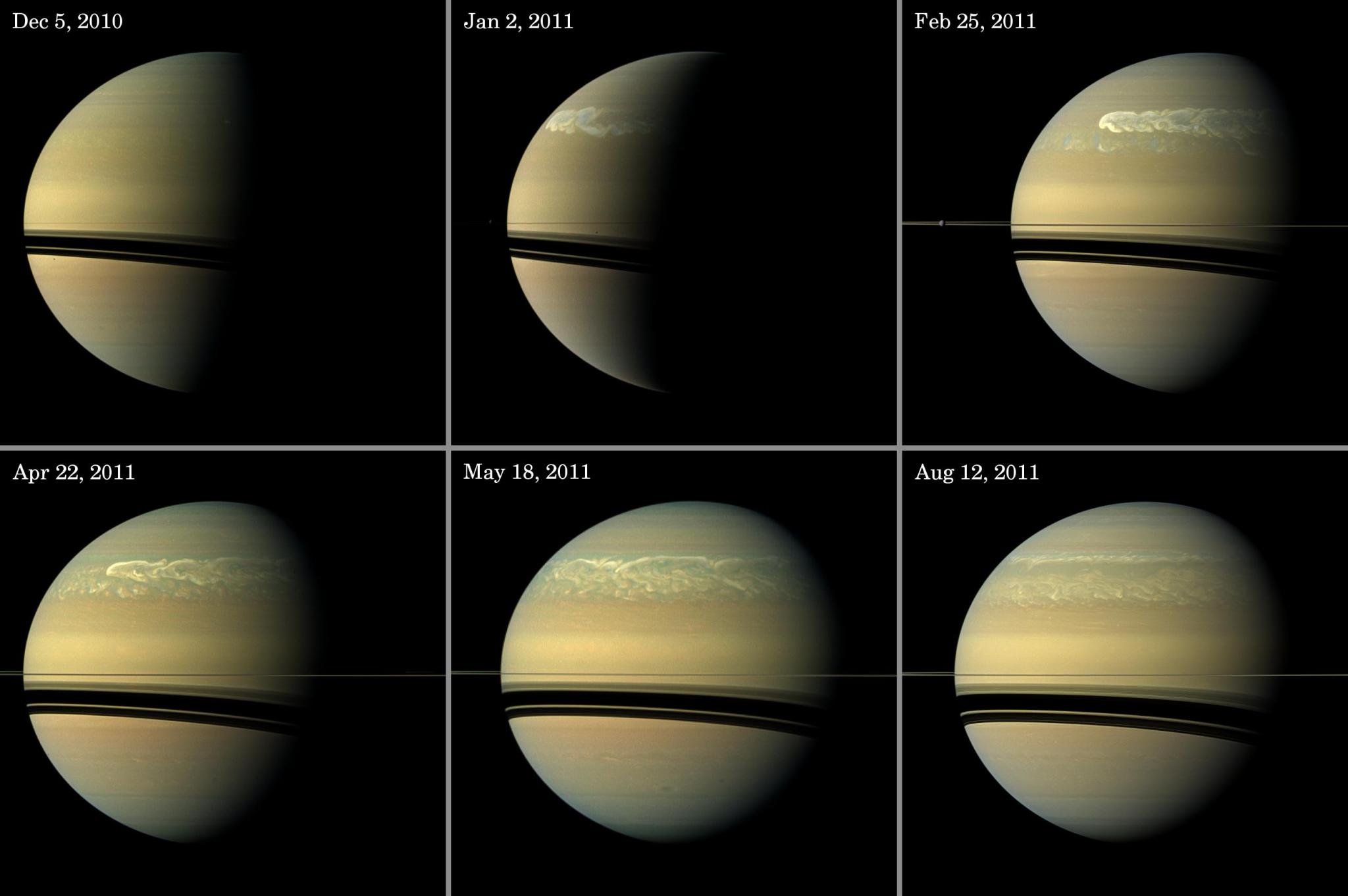
This series of images from NASA’s Cassini spacecraft shows the development of the largest storm seen on Saturn since 1990. These true-color and composite near-true-color views chronicle the storm from its start in late 2010 through mid-2011, showing how the distinct head of the storm quickly grew large but eventually became engulfed by the storm’s tail.
NASA/JPL-Caltech/Space Science Institute
Like fellow gas giant Jupiter, Saturn is a massive ball made mostly of hydrogen and helium and it doesn’t have a true surface. The mean temperature is -220°F (-140°C).
In addition to the bone-chilling cold, the winds in the upper atmosphere of Saturn reach 1,600 feet per second (500 meters per second) in the equatorial region. In contrast, the strongest hurricane-force winds on Earth top out at about 360 feet per second (110 meters per second). And the pressure – the same kind you feel when you dive deep underwater – is so powerful it squeezes gas into a liquid.
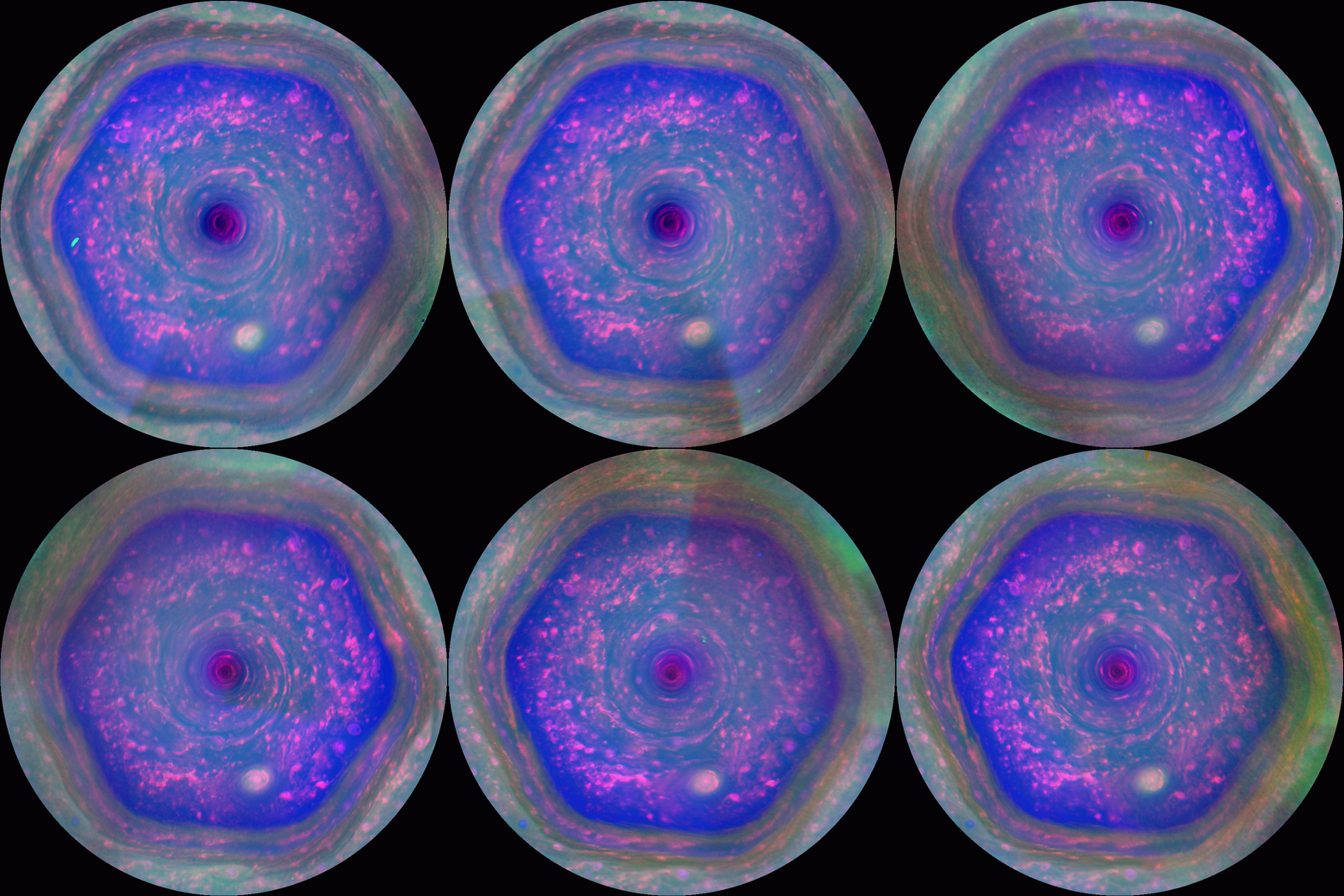
This colorful movie made with images taken by NASA’s Cassini spacecraft on Dec. 10, 2012. It is the highest-resolution view of the unique six-sided jet stream at Saturn’s north pole known as “the hexagon.”
NASA/JPL-Caltech/SSI/Hampton University
Saturn’s north pole has an interesting atmospheric feature – a six-sided jet stream. This hexagon-shaped pattern was first noticed in images from the Voyager I spacecraft, and was more closely observed by the Cassini spacecraft in 2012. Spanning about 20,000 miles (30,000 kilometers) across, the hexagon is a wavy jet stream of 200-mile-per-hour winds (about 322 kilometers per hour) with a massive, rotating storm at the center. There is no weather feature like it anywhere else in the solar system.
Crane your neck to the side while we go check out the weather on Uranus, the sideways planet.
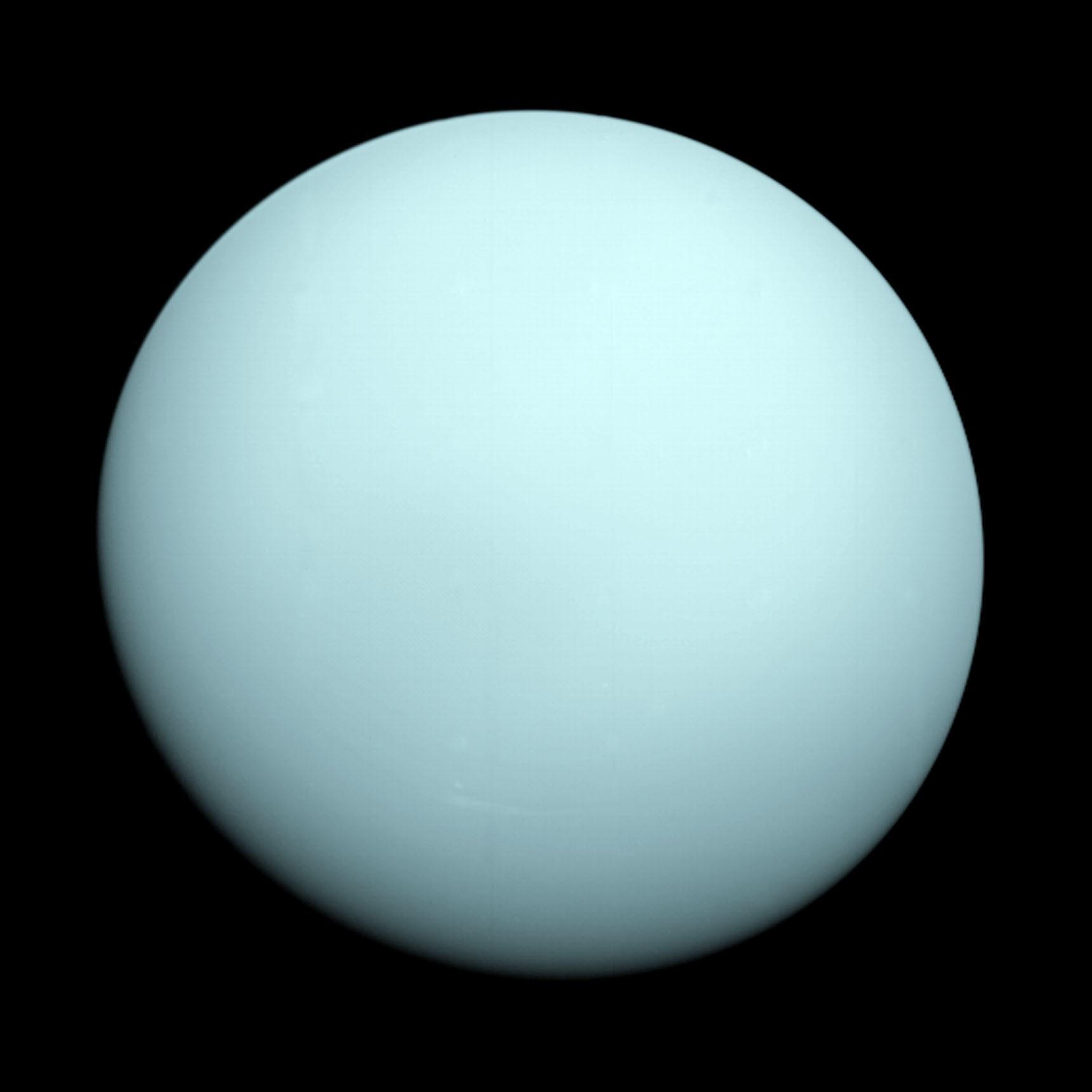
This is an image of the planet Uranus taken by the spacecraft Voyager 2 in 1986.
NASA/JPL-Caltech
The seventh planet from the Sun with the third largest diameter in our solar system, Uranus is very cold and windy. It has a mean temperature of -320°F (-195°C). Uranus rotates at a nearly 90-degree angle from the plane of its orbit. This unique tilt makes Uranus appear to spin sideways, orbiting the Sun like a rolling ball. And like Saturn, Uranus has rings. The ice giant is surrounded by 13 faint rings and 27 small moons.
Now we move on to the last major planet in our solar system – Neptune. What’s the weather like there? Well you would definitely need a windbreaker if you went for a visit. Dark, cold, and whipped by supersonic winds, giant Neptune is the eighth and most distant major planet orbiting our Sun. The mean temperature on Neptune is -330°F (-200°C).
And not to be outdone by Jupiter and its Great Red Spot, Neptune has the Great Dark Spot – and Scooter. Yep, Scooter.
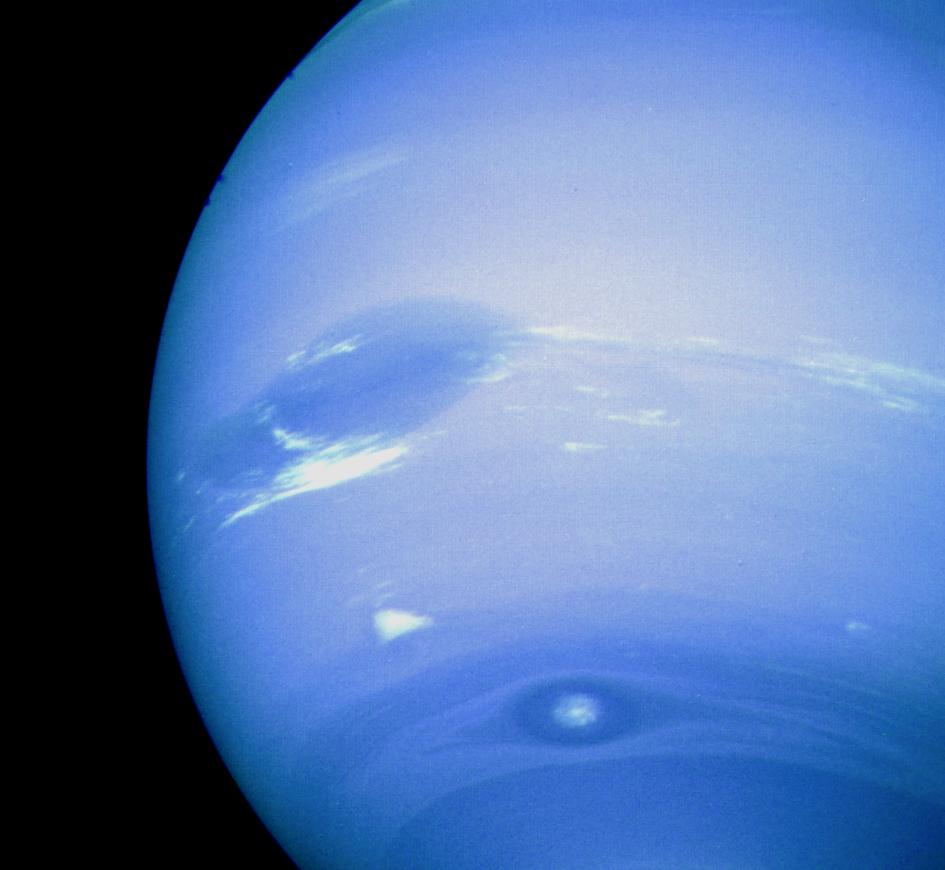
Voyager 2 photographed these features on Neptune in 1989.
NASA/JPL-Caltech
This photograph of Neptune was created from two images taken by NASA’s Voyager 2 spacecraft in August 1989. It was the first and last time a spacecraft came close to Neptune. The image shows three of the features that Voyager 2 monitored. At the north (top) is the Great Dark Spot, accompanied by bright, white clouds that undergo rapid changes in appearance. To the south of the Great Dark Spot is the bright, triangular-shaped feature that Voyager scientists nicknamed “Scooter.” Still farther south is the feature called “Dark Spot 2,” which has a bright core.
More than 30 times as far from the Sun as Earth, Neptune is not visible to the naked eye. In 2011, Neptune completed its first 165-year orbit of the Sun since its discovery.
That wraps up forecasting for the major planets.
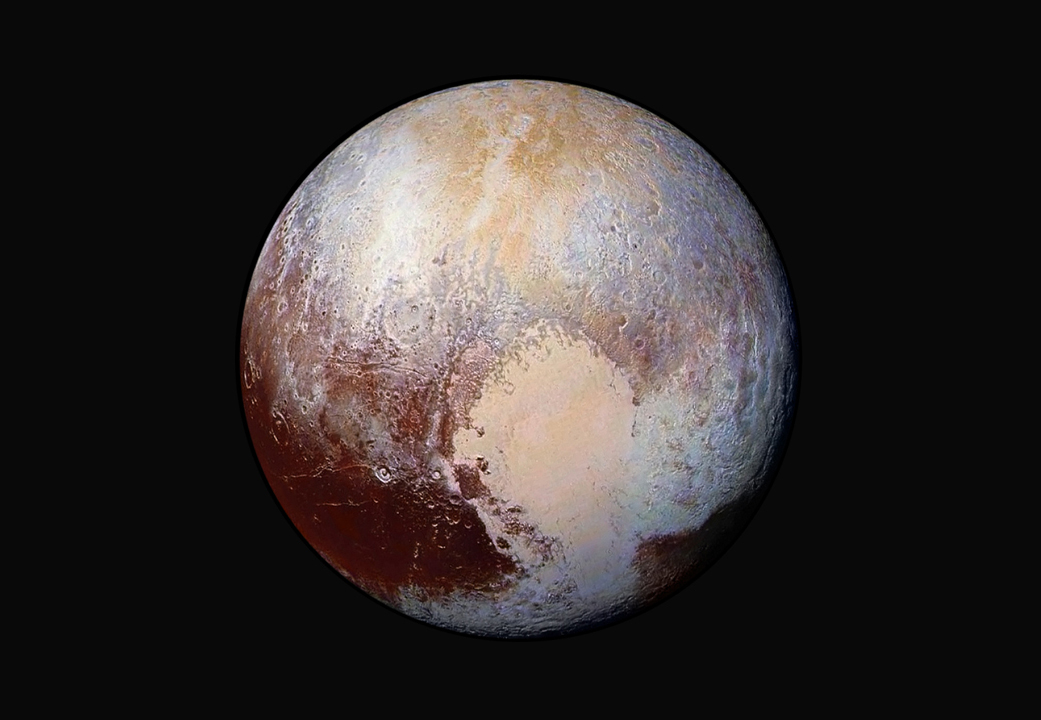
But there is one more place we need to check out. Beyond Neptune is a small world, with a big heart – dwarf planet Pluto.
New Horizons scientists use enhanced color images to detect differences in the composition and texture of Pluto’s surface.
NASA/JHUAPL/SwRI
With a mean surface temperature of -375°F (-225°C), Pluto is considered too cold to sustain life. Pluto’s interior is warmer, however, and some think there may be an ocean deep inside.
From an average distance of 3.7 billion miles (5.9 billion kilometers) away from the Sun, it takes sunlight 5.5 hours to travel to Pluto. If you were to stand on the surface of Pluto at noon, the Sun would be 1/900 the brightness it is here on Earth. There is a moment each day near sunset here on Earth when the light is the same brightness as midday on Pluto.
So the next time you’re complaining about the weather in your spot here on Earth, think about Pluto and all the worlds in between.
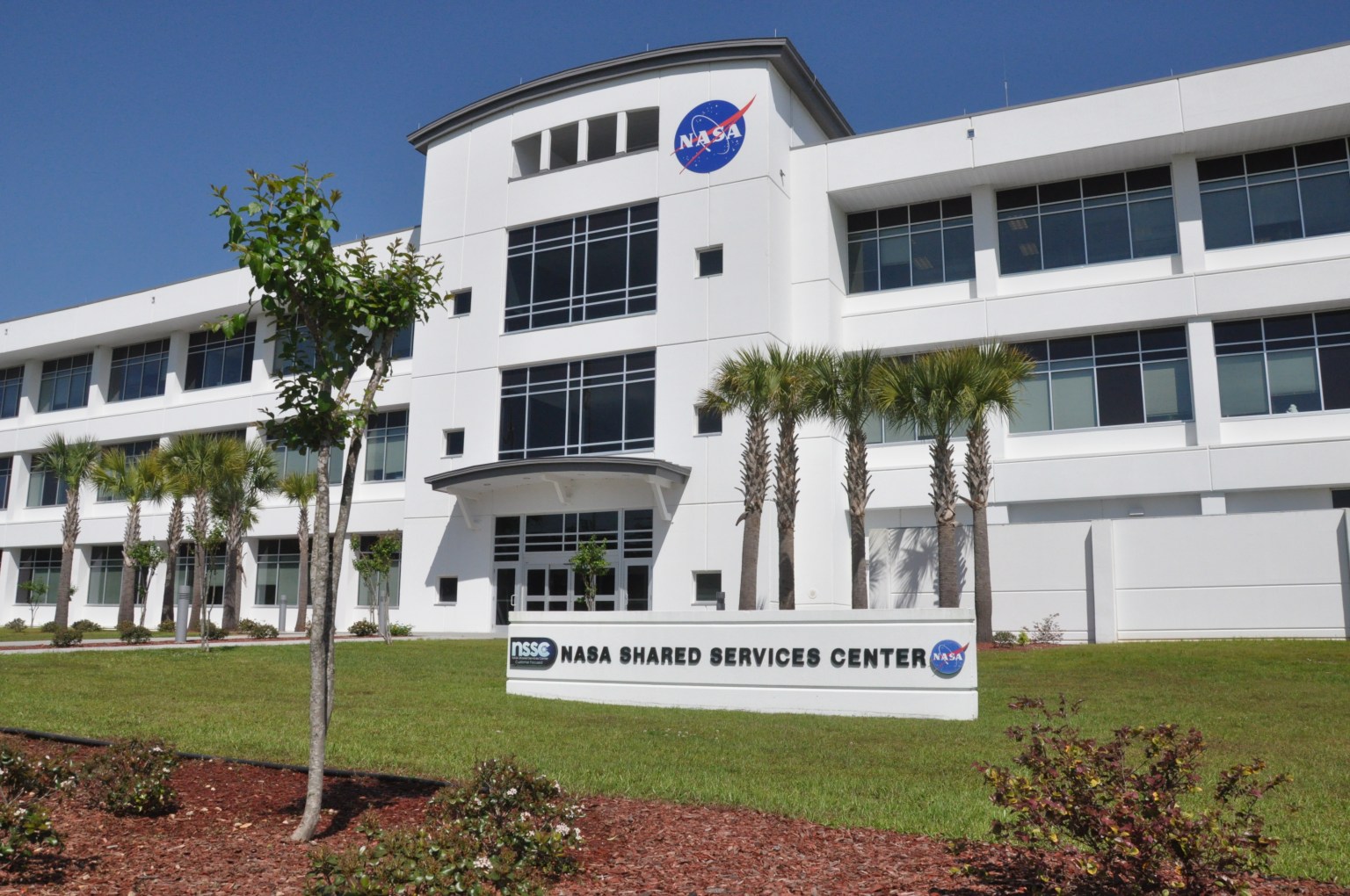
The NSSC Small Business Office is responsible for providing outreach and liaison support to industry (both large and small businesses) and other members of the private sector. These activities are accomplished through a combination of individual counseling sessions, dissemination of information on upcoming NSSC procurement opportunities, and participation in local small business outreach events. The NSSC small business specialist also serves as the primary advisor to the NSSC acquisition community on all matters related to small business.
The Vision of the NSSC Small Business Office is to promote and integrate all small businesses into the competitive base of contactors that pioneer the future of space exploration, scientific discovery, and aeronautics research.
The Mission of the NSSC Small Business Office is to:
Advise the NSSC acquisition community on all matters related to small business
Promote the development and management of NASA programs that assists all categories of small business
Develop small businesses in high-tech areas that includes technology transfer and commercialization of technology
Provide small business maximum practicable opportunities to participate in NSSC prime contracts and subcontracts
It is important to note the NSSC small business specialist:
Cannot assist contractors in the preparation of proposals
Cannot in any way guarantee receipt of a contract award
Serves as an advisor to the Contracting Officer who has final authority over contractual matters
Is not involved in the personnel decisions of a contractor, including the hiring of new employees
The Office of Small Business Programs (OSBP) website will identify the following:
How to do Business with NASA
Business Development and Technology
Small Business Program
How to Partner with NASA
Outreach
Awards and Achievement