Cygnus Counts Down to Launch, Station Crews Keep Up Research

Cygnus Counts Down to Launch, Station Crews Keep Up Research

NASA’s Northrop Grumman 20th commercial resupply mission will carry more than 8,200 pounds (3,720 kilograms) of cargo to the International Space Station.

Cargo mission preparations and space research kept the Expedition 70 and Axiom Mission 3 (Ax-3) crews busy at the beginning of the week. The 11 residents working together aboard the International Space Station also continued their ongoing biomedical science and lab maintenance activities.

Northrop Grumman’s Cygnus space freighter is sitting atop a SpaceX Falcon 9 rocket counting down to a lift off no earlier than 12:07 p.m. EST on Tuesday. Cygnus is packed with more than 8,200 pounds of science and supplies scheduled for delivery to the orbital outpost on Thursday, Feb. 1. Among the new science experiments being delivered are the Metal 3D Printer that tests the 3D printing of small metal parts in space and the Robotic Surgery Tech Demo that tests remotely controlled surgical techniques.

NASA astronauts Jasmin Moghbeli and Loral O’Hara trained on a computer Monday afternoon for Cygnus’ arrival. Moghbeli will be at the robotics workstation on Thursday commanding the Canadarm 2 robotic arm to capture Cygnus at 4:20 a.m. O’Hara will also be on duty monitoring Cygnus’ automated approach and rendezvous early Thursday.

The duo along with JAXA (Japan Aerospace Exploration Agency) astronaut Satoshi Furukawa started the day with blood, saliva, and urine sample collections. The samples were processed first then stowed in a science freezer for later analysis to understand how living in weightlessness affects the human body. Furukawa later assisted Ax-3 crewmates Michael López-Alegría and Alper Gezeravcı as they studied how to use the CRISPR method to genetically modify plants promoting space agriculture and sustainable life support systems.

Station Commander Andreas Mogensen from ESA (European Space Agency) started his day with a cognition test measuring his spatial orientation, visual tracking, and decision-making abilities in microgravity. Afterward, he supported the Ax-3 crew throughout the day, prepared the station for Cygnus cargo transfers, and recorded video messages for European students.

Ax-3 Pilot Walter Villadei documented his meals on Monday and answered a few questions about his dining experience. Villadei then videotaped a simple space physics experiment using a yo-yo then recorded a video message for future Italian pilots. Mission Specialist Marcus Wandt from ESA also recorded a video message using 360-degree virtual reality gear to promote science for Swedish audiences. He later documented his sleep experiences, took a cognition test, then uninstalled a high speed camera that photographed Earth’s thunderstorms.

Over in the orbiting lab’s Roscosmos segment, veteran cosmonaut Oleg Kononenko repressurized thermal control system components then swapped batteries inside hardware designed to inspect difficult to reach areas on the station. Flight Engineer Nikolai Chub spent his day inventorying tools and equipment inside the Poisk module and photographing windows on the Zvezda service module. Cosmonaut Konstantin Borisov started his day disconnecting a student-controlled Earth observation camera then serviced ventilation systems in Zvezda and the Nauka science module.

The space station is orbiting a few miles higher after the Roscosmos Progress 85 cargo craft fired its engines for over 13 minutes on Saturday. The orbital reboost lifted the station to the correct altitude for an upcoming Progress cargo launch in February and the next Soyuz crew swap planned for early spring.


Learn more about station activities by following the space station blog@space_station and @ISS_Research on X, as well as the ISS Facebook and ISS Instagram accounts.

Get weekly video highlights at: https://roundupreads.jsc.nasa.gov/videoupdate/

Get the latest from NASA delivered every week. Subscribe here: www.nasa.gov/subscribe

Powered by WPeMatico

Get The Details…

Mark Garcia

NASA Awards Contract to Support Agency Enterprise Service Center

NASA Awards Contract to Support Agency Enterprise Service Center

NASA meatball logo

NASA has selected Inspiritec Inc. of Philadelphia, to provide contractor support for the Shared Services Center at the agency’s Stennis Space Center in Bay St. Louis, Mississippi.

This indefinite-delivery/indefinite-quantity contract allows for special project task orders at either the firm-fixed-price or based on level of effort. The contract includes a 60-day transition period beginning on Thursday, Feb. 1, followed by a one-year base period and four one-year option periods. The total award value is $35 million over a five-year potential performance period.

The contract’s services include support of NASA’s Customer Contact Center, Enterprise Service Desk, and Document Imaging and Mailroom.

For information about the agency and its programs, visit:

https://www.nasa.gov

-end-

Abbey Donaldson
Headquarters, Washington
202-358-1600
abbey.a.donaldson@nasa.gov

Jamie Mettler
Stennis Space Center, Miss.
228-813-6490
jamie.m.mettler@nasa.gov

Powered by WPeMatico

Get The Details…
Abbey A. Donaldson

NASA Space Tech Spinoffs Benefit Earth Medicine, Moon to Mars Tools

NASA Space Tech Spinoffs Benefit Earth Medicine, Moon to Mars Tools

Inside of an underground subway station, two firefighters carry a robot mounted inside of a trapezoid-shaped wireframe toward a blazing fire. There is a subway car to the firefighters’ right, highlighted by the red, yellow, and orange hue of a fire in the background. The robot helps firefighters and other first responders protect their lives and the lives of others by investigating hazardous situations.
Squishy Robotics’ Tensegrity Sensor Robots help first responders determine their approach to a disaster scene. Firefighters used the robots during a subway attack exercise at the 2021 Unmanned Tactical Application Conference to detect gas leaks and other hazards.
Credits: FLYMOTION LLC

As NASA innovates for the benefit of all, what the agency develops for exploration has the potential to evolve into other technologies with broader use here on Earth. Many of those examples are highlighted in NASA’s annual Spinoff book including dozens of NASA-enabled medical innovations, as well other advancements.

This year’s publication, NASA’s 2024 Spinoff, features several commercialized technologies using the agency’s research and development expertise to impact everyday lives, including:

“As we continue to push new frontiers and do the unimaginable, NASA’s scientists and engineers are constantly innovating and advancing technologies,” said NASA Administrator Bill Nelson. “A critical part of our mission is to quickly get those advances into the hands of companies and entrepreneurs who can use them to grow their businesses, open new markets, boost the economy, and raise the quality of life for everyone.”

The medical innovations include the first wireless arthroscope – a small tube carrying a camera inserted into the body during surgery – to receive clearance from the U.S. Food and Drug Administration, which benefited from NASA’s experience with spacesuits and satellite batteries. Technologies for diagnosing illnesses like the coronavirus, hepatitis, and cancer have also stemmed from NASA’s space exploration and science endeavors. Even certain types of toothpaste originated from the agency’s efforts to grow crystals for electronics.

Additional 2024 Spinoff highlights include developments under NASA’s Artemis campaign, like a small, rugged video camera used to improve aircraft safety and a new method for detecting defects or damage in composite materials. Meanwhile, another spinoff story details the latest benefits of fuel cell technology created more than 50 years ago for Apollo, which is now poised to support terrestrial power grids based on renewable energy.

The book also features several technologies NASA has identified as promising future spinoffs and information on how to license agency tech. Since the 1970s, thousands of NASA technologies have found their way into many scientific and technical disciplines, impacting nearly every American industry.

“As NASA’s longest continuously running program, we continue to increase the number of technologies we license year-over-year while streamlining the development path from the government to the commercial sector,” said Daniel Lockney, Technology Transfer program executive at NASA Headquarters in Washington. “These commercialization success stories continually prove the benefits of transitioning agency technologies into private hands, where the real impacts are made.”

Spinoffs are part of NASA’s Space Technology Mission Directorate and its Technology Transfer program. Tech Transfer is charged with finding broad, innovative applications for NASA-developed technology through partnerships and licensing agreements, ensuring agency investments benefit the nation and the world.

To read the latest issue of Spinoff, visit:

https://spinoff.nasa.gov

-end-

Jimi Russell
Headquarters, Washington
202-358-1600
james.j.russell@nasa.gov

Share

Details

Last Updated

Jan 29, 2024

Powered by WPeMatico

Get The Details…
Roxana Bardan

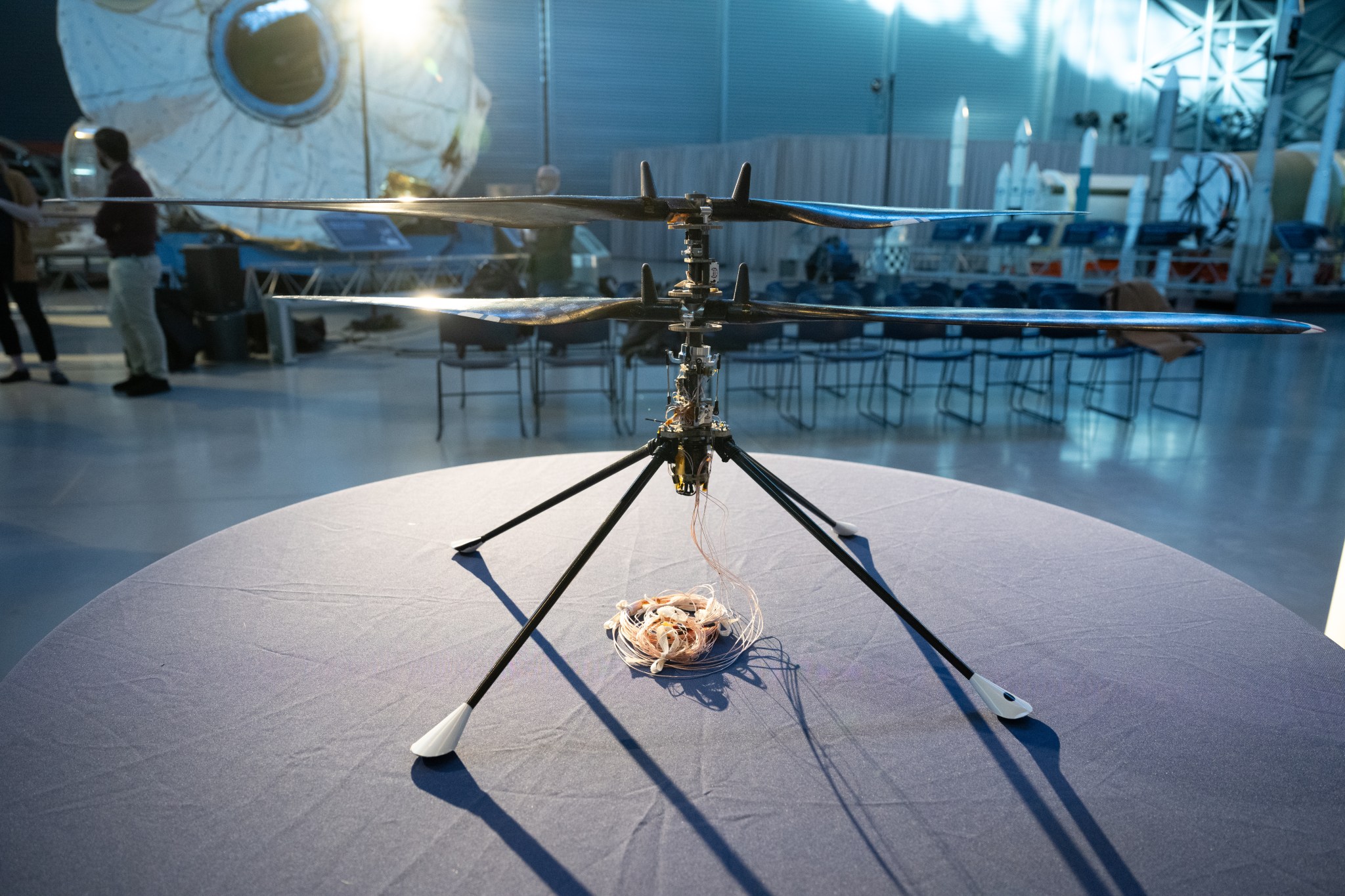
A New Home for Ingenuity Mars Helicopter Prototype

A New Home for Ingenuity Mars Helicopter Prototype

The Ingenuity Mars Helicopter prototype sits on a round, gray surface. Sunlight glints off of one of its blades. The blades are stacked vertically on a thin column. Four thin legs with white tips are attached to the column. A bundle of wires protrudes from the helicopter and rests on the table.
NASA/Joel Kowsky

The Ingenuity Mars Helicopter’s aerial prototype is seen at the Smithsonian National Air and Space Museum’s Steve F. Udvar-Hazy Center in Chantilly, Va, Dec. 15, 2023. The prototype, which was the first to prove it was possible to fly in a simulated Mars environment at NASA’s Jet Propulsion Laboratory, was donated to the museum.

Ingenuity’s history-making mission on Mars recently came to an end after one or more of its rotor blades sustained damage during landing, rendering it incapable of flight. Originally designed as a technology demonstration to perform up to five experimental test flights over 30 days, the first aircraft on another world operated from the Martian surface for almost three years, performed 72 flights, and flew more than 14 times farther than planned while logging more than two hours of total flight time.

Join the celebration of Ingenuity’s successful mission by using the #ThanksIngenuity hashtag on social media.

Image Credit: NASA/Joel Kowsky

Powered by WPeMatico

Get The Details…
Monika Luabeya

Thank You, Jovian Vortex Hunters! The Hunt Is Over…for Now.

Thank You, Jovian Vortex Hunters! The Hunt Is Over…for Now.

1 min read

Thank You, Jovian Vortex Hunters! The Hunt Is Over…for Now.

Vortices identified by Jovian Vortex Hunter volunteers.
Some of the vortices identified by Jovian Vortex Hunter volunteers.
NASA/JPL-Caltech/SwRI/MSSS/Sankar

We did it! The Jovian Vortex Hunter project, launched on Zooniverse in June 2022, is out of data as of December 23, 2023. 

Over 6,000 registered volunteers joined the project to view images from NASA’s JunoCam instrument of the swirling clouds in Jupiter’s atmosphere and draw on them using a computer mouse. Together, they contributed over a million marked-up images indicating exciting features such as vortices, where winds move in circular patterns. If you’re one of these volunteers, thank you! 

The newly marked-up data from the Jovian Vortex Hunters project revealed more than 7,000 vortexes, a much bigger collection than earlier studies contained. The hard work of our volunteers resulted in trends nobody had seen before! For example, the new data shows that white and dark ovals are more prominent in the higher latitudes, while the brown vortices are in the mid-latitudes.

Want to see those trends (and others) for yourself? Read the Jovian Vortex Hunters Blog! And stay tuned… The science team is hard at work analyzing the data and writing up papers on the results. They hope to launch another round of the Jovian Vortex Hunters project soon. 

Share

Details

Last Updated
Jan 29, 2024
Editor
NASA Science Editorial Team

Powered by WPeMatico

Get The Details…